Introduction
Gastrointestinal nematodes (GIN) significantly affect sheep production worldwide, leading to estimated annual losses of BRL$2 million in the south region of Rio Grande do Sul state, Brazil (Oliveira et al., Reference Oliveira, Ruas, Riet-Correa, Coelho, Santos, Marcolongo-Pereira, Sallis and Schild2017), USD$42 million in South America (Waller, Reference Waller2006) and AUD$369 million in Australia (reviewed by Hosking et al., Reference Hosking, Griffiths and Woodgate2009). In tropical and subtropical regions, most of these losses are associated with high prevalence of Haemonchus contortus, which is the most pathogenic parasite of small ruminants, causing anaemia, reduced weight gain and carcass value, and death (Besier et al., Reference Besier, Kahn, Sargison, Van Wyk, Gasser and Von Samson-Himmelstjerna2016).
The main strategy to control worms and avoid health and economic losses in sheep flocks is the use of anthelmintics. Among the anthelmintics, monepantel is one of the latest compounds to be released onto the market (Kaminsky et al., Reference Kaminsky, Ducray and Jung2008); it was introduced as an alternative to control worms in flocks with multidrug resistance (Little et al., Reference Little, Hodge, Maeder, Wirtherle, Nicholas, Cox and Conder2011). However, resistance to monepantel emerged several years later in goats in New Zealand (Scott et al., Reference Scott, Pomroy, Kenyon, Smith, Adlington and Moss2013) and in sheep in the Netherlands (Van den Brom et al., Reference Van den Brom, Moll, Kappert and Vellema2015), Uruguay (Mederos et al., Reference Mederos, Ramos and Banchero2014), Australia (Sales & Love, Reference Sales and Love2016), Brazil (Albuquerque et al., Reference Albuquerque, Bassetto and Almeida2017) and the UK (Hamer et al., Reference Hamer, Bartley, Jennings, Morrison and Sargison2018).
Resistance is an evolutionary process in which resistant individuals survive drug treatments and transmit their genes to the next generation (Barnes et al., Reference Barnes, Dobson and Barger1995). After a few generations, the prevalence of resistant individuals in the population increases (Blackhall et al., Reference Blackhall, Prichard and Beech2008), leading to anthelmintic treatment failures. The rate of selection for resistance depends on the number of genes involved, the dominant/recessive nature of the alleles and intensity of the selection pressure (Sargison, Reference Sargison2012). The dose of anthelmintics is a factor that influences the selection pressure (Chartier et al., Reference Chartier, Pors, Hubert, Rocheteau, Benoit and Bernard1998), and underdosing is assumed to allow the survival of heterozygous individuals, contributing to the development of anthelmintic resistance (Papadopoulos, Reference Papadopoulos2008).
Due to the widespread emergence of resistance, control measures need to be taken. One approach is to experimentally induce drug resistance in parasites and characterize the associated biological responses and genetic modifications; this may provide strategies to maintain drug efficacy, as well as providing biomarkers for the predictors of resistance and development of new therapeutics (Oduola et al., Reference Oduola, Milhous, Weatherly, Bowdre and Desjardins1988; Bartley et al., Reference Bartley, Devin, Nath and Morrison2015). In vivo induction of resistance by subdosing of sheep hosts has been previously used to confer H. contortus resistance to benzimidazoles (Kates et al., Reference Kates, Colglazier and Enzie1973) and macrocyclic lactones (Ranjan et al., Reference Ranjan, Wang, Hirschlein and Simkins2002; Coles et al., Reference Coles, Rhodes and Wolstenholme2005), whereas resistance to monepantel, in addition to being achieved in vivo with Teladorsagia circumcincta (Bartley et al., Reference Bartley, Devin, Nath and Morrison2015), has only been induced in H. contortus by an in vitro approach (Kaminsky et al., Reference Kaminsky, Ducray and Jung2008).
It is important to avoid or, at least, delay the establishment of resistance, and anticipating its physiological consequences and genetic basis, as achieved by the experimental induction of anthelmintic resistance, can be a very efficient way to prevent it from occurring. With this in mind, we describe herein an experimental procedure to induce H. contortus resistance to monepantel by in vivo subdosing of sheep hosts. We discuss the protocol adjustments, as well as the influence of parasite load and breed of sheep hosts in this experimental model.
Material and methods
Faecal egg counts (FEC) were obtained every week with a sensitivity of 50 eggs per gram (EPG). After seven days of each monepantel treatment, individual larval cultures were established for the production of infective larvae (L3), which descend from surviving parasites. These L3 were stored at 4°C for further (re-)infections. Monepantel efficacy was calculated based on a FEC reduction test (Coles et al., Reference Coles, Bauer, Borgsteede, Geerts, Klei, Taylor and Waller1992) seven days after treatment. A round of selection was defined as each monepantel dose to which a H. contortus population was submitted, resulting in surviving individuals that were then exposed to the next dose or used to (re-)infect sheep hosts.
Santa Ines or Ile de France sheep raised and weaned on pasture, where they were exposed to natural parasitic infection, were housed and treated with 10% trichlorphon (97 mg/kg; Neguvon®, Bayer S.A., Belford Roxo, RJ, Brazil) to clear natural infection by GIN, which was confirmed by two faecal examinations over a two-week interval. Sheep hosts were orally infected with up to 5000 H. contortus L3. After infection was established, they were treated with increasing subdoses (Coles et al., Reference Coles, Rhodes and Wolstenholme2005) of monepantel (Zolvix®, Novartis Animal Health Inc., Basel, Switzerland) from 0.075 mg/kg to the therapeutic dose of 2.5 mg/kg. Treatments were performed preferentially in hosts with FEC >500 EPG and within an interval of at least two weeks. However, monepantel doses and treatment intervals were adjusted throughout the experiment according to the outcomes in FEC and monepantel efficacy observed for each sheep host. When an increased monepantel dose resulted in no surviving parasites or in no increase in FEC after at least two weeks, the same sheep host was re-infected with L3 larvae recovered from the previous highest dose, and then treated with an intermediate dose of monepantel. However, the use of more than two reinfections per host did not result in any further round of selection. In that situation, the hosts were replaced and new hosts were infected with L3 larvae recovered from the previous hosts, constituting a new parasite passage.
Considering the entire subdosing procedure, a monepantel-susceptible H. contortus isolate, Embrapa2010 (Chagas et al., Reference Chagas, Katiki, Silva, Giglioti, Esteves, Oliveira and Barioni Júnior2013), was used to infect three sheep hosts and, after successive anthelmintic treatments and four consecutive passages in hosts, three monepantel-resistant isolates were obtained. In the first passage, three female Santa Ines lambs (171–187 days of age) infected with the Embrapa2010 H. contortus isolate were treated, and L3 larvae recovered from hosts treated with the highest monepantel dose were used to infect new hosts in the second passage, using three female Santa Ines lambs (114–123 days of age). The same procedure was performed in three male Santa Ines lambs (342–346 days of age) for the third passage and in three male Ile de France lambs (158–161 days of age) for the fourth passage. The breed of sheep hosts was changed from Santa Ines to Ile de France after no progress on induction of anthelmintic resistance in the third passage.
Results and discussion
This study presents the first report on the in vivo induction of H. contortus resistance to monepantel. Previously, resistance to monepantel was induced in vitro by culturing H. contortus from eggs to L3 larvae under monepantel pressure (Kaminsky et al., Reference Kaminsky, Ducray and Jung2008); while in vivo induction of resistance by underdosing sheep hosts has only been reported for T. circumcincta (Bartley et al., Reference Bartley, Devin, Nath and Morrison2015). Despite being laborious, selecting for anthelmintic resistance in vivo ensures that host–parasite interactions are maintained, and that there are no limitations on the type of anthelmintic that can be evaluated. These in vivo advantages contrast with in vitro selection methods that do not use sheep hosts and that are only suitable for anthelmintics effective against the larval stages of the parasite life cycle (Rufener et al., Reference Rufener, Kaminsky and Mäser2009).
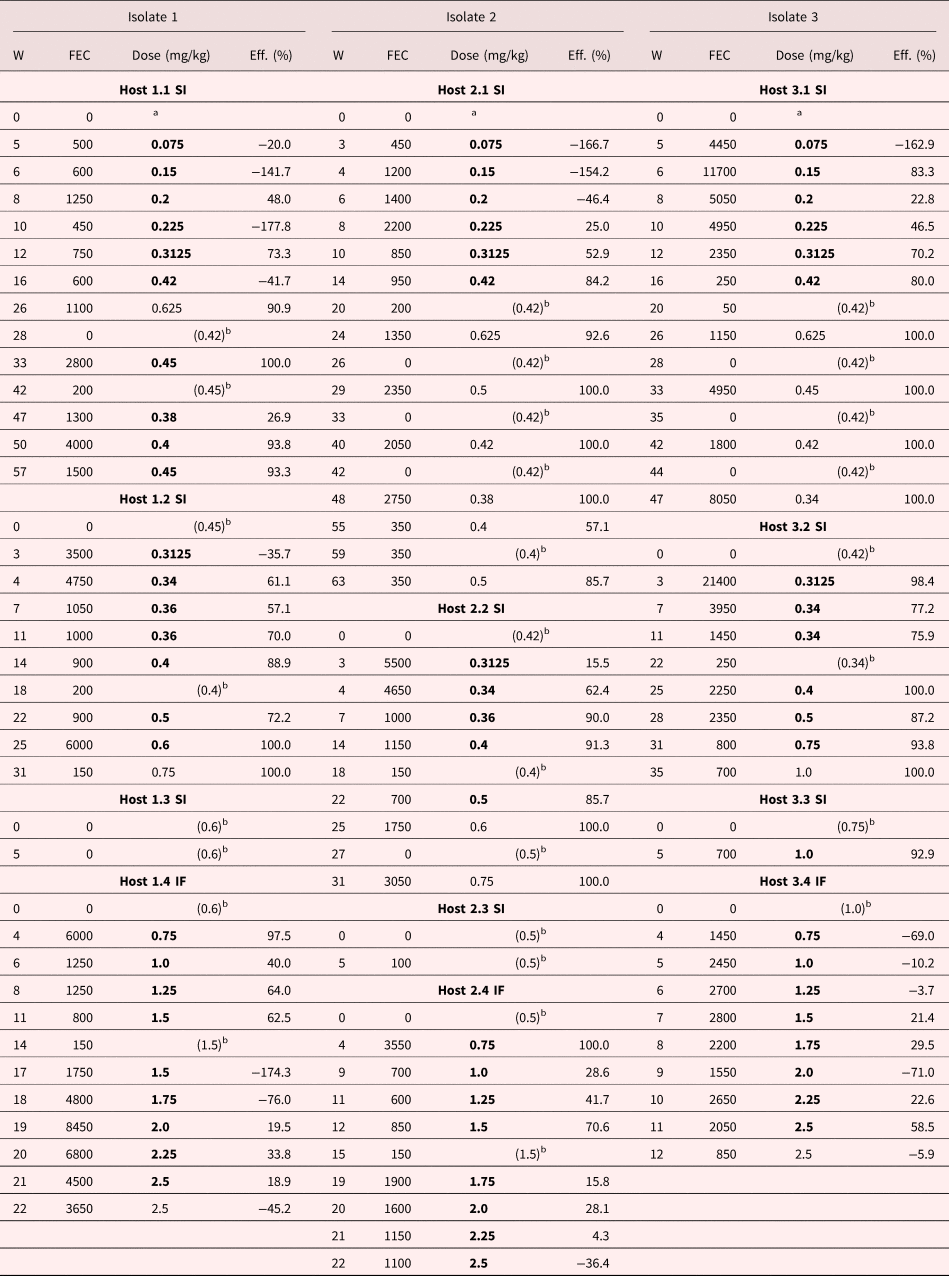
FEC, anthelmintic efficacy and monepantel doses used to treat sheep hosts resulting in three monepantel-resistant H. contortus isolates are presented in table 1. The experimental procedure lasted 112–133 weeks, and hosts were treated from the 0.075 mg/kg subdose to the 2.5 mg/kg therapeutic monepantel dose in 19–26 rounds of selection and with rates of 0.14–0.2 rounds of selection/week.
Faecal egg counts (FEC), monepantel doses and monepantel efficacy (Eff.) by week (W) during in vivo induction of monepantel resistance by subdosing Santa Ines (SI) or Ile de France (IF) sheep hosts resulting in three resistant Haemonchus contortus isolates.

a First infection of hosts with H. contortus L3 larvae from the Embrapa2010 isolate.
b (Re-)infection of hosts with H. contortus L3 larvae surviving the monepantel dose described in parenthesis.
Each monepantel dose in bold represents a round of selection.
Monepantel efficacy of the 2.5 mg/kg therapeutic dose was 18.9% for isolate 1, 0% for isolate 2 and 58.5% for isolate 3 (table 1). Even though the three sheep hosts were infected with the same H. contortus isolate (Embrapa2010; Chagas et al., Reference Chagas, Katiki, Silva, Giglioti, Esteves, Oliveira and Barioni Júnior2013) in the first passage, in vivo subdosing of successive hosts resulted in three isolates with differences in monepantel efficacy. As the initial isolate was the same, it was previously subjected to similar historical events of exposure and sensitivity to anthelmintics. Thus, despite assessing monepantel efficacy in only one host for each isolate, this finding highlights the complex nature of anthelmintic resistance. Indeed, resistance is influenced by inheritance mode (dominant/recessive; monogenic/polygenic) and influenced by non-specific mechanisms of resistance (Bartley et al., Reference Bartley, Devin, Nath and Morrison2015), including host–parasite interactions.
Mean FEC was 854, 981, 144 and 1472 EPG in passages 1, 2, 3 and 4, respectively. The crescent values of FEC from the first to the second and then to the fourth passages may reflect differences in host age and gender, which affect susceptibility to worms (Gauly et al., Reference Gauly, Kraus, Vervelde, Van Leeuwen and Erhardt2002), and may also be caused by the increased egg output by H. contortus in response to serial passages (Kemper et al., Reference Kemper, Elwin, Bishop, Goddard and Woolaston2009).
Higher FEC values, suggesting higher parasite load and prolificacy, in the fourth passage may have favoured the establishment of resistance, because parasite load increases the odds that a new mutation leading to resistance will emerge and, if under positive selection, become fixed and more frequent in the parasite population (Gilleard, Reference Gilleard2013).
The acquisition of monepantel resistance in the fourth passage may also be due to the use of worms that had already been selected by lower anthelmintic doses in previous passages. Underdosing affects the intensity of selection pressure for development of anthelmintic resistance, favouring the survival of worms with alleles conferring genetic resistance; this is especially the case for heterozygous individuals, and contributes to the development of anthelmintic resistance (Barnes et al., Reference Barnes, Dobson and Barger1995; Papadopoulos, Reference Papadopoulos2008). This has an important impact under field conditions, because the inappropriate use of anthelmintics, which includes underdosing (Chartier et al., Reference Chartier, Pors, Hubert, Rocheteau, Benoit and Bernard1998; Niciura et al., Reference Niciura, Veríssimo and Gromboni2012; Sargison, Reference Sargison2012), is a known risk factor for the establishment of anthelmintic resistance.
Although our experiments were not designed to compare sheep breeds, the change in host breed from Santa Ines to Ile de France – a less parasite-resistant breed (Amarante et al., Reference Amarante, Bricarello, Rocha and Gennari2004) – may have contributed to higher FEC values in the fourth passage. This change in breed also resulted in faster development of resistance, as observed in the mean round of selection/week rates (0.42 vs. 0.13). These results possibly reflect the differences in parasitic resistance between Santa Ines and Ile de France sheep breeds, but also the breed influence on the pharmacokinetics of monepantel, as reported for Merino and Dorset lambs (Hosking et al., Reference Hosking, Kaminsky, Sager, Karadzovska, Seewald, Giraudel and Vercruysse2010). Influence of sheep breed on resistance establishment was also observed under field conditions, where selective treatments of Ile de France, but not of Santa Ines sheep, resulted in monepantel resistance in H. contortus (Albuquerque et al., Reference Albuquerque, Bassetto and Almeida2017). In addition, the breed of the animals in which the treatments are performed, as reported for Dorper and Suffolk (Niciura et al., Reference Niciura, Veríssimo and Gromboni2012), can determine the likelihood of developing anthelminthic resistance in the field. Thus, the impact of sheep breed on development of resistance should be considered in experimental in vivo protocols and in field conditions. Farmers are strongly advised to carefully select sheep breeds if they aim to maintain long-term anthelmintic efficacy in flocks.
Experimental derivation of resistant parasites facilitates the study of the biochemical and genetic determinants of resistance. Such studies can inform the development of strategies to preserve drug efficacy, to design new drugs and to predict resistance-associated events that may occur under natural conditions. Also, the generation of resistant isolates derived from a common susceptible parental strain allows future tests of new drugs and mapping of genetic modifications associated with resistance (Oduola et al., Reference Oduola, Milhous, Weatherly, Bowdre and Desjardins1988; Bartley et al., Reference Bartley, Devin, Nath and Morrison2015). However, it is important to highlight that differences may occur among experimentally selected different isolates and also between experimentally and field-derived parasites. This is because anthelmintic resistance is a complex quantitative trait with several polymorphisms in one gene or in different genes, each of which may contribute to the resistance phenotype in an additive inheritance mode (Gilleard, Reference Gilleard2013). Furthermore, in field conditions, gene flow occurs between treated parasites and non-treated parasites kept in refugia, which constitutes a pool of susceptible genes that dilute the frequency of resistant genes (Fleming et al., Reference Fleming, Craig, Kaplan, Miller, Navarre and Rings2006). In addition, experimentally selected resistant populations have much less genetic variation than the same resistant strains selected under field conditions (Van Wyk, Reference Van Wyk2001).
In summary, we conclude that H. contortus resistance to monepantel can be induced in vivo by subdosing sheep hosts after adjusting the procedure for each experimental condition, considering the specific parasite population, host–parasite interactions, outcomes in anthelmintic efficiency and FEC after treatments and the breed of sheep hosts. The generation of a resistant parasite isolate increases our knowledge of the potential biological events that control the establishment of anthelmintic resistance. In turn, this knowledge will lead to the development of tools for prevention, detection and monitoring of resistance.
Author ORCIDs
S.C.M. Niciura, 0000-0003-0046-0050; G.G. Cruvinel, 0000-0002-6079-9235; C.V. Moraes, 0000-0001-9467-2294; A.C.S. Chagas, 0000-0003-3939-0088; S.N. Esteves, 0000-0001-9635-3086 M.V. Benavides, 0000-0002-0219-3163 and A.F.T. Amarante, 0000-0003-3995-5501
Financial support
This study was financially supported by the Sao Paulo Research Foundation – FAPESP (grant number 2014/25821-0). C.V.M. has a scholarship from the Coordination for the Improvement of Higher Education Personnel – CAPES (Finance Code 001) and S.C.M.N. has a fellowship from the National Council for Scientific and Technological Development – CNPq (grant number 302287/2015-9).
Conflicts of interest
None.
Ethical standards
The authors assert that all procedures contributing to this work comply with the ethical standards of the relevant national and institutional guides on the care and use of animals. All procedures performed in studies involving animals were approved by the Animal Ethics Committee of ‘Embrapa Pecuária Sudeste’ (numbers 06/2015 and 03/2017).