Introduction
While the primary goals of the ‘heroic age’ of Antarctic exploration (c.1897–1922) were scientific and geographical in nature, it was not uncommon for expedition members to engage in musical activities, particularly singing and song-writing, alongside other leisure pursuits, in order to occupy themselves during periods of idle time and to ward off symptoms of so-called ‘polar depression’ (Leane Reference Leane2012; Philpott Reference Philpott2012, Reference Philpott2013; Stuster Reference Stuster1996). Many of the diaries and published accounts include sets of original song lyrics, as well as details of numerous concerts and regular sing-a-long sessions (often accompanied by pianos or gramophone recordings) that were held in the far south. These sources suggest that music was highly prized by the men for its entertainment value, and not only within the Antarctic huts and vessels; music was also heard out on the ice during many of the sledging journeys that were undertaken during this period.
‘Sledging songs,’ as they were known, were normally created and performed by the expedition members while they were out ‘on the march,’ undertaking long and often arduous sledging journeys across the ice. The songs featured newly composed lyrics that were usually about topics related to the expeditions, the sledging journey and/or the team and its members. The lyrics were sung to pre-existing melodies – typically, tunes borrowed from popular songs of the day. A form of work song, the sledging song offered multiple benefits to the parties of men performing extended and labour-intensive sledging journeys across the continent. When voiced in unison by the men as they hauled sledges across the ice, the regular rhythms of a sledging song could help to assist with team synchronisation and cohesion. Although it was not always possible for the men to give voice to these songs while sledging (such as when battling against adverse weather and surface conditions), various entries in diaries dating from this period provide evidence that sledging songs were indeed sung during the activity of sledging, as well as before and after. However, the songs also had value beyond their role in helping to coordinate team movements: the creation and recalling of the lyrics could provide welcome mental distractions from the monotony and physical demands of sledging, while the meanings attached to the texts could also, in many cases, give the expeditions as a whole a greater sense of significance and purpose.
This article examines the genre of the sledging song by drawing upon diaries dating from the British (Discovery and Terra Nova) and Australasian (Aurora) Antarctic expeditions of the ‘heroic age’. The aim of this research is to investigate the historical context in which these songs were created and performed, and also to consider what they reveal about the experiences of the men who participated in the sledging journeys and their earliest perceptions of Antarctica.
History and characteristics of the sledging song genre
Like many aspects of the early Antarctic expeditions, the sledging song has its origins in traditions associated with north polar exploration. Arctic explorers had discovered that poetry and song were suitable matches for the rhythmic activity of polar sledging and that the process of composing such forms helped to keep their minds occupied. Sledging songs were composed as part of various Arctic expeditions and examples survive in diaries, shipboard newspapers and published narratives produced in connection with those expeditions. For example, the Illustrated Arctic News, the ‘newspaper’ created on board the HMS Resolute in 1850–1851 during its search for the missing Franklin expedition, features a series of songs sung to music, including ‘The traveller's evening song’ (to the tune of ‘As slow our ship’) and ‘Song of the sledge’ (to the tune of ‘I'm afloat’) (Osborne and McDougall Reference Osborne and McDougall1852). During the British Arctic Expedition of 1875–1876 (the Nares expedition), Pelham Aldrich recorded in his sledging diary that composing verse was ‘a first rate way of passing time at the drag belt in a fog’ (Aldrich Reference Aldrich1876). Albert Hasting Markham's account of that expedition, The great frozen sea, includes the lyrics to a ‘Grand palæocrystic sledging chorus’ (Markham Reference Markham1894: 216–217), which were sung to the melody of the maritime ballad ‘The Shannon and the Chesapeake.’ The chorus notes the importance to the ships’ crews of using ‘Music and song / To help the hours along,’ and goes on to wish all of the sledges (which are named) success in their undertakings: ‘Here's a health to Marco Polo — / May he reach his northern goal, oh!’ The chorus was sung by the whole company ‘vociferously . . . on all appropriate, and other, occasions,’ including when the sledging team set a new record for farthest north in May 1876 (Markham Reference Markham1894: 216, 310). These kinds of creative productions of Arctic expeditions have drawn some scholarly notice; however, critics tend to focus on poems rather than songs (MacLaren Reference MacLaren1992), or only on the lyrics of a song, paying little attention to the impact of the melodies to which verses were sung (Behrisch Reference Behrisch2003: 77–78).
While the sledging song can be considered a uniquely polar musical genre, it is also closely related to the traditional sailor's work song, or sea shanty, that was regularly heard aboard clipper ships in the mid-nineteenth century, and there are many obvious parallels between the these two separate forms of functional music. Clipper ships were the most efficient mode of transport from approximately 1843 to 1869 (Clark Reference Clark1970); however, a high degree of manpower in heaving and hauling was required to operate them. Sea shanties, which formed part of a larger repertory of songs associated with maritime traditions, were designed to aid the physically demanding group tasks that were necessary aboard such ships. They employed a regular beat in order to coordinate team movements, as well as motivational lyrics to spur the men on and encourage the greatest possible physical effort and endurance. Although different types of shanties were used to accompany different forms of shipboard labour, the refrains of the songs typically contained at least one or two accented syllables, at which point/s combined human forces could pull together (Gammond and Wilton Reference Gammond, Wilton and Latham2015). The melodies of shanties were commonly borrowed from, or strongly influenced by, pre-existing forms of music that were popular among sailors, including traditional folk songs and ballads, African American work songs, minstrel music, music hall songs and military marches (Hugill Reference Hugill1961: 12–20). Of these genres, the functional military march and African American work song appear to have been particularly appropriate sources, given that both types of music were conceived for the primary purpose of supporting ordered human movements and, as a result, tend to exhibit strong, repetitive rhythms and straightforward melodic patterns and phrasing (Schwandt and Lamb Reference Schwandt and Lamb2015). Many of the other types of borrowed tunes that were incorporated into shanties had to be adapted to suit the needs of the specific task for which they had been repurposed. Improvisation was also a common feature of shanty ‘performances,’ meaning that a song's lyrics and musical form would often vary from one hearing to the next (Whates Reference Whates1937: 261; Terry Reference Terry1914–1915: 136).
Most of the primary musical features of shanties are also to be found within sledging songs, including strong, repetitive, march-like rhythms and simple, easily memorisable tunes that were usually ‘performed’ with some degree of improvisation. These qualities could assist explorers physically and mentally as they undertook labour-intensive journeys across the ice. In fact, sea shanties and sledging songs share so many similar musical traits that it appears that the main difference between them relates to their function: shanties were designed to be performed aboard ships at sea, while sledging songs were created to assist land-based sledging journeys across frozen landscapes.
The expeditions that took place in Antarctica during the late nineteenth and early twentieth centuries relied heavily on sledging to enable scientific exploration and discovery within the interior of the continent. It was here, on the ‘wide white stage’ (Nielsen Reference Nielsen2013), that memorisable forms of entertainment, such as poetry, verse and song, proved invaluable in terms of occupying and motivating the men. As Apsley Cherry-Garrard (Terra Nova expedition 1910–1913) recognised, such forms ‘gave one something to learn by heart and repeat during the blank hours of the daily march’ (Cherry-Garrard Reference Cherry-Garrard2004: 203). Singing songs could also provide a welcome break from the silence that was frequently encountered and described as a pervasive aspect of the Antarctic experience (Leane Reference Leane, Hince, Summerson and Wiesel2015: 115). During the Australasian Antarctic expedition, Morton Moyes became all too familiar with the oppressing effects of silence when the single week that he was supposed to spend alone in a hut on an ice shelf unexpectedly turned into nine weeks. He later identified silence as one of the most difficult elements he had to contend with during this time: ‘The first impact was the sudden silence and I could not get used to it. I found it oppressive and unnerving. It was not the mere absence of noise; it was something more substantial and self-contained than that’ (Moyes Reference Moyes, Dovers and Niland1964: 21). Unsure whether or not his companions would ever return, Moyes played music on a gramophone in attempt to lift the ‘heavy burden of silence that gave no peace’ and when his companions finally returned, their arrival (and his release from the oppression of silence and isolation) was announced by the distant sound of a sledging song:
Then came the day when I felt the solitude had at last beaten me. As I sat writing up my journal, I thought I heard a sledging song, one of those rollicking ditties we used to sing to boost our morale. I stood up, alarmed by the fancy, shaking with a sense of confusion. I'm going dippy, I thought. This is it. I stared stupidly about me. I heard the singing again, as faint and elusive as the far-off note of a bugle (M. Moyes, as told to Dovers and Niland 1964: 23).
He later reported that as the ‘rollicking song’ became louder, he rushed outside the hut and his ‘heart almost stopped’ as he saw a sledge being hauled by four men, his four friends (M. Moyes quoted in J. Moyes Reference Moyes1996: 49, 53).
When composing a sledging song out on the Antarctic ice, expedition members would invent lyrics that were usually highly motivational and expressed a united identity, ‘proclaiming the composition of the team, its purpose, its trials and its achievements’ (Leane Reference Leane2012: 123). Rhyme was favoured due to its capacity to facilitate memorisation and recall. It may also have had other, less obvious, functions. The potential of rhyme to suggest order and control may have been attractive in the strange and unpredictable polar wilderness. Even today, the control that rhyme asserts over language seems to be popular among writers who visit the far south. The New Zealand poet Bill Manhire, who travelled to Antarctica in 1998 as a writer-in-residence, links his use of rhyme in the poems he produced with the unsettling nature of the Antarctic environment:
I wasn't always in a position to write things down, and rhyme helped me remember. But rhyme was also a way of asserting order in an environment that didn't always offer easy evidence that such a thing was possible. Rhyme was my way of standing up straight (Manhire c. Reference Manhire2000: 33).
Similarly, by singing their newly-composed, rhyming lyrics to a familiar song with a regular rhythm, the men of the expeditions could attempt to assert a sense of control over the often irregular rhythms of nature.
Conversely, when the icescape was particularly tedious, an advantage of rhyme was that its very repetition might make time seem to pass more quickly. Kristian Prestrud, a member of the Norwegian Antarctic Expedition (1910–1912) who led a sledging expedition east from the Bay of Whales to King Edward VII Land (now Edward VII Peninsula) while his leader Roald Amundsen led the more famous southern journey to the Pole, reflected, ‘If I were to undertake the description of a long series of days like those that passed while we were travelling on the flat Barrier, I am afraid the narrative would be strikingly reminiscent of the celebrated song of a hundred and twenty verses, all with the same rhyme. One day was very much like another. One would think that this monotony would make the time long, but the direct opposite was the case’ (Prestrud, in Amundsen 2001, 2: 230). These comments suggest that the monotonous landscape and repetitive movements could produce a meditative state not dissimilar to that generated by repetitive chanting – certainly contemporary Antarctic explorers refer to reaching such a state in their traverses (Leane Reference Leane2016: 183–184). Prestrud himself ‘had great success reciting self-made songs, poems and speeches,’ many of which he transcribed in his diary (Kløver Reference Kløver2012: 57), although it it unclear whether his musical contributions extended to sledging journeys, as he did not keep a diary during these times.
Antarctic explorers’ tendency to produce sledging songs (as well as topical songs purely for entertainment) was not only a product of the activities they undertook but also the culture in which they had been embedded. Many ‘heroic age’ expedition members came from a naval background, and all travelled to the continent by ship, so the sea shanty would likely have been familiar to them. They were also steeped in the literature of Arctic travel; the library of the Discovery expedition, for example, included numerous polar exploration narratives (Catalogue of Books of the ‘Discovery’, [1901]), in which they may well have encountered references to sledging songs. More broadly, the period spanning the late nineteenth and early twentieth centuries was the time of the amateur entertainer through most of the western world (Scott Reference Scott2001) and many of the men who participated in the expeditions were competent singers and musicians (Philpott Reference Philpott2012, Reference Philpott2013). The use of tunes from well-known songs of the day created a link with the world back ‘at home’; however, simultaneously, and perhaps also ironically, it also emphasised the men's distance from their familiar environment. Singing tunes from the civilised world in the middle of the plateau had a certain surreality to it. Nevertheless, as an oral tradition, these songs had an advantage over books in that they did not need to be lugged along in a volume. Setting the lyrics to familiar tunes made it easy for the men to recall the songs until such a time that they could be recorded in writing. The fact that so many original sledging song texts were written down, and sometimes many times, shows how important they were to the men who created and sang them: they wanted to preserve them. And, as with the songs that Arctic expedition members composed, sledging songs not only appeared in the men's journals: some were also printed in their in-house ‘newspapers’ and expedition narratives, taking on a public value outside the expedition itself.
Three sledging songs: lyrics, music, context and analysis
Here, we focus on three selected ‘heroic age’ sledging songs, one from each of three prominent English-speaking expeditions: ‘Summer sledging in sledgometer verse’ (Anon. 1903, Discovery expedition); ‘The Northern Party's sledging song’ (Raymond Priestley c.1911, Terra Nova expedition); and the ‘Southern sledging song’ (Frank Hurley 1911–1912, Aurora expedition). There are a number of examples that survive from this period, most often in sledging diaries (and probably many more, given the oral nature of the tradition, that were never written down or are lost). The three examined here have been selected as illustrative examples from three different English-speaking expeditions, for which full lyrics are available and readily accessible to the modern reader in published versions, and specific tunes known. Together, they indicate the range of situations in which sledging songs were produced, performed and recorded. For each song, we provide and analyse both lyrics and melody within the context of the particular sledging party's experience.
‘Summer sledging in sledgometer verse’
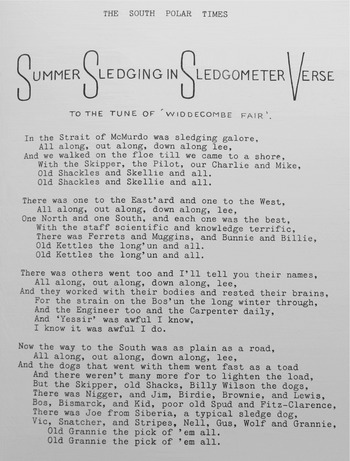
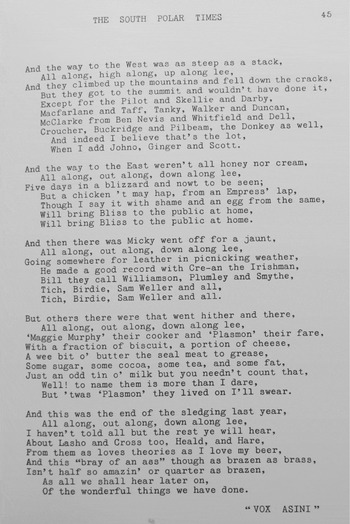
‘Summer sledging in sledgometer verse’ (Fig. 1) was published in the August 1903 issue of the South Polar Times, the shipboard newspaper produced by the men of the British National Antarctic expedition 1901–1904 (Discovery expedition), led by Robert Falcon Scott. The tune is given as ‘Widdecombe Fair,’ a famous Devon folk song about a group of eight men travelling to the eponymous fair using an old borrowed horse who dies on the way, possibly as a consequence of being ridden (farcically) by all eight men, or driven too hard by the men pulled behind in a cart or carriage. All of the contributions to the South Polar Times were pseudonymous, although a key provided in the published (1907) edition makes the authorship of many items plain. ‘Summer sledging’ is attributed to ‘Vox Asini’, a pseudonym used nowhere else in the newspaper and not listed in the key, but presumably intended to indicate the light-hearted and community-minded nature of the piece (an expression of the time was ‘vox populi, vox asini’, voice of the people, voice of the ass). The speaker of the verse gives his own translation of the title, describing the song as ‘the bray of an ass.’ Written, like ‘Widdecombe Fair’, in a rural English vernacular, the song may have been a group effort, or possibly the product of one of the expedition's crew, several of whom contributed pieces to the South Polar Times. Given that it is spoken by an ‘ass’, it is tempting to consider that it may have been created by the ‘donkeyman’ (that is in charge of the donkey boiler) William Hubert, who is referred to in the song as ‘the Donkey’. However, Hubert, a merchant marine sailor, contributed nothing else to the South Polar Times. He had a problematic expedition and he was sent home on the relief ship in March 1903. Although it is possible that a piece written in early 1903 may have appeared in a later edition of the South Polar Times, this scenario seems unlikely.
The text of ‘Summer sledging in sledgometer verse,’ as it appears in the published version of the South Polar Times (1907: 44–45).


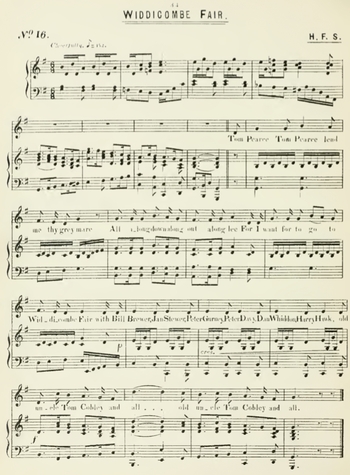
Like many sledging songs, this one relates the significant trials and achievements of the expedition in a comic, colloquial manner, with liberal use of nicknames, puns and insider jokes. The title of the song, with its reference to ‘sledgometer verse,’ emphasises the importance of rhythm in the context of ‘the march.’ A further link with marching is apparent in the meter of the song's borrowed tune, ‘Widdecombe Fair’ (Fig. 2). This tune is in 6/8 time – a compound duple meter that has a long history of use with marching and is still commonly found in processional marches performed today (Schwandt and Lamb Reference Schwandt and Lamb2015). In music written in this meter, there are two main beats (dotted crotchets) within each bar, making it ideally suited to taking two steps (one with each foot) per bar of music. Indeed, the music of ‘Widdecombe Fair’ has its own history of use with marching, having been used as a marching song for the Devonshire Regiment in the Boer War (Northcote Reference Northcote1908: 80), Widdecombe being a town in that county.
The first known published version of the folk song ‘Widdecombe Fair’ (here spelt ‘Widdicombe Fair’), transcribed by Reverend Sabine Baring-Gould and arranged for voice and piano by Reverend Henry Fleetwood Sheppard (Baring-Gould and Sheppard Reference Baring-Gould and Sheppard1891).

The strong, regular beat and marching meter of the pre-existing folk tune, combined with its many long-short note groupings, seem to naturally invoke forward momentum. Some published versions of the original folk song encourage this effect by incorporating evocative expressive markings. In the score excerpt shown in Fig. 2, which is from the earliest known published version of ‘Widdecombe Fair’ (transcribed by the English folk song collector Reverend Sabine Baring-Gould around 1890 and arranged for voice and piano by Reverend Henry Fleetwood Sheppard), the expressive marking provided at the opening simply indicates that it should be performed ‘Cheerfully.’ However, in a four-part vocal arrangement of the same folk song published in 1909, the expressive marking at the beginning of the score makes a more explicit reference to forward physical movement, although equine rather than human: ‘With well-marked rhythm, suggestive of the gait of an aged cart-horse’ (Andrews Reference Andrews1909: 1). While sledging parties may at times have felt like they were travelling with the gait of an ‘aged cart-horse’ as they hauled their sledges across the ice, this sledging song, when sung with well-defined rhythms, could indeed have helped to support and coordinate their steps. In addition to the meter and rhythm of the borrowed tune providing a suitable backdrop for the sledging song, the lyrics of ‘Widdecombe Fair’ inflect the sledging song ironically: it is, after all, both a tale of a party of travelling men who never arrive at their intended destination, and a tale of an animal that dies (presumably) as a result of the load it pulls.
The structure of the sledging song's narrative is straightforward, with the first verse introducing the location of the base and the officers: the Skipper (Scott), the Pilot (Albert Armitage), Charlie (Charles Royds), Mike (Michael Barnes), Shackles (Ernest Shackleton) and Skelly (Reginald Skelton). The second verse lists the scientific staff: Ferrets (Hartley Ferrar), Muggins (Alfred Hodgson), Bunnie (Louise Bernacchi), Billie (Edward Wilson) and ‘Kettles the long'un’ (Reginald Koettlitz, who was over six feet tall; his more usual nickname was ‘Cutlets’). The third verse deals with the trials of the first winter, and the remaining ones with the various sledging expeditions undertaken. The problems plaguing the attempts on the Pole by ‘Skipper, Old Shacks, Billy Wilson’ are comically acknowledged; ‘the dogs that went with them were fast as a toad’. Also mentioned are the Western journey led by Armitage and the Southwestern Barrier journey led by Barne. Puns on the men's names are evident: ‘the strain on . . . / . . . the Carpenter daily’ plays on the name of the carpenter, Fred Dailey; the ‘Bliss’ mentioned in the sixth verse alludes to Arthur Blissett. He had been one of a party that sledged to Cape Crozier in the hope of finding a newly hatched Emperor penguin chick – ‘a chicken . . . from an Empress’ lap’ – and an egg; there was no sign of chicks, but Blissett located an egg (Yelverton Reference Yelverton2000: 176).
The humorous elements of the sledging song's narrative are well matched to the ‘cheerful’ character of the melody to which it is set. The tune of ‘Widdecombe Fair’ is in a major key (in Fig. 2, it is written in the key of G major), which is often considered a happy, bright and hopeful mode compared to the minor mode, which is more typically associated with sadness, despair and longing (Hevner Reference Hevner1935: 103; Pinchot and others Reference Pinchot Kastner and Crowder1990; Webster and Weir Reference Webster and Weir2005). The melody has plenty of shape, which helps to make it memorable, and is also relatively straightforward to sing: it is completely diatonic, with no chromatic tones whatsoever, and spans no more than one octave in range. These features mean that it would be a fairly simple tune for amateurs to sing, even when away from a musical instrument, such as while out on ‘the march.’ As one of Devon's best known folk songs, this tune would have been familiar to most (if not all) of the Discovery’s men and thus relatively easy for them to recall and give voice to whilst they were undertaking physically demanding tasks such as man-hauling. Combined with the humorous newly composed verses related to sledging, the tune's regular beat, marching meter and cheerful character would have given the sledging song all the key elements to successfully support the team's movements across the ice.
However, although it is a self-identified sledging song and is certainly about sledging (indeed, it tries to encapsulate the experiences and achievements of a series of sledging journeys undertaken by the expedition), it is unclear how much, if any, of this song was composed or performed ‘on the march.’ Sledging songs were sometimes accumulative (verses would be added as achievements occurred), so although this song was completed in 1903 (as the reference to ‘last year’ makes clear) it may have been begun on an early sledging trip, or it may have been composed retrospectively in the comfort of the hut. Without knowing the author, it is difficult to find corroborating diary evidence.
Whatever its origins, the song acts as a kind of comic record of the men's achievements, appearing as it does late in the last issue of the South Polar Times published during the Discovery expedition. The final lines are significant in this context: the speaker predicts that his ‘brazen’ boasting of the expedition's achievements won't be ‘half as amazin’ or quarter as brazen, / As all we shall hear later on, / Of the wonderful things we have done.’ Again here the tone is ironic, pointing to the speaker's awareness of (and perhaps scepticism about) the public adulation that Antarctic explorers of the period inevitably experienced. This is a sentiment found in other contributions to the South Polar Times, such as Bernacchi's play script ‘When one goes forth a ’voyaging,’ a satire on London socialites’ lionisation of Antarctic explorers, as well as Scott's short story ‘In Futuro,’ in which a boastful returned explorer rolls out clichés to an awestruck journalist. As a whole, this song fulfils a very different function from the public celebrations that its author knows will inevitably follow the expedition's return: it is written as a record that only the expedition members themselves can really understand, its nicknames, in-jokes and puns giving its Antarctic readership a sense of belonging that those who later perused the published version of the South Polar Times could never share.
‘The Northern Party's sledging song’
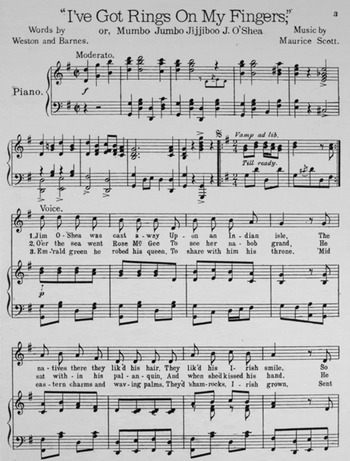
More typically, sledging songs would be produced by a specific sledging party and deal with their particular travails and successes, rather than those of the entire expedition. One example is ‘The Northern Party's sledging song,’ found in the diaries of geologist Raymond Priestley from the British Antarctic (or Terra Nova) expedition 1910–1913, and subsequently included as an appendix to the 1974 edition of his narrative of the expedition, Antarctic adventure. In a version of the song he transcribed and annotated in 1960, Priestley notes that the lyrics were sung to the tune of a ‘contemporary Music Hall song the first line of which was “Jim O'Shea was cast away upon a desert isle”, and [with a] chorus [beginning] “I've rings on my fingers and bells on my toes”’ (Priestley Reference Priestley1960). This music hall number, which is more commonly known by the title ‘I've got rings on my fingers’ (Fig. 3), was a popular British song of the day. It was composed by Maurice Scott, with words by Robert Weston and Fred Barnes, and was published in sheet-music format in 1909. The song was a hit for singers Ada Jones and Blanche Ring and seems to have been extremely popular among the men of the Terra Nova expedition: Griffith Taylor noted in his diary in December 1910 that the song was ‘a great favourite and a good tune’ (Taylor Reference Taylor and Hanley1979: 20).
Opening page of the sheet music for ‘I've got rings on my fingers’ (Scott Reference Scott, Weston and Barnes1909: 3).

The ‘Northern Party’ consisted of six men based in the area of Victoria Land to the north of Scott's main base on Ross Island. The original plan had them being deposited by the expedition ship Terra Nova in King Edward VII Land, to the east of Ross Island, but a lack of suitable landing places and a chance encounter with the Norwegian Antarctic Expedition led the group to fall back on their contingency plan. They thus transformed from the ‘Eastern Party’ to the ‘Northern Party’: after reporting to Scott, the Terra Nova headed north up the coast of Victoria Land to drop off the six men. Bad weather led to the men being landed at Cape Adare (a more northerly area than they had hoped, and one that had already been inhabited by Carsten Borchgrevink's Southern Cross expedition, 1898–1900), where they spent about a year living in a hut. When the Terra Nova returned to pick up the party in early 1912, it took them to a region of the coast further south, where they planned to undertake sledging journeys for about a month and a half before meeting the ship again and being delivered back to the main base. However, sea-ice prevented the vessel's return and, with few rations remaining, the six men were forced to spend the winter alone on an island they named ‘Inexpressible,’ living in a small cave dug out of the snow, consuming largely seal and penguin meat.
At all stages of their expedition, songs (their own and others’) were important to the men of the Northern Party. At Cape Adare, they made frequent use of the gramophone and had, Priestley observed, ‘an appropriate song for every thing that could happen here’ (Priestley Reference Priestley1915: 99). The gramophone also had very practical uses: the men invented a novel alarm, the ‘Carusophone,’ in order to make night-time meteorological observations without keeping a constant watch. A thread attached to a spring and tied through a notched candle would break after the candle had burnt for two hours, releasing the starting lever on the gramophone, which would play Enrico Caruso's very stirring rendition of the ‘Flower song’ from Carmen (Priestley Reference Priestley1915: 94). They also held ‘sledging concerts’ in which they would perform their own renditions of various songs (Priestley Reference Priestley1915: 105). Priestley's description of a short trip from Cape Adare makes the importance of song to the men's experience clear: ‘The chief feature of the march has been, I think, the general air of cheerfulness pervading the party, and when I cast my mind back, searching for incidents, as when writing this account, there is a continual under-current running through my thoughts which, in its clearer moments, resolves itself into the refrain of a song Browning was for ever singing or humming while he was at work with the primus, or when we were breaking camp’ (Priestley Reference Priestley1915: 136–137). Unsurprisingly, concerts were also a feature of the ice cave period: as conversation wore thin, they resorted ‘more and more to chorus songs [including ‘chanties’ and some of their own compositions] to pass the time’ (Priestley Reference Priestley1915: 295). Reflecting on the period in Antarctic adventure, Priestley notes the ability of verse to evoke another place. Remembered in England, songs could conjure up the Antarctic, and vice versa: ‘. . . memories . . . recalled by the verse of a song are unsettling, for they intensify the desire to return and try one's luck again under similar conditions. Each song has its own memories, from the chanties which speak of the clank of pumps and the rattle of blocks to a certain hymn, which, when sung in the Antarctic, recalled too vividly to my mind a vision of a certain oak-panelled drawing room in a little town in Gloucestershire’ (1915: 297–8).
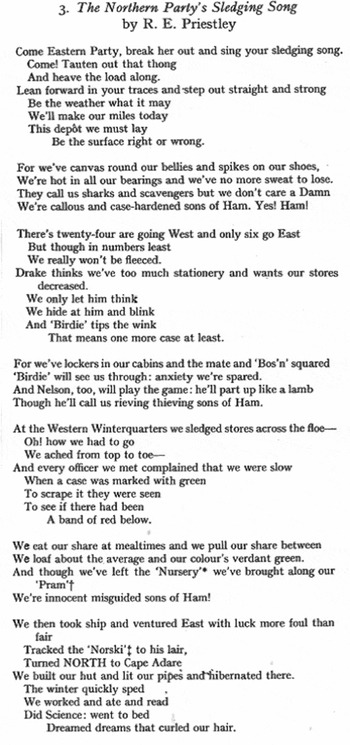
Given the Northern Party's love of song, it is hardly surprising that they developed their own sledging song. Initially titled the ‘Eastern Party chorus’, it was begun in the first summer, with nearly fifty lines written in Priestley's diary in early 1911 (Priestley Reference Priestley1910–Reference Priestley1911 [5 January 1911]). At this stage, the ‘Eastern Party’ was still at the expedition's main base, where its members were working to sledge supplies from the ship to the Main Base hut. Priestley, Victor Campbell (the Eastern Party leader) and physician Murray Levick were all hauling together at this point (Hooper Reference Hooper2010: 62). Although the expedition had not yet broken into different parties, the song voices a strong sense of separate identity from the outset: ‘Come Eastern Party, break her out [that is break the sledge from the ice to which it had frozen] and sing your sledging song. / Come! Tauten out that thong [sledging trace] / And heave the load along’ (Priestley Reference Priestley1960, Reference Priestley1974). At this point, the main focus is the friendly rivalry between the two parties, Campbell's and the main base men at Cape Evans, and particularly the Eastern Party's attempts to increase what they saw as their inadequate supplies: ‘There's twenty-four are going West and only six go East / But though in numbers least / We really won't be fleeced.’ Like ‘Summer sledging,’ these verses are full of nicknames and insider knowledge: it is hard to understand the third verse, for example, without knowing that crates destined for the Eastern Party were marked with a green stripe of paint, and those for the Ross Island party with a red stripe (Priestley Reference Priestley1960). Additional material was written during the time at Cape Adare: Priestley added a verse (about the meeting with Amundsen, the ‘Norski’) in April 1911 (Priestley Reference Priestley1911a [18 April]); and Petty Officer Frank Browning contributed another sixteen lines in October that year (Priestley Reference Priestley1911b [25 October]), although Priestley noted later that these were ‘never sung,’ and did not incorporate them into his version of the song (1960). It is unclear when the song was completed, as the final verse (‘Oh! It's fine to go spring sledging . . .’) does not appear in Priestley's diary. No lines appear to have been added in the ice cave: while some lyrics for new songs do occasionally feature in his ice-cave diary, Priestley later recalled that ‘life was too hard in the winter of 1912 for song-making, though singing was a main recreation’ (1960). Perhaps, too, the grim irony of their sledging song was too evident; they had been singing it to the tune they referred to as ‘Jim O'Shea was cast away upon a desert isle,’ and they were themselves now in a similar position, although their island was considerably more barren than Jim's.
Although the whole group were invested in it, Priestley attributes ‘The Northern Party's sledging song’ to himself. Its importance to him, at least, is evident from the many times he transcribed, edited and rearranged the song, adding and subtracting versus as he went along: the song changes form from his original holographs diaries, through the typed ‘fair copies’ he made while in Antarctica and the 1960 transcription, to the published version given in the 1974 edition of Antarctic adventure (it does not appear in the original 1915 edition). This published version (Fig. 4) is missing a verse and chorus composed at the main base, as well as Browning's contribution. The evolution of this sledging song over time points to the improvisatory nature of the genre: these songs were composed on the spot, surviving as an oral tradition until they could be written down, edited and refined.
‘The Northern Party's sledging song’ (Priestley Reference Priestley1974: Appendix 3). Used with permission.


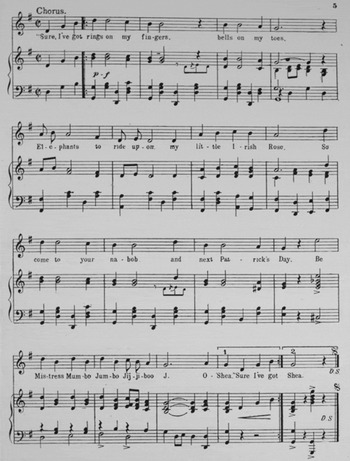
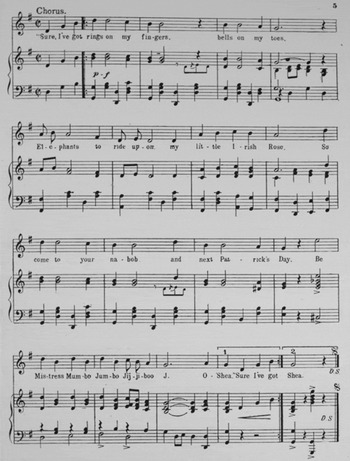
As with ‘Summer sledging’, performances of ‘The Northern Party's sledging song’ would have been inflected by the men's knowledge of the lyrics of the original, which was such a ‘favourite’ of theirs. The comic song tells of an Irishman who, castaway on a tropical island, is turned into a chief by the locals, gathering an ‘ornament[al]’ harem around him even while he writes to ask his Irish sweetheart to join him. Scott's men must have been aware of the ironic distance between this imperial fantasy and their very different experience of remote adventure on a freezing, uninhabited continent. There were further layers of meaning: the official title and chorus line, ‘I've got rings on my fingers’ (Fig. 5), borrows from a much older verse, the children's nursery rhyme ‘Ride a cock horse’, in which a ‘fine lady’ with ‘bells on her toes’ has, a little like the Northern Party, ‘music wherever she goes’. Thus, though adult in its humour, ‘I've got rings on my fingers’ had connotations of childhood, family and home comforts that would have provided a much needed, if subconscious, sense of reassurance for Scott's men. There are references to childhood comforts in the reinvented lyrics of the sledging song: the third chorus plays on the words ‘Nursery’ and ‘Pram’, the former a nickname for a cabin on the Terra Nova and the latter, as Priestley makes clear in his annotated 1960 version of the song, a term for their Norwegian-style boat. (Fram, the name of Amundsen's ship, is a confusing misprint in Priestley's footnote in Antarctic adventure. While its ostensible purpose is humour, this punning also points to the men's need for the familiar in the alien environment. Nursery rhymes were evidently appealing, as Priestley notes in his ice-cave diary that they ‘adapted one . . . to a sledging song’ (1912 [20 Aug. 1912]).
The chorus of ‘I've got rings on my fingers’ (Scott Reference Scott, Weston and Barnes1909: 5).
More obviously, the sledging song's lyrics enabled the men to acknowledge, without seeming to gripe, the toll that the extreme climate and environment was taking upon their bodies and temperaments: they ‘ached from top to toe’ after sledging ‘across the floe’, and ‘every officer [they] met complained that [they] were slow’ (see Fig. 4). Had such sentiments merely been spoken, especially by individuals, they could easily have been interpreted as complaints. However, when sung by the group together to a well-known tune of a comic song, the words were transformed into banter and accepted as a tolerable part of building team spirit. Expressing these negative thoughts through the act of singing together could nonetheless have a cathartic effect, providing an outlet for the release of any pent-up emotions and also serving to promote bonding and a sense of camaraderie and community among the men. This was similar to the function of sea shanties, which could also be used as outlets for venting shared frustrations; sailors were usually afforded ‘freedom of expression’ while shantying and were permitted to voice complaints through singing that otherwise would not have been tolerated by their superiors (Rose Reference Rose2012: 151, 154).
The overall mood or character of a sledging song was clearly an important consideration for Priestley, as it was for others who led the production of songs in the genre. During the ice cave period, he wrote in his diary that a ‘poem’ composed by Levick, with chorus lines such as ‘Bend your back & give a pull,’ was ‘too much in the heroic strain for a sledge song so we are not adopting it’ (Priestley Reference Priestley1912 [23 June 1912]). This suggests that the group (or Priestley, at least) was keenly aware of the role of music in affecting mood and hence actively sought to avoid using songs of a serious nature to accompany what was already a relatively solemn task. Instead, the men appear to have favoured songs with humorous and light-hearted qualities in the context of sledging journeys and the choice of a pre-existing tune upon which to base a new sledging song would have been made with these desired qualities in mind. On this basis, the tune they selected to accompany ‘The Northern Party's sledging song,’ from ‘I've got rings on my fingers’ (Figs. 3 and 5), was entirely appropriate: it was not only well-liked by the men, but it also had the requisite jovial mood. Like the tune used in ‘Summer sledging,’ the melody of ‘The Northern Party's sledging song’ is in a major key (G major) and is lively in character. It is also fairly simple to sing (it is completely diatonic, within the range of an octave and features mostly triadic and step-wise melodic movement) and is easily memorisable due to the regular repetition of phrases. The tune has a regular beat and a simple duple meter (in the published score, the time signature varies between 2/4 in the verses and cut common time in the chorus), which is commonly used in quick marches (Oxford University Press Reference Kennedy2015).
Although this pre-existing tune may be suitable for marching to when sung at a moderate tempo as indicated in the score (Fig. 3), it is unlikely that Priestley and his team ever gave voice to ‘The Northern Party's sledging song’ while actually pulling a sledge. Priestley states in his diary that the sledging team sang songs before and after the ‘serious work’ of sledging (Reference Priestley1911b [10 August]), but he does not mention that they were sung in conjunction with the activity itself. In fact, on one occasion Priestley writes that he generally finds it hard to talk while sledging (Reference Priestley1911b [7 Sept]), so it is difficult to believe that he could have found it possible to sing under the same circumstances. In this sense, the ‘Northern Party's sledging song’ acted less as a work song and more as an anthem, its performance prior to and after the physical effort of sledging providing both motivation and celebration.
‘Southern sledging song’
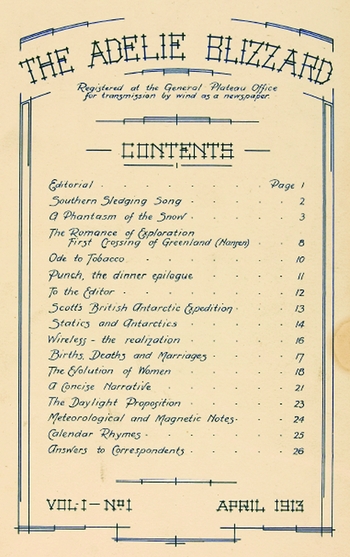
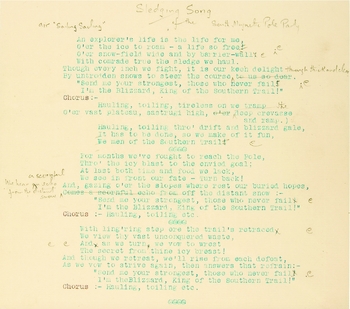
While ‘The Northern Party's sledging song’ may never have been utilised as a functional work song, the sledging song created by the men of the Australasian Antarctic Expedition 1911–1914, the ‘Southern sledging song,’ is known to have been performed out on the ice during sledging journeys. The ‘Southern sledging song’ appears as the opening item of the ‘newspaper’ of the Australasian Antarctic Expedition (AAE), The Adelie Blizzard (Fig. 6). Although all of the items in the Blizzard were published anonymously, notes about the newspaper made in preparation for its (unsuccessful) publication (probably by its editor, Archie McLean) state the lyrics for this song were written by the expedition photographer Frank Hurley ([McLean] Reference McLean1916). Over the summer of 1912–1913, Hurley had been a member of a three-man sledging journey toward the South Magnetic Pole. In addition to Hurley, the team comprised magnetician Eric Webb and engineer Robert ‘Bob’ Bage, the party's leader. Traversing the comparatively featureless plateau, the three occupied themselves by singing and reciting as they went, both on the march and in their tent. ‘Best 2 miles in less than 40 mins, Bob spouting Kipling all the way’ wrote Webb in mid-December (1912–1913 [18 December 1912]). ‘We have just been making the tent ring with an old tune,’ recorded Hurley in the same month, and on another occasion, ‘At lunch we were all merry & sang old favourite ditties’ (1912–1913 [2 December 1912; 16 December 1912]).
Contents of The Adelie Blizzard, showing the ‘Southern sledging song.’ Courtesy of the Australian Polar Collections, South Australian Museum, Adelaide.

Some of these songs were their own inventions: ‘Great production of songs last evening,’ noted Webb in mid-December, ‘and was fairly late when we got to sleep’; by January he could report that ‘our songs in general have progressed’ (1912-13 [10 December 1912; 3 January 1913]). Webb carefully recorded all the verse they composed in his diary, sixteen pages in total. Most of the pieces deal humorously with the events, characters and annoyances of life on the trail or at base. As the going became harder (having failed to reach the Pole and turned back towards base, the men were plagued by bad conditions, reduced to low rations and eventually feared for their lives), this composing of verse became correspondingly important in maintaining their spirits.
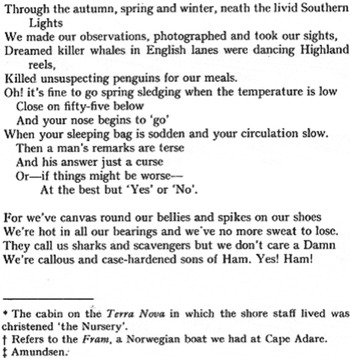
There was one particular song that, according to Hurley's narrative of the expedition, ‘urged us through many trials and tribulations’, and which they sang raucously when finally sledging into base (Hurley Reference Hurley1925: 93). The ‘Southern sledging song’ (see Fig. 7) has none of the humour and irreverence of many of the other verses recorded in the men's diaries, but rather is more in the Kiplingesque motivational vein: ‘Hauling, toiling, through drift and blizzard gale / It has to be done, so we make of it fun / We men of the Southern Trail.’ The men imagine themselves pitted in a fight against a hostile anthropomorphised icescape: ‘Send me your strongest, those who never fail, / I'm the Blizzard, King of the Southern Trail.’ They emphasise their loyalty, determination and indefatigability, turning their failure to reach the Pole into a victory: ‘And though we retreat, we'll rise from each defeat.’ While the song's rhyme and meter are determined by the pre-existing melody to which it was sung, the content echoes the ballads of the Yukon poet so beloved of Douglas Mawson, Robert Service, specifically his poem ‘The law of the Yukon,’ in which the far north embraces only the hardiest specimens of manhood, rejecting, in Social Darwinist style, ‘the foolish and feeble . . . / . . . the misfits, the failure’ (Service Reference Service1907: 5–6). Mawson's expedition members identify with the tough survivors, and with the landscape that seemingly accepts them: geographically inverting Service's typical phrasing, they declare themselves ‘men of the Southern Trail’! At the same time, the members of the sledging party, in what is essentially a working song, emphasise leisure and choice in their activity: their life is ‘free’; despite hardships, they are sledging ‘with keen delight’, their route is ‘dear’; in the chorus's rather awkward words, although the work ‘has to be done’ they ‘make of it fun.’
Hurley's sledging song as it appears in The Adelie Blizzard. Called the ‘Southern sledging song’ in the contents page, here it has no typed caption, although an alternative has been added in pencil. The additions and corrections were made with a view to publication, probably by the newspaper's editor A. McLean. Courtesy of the Australian Polar Collections, South Australian Museum, Adelaide.

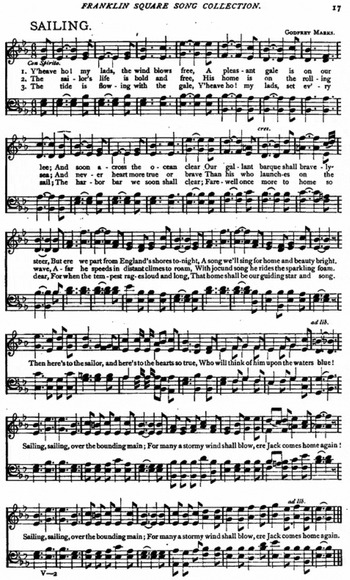
Again the original lyrics of the melody selected for the sledging song are worth considering for their parallels to the men's situation. The melody to which they set their lyrics is from a popular British sea song known as ‘Sailing, sailing’ (or simply ‘Sailing’) (see Fig. 8), written in 1880 by James Frederick Swift (1847–1931), a British composer and church organist who composed secular music under the pseudonym ‘Godfrey Marks’ (Averill Reference Averill2014: 426). Sometimes described as a children's song (for example Averill Reference Averill2014: 427), the lyrics of ‘Sailing’ spoke reassuringly of a return ‘home again’ after dangers at sea. Its opening lines – ‘Yeave ho! My lads, the wind blows free / A pleasant gale is on our lee’ – present, like the AAE men's lyrics, an urge to make light of the physical labour involved in the undertaking.
‘Sailing,’ by Godfrey Marks (James Frederick Swift), as published in the Franklin Square Song Collection (1888: 17).

Musically too there are connections between this melody and the tunes used in ‘Summer sledging’ and ‘The Northern Party's sledging song’. It is high-spirited, predominantly in a major key, and is eminently singable; its melody (the top line of notes in the version in Fig. 8) spans just over one octave in range and is mostly diatonic, with a few chromatic notes included for colouristic purposes. It is straightforward enough for amateurs to sing and simultaneously provides sufficient melodic interest to be memorable and keep singers’ minds occupied. The meter of the tune is 6/8, the same meter as that used for the melody that accompanies ‘Summer Sledging’ (from ‘Widdecombe Fair’), which, as mentioned previously, is commonly encountered in marching music. Like ‘Summer sledging,’ the ‘Southern sledging song’ also features a driving rhythm that would have helped to urge the men forward, keeping them motivated, entertained and moving together, unified in their movements, as well as their ambitions.
Conclusion
As the three examples discussed in detail in this article illustrate, Antarctic sledging songs tend to focus on the human experience of the continent, particularly on the trials and tribulations of hauling sledges across its expansive and unpredictable interior. The lyrics are typically highly motivational, projecting a united identity, and rhyme is also a primary feature. Musically, the songs draw upon tunes from popular songs of the day that are humorous or light-hearted in character. The tunes usually feature meters and rhythms that are suitable for accompanying marching, even if the sledging songs were not all (or always) used for this purpose. Perhaps coincidentally, the three sledging songs discussed here,‘Summer sledging’, ‘The Northern Party's sledging song’ and the ‘Southern sledging song’, all draw upon pre-existing songs that refer to some kind of physical movement in their original lyrics: in ‘Widdecombe Fair’ and ‘I've got rings on my fingers,’ there are references to riding horses and elephants, respectively, while in ‘Sailing,’ the lyrics refer to moving across the ocean. In the context of Antarctic expeditions, and sledging journeys in particular, this recurring theme is very appropriate.
While it may not have always been possible for sledging parties to sing while man-hauling, when conditions were suitable and the men were capable of singing, it became possible for the sledging songs to contribute in a very practical way to the primary goals of the expeditions. Giving voice to their sledging songs could enable the men to perform repetitive tasks in an efficient manner, whilst maintaining their mental strength and sense of team identity, all in the service of exploration and scientific discovery. Beyond their applications as working songs, sledging songs could serve other important functions as well. With the recording of scientific data and objective observations comprising such a significant portion of the men's time and duties in Antarctica, the act of writing and performing songs provided an outlet through which they could express personal, subjective thoughts and feelings about their human experiences of, and presence on, the ice.
Today, the sledging songs that survive in the diaries and published accounts of the expeditions are important historical records. They form a small but important part of a larger repertory of music created in Antarctica during the ‘heroic age’, which itself drew upon traditions associated with maritime and north polar exploration. Not only are the surviving Antarctic sledging songs examples of some of the first forms of music created in connection with the Antarctic continent, but they also provide valuable insight into what the early explorers did to pass the time and stay motivated while out on the march, as well as reveal fascinating details about their experiences and perceptions of the far south. Additionally, more than one hundred years after they were conceived, these songs are now inspiring professional composers to connect with Antarctica in their music. For example, Australian composer Scott McIntyre (b. 1968) has recently composed a song cycle titled Songs of the south (2014), which is based upon a series of songs from the ‘heroic age’, including ‘The Northern Party's sledging song’ (McIntyre Reference McIntyre2014; Philpott and others Reference Philpott, McIntyre and Leane2014). Such compositions have the capacity to breathe new life into the sledging songs and enable them to be heard beyond the ice, exposing them to a new and wider audience of people, and giving listeners a chance to engage with a part of the history of Antarctica, and human connections to its environment, in the process.
Acknowledgements
The authors would like to acknowledge the assistance of librarians and archivists at the following institutes for enabling access to manuscripts and other research materials: Scott Polar Research Institute, University of Cambridge; the Mitchell Library (State Library of New South Wales); the Alexander Turnbull Library (National Library of New Zealand); the Australian Polar Collections (South Australian Museum); and the Australian Antarctic Division. The authors also wish to thank Hester Blum of Penn State University, for offering advice on Arctic sledging songs, and the anonymous reviewers, for their useful feedback.
Financial support
This work was supported by the Australian Research Council under project FT120100402; and a Culture Domain Seed Grant and a Career Development Scholarship from the University of Tasmania.
Conflict of interest
None.