Introduction
A number of processes influence the success and persistence of local populations inhabiting patchy habitats, and these population-level patterns underlie patterns of spatial variation in community composition, or “beta diversity”. For example, community composition will vary minimally with geographic distance if, all else being equal, the communities in question host primarily highly vagile species (Soininen et al. Reference Soininen, Lennon and Hilledbrand2007a, Reference Soininen, McDonald and Hilledbrand2007b). Alternatively, if the constituent species are predominantly weak dispersers, then compositional similarity among communities will decrease with increasing distance among sites (Soininen et al. Reference Soininen, Lennon and Hilledbrand2007a, Reference Soininen, McDonald and Hilledbrand2007b). Habitat characteristics can also modify the relationship between community similarity and proximity. For example, if habitat patches differ considerably in one or more aspects of quality, then their communities will exhibit low similarity in composition of the magnitude of the intervening distance. Insights into these processes can often be gained through assessments of beta diversity (Anderson et al. Reference Anderson, Crist, Chase, Vellend, Inouye and Freestone2011), and in particular, through analyses of how the similarity of composition among sites varies in relation to inter-site distance (Nekola and White Reference Nekola and White1999).
Gall wasps (Hymenoptera: Cynipidae) induce some of the most complex and well-organised galls observed in nature (Cornell Reference Cornell1983; Stone and Cook Reference Stone and Cook1998; Csóka et al. Reference Csóka, Stone and Melika2005). These wasps are usually highly host-specific and are generally limited to inducing galls on a single plant species (Ronquist and Liljeblad Reference Ronquist and Liljeblad2001; Csóka et al. Reference Csóka, Stone and Melika2005). Cynipid galls are susceptible to invasion by a range of wasps, which consume either the nutritive tissues of the gall or the inhabitant larvae: these can be either gall inducers, inquilines, or parasitoids (Csóka et al. Reference Csóka, Stone and Melika2005; Shorthouse Reference Shorthouse2010b). The component community associated with cynipid galls (inducers, inquilines, and parasitoids) thus comprises a group of insects that rely on small, spatially segregated patches of habitat, which comprises a small fraction of the overall landscape (Abrahamson et al. Reference Abrahamson, Hunter, Melika and Price2003; Csóka et al. Reference Csóka, Stone and Melika2005).
Galls induced by cynipid wasps of the genus Diplolepis have a wide range of inquilines and parasitoids comprising their component communities often with species-specific assemblages associated with galls of each species (Shorthouse Reference Shorthouse2010b). The galls of one of these species, Diplolepis variabilis (Bassett), is the subject of this study and has been described and illustrated by Shorthouse (Reference Shorthouse2010b). Briefly, mature galls are single-chambered, spherical, and found on the abaxial surface of leaflets; however, most galls coalesce to make clusters irregularly rounded and globular. Single-chambered galls are about 8 mm in diameter, whereas coalesced galls are often 2 cm in diameter. Mature galls remain attached to the plant throughout the winter and are easily collected in late fall or early spring. An inquiline species in the genus Periclistus Förster (Hymenoptera: Cynipidae) inhabits and modifies many of the galls of D. variabilis. Common parasitoids that invade D. variabilis galls include Eurytoma Illiger sp. (Hymenoptera: Eurytomidae), Torymus Dalman sp. (Hymenoptera: Torymidae), Pteromalus Swederus sp. (Hymenoptera: Pteromalidae), Aprostocetus Westwood sp. (Hymenoptera: Eulophidae), Eupelmus Dalman sp. (Hymenoptera: Eupelmidae), and Orthopelma Taschenberg sp. (Hymenoptera: Ichneumonidae) (Shorthouse Reference Shorthouse2010b).
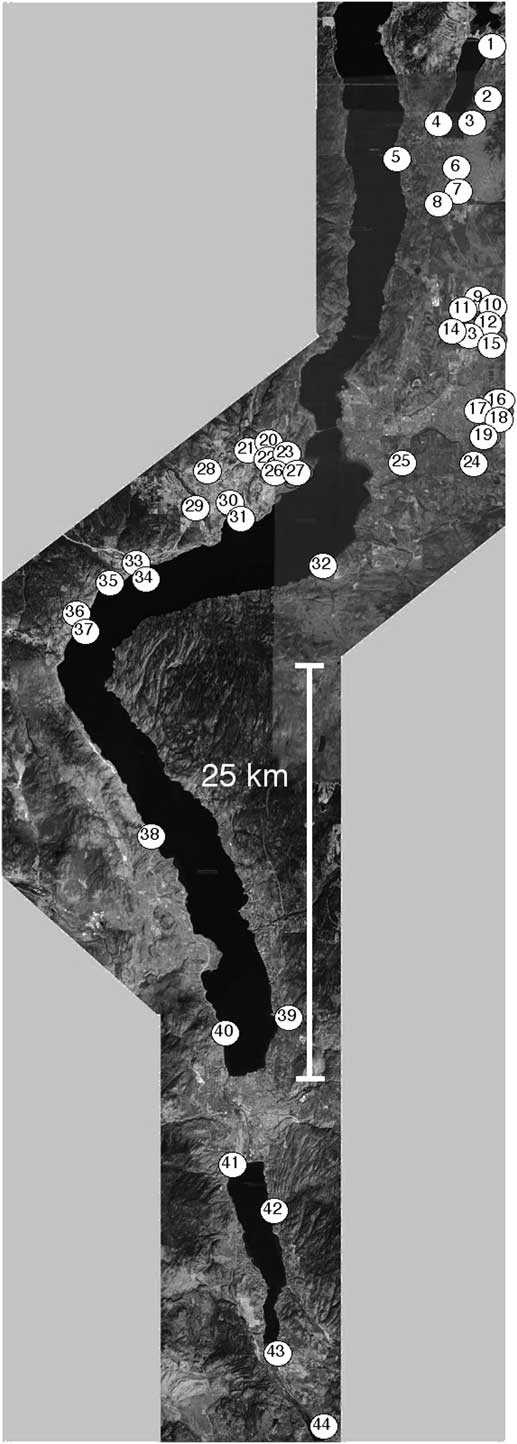
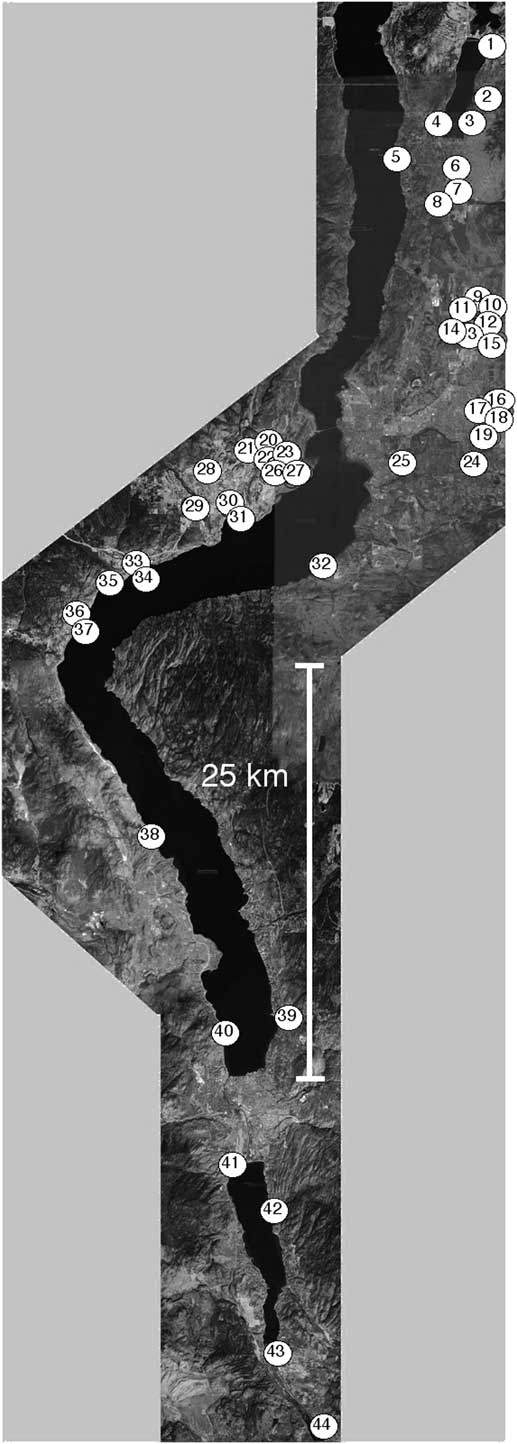
Previous studies of cynipid gall communities have shown the species composition across the entire range of the inducer remains similar (see references in Shorthouse Reference Shorthouse2010b). However, detailed assessments of the geographical structuring of species composition are comparatively rare (Fernandes and Price Reference Fernandes and Price1988, Reference Fernandes and Price1992; Price et al. Reference Price, Abrahamson, Hunter and Melika2004). Even so, dispersal, historical processes (e.g. historical colonisation), and the structure and dispersion of habitat patches are all factors that have been shown to structure the communities associated with cynipid wasps (Cornell Reference Cornell1985a, Reference Cornell1985b; Cornell and Lawton Reference Cornell and Lawton1992; Looney and Eigenbrode Reference Looney and Eigenbrode2010). Given that the D. variabilis gall community is composed of small, generally poor flying wasps, we hypothesised that spatial variation in community composition would be influenced by dispersal limitation, which would be manifested as a “distance decay” in community similarity (Nekola and White Reference Nekola and White1999), i.e., sites exhibiting a decline in similarity with increasing geographic distance. We tested this prediction using D. variabilis gall communities sampled throughout the Okanagan Valley, an area covering ∼2500 km2 (Fig. 1). Finally, the northernmost sites in our study region apparently represent the northern range limit for D. variabilis (J.D.S., personal observation). This provided an opportunity to explore how gall community richness varies at the range limits of the gall inducer.
Composite aerial photograph of the study region. Sample sites are plotted by site number.
Methods
Study system
The Canadian distribution of D. variabilis is restricted to southern British Columbia (Shorthouse Reference Shorthouse2010b) where it occurs in rain shadow valleys of the Cascade Mountains, along with adjacent regions of the United States of America (Looney and Eigenbrode Reference Looney and Eigenbrode2010). In the Okanagan Valley, D. variabilis is abundant over its entire range in the southern part of the valley, but disappears abruptly north of the town of Oyama. The study sites in south-central British Columbia are within the northern limit of the Great Basin shrub-steppe grasslands found south of the border with Washington State and extending to Mexico (Shorthouse Reference Shorthouse2010a). Galls were sampled along the Okanagan Valley, a narrow, low elevation valley that extends northward from the border with the United States of America to the city of Vernon (Fig. 1). This valley occurs in two of British Columbia's ecoregions, the Thompson–Okanagan Plateau Ecoregion to the north near the community of Kelowna and the Okanagan Highland Ecoregion to the south (Shorthouse Reference Shorthouse2010a) that abuts the United States of America border. Often referred to as Palouse grasslands in the United States of America (Looney and Eigenbrode Reference Looney and Eigenbrode2010), this term is not used in Canada's ecosystem classification.
Galls are found only on Rosa woodsii Lindley (Rosaceae) in the Okanagan Valley. Rosa woodsii is a dominant component of native grasslands in the two ecoregions (Douglas et al. Reference Douglas, Meiginger and Pojar1999) where it tends to form island-like patches with well-delineated borders. Not all suitable rose patches support galls of D. variabilis. There are 12 species of Diplolepis in the study area (Shorthouse Reference Shorthouse2010b) with galls of D. variabilis by far the most common.
Field sampling
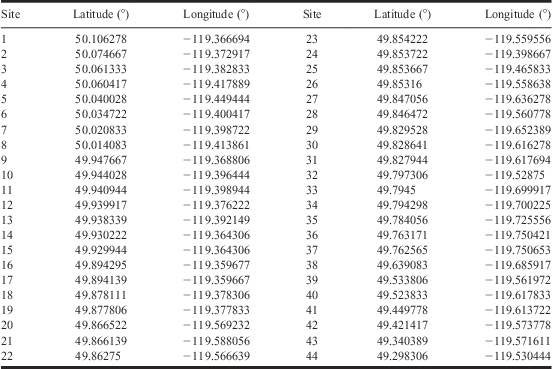
Galls of D. variabilis initiated the previous year were collected during the first two weeks in May 2007. Galls were collected at sites ranging from its northernmost extent in Oyama to the north and south to Oliver, with the most distant sites ∼90 km apart. Most collection sites were found throughout this cline by sampling galls on roses along primary and secondary roads, excluding heavily forested areas in the valley bottom. Galls were collected at 44 locations (Fig. 1). Collection size at each site depended on gall abundance, with the size of collections ranging from 25 to ∼250 galls. Each collection was limited to what was apparently a single clone of R. woodsii (either a single plant or a discrete, closely-associated aggregation of apparent ramets). Approximately half of the galls present on each clone were collected in a haphazard manner to ensure D. variabilis was not extirpated from any given locality. Latitude/longitude was recorded for each collection site using a handheld Global Positioning System. Collection sites ranged from as little as 10 m apart up to 90 km apart (Fig. 1). Galls from each site were placed into plastic bags and stored at 4°C within a few hours of collection and then were placed in glass jars at room temperature (19–23°C) to allow emerging adult wasps to exit their galls. Jars were checked daily from early May (depending on the collection, start times varied from 11 May 2007 to 18 May 2007) until 31 August 2007, the wasps were removed daily, counted, identified to genus, and transferred into 95% ethanol for preservation. A small percentage of wasps (1%) were not identifiable to genus but nonetheless were used in analyses as “Other”.
Data analyses
All analyses were conducted using the open-source software “R” v. 2.14 (R Development Core Team 2011). A general assessment of the spatial patterns of taxon abundance was first conducted. This included generating maps depicting variation in taxon abundance and assemblage diversity. The outcomes of these analyses facilitated interpretations of the main analyses of interest, described below.
To test our main prediction of a negative relationship between community similarity and geographic distance, we first calculated the Chao–Sørensen measure (Chao et al. Reference Chao, Chazdon, Colwell and Shen2005) using the “fossil” package for R (Vavrek Reference Vavrek2011). Using abundance data (here, the number of individuals per taxon per site), this statistic estimates the probability that a taxon randomly drawn from each of two assemblages will belong to a taxon that is shared between the assemblages, adjusted for undetected, shared taxa (Chao et al. Reference Chao, Chazdon, Colwell and Shen2005). This index of similarity was used to minimise any potential effects of unequal sample sizes among sites. A Mantel test between the Chao–Sørensen similarity index and geographic distance was then conducted using 999 permutations. Based upon the somewhat nonlinear form of the association between these two matrices (assessed using a scatter plot), we opted to conduct the Mantel test using the ranks of the distance (similarity) values, an approach that is equivalent to computing a Spearman correlation (Legendre and Legendre Reference Legendre and Legendre1998). Using the standard approach did not change the outcome (not shown). We repeated the preceding analysis using only distance in the north-south direction as a predictor. A principal coordinate on neighbour matrices analysis using the Hellinger-transformed species abundances as the response matrix (site × abundance) and geographic coordinates as the predictor matrix was also performed, which found no spatial patterns in the species abundance data (not shown) (Borcard and Legendre Reference Borcard and Legendre2002; Legendre et al. Reference Legendre, Borcard and Peres-Neto2005). Lastly, a multiple regression was conducted to test whether or not taxon richness was related to latitude after controlling for variation in the number of individuals among sites, with richness as the response variable, and the count of individuals and latitude as the predictor variables. Residual diagnostics revealed the need to log-transform (base-2) both richness and the count of individuals to meet regression assumptions.
Results
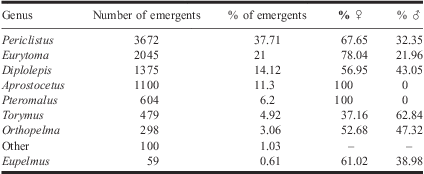
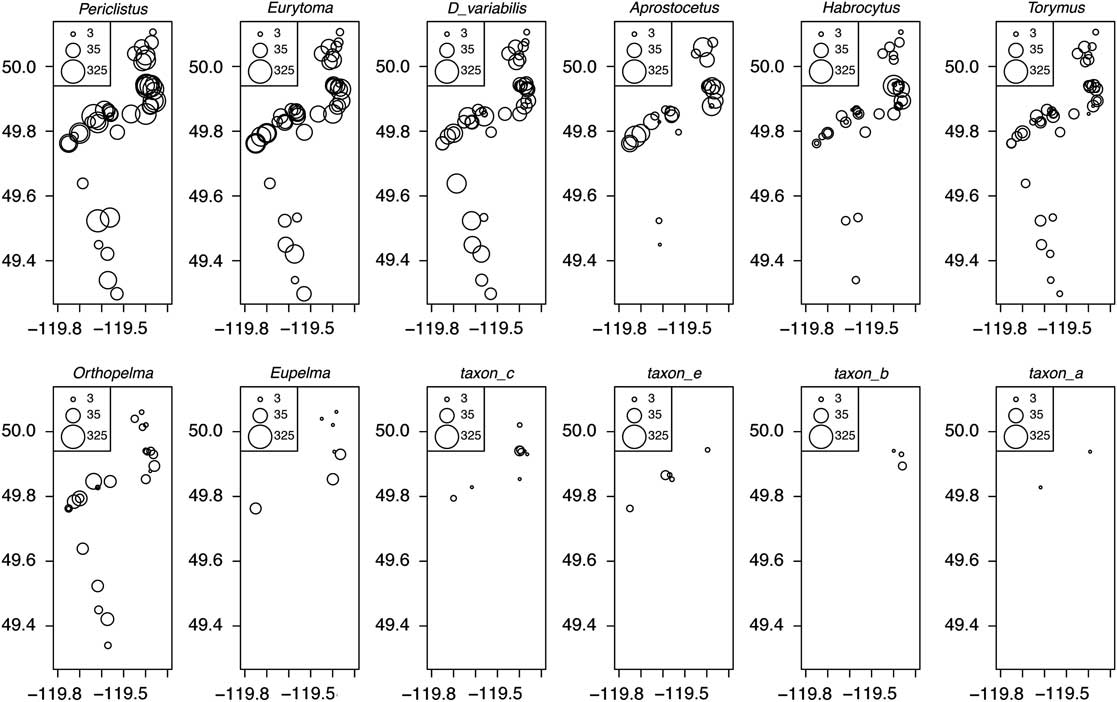
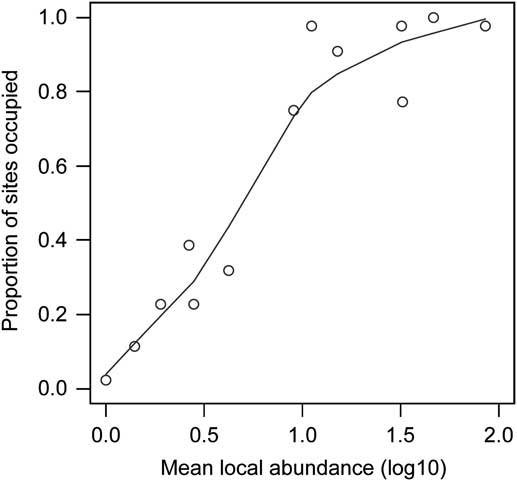
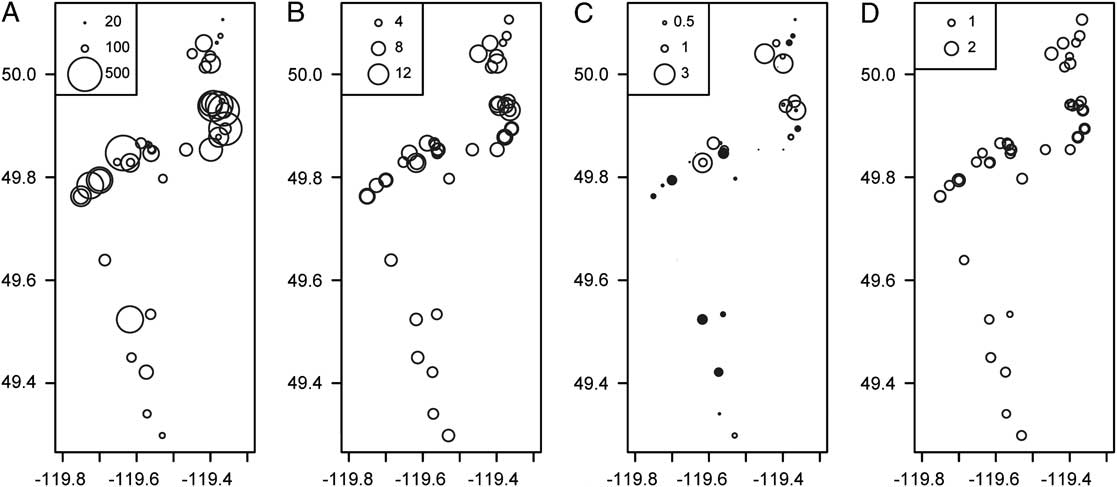
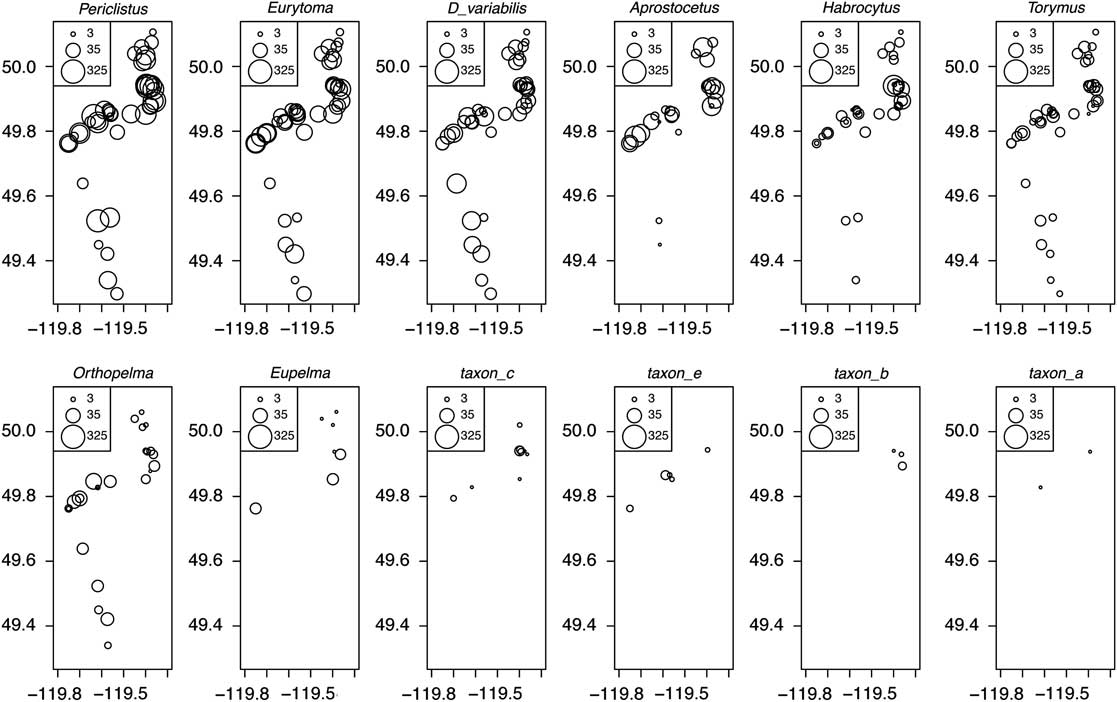
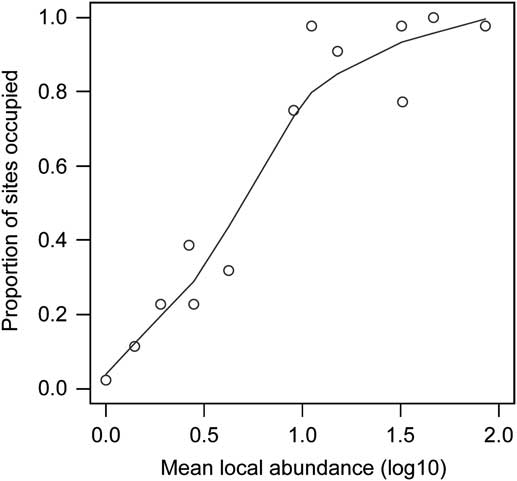
The proportions of species that exited the galls across all sites are summarised in Table 1. A total of 9738 wasps were obtained, with a mean of 221 wasps per site. There were seven abundant taxa that were found across the entire study area with no evident regions where any of these taxa were absent (Fig. 2). Collections yielded a minimum of four, and a maximum of 12 taxa. The smallest gall collection yielded 22, whereas the largest gall collection yielded 536 wasps. Periclistus accounted for 38% of the total number of individuals, while D. variabilis accounted for only 14% (Table 1), but was only absent in one small collection. The most prominent genera of parasitoids were Eurytoma (21%) and Aprostocetus (11%). Several taxa that were not identified to genus were uncommon in the assemblage and were included in the “Other” category in Table 1. As observed in many other taxa (e.g. Gaston et al. Reference Gaston, Blackburn and Lawton1997), the occupancy rate of the wasps (i.e. proportion of sites occupied) was strongly positively related to average local abundance where wasps were present (Fig. 3). As seen in Figure 2, several of the most abundant taxa are almost ubiquitous among sites.
Relative abundance and sex allocation of inhabitants emerged from all Diplolepis variabilis galls.

Bubble plots illustrating variation in taxon abundance among sites. Panels are ordered according to total regional abundance, with the most regionally abundant taxon (Periclistus) appearing in the top left panel. One “other” taxon is not shown because it appeared in only a single site.
Occupancy rates of the 13 taxa in relation to their average local abundance among the 44 sites. The dashed grey line represents maximum occupancy (44 sites). The positive association is highly significant (Spearman ρ = 0.91, P < 0.001).
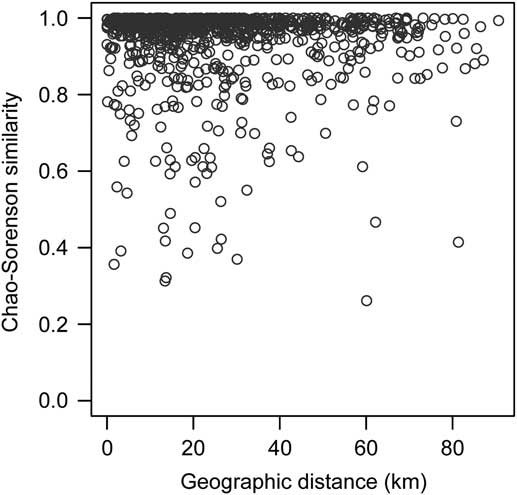
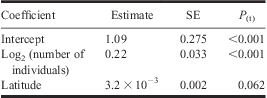
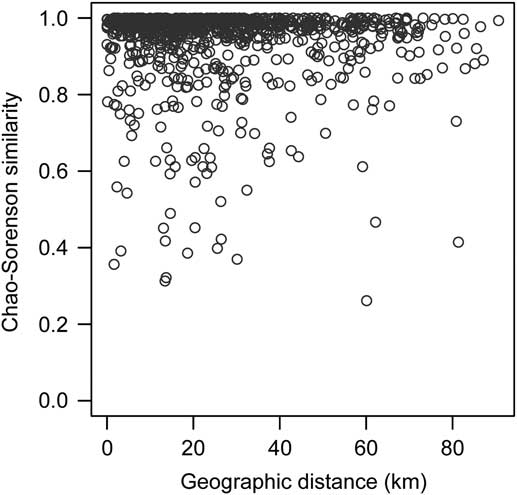
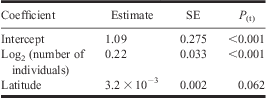
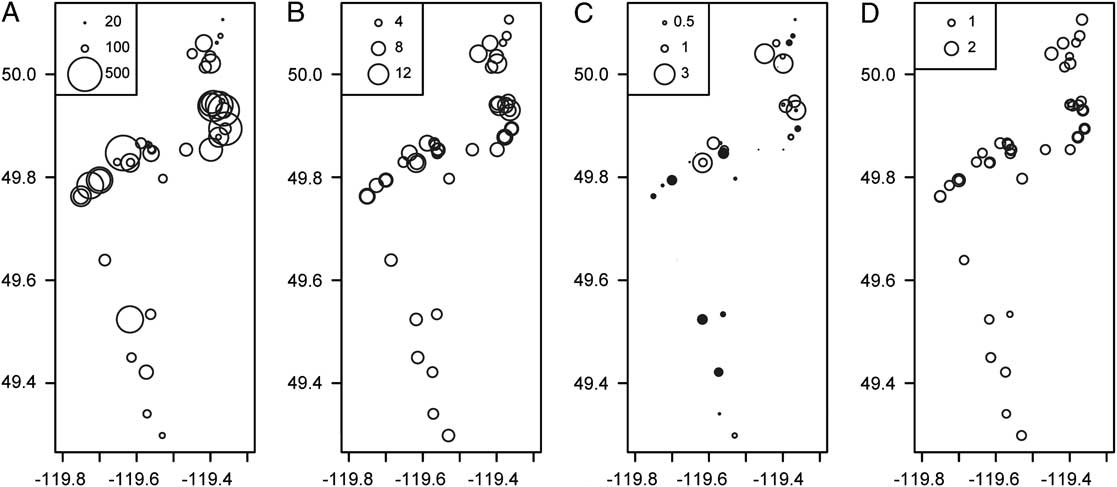
The combination of low overall taxonomic richness and high overall abundance and occupancy of a high proportion of the taxa (Table 1; Fig. 3), led to remarkably high similarity between communities in this study (median Chao–Sørensen index = 0.98, SD = 0.101). Similar results were found when presence–absence data were used (results not shown). Consequently, we found no support for our prediction of a negative relationship between community similarity and geographic distance (Fig. 4; Mantel test statistic = −0.04, P = 0.72), nor with similarity and latitudinal distance (Mantel test statistics = −0.03, P = 0.67). Taxonomic richness exhibited a marginally significant positive relationship with latitude, over and above the influence of sampling intensity (i.e. number of individuals) (Table 2; Fig. 5).
Relationship between community similarity and geographic distance among all pairs of 44 sites. The Mantel correlation (based upon Spearman rank correlation) was not significant.
Multiple regression of the effect of sample intensity (number of individuals per site, Log2 transformed) and latitude on number of taxa present (Log2 transformed) in a given site sample (F 2,41 = 22.3, adjusted R 2 = 0.50).
Bubble plots depicting spatial patterns of abundance and diversity among the 44 sample sites. Shown are (A) the total abundance of all taxa, (B) taxon richness, (C) richness residuals (negative residuals represented by filled symbols, positive by open symbols) after accounting for abundance (using least-squares regression), and (D) Shannon–Weiner diversity.
Discussion
To our knowledge, this represents the first study quantitatively examining community similarity in relation to geographic distance in insect gall communities.
In this study there were no notable absences of any of the common species across the study area, which supports their previous findings of Wiebes-Rijks and Shorthouse (Reference Wiebes-Rijks and Shorthouse1992), who qualitatively noted that the species composition of gall communities is generally similar across the range that the gall inducer inhabits. Diplolepis variabilis, Periclistus, and five parasitoid genera were present across the entire area of study, although not every species was found at each site. Although the D. variabilis gall communities differ in size and composition, they are remarkably similar with respect to the species present at each site (Fig. 2); a feature common to many study systems (Gaston et al. Reference Gaston, Blackburn and Lawton1997). This presents the question, how do the different species associated with gall communities locate habitat patches?
Little is known about the dispersal capability of cynipid wasps or the other wasps associated with their galls, but some species have been demonstrated to move up to 24 km/year (Cooper and Reiske Reference Cooper and Reiske2007). Small Hymenoptera are typically poor fliers and are most likely passively assisted by prevailing winds (Hough Reference Hough1951). The relatively homogeneous composition of D. variabilis gall communities across their limited range in Canada suggests that the rate of wasp dispersal between patches is high. Unfortunately, much of the taxonomic and all of the behavioural work necessary to establish host range and dispersal propensity for the members of the D. variabilis community remains to be done. In any case, prolonged local persistence on the part of the inducer and the possible ability to use alternate hosts on the part of parasitoids and inquilines may also factor in structuring gall communities.
The new Chao–Sørensen index was used since sample size was highly variable and this test is minimally influenced by unequal sample size (undersampling) (Chao et al. Reference Chao, Chazdon, Colwell and Shen2005). This index accounts for rare and potential unsampled members of the community in small samples. One underlying assumption built into this measure is that the overall community is generally similar between sites. As previously stated, this is generally true for gall communities (Wiebes-Rijks and Shorthouse Reference Wiebes-Rijks and Shorthouse1992; Shorthouse Reference Shorthouse1993). There was no relationship between community similarity and physical proximity of sites across our study region, which suggests that the regional species pool may be more important in determining the presence of any single species rather than dispersal limitations. Community composition may be also affected by differences in the microhabitat, condition, or the phenology of R. woodsii clones, which has not been addressed here. However, at a larger scale, such as across the inducer's entire North American range, there may be evidence of a distance decay relationship (Looney and Eigenbrode Reference Looney and Eigenbrode2010).
Although it was relatively easy to find D. variabilis galls throughout the study area, there were many patches of R. woodsii devoid of galls and even cases where galled plants were in close proximity to ungalled plants. This presents an interesting puzzle. Most gall-inducing insects are highly host-specific, only inducing galls on a single species of host plant (Abrahamson et al. Reference Abrahamson, Melika, Scrafford and Csóka1998, Reference Abrahamson, Hunter, Melika and Price2003; Ronquist and Liljeblad Reference Ronquist and Liljeblad2001; Csóka et al. Reference Csóka, Stone and Melika2005). However, little is known about the underlying basis of host fidelity between and D. variabilis and R. woodsii. For example, it is not known whether or not lineages of D. variabilis are restricted to particular genets of R. woodsii or if they can induce galls on any R. woodsii genet they encounter. Inasmuch as a number of other gall systems do show strong within-species variation among hosts for susceptibility to gall induction, (Fritz and Price Reference Fritz and Price1988; Strong et al. Reference Strong, Larsson and Gullberg1993; Egan and Ott Reference Egan and Ott2007), which can affect spatial patterning (Lászlói and Tóthmérész Reference Lászlói and Tóthmérész2011), it is possible that patches of R. woodsii without D. variabilis galls represent resistant clones. An alternative explanation is that established populations may be progressively colonised by parasitoids and inquilines over time, leading to the periodic extirpation of D. variabilis from that location, triggering the local extinction of the entire community (Washburn and Cornell Reference Washburn and Cornell1981; Hawkins and Mills Reference Hawkins and Mills1996). In the former case, there may be good constancy in parasitoid and inquiline presence across local gall communities. In the latter case, one would expect to see strong inter-patch variation in the prevalence of natural enemies of D. variabilis: a pattern not observed in this study. However, it is noteworthy that taxonomic richness, which is entirely driven by an increase in the richness of rarer parasitoid taxa in northern sites (Fig. 2), does increase marginally with latitude (Table 2). The basis for this pattern is unclear, but could be related to regional climate patterns, which include an increase in favourable conditions, specifically moisture, with increasing latitude, i.e., from the United States of America border northward (Shorthouse Reference Shorthouse2010a). This is opposite to the general trend, observed at biogeographic scales, of gall inducer diversity increasing towards the equator (Price et al. Reference Price, Abrahamson, Hunter and Melika2004).
Although the mechanisms are not understood, the assemblage of wasps associated with galls of D. variabilis appears to move readily between patches at the landscape scale. This propensity to disperse has resulted in communities that share the same species across the entire range of the gall inducer, although some of the variation in community composition is likely from proximity and latitude effects. Our data does not support the distance decay of similarity hypothesis (Soininen et al. Reference Soininen, Lennon and Hilledbrand2007a), and does not fully explain the community structuring observed. The absence of galls on some host patches and the high density of galls on other patches may result from the historical dispersal patterns and local extinction events or to variation among clones with respect to susceptibility to galling by D. variabilis. Further studies on the factors that influence patterns in the structure of gall wasp communities are warranted.
Acknowledgements
This work was supported by Natural Sciences and Engineering Research Council of Canada Discovery Grants held by R.G.L., J.D.S., and J.P. Additional financial support from the University of British Columbia Okanagan to J.P. is acknowledged. Constructive criticism from reviewers on this and previous versions of the manuscript was greatly appreciated.
Appendix
Global Positioning System coordinates for all collection sites in the Okanagan Valley.