The New Testament household codes (Haustafeln) have received tremendous scrutiny over the last century and none more so than the one in Ephesians. This special interest is due, in no small part, to the unique features of the Ephesian household code. One of these is that it ‘opens with a call to mutual subordination’.Footnote 1 For Markus Barth, neglecting ‘the dominant position of [chapter 5] vs. 21 over the Haustafel’ risks silencing ‘the unique message of Ephesians’ that challenges ‘the conservative and patriarchal concepts of social order which have often been attributed to Paul or derived from his teaching’.Footnote 2 Barth is not alone in reading 5.21 as governing what follows. J. Paul Sampley, in his influential work, calls 5.21 ‘a general introduction to the entire Haustafel form and therefore a rubric under which all of 5:22–6:9 is to be interpreted’.Footnote 3 For Sampley, this ‘rubric’ is a way in which the author of Ephesians critiques ‘the basic stance of the Haustafel form’ and so Christianises it.Footnote 4 In the same vein, John Muddiman says that 5.21 ‘reveals where the writer's real interest lies’, and Raymond Brown that ‘the opening of the code [Eph 5.21] modifies more radically the established order’ than what we find in Colossians.Footnote 5 As these quotes illustrate, the start of the Ephesian household code exerts significant influence over the interpretation of the whole.
The problem is that deciding where the household code actually does start is not easy. The NA28 begins a new paragraph before 5.21 because 5.22, without a main verb, depends on it to make sense. But the punctuation apparatus notes the possibility of placing a full stop after 5.21 rather than before it. As a result, interpreters divide over which of these two verses is the formal start. Given its interpretive importance, there is a need to re-examine the ‘transitional “messiness”’Footnote 6 by new means. As we will see, the wide disagreement about the function of 5.21 is based on an even wider agreement about the text of 5.22. It is by challenging the latter that we propose to resolve the former. The result is a smoother flow throughout the larger section and the dissolution of the apparent tension between 5.21 and 5.22–4. The first step is to explore the state of the problem in more detail.
1. The Current Problem
1.1 Widespread Disagreement about 5.21
The lack of a main verb in 5.22 is the most commonly cited reason for starting the code in the previous verse.Footnote 7 Thus Heinrich Greeven calls 5.21 ‘the common heading’ (‘die gemeinsame Überschrift’) for the entire Haustafel and says that this is so because the implied imperative in 5.22 has to be derived from the participle in 5.21.Footnote 8 T. K. Abbot, who also sees no verb in 5.22, says that ‘there is therefore no break between vv 21 and 22’ with the implication that ‘the connection [of 5.21] with the preceding context is, in fact, only in form, that with what follows is in substance’.Footnote 9 Francis Watson says that the lack of verb means that 5.22 is ‘not a new chapter or paragraph’ and that reading it that way ‘does violence to it’.Footnote 10 For Lynn Cohick the lack of a verb means that 5.21 ‘governs’ the instructions to wives in 5.22,Footnote 11 while Cynthia Westfall goes so far as to say that the wife's submission is ‘not prominent or even direct’ since ‘there is not a direct command, a direct address to women, or even a verb for submission in 5:22’.Footnote 12
All this changes if there is a verb in 5.22.Footnote 13 In that case, 5.21 naturally reads with the other participles in 5.19–20 that expand on being filled with the Spirit (πληροῦσθε ἐν πνεύματι) in 5.18 and this leaves 5.22 as the start of the household code. That, it should be noted, is how the text has been read until recently: a verb in 5.22 and thus the start of a new section. This began to change only in the last half of the twentieth century as opinion divided on where to break the text. We can see this shift in the editions, translations and commentaries surveyed next.
1.1.1 Editions
Starting with editions, Table 1 shows the development in important editions of the Greek New Testament, some of which did not use paragraphing (marked n/a). The first pattern that stands out is the general preference to place a new break before 5.22. Even among editions that do not print a verb in 5.22, the majority still break the text before 5.22 and not before 5.21. Naturally, editions with a verb in 5.22 also break before 5.22, the exception being that of Bernhard Weiss (1896).Footnote 14 (To my knowledge, no one has followed him.) Another stand-alone is Tasker, whose edition follows the text, punctuation and formatting of the NEB, and is thus the only Greek edition I know of to break before both 5.21 and 5.22. The major shift in printed editions seems to occur in the 1970s with NA26/UBS3. These are the first to have no verb in 5.22 and a break only before 5.21. Although known for sharing a text, these two editions did not (and still do not) always share paragraphing.Footnote 15 The NA26 introduction explains that paragraphing was ‘developed much more extensively than before’ for greater clarity and to aid the modern reader's understanding of the structure.Footnote 16 This is especially notable now that the more recent THGNT has tried to follow the paragraphing of the earliest manuscripts.Footnote 17
A Survey of the Text and Paragraphing in Important Greek New Testaments

* Erasmus does capitalise the first letter of Eph 5.22 but the significance of this is not apparent.
A few other textual notes before moving to translations: J. A. Bengel marks his reprinted textus receptus with a β, signifying that the omission (in his margin) has ‘better manuscript support than the reading in the text, but which is not absolutely certain to be the true reading’.Footnote 18 Griesbach likewise prints the textus receptus (ὑποτάσσεσθε) but marks it, along with ὑποτασσέσθωσαν, as a likely scribal addition. B. F. Westcott and F. J. A. Hort placed ὑποτασσέσθωσαν in the margin, meaning they were torn because it has ‘a reasonable probability of being the true reading’.Footnote 19 This may well reflect some of Hort's less decisive editorial stance since Westcott's (posthumously published) commentary says that the verb must be supplied by the reader.Footnote 20 Whatever the dynamic, Westcott and Hort still start a new paragraph before 5.22 despite its lack of a verb.
1.1.2 Translations
Turning to translations, we find still greater variety in paragraphing. English translations that start a new paragraph before 5.22 include the RV, NKJV, NASB, ESV, NET and CSB.Footnote 21 Others that do this include the Spanish LBLA, the French Segond 21 and the English NEG. The RSV is the sole English translation to break only before 5.21, but the same is found in the German Luther Bibel (1984 and 2017) and the Spanish NVI. Other translations have breaks before both 5.21 and 5.22. These include the NEB, NRSV, NCV, NIV (1984 and 2011), NLT and, in Spanish, the NTV. Most translations that give two breaks still put the heading over 5.21 thereby showing where they see the major division. The exception to this is the NIV(1984) and the Spanish NTV which place a break before both 5.21 and 5.22 but put the section heading over 5.22. A few other translations have no break before either verse. The CEV breaks only before 5.15, the LEB before 5.17 and 5.25, and the French BDS before 5.18 and 5.25. Two recent solo translation efforts also deserve mention. N. T. Wright has a break before 5.21 and 5.22 with a heading before 5.21 whereas David Bentley Hart breaks before 5.21 and gives no English verb in 5.22 (like the LEB).Footnote 22
1.1.3 Commentaries
Commentators who discuss 5.21 with what follows include Abbot, Adolf Schlatter, Heinrich Schlier, Barth, Andrew Lincoln, Ralph Martin, Rudolph Schnackenburg, Muddiman, Gerhard Sellin, Cohick and Frank Thielman.Footnote 23 That is not to say that these authors see no connection with what precedes; but they all read 5.21 more with what follows. As already seen, this choice is often significant for interpretation. Ralph Martin, for example, says that 5.21 functions like a bridge but that it is also ‘a curtain raiser to the ensuing discussion’.Footnote 24 Sellin sees the syntactical connection 5.21 has with what precedes but still calls it a ‘guide line’ (Leitzeile) under which the entire household code stands.Footnote 25
Those who discuss 5.21 with what precedes include Westcott, Hans Conzelmann, Michel Bouttier, Ernest Best, Peter O'Brien, Harold Hoehner, Charles Talbert, Clinton Arnold and Darrell Bock.Footnote 26 Here too opinions range on how to thread the text. Some, like Hoehner and Talbert, are quite firm in their rejection of reading 5.21 with what follows while others still see it as a hinge verse. Bouttier, for example, puts 5.21 with what precedes but discusses its role as both a ‘conclusion’ and an ‘introduction’.Footnote 27 Conzelmann likewise calls 5.21 a ‘transition’ (Überleitung) and sees the omission of the verb in 5.22 as evidence for how closely these sections are connected.Footnote 28 Arnold sees a ‘close grammatical and literary connection between 5:18, 21 and 5:22’, but the result is a minor inconsistency in his outlines.Footnote 29
A few others take the route of dividing the text before both 5.21 and 5.22. Petr Pokorný, for example, discusses 5.21 with 5.22–33 but gives headings to both (the former being ‘Einleitung zur Haustafel’).Footnote 30 F. F. Bruce takes a similar tack, putting 5.21 under the larger section of 5.21–6.9 but gives it its own, separate subsection.Footnote 31 Klyne Snodgrass’ commentary, based as it is on the NIV, also has two breaks and says a ‘transition clearly takes place in 5:22, but this section does not begin a new subject’.Footnote 32 The reason, of course, is the absence of the verb. Any new paragraph before 5.22, he says, should make clear that the wife's submission and the husband's love are ‘both examples of the mutual submission required of all Christians in 5:21’.Footnote 33 Again, the lack of a verb controls the reading of 5.22–33.
1.2 Widespread Agreement about 5.22
Writing in 1960, Else Kähler described the start of the Ephesians household code as a ‘controversial question’ (‘umstrittene Frage’).Footnote 34 From the preceding survey, it appears that little has changed. This disagreement is more striking as we turn to the text of 5.22, where every commentator listed above prefers no verb as the original reading. The one exception is Hoehner, who brackets ὑποτάσσεσθε because he thinks the internal and external evidence conflict.Footnote 35
This agreement among commentators on the textual question is almost matched by recent editions. All but three published in the last one hundred years print 5.22 with no verb. One of the exceptions is Heinrich Vogels, who prefers ὑποτασσέσθωσαν because he thinks its displacement in some manuscripts led to its omission. He notes, however, that Adalbert Merx objects to this reading precisely because it wanders,Footnote 36 an argument many today support. The only other modern editions to reject the shorter reading are the Robinson–Pierpont Byzantine text and the more recent THGNT. Neither is particularly unexpected given the former's editorial method and the influence of Tregelles on the latter.Footnote 37 Translations being what they are, it is usually difficult to know what precise Greek text they follow in a case like this.
In sum, the widespread disagreement about 5.21 is matched by an equally widespread agreement about the text of 5.22. Since the textual problem is the source of so much discord about how to segment the text, a fresh investigation is warranted. To that we now turn.
2. Challenging the Consensus
2.1 External Evidence
Our analysis of the textual problem begins with a review of the evidence, given here from the NA28 and supplemented by the UBS5 and Text und Textwert. In some cases, I have added to or adjusted these editions on the basis of my own investigation.Footnote 38 Witnesses in parentheses attest minor subvariation discussed below.
- —
P46 B; Clem1/2 Theodorelat com JeromeGreek mss
- ὑποτασσέσθωσαν
א A I P (Ψ) 048vid 0278 6 33 81 104 365 1175 1241s 1505 1739 1881 1874c 2464 al. l596 l895 l1178 ar b (f) gv.r. mon o vg syrhmg co arm eth; Clem1/2 Origen? Tertullian Basil Theodorelat Victorinus-Rome Ambrosiaster Ambrose Jeromelem Pelagius Augustine
- ὑποτάσσεσθε
(D F G) K L 630 1874*
 ${\frak M}$ Lect (d) (gtxt) syrh geo slav; Chrys
- ὑποτασσέσθω
522 664 1315
- ὑποτασσόμεναι
1851

The last two readings can be dispensed with first since ὑποτασσέσθω is probably a mistake for ὑποτάσσεσθεFootnote 39 and ὑποτασσόμεναι was probably created under the influence of ὑποτασσόμενοι in the preceding verse (cf. 1 Pet 3.1; 5.5 vl). We also note that 1874* shows that ὑποτάσσεσθε was corrected to ὑποτασσέσθωσαν. A different hand has written a thick ω over the final ε and placed σαν in the margin.Footnote 40 The three remaining readings are all cited in NA28/UBS5 and it is these that deserve attention.
In terms of Greek manuscripts, the shorter reading is the earliest attested, found in the third century in P46 and again in the fourth in B. The next is ὑποτασσέσθωσαν found in the fourth century in Codex Sinaiticus and in about fifty other Greek manuscripts according to Text und Textwert (after appropriate corrections). The last and most widely attested reading is ὑποτάσσεσθε, found first in the sixth-century Codex Claromontanus (D), and then in about 540 more manuscripts, almost all minuscules. Since Claromontanus provides the earliest evidence for this reading (albeit with word order variation), we would be remiss not to mention Jeffrey Kloha's conclusion that the shared ancestor of the bilinguals D F G shows evidence of clear ‘editorial activity which attempted to produce a clear, readable text, with occasional theologically motivated alterations’.Footnote 41
Moving to the patristic evidence, we find that Clement of Alexandria testifies not only to the shorter reading (Strom. 4.64.1), but also – contra NA28 – to the third-person imperative (Paed. 94.5). In this he provides second-century evidence for both readings.Footnote 42 The testimony of Origen presents its own difficulties. The citation of his Greek lemma in UBS5 does not instil confidence when investigated since the two Greek catena manuscripts that preserve selections of his Ephesians commentary are actually split between the two longer readings in the lemma.Footnote 43 Since Origen's commentary text does not repeat the verb, there is no reason to tie either reading to him specifically. Fortunately, the UBS5 reference to Origen in Latin is on firmer ground since he cites Eph 5.22 in Comm. on Song of Songs 2.7 with the third person (subiectae sint).Footnote 44 If this reflects his original Greek, then we have evidence for ὑποτασσέσθωσαν in the third century as well. Continuing with Latin, the evidence of Tertullian (discussed more below) probably does secure second-century evidence for the third person plural whereas the evidence from Theodore of Mopsuestia is less certain. The Latin translation of his commentary has the third person (subditae sint) in the lemma, but his comment immediately following this (hoc est, subiectae sint) suggests that his Greek text lacked the verb.Footnote 45 Ambrosiaster's lemma follows the Old Latin with the third person (subditae sint). The evidence from Chrysostom (4th cent.) supports the second-person imperative but his testimony warrants caution in light of recent work on the instability of his citations.Footnote 46 While illustrating the sometimes precarious nature of patristic evidence, these citations also show that ὑποτασσέσθωσαν is attested as early as the shorter reading and in a wider geographical range.
The earliest versions also tend to support ὑποτασσέσθωσαν. The Old Latin witnesses attest to both the second-person (subditae estote) and third-person imperative (subiectae sint, subditae sint). However, the only manuscripts to have the second person are the bilinguals d and g (VL 75 and 77), whose Greek texts also have the second person.Footnote 47 Houghton's judgement is that ‘it is rarely worth citing the Latin text of these later bilinguals as independent from their Greek side’Footnote 48 and we have already noted the editorial activity in their shared ancestor. All other Old Latin manuscripts attest to a form of the third-person imperative, supporting H. J. Frede's judgement that it is the earliest.Footnote 49 More importantly, Tertullian's text in Marc. 5.8.18 reads mulieres viris subiectas esse debere. Since no Old Latin witness attests subiectae estote, Frede is probably right to see this as evidence for subiectae sint in Tertullian.
The Syriac Peshitta preserves the second person plural ( ), putting this reading in the late fourth or early fifth century depending on when we date the Peshitta.Footnote 50 The translation of Thomas of Harkel (completed in 616/17) offers a typically more wooden rendering of the second person (
 ) with the third person in the margin (
 ). This probably means that it was present either in the earlier Philoxenian Syriac translation (finished in 507/8) or in the second of Thomas’ two Greek Vorlagen.Footnote 51 The Syriac text of the Didaskalia Apostolorum (ch. 3, l. 7) has the third person singular (
 ) in reference to Eph 5.22.Footnote 52 The other versions (Coptic, Armenian and Ethiopic) all support the third-person imperative according to NA28.
2.2 Problems with the Consensus
From this survey, it may seem surprising that the shorter reading is almost universally accepted as the original reading today, but the reasons most often cited are that (1) it is attested by early and important manuscripts; (2) it best explains the other readings as scribal additions to fill the awkward gap; (3) it was filled in when read aloud in the lectionary; (4) it explains why the alternate readings move around; (5) it is in keeping with Paul's (or the author's) succinct style; and, most importantly, (6) it is the only reading that has no explanation if it is not original.
Several of these arguments go all the way back to Erasmus, who wrote in his annotations to the New Testament that the verb was added ‘to make the sense clearer and to read the clause independently as the case requires’.Footnote 53 Today, most arguments are borrowed from Bruce Metzger's textual commentary which commentators cite liberally.Footnote 54 But on closer examination, each one has significant problems.
2.2.1 Early and Important Witnesses
The first point in favour of the shorter reading is the combined testimony of P46 and B. This is probably enough to convince many given their date and weight. In addition to these, Jerome tells us about other Greek manuscripts that do not have the verb.
The verb ‘let them be subject’ which has been added in the Latin copies (in Latinis exemplaribus) is not contained in the Greek codices (in Graecis codicibus) since the phrase is referred back to the words above, ‘Subjected to one another in the fear of Christ’, and the verb is understood so that it expresses ἀπὸ κοινοῦ (in common) the idea, ‘and wives subjected to their husbands … as to the Lord’. But this is better understood in Greek than in Latin.Footnote 55
As Abbott says, Jerome's testimony on this point is ‘very important’,Footnote 56 especially since he must be appealing to manuscripts other than P46 and B. Still, the difficulty with such statements from the church fathers is that we do not know how many Greek manuscripts are being referred to. For someone like Jerome, we can imagine it being more than a few and, yet, even then his knowledge must have been limited by his location and resources. Thus, the fact that he seems to know no Greek manuscripts with the verb whereas we know a great many may be less significant than it first appears to be. This possibility, we should note, is also recognised by Metzger.Footnote 57
In terms of extant evidence, however, the key point is to observe that both the shorter reading and at least one of the longer readings (ὑποτασσέσθωσαν) have equally early patristic support. Likewise, by the fourth century, we find both in our two great pandects, א and B. Furthermore, the greater diversity of manuscripts, versions and patristic sources actually favours ὑποτασσέσθωσαν over the shorter reading, which is not found beyond the fifth century. We will return to the weight of P46 and B, but for now it is enough to say that the shorter reading has no real advantage in terms of age or geographical spread.
2.2.2 Filling the Void
If the date of attestation does not favour the shorter reading, a second point made in support of it is that it does the best at explaining the other readings. Certainly, we have abundant evidence that scribes were prone to filling a void, and this is how both longer readings are often explained.
I offer no objection to the principle. Scribes unquestionably did fill awkward gaps in their texts. The problem in applying the principle here is that the two longer readings have been wrongly treated as if they are one and the same. By thinking more carefully about how scribes would be prone to filling this void, we can begin to appreciate their differences. In the context of the Ephesian household code, all the other groups are addressed with a vocative followed by a second-person plural imperative (5.25; 6.1, 4, 5, 9). In fact, there are no third-personal plural imperatives in Ephesians whereas there are thirty second-person plural ones. Expanding to the whole Pauline corpus, we find 218 second-person plural imperatives to only eighteen that are third person plural. Given these factors, we should certainly expect scribes to fill the blank with a second-person imperative to match both the immediate context and Pauline usage elsewhere. That is exactly what we find with ὑποτάσσεσθε.Footnote 58 What we should not expect is the third-person plural imperative found in so many witnesses.
Why would any scribe fill the blank here with a third-person imperative? The only possible answer I know comes from the text of 1 Cor 14.34 which also instructs αἱ γυναῖκες to be in submission using ὑποτασσέσθωσαν.Footnote 59 A number of witnesses do have the third person plural in both places (א A 33 81 365 1175 1241 2464) and this could be explained by harmonisation, in one direction or the other. The problem is that 1 Cor 14.34 is not the closest parallel to Eph 5.22.Footnote 60 The closer parallels are Tit 2.5, 1 Pet 3.1 and especially Col 3.18. All three of these texts include (αἱ γυναῖκες) ὑποτάσσ… τοῖς (ἰδίοις) ἀνδράσιν. More importantly, the vast majority of manuscripts in 1 Cor 14.34 actually read ὑποτάσσεσθαι (conforming to λαλεῖν), not ὑποτασσέσθωσαν. For these reasons, 1 Cor 14.34 is not a good explanation for ὑποτασσέσθωσαν in Eph 5.22.
Instead, if the variation in 1 Cor 14.34 illustrates anything, it is the documented tendency of scribes to harmonise to the immediate context, including the text that follows what they are copying. In his study of Sinaiticus, for example, Dirk Jongkind concludes that harmonisation to the immediate contexts ‘is such an important phenomenon and should be included in the standard canons of New Testament textual criticism’, drawing particular attention to harmonisation to what follows.Footnote 61 To repeat, the second person plural is the natural and obvious way to fill the void in Eph 5.22 whereas the third person would be unusual.
2.2.3 Liturgical Needs
The appeal to the lectionary system as the origin of both longer readings faces the same issues just discussed but with additional problems. The date of the fixed lectionary system is said to be no earlier than the seventh century for the Gospels and possibly later for the Apostolos. Earlier lectionary evidence is fragmentary at best.Footnote 62 Since this section of Ephesians has no relevance to important dates on the Christian calendar, dating it earlier than our lectionary manuscripts is precarious. When we do get manuscript evidence for the lectionary in Ephesians, the new lection starts before 5.20 not 5.22. There is certainly no direct evidence for Metzger's claim, followed by the NET Bible, that the verb was needed when ‘Αἱ γυναῖκες stood at the beginning of a scripture lesson’.Footnote 63 Thus, the appeal to liturgical needs should be abandoned as an argument for the shorter reading unless earlier lectionary evidence appears.
2.2.4 Variation in Word Order
Another argument for the shorter reading noted already is that the longer readings both ‘float’ and this signals their secondary status.Footnote 64 But once again, a closer look shows how precarious this explanation is. The witnesses that have the verb before τοῖς ἰδίοις ἀνδράσιν are very few: Ψ in the case of ὑποτασσέσθωσαν and D F G in the case of ὑποτάσσεσθε. In the latter, if the transposition happened in their common ancestor, then we have only two instances of transposition, not four. That is indicative of nothing more than normal scribal mistakes. After all, if we assumed that every transposition was the result of scribes adding to the text, we would have little Greek New Testament left of which to speak. More likely, the change is another way that scribes adjusted 5.22 to better fit with the rest of the household code where the verb follows the addressee (so 5.25; 6.1, 4, 5, 10; 6.9 is the exception).
2.2.5 Authorial Style
A fifth point argued in support of the shorter reading is authorial style. Metzger, for example, claims that ‘it accords with the succinct style of the author's admonitions’.Footnote 65 To this it must be said that leaving the imperative out of an admonition is an odd way to be succinct! Certainly, this type of succinctness is not found in the subsequent admonitions. More broadly, I suspect that no reader of Ephesians in Greek thinks of this book first when it comes to succinct style. To take only one measure, A. van Roon has counted more ‘exceeding long sentences’ (of fourteen or more lines) in Ephesians than in any other Pauline epistle.Footnote 66
Perhaps it might be thought that the absence of the verb reinforces an inclusio between φόβῳ in 5.21 and φοβῆται in 5.33.Footnote 67 But, as will be noted below, the third-person imperative creates its own inclusio with the other third-person injunctions in 5.33. If anything, the style of the household code would lead us to expect a verb, not the ellipsis of one. Once again, then, we have a principle appealed to defend the shorter reading that actually challenges it.
2.2.6 No Alternate Explanation
The last, and by far the strongest, argument in favour of the shorter reading is that there is simply no way to explain its origin if it is not original. This is the strongest argument because it leverages the fundamental axiom of all textual criticism: the reading that best explains the origin of the others (without being explained by them) is original. Without an explanation, the shorter reading is without a doubt original. Not surprisingly, this argument is the most cited in defence of the shorter reading.
But its Achilles's heel is that it too treats the two longer readings together. Commentators have usually assumed that both longer readings are additions to smooth the sense. Muddiman goes so far as to say that the ‘motive behind the longer readings is precisely to avoid creating that unfulfilled expectation’, namely, that 5.22 should have concluded with ‘and husbands [submit] to wives’.Footnote 68 But this again brings us up against the problem of why scribes would fill the gap with the rare third-person plural verb when the second is far more common in the New Testament, in Paul and in this very section of Ephesians.
More importantly, the treatment of both longer readings together seems to account for a curious neglect of a very simple explanation for the origin of the shorter reading. To see it requires seriously entertaining the idea that the third person plural could be original, something recent commentators have apparently been unwilling to do. Instead, the assumption seems to be that any explanation for one longer reading is an explanation for the other. This is precisely what I want to challenge by seeing the textual problem as a real choice between three readings rather than two.
3. A New Textual Solution
3.1 The Longer, More Difficult Reading
Once we give serious consideration to ὑποτασσέσθωσαν, it becomes obvious that homoioteleuton can explain the shorter reading as a simple, accidental omission (ἀνδράσιν ὑποτασσέσθωσαν). Having copied ἀνδράσιν, the scribe's eye returned to the wrong place given the similarity of -σιν and -σαν.Footnote 69 The result was the loss of the verb and the creation of the shorter reading. The third-person imperative can also explain the origin of the second-person imperative as a simple change from the uncommon to the common (influenced, of course, by the context). In this way, the third-person imperative easily and simply explains both the alternate readings.
Despite the simplicity of this explanation, some readers may hesitate to accept it, either because of the manuscripts supporting the shorter reading (P46 and B), or because the letters that caused the omission are not exactly the same.Footnote 70 In this case, both concerns are dispelled by what Westcott and Hort famously termed a ‘knowledge of documents’.
To start with P46, commentators seem unaware of its well-documented tendency to omit. This is the case whether we study P46's scribe using singular readings, as James Royse does, or expand the study to include any place where P46 differs from NA28, as does Edgar Ebojo. Royse's method produces 161 omissions and Ebojo's 432.Footnote 71 In fact, Royse found that out of the six early papyri he studied, P46 has the highest percentage of singular readings that are omissions (35.6).Footnote 72 Ebojo too concludes that ‘the number of omission variants is remarkably high’.Footnote 73 This same recognition led Günther Zuntz to conclude that we should ‘be particularly wary in considering [i.e. accepting] omissions in P46’.Footnote 74 Turning to B, Gregory Paulson found that it shows omissions in 10.5 per cent of its ninety-five singular readings in Matthew.Footnote 75 That is notably lower than P46, but still demonstrates that the scribe of B, like all scribes, was not immune to accidentally omitting.
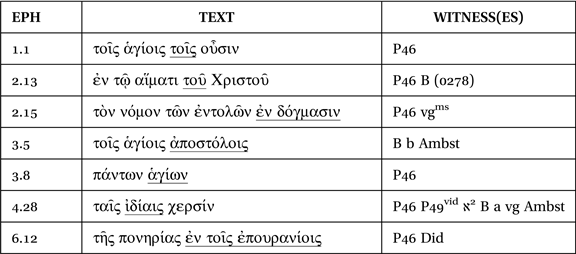
To see that P46 and B can share an accidental omission, we need go no further than this same chapter of Ephesians where, in v. 19, both manuscripts (along with b d Ambst) lack πνευματικαῖς due to parablepsis with ᾠδαῖς just before. Expanding to the rest of Ephesians, we note shorter readings in P46 and/or B that are rejected by the Nestle-Aland and that are easily explained as skips of the eye (Table 2); I have underlined the omitted word(s). The conclusion is unavoidable that P46 and B omit words in Ephesians.Footnote 76 In our verse, the omission was further encouraged by the graphical similarity between -σιν and -σαν in majuscule script. This particular combination of endings occurs five other times in the New Testament (John 5.22; Acts 19.38; 21.20–1; 1 Cor 8.12; 2 Cor 4.2). Checking the apparatus shows that P46 also omits ἀσθενοῦσαν immediately after συνείδησιν in 1 Cor 8.12 – the same mistake we find in Eph 5.22. Naturally, what explains the shorter reading in P46 in 1 Cor 8.12 can just as easily explain the same in P46 and B in Eph 5.22. The graphic confusion between -σιν and -σαν further explains why this omission is not found in many later manuscripts, since their text (ἀνδράσιν ὑποτάσσεσθε) does not allow for it.
Omissions in P46 and/or B in Ephesians

This evidence means that Eph 5.22 is a clear case where the shorter reading should not be preferred (lectio brevior non potior). The reason takes us to J. J. Griesbach's original formulation of the common (and now much debated)Footnote 77 preference for the shorter reading. He says that we should not prefer a shorter reading ‘if the occasion of the omission can be attributed to homoeoteleuton’.Footnote 78 The exception applies here, removing any compulsion to follow the shorter reading because it is shorter.Footnote 79
Finally, we should say something about the internal evidence for the third-person imperative. Despite its being rare, an attentive reading shows that the third person fits the pattern when ἴδιος is used.Footnote 80 Of the seven places in the Pauline corpus where ἴδιος occurs with an imperative verb, all employ the third person. Ephesians 4.28, for example, reads ὁ κλέπτων μηκέτι κλεπτέτω, μᾶλλον δὲ κοπιάτω ἐργαζόμενος ταῖς ἰδίαις χερσὶν τὸ ἀγαθόν.Footnote 81 The other instances are Rom 14.5; 1 Cor 7.2; 14.35; 1 Tim 3.12; 5.4; 6.1.Footnote 82 In terms of context, we might also note that Paul closes his instructions to husbands and wives in 5.33 with third-person commands to husbands (ἀγαπάτω) and wives (φοβῆται), thus forming a grammatical inclusio with ὑποτασσέσθωσαν. Even the shift between second- and third-person imperatives is present in Eph 5.6–7, so it is not entirely unexpected. Here, the shift probably serves to ease the transition from addressing the whole Christian gathering in 5.15–21 to the specific members of the Christian household in 5.22–6.9. In this way, the third-person imperative keeps the rest of the congregation in the periphery while shifting the focus to wives in particular.
In summary, ὑποτασσέσθωσαν is most likely the original reading. Externally, it is attested by important and early witnesses (e.g. א A I 048 33 1739) and by a good range of early versions and patristic sources (Latin, Coptic; Tertullian, Origen and perhaps Clement). Internally, it best explains the other readings. The shorter reading arose through the common error of homoioteleuton and ὑποτάσσεσθε developed by using a more common form that harmonised the text to its context. Most importantly, given the rarity of the third-person imperative form, ὑποτασσέσθωσαν is the more difficult reading (lectio difficilior) and thus the one least likely to be the creation of scribes. It is not, however, so difficult as to be impossible. Stylistically, it matches other third-person imperatives used with ἴδιος and fits the transition to specific household instructions. In short, ὑποτασσέσθωσαν is the reading that is best attested, the most difficult to explain if not original, and the one that best explains the others.
3.2 Implications
If ὑποτασσέσθωσαν belongs in the text of Eph 5.22, then the implications for the start of the household code are obvious. The participle in 5.21 should be read along with the four others that come before it as an explanation of what it means to be filled with the Holy Spirit. The mention of ὑπατάσσω as the final sign of the Spirit's presence leads naturally to a discussion of how such submission works in the concrete relationships among the Christian community. In this way, 5.22 is the start of the household code and 5.21 is not a heading, summary, rubric and, most of all, not a correction of what follows. Rather, 5.21 offers a final description of the Spirit-filled community that is unpacked in detail in the next section. In this, it should be read as more of a ‘curtain closer’ than a ‘curtain raiser’, to borrow Ralph Martin's metaphor.
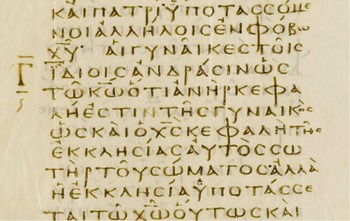
This reading has the added benefit of being consistent with what we find in the relevant paratextual features. The earliest Greek manuscripts that have paragraph breaks all start a new paragraph before 5.22. This is true in the fourth century (א B), the fifth (A I 048), the sixth (D) and beyond. Codex Sinaiticus (א) does also have a break before 5.21 (like the NIV) but it has one before 5.20 too (unlike the NIV). To be sure, since almost all Greek manuscripts have a verb in 5.22, a new paragraph there is not surprising. What is surprising is to find a break before 5.22 in B even without the verb.Footnote 83 Notably, the break in Codex Vaticanus is marked in three different stages of the manuscript's life (Fig. 1). The earliest break is the simple space and goes back to scribe B who copied the New Testament.Footnote 84 This type of delimitation ‘holds particular importance’ for scribe B, who rarely uses ekthesis outside his work in the prophets.Footnote 85 Later, a high stop and paragraphos were added for clarity, which was needed given the lack of ekthesis. Still later, in the seventh–ninth century, the numeral γ was added as the third and final such delimitation in Ephesians. At almost every stage of Vaticanus’ use, we see the break reinforced despite the lack of a verb.
The break before Eph 5.22 in Vaticanus marked at three different stages

In later manuscripts the kephalaion covers 5.22–6.9 and is titled διάταξις οἰκειακῶν καθηκόντων ἀρχομένοις καὶ ἄρχουσι κατὰ Χριστόν (‘the arrangement of proper household affairs for the governed and the governing in accordance with Christ’). In minuscules with both a lectionary system and kephalaia, the lection starts with 5.20 and the kephalaion is placed before 5.22 (see e.g. minuscule 1). The previous kephalaion covers 5.3–21.Footnote 86 This means that neither reading system started a new section with 5.21 as so many commentators and translations do today. It is a legitimate question why the break before 5.22 has been so obvious to past readers (even without the verb) but appears opaque to many today. Modern discomfort about the command in 5.22 may be a factor.
To be sure, we should be cautious about presuming that ancient textual delimitation mirrors our sense of paragraphing. In this vein, Best is right to note that ‘authors do not necessarily think in paragraphs when writing’.Footnote 87 At the same time, any well-conceived writing – ancient or otherwise – does have points of transition and development. What is clear from the manuscripts is that where ancient scribes and readers delimited the text of Ephesians 5, they usually did so before 5.22 rather than before 5.21. Given that the verb belongs in 5.22, it is all the clearer that 5.21 closes a section and 5.22 begins one.
4. Conclusion
This article has contrasted the wide disagreement on the start of the Ephesian household code with the widespread agreement on the text of Eph 5.22. Without an explicit verb, many have given 5.21 a controlling influence over the household code in general and 5.22–4 in particular. But a close study of the textual problem shows that ὑποτασσέσθωσαν – as the reading best attested, best able to explain the others and hardest to explain itself – is the original reading. The other imperative (ὑποτάσσεσθε) is an attempt to conform the text to the rest of the passage while the shorter reading, almost universally preferred by commentators today, is easily explained as an accidental omission.
The upshot of all this is not only a better textual solution but a resolution to the intractable debate about where the household code begins. With its verb restored, 5.22 is not syntactically dependent on 5.21 which can be neither the start of the household code nor its heading. Instead, 5.21 fits naturally as the final participle explaining the Spirit filling of 5.18. With the explicit repetition of ὑπατάσσω, 5.21 eases the transition to the household code, but it is not part of it. Any tension (or even outright conflict) between 5.21 and 5.22–4 is dissolved. The result is a smooth flow throughout the whole section of 4.1–6.20.Footnote 88