INTRODUCTION
Collections organized by the Israel National Institute of Oceanography during the years 2012–2015 (project by Bella Galil, from off Ashdod, Mediterranean coast) and sorted by members of the Section of Animal Biology, Department of STeBiCeF, University of Palermo, Italy, presented, among others, two new species of the amphipod genus Stenothoe. This genus is reviewed by Krapp-Schickel (Reference Krapp-Schickel2015) – 55 species are known to belong to this genus world-wide. Within the Mediterranean region, five species belong to the group of species that have telson lacking spines, while nine species are known having a spinose telson. Two new members of the latter group are described here.
MATERIAL AND METHODS
Material was collected by Bella Galil (Tel Aviv, Israel) and stored in the University of Palermo (Italy). In the course of surveys of the shallow soft bottoms along the Mediterranean coast of Israel, sediment samples were taken with a 32 × 35 cm Van-Veen grab (KAHLSICO, model WA265/SS214), volume 20 l, penetrating up to 20 cm into the substrate. They were then preserved in 70% alcohol and, within days of collection, sieved on a 250 mm mesh.
The amphipods were studied and dissected in temporary glycerine slides, preparations were made in Faure's fluid and studied under various light microscopes. Pencil drawings were scanned in and ‘inked’ by applying the software Adobe Illustrator CS3 and Wacom tablets A4 and A5. The examined specimens are deposited, together with archival organic DNA, in the Zoological Museum of the University of Palermo, Italy (MZPA).
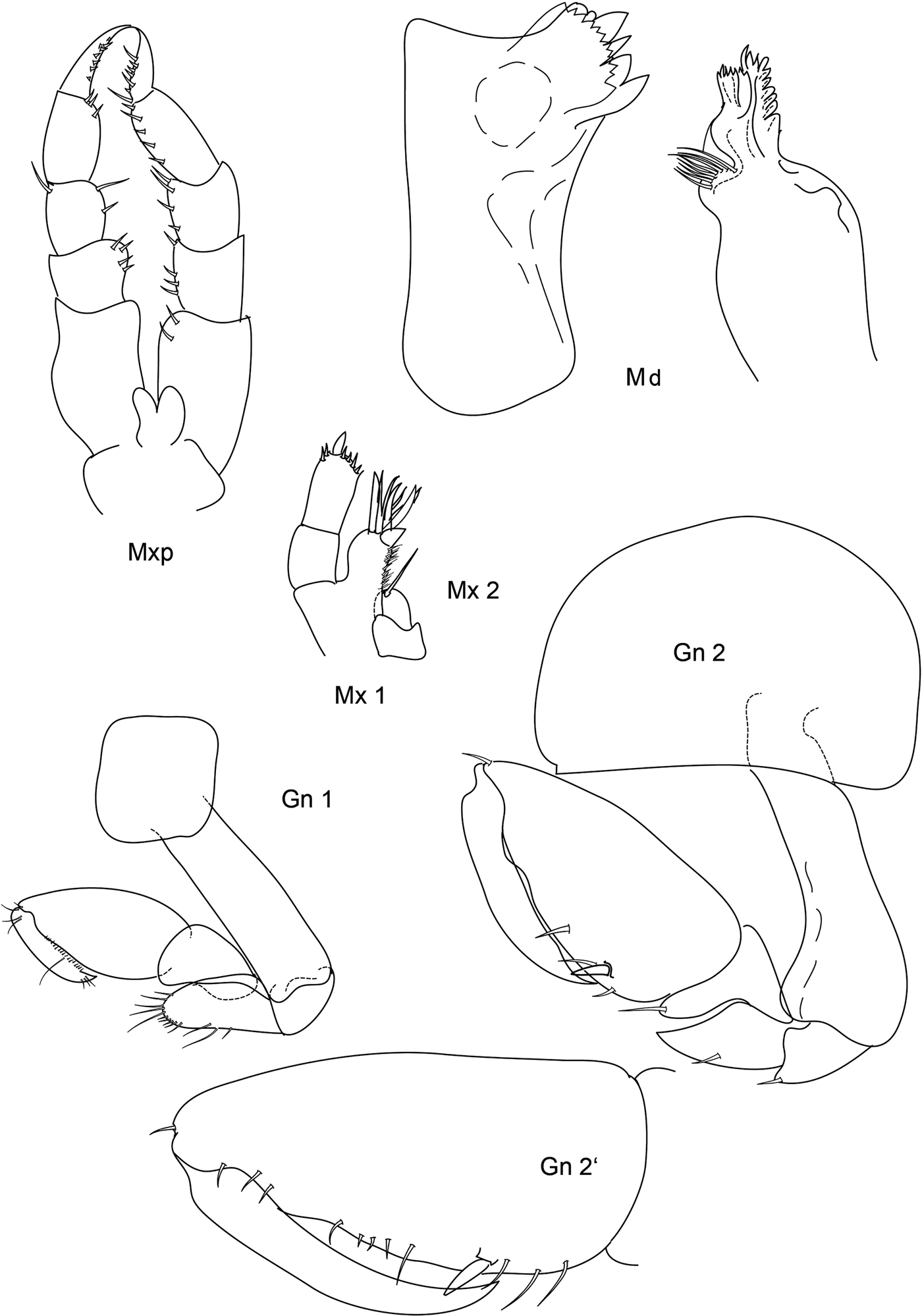
The following acronyms are used in the morphological descriptions: A1, 2 = antennae; art = articles, Cx = coxal plate; Ep = epimeral plate; flag = flagellum; Gn1, 2 = gnathopods; Md = mandible; Mx1, 2 = maxillae; Mxp = maxilliped; P3–7 = peraeopods; ped = peduncle; T = telson; U1–3 = uropods.
In this paper, the following morphological terms are applied in the same way as in most of the earlier publications by the first author (see also Krapp-Schickel, Reference Krapp-Schickel2011: 2): tooth = non-articulated pointed ectodermal projection; spine = stout (narrowly conical), articulated structure (synonymous to ‘robust seta’ of Watling, Reference Watling, Felgenhauer, Walting and Thiestle1989); seta = slender, flexible articulated hair-like structure.
SYSTEMATICS
Class MALACOSTRACA Latreille, Reference Latreille1802
Suborder GAMMARIDEA Latreille, Reference Latreille1802
Order AMPHIPODA Latreille, Reference Latreille1816
Family STENOTHOIDAE Boeck, Reference Boeck1871
Genus Stenothoe Dana, Reference Dana1852
Stenothoe bella sp. nov.
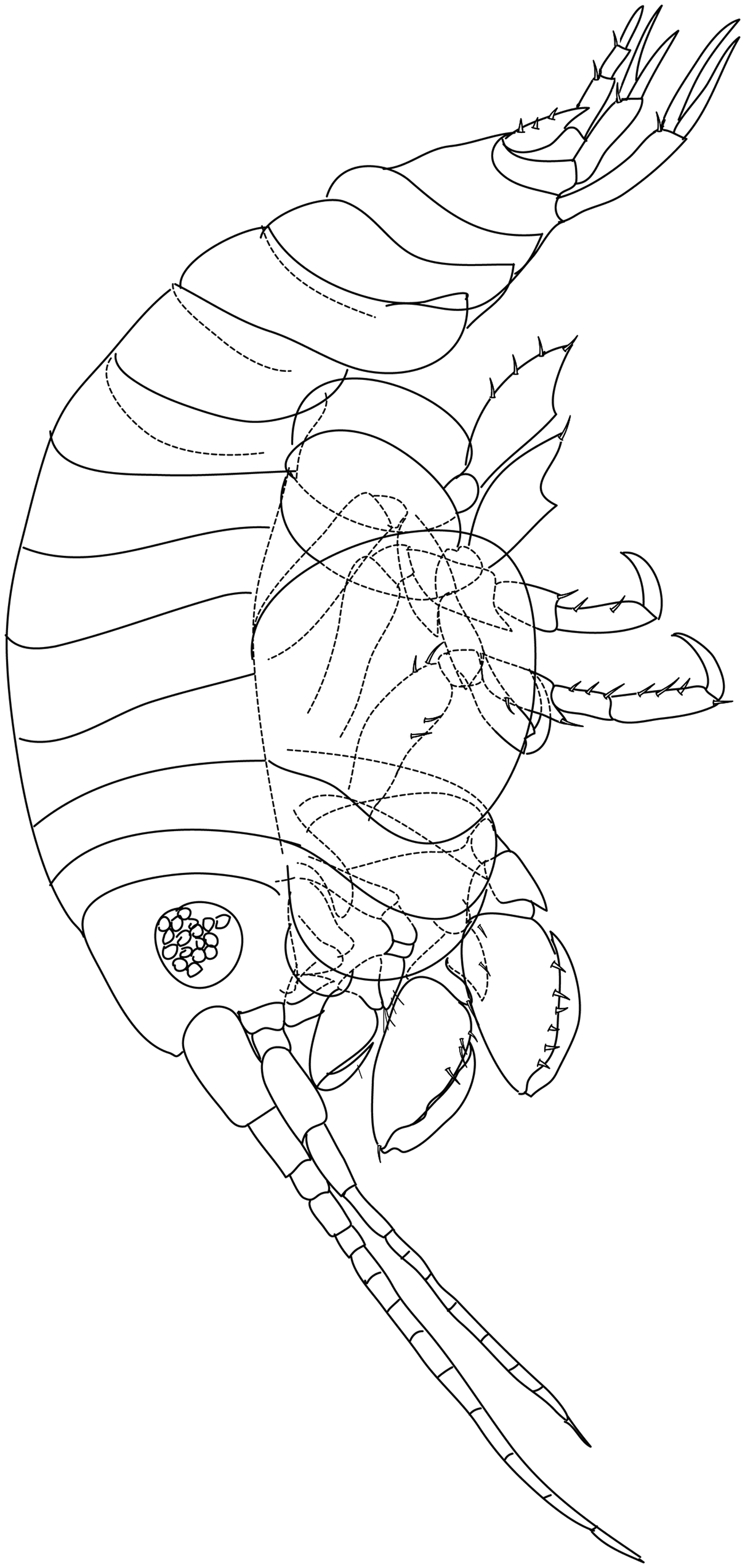
Figures 1–3
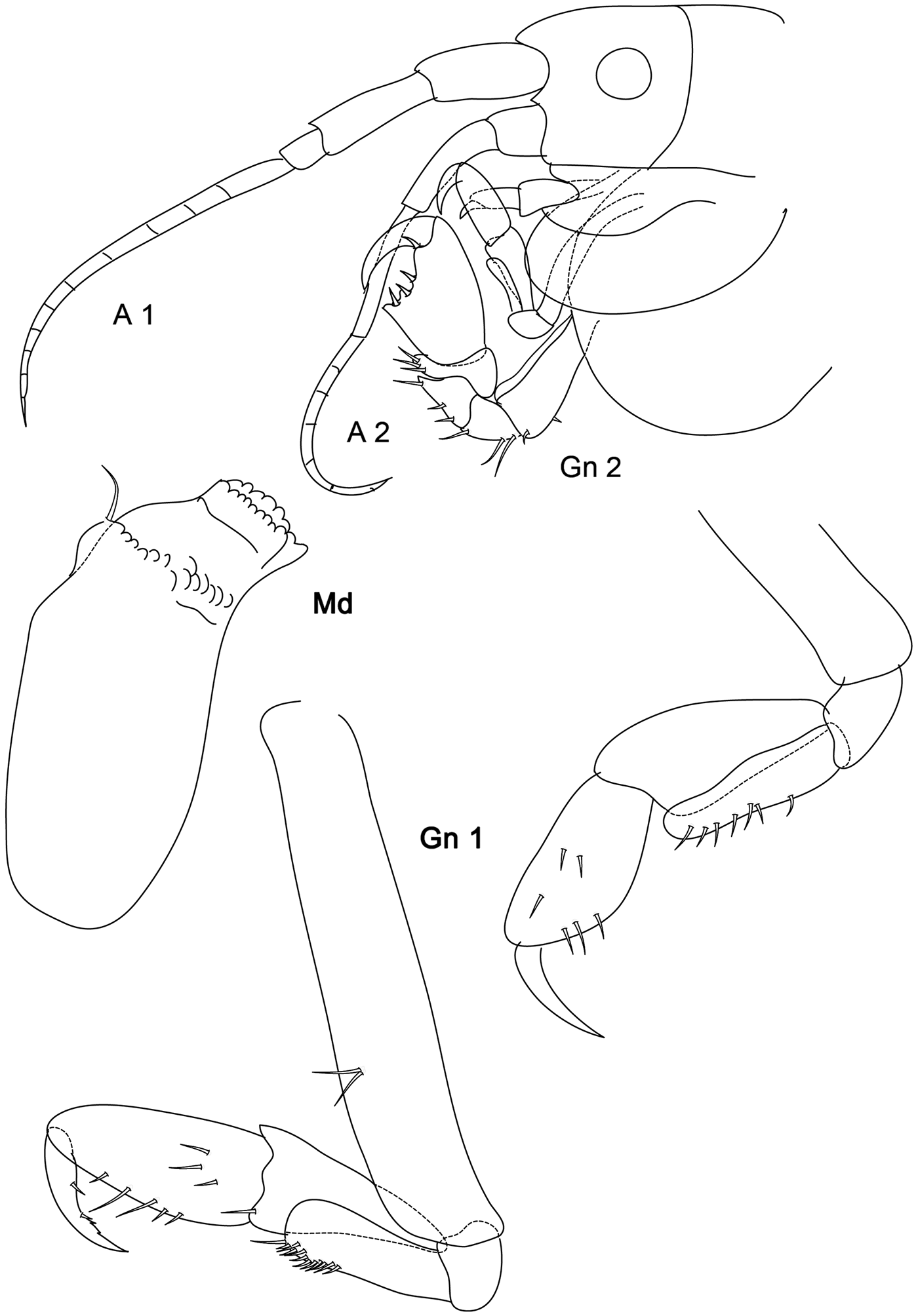
Stenothoe bella sp. nov.: head with antennae A1, A2 and gnathopods; Md = mandible; Gn1, Gn2 = gnathopods 1, 2.

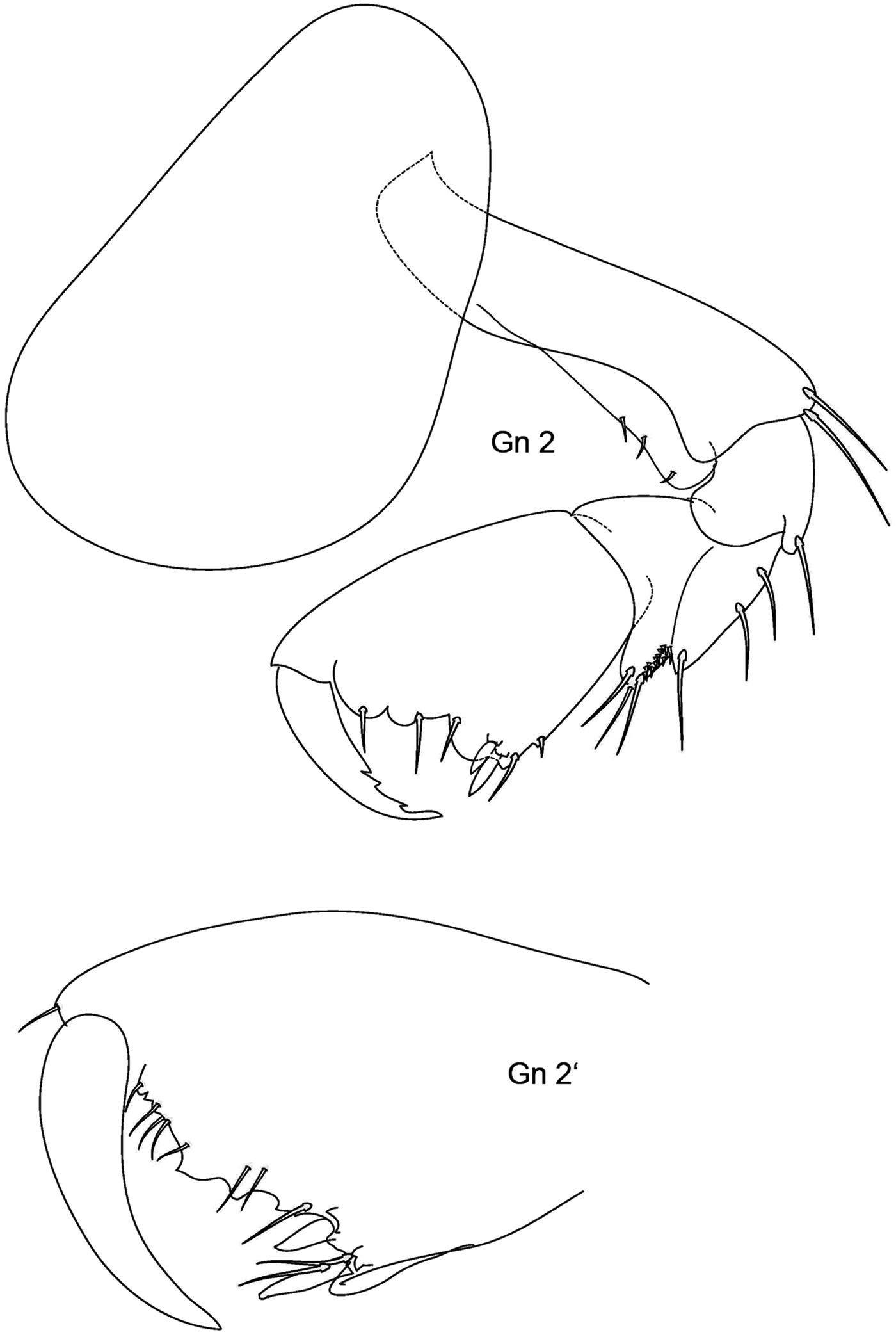
Stenothoe bella sp. nov.: Gn2 = gnathopod 2 in two different magnifications.

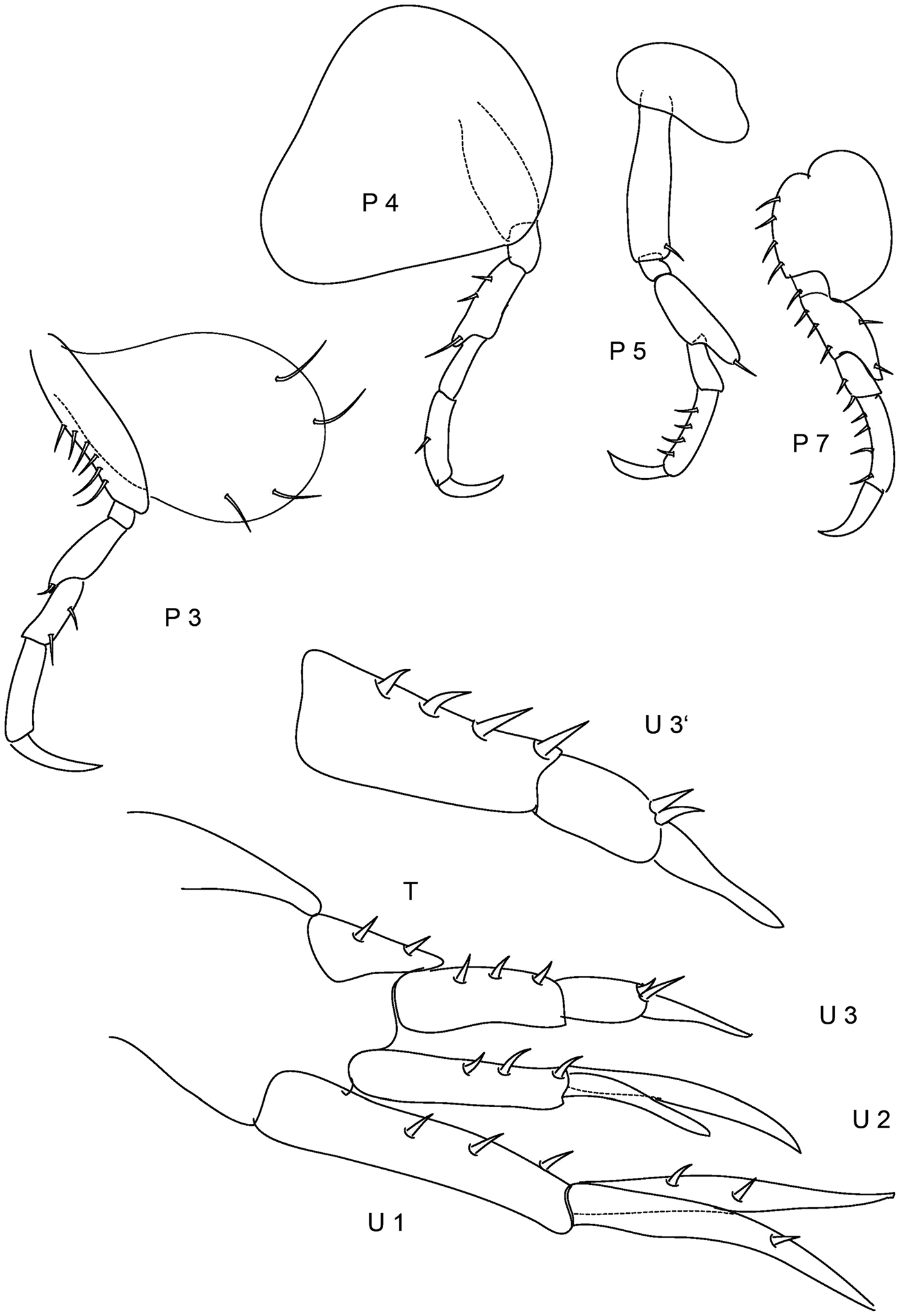
Stenothoe bella sp. nov.: P3–7 peraeopods; U1–3 = uropods; T = telson.
MATERIAL EXAMINED
Holotype: male, from sample VM 49 (A) Via Maris 31°51.1866′N 34°41.0671 ′E, 6 June 2015; 20.17 m depth; in alcohol. Holotype male and additional material in Faure coded as MZPA-AMPH-H_0006.
ADDITIONAL MATERIAL
One specimen from sample SB6 (C) Hani 31°49.0876′N 34°33.3381′E; May 2013; 37.34 m depth, in alcohol + glycerine.
One juvenile specimen from sample SB 18(A) 31°44.8272′N 34°33.0664′E; May 2014; 20.37 m depth, in alcohol + glycerine.
One juvenile from sample VM 44(A) Via Maris 31°56.1802′N 34°41.0255′E; 6 June 2013; 17.98 m depth; in alcohol + glycerine.
One specimen from sample 46 (C) Via Maris 31°56.1834′N 34°40.7737′E; 5 May 2014; 25.2 m depth; in alcohol + glycerine.
One specimen from sample 40 (A) Via Maris 31°51.1866′N 34°41.0671′E; 6 June 2012; 20.37 m depth; dissected in slide.
TYPE LOCALITY
Near Ashdod, Israel, Mediterranean.
ETYMOLOGY
Dedicated to Bella Galil.
DIAGNOSIS
Gn1 carpus and merus lengthened. Gn2 propodus palm concave and sculptured with incisions and spines, strong determining spine on palmar corner. P6, 7 basis rounded, posterodistal corner lengthened; merus distally lengthened but not much widened. U2 rami unequal. U3 peduncle subequal ramus. T spinose.
DESCRIPTION
Length: 0.7–1 mm.
Head: Eyes. Normally rounded. Mouthparts. Md palp absent. Antennae: A2 somewhat >A1.
Peraeon: Gn1 basis long and narrow, ratio l:b = 6; merus ratio l:b = 4–5, subequal in length to lengthened triangular carpus, propodus palm smooth, all articles poorly spinose.
Cx2 relatively narrow, ratio l:b = 13:8, distally regularly rounded. Gn2 basis much stronger than basis Gn1, distally widened; merus not reaching end of triangular carpus; propodus palm about as long as remaining hind margin, strongly sculptured with irregular excavations, palmar corner about 120°, beset with two strong spines.
Cx4 triangular, about as long as wide.
Peraeopods with long dactyli, ratio propodus: dactylus = 3:2 or 4:3; merus in all peraeopods overlapping carpus, but never reaching end of carpus. P6, 7 basis posteriorly regularly rounded, posterodistal corner lengthened.
Pleon: U1 peduncle and subequal rami of similar length. U2 length of peduncle between the one of the strongly unequal rami. U3 peduncle robust with 3 marginal spines, peduncle < ramus art1 + art2, ramus art2 straight and acute, longer than art 1.
Telson: Triangular, flappable, with two marginal spines.
Female: No sexual difference observed.
ECOLOGY
This species was found together with Bathyporeia sp., Perioculodes sp., Tanaissus microthymus Bird & Bamber, 2009 and Apseudopsis mediterraneus (Bacescu, 1961) on sandy-muddy bottoms. Depth range is between 12.4 m and 37.34 m.
DISTRIBUTION
Mediterranean coast of Israel.
REMARKS
This species is clearly a dweller of the interstitium; it bears a similarity to Stenothoe antennulariae Della Valle, Reference Della-Valle1893 as well as Stenothoe bosphorana Sowinsky, Reference Sowinsky1898 und Stenothoe cavimana Chevreux, Reference Chevreux1908. From the latter, it is distinguished by a spinose telson and a longer Gn1 carpus, from the former, especially, by the very different Gn2 propodus, but also by the much more robust U3.
MATERIAL EXAMINED
Holotype: one specimen 1.1 mm from sample 2B, Ala 32.90025°N 35.06735°E; 25 February 2011; 12.4 m depth. Slide in Faure together with additional material coded as MZPA-AMPH-N_0007.
ADDITIONAL MATERIAL
One specimen 0.7 mm from same sample as above, 32.90025°N 35.06735°E; 25 February 2011; 12.4 m depth. Slide in glycerine.
TYPE LOCALITY
Near Ashdod, Israel, Mediterranean.
ETYMOLOGY
Living in the far East of the Mediterranean, the epitheton should allude to ‘Levante’, allegoric for sunrise or East in general.
DIAGNOSIS
Gn1 carpus and merus short. Gn2 without sculpture, dactylus about as long as entire propodus. P6, 7 basis rounded, posterodistal corner lengthened; merus strongly widened and acutely lengthened. U2 rami unequal. U3 peduncle subequal ramus. T spinose.
DESCRIPTION
Length: 0.7–1.1 mm.
Head: Eyes round. Mouthparts: Md clearly asymmetrical. Mx2 plates sitting upon each other, very much reduced. Mxp: outer plate vanishing. Antennae: A1 > A2.
Peraeon: Gn1 basis long and narrow, merus and carpus carpus not much lengthened, propodus with smooth palm without palmar corner, dactylus reaching nearly end of propodus hind margin.
Cx2 broad, anterior margin semicircular, posterior margin slightly concave. Gn2 basis distally widened, merus distally acutely pointed, carpus triangular, propodus palm smooth, beset with some short setae and one stronger spine near end of dactylus.
Peraeopods: P3–P7 merus lengthened, in P6, 7 also widened. P6, 7 basis similarly rounded.
Pleon: U1 peduncle subequal to subequal rami, scarcely spinose. U2 rami clearly unequal, scarcely spinose. U3 peduncle subequal to rami, poorly spinose.
Telson: Flappable, triangular, with three marginal spines.
Female: Not known.
ECOLOGY
Similar to Stenothoe bella.
DISTRIBUTION
Mediterranean coast of Israel.
REMARKS
This species also seems to live between sand grains. While the body shape, the antennae, peraeopods and uropods are very similar to the species described above, it differs in its Gn1 and Gn2, which are similar to each other here, not sculptured and with carpus and merus short.
World-wide, this species is similar to Stenothoe cavimana Chevreux, Reference Chevreux1908, but differs in the unsculptured Gn2 and spinose telson. It certainly belongs to the group of Stenothoe elachista, Stenothoe pieropan and Stenothoe mandragora, all in Krapp-Schickel, Reference Krapp-Schickel1996 and all found among sand or mud, probably licking the surface of the grains; but it differs by the shape of its peraeopods and its spinose telson.
ACKNOWLEDGEMENTS
The authors are grateful to Dr Bella Galil, Senior Scientist at the Israel National Institute of Oceanography for Oceanographic and Limnological Research (IOLR), for making this material available for our study; and to Davide Iaciofano for technical assistance at the University of Palermo.