





Human appetite is often explained with reference to the ‘satiety cascade’, a useful temporal approximation in which hunger promotes meal initiation, satiation contributes to meal termination and satiety inhibits further eating between meals(Reference Blundell and Bellisle1,Reference Garutti, Sirico and Noto2) . These are functional processes within the temporal control of eating. Food reward must therefore interact with these processes rather than operating as a separate system. Physiological signals, sensory experience, emotion, cognition and the food environment are also integrated in determining whether eating begins, continues, ends or resumes. Within this integration, food reward refers to the hedonic impact and motivational value of a particular food for a particular person in a particular state(Reference Berthoud, Münzberg and Morrison3– Reference Ferrario, Labouèbe and Liu5).
Reward-related eating is frequently described using broad terms such as palatability, craving, hedonic hunger or, more recently, labels such as hyperpalatability, food noise and food addiction. These terms operate at different explanatory levels, and none identify, by themselves, which reward-related processes are involved. Understanding their relationship with eating therefore requires clearer distinctions between pleasure, motivation and learning.
The distinction between liking and wanting provides one such framework. Liking refers to the hedonic impact or pleasure associated with food, whereas wanting refers to its current motivational pull, often termed incentive salience. Learning connects liking and wanting to cues and anticipated consequences(Reference Berridge6–Reference Berridge and Robinson8). Liking and wanting usually covary, and in humans they cannot be isolated as pure processes. The distinction becomes particularly informative when their measures diverge across foods, states or individuals. A food may remain pleasant but have less immediate motivational pull after a meal. Conversely, a person may be drawn towards a food that holds limited expected sensory pleasure(Reference Finlayson, King and Blundell9,Reference Tibboel, De Houwer and Van Bockstaele10) .
This review examines what the distinction between liking and wanting contributes to human nutrition. It first considers how these components are operationalised in humans, focusing on the Leeds Food Preference Questionnaire (LFPQ). It then evaluates what LFPQ studies indicate about food selection and intake across nutritional states, sensory contexts and person-level characteristics. Finally, it considers how a component account can clarify contemporary labels for reward-related eating, food- and person-level variation and responses to intervention. This is a selective narrative review of human experimental and intervention evidence, including null and inconsistent findings.
Liking and wanting are related, not competing, processes
The liking/wanting distinction emerged from animal experiments in which positive facial and oral reactions to a taste could be separated from effort or approach directed towards obtaining it(Reference Grill and Norgren11). ‘Liking’ is inferred from these characteristic affective reactions to taste, whereas ‘wanting’ is inferred from incentive-driven behaviour. These two processes have partly dissociable neurobiological substrates. Opioid and related networks within restricted hedonic hotspots can amplify affective reactions, while broader mesocorticolimbic systems contribute to incentive salience(Reference Berridge7,Reference Berridge and Robinson8,Reference Morales and Berridge12) . Learning links both processes to cues and anticipated outcomes. This framework does not imply that dopamine is simply a ‘wanting chemical’, that wanting is necessarily unconscious or that neural activation elicited by a food or food cue is necessarily process-specific.
In humans, liking and wanting are inferred from measures rather than observed directly. Experienced liking can be assessed while a food is being tasted. By contrast, asking how pleasant a currently uneaten food would be to taste assesses anticipated pleasure based partly on memory and expectation. A rating of desire to eat measures consciously perceived wanting but can also incorporate hunger, expected pleasure, appropriateness and intention. Reaction-time and effort measures add behavioural information but are also influenced by familiarity, visual salience and task demands. Human liking and wanting are therefore operational constructs, assessed using self-report and behavioural measures that index hedonic evaluation or motivational attraction to food(Reference Finlayson, King and Blundell9,Reference Pool, Sennwald and Delplanque13,Reference Rogers and Hardman14) .
The Leeds food preference questionnaire as a measure of food reward
The LFPQ was developed to compare explicit liking, explicit wanting and implicit wanting within the same person and across an array of foods(Reference Finlayson, King and Blundell15–Reference Oustric, Thivel and Dalton17). In its widely used form, participants view standardised food images crossing categories such as sweet versus savoury and higher versus lower fat. Explicit liking is assessed by rating pleasantness (i.e. ‘how pleasant would it be to taste…’), an anticipated rather than consummatory judgement. Explicit wanting is also rated directly (i.e. ‘how much do you want some…’). In forced-choice trials, participants then rapidly select which of two foods from different categories they most want to eat at that moment; the direction and speed of those choices are combined into a relative implicit-wanting index(Reference Oustric, Thivel and Dalton17).
In meal, preload and intervention studies, the consumed food may not always be part of the pictured test array. The LFPQ therefore assesses how eating or another manipulation changes anticipated liking and wanting for the comparison foods in the task. Concurrent experienced liking of the consumed food and desire to continue eating it can be measured separately. The relative nature of the implicit-wanting index is important. A post-meal shift towards sweet foods does not necessarily mean that absolute wanting for every sweet item has increased. It may instead reflect a smaller decline in the motivational pull of sweet foods than of savoury alternatives. Interpretation therefore depends on the foods and comparisons included in the task. It is an inferred behavioural index of motivational preference, not a direct measure of unconscious desire, dopamine activity or incentive sensitisation.
The foods selected for the test therefore determine what the task can validly assess. Images must be recognisable, culturally appropriate and capable of representing the contrast under study. In studies comparing different times of day, the foods must also be similarly appropriate for consumption across the assessment periods; otherwise, apparent temporal differences may partly reflect culturally learned meal conventions rather than changes in liking or wanting(Reference Beaulieu, Oustric and Alkahtani18). A design crossing sweet versus savoury with higher versus lower fat content is well suited to questions about sensory-specific satiety and preferences for high-fat or high-fat sweet foods but does not automatically translate to protein appetite, texture, processing, cultural meal structure or specific clinical diets. Nutritional and cross-cultural adaptations are therefore sometimes necessary(Reference Oustric, Thivel and Dalton17) and a recent LFPQ scoping review shows that food stimuli and perceived categories can be localised and validated for recognition, familiarity and intended category membership before use(Reference Oustric, Chambon and Rousselet19).
No single method provides a definitive assay of food reward. In this review, the LFPQ operationalises hedonic evaluation and motivational attraction as explicit liking, explicit wanting and relative implicit wanting. Other self-report, effort-based, attentional, psychophysiological and neuroimaging measures sample related but non-identical processes. Multiple measures are most informative when each is selected in advance to test a defined hypothesis, rather than combined into an undifferentiated reward battery(Reference Tibboel, De Houwer and Van Bockstaele10,Reference Pool, Sennwald and Delplanque13,Reference Rogers and Hardman14) .
Liking and wanting during the eating episode
Placing these components of food reward within the temporal structure of eating clarifies their behavioural role. Before eating, hunger generally increases both anticipated liking and wanting for familiar, acceptable foods. Learning, cues and expectations then influence which food has the greatest motivational value and is selected. Reward therefore contributes to what is chosen and whether eating begins, but always in conjunction with physiological state and the available alternatives.
During eating, experienced liking can sustain consumption while the food remains pleasurable. Satiation develops through accumulating physiological inhibition together with declining reward for the food being consumed. Sensory-specific satiety describes the greater reduction in pleasure for the consumed food or sensory category than for foods not eaten. It can therefore alter what is chosen next, and variety can renew consumption even when hunger is low(Reference Finlayson, Bordes and Griffioen-Roose20–Reference Rolls, Rolls and Rowe22). A pleasurable meal need not be regarded as appetite-dysregulating. How much is eaten depends on how these excitatory and inhibitory influences change together, rather than on liking, wanting or fullness alone.
After eating, satiety reduces the likelihood that another eating episode will begin. Food cues, routines and the availability of uneaten sensory alternatives can nevertheless change the relative ordering of foods before physiological hunger has fully returned. Persistent or reinstated wanting may therefore contribute to snacking or resumption of eating during post-meal satiety. This does not imply a global failure of satiety. Rather, satiety may be considered conditionally fragile when its inhibitory influence coexists with persistent motivation for particular foods or cues. A useful prediction is that foods or person-level characteristics associated with overeating should show reproducible trajectories in liking, explicit wanting or relative implicit wanting across hunger, satiation and satiety that predict later choice or intake.
The LFPQ is experimentally useful because the same food array can be assessed before and after a meal, manipulation or intervention. This permits comparison of changes in anticipated liking, explicit wanting and relative implicit wanting under standardised conditions. The resulting scores remain specific to the represented foods; explicit liking and wanting ratings apply to each pictured food, whereas relative implicit wanting depends on its alternatives. Associations with later food selection and intake support the behavioural relevance of the task, but a change in an LFPQ outcome does not by itself demonstrate mediation or establish that the task has measured experienced liking of the food consumed. Comparison studies show only partial convergence between LFPQ outcomes and other behavioural reward measures, including attentional and willingness-to-work tasks. However, LFPQ outcomes were more consistently associated with observed intake than were these alternative measures(Reference Tibboel, De Houwer and Van Bockstaele10,Reference Arumäe, Kreegipuu and Vainik23–Reference Havermans25) .
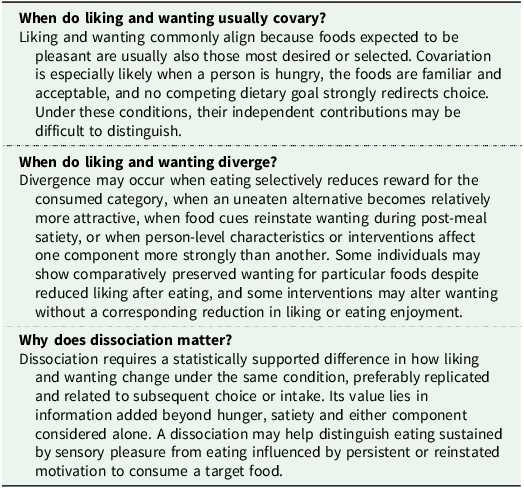
In ordinary eating, liking and wanting generally decline together as satiation develops. A component analysis becomes especially informative when one component changes less, changes later or is reinstated under a defined condition. Once reward is treated as multicomponent, eating beyond satiety or dietary goals can be understood through different patterns(Reference Berthoud, Lenard and Shin26). Persistent pleasure may help sustain consumption; comparatively preserved wanting may favour an alternative food after a meal; and cue-triggered wanting may contribute to later eating without a comparable increase in hunger or liking. These patterns make different predictions about choice and intake and can therefore be tested rather than inferred from a broad reward score(Reference Finlayson, King and Blundell9,Reference Rogers and Hardman14) . Table 1 summarises how covariation and divergence between liking and wanting should be interpreted.
Interpreting covariation and divergence between liking and wanting

Table 1. Long description
A textbox containing three questions and their answers. The first question, ‘When do liking and wanting usually covary?’, explains that liking and wanting usually align when foods are pleasant, desired, and selected, especially when a person is hungry and no competing dietary goals redirect choice. The second question, ‘When do liking and wanting diverge?’, describes situations where eating selectively reduces reward, an uneaten alternative becomes more attractive, or food cues reinstate wanting. The third question, ‘Why does dissociation matter?’, states that dissociation requires a statistically supported difference in how liking and wanting change under the same condition, which can help distinguish eating sustained by sensory pleasure from persistent or reinstated motivation to consume a target food.
Covariation and conditional dissociation across states, sensory contexts and phenotypes
The default expectation is that liking and wanting will covary, particularly for familiar foods under ordinary eating conditions. Evidence of dissociation requires more than one statistically significant outcome and one non-significant outcome. It requires a supported difference in the way the component measures change across a state, food comparison or person-level characteristic. Because explicit ratings and a relative forced-choice index do not ask identical questions, interpretation must remain bounded by the foods and comparisons tested. Evidence is strongest when the pattern is reproducible and predicts observed food choice or intake(Reference Tibboel, De Houwer and Van Bockstaele10,Reference Pool, Sennwald and Delplanque13,Reference Arumäe, Kreegipuu and Vainik23) .
Nutritional state and the selective effects of eating
Hunger generally increases liking and wanting for familiar, acceptable foods, but eating does not necessarily alter every component or food category to the same degree. In one of the first LFPQ studies, seventy young adults completed the task before and immediately after a savoury test meal(Reference Finlayson, King and Blundell15). Explicit liking and explicit wanting declined across food categories, with larger reductions for savoury than sweet foods. By contrast, the relative implicit wanting index increased for sweet categories and did not increase for savoury categories(Reference Finlayson, King and Blundell15). The important result was not an absolute increase in desire for all sweet foods but a selective reordering of the available alternatives as hunger and explicit evaluations declined. An uneaten sensory category could therefore become relatively more attractive despite declining hunger and pleasure. This pattern is compatible with sensory-specific satiety, in which pleasantness declines more for a consumed food than for uneaten alternatives(Reference Rogers, Ferriday and Irani21,Reference Rolls, Rolls and Rowe22,Reference Griffioen-Roose, Finlayson and Mars27) . Subsequent work has not always reproduced a complete separation between changes in liking and wanting, and sensory-specific satiety may involve reductions in both components(Reference Pool, Sennwald and Delplanque13,Reference Finlayson, King and Blundell15) . The evidence therefore supports conditional rather than universal dissociation. Eating usually reduces liking and wanting together, while particular comparisons can reveal that one category or component may increase or decline less than another. The finding also accords with the well-established observation that variety can renew intake.
Sensory and nutrient context shape liking, wanting and selection
Controlled preload studies provide a useful experimental example of sensory and nutrient effects on food reward. In a crossover study of thirty women who consumed savoury, sweet and bland isoenergetic preloads, total satiation or subsequent energy intake did not differ(Reference Finlayson, Bordes and Griffioen-Roose20). The savoury preload nevertheless reduced liking and intake of high-fat savoury foods, and trait disinhibition moderated the effect of preload taste on later intake. Independent of taste condition, higher disinhibition was associated with weaker satiating efficiency and stronger implicit wanting for high-fat sweet foods(Reference Finlayson, Bordes and Griffioen-Roose20). Sensory exposure and individual susceptibility therefore influenced different outcomes even when total intake did not differ by preload taste.
A 24-hour controlled total energy intake study produced a similar distinction between direction of preferences and amount consumed(Reference Griffioen-Roose, Hogenkamp and Mars28). Thirty-nine healthy adults consumed predominantly sweet, savoury or mixed diets over the course of a full day, matched on energy and macronutrient composition. At a test-meal buffet the next day, the savoury diet shifted selection towards sweet foods, but the reverse tendency after the sweet diet was weaker, and total buffet energy intake did not differ between conditions(Reference Griffioen-Roose, Hogenkamp and Mars28). Longer-duration protein-balance experiments likewise showed compensatory changes in preference and intake following a 2-week low-protein diet exposure, including enhanced preference for savoury or higher-protein foods(Reference Griffioen-Roose, Mars and Siebelink29,Reference Griffioen-Roose, Smeets and van den Heuvel30) . Together, these studies show that sensory and nutrient exposure can alter the relative value and selection of foods without changing total energy intake. A meal may suppress hunger and reduce reward for the consumed category while preserving responsiveness to foods with different sensory or nutrient properties. State-sensitive liking and wanting measures may therefore be more informative about what is selected than how much is consumed. Claims that altered food reward promotes overconsumption require direct evidence from intake.
Diurnal variation in liking and wanting
Liking and wanting may also vary across the day(Reference Byrne and Murray31). Appetite and appetite-related hormones show diurnal and circadian variation, and the satiating capacity of food may decline as the day progresses(Reference Scheer, Morris and Shea32). Consequently, the same food may carry different motivational value depending on when it is encountered. In a counterbalanced study of forty-four young adults using an LFPQ food set validated as appropriate for consumption in both morning and later-day settings, liking and implicit wanting for high-fat relative to low-fat foods were greater in the late afternoon or early evening than in the morning(Reference Beaulieu, Oustric and Alkahtani18). Appetite was also greater and the standardised meal was perceived as less filling later in the day. These findings suggest that time of assessment may influence both hedonic evaluation and relative motivational preference, partly alongside greater appetite and weaker perceived satiation later in the day(Reference Beaulieu, Oustric and Alkahtani18).
Person-level variation in liking and wanting
Psychometric assessment of trait binge eating offered an early test of whether post-meal reward patterns differ between people. In women without obesity (BMI <30 kg/m2), higher scores on the Binge Eating Scale were associated with weaker hunger suppression, greater test-meal intake and enhanced implicit wanting for high-fat sweet foods(Reference Finlayson, Arlotti and Dalton33). In a matched study of twenty-four women with obesity, those with higher binge-eating scores consumed more than their estimated energy requirements in the laboratory, consumed more energy from sweet snacks across laboratory and free-living assessments and showed greater implicit wanting for high-fat sweet foods(Reference Dalton, Blundell and Finlayson34). Related work reported a post-meal pattern in which liking declined, but implicit wanting for high-fat sweet foods remained comparatively elevated in the binge-type group(Reference Dalton, Blundell and Finlayson35,Reference Dalton and Finlayson36) .
Chronotype provides a different type of person-level characteristic through which food reward may vary. It reflects individual differences in preferred timing of sleep, eating and other daily activities, and later chronotype has been associated with later and less regular eating, poorer diet quality, greater disinhibition, frequent food craving and binge-eating tendencies and higher BMI in some studies(Reference Beaulieu, Finlayson and Quist37). These associations make chronotype relevant to appetite control because it may alter when food is encountered and the degree to which rewarding foods influence food choice. In the meal-timing study described above(Reference Beaulieu, Oustric and Alkahtani18), chronotype did not significantly interact with time of day. However, when treated continuously, later chronotype was associated with greater implicit wanting for high-fat relative to low-fat foods, but not with liking. High-fat wanting was also associated with higher habitual energy intake. This selective association suggests that later chronotype may be linked more strongly to implicit wanting towards high-fat foods than to their expected pleasantness. Meal timing and chronotype therefore appeared to make additive rather than interactive contributions to food reward(Reference Beaulieu, Oustric and Alkahtani18).
These studies are informative demonstrations but should not be generalised to all people with obesity or interpreted as evidence of globally excessive food reward. The binge-eating findings support the narrower hypothesis that loss of control or excess intake may in some individuals be accompanied by comparatively preserved post-meal wanting for particular foods, especially high-fat sweet foods. The chronotype findings suggest that stable temporal preferences may also be associated more strongly with relative wanting than with anticipated liking. Together, the studies identify candidate patterns of person-level variation, not established or diagnostically distinct phenotypes.
Dissociation is not the same as prediction
A component measure can be sensitive to a meal or intervention without improving prediction of eating behaviour. Evidence that liking and wanting provide added predictive value over simpler measures is mixed. Some experimental studies have reported associations between wanting and immediate food choice or intake. For example, enhanced wanting for high-fat sweet foods has accompanied greater selection or consumption of these foods in studies of trait binge eating(Reference Finlayson, Arlotti and Dalton33,Reference Dalton, Blundell and Finlayson34,Reference Dalton and Finlayson36) , while compensatory eating following acute exercise has been associated with increased implicit wanting(Reference Finlayson, Bryant and Blundell68). Other studies report weak convergence across reward tasks, limited sensitivity of reaction-time indices to hunger or no improvement in intake prediction when reward and biometric measures were combined in one machine-learning study(Reference Oustric, Chambon and Rousselet19,Reference Arumäe, Kreegipuu and Vainik23,Reference Pedersen, Diaz and Clemmensen38) . Repeated self-reports have also shown that liking and wanting for foods consumed that day can load on a common factor, whereas wanting for uneaten foods is more distinct(Reference Hildebrandt, Mikhail and Gearhardt39). In adolescents, pooled trial data found no simple association between high-fat liking or wanting and later change in weight or fat mass, although relative implicit wanting for sweet foods predicted some body-composition outcomes(Reference Moore, Siroux and Miguet40).
Group means can also conceal different within-person trajectories. In a secondary analysis of the DIVA study(Reference Beaulieu, Casanova and Oustric41), diet-induced weight loss reduced liking across food categories without a corresponding group-level reduction in relative implicit wanting. Exploratory analyses identified several patterns of change, including decreases in both liking and wanting, increases in liking and opposing changes for sweet and savoury foods(Reference Oustric42). Cross-sectional analyses also suggested that higher liking and wanting for high-fat-sweet foods were associated with indicators of weaker appetite control, including binge eating, disinhibition and lower craving control. These findings illustrate possible response heterogeneity but do not establish stable phenotypes. Repeatability within individuals (see e.g.(Reference O’Connor, Casanova and Oustric75)) and prospective association with eating behaviour or weight treatment outcome would be required before such patterns could guide intervention.
Overall, multicomponent measures provide a more differentiated account of food reward by showing when liking and wanting covary and when they change differently from each other or from hunger. Divergence has been observed after eating, when reward for the consumed category declines but relative wanting for an uneaten alternative is preserved and may also occur during post-meal satiety, when food cues reinstate wanting without a parallel return of hunger or liking. Selective patterns have also been reported in particular individuals and following interventions. These findings indicate that the motivational ordering of foods can be preserved or reordered despite declining hunger and pleasure, helping to explain what is selected and when eating may continue or resume. Future studies should establish whether and under what conditions these patterns improve prediction of choice or intake beyond simpler measures.
From broad labels to testable mechanisms
Several contemporary terms for reward-related eating operate at different explanatory levels. ‘Hyperpalatability’ concerns properties attributed to foods, ‘food noise’ describes a subjective cognitive–affective experience and ‘food addiction’ proposes a clinical or diagnostic account. Perceived ‘hedonic overeating’, considered separately below, is a self-reported judgement that a food is prone to be overeaten because of its pleasure or desirability. None is equivalent to explicit liking, explicit wanting or relative implicit wanting. Their explanatory value depends on whether they generate specific predictions about these components and subsequent food choice or intake.
Hyperpalatability
Hyperpalatability denotes the hypothesis that some foods provide unusually strong sensory-reward stimulation and are especially easy to overconsume. In empirical work, however, ‘hyperpalatable foods’ are commonly operationalised using nutrient combinations such as fat with sodium, fat with simple sugars or carbohydrate with sodium(Reference Fazzino, Rohde and Sullivan43). These rules permit foods and food supplies to be classified consistently, but classification by composition does not by itself demonstrate the proposed behavioural mechanism. Experienced palatability remains dependent on the interaction between the food, person and current state.
Greater intake of a food or diet classified as hyperpalatable according to these nutrient-combination criteria could reflect greater experienced liking, stronger cue-triggered wanting, a slower post-consumption decline in reward or properties such as energy density, texture and eating rate. These possibilities should not be conflated. A food may be highly liked without producing persistent wanting, while texture or eating rate may increase intake without increasing reported liking or wanting.
An analysis of 2,733 meals from four controlled dietary patterns found that energy density, eating rate and whether foods met the nutrient-combination criteria used to classify hyperpalatable foods were each positively associated with ad libitum meal energy intake(Reference Fazzino, Courville and Guo44). This supports the behavioural relevance of the classification but does not establish that the defining nutrient combinations increased intake through liking or wanting, because energy density and eating rate made independent contributions.
Food-level studies similarly show that nutrient-cluster and processing classifications explain less variation in liking once sensory and perceived nutrient attributes are considered(Reference Finlayson, Allen and Baaij45–Reference Rogers, Vural and Flynn47). Nutrient-defined hyperpalatability should therefore be treated as a compositional proxy for a mechanistic hypothesis, not as direct evidence of experienced liking, wanting or amplified sensory stimulation. Its explanatory value depends on showing how classified foods alter component measures or intake.
Food noise
Food noise describes persistent food-related thoughts that are experienced as intrusive, difficult to disengage from or distressing(Reference Dhurandhar, Maki and Dhurandhar49). The term may have clinical and descriptive value because it captures a patient-reported experience in which thoughts about food occupy disproportionate attention. Hunger, craving and anticipatory or consummatory pleasure are not inherently pathological, however, and ordinary food-related thoughts form part of normal appetite regulation(Reference Finlayson and Gibbons48).
Food noise is conceptually closer to explicit wanting than to relative implicit wanting because both food noise and explicit wanting are consciously reportable. Nevertheless, intrusive food thoughts are not equivalent to desire to eat. They may arise from energetic deprivation, cue-triggered wanting, dietary restraint, worry or rumination. Conversely, relative implicit wanting may influence choice without being experienced as intrusive or distressing. Existing evidence does not yet establish how food noise covaries with explicit or relative implicit wanting. Recent conceptual and psychometric work has begun to operationalise food noise(Reference Dhurandhar, Maki and Dhurandhar49–Reference Hayashi, Edwards and Emond52), although its boundaries remain contested(Reference Brewis, Hayashi and Gualano53). Food noise may also overlap with the established concept of ‘food preoccupation’(Reference Tapper and Pothos54). Persistence, unwantedness and disruption are relevant because they distinguish food noise from ordinary thoughts about an appealing food.
Reports that incretin-based therapies reduce food noise are clinically important but mechanistically ambiguous. Reduced food-related thought could arise through lower hunger, greater fullness, reduced craving, improved perceived control over eating or a more selective reduction in cue-triggered wanting(Reference Blundell, Finlayson and Axelsen55,Reference Wharton, Batterham and Bhatta56) . These constructs need to be measured separately and related prospectively to food noise, choice and intake. Reduced food noise accompanied by lower wanting but preserved liking would indicate diminished motivational intrusion without loss of eating pleasure. A change accounted for by hunger or fullness would indicate a different pathway. Food noise is therefore best treated as a patient-reported experience whose relationships with hunger, liking and wanting remain to be established.
Food addiction
Food addiction makes a stronger claim that some eating patterns constitute an addictive disorder involving foods, food components or eating itself. Proponents draw on symptom-based assessments, behavioural parallels with substance-use disorders, responses to food cues and reward-related neural systems and animal evidence and argue that highly processed nutrient combinations may function analogously to refined addictive substances(Reference Gearhardt, Bueno and DiFeliceantonio57,Reference LaFata, Allison and Audrain-McGovern58) . Within a liking/wanting account, this hypothesis predicts that learning gives food cues a motivational pull that becomes disproportionate to liking, persists or is reinstated during post-meal satiety and continues to influence consumption despite impairment or adverse consequences.
The framework has potential value if it reduces moral blame and generates predictions of this kind. However, it also carries diagnostic and social implications that require a higher evidential threshold than either a food classification or a descriptive symptom label. As we and others have argued, the construct risks medicalising reward-driven eating if substance-use criteria are applied to common eating difficulties before a food, formulation or eating process with demonstrably addiction-specific effects, a distinct clinical syndrome and clear diagnostic boundaries have been established(Reference Gearhardt, Bueno and DiFeliceantonio57–Reference Hebebrand, Albayrak and Adan60). Current evidence does not resolve these requirements. Diagnostic overlap with binge eating, emotional eating, dietary restraint and loss of control remains substantial, and there is no consensus that a specific food or food constituent functions as an addictive agent in humans(Reference Gearhardt, Bueno and DiFeliceantonio57–Reference Hebebrand, Albayrak and Adan60). Activation of reward-related neural or behavioural systems by food does not establish addiction because liking, wanting and learning are normal components of appetitive motivation. Similarly, even if foods are formulated to maximise appeal or consumption, high liking, strong wanting or high intake alone does not demonstrate an addictive process.
A more productive use of the liking/wanting framework is to test the proposed mechanism before accepting the diagnostic inference. The predicted dissociation should be demonstrated rather than inferred from intake or reward-system activation. Evidence is needed that cue-triggered wanting is unusually specific, persists or is reinstated during satiety, becomes disproportionate to liking, contributes to functional impairment and adds clinically useful information beyond established assessments. We have argued elsewhere that, without this added specificity, ‘food addiction’ explains little beyond existing accounts of the impact of food hedonics on eating(Reference Blundell and Finlayson61).
In summary, these three terms are descriptive or classificatory constructs operating at different explanatory levels rather than components of food reward themselves. ‘Hyperpalatability’ directs attention towards food composition; ‘food noise’ towards food preoccupation; and ‘food addiction’ towards a diagnostic addictive disorder. Their value in this review lies in generating specific, testable predictions about liking, wanting and subsequent eating behaviour.
Towards integration of food, state and person-level influences on food reward
Most LFPQ studies examine how explicit liking, explicit wanting and relative implicit wanting for predefined food categories change within a person following a meal, manipulation or intervention. A complementary food-level question, addressed using survey methods rather than the LFPQ, is which food characteristics shape reward-related evaluations across people. Perceived hedonic overeating is a single-item, self-reported judgement of the extent to which a food is associated with eating too much because of its pleasure or desirability(Reference Finlayson, Allen and Baaij45). The same item was previously labelled ‘desire to (over) eat’(Reference Buckland, Dalton and Stubbs76) and, when reverse-scored, ‘controllability’(Reference Buckland, Stubbs and Finlayson62). It does not measure actual intake and is not a composite of liking and wanting. In an earlier study developing a ‘satiety map’ (SatMap) of common foods, we showed that perceived satiety reflected both objective nutritional characteristics and perceived food attributes(Reference Buckland, Stubbs and Finlayson62).
In three online surveys, 3,364 UK adults rated subsets drawn from 436 ready-to-eat foods and beverages(Reference Finlayson, Allen and Baaij45). The outcomes were liking of pictured foods and perceived hedonic overeating. Explicit wanting and relative implicit wanting were not measured. The outcomes were strongly associated but not interchangeable. Some fruits, vegetables and lean meats were highly liked without being rated correspondingly high in perceived hedonic overeating. High liking alone was therefore insufficient for a food to be perceived as particularly prone to hedonic overeating.
Nutritional composition explained approximately 20% of the variance in liking and 40–60% of variance in hedonic overeating. Perceived sensory and nutrient attributes explained additional variance beyond actual nutrient composition, whereas carbohydrate-to-fat ratio added no further explanatory value(Reference Finlayson, Allen and Baaij45). These findings argue against reducing food-level reward judgements to a single nutrient ratio.
These studies demonstrated cross-sectional, self-reported, food-level associations but could not determine how consuming specific foods alters postprandial liking, wanting, satiety or subsequent intake. A registered SatMap preload study was designed to test these post-ingestive effects across individual foods, although its findings are not yet published(63). The survey evidence should therefore be viewed as identifying food-level contrasts for experimental testing rather than establishing behavioural effects.
At the person level, broader motivational profiles may help explain why state-sensitive liking and wanting differ between individuals. The seven-factor Motivations for Eating Profile (MEP-7) is a comprehensive, theory-driven questionnaire developed from a recently validated framework of eating behaviour traits that assesses reactive eating, restrictive eating, negative and positive emotional eating, homeostatic eating, eating for pleasure and eating for health(Reference Dakin, Finlayson and Stubbs64,Reference Dakin, Finlayson and Stubbs65) . As a trait-based instrument, it characterises the broader motivational context in which LFPQ responses occur. It could therefore be used to test whether person-level motivations for eating modify the relationship between post-meal wanting and subsequent food choice. The Control of Eating Questionnaire (CoEQ) provides a complementary 7-day retrospective assessment of food craving and perceived control over eating(Reference Dalton, Finlayson and Hill66). It characterises recent subjective appetite experience rather than the momentary response measured by the LFPQ, allowing relationships between these different timescales to be examined(Reference Dalton, Finlayson and Hill66).
Fig. 1 organises four candidate sources of variation in liking and wanting: food characteristics and perceived attributes; current physiological and psychological state; person-level motivations; and environmental or treatment context. The LFPQ provides state-sensitive, within-person measures of liking and wanting for a defined set of foods. SatMap characterises between-food differences in perceived attributes and food-level evaluations across people; the CoEQ assesses recent experiences of craving and perceived control over eating; and the MEP-7 characterises broader motivations for eating. These measures address different units of analysis and timescales and are complementary rather than interchangeable. Fig. 1 therefore presents a hypothesis-generating account; it does not imply that the measures converge on a single construct or that the proposed cross-level relationships have been established. Instead, it supports pre-specified tests of whether food-, state-, person- and context-level influences, considered separately or in combination, add explanatory or predictive value for food choice and intake beyond simpler measures.
Candidate influences on liking and wanting across foods, people and states. The figure organises candidate influences on state-sensitive liking and wanting across food characteristics and perceived attributes, current physiological and psychological state, person-level motivations and environmental or treatment context. The accompanying measures address different units of analysis and timescales and are not assumed to converge on a single construct. The arrows indicate proposed relationships rather than established causal pathways. The figure highlights three testable questions: whether post-meal relative implicit wanting for uneaten alternatives predicts later choice or intake after accounting for hunger, explicit liking and wanting, familiarity and baseline preference; whether cue exposure during post-meal satiety reinstates relative implicit wanting and choice without parallel increases in liking or hunger; and whether pre-specified interactions between food characteristics, person-level motivations and current state improve prediction of later choice or intake beyond their separate contributions. Of particular interest is relative implicit wanting that is preserved or reinstated after hunger and liking for the consumed food have declined.

On balance, existing LFPQ evidence is strongest for identifying (pre- and post-ingestive) state- and food-category-dependent differences in which foods are selected. Evidence that LFPQ measures explain how much energy is consumed is less consistent and direct evidence that they predict whether and when eating resumes while participants remain in a post-meal satiated state is limited. Some studies show that pre-meal wanting is associated with immediate food selection or intake, but there is less evidence that post-meal relative implicit wanting predicts later eating after accounting for hunger, explicit liking and wanting, familiarity and baseline preference. Moderation by broader motivational profiles and cue-induced reinstatement of wanting during a post-meal satiated state also remain hypotheses for prospective testing. Support for these hypotheses will depend on replication, within-person repeatability, robustness to the comparator foods and demonstrable associations with observed behaviour.
This approach does not infer a reward mechanism directly from body weight, diagnosis or questionnaire score. A candidate phenotype would instead require a reproducible within-person pattern of liking and wanting under specified conditions that predicts behaviour or intervention response beyond the grouping characteristic and simpler predictors. A single dissociation observed on one occasion is insufficient to establish a stable phenotype.
Implications for translation and intervention
The translational value of liking and wanting measures depends on whether intervention-related changes relate to subsequent behaviour or clinical outcome. A 2018 systematic review identified only seventeen longitudinal weight-management studies spanning dietary, pharmacological, behavioural, cognitive and exercise approaches and using heterogeneous measures grouped under the umbrella term ‘food reward’(Reference Oustric, Gibbons and Beaulieu67). Twelve studies reported changes, generally towards lower liking and/or wanting for higher-energy foods, but only three linked these changes to improved weight-management outcomes. A recent LFPQ scoping review similarly found broad use across dietary intervention, physical activity, obesity and weight-management studies, but substantial variation in task implementation, timing and outcome reporting(Reference Oustric, Chambon and Rousselet19). Together, these reviews show that liking, wanting and related outcomes can change at the group level, while evidence remains limited that these changes mediate clinical outcome or identify which individuals are likely to respond(Reference Oustric, Chambon and Rousselet19).
Exercise studies also show variable responses. Acute exercise can be followed by compensatory eating in individuals showing increased wanting for high-fat or sweet foods(Reference Finlayson, Bryant and Blundell68), whereas longer training can reduce reward for high-fat foods in adults with overweight or obesity(Reference Beaulieu, Hopkins and Gibbons69). An overall null or significant group-level effect may therefore conceal substantial heterogeneity in individual responses.
Pharmacological and surgical interventions can also alter liking, wanting and food preference as well as hunger. In a placebo-controlled crossover trial, twelve weeks of semaglutide reduced energy intake, cravings and relative implicit wanting for high-fat foods alongside weight loss(Reference Blundell, Finlayson and Axelsen55). A 60-week semaglutide trial found lower food preoccupation at week 20, but group differences in appetite measures were no longer evident at weeks 40 or 60 despite lower energy intake, cautioning against a single enduring reward mechanism(Reference Tronieri, Allison and DeRouen70). Following diet-induced weight loss, liraglutide, with or without exercise, helped maintain reductions in some high-fat-sweet implicit wanting outcomes over one year, although these analyses were exploratory(Reference Jensen, Janus and Lundgren71). Bariatric studies report heterogeneous changes in hedonic hunger and component measures of food reward; in one study, lower sweet liking and relative implicit wanting after gastric bypass were not accompanied by lower intake of those foods(Reference Aukan, Finlayson and Martins72–Reference Redpath, Livingstone and Dunne74). These studies show that liking, wanting and related preference measures are responsive to intervention but do not establish that such changes mediate clinical outcome.
Translational studies should therefore specify which construct an intervention is expected to change and use a corresponding measure. A reduction in post-meal wanting, for example, should be assessed directly and linked prospectively to later choice or intake rather than inferred from a broad reward score. A component approach also avoids treating reduced food pleasure as a necessary intervention goal. Enjoyment contributes to dietary acceptability, eating satisfaction and adherence, so an appropriate aim may be to preserve or build liking for a nutritionally appropriate diet while reducing wanting that repeatedly overrides satiety or longer-term goals.
Matching treatment to a dominant process remains ahead of current evidence. The LFPQ has mainly been used as an intervention or experimental outcome, with much less evidence for individual-level phenotyping or treatment stratification. Some outcomes appear reproducible under specified conditions(Reference O’Connor, Casanova and Oustric75), but the instrument does not yet provide validated individual thresholds for treatment selection or clinically meaningful change. Because LFPQ outcomes are stimulus-dependent and state-sensitive, individual decision support requires a reproducible profile under defined conditions and evidence that the profile improves prediction or treatment selection beyond simpler assessment. At present, LFPQ measures are strongest for testing experimental mechanisms and evaluating group-level effects.
For food design and reformulation, composition-based classifications are a starting point rather than a behavioural explanation. Changes in composition, texture, eating rate or sensory properties should be tested for their effects on sensory acceptance, liking, post-meal wanting, satiety and later intake. The translational question is whether a product formulation can preserve enjoyment while improving satiety, nutritional quality or subsequent choice.
Priorities for clarifying the role of food reward in eating behaviour
The evidence reviewed above points to four priorities for strengthening inference from human food-reward studies.
First, terminology should match measurement. Explicit liking, explicit wanting, relative implicit wanting, attentional bias indices, effort-based measures of reinforcing value and neural responses are not interchangeable. In the LFPQ, relative implicit wanting refers specifically to a reaction-time-weighted forced-choice index; stronger claims about unconscious motivation, dopamine or incentive sensitisation require independent evidence.
Second, task design and reporting should be consistent. Studies should report the food images, category construction, cultural validation, timing relative to food intake, time of day, appetite state, scoring and all outcomes tested. Adapted food sets should be checked for recognisability, familiarity and the intended nutritional or perceptual contrasts(Reference Oustric, Thivel and Dalton17).
Third, studies should distinguish sensitivity, explanation and prediction. A measure may change after a meal or intervention without explaining subsequent intake or predicting a later outcome. Mediation and added value over hunger, expected satiety, familiarity and simpler desire ratings should therefore be tested directly. In intervention studies, measurements should also occur when the proposed process is expected to operate and be related prospectively to subsequent choice, intake or adherence.
Finally, phenotyping should remain hypothesis-led and context-specific. Repeated within-person designs should test pre-specified food-by-person or food-by-state patterns against relevant behavioural outcomes. A broad appetite battery should not be treated as a complete individual phenotype, and group-average change should not be assumed to identify who will benefit.
Conclusion
Liking and wanting are related components of food reward that operate within, rather than separately from, hunger, satiation and satiety. They usually covary because foods expected to be pleasant are commonly also those wanted and selected. This joint variation helps explain what people choose and how pleasure and motivation sustain eating. Their separation becomes informative under defined conditions: liking for the consumed food may decline more rapidly than relative implicit wanting for an uneaten alternative, or wanting may persist or be reinstated as hunger and pleasure decline. Such divergence is meaningful only when it is reproducible and related to subsequent choice or intake.
The LFPQ provides a practical experimental approach to addressing these questions by comparing explicit liking, explicit wanting and relative implicit wanting within a defined set of foods. It generally assesses responses to uneaten comparison foods, and its outcomes depend on the food categories and comparisons built into the task. LFPQ measures should therefore be interpreted as operational, stimulus-dependent indices and tested against behaviour.
For researchers in human nutrition, food producers and clinicians managing obesity and related metabolic diseases, the principal contribution of the component approach is to distinguish effects on food enjoyment, current desire, relative motivational preference and consumption. The translational aim is not to eliminate pleasure or to assume that liking and wanting can always be changed independently. It is to test whether foods and interventions can preserve enjoyment and dietary acceptability while reducing motivational responses that repeatedly promote selection or intake when hunger is low, satiety is present or longer-term dietary goals are in conflict.
Data availability statement
No new data were collected for this review.
Author contributions
The authors’ contributions were as follows: G.F. conceived the review, defined its scope and central argument, synthesised the literature and drafted the manuscript and figure; P.O., K.B., C.G., D.B., C.D. and J.E.B. contributed to the interpretation of the evidence and critically revised the manuscript for important intellectual content. All authors meet the ICMJE criteria for authorship, approved the final version of the manuscript and agree to be accountable for all aspects of the work.
Financial support
This article received no specific grant from any funding agency, commercial or not-for-profit sectors.
Competing interests
None.
Use of generative AI
During preparation of this manuscript, the authors used OpenAI Codex to assist with extraction of presentation notes, manuscript planning and formatting. ChatGPT Images was used for the final rendering of fig. 1, after drafting the content in Microsoft PowerPoint. The authors critically reviewed and revised all generative AI outputs and take full responsibility for the content of the manuscript.


 Open access

