Introduction
The capacity to be empathic – sharing and understanding the emotional states of others and responding appropriately to those states – is crucial for maintaining successful social relationships (Eisenberg & Miller, Reference Eisenberg and Miller1987). As a fundamental interpersonal phenomenon, empathy comes into play in virtually all social interactions, and, as such, difficulties in experiencing empathy may lead to social dysfunctions, including those that characterize severe mental illnesses such as schizophrenia and autism (Blair, Reference Blair2005; Henry et al. Reference Henry, Bailey and Rendell2008). Despite its potential importance in interpersonal interactions, little is known about empathy in schizophrenia.
Empathy is generally regarded as an ability to understand emotions and feelings of another person; it is a complex construct comprised of multiple abilities whose inter-relationships have been the subject of debate (Davis, Reference Davis1983; Ickes et al. Reference Ickes, Stinson, Bissonnette and Garcia1990; Marangoni et al. Reference Marangoni, Garcia, Ickes and Teng1995; Preston & de Waal, Reference Preston and de Waal2002; Decety & Jackson, Reference Decety and Jackson2004; Gallese et al. Reference Gallese, Keysers and Rizzolatti2004; de Vignemont and Singer, Reference Singer2006; Singer, Reference Singer2006; Singer & Lamm, Reference Singer and Lamm2009). Two of the most studied components of empathy are the ability to share or mimic the internal affective or intentional states of others (e.g. sharing the sadness of a grieving friend) and the ability to make explicit social cognitive attributions about those mental states (‘I think he's sad.’). A third area concerns self-reported trait empathy that involves self-assessment of one's empathic abilities (e.g. endorsing questionnaire items such as ‘I take on the sadness of others’). Few studies have examined empathy in schizophrenia and the initial findings suggest that patients show differences from controls in these abilities. For example, schizophrenia patients tend to mimic less than controls when presented with another person yawning or laughing (Haker & Rossler, Reference Haker and Rossler2009), show atypical neural activation when making explicit attributions about another's emotions (Benedetti et al. Reference Benedetti, Bernasconi, Bosia, Cavallaro, Dallaspezia, Falini, Poletti, Radaelli, Riccaboni, Scotti and Smeraldi2009; Lee et al. Reference Lee, Kang, Kim, Gu, Park, Choi, Shin, Lee and Kwon2010) and exhibit lower scores on questionnaires assessing self-reported trait empathy (Montag et al. Reference Montag, Heinz, Kunz and Gallinat2007; Shamay-Tsoory et al. Reference Shamay-Tsoory, Shur, Harari and Levkovitz2007; Benedetti et al. Reference Benedetti, Bernasconi, Bosia, Cavallaro, Dallaspezia, Falini, Poletti, Radaelli, Riccaboni, Scotti and Smeraldi2009; Derntl et al. Reference Derntl, Finkelmeyer, Toygar, Hulsmann, Schneider, Falkenberg and Habel2009; Sparks et al. Reference Sparks, McDonald, Lino, O'Donnell and Green2010).
While these studies, using diverse methods, suggest impaired empathy in schizophrenia, they provide little insight into the nature of empathic processes in schizophrenia in real-world social situations. Interactions with others in real life involve multi-modal social cues that are typically dynamic and rapidly changing (Zaki & Ochsner, Reference Zaki and Ochsner2009). Static, unimodal stimuli (e.g. pictures of posed facial expressions of emotion) of the sort that have been employed in previous studies on empathy in schizophrenia do not fully capture the experience of reading empathic cues in a natural setting. More importantly, empathic behavior in everyday life involves not just a perceiver (i.e. a person who is empathizing) but a target as well (i.e. the person whose affective state is being shared and/or inferred). Hence, it is necessary to consider both the cues sent by the target and the ability to read these cues by the perceiver when examining the empathic behavior of schizophrenia patients (Zaki et al. Reference Zaki, Bolger and Ochsner2008).
The ability to empathize with another person from naturalistic stimuli has been studied in the context of empathic accuracy, which refers to the ability to accurately judge the amount and kind of emotion experienced by another person (Ickes et al. Reference Ickes, Stinson, Bissonnette and Garcia1990; Levenson & Ruef, Reference Levenson and Ruef1992; Marangoni et al. Reference Marangoni, Garcia, Ickes and Teng1995; Zaki et al. Reference Zaki, Bolger and Ochsner2008). Empathic accuracy is important for everyday life in that inaccurate empathic judgements would lead to social misperceptions, inappropriate responses, and problems at work or school – all of which are common in schizophrenia. A typical empathic accuracy task asks participants or perceivers to continuously judge the emotional experiences of ‘target’ individuals describing emotionally charged autobiographical events on a video clip. Empathic accuracy can be assessed by the extent to which the perceiver's rating of the target's emotion matches the target's own self-rated emotional response moment to moment. Importantly, empathic accuracy depends on characteristics of both perceivers and targets. Empathic accuracy is generally high when perceivers judge the emotional experiences of targets who describe themselves as being emotional expressive (Snodgrass et al. Reference Snodgrass, Hecht and Ploutz-Snyder1998; Zaki et al. Reference Zaki, Bolger and Ochsner2008; Flury et al. Reference Flury, Ickes and Schweinle2009), presumably because their emotions are more easily readable. Further, target expressivity appears to moderate the relationship between self-reported trait empathy and empathic accuracy: high self-reported trait empathy of a perceiver predicts high empathic accuracy, but only when a perceiver was judging the affective state of highly expressive targets (Zaki et al. Reference Zaki, Bolger and Ochsner2008).
In the current study, we used an empathic accuracy task to study the ability of schizophrenia patients and healthy controls to correctly assess the emotions of others using naturalistic social stimuli (Zaki et al. Reference Zaki, Bolger and Ochsner2008, Reference Zaki, Weber, Bolger and Ochsner2009b; Zaki & Ochsner, Reference Zaki and Ochsner2009). We had three primary goals. First, we examined whether schizophrenia patients showed lower empathic accuracy compared with controls. Second, we examined whether the level of emotional expression of a target moderated group differences between patients and controls. Third, we examined whether empathic accuracy was associated with self-reported trait empathy or clinical characteristics in the schizophrenia sample.
Method
Participants
A total of 30 patients with schizophrenia and 22 healthy controls participated in this study. All participants received the Structured Clinical Interview for DSM-IV (SCID) Axis I disorders (First et al. Reference First, Spitzer, Gibbon and Williams1997) to confirm their eligibility. Schizophrenia patients were recruited from out-patient clinics at the Veterans Affairs (VA) Greater Los Angeles Healthcare System and University of California, Los Angeles and from local board and care facilities. Healthy control participants were recruited through flyers posted in the local community and website postings. Exclusion criteria for patients included: (1) substance abuse or dependence in the last 6 months based on the SCID (First et al. Reference First, Spitzer, Gibbon and Williams1997); (2) current major depressive episode; (3) mental retardation based on review of medical records; (4) history of loss of consciousness for more than 1 h due to head trauma; (5) an identifiable neurological disorder; or (6) insufficient fluency in English to understand the procedures based on clinician's judgement. Controls were excluded if they had: (1) history of schizophrenia or other psychotic disorder, bipolar disorder, recurrent depression, substance dependence, or any substance abuse in the last 6 months based on the SCID (First et al. Reference First, Spitzer, Gibbon and Williams1997); (2) current major depressive episode; (3) any of the following Axis II disorders: avoidant, paranoid, schizoid, or schizotypal, based on the SCID for Axis II disorders (First et al. Reference First, Gibbon, Spitzer, Williams and Benjamin1996); (4) schizophrenia or other psychotic disorder in a first-degree relative; (5) any significant neurological disorder or head injury; or (6) insufficient fluency in based on clinician's judgement.
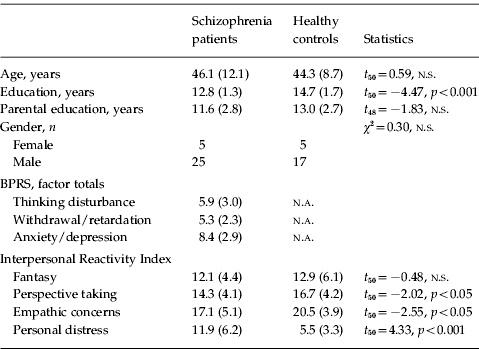
Schizophrenia patients and healthy controls were comparable in terms of age and parental education, but not personal education (for demographic information, see Table 1). All of the patients were taking antipsychotic medications at the time of testing. All participants had normal or corrected to normal vision of at least 20/30. Using the expanded 24-item version of the Brief Psychiatric Rating Scale (BPRS; Ventura et al. Reference Ventura, Lukoff, Nuechterlein, Liberman, Green and Shaner1993), clinical symptoms for patients were divided into three factors: thinking disturbance factor consisting of unusual thought content, hallucination and conceptual disorganization; withdrawal/retardation factor consisting of blunted affect, emotional withdrawal and motor retardation; and anxiety/depression factor composed of somatic concern, anxiety, depression and guilt.
Demographics of schizophrenia patients and healthy controls

n.s., Non-significant; BPRS, Brief Psychiatric Rating Scale; n.a., not applicable.
Data are given as mean (standard deviation).
All interviewers were trained through the Treatment Unit of the Department of Veterans Affairs VISN 22 Mental Illness Research, Education, and Clinical Center (MIRECC). SCID interviewers were trained to a minimum κ of 0.75 for key psychotic and mood items, and symptom raters were trained to a minimum intraclass correlation of 0.80. All participants were evaluated for the capacity to give informed consent and provided written informed consent after all procedures were fully explained, according to procedures approved by the Institutional Review Board at the VA Greater Los Angeles Healthcare System.
Empathic accuracy task
The empathic accuracy task was adapted from Zaki et al. (Reference Zaki, Bolger and Ochsner2008, Reference Zaki, Weber, Bolger and Ochsner2009b). It consisted of 12 video clips (six positive valence and six negative valence), each lasting for 1–2.3 min (mean, 102 s; range 62–137 s). A detailed explanation of the development of these videos is provided elsewhere (Zaki et al. Reference Zaki, Bolger and Ochsner2008, Reference Zaki, Weber, Bolger and Ochsner2009b). Briefly, the head and shoulders of an individual (referred to as the ‘target’) were videotaped while he/she discussed a positive or negative autobiographical event. Immediately after the videos were filmed, targets: (1) provided continuous ratings of their own emotional experience while watching their own videos; and (2) completed the 10-item Berkeley Expressivity Questionnaire (BEQ; Gross, Reference Gross, Maltby, Lewis and Hill2000), which assesses tendencies to experience and express strong emotions in general. Six positive and six negative videos of this study had equal numbers of male and female targets and were equated for the targets' self-reported expressivity rated by the BEQ.
For the current study, a central fixation was presented at the start of each trial. Immediately after the fixation disappeared, a video was presented in the center of a black screen. Above the video, an instruction was presented that oriented participants to the judgement that they were to make (i.e. how good or bad is this person feeling?). Below the video, a nine-point rating scale was presented (1, very negative; 5, neutral; 9, very positive). Participants were asked to continuously rate how positive or negative they believed the target was feeling at each moment using the left or right arrow keys. Each video started with the number 5 selected and participants pressed the left or right arrow key to move the number upward (toward positive) or downward (toward negative). The selected number on the scale was always highlighted so that participants could monitor their ratings of the target's emotion.
If patients show poorer empathic accuracy than controls, it is important to verify that it is not due to the motoric rather than the empathic demands of the task. We considered this confound in two ways. First, we recorded the number of times that subjects pressed the arrow keys to see if patients were making rating responses significantly less often than controls. Second, most of the participants (26 patients and 14 controls) received an additional motor tracking task that approximated the motoric demands of the empathic accuracy task but did not involve a social component. This task was designed to examine whether patients were able to sustain their attention and track a range of changes for about 2 min. This task included two videos (each lasting 2 min) that showed a thin vertical red line moving left or right at varying speeds. Similar to the empathic accuracy task, participants continuously rated the location of a moving visual target by pressing the arrow keys right or left along a nine-point scale.
The Interpersonal Reactivity Index (IRI)
All participants completed the IRI (Davis, Reference Davis1983) to assess self-reported trait empathy. The IRI is a reliable and valid way of measuring one's belief in one's own empathic tendencies (Davis, Reference Davis1994). The IRI consists of four subscales, each with seven items: fantasy, perspective taking, empathic concern, and personal distress. Participants responded using a five-point Likert scale, with 1 being ‘does not describe me well’ and 5 being ‘describes me very well’. The fantasy subscale measures the tendency to imagine oneself in a fictional situation (e.g. ‘After seeing a play or movie, I have felt as though I were one of the characters.’). The perspective taking subscale assesses the tendency to adopt the point of view of others and reason about their mental state (e.g. ‘I try to look at everybody's side of a disagreement before I make a decision.’). The empathic concern subscale measures the tendency to experience emotions in response to others and/or sympathy and concern for them (e.g. ‘I am often quite touched by things that I see happen.’). The personal distress subscale assesses the tendency to experience distress or discomfort in response to others' misfortune (e.g. ‘In emergency situations, I feel apprehensive and ill-at-ease.’).
Statistical analyses
Data reduction and time-series analysis for the empathic accuracy and motoric tracking tasks were conducted using Matlab (Mathworks, UK). Continuous affect ratings were converted into a time series of sequential values – one number for every 2 s of video. Specifically, the average rating was determined for each 2-s epoch for each participant, and these values served as data points in subsequent time-series analyses. To calculate empathic accuracy, participants' continuous ratings across these 2-s epochs were correlated with the target's own continuous ratings across the same epochs for each video. The resulting correlation coefficient (r) between two time series is the measure of empathic accuracy. For the motoric tracking task, the participants' responses to the movement of the line were correlated with the actual line movement for each video. Before conducting any statistical analyses, the individual correlation coefficients for both tasks were converted into z scores, which were used in subsequent analyses. To compare group difference on the empathic accuracy task, z scores were summed for positive and negative valence separately and a 2×2 repeated-measures analysis of variance (ANOVA) was performed with valence as a within-subject factor and group as a between-subject factor. For the motoric tracking task, a t test for independent samples was used to examine group differences. To examine the effect of the target's expressivity on empathic accuracy score, the mixed linear model was performed with the expressivity and group as fixed effects and subject as a random effect. To examine whether impaired empathic accuracy of patients is related to other characteristics, we examined its correlation with the four subscales of the IRI and clinical symptoms measured by the BPRS.
Results
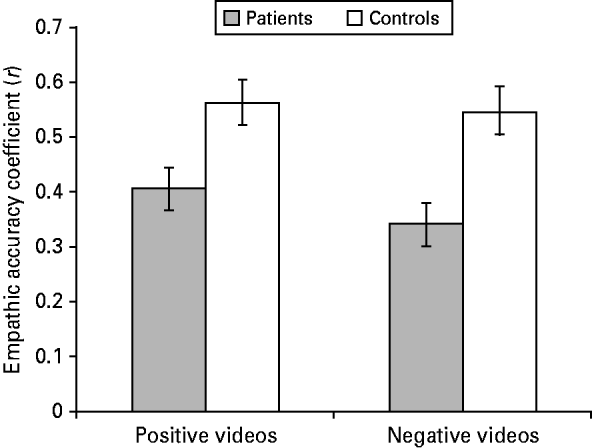
Figure 1 shows the empathic accuracy scores (r) for each group. The patients' empathic accuracy scores for both positive and negative valence were significantly above zero (t 29=9.48, p<0.001 and t 29=7.66, p<0.001, respectively). For the 2×2 ANOVA, the main effects of group (F 1,50=12.88, p<0.01) and valence (F 1,50=7.15, p<0.01) were both significant. The interaction was not significant. Overall, patients showed lower accuracy for rating the target's emotion and both groups showed better accuracy for positive valence. We then examined possible confounds for this significant group difference in empathic accuracy by assessing whether groups differed in the number of manual responses during the task. There was a significant main effect of valence (F 1,50=14.27, p<0.001); both groups responded more to negative than positive videos. However, neither the group nor the interaction was significant [patients: positive=13.3 (s.d.=17.6), negative=21. 8 (s.d.=29.9); controls: positive=7.4 (s.d.=5.5), negative=10.3 (s.d.=6.9)], although patients responded more frequently than controls. We also examined whether patients accurately performed the motoric tracking task. Both groups tracked the line with extremely high accuracy (r=0.90, s.d.=0.16; r=0.97, s.d.=0.02, for patients and controls, respectively). This difference was significant (t 36=−3.63, p<0.01), but the high level of accuracy in patients indicates that the motoric aspects of the empathic accuracy task are unlikely to account for their lower empathic accuracy.
Empathic accuracy scores (r) of schizophrenia patients and controls for positive and negative video clips. Schizophrenia patients showed overall lower empathic accuracy scores. Both groups showed better accuracy for understanding positive emotional experiences of a target than negative emotional experiences. Values are means, with standard errors represented by vertical bars.

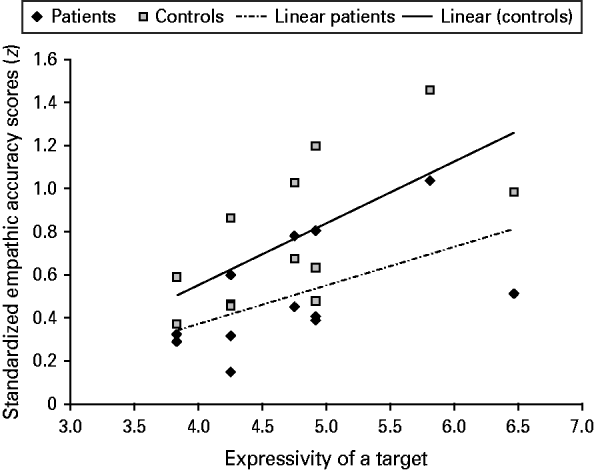
Next we considered the effect of target expressivity on empathic accuracy using a mixed linear model. We found a significant main effect of expressivity (F 1,566=21.78, p<0.001) and a significant group×expressivity interaction (F 1,566=3.18, p<0.05), indicating that the expressivity of the target was associated with higher empathic accuracy scores in both groups, but that this relationship was significantly smaller in schizophrenia patients. Fig. 2 shows the mean of standardized empathic accuracy scores from the patient and control groups for each video as a function of the target's expressivity.
Empathic accuracy of the patient group and control group as a function of a target's expressivity. The mean of standardized empathic accuracy scores from the patient and control groups for each video are plotted as a function of the target's expressivity, and the linear associations are shown. Both groups showed better accuracy for understanding emotional experiences of a highly expressive target, but this effect is much smaller in patients.

Finally, we examined whether the empathic accuracy of schizophrenia patients was related to: (1) their self-reported empathy and (2) clinical symptoms. The mean trait empathy subscale scores and the three clinical symptom factors are shown in Table 1. No significant relationship was observed between empathic accuracy score and the four IRI subscales. Similarly, empathic accuracy was not correlated with the three factors of the BPRS.
Discussion
In this study we examined one key aspect of empathy in schizophrenia; this was empathic accuracy, which refers to the ability to make accurate empathic judgements of others' emotions. We used an empathic accuracy task that required participants to track, in real time, the fluctuating contours of a target's emotions in a manner that approximates the need to track emotion in real-world social interactions. Three key findings were obtained. First, compared with controls, schizophrenia patients showed reduced empathic accuracy across both positive and negative video clips, indicating that schizophrenia patients are less accurate at inferring the affective state of another person. The impaired performance of patients is less likely to be attributable to impairments in sustained attention or motor abilities, given that schizophrenia patients tracked a dynamically moving non-social visual stimulus over 2 min with high accuracy. Second, although both groups showed greater empathic accuracy for highly expressive targets, this effect was significantly smaller in schizophrenia patients. Third, empathic accuracy was not related to the participants' self-reported belief in their empathic ability or clinical symptoms within the schizophrenia group. Taken together, these results suggest that schizophrenia patients are likely to have reduced empathic ability compared with controls interacting with others in everyday life, and these differences are greatest when interacting with highly emotionally expressive people.
Despite the rapid emergence of research on social cognition in schizophrenia, there is a relative paucity of appropriate measures for studying empathic processes in this population (Green et al. Reference Green, Penn, Bentall, Carpenter, Gaebel, Gur, Kring, Park, Silverstein and Heinssen2008). Empathy is a multi-faceted construct and the few previous studies on empathy in schizophrenia focused on certain aspects, such as low trait empathy or deficits in mimicking the affect of another person (Montag et al. Reference Montag, Heinz, Kunz and Gallinat2007; Shamay-Tsoory et al. Reference Shamay-Tsoory, Shur, Harari and Levkovitz2007; Benedetti et al. Reference Benedetti, Bernasconi, Bosia, Cavallaro, Dallaspezia, Falini, Poletti, Radaelli, Riccaboni, Scotti and Smeraldi2009; Derntl et al. Reference Derntl, Finkelmeyer, Toygar, Hulsmann, Schneider, Falkenberg and Habel2009; Haker & Rossler, Reference Haker and Rossler2009; Sparks et al. Reference Sparks, McDonald, Lino, O'Donnell and Green2010). However, the ability to accurately understand the affective state of another person is an important component of empathic ability that had not been previously studied in schizophrenia. The current study showed that schizophrenia patients were impaired in empathic accuracy; that is, they were less accurate at tracking the positive and negative affective state of another person compared with controls.
The empathic accuracy task used in this study involved the ability to monitor the valence of others' affect, as opposed to the ability to decode the specific content of targets' thoughts and feelings; both of these approaches provide important and complementary information about empathic abilities. Whereas content-driven approach accuracy tasks can provide more specific insights about what types of thoughts and feelings perceivers accurately understand, they tend to be highly dependent on verbal ability (Davis & Kraus, Reference Davis, Kraus and Ickes1997), and often require somehow subjective coding of accuracy based on targets' and perceivers' verbal reports. By contrast, a valence-driven approach provides more ‘coarse’ information about accuracy for positive and negative affect, but also produces a highly tractable, quantitative operationalization of accuracy that does not depend on targets' or perceivers' specific verbal content (Zaki et al. Reference Zaki, Bolger and Ochsner2009a). Further, both valence- and content-focused measures of empathic accuracy are associated with functionally important outcomes, such as relationship quality and social support (Carton et al. Reference Carton, Kessler and Pape1999; Bartz et al. Reference Bartz, Zaki, Bolger, Hollander, Ludwig, Kolevzon and Ochsner2010; Zaki & Ochsner, in press). As such, impairments in either type of accuracy are likely to provide meaningful sources of information about poor social functioning in schizophrenia.
In this study, empathic accuracy in both schizophrenia patients and controls was not associated with self-reported trait empathy. The lack of association between empathic accuracy and trait empathy may seem surprising and counterintuitive. However, such dissociation between empathic accuracy behavior and self-report empathy is quite common (Levenson & Ruef, Reference Levenson and Ruef1992; Ickes et al. Reference Ickes, Buysse, Rivers, Erickson, Hankock, Kelleher and Gesn2000; Zaki et al. Reference Zaki, Bolger and Ochsner2008). Self-reported trait empathy concerns the belief about one's own empathic characteristics, whereas empathic accuracy measures how well a person understands the affective state of another person. Furthermore, individuals with high self-reported trait empathy are often no better at understanding the affective state of another person than people with low self-rated empathy (Hall, Reference Hall and Rosenthal1979; Ickes et al. Reference Ickes, Stinson, Bissonnette and Garcia1990; Levenson & Ruef, Reference Levenson and Ruef1992; Ames & Kammrath, Reference Ames and Kammrath2004). Thus, self-reported trait empathy appears to reflect one's own belief in his/her empathic characteristic, as opposed to the strength or accuracy of his/her empathic ability. The current findings suggest that the empathic accuracy diverges from the self-reported trait empathy in schizophrenia as well as in healthy individuals and further empathizes that empathy is indeed a multi-faceted psychological construct. Further studies will help us better understand the relationship among diverse aspects of empathy in schizophrenia.
The current study advances prior work on empathy in schizophrenia in two ways. First, this study employed an experimental method that assesses the naturalistic processes of empathic judgement. In real life we often encounter dynamically fluctuating emotional experiences of another person and make moment-to-moment judgements on the transient affective state over time. It will be possible to employ this method in studies with other psychotic disorders that may also have difficulties with empathic processes to examine whether impaired empathic accuracy is specific to schizophrenia. Second, the empathic accuracy paradigm provides a clear performance metric of empathic accuracy that can be used for relating task performance to other individual difference variables such as other aspects of empathy, theory of mind and non-social cognition.
What would contribute to lower empathic accuracy in schizophrenia? People generally have higher empathic accuracy when they interact with another person who is highly expressive (Zaki et al. Reference Zaki, Bolger and Ochsner2008, Reference Zaki, Bolger and Ochsner2009a). While both groups were more accurate with highly expressive individuals, schizophrenia patients were significantly less able to benefit from the expressivity of the target. The reduced ability of schizophrenia patients to benefit from an expressive target could be partly due to impaired early perceptual abnormalities in schizophrenia. Previous studies with healthy individuals demonstrated that people rely more on verbal social cues than visual cues in reaching empathic accuracy judgements (Gesn & Ickes, Reference Gesn and Ickes1999; Zaki et al. Reference Zaki, Bolger and Ochsner2009a). Perhaps schizophrenia patients had difficulty detecting subtle changes of auditory information from an expressive target, resulting in lower empathic accuracy. Along these lines, schizophrenia patients show impaired early auditory processing with tone matching and this impairment has been associated with impaired prosody detection (Leitman et al. Reference Leitman, Foxe, Butler, Saperstein, Revheim and Javitt2005, Reference Leitman, Hoptman, Foxe, Saccente, Wylie, Nierenberg, Jalbrzikowski, Lim and Javitt2007). Future research could determine whether lower empathic accuracy in schizophrenia is associated with early perceptual abnormalities and whether schizophrenic patients have more trouble inferring emotion from verbal versus non-verbal cues.
This study is the first, to our knowledge, to assess empathic accuracy in schizophrenia. The current findings provide a foundation for further exploration. Low empathic accuracy of schizophrenia patients found in this study may be used to identify neural correlates of empathic understanding in schizophrenia patients. Recent studies with healthy individuals showed that higher empathic accuracy is related to increased activations in several brain regions including the medial prefrontal cortex (Zaki et al. Reference Zaki, Weber, Bolger and Ochsner2009b, Reference Zaki, Hennigan, Weber and Ochsner2010). Finally, the current study has some limitations. All of the patients were taking antipsychotic medications. With first-episode patients without medication history, it will be possible to determine the potential effect of pharmacological treatment on empathic accuracy in schizophrenia. In addition, this study did not include non-social neurocognitive measures or assess community functioning. With a larger sample and broader range of assessments, it will be possible to determine the relationship between reduced empathic accuracy and non-social cognition, or whether empathic accuracy is related to certain domains of community functioning, such as social connectedness or vocational success.
Acknowledgements
Support for this study came from a National Institute of Mental Health (NIMH) grant (no. MH043292 to M.F.G.), a National Institute on Drug Abuse (NIDA) grant (no. DA022541 to K.O.), a NIMH grant (no. MH076137 to K.O.) and an Autism Speaks Grant (no. 4787 to J.Z.). The authors thank Mark R. McGee, Shelly Crosby and Cory Tripp for assistance in data collection.
Declaration of Interest
None.