Introduction
Since the beginning of the 2000s, Latin American countries have made great social policy advances. Across policy areas, access increased markedly, as did levels of coverage and benefits. After a long period of social policy retrenchment, beginning in the 1980s, the new millennium saw a clear development of equitable social policy.
This paper seeks to explain the causes of the expansion of equitable social policy in Latin America. We are interested in understanding why and under what conditions governments promote equitable social policy. In defining equitable social policy, we take insights from Ruth Lister’s characterization of equity as a “distributional principle applied to the allocation of services and benefits in order to achieve what is considered a fair division” (Lister, Reference Lister2002: 79). The expansion of equitable social policy, in turn, refers to the extension of social services and benefits that promote fairer allocation.
In explaining the expansion of equitable social policy, this paper proposes a quantitative study of 18 Latin American countries from 1990 to 2013. We evaluate the impact of the political orientation of the government and economic growth and test additional explanations derived from the qualitative comparative social policy literature. We show that the level of electoral competitiveness, the strength of civil society, and the level of wealth account for the expansion of equitable social policy.
Our research makes three main contributions. First, it challenges the relevance of two important explanations of the literature on expansionary social policy – the left turn and economic growth. Second, it offers a quantitative test of some of the key explanations derived from small-n research. Third, it develops a novel way to account for the expansion of equitable social policy.
This paper proceeds as follows. First, it discusses the literature on comparative social policy and explains how both political factors and the economic environment may affect the expansion of equitable social policy. The second section discusses the dependent variable, an index of equitable social policy, which is operationalized using a principal component factor (PCF) of three indicators of social policy from the varieties of democracy database (V-DEM). This measure has been calculated for every year since 1990 for every country in Latin America. The third section presents our hypotheses and methods and operationalizes the independent variables. Then, in the fourth section, different specifications of survival models are studied, and the results are discussed. Next, we present our findings in the context of the relevant literature. The final section reflects on the analysis and offers some conclusions.
Social Policy since 1990: Trends and Debates
Latin American countries have recently exhibited remarkable advances in terms of social policy. After a long period of social policy retrenchment, beginning in the 1980s, which resulted in targeting, means-testing, privatization, harsh eligibility rules, and the cutting of benefits, Latin American social policies entered a new phase of development. The new millennium saw an extension of coverage, the introduction of new or enhanced benefits, and improvements in equality as social policies moved closer to universalism (Martínez Franzoni and Sánchez Ancochea, Reference Martínez Franzoni and Sánchez Ancochea2016; Pribble, Reference Pribble2013).
This social policy shift generated a growing literature that explains differences in scope and achievement in diverse dimensions and aspects of social policies and social policy outputs (see, for example, Ewig, Reference Ewig2016; Garay, Reference Garay2016; Huber and Stephens, Reference Huber and Stephens2012; Lloyd-Sherlock, Reference Lloyd-Sherlock2008; Martínez Franzoni and Sánchez Ancochea, Reference Martínez Franzoni and Sánchez Ancochea2016; Niedzwiecki, Reference Niedzwiecki2018; Pribble, Reference Pribble2013; Staab, Reference Staab2010). These accounts assess the relevance of several macro-explanatory factors to explain variations among countries.
This shift took place in the context of the so-called left turn. In 1990, the left was present in the government of only two Latin American countries. Later, left-wing governments sprang up in many Latin American nations. After Hugo Chávez’ first election to office in 1998, several other countries “turned left.” Just a decade later, nine countries were governed by the left and center-left governments (Castañeda and Morales, Reference Castañeda and Morales2008: 6). Huber and Stephens (Reference Huber and Stephens2012) argue that the irruption of the “pink tide” was consequential for social policy because left and center-left parties “favor social programs that are distributive and benefit the large majority of underprivileged citizens” (Huber and Stephens, Reference Huber and Stephens2012: 32).
Part of the literature has emphasized left-wing governments favor redistribution and a movement towards more universal social policy solutions and instruments, asserting that “social justice has always been a central goal of the left, and it has motivated both the contestatory and the moderate left in contemporary Latin America” (Madrid et al., Reference Madrid, Hunter, Weyland, Weyland, Madrid and Hunter2010: 160). Left-wing governments expand social policy because they are sensitive to the demands of the popular sectors (Silva, Reference Silva2017: 92). Expansionary social policy reflects the commitment of left-wing governments to reversing the most conspicuous effects of neoliberal policies inherited from previous governments (Rojas, Reference Rojas2018). Moreover, “even within ‘well-defined structural and institutional constraints’, left governments are ideologically committed to improving social inequalities and expanding social citizenship rights” (Cook and Bazler, Reference Cook and Bazler2013: 4). When left-wing parties were relatively strong, social policy development was possible (Anria and Niedzwiecki, Reference Anria and Niedzwiecki2015; Huber, Reference Huber and Vicuña2011; Huber and Stephens, Reference Huber and Stephens2012). Additionally, Huber et al. (Reference Huber, Mustillo and Stephens2008) show that while right-wing parties may have a negative effect on education and health spending, the left has a positive impact. A related argument is that the economic bonanza generated by the commodity boom provided left-wing governments with the necessary economic resources to finance social welfare expansion (Hagopian, Reference Hagopian2016; Levitsky and Roberts, Reference Levitsky, Roberts, Levitsky and Roberts2011; Roberts, Reference Roberts2008).
The analysis of the effects of the Latin American left on social policy is consistent with the abundant evidence produced in the literature on welfare state expansion in Western Europe. In fact, classic works subscribing to power resource theory argue that the existence of social democratic/left-wing parties that enjoy a large pool of working-class support is central in explaining the development of the welfare state. Power resource scholars show that when these conditions were present, the welfare state emerged earlier and continued to develop, particularly in contexts in which right-wing parties remained weak and labor was capable of building cross-class political coalitions (Carnes and Mares, Reference Carnes, Mares, Boix and Stokes2007; Esping-Andersen, Reference Esping-Andersen1990; Esping-Andersen and Van Kersbergen, Reference Esping-Andersen and Van Kersbergen1992; Korpi, Reference Korpi1989). In this way, “expectations regarding policy preferences of the left derived from the work on social policy in Europe travel relatively well to Latin America” (Huber and Stephens, Reference Huber and Stephens2012: 32).
Nonetheless, there are at least two caveats for those analyzing Latin America. First, with a few exceptions, most of the evidence comes from in-depth studies of a few cases, generally of left-wing governments. Accordingly, it is unclear whether these results are generalizable beyond the studied cases. Second, during the “left turn” era, a few right-wing governments also expanded social policy. Colombia, Chile, and Mexico provide excellent illustrations of this apparently counterintuitive move of right-of-center governments towards equitable social policy.
In the early 1990s, Colombia introduced a constitutional reform that recognized health as a right of all citizens, established a new health insurance system, and defined a basket of benefits through a mandatory health plan (OECD, 2015). The system has since undergone transformations that strengthen primary care, regulation, management, and improve access to health care, particularly under the right-of-center administrations of Álvaro Uribe (2002–2010) and Juan Manuel Santos (2010–2018). As a result, health coverage increased significantly, from 23.5% in 1993 to 96.6% in 2014 (OECD, 2015: 13).
In Chile, President Sebastián Piñera (2010–2014) expanded maternity leave allowances to the point that nowadays Chile enjoys the most extensive scheme of Latin America (and it is certainly ahead of several advanced industrial democracies around the world). This reform “extended paid maternity leave by 12 weeks, granting mothers the right to stay with their children twice the amount of time they did before; it increased coverage of workers in less stable employment relationships; and it established comparatively generous income replacement subsidies” (Staab, Reference Staab2017: 163). Moreover, during his second administration, President Piñera (2018–2022) submitted to Congress a bill to extend free, technical tertiary education to the most vulnerable 70% of students.
Mexico’s President Vicente Fox (2000–2006) introduced Popular Insurance (Seguro Popular), a healthcare scheme designed to grant coverage to those individuals not covered by social insurance. Popular Insurance continued growing under the Presidency of Felipe Calderón (2006–2012) and by 2018 it reached more than 53 million Mexicans.Footnote 1 As these examples suggest, right-of-center governments also expanded social policy.
Some authors, in fact, suggest that there is some evidence that shows that social policy expansion may also occur under right-wing and even authoritarian governments. In Europe, for example, Germany’s Chancellor Otto von Bismarck (1871–1890) extended social rights to avoid granting political rights as well as to generate ruptures among workers and to forge loyalties to the state authority (Esping-Andersen, Reference Esping-Andersen1990: 24; Rimlinger, Reference Rimlinger1971:112). Other authors suggest that when right-wing governments confront an electorally consequential left, they are pressured to adopt more pro-welfare positions, something that has been labeled the “contagion from the left” (Hicks and Swank, Reference Hicks and Swank1992: 667-8). More recent studies on the European welfare state have shown that the presence of radical right-wing parties, interested in gaining the electoral support of conservative working-class voters, resulted in increased pension generosity (Abou-Chadi and Immergut, Forthcoming: 18). Similarly, some of the authoritarian governments of the East Asian “dragons” introduced minimum social rights to boost productivity and economic growth as well as to gain political legitimization (Altman and Castiglioni, Reference Altman and Castiglioni2009: 300; Holliday, Reference Holliday2000: 708; Moon and Yang, Reference Moon, Yang, Tulchin and Brown2002: 151).
A few authors also argue that expansion may also occur under right-wing governments in Latin America. Fairfield and Garay (Reference Fairfield and Garay2017) show that conservative administrations in Chile and Mexico introduced expansionary social policy and progressive tax reforms. Similarly, Pribble suggested that right-wing governments facing intense competition from left-wing parties might carry out progressive social policy change (Reference Pribble2013: 29). Finally, there is also strong empirical evidence showing that right-of-center parties and governments were behind the early adoption of conditional cash transfers in Latin America (Diaz-Cayeros et al., Reference Diaz-Cayeros, Estévez and Magaloni2016; Osorio Gonnet, Reference Osorio Gonnet2018; Pena, Reference Pena2014).
Additionally, another part of the relevant literature on social policy in Latin America challenges the relevance of the ideological color of the governing party and suggests a series of alternative explanatory factors to account for social policy change. Although most of these insights focus on the analysis of social policy variation and results, some of these findings might be relevant to the analysis of the recent advances towards equitable social policy. Most of this research corresponds to qualitative studies of a few, very well selected and studied cases. Here, we discuss some of these assessments in a nutshell.
Electoral competition has been considered a relevant explanatory factor for social policy change that might be also relevant in terms of equitable social policy. In political systems where electoral competition is prominent, parties have greater incentive to capture new votes, either gaining the allegiance of broad sectors of society (Pribble, Reference Pribble2013) or the electoral support of low-income voters (Fairfield and Garay, Reference Fairfield and Garay2017; Garay, Reference Garay2016). To put it bluntly and generally, “electoral competition is what motivates politicians to support comprehensive reform” (Ewig, Reference Ewig2016: 197). In this way, “parties facing intense electoral competition are more likely to pursue universalistic social policy reform than parties that face a weak opposition” (Pribble, Reference Pribble2013: 176).
Additionally, comparative social policy research also shows that the strength of civil society has important implications for social policy change. The presence of civil society organizations and their ability to influence social policy has been well documented in Latin America, particularly in the area of pensions (see, for example, Castiglioni, Reference Castiglioni2005; Kay, Reference Kay1998; Madrid, Reference Madrid2002). Case study research conducted in different Latin American countries has also suggested that social movements may have shaped the expansion of social policies in recent years. For example, Anria and Niedzwiecki show that Bolivian “social movements have played a decisive role in achieving the universal pension scheme by exercising direct agency” (Reference Anria and Niedzwiecki2015: 309). Similarly, Silva argues that in Bolivia and Ecuador mobilized indigenous groups facilitated the integration of indigenous people “into a system of substantive rights focused on expansive social policy” (Reference Silva2015: 35). In the same vein, Garay (Reference Garay2016) has also shown that social policy expansion occurred in countries that experienced large-scale social mobilization from below.
Finally, the comparative literature also contends that recent social policy expansion was possible because of the extraordinary economic growth that Latin American nations experienced during the new millennium (Hagopian, Reference Hagopian2016; Kingstone, Reference Kingstone2011; Levitsky and Roberts, Reference Levitsky, Roberts, Levitsky and Roberts2011; Lustig, Reference Lustig2010). Latin America enjoyed heightened prosperity between 2003–2008 in particular, a period that ECLAC has called “Latin America’s Six Golden Years” (el sexenio de oro), in honor not only of growth and fiscal surplus but also of the 41 million people who left poverty (Montaño, Reference Montaño2011: 15). Sustained economic growth in most Latin American countries, in turn, may have facilitated expansionary social policy. In other words, the left turn coincided with a period of unprecedented prosperity. Economic growth provided the necessary resources to finance social policy expansion throughout Latin America.
Following these insights, this paper assesses the impact of the political orientation of the government, levels of electoral competition, civil society strength, wealth, and economic growth on the extension of equitable social policy. In the next section, we discuss the dependent variable, equitable social policy. We then present the main hypotheses and discuss the research methods, goals, and work plan.
Equitable Social Policy
Our goal is to explain why and under what conditions governments expand equitable social policy. In order to define equitable social policy, we take insights from Ruth Lister’s characterization of equity as a “distributional principle applied to the allocation of services and benefits in order to achieve what is considered a fair division” (Reference Lister2002: 79). Lister’s conceptualization of equity resonates with Amartya Sen’s capabilities approach (Sen, Reference Sen1999). In this view, disparities at the individual level may translate into different opportunities to turn resources into capabilities. In other words, equal resources do not necessarily or automatically mean equitable outcomes (Lister, Reference Lister2010; Sen, Reference Sen1999).
It is precisely in this realm that social policies may constitute an important means to “correct” skewed outcomes. In fact,
[the] expansion of health care, education, social security, etc., contribute directly to the quality of life and its flourishing. There is every evidence that even with relatively low income, a country that guarantees health care and education to all can actually achieve remarkable results in terms of the length and quality of life of the entire population (Sen, Reference Sen1999: 144).
Following these ideas, we define equitable social policy development, as the extension of social services and benefits that further a fairer allocation to promote more equitable outcomes.
Inspired by the capabilities approach, this work also emphasizes the relevance of equitable outcomes in health care and education because of their potential to promote individual wellbeing and freedom (Drèze and Sen, Reference Drèze and Sen2002). Access to education and health constitute a pre-requisite for a meaningful participation in society and in the modern economy as well as for the achievement of broader welfare outcomes (Gauri, Reference Gauri2004). Health and education are essential for the development of social opportunities and to increase individual ability to overcome deprivation (Sen Reference Sen1999). Taking insights from Drèze and Sen (Reference Drèze and Sen2002), we attribute a particular importance to education and health inasmuch as they constitute enabling factors: they are intrinsically relevant, they are instrumental for personal, social, and process roles, and they play crucial empowerment and distributive roles.
We also emphasize the relevance of universal outcomes (as opposed to particularistic outcomes associated to targeted, means-tested social policies), for at least two reasons. First, because “when both the poor and the middle class are incorporated into the same policies, the voice and mobilization capacity of the latter benefit the former as well” (Martínez Franzoni and Sánchez Ancochea, Reference Martínez Franzoni and Sánchez Ancochea2016: 7). Second, there is evidence that targeted policies hinder quality (Sen, Reference Sen, van de Walle and Nead1995; Staab, Reference Staab2010).
In order to operationalize the dependent variable – equitable social policy – we built a novel index comprised of a principal component factor analysis of three variables coming from the Varieties of Democracy (V-Dem) database. V-Dem is a multidimensional and disaggregated dataset that provides information on a full range of issues related to democracy, including wellbeing and egalitarianism. V-Dem relies on a wide network of experts that produce cutting-edge research and support in the development of the dataset. Roughly 50% of the indicators come from official documents, and the rest from expert assessment.Footnote 2 As discussed below, our dependent variable is an index comprised of three V-Dem indicators. These indicators are the result of expert assessment.
An alternative approach to measurement of the dependent variable could have been to work with factual information instead of expert opinion. We discarded this option for two main reasons. First, we believe that V-Dem offers highly rigorous, reliable information. Second, to this date, there is no alternative comparable quantitative data for the 23 year period and 18 countries under study. Although high quality data on access and coverage do exist, this information is not available by income quintile. As a result, having us opted to work with available factual information, we would have been unable to evaluate the equity enhancing nature of social policy.
Our new index of equitable social policy combines the following three components: “health equality,” “education equality,” and “means-tested vs. universalistic.” More specifically,
a) the first component, health equality, measures “to what extent high-quality basic healthcare is guaranteed to all.”
b) the second component, education equality, measures “to what extent high-quality basic education is guaranteed to all.”
c) the third component, named means-tested versus universalistic, measures “how many welfare programs are means-tested and how many benefit all (or virtually all) members of the polity.”
Figure 1 below displays the patterns of equitable social policy in Latin America from 1990 until 2013. In the next few paragraphs, we discuss the independent variables of this paper as well as the hypotheses and methods we pursue.
Equitable Social Policy in Latin America (1990-2013).

Hypotheses and Methods
This paper offers three hypotheses derived from the comparative social policy literature on Latin America. It also considers three control variables, which we discuss below. For all hypotheses, the dependent variable is the expansion of equitable social policy. These three hypotheses are as follows:
1. Left-wing governments are more likely to expand equitable social policy than right-wing governments.
Following the literature on the left turn in Latin America as well as the power resources theory, which analyzes the expansion of welfare states in Europe, the theoretical expectation is that left-wing governments are more prone to expanding equitable social policies than right-wing. However, given the fact that within the left turn period, right-wing governments appear to have engaged in expansionary social policy, we expect to falsify this hypothesis.Footnote 3
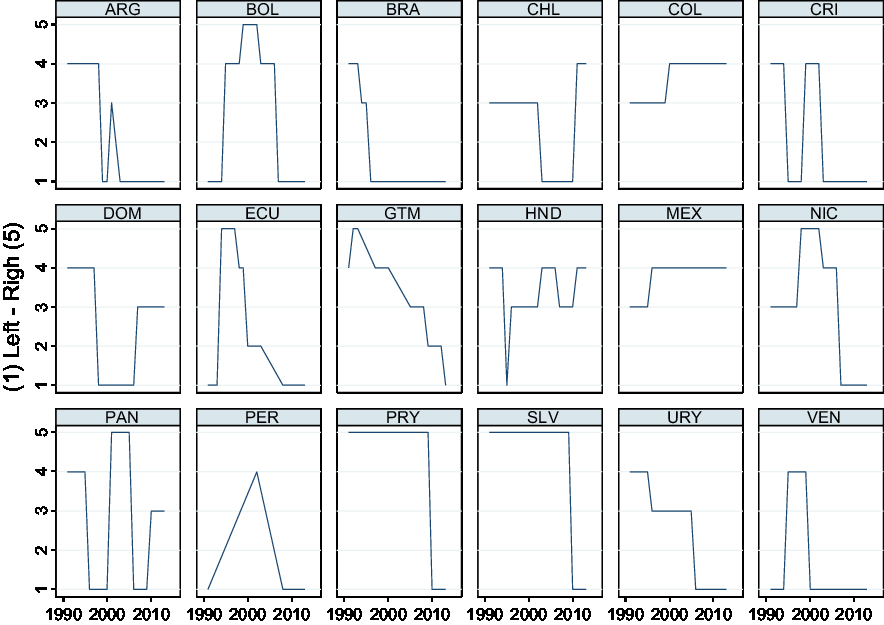
In testing this hypothesis, we rely on Coppedge’s (Reference Coppedge1997) definition and taxonomy of political parties, which was updated by Huber and Stephens (Reference Huber and Stephens2012).Footnote 4 Based on this data, we classify governing political parties on a five-point left–right scale, see Figure 2.Footnote 5
2. Electoral competition favors the expansion of equitable social policy. Whenever the political system becomes increasingly competitive, government and opposition will be likely to move towards equitable social policy in order to expand their electoral pool of support.
Governing parties (or coalitions) in a five-point left-right scale.

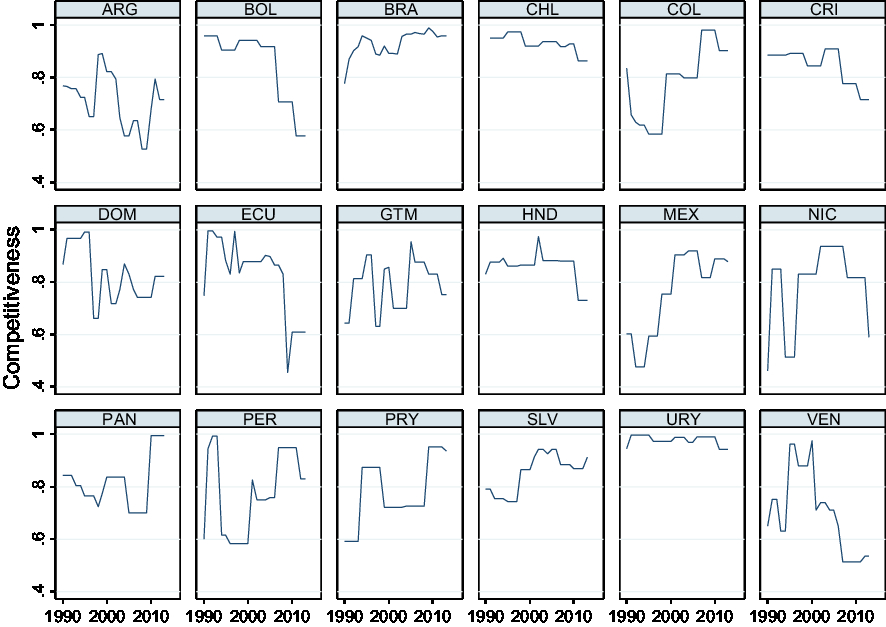
Whenever electoral competition is tight, both government and opposition have incentives to engage in expansionary social policy to broaden their share of votes. In order to substantiate this hypothesis, we rely on Altman and Pérez Liñán’s (Reference Altman and Pérez-Liñán2002) and Pérez Liñán and Altman’s (Reference Pérez-Liñán and Altman2017) definition, operationalization, and data on effective competition. To account for effective competition, these authors first measure “opposition’s access to power as a weighted difference between the share of the seats of the government and the opposition parties in the lower chamber” (Reference Altman and Pérez-Liñán2002: 89). Their formula penalizes fragmentation, so they design a measure to identify the typical opposition party that weights the seats corresponding to the largest political parties and the typical party in government.Footnote 6 Based on these measures, they develop the following index of effective competitiveness:
 $$C = 1 - \left| {{{G - O} \over {100}}} \right|$$
According to this formula, whenever the government (or the opposition) controls the whole legislature the value of C will tend to zero and whenever there is a balance between government and opposition C will move close to one (Altman and Pérez-Liñán Reference Altman and Pérez-Liñán2002: 90).
3. The stronger organized civil society is, the more likely equitable social policy will be to expand. When organized civil society is strong and actively involved in public affairs, politicians have greater incentive to adopt equitable social policy.
Competitiveness in Latin America (1990-2013).

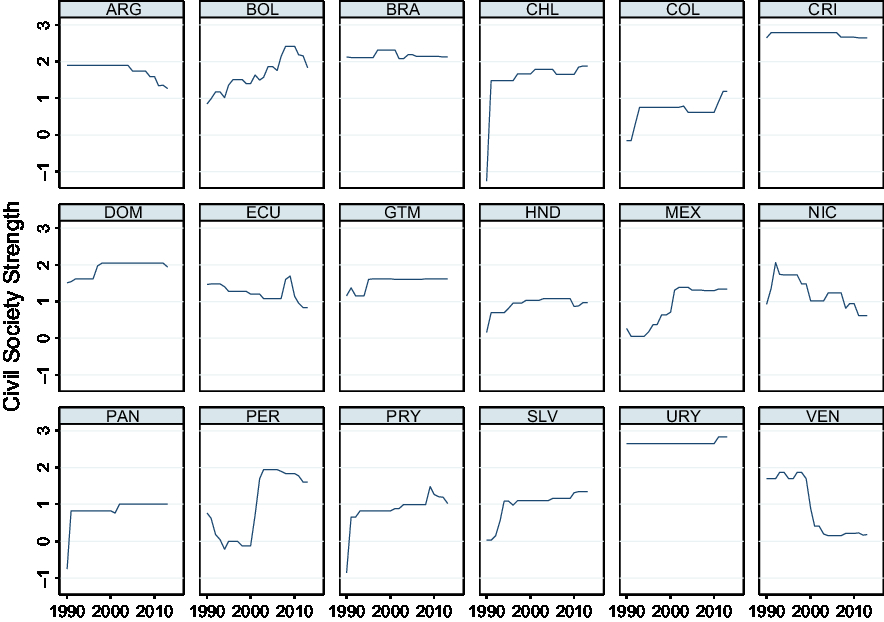
When civil society is strong, it has increased capacity to compel decision-makers to act in its best interest, introducing new or better social policies. Moreover, for civil society to be strong, it is important that individuals be involved in civil society organizations (CSOs) and that CSOs can act freely and flourish. For this independent variable, we rely on the average of three civil society indicators of the Varieties of Democracy database: 1. Civil society consultation (v2cscnsult), which aims to measure the degree to which major CSOs are routinely consulted by policymakers on policies relevant to their members; 2. Civil society participatory environment (v2csprtcpt), which aims to describe the level of involvement of people in civil society organizations; and 3. Civil society entry and exit (v2cseeorgs), an indicator that assesses to what extent the government exerts control over entry and exit by CSO into public life. We follow Bernhard et al. (Reference Bernhard, Tzelgov, Jung, Coppedge and Lindberg2015: 7), who argue that “civil society organizations include, but are by no means limited to, interest groups, labor unions, spiritual organizations (if they are engaged in civic or political activities), social movements, professional associations, charities, and other non-governmental organizations.” Figure 4 below shows civil society strength index we built for each Latin American country.
Civil Society Strength in Latin America (1990-2013).

Additionally, our model includes three control variables. First, we control for level of wealth, measured as GDP per capita. Since Harold Wilensky’s seminal contribution, it has been well established in the literature on welfare states that “economic level is the root cause of welfare development” (Reference Wilensky1975: 47). As a result, one might expect that the more well-to-do a country, the more likely it will be to invest in equitable social policy expansion. Moreover, as we discussed above, the comparative social policy literature has also emphasized that the extraordinary economic growth of recent years, may explain expansionary social policy. Economic per capita growth may be also important because “what matters for individual well-being is the growth of each person’s income and consumption, rather than the development of the aggregate economy” (Przeworski et al., Reference Przeworski, Alvarez, Cheibub and Limongi2000: 216). Therefore, we also control for GDP per capita growth. Data for both GDP per capita growth and GDP per capita comes from the World Bank DataBank.Footnote 7 Finally, we also control for year and lustrum to foresee if these relationships are contingent to particular moments. All our models are run with country fixed effects.
To test these hypotheses, we pursue a cross-national longitudinal comparison. Our pooled time-series database is composed of 18 Latin American countries (Argentina, Bolivia, Brazil, Chile, Colombia, Costa Rica, Dominican Republic, Ecuador, Guatemala, Honduras, Mexico, Nicaragua, Panama, Peru, Paraguay, El Salvador, Uruguay, and Venezuela) over 23 years/observations each (n=414), from 1990 to 2013. As indicated above, data came from a variety of sources, including the Varieties of Democracy Database, Coppedge’s (Reference Coppedge1997) classification of parties and Huber and Stephens’ (Reference Huber and Stephens2012) update thereof, the Altman and Pérez-Liñán database on competitiveness, and the World Bank DataBank. The method of analysis has been to regress the equitable social policy dependent variable on the most relevant explanatory variables, using transformations and interactions as indicated by theory.
Empirical Evidence
We have hypothesized that equitable social policy is contingent on the degree of competitiveness, the ideological orientation of the government, civil society strength, GDP per capita, and economic growth. To test this argument, we employ data for 18 Latin American countries between 1990 and 2013. The dependent variable, equitable social policy, is operationalized as the factor extracted using principal component factor (PCF) analysis from the three V-DEM variables: health equality, education equality, and means-tested versus universalistic measures (see Table 1 for descriptive statistics). Because the operationalization of any index through PCF can be discussed in terms of its interpretativeness, we check also for their arithmetic average.
Descriptive Statistics

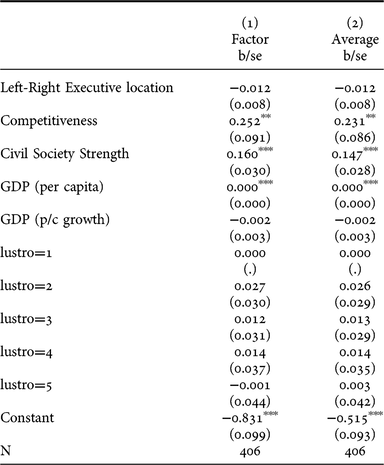
To assess the impact of our independent variables on the expansion of equitable social policy, we estimate two panel models using the extracted factor as the dependent variable in Model 1, and the average of the three components of the index as the dependent variable in Model 2 (see Table 2). All independent variables are lagged one year, and both models are run with country fixed-effects. As explained, we anticipate all independent variables, apart from L-R, to be positive. In other words, the wealthier the country, the higher economic per capita growth, the more competitive the political system, and the stronger the civil society, the higher the equitable social policy.
Models of Equitable Social Policy (Coefficient and Std. Err)

* p<0.05, ** p<0.01, *** p<0.001.
The two models are notably statistically robust (Prob > F = 0.000), and they are surprisingly consistent between the different specifications of the dependent variable (principal component in Model 1 and arithmetic mean in Model 2). As expected, competitiveness, civil society strength, and GDP per capita are strongly significant and with the anticipated signs. For the purposes of this research, perhaps the most significant finding is the impossibility of differentiating from zero the ideological executive location in a left–right continuum, regardless of the specification of the dependent variable.Footnote 8 We were also surprised to discover that per capita economic growth is unable to explain the expansion or equitable social policy.Footnote 9
Figure 5 graphically represents the two models and includes all variables and controls. Unlike the models presented in a tabular form, this figure (named coefplot) uses small circles to illustrate coefficients and horizontal bands to represent confidence intervals.Footnote 10 If the bar of a given coefficient crosses the vertical line drawn at zero on the x-axis, it means that we cannot statistically differentiate it from zero, and therefore the coefficient is “statistically insignificant.”
Determinants of Equitable Social Policy (coefficients and confidence intervals).

Figure 6, based on Model 1, exhibits the impact that each of the significant independent variables has on the equitable social policy index (holding all other variables constant at their mean level). As seen, civil society, wealth, and competitiveness show a notably strong and positive effect on equitable social policy; that is, the stronger the civil society, the more equitable social policy (6.a). The wealthier the society (understood as per capita income), the more equitable social policy (6.b). Finally, the more competitive the political system is, the more equitable social policy (6.c).
Marginal Effects of Civil Society Strength, Wealth, and Political Competitiveness over Equitable Social Policy in Latin America (1990-2013).

Findings in the Context of the Existing Literature
The fact that the ideological leaning of governments held no statistical significance once we included competing covariates challenges the idea that the recent expansion of social policy is the result of the left turn. Equitable social policy – at least as we have operationalized it – does not seem to be contingent on the ideological color of the government. Results far exceed even a minimum tolerable statistical significance (regardless of using imputed values for some cases or not, as explained above). This conclusion tends to reinforce alternative explanations of qualitative studies of social policy in Latin America.
Another surprising finding of this research is that economic per capita growth does not explain the expansion of equitable social policy. This discovery calls into question the widely accepted assumption that prosperity was an important factor behind expansionary social policy. This finding may reveal that part of the problem is that the treatment of this variable has been predominantly at the assumptions level and that there is insufficient empirical research on this matter. In other words, the literature tends to assume that increases of per capita growth in the context of the commodity boom led to the expansion of social policy. However, this hypothesis has seldom been tested empirically.
As we anticipated, our work confirms that some of the variables that small-n studies emphasize to explain recent social policy developments in the Latin American region also explain the expansion of equitable social policy. In fact, equitable social policy depends on the degree of political competition, civil society strength, and level of wealth. As previous qualitative research has suggested, political competition generates incentives for political parties to pursue vote maximizing strategies. A tight electoral scenario, pushes political parties to gain new votes through the expansion of social policies (Ewig, Reference Ewig2016; Garay, Reference Garay2016; Pribble, Reference Pribble2013). This finding is also consistent with recent studies of welfare reform in Western Europe (see, for example, Abou-Chadi and Immergut, forthcoming; Häusermann et al., Reference Häusermann, Picot and Geering2013; Morgan, Reference Morgan2013). Adapting social policies in an electorally competitive scenario, in an effort to win the hearts and minds of new voters, does not mean that ideological labels are unimportant. Yet, tight electoral competition might push parties to sacrifice their own ideological principles in order to survive.
Additionally, a robust civil society usually has the capacity to organize, mobilize, and/or access policymakers to push for better or new benefits. Strong civil society actors become particularly relevant when policy decisions potentially threaten their interests. This finding confirms earlier small-n studies on the role of social movements and organized stakeholders as well as more recent examinations of the impact of social mobilization from below on social policy expansion (Anria and Niedzwiecki, Reference Anria and Niedzwiecki2015; Castiglioni, Reference Castiglioni2005; Garay, Reference Garay2016; Kay, Reference Kay1998; Madrid, Reference Madrid2002; Silva, Reference Silva2015).
Finally, as discussed above, classic studies claim that the overall level of economic development is the primary cause of welfare development (Wilensky, Reference Wilensky1975). The very well-grounded hypothesis of students of advanced industrial democracies that economic level is a crucial variable to explain welfare expansion travels well to Latin America. Consistent with this view, this research also concludes that wealthier countries are more likely to adopt expansionary social policies.
Conclusions
There is no doubt that the expansion of social policy took place during the so-called left turn in the region. Part of the comparative social policy literature has tended to give extraordinary weight to the government’s ideological leaning in the analysis of recent social policy developments. Additionally, the literature has also emphasized that economic growth during the past few decades provided the necessary resources to finance expansionary social policy. Thus, we explored to what extent social policy is contingent on ideological leaning of governments as well as on a prosperous phase of the economy.
We argue that the fact that equitable social policy expanded during the left turn in the region does not mean, per se, that the ideological color of governing parties and coalitions is the engine behind recent changes in social policy. Rather, inspired by qualitative research on the expansion of social policy in recent years, we hypothesized that political competition and the strength of civil society – without forgetting wealth itself – are the forces behind the expansion of equitable social policy. From this angle, we sought to include political and social aspects as well as to statistically test the relative importance of the ideological position of governing parties and economic growth.
This article cast some doubt on previous research emphasizing the expansion of social policy based on the ideological leaning of governing parties and the impact of economic growth. In a way, with the evidence presented here, we must ask whether the literature extrapolated the weight that the ideological color of the governments of some salient cases had to the entire Latin American region. Once all countries in the region are included, the impact of the government’s ideological leaning and economic growth evaporates.
While we agree that different ideological families feel more comfortable with certain public policies (e.g. the left might be more prone to increase the role of the state in economic regulation and in the provision of public goods and services, the right otherwise), we also acknowledge that politicians and political parties are survivor machines. Facing a highly competitive electoral scenario, politicians sometimes need to embrace policies that they probably would not endorse in less competitive electoral contexts. Appealing to the median voter sometimes requires sacrificing cherished ideological principles in order to win the hearts and minds of particular constituencies and thereby broaden the pool of voters. This is evident in the expansion of equitable social policy under right-wing governments. This article also shows that civil society strength is important for the expansion of equitable social policy. Wealth, at least measured as GDP per capita, is also relevant for the adoption of an equitable social policy.
The findings of this paper suggest that social policies are not the exclusive domain of the left. Therefore, further research is needed to better understand the context in which right-wing governments engage in expansionary social policy, which remains a relatively underexplored domain and has received insufficient attention. As Jensen (Reference Jensen2014: 127) has argued regarding Western Europe, “we need a much more nuanced approach to preferences than simply presuming that the left invariantly wants more and the right invariantly less government.” While the mechanisms of expansion of social policy under conservative/right-wing governments are beyond the scope of this paper, future research should explore more in-depth this counter-intuitive phenomenon.
Future research should attempt to better characterize the limitations of expansionary social policy in at least three main areas. First, while Latin America has clearly moved in the direction of more equitable social policy outcomes, expansion in the past few years has remained segmented, dualistic, and, in some cases, exclusionary (Antía et al., Reference Antía, Castillo, Fuentes and Midaglia2013; Arza, Reference Arza2018; Garay, Reference Garay2016; Gideon and Molyneux, Reference Gideon and Molyneux2012; Hunter and Sugiyama, Reference Hunter and Sugiyama2009; Martínez Franzoni and Sánchez-Ancochea, Reference Martínez Franzoni and Sánchez-Ancochea2013). Additionally, advances have not been consistent across the board, as there might be important differences across social policy areas. In this regard, Holland and Schneider (Reference Holland and Schneider2017) argue that expansion of non-contributory benefits has been quite widespread and relatively easy to achieve, but other, more complex areas, such as social insurance, have not been sufficiently tackled yet. Finally, we know very little about differences in implementation, particularly at the subnational level. Recent research has shown that welfare provision has not “trickled down evenly within countries” (Giraudy and Pribble, Reference Giraudy and Pribble2019: 152). Advances at the national level might contrast starkly with important shortcomings at the subnational level. In fact, there is evidence that national social policies are unevenly implemented in decentralized countries at the territorial level (Niedzwiecki, Reference Niedzwiecki2018). In sum, future research on the politics of social policy expansion should consider these important issues.
Acknowledgements
We thank José Miguel Cabezas, Steven Levitsky, Staffan Lindberg, Juan Pablo Luna, Frances Hagopian, Scott Mainwaring, Juliana Martínez-Franzoni, Carmen Midaglia, Sara Niedzwiecki, Jennifer Pribble, Cecilia Rossel, Diego Sánchez-Ancochea, Natália Sátyro, Francisco Urdínez, and our PolSoc colleagues for their helpful suggestions and advice. We also thank the anonymous reviewers of Journal of Social Policy. An earlier version of this paper was delivered at the International Conference on Global Dynamics of Social Policy, 25-26 October 2018 - University of Bremen, and the David Rockefeller Center for Latin American Studies (DRCLAS) at Harvard University. This work is framed within FONDECYT projects 1180184 and 1170096.