Over the past 20 years, there has been considerable research pointing to the importance of relationships between students and teachers, indicating that these relationships “play a prominent role in the development of students’ academic, social, and emotional competencies in the preschool, elementary, and middle-school years” (Pianta, Reference Pianta2001, p.1). The literature provides evidence that strong and supportive student-teacher relationships are fundamental to the healthy development of all students in schools (e.g., Hamre & Pianta, Reference Hamre and Pianta2001; Myers & Pianta, Reference Myers and Pianta2008; Pianta, Reference Pianta1999), to children’s academic success and socioemotional development (Pianta, Hamre, & Stuhlman, Reference Pianta, Hamre, Stuhlman, Reynolds and Miller2003; Pianta, La Paro, Payne, Cox, & Bradley, Reference Pianta, La Paro, Payne, Cox and Bradley2002; Pianta, Nimetz, & Bennett, Reference Pianta, Nimetz and Bennett1997; Pianta & Stuhlman, Reference Pianta and Stuhlman2004), and also to future academic skills. In contrast, students with poor student–teacher relationships have poorer grades in school (DiLalla, Marcus, & Wright-Phillips, Reference DiLalla, Marcus and Wright-Phillips2004). Conflicting student-teacher relationships in kindergarten have a negative correlation with students’ math and language achievement in Grades 1 through 9 (Hamre & Pianta, Reference Hamre and Pianta2001).
Student–teacher relationships are also associated with several key factors to academic success, namely motivation and school involvement (Baker, Grant, & Morlock, Reference Baker, Grant and Morlock2008; Pianta, Reference Pianta1999), school adjustment (Lee, Reference Lee2007; Pianta & Steinberg, Reference Pianta and Steinberg1992), attendance and reduction of problem behavior (Rosenfeld, Richman, & Bowen, Reference Rosenfeld, Richman and Bowen2000), development of positive peer relationships (Hamre & Pianta, Reference Hamre, Pianta, Bear and Minke2006; Pianta & Stuhlman, Reference Pianta and Stuhlman2004), socioemotional competence (e.g. Birch & Ladd, Reference Birch and Ladd1998; Howes, Reference Howes2000; Pianta & Steinberg, Reference Pianta and Steinberg1992; Silver, Measelle, Armstrong, & Essex, Reference Silver, Measelle, Armstrong and Essex2005), and attitudes towards school (e.g. Birch & Ladd, Reference Birch and Ladd1997). In contrast, conflict (i.e. negative, discordant, unpredictable, and unpleasant student-teacher interactions) and dependency (i.e. overreliance and possessiveness of the child in the relationship) in student-teacher relationships are both related to more negative attitudes towards school, more school avoidance, less self-directedness and less cooperative participation in the classroom (Birch & Ladd, Reference Birch and Ladd1997). Dependency relationships are also associated to hostile aggression and social withdrawal (Birch & Ladd, Reference Birch and Ladd1997; Howes, Hamilton, & Matheson, Reference Howes, Hamilton and Matheson1994). Research also demonstrates the influence of student-teacher relationships in variables like school dropout. Although the school dropout is highly determined by social and familiar variables, the student-teacher relationship is determinant to the student decision of giving up or staying in school (Fortin, Royer, Potvin, Marcotte, & Yergeau, Reference Fortin, Royer, Potvin, Marcotte and Yergeau2004; Lessard et al., Reference Lessard, Butler-Kisber, Fortin, Royer, Marcotte and Potvin2008).
Additionally, positive student-teacher relationships are important not only for the development of children, but also for the wellbeing of teachers. According to the review by Spilt, Koomen, and Thijs (Reference Spilt, Koomen and Thijs2011), teacher reports of conflict (i.e. negative, discordant, unpredictable, and unpleasant student-teacher interactions) and closeness (i.e. affection, warmth, and open communication) are related to teachers’ efficacy beliefs. High teacher–student conflict can reduce teachers’ efficacy beliefs, while high teacher-student closeness can improve teachers’ efficacy beliefs. Thus teachers benefit from close relationships with students and experience negative affect from conflicting relationships with students (Spilt et al., Reference Spilt, Koomen and Thijs2011).
Research also demonstrates that student-teacher relationships incorporate demographic, psychological and developmental features of individuals and their representation of the relationship (Hamre & Pianta, Reference Hamre, Pianta, Bear and Minke2006). As such, they vary according with students’ and teachers’ characteristics. Evidence shows that teachers tend to have more conflicting relationships with boys than with girls, and more closeness in relationships with girls than with boys (e.g., Kesner, Reference Kesner2000; Spilt, Koomen, & Jak, Reference Spilt, Koomen and Jak2012). Teachers tend to develop closer relationships with the youngest students, and with students in earlier grades (e.g., Barbosa, Campos, & Valentim, Reference Barbosa, Campos and Valentim2011; García & Martínez-Arias, Reference García and Martínez-Arias2008; Pianta, Reference Pianta2001).
Teachers’ gender and experience also seem to be relevant to the student-teacher relationship, although this is less investigated and with inconsistent results. Some studies indicate that older male teachers report less conflict, and that teachers with more experience report less conflict and more closeness (e.g., Quaglia, Gastaldi, Prino, Pasta, & Longobardi, Reference Quaglia, Gastaldi, Prino, Pasta and Longobardi2013). In contrast, other results indicate that first-grade teachers with fewer years of experience are more responsive to their students than teachers with more experience (e.g., Connor, Son, Hindman, & Morrison, Reference Connor, Son, Hindman and Morrison2005), that female teachers report better relationships with their students than male teachers, and that there are more conflict relationships between male teachers and boys (e.g., Spilt et al., Reference Spilt, Koomen and Jak2012).
Overall, these findings highlight the importance of student-teacher relationships in the context of prevention and intervention on children’s academic, social, emotional and behavioral adjustment and success. Consequently, student-teacher relationships have become the focus of many small-sample and at-scale school-based interventions for both academic and behavioral problems (Doth & Lyon, Reference Doth and Lyon1998). For example, the “My teaching partner curriculum” (MTP) aimed to improve teacher-student interactions, in order to improve the students’ achievement. Experimental evaluations of this curriculum demonstrated that teachers participating in MTP engage in more effective interactions with students and teach more effectively (Center for Advanced Study of Teaching and Learning, 2013). However, student-teacher relationships are seldom the focus of the evaluation of public policies directed at reducing academic and behavioral problems through the enhancement of student-teacher relationships.
Assessing Student-Teacher Relationships
One of the instruments recommended for the assessment of student-teacher relationships in schools is Pianta’s Student–Teacher Relationship Scale (STRS; Pianta, Reference Pianta1992). This scale was developed to measure the overall quality of the student-teacher relationship, and also the relationship patterns in terms of conflict, closeness and dependency (Pianta, Reference Pianta2001). The STRS is appropriate for teachers of children between the ages of 3 and 8, is composed by 28 items (Pianta, Reference Pianta2001), and the scale has been widely validated and accepted for these age groups (Doumen et al., Reference Doumen, Verschueren, Buyse, De Munter, Max and Moens2009). This scale was translated, adapted and used in several countries and it seems to be a reliable and valid measure of the student-teacher relationship in several American (e.g., Pianta, Reference Pianta2001; Webb & Neuharth-Pritchett, Reference Webb and Neuharth-Pritchett2011) and European countries (e.g., Beyazkurk & Kesner, Reference Beyazkurk and Kesner2005; Drugli & Hjemdal, Reference Drugli and Hjemdal2013; Fraire, Longobardi, Prino, Sclavo, & Settanni, Reference Fraire, Longobardi, Prino, Sclavo and Settanni2013; García & Martínez-Arias, Reference García and Martínez-Arias2008; Koomen, Verschueren, van Schooten, Jak, & Pianta, Reference Koomen, Verschueren, van Schooten, Jak and Pianta2012; Tsigilis & Gregoriadis, Reference Tsigilis and Gregoriadis2008). These studies have shown that the STRS has adequate psychometric characteristics, even though small changes (i.e., some items were removed, modified and others changed subscale) had to be made in order to adapt the scale to each context (Sclavo, Prino, Fraire, & Longobardi, Reference Sclavo, Prino, Fraire and Longobardi2012). For example, in Greece two items were eliminated (Gregoriadis & Tsigilis, Reference Gregoriadis and Tsigilis2008); in Italy six items were eliminated (Fraire et al., Reference Fraire, Longobardi, Prino, Sclavo and Settanni2013); and in the Netherlands the adaptation of the scale included the elimination of four original items and the introduction of four new items, and the authors concluded that the adapted dependency scale showed higher internal consistencies than the original scale (Koomen et al., Reference Koomen, Verschueren, van Schooten, Jak and Pianta2012).
Although there are other instruments to assess different dimensions of the student-teacher relationship (e.g., Classroom Environment Scale (Moos & Trickett, Reference Moos and Trickett2002); Young Children’s Appraisals of Teacher Support (Mantzicopoulos & Pritchett, Reference Mantzicopoulos and Neuharth-Pritchett2003); Teacher-Student Relationship Inventory (Ang, Reference Ang2005); Student´s trust in teachers scale (Adams & Forsyth, Reference Adams, Forsyth, Hoy and DiPaola2009); My Family and Friends – Child (Reid, Landesman, Treder, & Jaccard, Reference Reid, Landesman, Treder and Jaccard1989); Feelings About School (Essex, Reference Essex1997)), STRS was selected because it is widely used and validated in American and European countries. As such, this scale allows the use of a common language for studying teacher-child relationships and comparing findings (Tsigilis & Gregoriadis, Reference Tsigilis and Gregoriadis2008). Moreover, although the scale may be subject to social desirability bias, it has the advantage of providing information from inside the dyad, it is correlated with other measures of relationship quality (Y-CATS; Spilt, Koomen, & Mantzicopoulos, Reference Spilt, Koomen and Mantzicopoulos2010), and there is also moderate agreement between teacher reports and observer reports (Doumen, Koomen, Buyse, Wouters, & Verschueren, Reference Doumen, Koomen, Buyse, Wouters and Verschueren2012). The convergence between different perspectives (e.g., teacher, child, classmates, and observers) shows that the teacher’s view on STR is not purely subjective, especially for the closeness and conflict scales, while for the dependency scale more research is still needed (Doumen et al., Reference Doumen, Verschueren, Buyse, De Munter, Max and Moens2009).
In sum, the three dimensional structure of STRS have been established in samples from different countries, including US (Pianta, Reference Pianta2001); Brazil (Barbosa et al., Reference Barbosa, Campos and Valentim2011), Greece (Gregoriadis & Tsigilis, Reference Gregoriadis and Tsigilis2008), Italy (Fraire et al., Reference Fraire, Longobardi, Prino, Sclavo and Settanni2013), Netherlands (Koomen, Verschueren, & Pianta, Reference Koomen, Verschueren and Pianta2007; Koomen et al., Reference Koomen, Verschueren, van Schooten, Jak and Pianta2012), Norway (Drugli & Hjemdal, Reference Drugli and Hjemdal2013), Portugal (Abreu-Lima, Cadima, & Silva, Reference Abreu-Lima, Cadima, Silva, Noronha, Machado, Almeida, Gonçalves, Martins and Ramalho2008), Turkey (Beyazkurk & Kesner, Reference Beyazkurk and Kesner2005), and Spain (García & Martínez-Arias, Reference García and Martínez-Arias2008), but there are some inconsistencies, especially on the dependency subscale, therefore cross cultural replication is still warranted (Spilt et al., Reference Spilt, Koomen and Jak2012; Sclavo et al., Reference Sclavo, Prino, Fraire and Longobardi2012).
When evaluating the impact of programs at scale or with large samples, the length of the scale may be considered an obstacle, especially when applied together with other measures. Therefore, Pianta developed a shortened version of the STRS (STRS-SF, Pianta, 1992), which requires less time to complete. The STRS-SF measures the overall quality of the student-teacher relationship, and the student-teacher relationship in terms of conflict and closeness, and is composed by 15 items. The conflict scale measures the degree to which a teacher experiences a negative and conflicting relationship, discordant interactions, and a lack of connection with a student. The closeness scale measures the degree to which a teacher experiences affection, warmth, and open communication with a student. The overall scale measures the degree to which a teacher has a good relationship with the student, i.e. a relationship with low conflict and high closeness.
Moreover, since the dependency subscale is more culturally sensitive and less relevant for older children (Drugli & Hjemdal, Reference Drugli and Hjemdal2013) the STRS-SF may be a preferable choice because it is more robust across different cultures than the complete version of the STRS (Drugli & Hjemdal, Reference Drugli and Hjemdal2013; Sclavo et al., Reference Sclavo, Prino, Fraire and Longobardi2012). However there are few studies that explore the factorial validity of the STRS-SF (e.g., Drugli & Hjemdal, Reference Drugli and Hjemdal2013; Tsigilis & Gregoriadis, Reference Tsigilis and Gregoriadis2008). As such, these authors conclude that further exploration of the validity of the STRS-SF in other cultural and educational settings and with older children is needed (Drugli & Hjemdal, Reference Drugli and Hjemdal2013; Tsigilis & Gregoriadis, Reference Tsigilis and Gregoriadis2008), before any cross-cultural comparison can be made. In fact, although the student-teacher relationship is considered to remain an important predictor for school adjustment at upper elementary levels and middle school (Davis, Reference Davis2003), and particularly salient at transition points such as from elementary to middle school (Wenzel, Reference Wenzel1998), the vast majority of the studies were conducted with young student, and fewer studies have examined the student-teacher relationship during later childhood and adolescence (e.g., Koomen et al., Reference Koomen, Verschueren, van Schooten, Jak and Pianta2012). In Portugal, there is an adapted version of the Student-Teacher Relationship Scale, but it is an adaptation of the complete scale, and only tested first graders (i.e. six to seven year old students) (Abreu-Lima et al., Reference Abreu-Lima, Cadima, Silva, Noronha, Machado, Almeida, Gonçalves, Martins and Ramalho2008).
The studies using this short form of the STRS have shown good psychometric properties (Drugli & Hjemdal, Reference Drugli and Hjemdal2013; Tsigilis & Gregoriadis, Reference Tsigilis and Gregoriadis2008), and the expected positive relation between teacher-child relationships and the children's ability to acquire the skills necessary for success in school (Pianta & Stuhlman Reference Pianta and Stuhlman2004), and with children's psychosocial adjustment (Buyse, Verschueren, Verachtert, & Damme Reference Buyse, Verschueren, Verachtert and van Damme2009). Moreover, studies using this version of the scale have shown that student-teacher conflict mediates the relationship between childrens’ difficult temperament and risky behavior and that more conflict predicted more risky behavior, while closeness predicted less risky behavior (Rudasill, Reio, Stipanovic, & Taylor Reference Rudasill, Reio, Kosine-Stipanovic and Taylor2010). Studies using the STRS-SF have also shown that children with externalizing behavior have more conflict, less closeness, and less overall positive relationship with teachers (Fowler, Banks, Anhalt, Der, & Kalis, Reference Fowler, Banks, Anhalt, Der and Kalis2008), but this relationship can be moderated by the teaching style, such as emotionally supportive teachers (Buyse, Verschueren, Doumen, Damme, & Maes, Reference Buyse, Verschueren, Doumen, Damme and Maes2008). Studies using the short form of the scale have also demonstrated that the children’s behavior partially mediated the effect of gender on student-teacher conflict, but not the effect of minority status, since the African American students had more conflict relationships with teachers regardless of behavior (Gallagher, Kainz, Vernon-Feagans, & White, Reference Gallagher, Kainz, Vernon-Feagans and White2013). Therefore, the short form of the STRS can be used for research and intervention purposes. In fact it has been used to evaluate educational interventions such as Family-School Success—Early Elementary (Mautone et al., Reference Mautone, Marshall, Sharman, Eiraldi, Jawad and Power2012) or Best in Class (Vo, Sutherland, & Conroy, Reference Vo, Sutherland and Conroy2012).
Moreover, although students’ and teachers’ individual characteristics are a basic component of the student-teacher relationship (Myers & Pianta, Reference Myers and Pianta2008), STRS adaptation studies have generally focused on the association of this relationship with students’ socio demographic variables, and not with teachers’ socio demographic variables (e.g., Abreu-Lima et al., Reference Abreu-Lima, Cadima, Silva, Noronha, Machado, Almeida, Gonçalves, Martins and Ramalho2008; Barbosa et al., Reference Barbosa, Campos and Valentim2011; García & Martínez-Arias, Reference García and Martínez-Arias2008). As stated above, these studies show that teachers tend to have more conflicting relationships with boys and more closeness in relationships with girls (e.g., García & Martínez-Arias, Reference García and Martínez-Arias2008; Gregoriadis & Tsigilis, Reference Gregoriadis and Tsigilis2008), and that teachers tend to develop closer relationships with the youngest students, and with the students in earlier grades (e.g., Barbosa et al., Reference Barbosa, Campos and Valentim2011; García & Martínez-Arias, Reference García and Martínez-Arias2008; Pianta, Reference Pianta2001).
The present study
Despite the potential importance of student-teacher relationships, there is no Portuguese-validated measure of student-teacher relationships that is applicable to students throughout all compulsory schooling (from first to ninth grade), that is short and simple to apply, and that allows to evaluate the impact of large-scale programs and public policies in the student-teacher relationship. As such, in this article we present the adaptation procedures and psychometric properties of a Portuguese version of Pianta’s Student-Teacher Relationship Scale – Short Form (STRS-SF; Pianta, Reference Pianta1992), with a large sample of students enrolled in the first through ninth grade. Additionally, in this study we also examined the association of the STRS-SF, not only with students’ socio demographic characteristics, but also with teachers’ characteristics. Considering the above review, we hypothesized the following findings:
-
Hypothesis 1: the data to fit a bi-dimensional structure (i.e. conflict and closeness dimensions) of the 15-item version of the STRS in a Portuguese sample of children in grades one to nine;
-
Hypothesis 2: better student-teacher relationships with girls rather than boys, and in earlier school years, rather than later school years;
-
Hypothesis 3: at the teacher level, better student-teacher relationships reported by female teachers, rather than male teachers, and for teachers with more teaching experience, rather than less experience.
Method
Sample
The survey sample included 535 teachers, of which 78.2% were female, aged between 26 and 62 years (M = 43.43, SD = 7.60), teaching in 127 schools. The schools in the sample were all public schools, located both in the north and in the south of the country, offering various levels of compulsory education. Ten percent of the teachers in the sample taught first to fourth grade, 20% fifth to sixth grade, and 70% seventh to ninth grade. The teaching experience varied between 2 and 42 years (M = 20.15, SD = 7.81), and teaching experience in the current school varied between 1 and 39 (M = 10.22, SD = 8.13). These teachers reported their relationship with a total sample of 535 students, of which 48% were girls, 9.6% were in the first to fourth grade, 12.1% were in the fifth to sixth grade, and 78.3% were in the seventh to ninth grade.
Measures
Student-teacher relationship
The Student-teacher Relationship Scale – Short Form (STRS-SF; Pianta, Reference Pianta1992) is composed of a total of 15 items, of which 7 items evaluate closeness (e.g. “I share an affectionate, warm relationship with this child”) and 8 items evaluate conflict (e.g. “This child and I always seem to be struggling with each other”) in the student-teacher relationship. For each item the teacher rates the degree to which the item applies to his relationship with one individual student, from 1 (i.e. Definitely does not apply) to 5 (i.e. Definitely applies). The raw scores consist of the sum of item responses. Therefore, the closeness dimension can vary between 7 and 35 and the conflict dimension can vary between 8 and 40. The total score of the STRS consists on the sum of all the items (with the items of the conflict dimension inverted), and varies between 15 and 75.
Procedure
The adapted STRS-SF was first translated to European Portuguese, and then reverse translated to English by a bilingual researcher. Since the objective of this study was to adapt a measure of student-teacher relationship that is applicable to students from first to ninth grade, that is short and simple to apply, and that allow us to evaluate the impact of large-scale programs and public policies in student-teacher relationship retrospectively, we made other modifications to the STRS-SF. The modifications included: (1) switching the word “child” to “student” from instructions and items to match our sample of first to ninth graders; and (2) removing the term “currently” from the instructions to allow for retrospective assessment of student-teacher relationships, and the retrospective evaluation of large-scale programs and public policies. To reduce a possible selection bias, for each item of the adapted version the teacher rates the degree to which it applies to his relationship with one individual student from one class in the previous year that he/she selects according to the first letter of the student’s first name (C or J, some of the most frequent first letters of first names in Portuguese for both genders). The teacher could choose a boy or a girl, and if there were two students with the same name the teacher could choose one of them, there was no second order rule to choose. The STRS-SF was initiated with the following instructions: “This questionnaire contains statements about the relationship between students and teachers. First, please think about a student of one of the classes that you taught in the last year whose first name begins with the letter C or J. Then type the first name of student in the space below. Student Name: __________Year in school: ______. Now, please rate to what extent each of the following statements applies to your relationship with this student”. The translation, reverse translation and scale adaptation procedures were shared and then discussed with the scale developer until there was consensus regarding the final version.
The adapted STRS-SF was posted on an online platform (Qualtrics) and pretested with 11 teachers from the first to the ninth grade. Then the link to the questionnaire was sent to 188 schools via e-mail. This mailing list integrated public schools throughout Portugal that participated in a national public program in 2009. At the beginning of the questionnaire, we guaranteed all participants anonymity and confidentiality in data collection. The response rate was of 67.55%. All the teachers that participated completed the questionnaire.
Data Analysis
First, we did a descriptive analysis of the STRS items and dimensions. Next we used Cronbach’s alpha, the item-total correlation, and the inter-item covariance to measure the internal consistency of the scale. Then, to test the construct validity of this scale, we examined the factor structure of the scale by randomly dividing the sample into two subsamples. This division was made automatically trough the SPSS command that randomly selects approximately 50% sample of cases. Then we used part of the sample (n = 258) in an exploratory factor analysis (with a principal components extraction method and Varimax rotation), and the other part (n = 277) in a confirmatory factor analysis. The indices and respective cut-off values used to evaluate the model fit were Comparative Fit Index (CFI) with .95, Goodness-of-Fit Index (GFI) with .95, and Root Mean Squared Error of Approximation (RMSEA), with .06 (Hu & Bentler, Reference Hu and Bentler1999; Schermelleh-Engel, Moosbrugger, & Müller, Reference Schermelleh-Engel, Moosbrugger and Müller2003). We also tested the relationship between STRS-SF subscales using the Pearson correlation coefficient.
Finally, we used T-tests to estimate the associations between STRS constructs and total score and students’ and teachers’ gender, and regressions to estimate the associations between these constructs and students’ school grade and teacher’s age, average teaching experience in general, and average teaching experience in the current school. We used SPSS (Version 20) and Stata (Version 12.1) to analyze the data.
Results
Descriptive Analysis of the Adapted STRS-SF
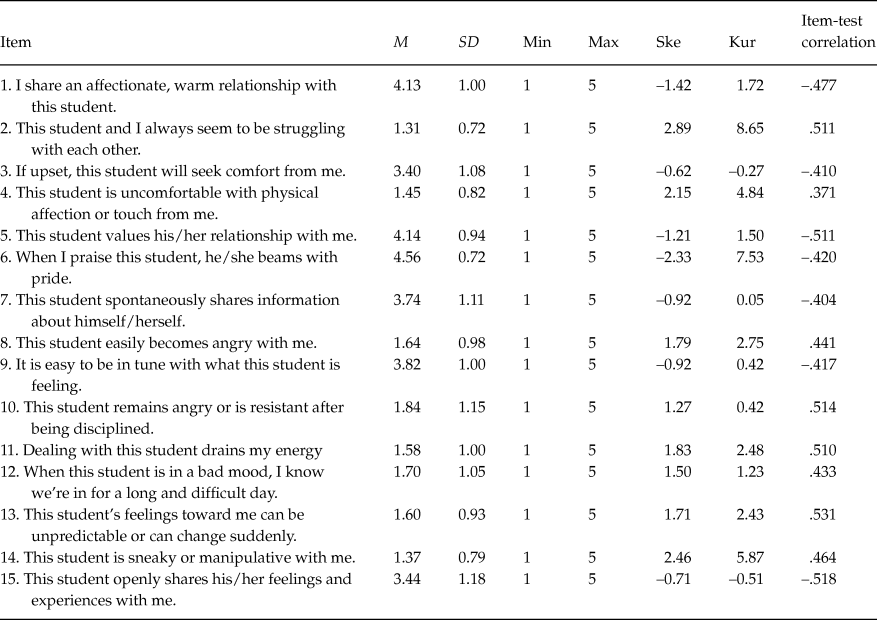
All items demonstrated adequate variance (see Table 1), with values ranging from 1 to 5, and standard deviations from 0.72 to 1.18. Values less than 2 for univariate skewness and 7 for univariate kurtosis were used as criteria for evaluating univariate normality (Curran, West, & Finch, Reference Curran, West and Finch1996). These values indicated a positive asymmetry for three negative items (2, 4 and 14), a negative asymmetry for one positive item (6), and a leptokurtic distribution in two items (2 and 6). This indicates that in general the majority of the items (except item 2 and 6) are not far from normality. The item-total correlations ranged from .37 and .53, suggesting that all items share variance with the total scale.
Item-level statistics
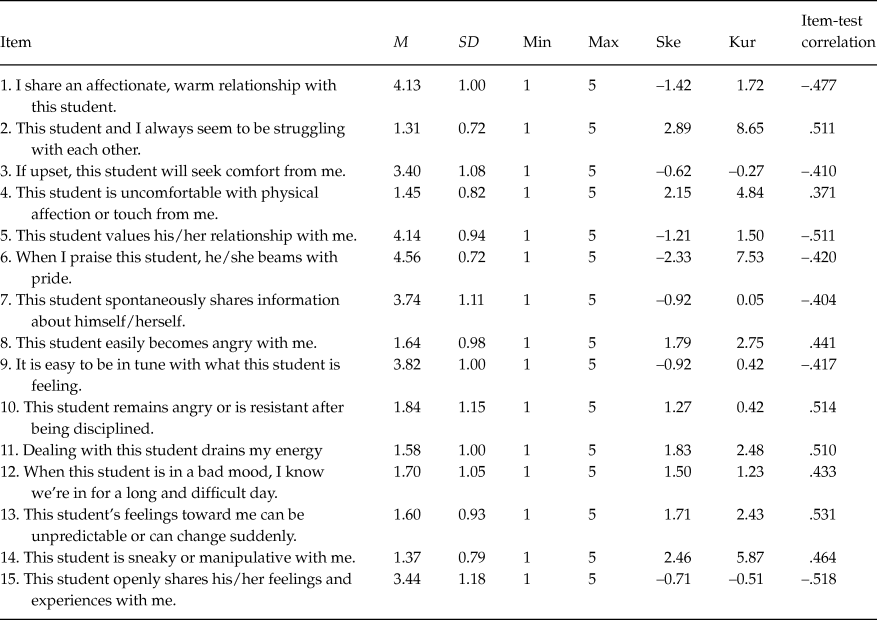
Note: Ske = skewness; Kur = kurtosis.
The descriptive statistics for the two dimensions (see Table 2) indicated that the conflict and closeness values varied between the maximum and minimum possible values of the scale (i.e. 40 and 8, and 35 and 7, respectively), while the STRS total score varied between the maximum and almost the minimum possible values of the scale (i.e. 75 and 15). Although the analysis of the Kolmogorov-Smirnov Test indicated that these scales do not have a normal distribution, the skewness and kurtosis values showed that they are not far from normality. However, the percentile values for each subscale and for the total score indicated that the teachers tend to view the student-teacher relationship positively. In fact, the teachers reported significantly higher scores on the closeness subscale, than on the conflict subscale, F(1, 534) = 1795.31, p < .001.
Dimension-level statistics

Note: Ske = skewness; Kur = kurtosis. KS = Kolmogorov-Smirnov test; P25 = 25th percentile; P50 = 50th percentile; P75 = 75th percentile.
*p < .05 **p < .01 ***p < .001.
Reliability
Cronbach’s alpha indicated high internal consistency of conflict and closeness dimensions (α = .87, and α = .86, respectively) and also in the STRS total score (α = .84). The item-total correlation varied between .44 and .69 in all items in both subscales, and inter-item correlations varied between .27 and .63, suggesting that all items are relevant to these subscales.
Construct Validity
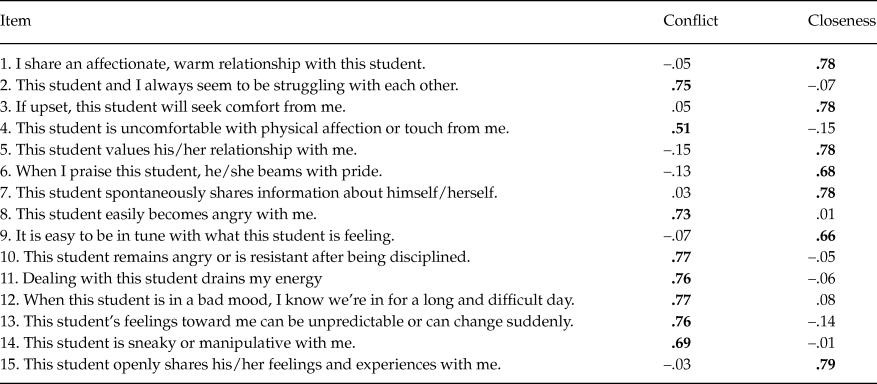
The exploratory factor analysis, with a principal components extraction method and Varimax rotation, supported the original two-factor solution by Pianta (Reference Pianta1992). This two-factor solution accounted for 54.89% of total variance (see Table 3). The two factors presented Eigenvalues of 4.62 and 3.61, and accounted for 30.83% and 24.06% of the total variance, respectively for conflict and closeness.
Rotated factor loadings
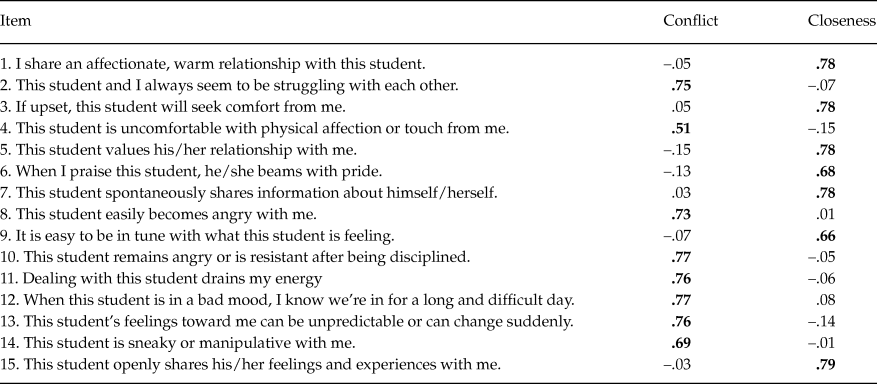
Note: Factor loadings > .40 are in boldface.
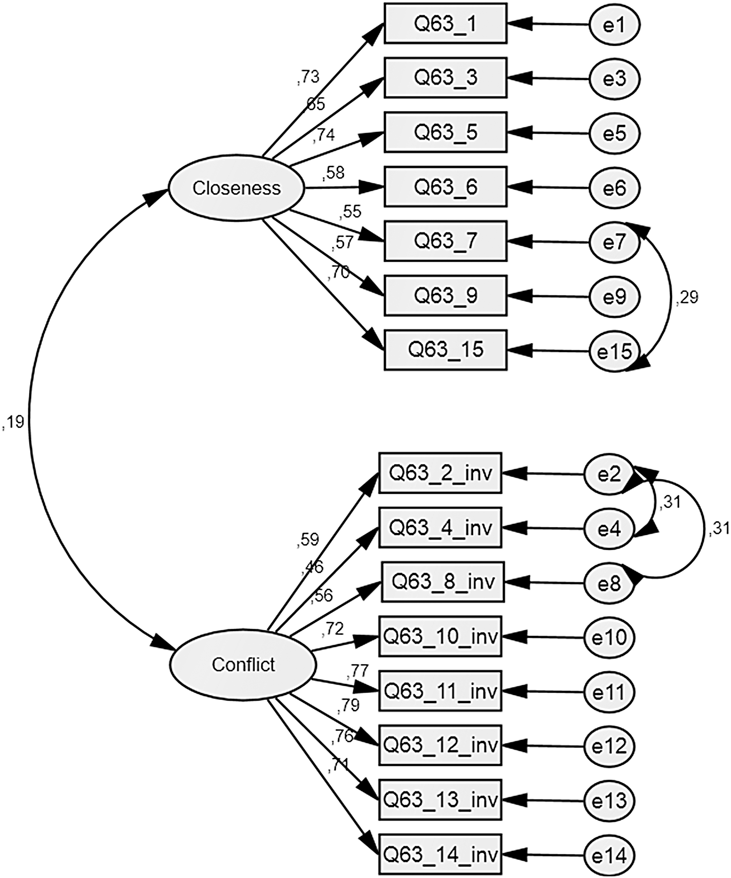
In the confirmatory factor analysis, we tested the model fit for the two-factor model. This first model (Model A) displayed satisfactory fit index values (CFI = .92, GFI = .90, RMSEA = 0.07, χ2/df = 2.32), but three pairs of errors in the same dimensions had high modification indices. Therefore, we tested a second model assuming correlations of these errors (Model B, Figure 1), and a good fit was achieved (CFI = .96, GFI = .93, RMSEA = 0.05, χ2/df = 1.65; Hu & Bentler, Reference Hu and Bentler1999).
Model B and standard loadings.

The relation between the conflict and closeness subscales was weak but significant and negative (r = –.15, p < .001). The relation between the subscales and the STRS total score was also significant, but strong and negative with the conflict subscale (r = –.77, p < .001) and strong and positive with the closeness subscale (r = .74, p < .001).
Relationship between the STRS-SF and Student and Teacher Characteristics
The proportion of female and male students selected by the teachers differed in function of their gender, i.e., female teachers chose more female than male students and male teachers chose more male than female students, χ2 (1) = 5.034, p = .025.
Regarding the relationship quality T-tests indicated that there were significant differences in teachers’ reported conflict, t(525) = –3.80, p < .001, and overall student-teacher relationship, t(525) = 3.67, p < .001, depending on the student’s gender. Teachers reported less conflict in student-teacher relationships with the female students (M = 11.52, SD = 4.63) than male students (M = 13.26, SD = 5.75), and globally better student-teacher relationships with female students (M = 64.14, SD = 7.37) than male students (M = 61.62, SD = 8.34). There was no statistical evidence of a significant difference in closeness in student-teacher relationships by students’ gender, t(525) = 1.76, p = .079.
The regression model indicated that the students’ grade level was significantly associated with the closeness subscale, F(1, 518) = 22.74, p < .001, and the STRS total scale, F(1, 518) = 9.23, p = .003, but not with the conflict subscale, F(1, 518) = 0.00, p = .991. The teachers with students in the first grades had closer relationships (β = –.21, CI = –.83 - –.35) and better student-teacher relationships overall (β = –.13, CI = –.97 - –.21), than the teachers with students in the more advanced grades.
T-tests indicated that there were significant differences in teachers’ reported conflict, t(530) = –3.34, p < .001, closeness, t(530) = 4.06, p < .001, and overall student-teacher relationship, t(530) = 4.90, p < .001, depending on the teachers’ gender. Female teachers reported less conflict (M = 12.10, SD = 5.14), more closeness (M = 27.75, SD = 5.06) and better overall student-teacher relationships (M = 63.65, SD = 7.93), than male teachers (M = 13.99, SD = 6.21, M = 25.59, SD = 5.04, and M = 59.60, SD = 7.66 respectively).
Finally, the regression model indicated that there are no significant differences in conflict, F(3, 517) = 0.24, p = .867, closeness, F(3, 517) = 1.98, p = .116, and total student-teacher relationships, F(3, 517) = 0.62, p = .600, by age, average teaching experience in general, and average teaching experience in the current school.
Discussion
The purpose of the present study was to adapt a widely-validated and accepted measure of student-teacher relationships, to be applicable to students from first to ninth grade, and to allow us to evaluate the impact of public large-scale programs and public policies in the student-teacher relationship. To achieve this goal we presented the adaptation procedures and psychometric properties of a Portuguese version of the Student-Teacher Relationship Scale – Short Form (STRS-SF; Pianta, Reference Pianta1992). We also tested the association of this version of the STRS-SF with students’ and teachers’ characteristics. Overall this adapted version of the STRS-SF showed good psychometric properties, namely high reliability and expected construct validity.
With regards to the descriptive properties of the adapted scale, we demonstrated that the items had adequate variability and are not far from a normal distribution. Only three items of the conflict dimension had a positive asymmetry (one of them with a leptokurtic distribution) and one item of the closeness dimension had a negative asymmetry and a leptokurtic distribution. This result is consistent with the results obtained for the original scale (Pianta, Reference Pianta2001) and in the other adaptations of the scale (e.g., Abreu-Lima et al., Reference Abreu-Lima, Cadima, Silva, Noronha, Machado, Almeida, Gonçalves, Martins and Ramalho2008) that showed some asymmetric values in the item level statistics. We also verified that the subscales and the STRS total score had adequate variability and are not far from a normal distribution. However, the teachers seem to have a tendency to view the student-teacher relationship positively. This result is consistent with other studies that showed the same tendency, i.e. teachers tend to report closer rather than conflicting relationships (e.g., Barbosa et al., Reference Barbosa, Campos and Valentim2011; Pianta, Reference Pianta2001).
Regarding reliability, we demonstrated that the internal consistency of the conflict and closeness subscales, and of the STRS total score was high (α = .87, α =.86, and α = .84, respectively) and similar to the values obtained in the original scale (α = .92, α =.86, and α = .89, respectively; Pianta, Reference Pianta2001) and in the other adaptations of the scale (e.g. from .76 to .90; e.g., Abreu-Lima et al., Reference Abreu-Lima, Cadima, Silva, Noronha, Machado, Almeida, Gonçalves, Martins and Ramalho2008; Drugli & Hjemdal, Reference Drugli and Hjemdal2013; Fraire et al., Reference Fraire, Longobardi, Prino, Sclavo and Settanni2013; García & Martínez-Arias, Reference García and Martínez-Arias2008; Gregoriadis & Tsigilis, Reference Gregoriadis and Tsigilis2008; Koomen et al., Reference Koomen, Verschueren, van Schooten, Jak and Pianta2012).
Regarding construct validity, we analyzed the factor structure of the STRS-SF and the relationship between the STRS subscales. The results from the exploratory analysis showed that this scale has exactly the same factors, with the same items, as the original short form of the scale (Pianta, Reference Pianta1992). In this adapted version, the total variance explained by this two-factor solution was higher than in the original scale (Pianta, Reference Pianta2001) and in the other adaptations of the scale (e.g., Abreu-Lima et al., Reference Abreu-Lima, Cadima, Silva, Noronha, Machado, Almeida, Gonçalves, Martins and Ramalho2008; García & Martínez-Arias, Reference García and Martínez-Arias2008). We hypothesize that this can be explained by the fact that in this study we analyzed the short form of the scale, while the other adaptation studies analyzed the complete scale, since the factor analysis of the short form of the scale explained more total variance than the complete scale on other Pianta’s studies (55% and 49%, respectively; NICHD Study of Early Child Care, 2000; Pianta, Reference Pianta2001). We then tested this two-factor solution using confirmatory factor analysis, which allowed us to confirm that this two-factor model has a good fit. The values obtained are similar to those obtained in other confirmatory factor analysis of the STRS-SF (Drugli & Hjemdal, Reference Drugli and Hjemdal2013; Gregoriadis & Tsigilis, Reference Gregoriadis and Tsigilis2008), confirming that this bi-dimensional structure seems to be robust and consistent in different cultural contexts.
With regards to the relationship between the STRS subscales and the total score, the results showed a weak and negative correlation between the closeness and the conflict subscales, a strong and negative correlation between the conflict subscale and the STRS total score, and a strong and positive correlation between the closeness subscale and the STRS total score. These results were consistent with the correlations observed in other studies (Abreu-Lima et al., Reference Abreu-Lima, Cadima, Silva, Noronha, Machado, Almeida, Gonçalves, Martins and Ramalho2008; Fraire et al., Reference Fraire, Longobardi, Prino, Sclavo and Settanni2013; Galanaki & Vassilopoulou, Reference Galanaki and Vassilopoulou2007; Pianta, Reference Pianta2001) although in this study the correlation between the subscales was weaker. The weakest value of this correlation comparing to other studies is probably due to the use of the short version of the scale, since this correlation seems to be weaker when assessed with the short version than with the complete scale (Drugli & Hjemdal, Reference Drugli and Hjemdal2013; Tsigilis & Gregoriadis, Reference Tsigilis and Gregoriadis2008). This negative correlation between conflict and closeness seems to be stable across cultures and means that this scale assesses two distinct constructs of the student-teacher relationship.
After we tested these psychometric properties, we analyzed the relationship of the student-teacher relationship with student characteristics, namely students’ gender and grade level in which students were enrolled. The results showed that teachers reported more conflicting relationships and worse overall student-teacher relationships with boys than with girls; and closer relationships and better overall student-teacher relationships with students in early compulsory grades than in later grades. These results are consistent with the results obtained in other studies, which showed that the teachers have more conflict in relationships with boys than girls, and more closeness in relationships with the youngest students and with the students in the early compulsory grades, than older and students in later grades, respectively (Barbosa et al., Reference Barbosa, Campos and Valentim2011; García & Martínez-Arias, Reference García and Martínez-Arias2008; Pianta, Reference Pianta2001). These results also seem to be consistent across different countries (Fraire et al., Reference Fraire, Longobardi, Prino, Sclavo and Settanni2013; Galanaki & Vassilopoulou, Reference Galanaki and Vassilopoulou2007; García & Martínez-Arias, Reference García and Martínez-Arias2008; Gregoriadis & Tsigilis, Reference Gregoriadis and Tsigilis2008), putting the boys and the older students at more risk for failure. Therefore, as stated by Spilt et al. (Reference Spilt, Koomen and Jak2012) they highlight the need for teachers to reflect and develop a view of the good student more in line with male gender role standards, that minimize the feminization of education, and the value of the stereotypical female behaviors (e.g., cooperation, compliance, attentiveness). The decrease in student-teacher closeness in the later school years seems to reflect the changes in the nature and function of the student-teacher relationships in later school years (Jerome, Hamre, & Pianta, Reference Jerome, Hamre and Pianta2009). Indeed, young adolescents report that these relationships tend to become less supportive (Midgley, Feldlaufer, & Eccles, Reference Midgley, Feldlaufer and Eccles1989), and the school environment becomes more impersonal, formal, evaluative and competitive (Eccles, Midgley, & Adler, Reference Eccles, Midgley, Adler and Nicholls1984).
In this study we also examined the association between teacher variables that could have influence on student-teacher relationship, such as teachers’ gender, age, average teaching experience in general, and average teaching experience in the current school. We demonstrated that female teachers reported more closeness, less conflict, and better overall student-teacher relationships, than the male teachers. These relationships were not analyzed in the original scale (Pianta, Reference Pianta2001), nor in some adaptations of the scale (e.g., Abreu-Lima et al., Reference Abreu-Lima, Cadima, Silva, Noronha, Machado, Almeida, Gonçalves, Martins and Ramalho2008; Barbosa et al., Reference Barbosa, Campos and Valentim2011; García & Martínez-Arias, Reference García and Martínez-Arias2008). The studies that examined these correlations showed similar results, i.e. female teachers report better relationships with their students than male teachers, stressing the need to encourage male teachers to invest in closer student-teacher relationships (Spilt et al., Reference Spilt, Koomen and Jak2012).
This study has several limitations. First, because our sample was composed by teachers in schools that applied for a specific public policy, the results may not generalize to all teachers in the country. Second, we do not know if the process of filling the questionnaire online skewed the results. Third, we did not evaluate the extent to which retrospective assessment of the student-teacher relationship, rather than current, had an impact on the results. Fourth, we did not test other types of validity, and the influence of contextual variables in student-teacher relationship.
In future studies of this version of the STRS-SF, the predictive validity of this scale should be analyzed, correlating the STRS subscales and total score to student academic success and other student outcomes (e.g. problem behavior, school dropout). It is also important to make sure that the discriminant and convergent validity of this adapted scale are verified.
In terms of implications for intervention, the described associations between student-teacher relationship and students’ and teachers’ characteristics have clear implications for program and policy development. It is critical to implement systems of professional-development such as My Teaching Partner, to teachers become aware of the biases in the student-teacher relationship (e.g., by gender and grade), to learn how to overcome them, and to improve the student-teacher interactions.
Finally, the student-teacher relationship may be a direct focus of intervention or an important feature of successful implementation of many interventions (Hamre & Pianta, Reference Hamre, Pianta, Bear and Minke2006). Therefore the Portuguese STRS-SF can be used for intervention design and program evaluation in all compulsory grade levels. It can also be used to measure the relationship between conflict and closeness and other important variables such as academic achievement or child development.
Considering our initial hypothesis we conclude that this study offers initial evidence of the validity of the bi-dimensional structure the STRS-SF in a Portuguese sample of children in grades one to nine, which reinforce the idea that this structure is robust and consistent in different cultural contexts. This study also corroborates the hypothesis that teachers report better relationships with girls and in earlier school years; and that female teachers report better relationships than male teachers. However, in this study, the teaching experience did not have impact on the reports of student-teacher relationship.
In sum, the results obtained from this study are consistent with previous studies, which support the validation of this construct and of this measure across different cultures. This study also demonstrated that the adapted version of the STRS-SF has good psychometric properties, namely high reliability and expected construct validity, and can now be used in Portugal to measure student-teacher relationship across all compulsory grade levels. This version can be used for further research and intervention purposes, with a particular emphasis in the evaluation of large-scale programs and public policies and their impact on student-teacher relationships.
This study was funded by the Portuguese Ministry of Education and Science Procedure n° 2011/109/GEPE/ABS, through a grant from the POAT-European Social Fund, European Commission. We would like to thank participating students, teachers and principals. M. Clara Barata acknowledges funding from the European Union under the Marie Curie International Incoming Fellowship (FP7-PEOPLE-2011-IIF 303242).