Parenting has strong instrumental connotations and is widely believed to contribute in central ways to the course and outcome of child development and adjustment by regulating the majority of child–environment interactions and helping to shape children's adaptation (for a review, see Bornstein, Reference Bornstein, Lerner, Bornstein and Leventhal2015). Parenting is expressed in cognitions and practices. Parents’ cognitions, for example, their parenting knowledge, satisfaction, and attributions, are believed to serve many functions: parenting cognitions shape parents’ sense of self, help to organize parenting, and contribute to determining how much time, effort, and energy to expend in parenting. Parents’ practices instantiate the actual opportunities parents provide children and so constitute a large measure of children's worldly experience. Insofar as parenting practices embody or are motivated by parenting cognitions, cognitions are thought to generate and give meaning to practices and mediate their effectiveness. It is therefore often assumed that caregiving cognitions engender caregiving practices and, ultimately, children's development and adjustment (e.g., Darling & Steinberg, Reference Darling and Steinberg1993; De Houwer, Reference De Houwer, Extra and Verhoeven1999; Goodnow, Reference Goodnow and Bornstein2002; Holden & Buck, Reference Holden, Buck and Bornstein2002; Sigel & McGillicuddy-De Lisi, Reference Sigel, McGillicuddy-De Lisi and Bornstein2002). For example, in the basic model of the emergence of attachment relationships, parents’ mental representations of their own childhood attachment experiences are asserted to influence their styles of parenting sensitivity, which, in their turn, promote development of particular qualities of the parent–child attachment relationship and, hence, shape child development (see, e.g., Haltigan et al., Reference Haltigan, Leerkes, Wong, Fortuna, Roisman, Supple and Plamondon2014; Pederson, Gleason, Moran, & Bento, Reference Pederson, Gleason, Moran and Bento1998).
It is surprising that, however widely this three-term “standard model” is presumed, it has seldom been confirmed in toto in conservative independent longitudinal investigation, such as we do here. The meaningfulness of the three-term model is not insignificant because parenting research, and parenting interventions designed to improve child development and foster adjustment, often simply assume it (e.g., Cowan, Cowan, Ablow, Johnson, & Measelle, Reference Cowan, Cowan, Ablow, Johnson and Measelle2005), perhaps because pairs of relations from the three-term model are fairly common in the extant literature. It could be that 2 + 2 = 3, but assuming so does not make it so. We first review neighboring pairs of relations in the three-term model: given the enormity of the apposite literature, illustrations suffice. Afterward, we add the pairs together to lay out the design advances of the present study of the complete three-term standard model.
Cognitions → Practices
Do parents’ cognitions always animate their practices? General relations between “beliefs and behaviors” are historically an unsettled area in social psychology (e.g., Festinger, Reference Festinger1964; Green, Reference Green1954; LaPiere, Reference LaPiere1934). Ajzen and Fishbein's (Reference Ajzen and Fishbein1980) theory of reasoned action was developed to better understand this relation. An especially popular group for assessing belief–behavior relations has been parents (Holden & Buck, Reference Holden, Buck and Bornstein2002), but establishing relations between cognitions and practices in parenting specifically has proved elusive or relations appear only weak (e.g., Coleman & Karraker, Reference Coleman and Karraker2003; Cote & Bornstein, Reference Cote and Bornstein2000; Goodnow & Collins, Reference Goodnow and Collins1990; Holden, Reference Holden2002; Okagaki & Bingham, Reference Okagaki, Bingham, Luster and Okagaki2005; Sigel & McGillicuddy-De Lisi, Reference Sigel, McGillicuddy-De Lisi and Bornstein2002). For example, a larger proportion of parents report using corporal punishment than believe that it is necessary to use corporal punishment in child-rearing (Lansford & Deater-Deckard, Reference Lansford and Deater-Deckard2012). On the one hand, cognitions do not always map onto practices directly, but the two coexist in complex relations, and meaning assigned to each is critical (Bornstein, Reference Bornstein1995). Many parenting cognition–practice relations, whose causal association has been evaluated, have been overly general, giving little reason to expect this connection. On the other hand, when more circumscribed and conceptually corresponding cognition–practice associations are evaluated, as, for example, between authoritarian attitudes and harsh discipline strategies (Kochanska, Kuczynski, & Radke-Yarrow, Reference Kochanska, Kuczynski and Radke-Yarrow1989), some maternal child-rearing cognitions have been found to relate to some self-reported or observed child-rearing practices, thereby supporting the first expected link in the putative three-term causal chain (Kinlaw, Kurtz-Costes, & Goldman-Fraser, Reference Kinlaw, Kurtz-Costes and Goldman-Fraser2001). As supporting examples, mothers who think of themselves as efficacious and competent in their role as parents tend to be more responsive and empathic, and less punitive, and hold more appropriate developmental expectations (de Haan, Prinzie, & Deković, Reference de Haan, Prinzie and Deković2009; Meunier, Roskam, & Browne, Reference Meunier, Roskam and Browne2011). The degree to which mothers believe that children's development can be facilitated by their social environment is positively correlated with the amount and type of language that mothers use during mother–child interactions (Donahue, Pearl, & Herzog, Reference Donahue, Pearl and Herzog1997). Low-income mothers with lower levels of belief in parents-as-teachers (with respect to emergent literacy) are less likely to engage in facilitative reading, discussing topics with their children during shared book reading, and the like (DeBaryshe, Reference DeBaryshe1995). Eccles and Harold (Reference Eccles, Harold, Booth and Dunn1996) reported that parents’ confidence in their ability to influence their children's academic performance and school achievement is associated with parents’ school involvement and predicts parents’ helping with children's academic interests (see Hoover-Dempsey & Sandler, Reference Hoover-Dempsey and Sandler1997). Mothers who hold concerns about infant bad behavior and spoiling interact less positively with their infants (Burchinal, Skinner, & Reznick, Reference Burchinal, Skinner and Reznick2010).
In brief, belief–behavior connections are complex, and whether a belief predicts a behavior depends on many factors. Therefore, links between parents’ cognitions and their practices, or their strength, appear to depend, at least in part, on conceptual alignment of the contents of the cognitions and the practices in question. Parents’ cognitions may provide parents with a framework for, among other things, guiding their interactions with their children and determining the opportunities they supply their children.
Practices → Outcomes
Parenting practices are commonly linked to children's development (Belsky, Fearon, & Bell, Reference Belsky, Fearon and Bell2007; Bornstein, Reference Bornstein, Lerner, Bornstein and Leventhal2015). For example, parent limit setting is associated with higher levels of child competence and lower levels of child disruptive behavior (Koblinsky, Kuvalanka, & Randolph, Reference Koblinsky, Kuvalanka and Randolph2006); parent rejection with child internalizing and externalizing (Deater-Deckard, Ivy, & Petrill, Reference Deater-Deckard, Ivy and Petrill2006; Khaleque & Rohner, Reference Khaleque and Rohner2002); parent psychological control, harsh parenting, negative support (rejection, hostility, and neglect), and inconsistent discipline with child negative reactivity and delinquency (Braungart-Rieker, Hill-Soderlund, & Karrass, Reference Braungart-Rieker, Hill-Soderlund and Karrass2010); and parent warmth, sensitivity, and involvement with child social competence, prosocial behavior, and academic achievement (Bates, Schermerhorn, & Petersen, Reference Bates, Schermerhorn, Petersen, Zentner and Shiner2012).
The early literature on “parenting effects” grew up as a natural consequence of unidirectional thinking about socialization, but much of it relied on parent–child correlations; that is, parents who did more of something had children who did more of a related something. However true it may be that parents influence children, we recognize that in cross-sectional designs, correlation does not prove causation and that the arrows of influence in an association may run in either or both directions (viz., that parents influence children and children influence parents). More advanced longitudinal, behavior genetic, and experimental research designs have corroborated practices-to-outcomes relations. Longitudinally, maternal talk with toddlers about cognitions (but not about desires or emotions) predicts children's later mental-state language, emotion understanding, and children's cognitive talk, controlling for earlier cognitive talk and language ability (Jenkins, Rasbash, & O'Connor, Reference Jenkins, Rasbash and O'Connor2003; Taumoepeau & Ruffman, Reference Taumpoepeau and Ruffman2008). In parent–offspring behavior genetic designs, parent corporal punishment and child externalizing behaviors are positively correlated in both genetically related and adoptive mother–child dyads (Deater-Deckard et al., Reference Deater-Deckard, Ivy and Petrill2006), and adoptive mothers’ sensitivity and support are associated with better social and cognitive development (Stams, Juffer, & van IJzendoorn, Reference Stams, Juffer and van IJzendoorn2002) as well as with stronger attachment relationships (Beijersbergen, Juffer, Bakermans-Kranenburg, & van IJzendoorn, Reference Beijersbergen, Juffer, Bakermans-Kranenburg and van IJzendoorn2012) in adopted children. Experimentally, Belsky, Goode, and Most (Reference Belsky, Goode and Most1980) rewarded mothers’ didactic interactions with their young children during play in a treatment group and later observed increases in mothers’ didactic interactions and more advanced play in children.
In brief, parents’ practices can affect their children's development, but, again, relations seem to depend on conceptual alignment of practice and outcome. Moreover, practice–outcome relations are not merely reducible to shared genetics between parents and their children.
Cognitions → Practices → Outcomes
Pairwise cognition–practice relations within parenting, and practice–outcome relations between parents and children, lend credence to an expected three-term causal chain. Going beyond pairwise links, and the compelling logic and intuitive appeal of the three-term cognitions → practices → outcome standard model notwithstanding, the developmental literature to date has amassed precious few appropriate, longitudinal, and conservative demonstrations of the full and fundamental three-term causal model. Methodological issues have posed a principal impediment. Many published associations between parents’ cognitions and practices, and parents’ practices and children's outcomes, are undermined by shared source and method variance. That is, much research that has reported connections between each pair of relations has utilized parents’ self-reports to measure the two, inflating their association. However, neither pair of associations must share source variance if, for example, practices and outcomes are rated by third parties. In some designs, cognitions and practices are measured at the same developmental wave, leaving direction of effects unclear, and concurrent measurements between “links” also inflate relations between constructs. In other designs purporting to support this pathway, only pairs (rather than the triad) of relations are included. Still other approaches fail to account for common-cause third variables; that is, associations between parent rearing and child characteristics could arise from shared third familial or extrafamilial factors (e.g., parents and their children come from the same socioeconomic stratum). Here, revisiting the three-term standard model, we attempt to redress all these methodological shortfalls.
That said, some more successful attempts have appeared in the literature from time to time. For example, Belsky, Hsieh, and Crnic (Reference Belsky, Hsieh and Crnic1998) observed that negative and intrusive mothering predicted externalizing behavior in 3-year-olds judged at 1 year of age to be temperamentally difficult. Parenting stress predicts perceived parenting behaviors that were, in turn, related to specific domains of self-concept in adolescence (Putnick et al., Reference Putnick, Bornstein, Hendricks, Painter, Suwalsky and Collins2008), and parenting stress predicts child problematic behaviors through its negative effect on parenting practices (Buodo, Moscardino, Scrimin, Altoè, & Palomba, Reference Buodo, Moscardino, Scrimin, Altoè and Palomba2013). However, in the first case the triggering cognition emanated from a parent report of infant temperament, and in the second and third cases the culprit was a psychophysiological state and not a cognition.
In brief, parents’ cognitions are widely thought to prompt or direct parents’ practices and, ultimately, children's development and adjustment, but this fundamental three-term formulation in family life and human development still awaits full independent confirmation.
This Study
A strong test of the three-term model would entail several design considerations. Measures of parenting cognitions, parenting practices, and child outcomes need to be displaced from one another in time and so require a minimum of three developmental waves: parental cognitions assessed at Wave 1 predicting parenting practices at Wave 2 in turn predicting child outcomes at Wave 3. Here, we demonstrate the longitudinal succession from parenting cognitions in toddlerhood to parenting practices in preschoolers to middle childhood externalizing behaviors in three temporally separate waves. Controls for stability of each construct should be included. Here, we controlled for stability in supportive parenting practices from toddlerhood to preschool, and stability in child externalizing from preschool to middle childhood, to ensure that stability was not driving the between-construct relations over time. The measures at each wave should be methodologically independent. Here, we use nonoverlapping methodological sources: parents’ self-reports at Wave 1, independent observations of parents interacting with their children at Wave 2, and teacher reports of children's classroom externalizing behaviors at Wave 3. Given the multidimensional and modular nature of parenting and expected specific relations among terms of the model, conceptually corresponding cognition–practice–outcome relations should be examined. Here, we included parenting cognitions antecedent to conceptually related specific dimensions of supportive parenting practices and child behavioral outcomes. Given a range of processes that might explain links from parenting cognitions to parenting practices to children's outcomes, a broad array of appropriate common-cause third-variable controls should be included. Here, we controlled for a comprehensive set of 12 child, maternal, and family factors that drew from the prevailing relational contextual perspective in developmental science, specifically Bronfenbrenner's bioecological model (Bronfenbrenner & Morris, Reference Bronfenbrenner, Morris, Lerner and Damon2006). Finally, we explored the generalizability of the three-term model by child gender.
For this study, we selected mothers’ parenting knowledge of child-rearing and child development, satisfaction with parenting, and internal attributions of parenting successes as parenting cognitions predictive of supportive parenting practices and child externalizing behaviors. The three types of cognitions are different from one another, but each cognition increases a mother's skill set for parenting in a different way. Parenting knowledge of child-rearing and child development equips a parent to fulfill the biological, physical, socioemotional, and cognitive needs of a child by providing an understanding of normative child development, an awareness of strategies for maintaining and promoting a child's health, and schemes for coping effectively with a child's illness. Parenting knowledge draws on science as well as social construction and is thought to be valid and reliable by members of the clinical and research communities (Bornstein, Cote, Haynes, Hahn, & Park, Reference Bornstein, Cote, Haynes, Hahn and Park2010; MacPhee, Reference MacPhee1981). Knowledge about children's development affects parents’ everyday decisions about their children's care and upbringing and about how to foster child health (Zuckerman & Keder, Reference Zuckerman, Keder, Lerner, Bornstein and Leventhal2015). Parenting knowledge equips a mother with information to interpret her child's abilities and accomplishments and tailor her interactions accordingly. The general state of knowledge that parents possess constitutes a frame of reference from which they interpret their children's behaviors. More knowledgeable parents have more realistic expectations of their children, they are more likely to behave in developmentally appropriate ways with their children (Grusec & Goodnow, Reference Grusec and Goodnow1994), and knowledge of child-rearing and child development explains variation in mother's emotional relationships with their children (Bornstein, Putnick, & Suwalsky, Reference Bornstein, Putnick and Suwalsky2012).
Parenting satisfaction refers to the perceptions of pleasure and gratification arising from the parenting role. Satisfaction affords a sense of well-being to parenting that translates to positive emotional availability to children in parent–child interactions (Bornstein et al., Reference Bornstein, Putnick and Suwalsky2012); thus, parenting satisfaction is intimately tied to parental affective reactions to their children. Parenting satisfaction is consequential because early parental caregiving patterns often persist and influence the ways in which parents interact with their children over time (Holden & Miller, Reference Holden and Miller1999). First-time parents’ perceptions of parenting satisfaction are intimately related to their interactions with their children (Pridham & Chang, Reference Pridham and Chang1989). Low parenting satisfaction is associated with dysfunctional parenting practices and behavioral problems in children (Johnston & Mash, Reference Johnston and Mash1989; Ohan, Leung, & Johnston, Reference Ohan, Leung and Johnston2000). Satisfaction motivates parents to care for, nurture, and interact constructively with their offspring.
Attributions are interpretations of causations of events and behaviors, and parenting attributions refer to the meanings and definitions assigned to a child's behavior (Bugental & Happaney, Reference Bugental, Happaney and Bornstein2002). Models of parent cognitions typically include attributions as important predictors of parent behavior (Bugental, Reference Bugental and Sameroff2009; Milner, Reference Milner2003). Attributions distinguish between internal (intentional) and external (situational), and parents’ attributions are conceptualized in terms of the balance of power in the parent–child dyad that parents attribute to themselves or to their child. That is, for a given parent–child interaction, parents may interpret the outcome of the interaction as having been caused primarily by themselves or primarily by their child. An internal attribution of parental success might refer to interpretations of a parental practice as dispositional and deliberate, whereas an external attribution of parental success might refer to interpretations of a parental practice as contextual, transitory, or even accidental. Like knowledge and satisfaction, parent attributions matter. Holding strong internal attributions of parenting successes imbues a mother with feelings of control in her parenting achievements, and how mothers attribute child intent regarding their child's behavior is associated with their endorsing discipline or not (Dix, Ruble, & Zambarano, Reference Dix, Ruble and Zambarabo1989). Parents who make attributions that give them little control over caregiving situations interact with their children in more maladaptive ways than parents who believe they have more control over their parenting successes and failures (Bugental et al., Reference Bugental, Ellerson, Lin, Rainey, Kokotovic and O'Hara2002, Reference Bugental, Ellerson, Lin, Rainey, Kokotovic and O'Hara2010; Sanders et al., Reference Sanders, Pidgeon, Gravestock, Connors, Brown and Young2004). Maternal social cognitive processes, and attribution processes in particular, are effective mechanisms linking parenting practices and child development.
Parents consider children's behavior as an important factor in child outcomes, but they also recognize that their own parenting cognitions and practices play key roles in parenting (Bornstein, Reference Bornstein and Cicchetti2016). The foregoing parenting cognitions have been determined to relate to some parenting practices (e.g., Coleman & Karraker, Reference Coleman and Karraker1997; Huang, O'Brien Caughy, Genevro, & Miller, Reference Huang, O'Brien Caughy, Genevro and Miller2005). We measured these three parenting cognitions in the second year of the child's life, our first data-collection wave, when we expected that many parenting cognitions would have stabilized (Holden & Miller, Reference Holden and Miller1999).
Two years later, we observed and coded mothers’ actual supportive parenting practices when their children were age 4. Age 4 is an ideal time to examine mother–child relationships because children are increasingly gaining independence and asserting themselves, just as they are gaining critical cognitive and problem-solving skills. Parents’ supportive behavior during this time may lay the foundation for successful school behavior in later childhood. We measured four diverse parenting practices during three different parenting tasks to gain a rounded picture of mothers’ actual interactive behaviors with their children. We recorded and coded mothers’ emotional support of their children by helping their children to regulate mood, by scaffolding interactive tasks, and by avoiding both intrusive and hostile interactions during joint picture book reading, puzzle solution, and drawing situations. Therefore, our second data-collection wave was based on observed and independently coded behaviors of mothers interacting with their preschoolers.
Finally, in the third study wave at age 10, we sought teachers’ ratings of child externalizing behaviors in the classroom setting as outcome measures. We did so for three reasons. First, age 10, near the end of elementary school, is a critical time for children who are learning to control their classroom behavior. Children at this age generally still have a single primary teacher and a consistent set of classroom peers. Children who exhibit high levels of externalizing behaviors at this age are likely to continue to do so in middle school (Bornstein, Hahn, & Haynes, Reference Bornstein, Hahn and Haynes2010), when the school environment becomes more variable. Second, a major goal of parenting is to rear children to function successfully in the formal educational system as children prepare themselves for adult life. Third, we also wished to obtain information about children's outcomes from a third and independent source, children's teachers.
Model Comparisons
To test the three-term standard model in parenting, we pursued and compared two statistical approaches, one via mediation (Cole & Maxwell, Reference Cole and Maxwell2003) and one via cascades (Masten & Cicchetti, Reference Masten and Cicchetti2010), instantiating three constructs: parenting cognitions (X), parenting practices (Y), and child outcomes (Z). Exploring the mediation of Y in the relation between X and Z normally includes establishing a relation between X and Z and then assessing whether that direct X → Z relation attenuates when Y is added to the model as a mediator. By contrast, a cascade is a developmental relation where X uniquely affects Y, which in turn uniquely affects Z, separate from any X → Z relation or other intrapersonal and extrapersonal factors. We did not observe any significant X → Z direct effects here, but considered that obtaining an X → Y→ Z cascade constitutes a critical test of the three-term parenting model because a cascade exposes a key temporal mechanism in the model regardless of any direct X → Z relation. Finding a developmental cascade elucidates how parenting cognitions relate to parenting practices that in turn relate to child outcomes.
In brief, we tested the hypothesized model that parenting cognitions generate parenting practices that in turn influence child outcomes: parenting cognitions → parenting practices → child outcomes.
Method
Participants
A total of 317 mother–child dyads participated in this three-wave prospective longitudinal study. Families were recruited from East Coast metropolitan and rural areas. Children (46.1% female) were firstborn in their families and averaged 20.09 (SD = 0.22) months at the first wave, 4.05 (SD = 0.09) years at the second wave, and 10.26 (SD = 0.17) years at the third wave. Mothers averaged 31.01 (SD = 6.35) years of age at the first wave. Approximately 11% of mothers had received a high school diploma or less education, 21% had completed some college or specialized training, 32% had a 4-year college degree, and 36% had some graduate or professional training. Most (91%) mothers were married, and 65% were employed. Family socioeconomic status (indexed by Hollingshead, Reference Hollingshead1975) ranged over nearly the full spectrum from 19 to 66 (M = 52.41, SD = 11.68). We recruited a sociodemographically heterogeneous, but ethnically homogenous, European American community sample as a first step in understanding this matrix of longitudinal cognition–practice–adjustment associations before embarking on more complex studies and analyses with ethnically diverse samples because parenting and child development are known to vary with ethnicity (Bornstein, Reference Bornstein, Lerner, Bornstein and Leventhal2015; Murry, Hill, Witherspoon, Berkel, & Bartz, Reference Murry, Hill, Witherspoon, Berkel, Bartz, Lerner, Bornstein and Leventhal2015). By including only European American families, we intentionally avoided an ethnicity confound that has vexed the existing literature and would also cloud our findings (Bornstein, Jager, & Putnick, Reference Bornstein, Jager and Putnick2013).
At the third wave, each child's primary teacher provided information about the child's classroom behavior. Teachers had known children for an average of 8.52 (SD = 5.59) months, and duration was unrelated to their student ratings, rs (162–163) = .01–.07, ps = .380–.934.
Procedures
At the first wave, mothers completed a demographic questionnaire, three self-report questionnaires about their parenting cognitions, and engaged in a videorecorded free-play session with their child. At the second wave, mothers and their children were videorecorded while completing three tasks together: a joint picture book, a puzzle, and a drawing of their home, and mothers completed a questionnaire about the child's problem behaviors. At the third wave, mothers delivered questionnaires to their child's teacher, and teachers independently completed the questionnaires and returned them by mail to the investigators. We used multiple measures at each age to stabilize the findings.
Measures
20-Month parenting cognitions
The Knowledge of Infant Development Inventory (MacPhee, Reference MacPhee1981) is composed of 75 items used to assess mothers' knowledge of parental practices, developmental processes, health and safety guidelines, and norms. For example, “A good way to teach your child not to hit is to hit back” (correct answer = disagree) and “The two-year-old's sense of time is different from an adult's” (correct answer = agree). Items are all close-ended, and the response format varies by question (e.g., agree-disagree, multiple choice). Items were recoded into correct (1) and incorrect (0) answers, and the proportion of total items that were correct was used. Because Cronbach α is a poor measure of reliability for knowledge indices (Streiner, Reference Streiner2003), split-half reliability was calculated and was satisfactory at 0.76.
Maternal satisfaction with parenting was evaluated using the Self-Perceptions of the Parental Role (MacPhee, Benson, & Bullock, Reference MacPhee, Benson and Bullock1986). Five items of the Self-Perceptions of the Parental Role pertaining to maternal satisfaction were averaged to create the scale. Each item has a pair of statements that describe contrasting endpoints of the dimension, thereby minimizing socially desirable responses. For example, one item states: “For some parents, children mostly feel like a burden. BUT For other parents, their children are a main source of joy in their lives.” The respondent chooses the statement that describes her best and then checks Sort of true for me or Really true for me. There are four response items, weighted 1, 2, 4, and 5 to account for the absence of a response indicating that the item was equally like and unlike the respondent. Internal consistency α was 0.76.
The Parent Attributions Questionnaire (MacPhee, Seybold, & Fritz, Reference MacPhee, Seybold and Fritzn.d.; Sirignano & Lachman, Reference Sirignano and Lachman1985) contains five causal attributions to explain successes (and failures) in seven parenting tasks. The causes are mothers' ability, effort, and mood; difficulty of the task; and the child's behavior (Weiner et al., Reference Weiner, Frieze, Kukla, Reed, Rest, Rosenbaum, Jones, Kanouse, Kelley, Nisbett, Vanins and Weiner1972). The parenting tasks are dressing, bathing, comforting, teaching, disciplining, communicating, and playing. For example, one of the items asks “When I am able to get my child to take a bath, it is because: (a) I am good at this, (b) This is easy to do, (c) My child makes this easy to do, (d) I've tried hard, and (e) I'm in a good mood.” Each of the causal attributions for each parenting task was rated on a scale from 1 (not at all a reason) to 5 (very much a reason). We used the internal attributions of success scale, which was computed as the mean of three subscale scores (21 items): the sums of the seven ratings attributing successes to maternal ability, effort, and mood. Higher scores indicated that mothers rated internal factors as contributing more to their parenting successes (range = 7–35). Internal consistency α was 0.88.
20-Month supportive parenting
Each mother–child dyad was visited at home and videorecorded for 10 min of free play by a single female filmer. A standard set of toys was brought to the home; the child's own toys were not used to control for variations in the quality and quantity of toys a 20-month child might have available. Videorecords were coded using three rating scales from the Emotional Availability Scales: Infancy to Early Childhood Version (Biringen, Robinson, & Emde, Reference Biringen, Robinson and Emde1998). Maternal sensitivity, ranging from 1 (highly insensitive) to 9 (highly sensitive), assessed acceptance, flexibility, affect regulation, and variety and creativity of behavior displayed toward the child. Maternal structuring, ranging from 1 (nonoptimal) to 5 (optimal), assessed appropriate facilitation, scaffolding, mediation, and organization of child activity, exploration, and routine by providing rules, regulations, and a supportive framework for interaction without compromising the child's interest in such activities. Maternal nonintrusiveness, ranging from 1 (intrusive) to 5 (nonintrusive), measured support for the child without interrupting the child by being overdirective, overstimulating, overprotecting, and/or interfering. All scales were coded in half-points, and after achieving reliability with an author of the scales, coder agreement intraclass correlations (ICCs), computed on 19% of the sample, ranged from 0.84 to 0.90.
4-Year supportive parenting
Mother–child dyads were videorecorded while they engaged in three joint tasks: reading a picture book, assembling a puzzle, and creating a drawing of their home. Videorecords were coded using four rating scales that focused on maternal parenting practices from the Teaching Tasks (Egeland et al., Reference Egeland, Weinfield, Hiester, Lawrence, Pierce, Chippendale and Powell1995): supportive presence includes maternal involvement and acting as a secure base for the child; quality of instruction indicates appropriate, timely, and helpful guidance to complete the tasks; intrusiveness connotes interference with the child's progress and indicates a lack of respect for the child's autonomy; and hostility indicates anger toward or rejection of the child. All scales ranged from 1 to 7, with higher scores indicating higher levels of the maternal behavior being evaluated. Interrater reliability was assessed using average absolute agreement ICC in a two-way random effects model (McGraw & Wong, Reference McGraw and Wong1996). Six coders (blind to parents’ 20-month supportive parenting and self-reports) reached reliability with a coder trained by the authors of the system, and ICCs ranged from 0.71 to 0.95. All interactions were double-coded (ICCs = 0.69–0.85), and scores within 1 point were averaged; discrepant scores (12%) were coded by consensus to achieve perfect agreement.
4-Year mother report of child externalizing behavior
The Preschool Behavior Questionnaire (Behar & Stringfield, Reference Behar and Stringfield1974) was used to assess the mother's perceptions of child problem behaviors. Each of 30 questions was rated on a 3-point scale for the degree to which a target behavior applied to the child: 0 = doesn't apply, 1 = applies sometimes, and 2 = certainly applies. The hostility/aggression scale was computed as the sum of the 11 items that made up the scale. Internal consistency α was 0.75.
10-Year teacher reports of child classroom externalizing behavior
Four measures assessed child externalizing behavior (anger, aggression, and delinquency) in the classroom. The four-item expresses anger subscale of the Child Rating Questionnaire (Roberts & Strayer, Reference Roberts and Strayer1996) was the first instrument used. An example item states, “Behaves aggressively with other children.” Items were rated on a 5-point scale ranging from not at all characteristic (1) to extremely characteristic (5) and averaged to form the scale. Internal consistency α was 0.72.
The 10-item Aggression Peer Nomination Scale of the Teacher Prediction of Peer-Nomination Inventory (Huesmann, Eron, Guerra, & Crawshaw, Reference Huesmann, Eron, Guerra and Crawshaw1994) represents the teacher's estimate of the average percentage of classmates who would identify the target child as aggressive. For each item, teachers estimate the percentage of the target student's classmates who would agree with the statement. For example, 1 item asks, “In your opinion, what percentage of students in your class would say that this child starts a fight over nothing.” Items are rated on a 6-point unequal interval scale from (0) 0% to (5) over 50% and then converted to percentages according to the midpoint of the percentage range for the response option. For example, if the teacher rated the item as a 3 (11%–25%), this item was assigned a score of 18% (the midpoint between 11% and 25%). Internal consistency α was 0.92.
The 25-item aggressive behavior and the 9-item delinquent behavior subscales of Achenbach's (Reference Achenbach1991) Teacher Report Form use items such as “Defiant, talks back to staff,” rated on a scale from (0) not true to (2) very true or often true, and scale items are summed. Internal consistencies α were 0.93 for aggressive behavior and 0.60 for delinquent behavior.
Covariates
To assess whether the three-term model held independent of potential covariates, we evaluated 12 candidate family, mother, and child third variables for their relations with the study variables. To be comprehensive and theoretically derived, the selection of the 12 covariates was guided by Bronfenbrenner's bioecological model: family socioeconomic status (SES; Hollingshead, Reference Hollingshead1975); mothers’ weekly hours of employment; mothers’ reports of satisfaction with work/family balance (single item; 1 = very dissatisfied to 5 = very satisfied); mothers’ community support from friends, neighbors, doctors, and clergy (averaged 0–5 scale); mothers’ parenting support measured by the Social Network Form (Weinraub & Wolf, Reference Weinraub and Wolf1983); mothers’ age; mothers’ verbal intelligence measured by the Peabody Picture Vocabulary Test (Form L; Dunn & Dunn, Reference Dunn and Dunn1981); mothers’ stress measured by the Perceived Stress Scale (Cohen, Kamarck, & Mermelstein, Reference Cohen, Kamarck and Mermelstein1983); mothers’ coping measured by the Social Network Form (Weinraub & Wolf, Reference Weinraub and Wolf1983); family support from the child's maternal grandparents, paternal grandparents, and other relatives (averaged 0–5 scale); child intelligence measured by the Wechsler Preschool and Primary Scale of Intelligence—Revised (Wechsler, Reference Wechsler1989); and mothers’ reports of child social competence measured by the Vineland Adaptive Behavior Scales (Sparrow, Balla, & Cicchetti, Reference Sparrow, Balla and Cicchetti1984). These 12 covariates shared between 0% and 31% of their variance.
Missing data and analysis plan
Of the 317 families who participated at 20 months, 4 years, and/or 10 years, 286 participated at 20 months and 265 participated at 4 years. Only 173 teachers provided data at 10 years. However, missing data points across the data set (22%) were missing completely at random, Little's missing completely at random χ2 (1,992) = 2,092.98, p = .057, and handled using full information maximum likelihood (Arbuckle, Reference Arbuckle, Marcoulides and Schumacker1996) within Mplus. Still, because there was a large percentage of missing data for teacher reports (45%), separate-variance t-tests were computed to identify differential missingness in the main study variables. The family's SES was lower for cases that were missing the teacher variables, ts (197.7–207.4) = 3.5–3.9, ps < .001. Consequently, to improve the full information maximum likelihood estimation and account for differential missingness, family SES was included as an auxiliary variable in the models that follow (Graham, Reference Graham2009).
First, we examined all variables for outliers and deviations from univariate normality. Standard transformations (e.g., second power, cube root) were applied as needed for any variables to approximate a normal distribution. Second, we explored descriptive statistics and correlations among the variables of interest. Third, we used Mplus version 7.2 (Muthén & Muthén, Reference Muthén and Muthén2014) to model (a) the effects of parenting cognitions when the child was 20 months directly on 10-year classroom behavior, and (b) the cascade from parenting cognitions at age 20 months to supportive parenting at age 4 years controlling for 20-month supportive parenting, and from supportive parenting at age 4 to classroom externalizing behavior at age 10 years controlling for age 4 externalizing behavior. A model was considered to have good fit if the χ2 test was nonsignificant (p > .05), the comparative fit index (CFI) and Tucker–Lewis index (TLI) ≥ 0.95 (Marsh, Balla, & Hau, Reference Marsh, Balla, Hau, Marcoulides and Schumacker1996), the root mean square error of approximation (RMSEA) ≤ 0.06, and the standardized root mean square residual (SRMR) ≤ 0.08 (Hu & Bentler, Reference Hu and Bentler1999), but we gave greater weight to the incremental fit indices than to the significance of the χ2 because the χ2 value is known to be sensitive to sample size (Cheung & Rensvold, Reference Cheung and Rensvold2002). To determine whether the model fit equally well for girls and boys, we computed two additional multiple-group models, constraining the factor loadings and structural paths to be equal in the first model and releasing these paths in the second model. Following Cheung and Rensvold (Reference Cheung and Rensvold2002), if the differences in χ2 values for the two models were nonsignificant, and the change in CFI ≤ 0.01, we could reasonably conclude that the same model fit well for girls and boys. Fourth and finally, we evaluated the 12 possible covariates and added those that were significantly correlated with one or more observed variables to the three-term cascade model to assess whether the covariates explained the structural paths.
Results
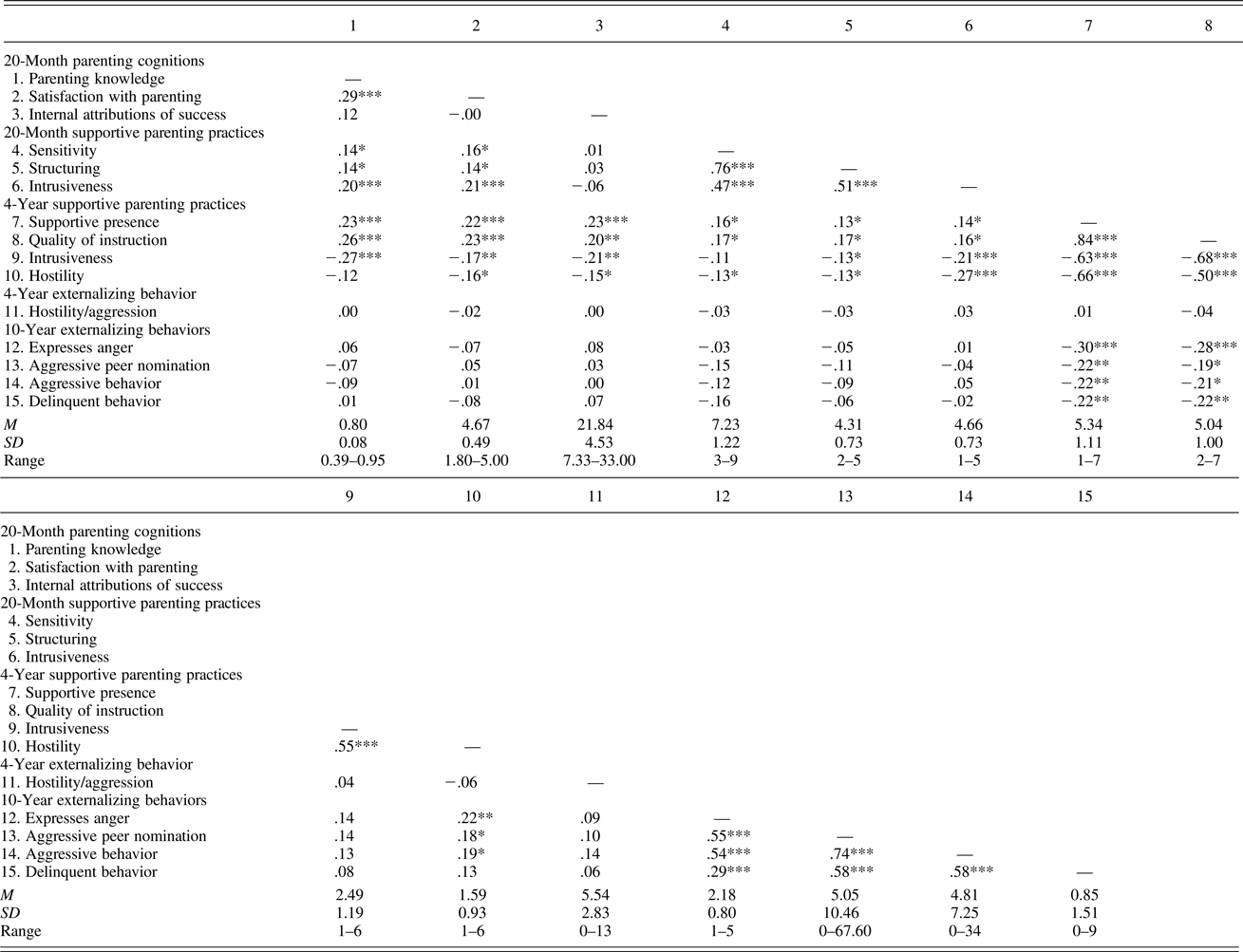
Table 1 displays descriptive statistics (untransformed to aid interpretation) and correlations among the study variables. Descriptive statistics indicate that the sample was normative on average, but there was a wide range of parent and child functioning. For example, mothers varied in their supportive parenting across nearly the full range of the scales, and children were rated from very low to very high in anger and aggressive behavior in the classroom. The temporally distributed correlations indicate that a model of parenting cognitions predicting supportive parenting and supportive parenting predicting child classroom behavior was warranted. As hypothesized, the three parenting cognitions were not highly correlated and were retained as independent individual predictors. The three supportive parenting practices at 4 years and the four supportive parenting practices at 10 years were intercorrelated, as were the four teacher measures of child classroom externalizing behavior, indicating that these three sets of variables would make strong factors. The correlations between parenting cognitions at 20 months and child classroom externalizing behaviors at 10 years were all small and nonsignificant, rendering a formal test of mediation moot (e.g., MacKinnon, Lockwood, Hoffman, West, & Sheets, Reference MacKinnon, Lockwood, Hoffman, West and Sheets2002).
Correlations and descriptive statistics of parenting cognitions, supportive parenting practices, and child externalizing behavior

*p < .05. **p < .01. ***p < .001.
Cascade model among parenting cognitions, parenting practices, and child adjustment
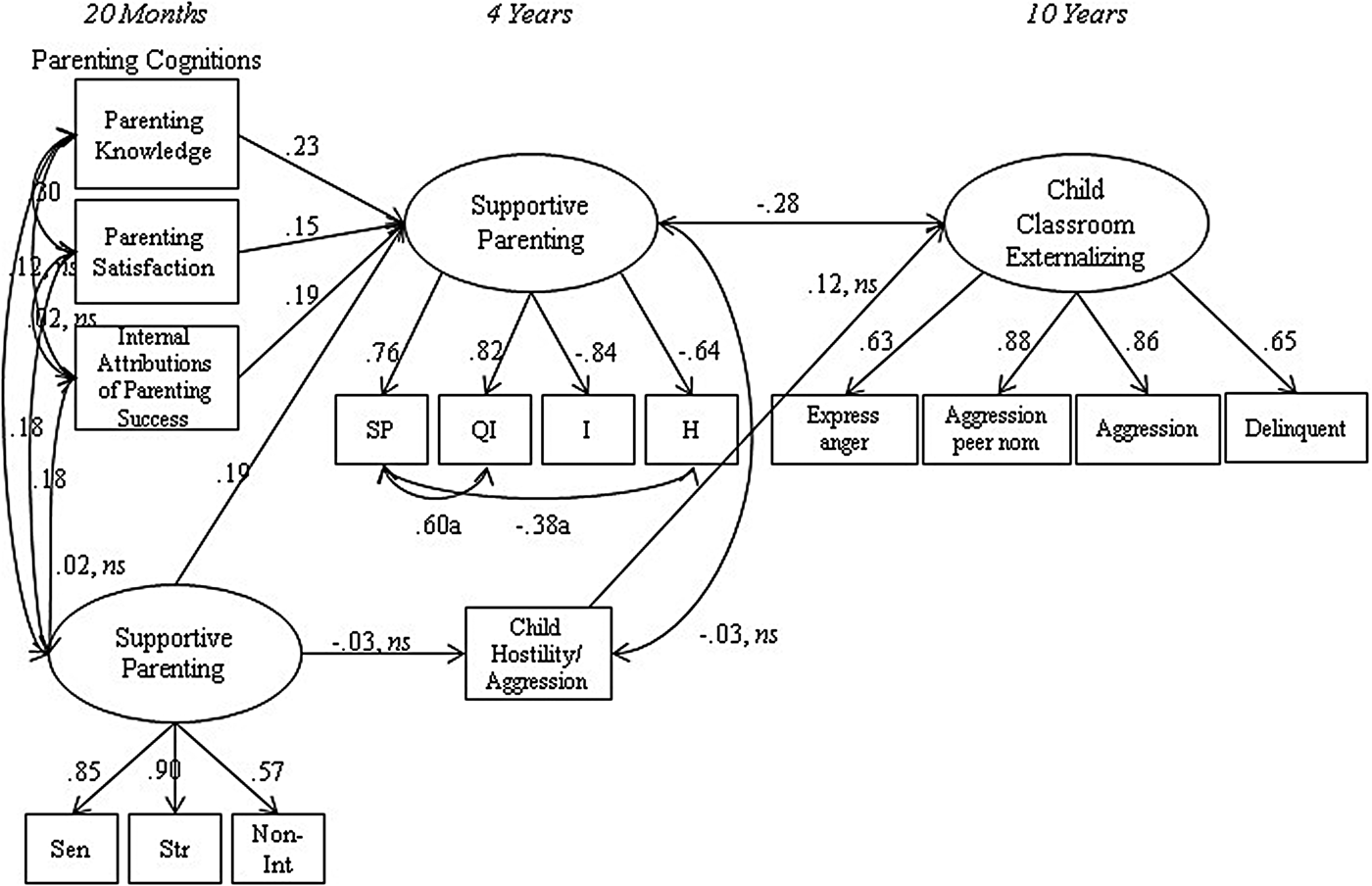
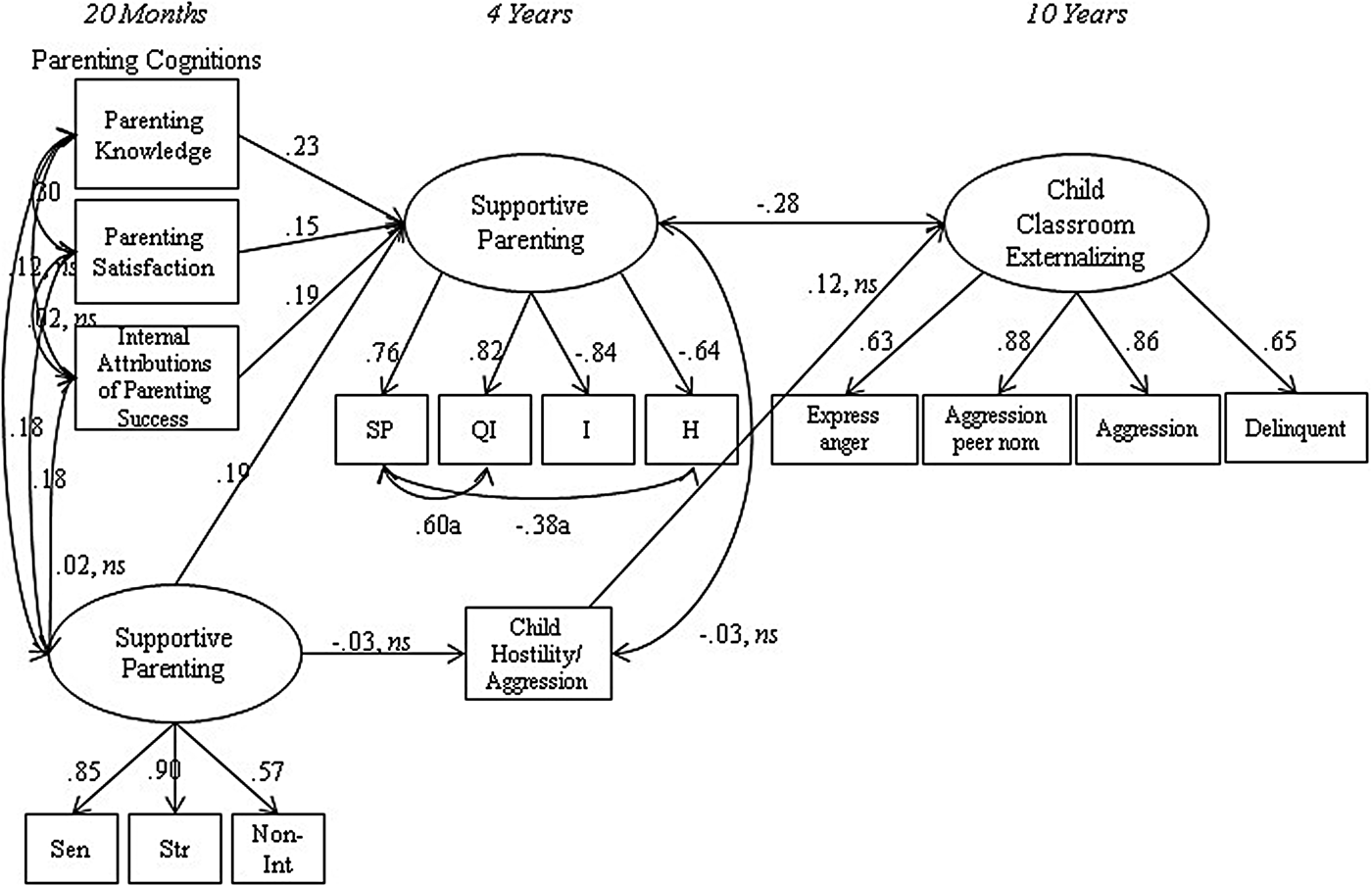
An initial cascade model was a reasonable fit to the data, χ2 (80) = 142.34, p < .001, CFI = 0.954, TLI = 0.940, RMSEA = 0.050, 90% confidence interval (CI) [0.036, 0.063], SRMR = 0.050, but modification indices indicated that three supportive parenting indicators at 4 years shared variance that was not accounted for by the latent factor. In a revised model, the residual term for supportive presence was allowed to covary with those of quality of instruction and hostility. This revised model (Figure 1) fit the data well, χ2 (78) = 92.82, p = .121, CFI = 0.989, TLI = 0.985, RMSEA = 0.024, 90% CI [0.000, 0.042], SRMR = 0.050. All three parenting cognitions at 20 months significantly and independently predicted increased supportive parenting at 4 years, and better supportive parenting at 4 years significantly predicted lower teacher-rated child externalizing behavior in the classroom at 10 years. This model explained approximately 21% of the variance in supportive parenting and 10% of the variance in externalizing behavior (standard errors = 5.5%). Indirect effects from parenting knowledge to classroom externalizing behavior (β = –0.065, p = .024) and from internal attributions of success to classroom externalizing behavior (β = –0.053, p = .045) were small and significant.
Standardized model of parenting cognitions predicting supportive parenting and supporting parenting predicting teacher-rated child classroom behavior. All model coefficients are significant at p < .05, unless otherwise noted. Residual terms are excluded from the figure to simplify the presentation and facilitate interpretation. Sen, sensitivity; Str, structuring; Non-Int, nonintrusiveness; SP, supportive presence; QI, quality of instruction; I, intrusiveness; H, hostility. aCovariance added to the a priori model.
Multiple-group gender cascade model among parenting cognitions, parenting practices, and child adjustment
To determine whether the model in Figure 1 fit equally well for girls and boys, we compared two multiple-group models. We were interested in whether the loadings of the latent variables and the structural paths were invariant. Therefore, we constrained the loadings and structural paths to be equal in girls and boys and compared this model to a model with no equality constraints. The difference in model fit was nonsignificant, Δχ2 (15) = 22.61, p = .093, ΔCFI = 0.006, indicating that the model factor loadings and structural paths were similar in girls and boys.
Covariate-controlled cascade model among parenting cognitions, parenting practices, and child adjustment
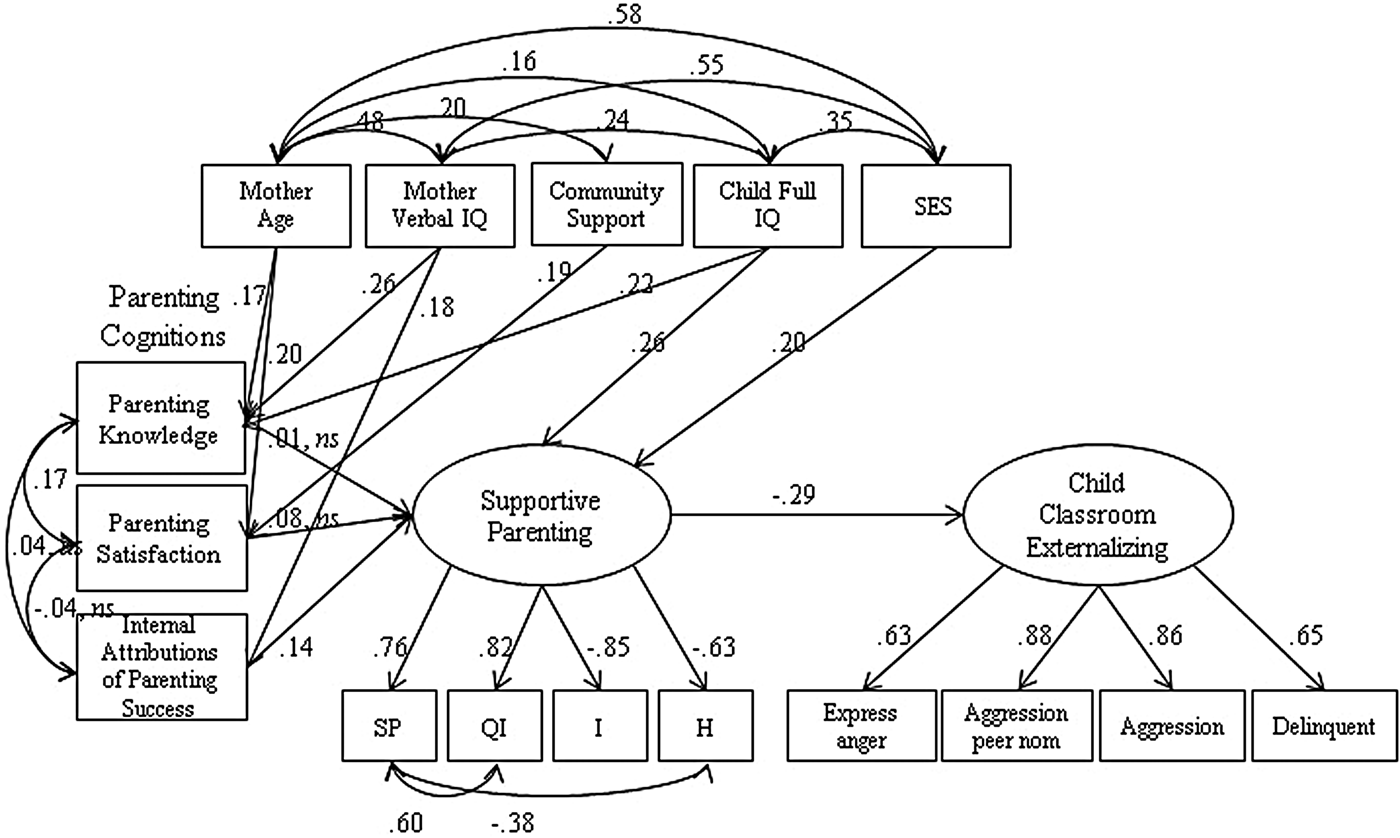
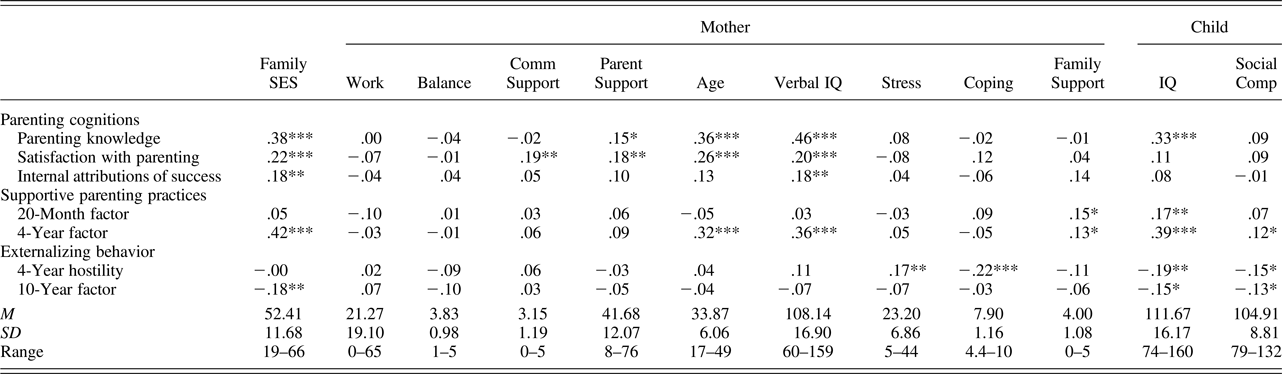
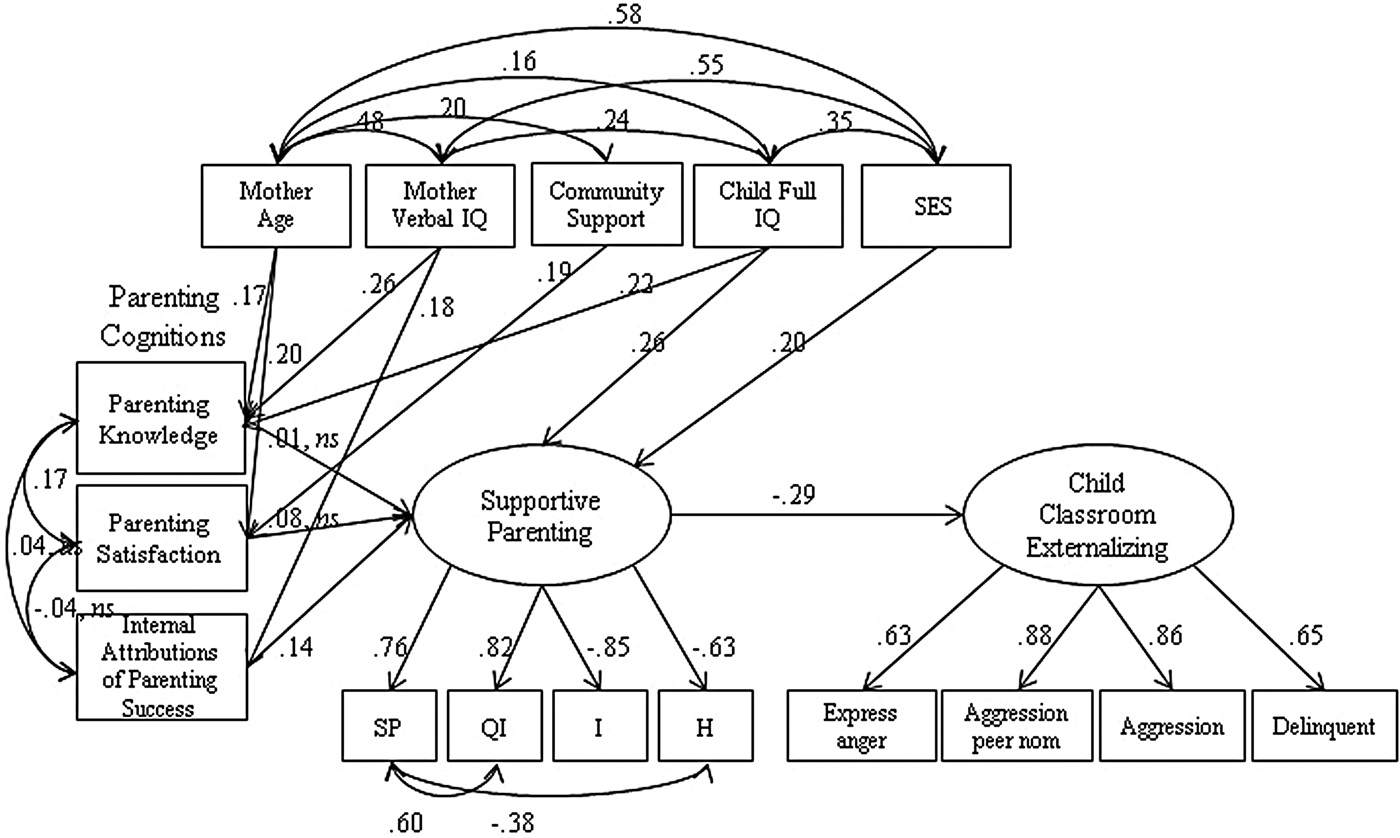
The model in Figure 1 does not take into account the possibility that other variables might account for three-term longitudinal relations. Two of the 12 potential covariates (mothers’ hours of employment and satisfaction with work/life balance) were not significantly related to any of the study variables and so were excluded from further inquiry (Table 2). The remaining 10 covariates were added as observed variables to the model. However, parenting support, stress, family support, and child social competence were not significant predictors of any study variables once other covariates were in the model and therefore were dropped. In the final comprehensive covariate model (Figure 2), the model fit was good, χ2 (149) = 185.21, p = .024, CFI = 0.977, TLI = 0.967, RMSEA = 0.028, 90% CI [0.011, 0.040], SRMR = 0.049, and the three-term cascade model was retained with internal attributions of parenting success in toddlerhood predicting increased supportive parenting from 20 months to 4 years and supportive parenting in preschool predicting lower classroom externalizing behavior at 10 years.
Covariate-controlled standardized model of parenting cognitions predicting supportive parenting and supporting parenting predicting teacher-rated child classroom behavior. All model coefficients are significant at p < .05, unless otherwise noted. Supportive parenting at 20 months, child hostility/aggression at 4 years, and residual terms are excluded from the figure to simplify the presentation and facilitate interpretation. Mother coping was related to child hostility aggression at 4 years, but no other variables in the model. SP, supportive presence; QI, quality of instruction; I, intrusiveness; H, hostility.
Correlations of parenting cognitions, supportive parenting practices, and child externalizing behavior with potential covariates, and descriptive statistics of the covariates
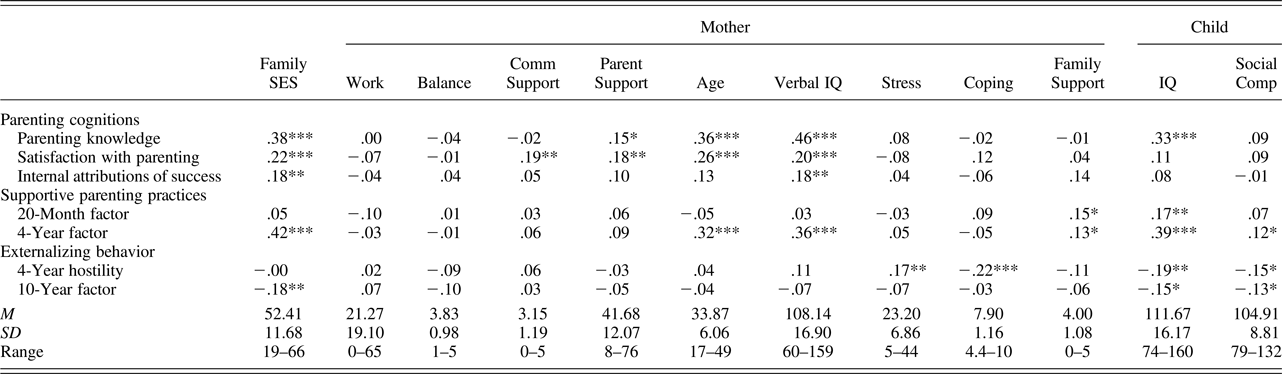
Note: SES, family socioeconomic status; Work, mothers’ weekly hours of employment; Balance, mothers’ satisfaction with work/family balance; Comm Support, mothers’ community support from friends, neighbors, doctors, and clergy; Parent Support, mothers’ parenting support; Verbal IQ, mothers’ verbal intelligence; IQ, child intelligence; Social Comp, child social competence.
*p ≤ .05. **p ≤ .01. ***p ≤ .001.
Discussion
In parenting, caregiver cognitions are commonly thought to shape caregiver practices and, in turn, caregiver practices to shape children's development and adjustment. Here, we tested that putative “cascade” longitudinally over an 8-year period from a set of parenting cognitions to a set of supportive parenting practices to a set of child behavioral adjustment outcomes especially pertinent to child development and psychopathology, and we did so with nonoverlapping multiple methods, with multiinformant data, in girls and boys, and with a comprehensive dozen potential common-cause controls. We found support for a standard model in which three kinds of parenting cognitions in toddlerhood (Wave 1) predicted more positive parenting practices in preschool (Wave 2) that in turn predicted lower levels of classroom externalizing behaviors in middle childhood (Wave 3). This developmental pattern held when controlling for previous supportive parenting and child hostility/aggression, indicating that the longitudinal relation between parenting cognitions or practices and child classroom externalizing behaviors was not simply a reflection of stability in the parent or child over time. Moreover, the model was robust to child gender, holding for families with girls and families with boys. Substantively, this study suggests that mothers who command greater knowledge of child development and caregiving, enjoy greater satisfaction in the parenting role, and possess stronger internal attributions for their successes in parenting when their children are toddlers engage in more supportive parenting practices with their preschoolers over 2 years later. Furthermore, mothers who support their preschool children emotionally (helping their children to regulate moods), scaffold interactive tasks, and avoid intrusive and hostile interactions when their children are 4 years old have children who better regulate their own behavior and display better classroom behavioral adjustment in the eyes of their teachers at age 10 years. Parenting knowledge (not unexpectedly) and parenting satisfaction covaried with maternal age and verbal IQ, community support, and/or child IQ, and both attenuated as unique independent predictors.
Moreover, the effect of internal attributions of parenting success on supportive parenting practices and then on child classroom externalizing adjustment obtained independent of 12 potential ecological covariates. These results raise the question of what process might link parent attributions to rearing practices, especially hostility and intrusiveness? Perhaps parent affect plays a role (Dix, Reference Dix1991). Parents who have low internal attributions of success may feel that they command insufficient control in parenting that may evoke anger toward the child (e.g., hostility) or maladaptive attempts to regain control (e.g., intrusiveness). Their behaviors essentially model a lack of self-regulation that children might internalize, say, in the form of hostile attributions about peers’ behavior and underregulated aggression that manifests as externalizing behavior in the classroom (Crick & Dodge, Reference Crick and Dodge1996).
Past concerns and future directions
We note, first, that the broad generality of the three-term parenting model depends on identifying parenting cognitions that relate to parenting practices and parenting practices that relate to child outcomes, when neither link is assured. Parents’ cognitions do not invariably affect their practices, just as parenting practices need not affect child outcomes. Coordinate relations between parents’ cognitions and their practices, and parents’ practices and their children's development, have often proven elusive, with many researchers failing to uncover systematic relations between parents’ professed parenting attitudes and their activities with their children, and between parents’ activities with their children and children's outcomes.
In part, these conjunctions or disjunctions reflect how cognitions, practices, and outcomes are defined, operationalized, and assessed in relation to one another. Furthermore, the theory of reasoned action recognizes the role of an individual's beliefs and views about other people's orientations, motivation, and behavior intentions as separate components contributing to the decision whether to engage in a behavior that is consonant with a belief. Here, we found that certain parenting cognitions predicted a certain parenting practice that related to a certain child outcome. Thus, the strength of associations in parents’ cognitions and practices and child adjustment appears to depend, at least in part, on specific and aligned conceptual relations in the contents of each.
One important issue in the three-term model that merits additional attention is thus conceptual. A second is statistical. The effect sizes in our model were generally small. Before engaging statistical controls, three independent parenting cognitions initiated developmental relations to parenting practices and eventually to child classroom behaviors. Only one of those cognitions maintained significance when controlling for all 12 family, parent, and child characteristics. However, given the wide range of controls considered in this study, retaining any three-term model, even with small effects, extending over nearly a decade is highly conservative. Moreover, effect size is a multiplicative product of associations between terms, and even if each pair of factors in a three-term chain were related to one another with a relatively large degree of strength of, say, 0.50, the effect size across the three would only be 0.25. That said, in development even small effects that aggregate over time are meaningful (Abelson, Reference Abelson1985; Bornstein, Reference Bornstein2014).
The three-term model is common and compelling, but is it complete? Here, we briefly point to three possible future modifications. First, parental cognitions are commonly acknowledged to be shaped by their context, for example SES and culture, and second, by characteristics of children. Third, children's perceptions of parenting play a significant role in the efficacy of parenting practices for child outcomes. On the first point, SES and culture condition parenting cognitions and so practices (Bornstein, Reference Bornstein and Cicchetti2016). For example, in accordance with the family stress model (Conger, Conger, & Martin, Reference Conger, Conger and Martin2010; Conger, Rueter, & Conger, Reference Conger, Rueter, Conger, Crockett and Silbereisen2000), low SES triggers economic pressure that in turn undermines parental well-being, the quality of interparental relationships, and mediated through these latter two factors, the quality of parenting (Emmen et al., Reference Emmen, Malda, Mesman, van IJzendoorn, Prevoo and Yeniad2013). Sturge-Apple, Suor, and Skibo (Reference Sturge-Apple, Suor and Skibo2014) found that mothers’ self-reported attributions for child behavior were most strongly linked to dysfunctional parenting among mothers who were socioeconomically disadvantaged (and had limited working-memory capacity). Among Mexican American mothers, endorsement of familism values predicts greater use of prosocial parenting practices (explaining to children why their help around the house is needed and expecting children to take care of younger family members), which in turn predicts more prosocial behavior (behaviors intended to benefit others, including comforting others when they are upset, helping others when asked, and assisting others during a crisis), as well as higher familism value endorsement among adolescents (Calderón-Tena, Knight, & Carlo, Reference Calderón-Tena, Knight and Carlo2011). Differences in cultural normativeness of corporal punishment and belief in the necessity of using corporal punishment to rear children relate to mothers’ and fathers’ reported likelihood of using corporal punishment (Lansford et al., Reference Lansford, Godwin, Uribe Tirado, Zelli, Al-Hassan, Bacchini and Alampay2015). As D'Andrade (Reference D'Andrade, Fiske and Schweder1986, p. 117) observed: “To understand people, one needs to understand what leads them to act as they do; to understand what leads them to act as they do, one needs to know their goals; to understand their goals, one needs to understand the overall interpretive system they have that triggers these goals.” Following this reasoning, it could be that the three-term model accounts for parenting cognitions affecting parenting practices affecting child outcomes in, say, some SES or cultural groups, but not others, and so testing multiple groups is warranted to affirm the generalizability of the model.
Second, a broad array of individual-difference characteristics in children (age and stage, birth order and gender, health status and cognitive development, temperament and personality) stimulate parenting cognitions and so practices, which then influence children's adjustment and development (Bornstein, Reference Bornstein and Cicchetti2016). For example, the achievement of certain milestones by children, such as standing upright and walking, alters the nature and quality of caregiving cognitions and practices (Karasik, Tamis-LeMonda, & Adolph, Reference Karasik, Tamis-LeMonda and Adolph2014). Having a temperamentally easy child or perceiving a child to be temperamentally easy (relatively happy, predictable, soothable, and sociable) enhances mothers’ feelings of competence and efficacy (Bates & Pettit, Reference Bates, Pettit, Grusec and Hastings2014), whereas a more unsociable infant temperament undermines maternal self-esteem (Farrow & Blissett, Reference Farrow and Blissett2007), and child negative affectivity and conduct problems predict maternal reports of their own parenting (Browne, Meunier, O'Conner, & Jenkins, Reference Browne, Meunier, O'Connor and Jenkins2012; Jenkins et al., Reference Jenkins, Rasbash and O'Connor2003). All that said, the specific mechanisms that undergird child effects on parenting cognitions (and so practices) remain largely unknown.
Third, children's perceptions of parental behavior, as distinct from parenting behavior itself, may mediate child outcomes. That is, children not only influence which parenting experiences they will be exposed to but also interpret and appraise those experiences and so (to some degree) determine how parent practices qua developmental experiences will affect them. For example, even within the same family and home setting, parenting is not always perceived by different children in the same way, and parenting does not always affect different children in the same way (Suitor et al., Reference Suitor, Sechrist, Plikuhn, Pardo, Gilligan and Pillemer2009; Turkenheimer & Waldron, Reference Turkheimer and Waldron2000). Thus, children's perceptions of parental differential treatment relate to children's adjustment (Feinberg & Hetherington, Reference Feinberg and Hetherington2001). Parent reports of their cultural socialization messages indirectly link to adolescents’ ethnic identity via adolescents’ reports of parents’ cultural socialization messages (Peck, Brodish, Malanchuk, Banerjee, & Eccles, Reference Peck, Brodish, Malanchuk, Banerjee and Eccles2014). More generally, the overall effectiveness of parenting (e.g., with respect to discipline that emphasizes communication and reasoning) depends on how children perceive and construe their parents (Grusec & Goodnow, Reference Grusec and Goodnow1994). Thus, children's perceptions of parental practices should be considered alongside parents’ objective practices. Rohner's (Reference Rohner1986) parental acceptance-rejection theory, which has been examined across many cultures, asserts that how children experience and interpret their parents’ behavior, for example, as accepting or as rejecting, has conducive or deleterious effects on their adjustment. In a meta-analysis of 43 studies with 7,563 participants from around the world, children's subjective perceptions of their parents’ acceptance and rejection were associated with children's psychological adjustment in virtually every group tested (Khaleque & Rohner, Reference Khaleque and Rohner2002). Greater perceived warmth from mothers and fathers is associated with higher teacher-rated academic achievement in children in Brazil, Canada, China, and Italy (Chung, Zappulla, & Kaspar, Reference Chung, Zappulla, Kaspar and Ramirez2008). Children's perceptions of maternal hostility mediate links between parent physical and harsh verbal discipline and children's adjustment in China, India, the Philippines, and Thailand (Lansford et al., Reference Lansford, Malone, Dodge, Chang, Chaudhary, Tapanya and Deater-Deckard2010). Mothers’ and fathers’ parenting stress is related to children's perceptions of parental acceptance and psychological control, and perceived psychologically controlling parental behavior is related to adolescent self-concept (Putnick et al., Reference Putnick, Bornstein, Hendricks, Painter, Suwalsky and Collins2008). Thus, the meaning children attach to parents’ practices is important in understanding associations between parenting and children's development, and cultural context shapes children's interpretations. Early adolescents’ unique perspectives of parental rejection are associated with poorer self-perceived adjustment (i.e., internalizing and externalizing behaviors) as well as perceptions of cooler (i.e., less warm) adolescent–parent relationships 1 year later, even after controlling for initial levels (Jager et al., Reference Jager, Mahler, An, Putnick, Bornstein, Lansford and Deater-Deckard2016). A study with African American adolescents and mothers confirmed the important role of children's perceptions of their parents’ cultural socialization messages (Peck et al., Reference Peck, Brodish, Malanchuk, Banerjee and Eccles2014): parents’ reports of their cultural socialization messages were indirectly linked to adolescents’ ethnic identity via adolescents’ reports of parents’ cultural socialization messages. That is, youth must accurately perceive parental messages for them to be constructed into their identity.
Thus, a logical next step in this line of research would be to move beyond three terms to examine four, five, or six terms in an expanded parenting model: culture or SES/child effects → parenting cognitions → parenting practices → child perceptions → child outcomes.
Limitations, implications, and conclusions
We studied the three-term model in mothers. Although longitudinal and controlled, a cascade (such as we found) is a series of relations between terms and does not confirm causality. Longitudinal data approach causal analysis because they follow a clear temporal order, a necessary, although not sufficient, precondition for identifying causality. Longitudinal data are much more powerful in testing developmental theories than, say, cross-sectional data, but are not definitive. Although we demonstrated the tenability of the three-term model in both girls and boys, and independent of multiple covariates, ours is only a demonstration; has the three-term model even greater generalizability? Does this standard model, for example, hold for fathers? For other child caregivers? A pertinent point is that mothers and fathers report different levels of parenting satisfaction (Elek, Hudson, & Bouffard, Reference Elek, Hudson and Bouffard2003). We also studied mothers and the children born to them. A strong test of the three-term model might examine whether maternal cognitions relate to maternal practices and those practices in turn affect adjustment in genetically unrelated (e.g., adopted or step) parent–child pairs or in nonresident fathers. Perhaps an even stronger test of the cascade would require measurement of all three terms at each age. However, classroom behavior is not applicable in toddlerhood and might be quite different in preschool. Our attempt to control for earlier hostility/aggression indicated that ratings of child behavior may not generalize across informants (mother–teacher), ages (4–10), and settings (home–classroom). It is possible that preschool teacher ratings of child functioning would have related better to 10-year classroom behavior, as some child functioning is setting specific (Rettew et al., Reference Rettew, Oort, Verhulst, Buitelaar, Ormel, Hartman and Hudziak2011). Research on causal attributions distinguishes two processes underlying attributional judgments (Gilbert, Reference Gilbert, Gilbert and Andrews1998): an initial, relatively effortless, possibly unconscious automatic implicit attribution followed by a more cognitively effortful, attributional output reflecting explicit processing. Associations between parent attributions and parenting are seldom strong, and factors such as the presence of other tasks or measures and the normative nature of the sample may account for nonsignificant findings. Implicit attributions may be uniquely associated with parenting behavior.
Whereas most family research focuses on processes within dyads at a single time point, in this study we traced a three-term longitudinal path from parenting cognitions in toddlerhood through parenting practices in preschoolers to developmental adjustment in childhood. Our study demonstrates the need to understand specific links among parenting cognitions, parenting practices, and children's outcomes. These considerations have unsurprising theoretical and practical implications. For example, self-efficacy theory posits that adults who evaluate themselves as competent, who know what they can do, and who understand the probable effects of their actions will, as parents, more likely act as constructive partners in their children's development (Bandura, Reference Bandura1989). The three-term model offers a design to test this theory appropriately.
The outcome measure we selected to study, teacher ratings of child externalizing behaviors in the classroom, is significant developmentally. We found that parenting cognitions in toddlerhood appear to instigate a cascade that eventuates in this nontrivial aspect of children's behavioral adjustment, highlighting the importance of early positive parenting cognitions as well as the clinical and applied values of promoting them.
Given the unfolding links from parent cognitions to parent practices to child outcomes, our results therefore point to potentially effective models of parent prevention vis-à-vis child behavior problems in which specific parenting cognitions and practices could be emphasized and promoted early in a child's life. It ought to be the case that intervening with or manipulating certain parenting cognitions (but not others) would modify related parenting practices that in turn affect related child adjustment outcomes. Clearly, the content foci of prevention and intervention should be aligned with desired outcomes. A meta-analysis of parenting intervention studies indicates that outcomes with just such orientations are the most effective (e.g., Pinquart & Teubert, Reference Pinquart and Teubert2010). In this connection it is important to note that many parenting cognitions, such as knowledge, satisfaction, and attributions, are modifiable (Jacobs & Eccles, Reference Jacobs, Eccles, Sansone and Harackiewicz2002; Nowak & Heinrichs, Reference Nowak and Heinrichs2008). For example, concerning attributions specifically, Slep and O'Leary (Reference Slep and O'Leary1998) experimentally manipulated mothers’ child-centered responsibility attributions for their hard-to-manage toddlers’ misbehavior to address direction of causality underlying the robust association of mothers' attributions for child misbehavior and mothers' parenting. Relative to mothers who were told that their children were not to blame for misbehaving, mothers who were told that their children would misbehave voluntarily and with negative intent were rated as significantly more overreactive in their discipline and felt angrier; their children exhibited higher rates of negative affect. Therefore, mothers' attributions for children's misbehavior help to determine the harshness of their discipline. Further research on attribution-focused interventions and their role in facilitating treatment response and maintenance in parenting programs is warranted. In intervention, how would therapy proceed? Parents’ attributions are sensitive to the effects of new information, in particular to specific characteristics of their own children (Himelstein, Graham, & Weiner, Reference Himelstein, Graham and Weiner1991; Snyder, Cramer, Afrank, & Patterson, Reference Snyder, Cramer, Afrank and Patterson2005; Wilson, Gardner, Burton, & Leung, Reference Wilson, Gardner, Burton and Leung2006). Accordingly, parental attributions are customized to each individual child (Himelstein et al., Reference Himelstein, Graham and Weiner1991) and are continuously modified throughout parents’ interactions with their children (Snyder et al., Reference Snyder, Cramer, Afrank and Patterson2005; Wilson et al., Reference Wilson, Gardner, Burton and Leung2006).
It is likely that parenting cognitions and practices are more easily modifiable than, say, family SES, parent age and intelligence, or even child intelligence (covariates that attenuated two longitudinal effects). Perhaps early parenting programs designed to bolster parents’ knowledge of parenting and children's growth and development, parenting satisfaction, and internal attributions of parenting success should have positive cascading effects on parenting practices and, eventually, on child behavioral control. One, psychoeducational intervention incorporating aspects of a motivational interviewing approach to changing positive attitudes toward corporal punishment, behavioral intentions, and behavior was associated with greater reductions in corporal punishment attitudes and intentions versus the waitlist, and these effects were replicated in the crossover group (Holland & Holden, Reference Holland and Holden2015). Parents’ cognitions are commonly hypothesized to prompt or direct parents’ practices and, ultimately, children's development and adjustment. This standard model appears to represent a nontrivial, valid, and exploitable, if qualified and specific, developmental dynamic that merits more concerted examination and expansion.