Given the wide range of chemical compositional techniques available to archaeologists, our field has become increasingly successful at determining the geological provenance of materials from which objects were made. We have been less successful at adequately linking the movement of those raw geological materials and objects made from them with specific practices and how those practices materialize Indigenous knowledge systems as inscribed in the landscape and embodied in social memory. In this article, we take up the challenge of one of our coauthors (Huntley Reference Huntley, Herhahn and Ramenofsky2016) to move beyond simply documenting geospatial patterning in compositional data and toward developing a narrative that explores how people's choices and preferences resulted in those patterns. In particular, we examine how those choices were informed by (1) the complex interplay of local artisans’ understanding of the physical characteristics of raw materials from known sources, (2) the way resource collection was embedded in how community members routinely moved across the landscape as they engaged in various daily tasks or interacted with others through exchange, and (3) how the source location of specific resources may have come to be associated with places of cultural, historical, and cosmological significance.
This article summarizes our interpretations of provenance data collected from obsidian, blue-green minerals, and lead used to make glaze paint, all of which were recovered at Goat Spring Pueblo in central New Mexico (Figure 1). This Ancestral Pueblo village is an ideal case study for examining provenance data from a perspective that reimagines artifacts as consolidated taskscapes (Ingold Reference Ingold2000; Michelaki et al. Reference Michelaki, Braun and Hancock2015) that materialize and embody local ethnomineralogies (Arnold Reference Arnold1971, Reference Arnold2018). In other words, this approach allows us to ask how local systems of knowledge, history, and belief may have structured the persistent selection and use of natural resources from specific places as well as how habitual patterns of movement across and engagement with local and regional landscapes may have embedded these choices within social memory. Furthermore, we argue that because the inhabitants of Goat Spring Pueblo probably interacted regularly with peoples from other regions of the Ancestral Pueblo world, the practices of artisans within the village were defined by knowledge and beliefs that, in some cases, transcended the local and connected specific craft traditions to pan-Puebloan knowledgescapes (Herhahn and Huntley Reference Herhahn, Huntley and Spielmann2017), which were generationally sustained and widely shared over broad areas of the Southwest.
Map of the Ancestral Pueblo world.

The village now known as Goat Spring Pueblo was built overlooking the southern Rio Grande Valley in the mountains near the modern-day town of Magdalena and dates to the period of glaze-painted pottery production (AD 1275–1680). The village is situated near at least three geological resources (lead, obsidian, and the blue-green mineral smithsonite) that were important to Ancestral Pueblo artisans. For this reason, the site was initially of interest to us given its potential for examining how village residents may have transformed local resources from raw materials to finished products. Contrary to these initial expectations, the analyses presented here suggest that although residents of the village did make use of the local blue-green smithsonite to produce ornaments, they did not rely primarily on local geological sources for the creation of their glaze paints or obsidian tools. These unexpected patterns led us to take on Huntley's challenge to examine our data through a more inclusive assessment of the notion of movement that takes into account recent ethnoarchaeological observations that emphasize how artisans’ resource choices are often imbedded in local Indigenous knowledge systems that merge practical material constraints with notions of the historical and cosmological importance of place (Bradley Reference Bradley2000; Eckert et al. Reference Eckert, Schleher and Snow2018). Consequently, we reassess the significance of provenance data from Goat Spring Pueblo using a mix of Indigenous knowledge and material agency perspectives, in conjunction with landscape approaches that examine how people move through and utilize their physical surroundings in ways that create historically persistent and culturally meaningful places.
Ethnomineralogies, Taskscapes, and Knowledgescapes
Huntley (Reference Huntley, Herhahn and Ramenofsky2016) recently reflected that geological provenance data are the result of multiple types of movement, including of people, objects, and ideas. She argues that the real challenge for archaeologists is developing explanations that consider the multiple underlying causes behind these various types of movement (Huntley Reference Huntley, Herhahn and Ramenofsky2016:210). Part of developing such explanations is to recognize that ancestral peoples did not perceive the economic geology of their landscapes in the same way that modern archaeologists do (Arnold Reference Arnold2018). Decades of ethnoarchaeological studies (Andrefsky Reference Andrefsky1994; Arnold Reference Arnold2018; Rye Reference Rye1976) have shown that Indigenous artisans’ choices of raw materials are based on practical knowledge of those resources and their appropriateness to the task at hand. Arnold (Reference Arnold2018:218) refers to these forms of knowledge and practice as “ethnomineralogies,” which include “a practical set of categories, guidelines, problem-solving skills, and strategies” by which artisans “use visual and tactile feedback from the raw materials to make their choices” and deal with the physical consequences of those choices. That said, archaeologists often identify accessible resources with the appropriate affordances that local communities of artisans chose not to use (e.g., Michelaki et al. Reference Michelaki, Braun and Hancock2015), suggesting that artisans’ resource choices were based on more than just material considerations.
When considering why artisans chose to use one raw material source and not another, we also need to consider how resource acquisition may have been associated with other activities and the way that people moved around the landscape as they engaged in a variety of daily tasks (Huntley et al. Reference Huntley, Fenn, Habicht-Mauche, Mills, Cordell and Habicht-Mauche2012; Michelaki et al. Reference Michelaki, Braun and Hancock2015). Ingold (Reference Ingold2000) refers to this array of related tasks, as they play out routinely across both space and time, as “taskscapes” (similar to Binford's concept of imbedded procurement; see Binford Reference Binford1979). Various, although sometimes intersecting, taskscapes may have been associated with diverse groups within a community. Women potters or their family members may have gathered clay and temper close to areas where they engaged in other activities, such as gathering wild plants. Men skilled in the making of arrow points may have collected obsidian while ranging further afield as part of hunting or foraging expeditions.
Specialized minerals or pigments, important for ritual activities, may have been collected by specialists as part of pilgrimages to ancestral or sacred sites. The rhythm and routine of these taskscapes would have oriented people's perceptions of the landscape and how they moved across it, imbuing places associated with specific activities or resources with cultural meaning and embedding them in social memory.
Both ethnomineralogies and taskscapes are generally associated with highly localized and distinct communities of practice (Arnold Reference Arnold2018). Communities of practice are groups of people who come to share a collective social identity through learning, making, and doing together (Lave and Wenger Reference Lave and Wenger1991). They are characterized by sets of knowledge, techniques, and beliefs that are socially transmitted within and between generations. A group of artisans within a village, such as the potters or ornament makers of Goat Spring Pueblo, would constitute such a local community of practice. But individuals can and do belong to multiple communities of practice; at the same time, members of specific local communities of practice often have contact and interaction with members of similar communities of practice at other locales, sometimes over long distances. These intersections and interactions create much broader constellations of shared knowledge and practice than is normally associated with specific, localized ethnomineralogies, taskscapes, or communities of practice.
These broader constellations of knowledge, practice, and belief have been conceptualized as “knowledgescapes” (Herhahn and Huntley Reference Herhahn, Huntley and Spielmann2017; Shariq Reference Shariq1999). Knowledgescapes are constituted and spread within social networks of varying scales and facilitated by interactive processes such as migration, intermarriage, and trade. They may be associated with broadly shared cosmological beliefs and ritual practices—practices that may require special regalia made from materials acquired from specific cosmologically charged sources or places. In the diasporic context of the late precontact Southwest, shared knowledgescapes may have maintained connections and identity with distant Ancestral Pueblo homelands. Access to and preference for some distant raw materials may have been associated with sustaining and reaffirming connections to these broader interregional knowledgescapes.
Below we examine how these concepts of ethnomineralogies, taskscapes, communities of practice, and knowledgescapes help us to understand sets of provenance data from materials recovered from Goat Spring Pueblo—in terms of human choices and actions that attended to the material affordances of specific raw materials—and were embedded in systems of shared knowledge and practice that constituted social networks and identities of varying types and scales. Ultimately, this approach allows us to examine how artisans’ knowledge and belief systems may have helped to organize persistent choices of natural resources from specific places over time, resulting in long-term engagement with cultural landscapes that eventually embedded these choices within social memory.
Goat Spring Pueblo (LA285)
Located at a little over 1,825 m (6,000 ft.) in elevation along the eastern edge of the Bear Mountains, Goat Spring Pueblo overlooks the Plano San Lorenzo of the Rio Grande floodplain. The village consists of a U-shaped pueblo opened to the east (Figure 2). Three masonry roomblocks are estimated to have held 200 ground-floor rooms (Marshall and Walt Reference Marshall and Walt1984:215). All decorated pottery sherds recovered from the site are glaze-painted ware. Although surface sherds suggest that the village was occupied from the late 1400s to about AD 1680 (Marshall and Walt Reference Marshall and Walt1984:217; Mera Reference Mera1940:7), cross-dated ceramic types from Eckert and Huntley's recent excavations suggest that the site may have been occupied as early as the 1300s.
Goat Spring Pueblo. Photo taken from nearby ridge; view to the northeast. Photograph courtesy of Suzanne Eckert. (Color online)

Archaeology at Goat Spring Pueblo
Goat Spring Pueblo was first recorded by H. P. Mera in the 1930s (Mera Reference Mera1940). Along with one other highland village, Goat Spring Pueblo defines the western extent of Ancestral Piro settlement (Marshall and Walt Reference Marshall and Walt1984). The Piro are thought to be descendants of a combination of indigenous Piro speakers and immigrant Mogollon populations that came together during the late fourteenth and fifteenth centuries in the southern Rio Grande district (Cordell and McBrinn Reference Cordell and McBrinn2012; Marshall and Walt Reference Marshall and Walt1984). Some archaeologists have suggested that villages in the southern Rio Grande district played a major role in late Ancestral Pueblo period (AD 1300–1680) social dynamics. For example, the southern trail between the Western Pueblo and Rio Grande regions began at the modern-day Hopi mesas and utilized the pass between the Magdalena and Bear Mountains (near Goat Spring Pueblo) before ending near modern-day Socorro, where it joined the trail that ran north–south along the Rio Grande (Phillips et al. Reference Phillips, Franklin, Eckert, Ballagh, Brown, Barbour, Boyer and Head2021). Given this known trail, the southern Rio Grande district may have been a gateway for the movement of people, cosmological ideas and ritual practices, and goods between the Rio Grande and Western Pueblo regions.
Research by Huntley (Reference Huntley2008) has shown that lead from sources in the southern Rio Grande district were used to make paints on glaze-painted pottery produced in the Zuni region. Huntley, Habicht-Mauche, and other colleagues have argued that at least some sites in the region may have played a role in circulating this important resource (Huntley et al. Reference Huntley, Fenn, Habicht-Mauche, Mills, Cordell and Habicht-Mauche2012). Although more difficult to trace archaeologically, historic documents record that the southern Rio Grande district was also the source of cotton and tobacco for northern Rio Grande district villages (Ford Reference Ford and Ortiz1972; Snow Reference Snow, Wilcox and Bruce Masse1981).
Artifacts examined in this study come from recent excavations (2013–2017) led by Eckert and Huntley. We developed a preservation archaeology project (Doelle and Huntley Reference Doelle and Huntley2012) that combined low-impact research methods (e.g., survey, surface mapping, geophysical subsurface techniques) with limited, targeted excavations. Approximately 24 m3 of material were excavated, which sampled the trash midden, the three roomblocks, the kiva, and the plaza; additional sampling included 50 shovel test pits and clearance of two rooms previously excavated but never backfilled (Davis and Winkler Reference Davis and Winkler1960).
Once fieldwork was complete, we began basic and specialized analyses to determine the chronology of the site and to explore issues of cultural continuity and change, ritual, migration, exchange, and resistance. We have created a detailed map of the roomblocks; determined the locations and extent of trash middens; identified subsurface cultural features using a combination of electromagnetic conductivity, ground-penetrating radar, and resistivity; and extended our understanding of the village's chronology. Some of this fieldwork confirmed what we already knew; for example, the site consists of three roomblocks composed of approximately 200 ground-floor rooms constructed of rhyolite masonry. Some of this fieldwork provided additional information; for example, although five depressions were initially identified as possible pit structures by early researchers, our geophysical work and testing confirmed that only one of these depressions is a cultural feature. We are currently in the process of analyzing artifacts and writing the final report, of which this current article is a part.
Chronological reconstruction of the site is in the process of being refined but is hampered by several obstacles. Radiocarbon dates (Hood Reference Hood2012) on maize recovered from stratigraphically excavated midden units identify an early phase dating to circa AD 1470–1515 (prior to Spanish missionization of southern Rio Grande villages) and a late phase dating to circa AD 1625–1700 (post-missionization). Although some architectural evidence suggests two separate components, cross-dating of pottery and trash stratigraphy in some units suggest continuous occupation possibly with multiple construction phases. Currently, many excavation units cannot be confidently assigned to a specific phase, and stratigraphy in at least one unit shows disturbance either through pothunting or the 1950s excavations. Given that chronology building is more complex than we had anticipated, and that sample counts are too small if we only work with material from confirmed phases, the analyses presented here apply to the site as a whole in both time and space.
Culturally Significant Geological Resources in the Goat Spring Pueblo Vicinity
One of the primary reasons we were initially interested in Goat Spring Pueblo was its location near various geological resources that were potentially significant to Ancestral Pueblo artisans (Figure 3). The village and these geological resources occur in different formations in or below the Mogollon-Datil volcanic field. The geology of the region is very complex (Cather et al. Reference Cather, Chamberlin, Ratte, Chamberlin, Kues, Cather, Barker and McIntosh1994; Lasky Reference Lasky1932), and nomenclature has been revised numerous times; we are following the nomenclature recommended by Cather and colleagues (Reference Cather, Chamberlin, Ratte, Chamberlin, Kues, Cather, Barker and McIntosh1994). We limit our focus to those formations containing resources that could have been culturally significant to Ancestral Puebloans in terms of chipped stone tool production, lead for glaze-paint recipes, or blue-green minerals for ornament production.
Location of culturally significant geological resources discussed.

Goat Spring Pueblo is situated in the Bear Mountains of the Hells Mesa Tuff Formation of the Datil Group (Cather et al. Reference Cather, Chamberlin, Ratte, Chamberlin, Kues, Cather, Barker and McIntosh1994), which consists of 610–760 m thick volcanic deposits throughout much of the area. Various andesites, rhyolites, and quartz latites are available within the immediate vicinity of the pueblo; intrusive monzonites and granites are present within 3 km of the village. These igneous materials were used for masonry construction, lithic tool manufacture, and tempering clay for pottery production.
The nearest obsidian source to Goat Spring Pueblo is the McDaniel Tank source, which is part of the BearFootnote 1 Mountain Tuff Formation of the Datil Group (Cather et al. Reference Cather, Chamberlin, Ratte, Chamberlin, Kues, Cather, Barker and McIntosh1994). The identification of this source is relatively recent, although its distinct chemistry has been observed in numerous New Mexico lithic assemblages (LeTourneau et al. Reference LeTourneau, Ferguson and McLemore2010). The obsidian occurs as nodules weathering out of a rhyolitic parent rock, tends to be an opaque black, and exhibits excellent workability. Although observed nodules range up to 3–5 cm in diameter (the vast majority are 1 cm or less), the discovery of a Paleoindian projectile-point base made of McDaniel Tank obsidian suggests that at least some larger nodules existed (Schaefer Reference Schaefer2020). Nodule distribution is dispersed, occurring over roughly 32 km2 in scattered deposits, but at least some deposits are located as close as 20 km south of Goat Spring Pueblo and could have been collected on short foraging trips from the pueblo.
Smithsonite, a zinc-bearing, blue-green mineral that could have been worked similarly to turquoise, occurs within the Kelly Formation of the Mississippian System. This formation of approximately 30 m of marine limestone was deposited in a major advance of the ocean across the continent some 350 million years ago and is located in the Magdalena Mountains. The only known source of blue-green smithsonite in the greater Southwest is from the Kelly Formation (Eveleth and Lueth Reference Eveleth, Lueth, Hughes, Liebetrau and Staebler2010). Although the Hells Mesa Tuff Formation of the Datil Group was deposited over the Kelly Formation around 30 million years ago (Cather et al. Reference Cather, Chamberlin, Ratte, Chamberlin, Kues, Cather, Barker and McIntosh1994), various geological processes since then—including rapid uplift and tilting—have resulted in portions of this formation being exposed near or on the surface. One of these exposures is only 11 km south of Goat Spring Pueblo, where smithsonite can still be found on the surface.
Galena and other lead-bearing minerals, which were used by Ancestral Pueblo potters to make glaze paint, are available in various deposits throughout New Mexico, including two surface locations near Goat Spring Pueblo. One location is from the Kelly Formation discussed above; the other is from Miocene alteration of andesites in the La Jara Formation in an area located 15 km south-southwest of the pueblo. Given the modern economic importance of these areas, they are known as the Magdalena Mining District and North Magdalena Mining District, respectively (Lasky Reference Lasky1932). Although various mines are located within each district, our comparative samples (mostly galena and cerussite) come primarily from the Kelly Mine in the Magdalena Mining District and the Jack Frost Mine in the North Magdalena Mining District.
Chemical Compositional Analyses
Lead-Based Glaze Paints
Glaze-painted pottery from Goat Spring Pueblo is assumed to have been used in ritual and feasting contexts, with pottery decorations conveying important and highly visible messages about both identity and ritual practice. We are especially interested in examining the production and distribution of ceramic vessels, as well as the lead required to make glaze paint, because these activities were not strictly economic: the production, movement, and use of glaze-painted pottery across the Ancestral Pueblo landscape played an important role in defining local communities of practice and broader knowledgescapes specific to emerging Pueblo ritual practices during the late Ancestral Pueblo period (Eckert Reference Eckert2008; Habicht-Mauche and Eckert Reference Habicht-Mauche and Eckert2021; Mills Reference Mills, Gregory and Wilcox2007a; Spielmann Reference Spielmann and Spielmann1998). Furthermore, we were specifically interested in if and when potters at Goat Spring Pueblo began to rely on locally collected lead. This local lead would have been easily accessible and would have had physical attributes needed for making glaze paint that were indistinguishable from physical attributes of lead collected from elsewhere in New Mexico (Herhahn Reference Herhahn1995). Goat Spring Pueblo is the closest known site with locally produced glaze-painted pottery to the Magdalena Mining District and the North Magdalena Mining District, and previous studies have established that lead from both districts was used by Ancestral Pueblo potters from both the Zuni and southern Rio Grande districts (Habicht-Mauche et al. Reference Habicht-Mauche, Glenn, Schmidt, Franks, Milford and Russell Flegal2002; Huntley Reference Huntley2008; Huntley et al. Reference Huntley, Fenn, Habicht-Mauche, Mills, Cordell and Habicht-Mauche2012). We originally postulated that, at some point, residents of Goat Spring Pueblo may have controlled the distribution of lead from the area to other Pueblo villages. However, our isotopic sourcing of the lead used to produce locally made glaze-painted pots challenges this assumption.
We used inductively coupled plasma–mass spectrography (ICP-MS) to identify geographic sources of lead ores used to make glaze paints based on their stable lead isotope ratios. The application of ICP-MS to the analysis of lead glazes is based on the principle that lead ores from different geological sources—and the glaze paints made from them—can be distinguished by their stable lead isotope fingerprints, which generally differ in isotopic composition as a function of the age of the deposit (Flegal and Smith Reference Flegal and Smith1992; Habicht-Mauche et al. Reference Habicht-Mauche, Glenn, Milford and Flegal2000). We examined 48 glaze-painted sherds, the primary selection criteria being that (1) the sherds were produced at Goat Spring Pueblo as indicated by the presence of rhyolite temper identified through Eckert's petrography work as being local, and (2) each sherd contained a fairly large area of glaze paint in order to minimize destruction due to sample preparation. A small amount of glaze paint was dissolved in 1% nitric acid. Lead concentrations were measured using inductively coupled plasma-optical emission spectroscopy (ICP-OES) and then diluted with blank acid to a standard dilution. To measure lead isotope ratios, Habicht-Mauche and Eckert used the Element XR high-resolution ICP-MS instrument in the Plasma Analytical Facility, which is part of the Institute of Marine Sciences at the University of California, Santa Cruz. The results from this analysis were compared with existing data compiled by Habicht-Mauche, Huntley, and other colleagues to track the sources of lead ore used by Ancestral Pueblo potters (Habicht-Mauche et al. Reference Habicht-Mauche, Glenn, Milford and Flegal2000, Reference Habicht-Mauche, Glenn, Schmidt, Franks, Milford and Russell Flegal2002; Huntley Reference Huntley2008; Thibodeau et al. Reference Thibodeau, Habicht-Mauche, Huntley, Chesley and Ruiz2013).
Our results show that the vast majority of lead used to formulate the glaze paints found on pottery made at Goat Spring Pueblo comes from the Hansonburg Mining District, some 160+ km east of the village. The second most common source of lead is from the Cerrillos Mining District (Figures 4 and 5), located a bit less than 160 km (depending on the trail that was taken) northeast. Several of the glaze paints appear to have been made from a mix of Cerrillos and Hansonburg lead, given that their ratios fall along a line that connects the mean of the ratios recorded from both districts. Two of the glaze-paint samples had ratios that fall somewhat outside the range of the Hansonburg ore field as currently measured. Analyses of Rio Grande Glaze Ware paints on pottery produced at other sites have recorded ratios in this same range (Giomi Reference Giomi2022; Habicht-Mauche, personal communication 2022), suggesting that our comparison sample of Hansonburg lead ore (mostly sampled from a single mine) may not be representative of the full isotopic variability within that district. However, the nearest lead source (the North Magdalena Mining District) was possibly used in only one or two of the analyzed samples, whereas lead from the other local source (the Magdalena Mining District) appears not to have been used at all. Implications for these results are discussed below.
208Pb/204Pb isotope data plotted against 206Pb/204Pb from 40 glaze-paint samples on locally produced pottery recovered from Goat Spring Pueblo. (Color online)

207Pb/204Pb from 40 glaze-paint samples on locally produced pottery recovered from Goat Spring Pueblo. (Color online)

Obsidian Artifacts
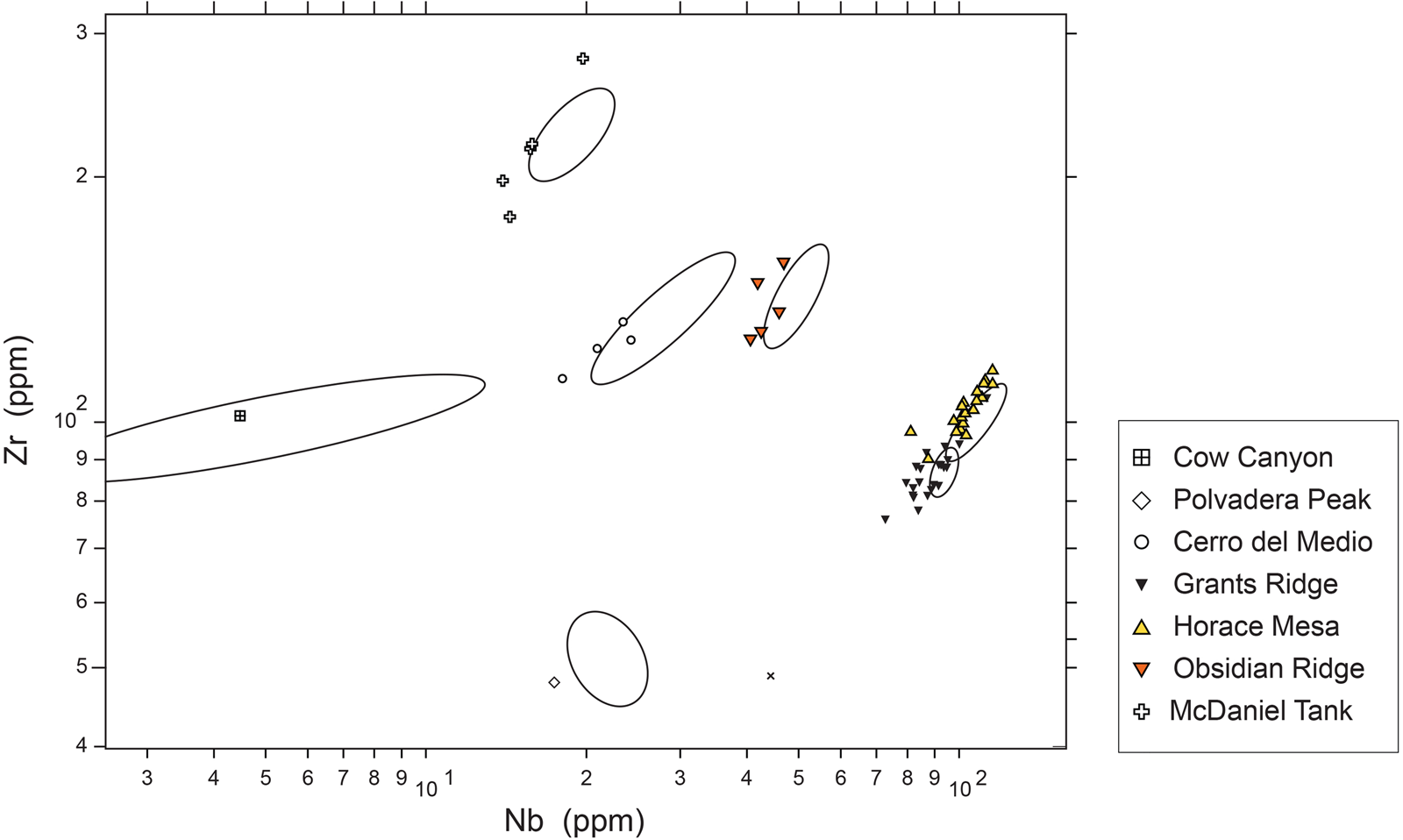
Obsidian artifacts from Goat Spring Pueblo are primarily debitage, with only a handful of formal tools. Although obsidian tools were probably valued for their especially sharp edges, obsidian may also have been valued for its glassy shine (Munson Reference Munson, Munson and Hays-Gilpin2020a). The complete assemblage of 58 obsidian artifacts from Goat Spring Pueblo were analyzed using the Thermo Scientific ARL Quant'X Energy Dispersive X-ray Fluorescence (EDXRF) instrument at MURR. This instrument has a rhodium-based X-ray tube operated at 35 kV and a thermoelectrically cooled silicon-drift detector. The obsidian calibration uses a set of 37 very well characterized obsidian sources with data from previous ICP, XRF, and neutron activation analysis (NAA) measurements (Glascock and Ferguson Reference Glascock and Ferguson2012). Ferguson counted the samples for two minutes to measure the minor and trace elements present. The elements measured include rubidium (Rb), strontium (Sr), yttrium (Y), zirconium (Zr), and niobium (Nb). These five elements are excellent for discriminating most sources in the American Southwest. Iron (Fe) and manganese (Mn) are also reported but are less reliable in assemblages with smaller artifacts (Ferguson Reference Ferguson, Shugar and Mass2012). In most cases, source assignments for obsidian artifacts are based on visual inspection of elemental bivariate plots. XRF data tend to skew along correlation lines (largely as a function of variable sample mass), and visual inspection provides reliable source assignments (Ferguson Reference Ferguson, Shugar and Mass2012).
Our results show that residents of Goat Spring Pueblo did not rely primarily on obsidian from the nearest source (Figure 6). Almost three-quarters of the obsidian from the village is identified as being from the Mount Taylor source area (Horace Mesa and Grants Ridge sources in Figure 5), some 113 km northwest of the village. There are a few obsidian sources—Red Hill, Mule Creek, and Gwynn Canyon—that are essentially the same distance as Mount Taylor, as well as secondary deposits that may have been collected from the southern Rio Grande (Shackley Reference Shackley2021). The nearest obsidian source, McDaniel Tank, is represented by less than 10% of the assemblage. Although there is a size limitation of the McDaniel Tank source, with specimens larger than 2 cm in diameter being difficult to find on the modern surface, this size limitation did not stop residents of other sites from relying primarily on this source. For example, at the Archaic period site of Buttercup Spring in the Magdalena Mountains just east of the source area, most of the obsidian assemblage is from the McDaniel Tank source (LeTourneau et al. Reference LeTourneau, Ferguson and McLemore2010). Similarly, four twelfth-century Pueblo sites in the Lion Mountain area, located 35 km due east of Goat Spring Pueblo, have obsidian assemblages dominated by McDaniel Tank obsidian (Schaefer Reference Schaefer2020). Given that residents of some other local sites had relied primarily on McDaniel Tank obsidian, and given that other obsidian sources were available that were the same distance as the Mount Taylor source, it appears that residents of Goat Spring Pueblo were actively seeking material from the Mount Taylor area.
XRF results for all 58 obsidian specimens recovered from Goat Spring Pueblo with ellipses representing composition of known sources. (Color online)

Blue-Green Minerals
Blue-green minerals are, and were, used in the creation of personal ornaments and of pigments, and as offerings (Mattson Reference Mattson2016; McBrinn and Altshuler Reference McBrinn and Altshuler2015; Munson Reference Munson, Munson and Hays-Gilpin2020b). The most extensively used (and studied) blue-green mineral among Ancestral Puebloans was turquoise (Hull et al. Reference Hull, Fayek, Joan Mathien and Roberts2014; Mathien Reference Mathien2001; Thibodeau et al. Reference Thibodeau, Killick, Hedquist, Chesley and Ruiz2015). However, other blue-green minerals were available, including malachite, azurite, chrysocolla, and smithsonite. The availability of blue-green smithsonite in New Mexico from only the Magdalena Mining District, its modern workability as a gemstone, and the identification of ornaments made from smithsonite at other archaeological sites (Eveleth and Lueth Reference Eveleth, Lueth, Hughes, Liebetrau and Staebler2010) suggest that residents of Goat Spring Pueblo may have relied on it in a way similar to turquoise.
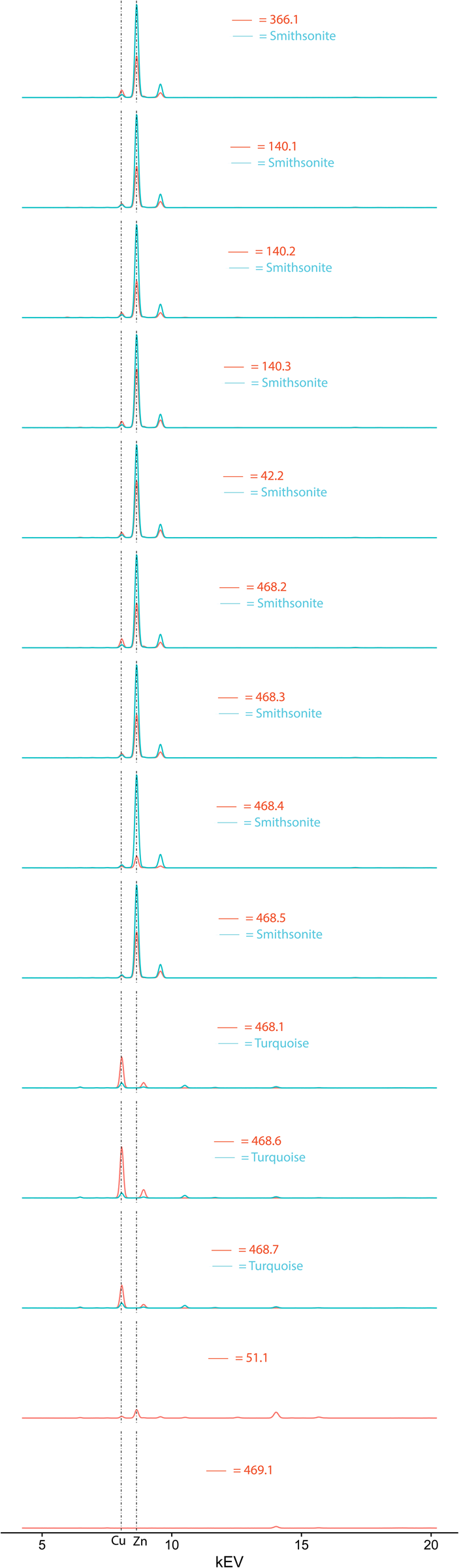
Although other blue-green minerals found in New Mexico are copper bearing, smithsonite is a zinc-bearing mineral (Pohwat Reference Pohwat, Hughes, Liebetrau and Staebler2010). This suggested that XRF analysis could be used to determine qualitatively if the blue-green minerals recovered from Goat Spring Pueblo were smithsonite. Ferguson used a portable Bruker TRACER 5i XRF spectrometer to perform the analysis. Spectra of the Goat Spring Pueblo samples were compared to those from a Kelly Mine smithsonite specimen and an unprovenienced New Mexico turquoise specimen. Again, this analysis was not used to source the blue-green minerals recovered from Goat Spring Pueblo, but to verify whether any of the samples were zinc bearing and therefore probably smithsonite.
All 14 blue-green mineral specimens recovered from Goat Spring Pueblo were analyzed (Figure 7). Although some of these artifacts were clearly worked ornaments, most represented debitage from the production process or unworked nodules of material (Arthur Vokes, personal communication 2021). Nine samples are a close match to the zinc (Zn) peaks expected of smithsonite, three samples are a close match to the copper (Cu) peaks expected of turquoise, and two samples could not be matched. All told, residents of Goat Spring Pueblo were primarily relying on the locally available smithsonite, but they appear to have had access to raw blue-green minerals from farther afield. All three specimens (468.1, 468.6, 468.7) of the copper-bearing blue-green minerals recovered from Goat Spring Pueblo were identified as “unworked nodules.” This suggests that people were bringing at least some nonlocal blue-green minerals to Goat Spring Pueblo as raw material for manufacture rather than as finished products.
XRF results for all 14 blue-green mineral specimens recovered from Goat Spring Pueblo. (Color online)

Summary
The original working hypothesis for our chemical compositional and isotopic studies was that local patterns of resource acquisition would follow Western principals of economic optimization; that is, that residents of Goat Spring Pueblo would have taken advantage of the geological resources that were locally available to them within a day or two's foraging range from the village. In the case of blue-green minerals, this assumption appears to be true given that residents appear to have primarily used the locally available smithsonite. Although raw turquoise was also acquired from unknown distant sources, the distant sources could also have been sources of other resources, such as the Cerrillos Hills, which is known to have been a significant source of both lead and turquoise that was widely distributed throughout the Ancestral Pueblo world. The obsidian and lead analyses presented here show that these materials were often transported some distance across the landscape to be brought to Goat Spring Pueblo. Because objects and materials “are only ‘moved’ as a result of human activity, although the behavioral processes vary” (Huntley Reference Huntley, Herhahn and Ramenofsky2016:202), we must consider potential social and cultural explanations for our observed compositional data patterns. Huntley's challenge (Reference Huntley, Herhahn and Ramenofsky2016) becomes important as we consider our findings within the framework of Goat Spring Pueblo artisans in different communities of practice negotiating their ethnomineralogies, taskscapes, and knowledgescapes.
Ethnomineralogies, Taskscapes, and Knowledgescapes at Goat Spring Pueblo
At its most basic, this research examines the obtainment of geological resources needed for the manufacture of objects by residents of Goat Spring Pueblo. There is no doubt that we are looking at the movement of geological resources into the village to make specific types of objects rather than the movement of completed objects. In the case of obsidian, there are a few finished tools, but the majority of the material is by far in the form of flakes that were the result (or perhaps goal) of toolmaking. Similarly, most of the blue-green mineral from the site is manufacturing debris. In the case of lead to make glaze paint, paints made using nonlocal lead was applied to locally produced pottery; in other words, it was the raw resource to make the paint that was moved, but the final ceramic vessels were not. In terms of context, raw geological materials were moved into Goat Spring Pueblo, and the production of finished products was occurring there.
There is also no doubt that residents of the village were aware of the existence of local resources; smithsonite, McDaniel Tanks obsidian, and North Magdalena Mining District lead are all present in the samples examined in this study. However, artisans of the village were not primarily relying on local geological sources for the creation of their glaze-painted pottery or obsidian tools, although they were for their blue-green ornaments. We believe that the question is not “why were village artisans not using some locally available resources?”; instead, it is “why were they selecting the specific sources that they did utilize?” We conceptualize the village's artisans as working within social networks that shared a technological tradition for the manufacture of specific material cultures—in other words, within communities of practice (Stark Reference Stark, Habicht-Mauche, Eckert and Huntley2006:25). As discussed above, members of a community of practice share a collective identity developed through learning, making, and doing together (Lave and Wenger Reference Lave and Wenger1991). Part of this “learning, making, and doing” would have been structured around other cultural behaviors, including ethnomineralogies, taskscapes, and knowledgescapes. Here, we consider our data more thoroughly through communities of practice while taking these behaviors into consideration. Ultimately, it should be remembered that these behaviors are not mutually exclusive. For example, if Mount Taylor obsidian was important to residents of Goat Spring Pueblo for cosmological reasons, qualitative reasons, or both, then they probably would have been pleased to procure it whenever possible and through multiple means.
Ethnomineralogies
As discussed above, ethnomineralogies are shared sets of practical knowledge and strategies within a community of practice that allow artisans to test, manipulate, and problem solve when working with raw materials (Arnold Reference Arnold1971, Reference Arnold2018). Ethnomineralogies are taught through the process of learning a craft within a community of practice but may also be expanded through an artisan's testing of new materials or through knowledge shared by individuals from a different community of practice. At Goat Spring Pueblo, and among Ancestral Pueblo potters in general, an ethnomineralogy for the testing and use of lead minerals in the production of glaze paints was a relatively recent development and was probably regionally shared (see below).
Ethnomineralogies for the testing and knapping of obsidian (local or otherwise) among flintknappers at Goat Spring Pueblo—and in the broader Ancestral Pueblo region in general—probably went back centuries, if not more. As discussed above, local obsidian had excellent workability, but nodules tend to be small (<5 cm in diameter). Most obsidian recovered from Goat Spring Pueblo was collected from nonlocal sources, primarily Mount Taylor. Mount Taylor obsidian also would have had excellent workability, but nodules 10 cm and over in diameter are “relatively common” near the top of Grants Ridge at Mount Taylor (Shackley Reference Shackley1998:1077); this larger nodule size may have been preferred by flintknappers for practical reasons and may have been sought out through various means as discussed below.
The use of smithsonite for the construction of ornaments is a good example of an expanded ethnomineralogy that was probably local to the community of practice at Goat Spring Pueblo. The importance of the color blue-green—and, by extension, blue-green minerals—in Ancestral Pueblo cosmology has been well documented and extends into historic and modern Pueblo thought (Mattson Reference Mattson2016; McBrinn and Altshuler Reference McBrinn and Altshuler2015; Munson Reference Munson, Munson and Hays-Gilpin2020b). Although the use and provenance of turquoise has been extensively studied in the US Southwest (Hull et al. Reference Hull, Fayek, Joan Mathien and Roberts2014; Mathien Reference Mathien2001; Sigleo Reference Sigleo1975; Thibodeau et al. Reference Thibodeau, Killick, Hedquist, Chesley and Ruiz2015), the source and use of other blue-green minerals are not as well understood. The evidence at Goat Spring Pueblo for limited working of smithsonite in ways similar to turquoise (Arthur Vokes, personal communication 2021) suggests that at least one artisan at the village was using an established ethnomineralogy to test and manufacture ornaments from locally available smithsonite in ways similar to the production of turquoise objects. At the same time, the limited amount of blue-green minerals currently found at Goat Spring Pueblo indicates that the village was never a workshop or a source of blue-green mineral for other Ancestral Pueblo villages. The local artisans working the smithsonite may have been making ornaments for use by residents of the village, but the presence of copper-bearing minerals (possibly turquoise) at the site indicates that these artisans were happy to use, and possibly preferred, nonlocal blue-green minerals when available.
Taskscapes
Taskscapes reflect histories of interactions of people with their cultural landscape and natural resources (Huntley et al. Reference Huntley, Fenn, Habicht-Mauche, Mills, Cordell and Habicht-Mauche2012; Michelaki et al. Reference Michelaki, Braun and Hancock2015); in other words, they are the human use of a landscape structured by the interaction of resource locales, daily tasks, and ethnomineralogies. At Goat Spring Pueblo, collection of smithsonite—and the occasional piece of galena and obsidian, according to our data patterns—would have been possible within a day's walk, and procurement probably was part of locally defined taskscapes. Collection of these resources may have occurred as part of other trips from the village to hunt, forage wild plants, or collect other geological resources such as pigments or clays. There is no reason to believe that local geological resources were moved into the village through any means other than as part of local procurement practices.
The majority of obsidian recovered from Goat Spring Pueblo was collected from nonlocal sources: primarily Mount Taylor but also the Jemez Mountains, located in the northern Rio Grande area. Obsidian provenance studies at archaeological sites across the Ancestral Pueblo landscape have shown that Mount Taylor was a popular source of material for centuries (Benedict and Hudson Reference Benedict and Hudson2008; Duff et al. Reference Duff, Moss, Windes, Kantner and Steven Shackley2012; Shackley Reference Shackley2010), including within the southern Rio Grande district (Eckert and Huntley Reference Eckert and Huntley2022; Schaefer Reference Schaefer2020). Additionally, some Mount Taylor obsidian (and Jemez Mountains obsidian), whether Ancestral Puebloans recognized it as such or not, may have been collected in secondary deposits in the Rio Grande (Shackley Reference Shackley2021). The majority of lead minerals was also collected from a nonlocal source in the Hansonburg Mining District. Procurement of obsidian and lead minerals, then, make for an interesting consideration of broader taskscapes as realized by residents of Goat Spring Pueblo.
Procurement of nonlocal obsidian and lead minerals may have been, in part, associated with longer-distance hunting or foraging expeditions by village residents moving over a regional taskscape. Evidence for short-term use of Mount Taylor by Ancestral Pueblo populations, probably for “hunting and gathering of specific resources,” has been documented (Benedict and Hudson Reference Benedict and Hudson2008:7; see also Popelish Reference Popelish1990). Similarly, long-term use of the Hansonburg Mining District region by Ancestral Puebloans comes from nonarchaeological reporting of stone hammers found in caves (MacCarthy Reference MacCarthy1918), projectile points dating to various time periods (Eveleth and Lueth Reference Eveleth, Lueth, Lueth, Lucas and Chamberlin2009), and water holes covered with flat stones (Blanchard ca. Reference Blanchard1965). Although it is impossible to tie the Ancestral Pueblo material culture recovered from Mount Taylor or the Hansonburg Mining District to a specific region or village, the presence of raw resources from these two areas at Goat Spring Pueblo makes it reasonable to speculate that at least some residents of the site were going to these locations to collect resources, quite possibly as part of larger taskscapes that would allow them to complete various activities in various locations as part of a single long-distance trip.
Although it is difficult to determine, it should be noted that part of these longer foraging expeditions may have included collecting resources with cosmological importance from their source (Benedict and Hudson Reference Benedict and Hudson2008; Mills and Ferguson Reference Mills and Ferguson1998). The long-standing importance of Mount Taylor obsidian, including the current importance of Mount Taylor in modern Pueblo cosmology, has been well documented (Benedict and Hudson Reference Benedict and Hudson2008; Berthier-Foglar Reference Berthier-Foglar2012).
Similarly, given the numerous natural caves in the Hansonburg Mining District—including the “Enchanted Cave of the Oscuras” described in 1881 as extensive, remarkably beautiful and containing spectacular stalactites, stalagmites, and flowing springs (Eveleth and Lueth Reference Eveleth, Lueth, Lueth, Lucas and Chamberlin2009)—it is possible that this region also held cosmological significance to Ancestral Pueblo peoples.
Knowledgescapes
If taskscapes are structured by landscape and natural resources, knowledgescapes are structured by contact and interaction with members of other communities that share a broad suite of practice and belief (Herhahn and Huntley Reference Herhahn, Huntley and Spielmann2017; Shariq Reference Shariq1999). These knowledgescapes are not usually associated with local ethnomineralogies or taskscapes but rather with more expansive constellations of shared knowledge that cross-cut villages, regions, and communities of practice. Knowledgescapes can be associated with broadly shared cosmological beliefs, ritual practices, and ceremonies requiring objects made from materials collected from cosmologically important places. As discussed above, Mount Taylor and caves in the Hansonburg Mining District may have been such places. A shared knowledgescape between artisans at Goat Spring Pueblo and those from other villages may have maintained connections and identity with these distant source locations; preference for such materials may have actually been a means of reaffirming these broad knowledgescapes.
If knowledgescapes are constituted and spread through participation in regular markets, feasts, and religious ceremonies sponsored by different villages, then the acquisition of at least some geological resources by residents of Goat Spring Pueblo may have been through trade networks or exchange partners. Much has been written about the expansion of trade networks during the late Ancestral Pueblo period and how access to these networks would have been made possible by visiting different villages throughout the year (Mills Reference Mills2007b; Snow Reference Snow, Wilcox and Bruce Masse1981; Spielmann Reference Spielmann and Spielmann1998). Ethnographic and historical accounts suggest that Puebloans regularly visited other villages to participate in markets, feasts, marriages, deaths, coming-of-age events, and other religious ceremonies (Ford Reference Ford and Ortiz1972; Snow Reference Snow, Wilcox and Bruce Masse1981). In addition, the southern Rio Grande district is known to have played an important role in these exchange networks. Within the Rio Grande region, southern Rio Grande villages were the source of cotton and tobacco (Snow Reference Snow, Wilcox and Bruce Masse1981:356). Many exchange networks appear to have been informal, occurring between individuals or families or artisans with a shared practice rather than controlled by a village or specific social segment (Cordell Reference Cordell1998). Consequently, residents of Goat Spring Pueblo may have acquired raw resources when visiting other villages for any number of reasons.
Visiting Goat Spring Pueblo may also have been part of the knowledgescape of residents from other villages. As described above, the village is located on a trail connecting Western Pueblo and southern Rio Grande villages. People would have been moving back and forth along the trail, and it is likely they would have stopped at Goat Spring Pueblo. During our ceramic analysis, we identified Zuni Glaze Ware and decorated Zuni Buff Ware at Goat Spring Pueblo in small quantities. We know that lead from Hansonburg and Cerrillos Mining Districts were also used in Western Pueblo glaze paint, we know that Mount Taylor obsidian is found throughout Western Pueblo and southern Rio Grande sites, and we know that blue-green minerals were moving throughout the Southwest. It is quite likely that at least some of this material was carried to Goat Spring Pueblo by short-term visitors to the village. Various other commodities could also have been traded or exchanged: salt from the Zuni Salt Lake or Salinas district, textiles, feathers, pigments, buffalo meat and hides, and obsidian and glaze paints (Ford Reference Ford and Ortiz1972).
Ultimately, our current understanding of glaze-paint production suggests that Goat Spring Pueblo potters probably obtained most of their lead minerals through trade relations associated with a broader knowledgescape. This knowledgescape would likely have been focused on the knowledge and technology transfer of glaze-paint production as well as glaze paint's association with cosmology and ritual practice (Eckert Reference Eckert2008; Habicht-Mauche and Eckert Reference Habicht-Mauche and Eckert2021; Spielmann Reference Spielmann and Spielmann1998). Nelson and Habicht-Mauche (Reference Nelson, Habicht-Mauche, Habicht-Mauche, Eckert and Huntley2006) have argued that specialized resources for pottery production such as lead for glaze paint appear to have moved between households across ethnolinguistic social groups as part of a broader network of regional interactions. Eckert and colleagues (Reference Eckert, Schleher and Snow2018) argued that the movement of these more specialized resources reflect historically contingent, kin-based relationships between households from different ethnolinguistic villages. Pottery data from Goat Spring Pueblo provides further evidence that multiple Pueblo groups, including potters in both the Salinas and Zuni regions (Huntley Reference Huntley, Habicht-Mauche, Eckert and Huntley2006, Reference Huntley2008; Huntley et al. Reference Huntley, Spielmann, Habicht-Mauche, Herhahn and Russell Flegal2007), were using lead from the Hansonburg Mining District, although this district seems to be peripheral to the glaze-producing Pueblo world. All of these communities of practice focused on the production of glaze paint were probably tied into a larger knowledgescape that allowed them access to the knowledge, technology, and materials required to produce glaze wares.
Conclusion
The logic behind performing most geochemical techniques is one of identifying provenance: understanding from where geological resources were obtained, which types of objects were made from these sources, and how far the material (raw or finished) moved. Huntley (Reference Huntley, Herhahn and Ramenofsky2016:202) stated that “identifying provenance—place of origin—is necessary before we can explain behavioral processes behind the distributions of objects across the landscape.” But once we identify provenance, understanding the behaviors is still difficult because human behavior is complex.
In this article, we have examined the acquisition of raw materials at Goat Spring Pueblo through the lens of ethnomineralogies, taskscapes, and knowledgescapes. We argue that if artisans at the village structured their taskscapes around ethnomineralogies and location of geological resources, and structured their knowledgescapes around interaction with artisans from other communities that shared a broad suite of practice and belief, then the movement of raw materials into the village was based on a complex set of cultural behaviors. The specific location of a geological resource would have been only one part of the community's greater understanding of its physical surroundings. Mountains, rivers, and other landmarks associated with stories, histories, and cultural traditions would have defined the space in which villagers lived and may also have informed preferences for certain resources. Consequently, the surviving material culture at Goat Spring Pueblo is a reflection of day-to-day practice and beliefs that were integrated into a broader Ancestral Pueblo worldview about place.
Acknowledgments
We thank our team of volunteers, graduate student crew chiefs, and field school students. We also thank the staff at the Cibola National Forest Service (CNFS) Magdalena District Office, the staff at the CNFS Albuquerque Supervisors Office, Matt Basham (previously of CNFS, now of BLM), Jeremy Kulisheck, and the staff at the Archaeological Records Management Section (ARMS). We are grateful to Arthur Vokes for the analzying our blue-green minerals, to Marion Coe for preparing our maps, and James T. Watson for translating our abstract to Spanish.
Funding Statement
Fieldwork was funded by Texas A&M University’s (TAMU) Program for the Enhancement of Creative and Scholarly Activities, TAMU’s Summer School Program, and an Ariziona State Museum 2017 Burgan Fund grant. Funding for lead isotope analysis was funded by a 2018 New Mexico Archaeological Council grant. Funding for XRF analysis was provided in part from a National Science Foundation grant (#1912776) to the Archaeometry Laboratory at MURR.
Data Availability Statement
Lead isotope data available at tDAR id: 472667; doi:10.48512/XCV8472667. XRF data available upon request from Jeffrey R. Ferguson at MURR. Excavation materials and records will be curated at the Maxwell Museum of Anthropology, Albuquerque, New Mexico, but can also be accessed by contacting Suzanne L. Eckert.
Competing Interests
The authors declare none.