The construction of a personalized sense of identity is critical as it promotes the individual’s awareness of his or her strengths and weaknesses and thus facilitates personal functioning and well-being (Erikson, Reference Erikson1968). Although Erikson proposed the theory of identity formation for the late adolescence stage in one’s life, it has been argued that the process of identity development and achievement could extend into early adulthood (Schwartz, Côté, & Arnett, Reference Schwartz, Côté and Arnett2005), such as university students. Questions such as “Who am I?” and “Who will I be in the future?” are frequently posed and discussed in this age group (Eccles, Reference Eccles2012). Considerable research evidence shows that theories about self, such as self-determination theory (La Guardia, Reference La Guardia2009; Luyckx, Vansteenkiste, Goossens, & Duriez, Reference Luyckx, Vansteenkiste, Goossens and Duriez2009) and self-categorization theory (Turner, Hogg, Oakes, Reicher, & Wetherell, Reference Turner, Hogg, Oakes, Reicher and Wetherell1987), provide important perspectives that offer deeper insight of identity construction and how and why individuals see themselves in particular ways. Future orientation such as hope or optimism also stems from how individuals conceive their identity (Markus & Nurius, Reference Markus and Nurius1986). Therefore, the current study examined the relations between university students’ self-determination, future orientation and their identity construction to delineate the roles that motivational and emotional dynamics play in shaping one’s identity.
Literature Review
Personal identity
Identity development has been a key conceptualization of the adolescent process (Griffin, Adams, & Little, Reference Griffin, Adams, Little, Wehmeyer, Shogren, Little and Lopez2017, p.191), and an adolescent’s identity indicates his or her psychological maturity level (Morales-Vives, Camps, Lorenzo-Seva, & Vigil-Colet, Reference Morales-Vives, Camps, Lorenzo-Seva and Vigil-Colet2014). Relevant to the conceptualization of personal identity is the self-categorization theory (Turner et al., Reference Turner, Hogg, Oakes, Reicher and Wetherell1987). According to this theory, one’ identity is conceptualized as a hierarchical structure that includes the intrapersonal and intergroup levels of the system. It can be described in the distinctions of an individual from others (e.g., “I am a unique person, different from others”) or the similarities shared with other members of the group (e.g., “I recognize myself as a citizen of my country”). In this study, we only focused on the intrapersonal level to examine how different factors affect the construction of personal identity in Chinese urban youth because Chinese youth nowadays are experiencing a more complicated identity construction than their Western counterparts. China has been in the transition between socialist collectivism and materialistic individualism both in society and economy. The discrepancies between these two values create mounting pressure for the young people to compete with each other and excel (Li, 2015). This inculcates the youth with the values of materialism, individualism and alienation (Lee & Ho, Reference Lee, Ho, Arthur and Davies2008). Thus, individuals with a more global perspective would require a developed sense of their own identities (Merrill, Braskamp, & Braskamp, Reference Merrill, Braskamp and Braskamp2012). In this context, the shift in Chinese youth’s ideology is best reflected by the way they define themselves. Focusing on their individuality would allow us to further explore its antecedents.
Past studies have identified a range of contributing factors to one’s personal identity formation, including emotion (Beauchamp & Thomas, Reference Beauchamp and Thomas2009), self-esteem (Luyckx et al., Reference Luyckx, Klimstra, Duriez, van Petegem, Beyers, Teppers and Goossens2013), personality (Wille & De Fruyt, Reference Wille and De Fruyt2014), and sense of coherence (Shlomo, Levy, & Itzhaky, Reference Shlomo, Levy and Itzhaky2012). To date, different identity models have been established and discussed (e.g., Jones & McEwen, Reference Jones and McEwen2000; Marcia, Reference Marcia and Adelson1980), yet surprisingly little is known about the role of motivation and emotion in identity processes.
Drawing from existing findings on the underlying motivational basis for identity formation (Strachan, Fortier, Perras, & Lugg, Reference Strachan, Fortier, Perras and Lugg2013; Vlachopoulos, Kaperoni, & Moustaka, Reference Vlachopoulos, Kaperoni and Moustaka2011), as well as on positive emotions and identity (Nurmi, Reference Nurmi and Zaleski1994; Pulkkinen & Ronka, Reference Pulkkinen and Ronka1994), we proposed a distal–proximal framework of identity. We argue that future positive expectations are conceptually closer to personal identity than self-determination. Further, future positive expectations are conceptualized as a mediator in the relationship between self-determination and the formation of personal identity. Positive future expectations, as a temporal path to personal identity formation, act as a proximal emotional mechanism that can account for the distal relationships between motivation and personal identity.
In this framework, distal factors of identity formation include self-determination theories that emphasize the motivational sources needed for identity formation. Proximal factors include positive future expectations such as hope and optimism that highlight mechanisms that control the initiation and utilization of the motivational sources. Proximal factors are particularly important when motivational resources are not available or insufficient such as when individuals do not experience autonomy during exploring their identity. We anticipated that these factors played different roles in explaining one’s personal identity construction. The following review will shed light upon the contribution of these personal resources on one’s identity construction.
Self-Determination Theory (SDT) and Personal Identity
By the most general definitions, researchers have interpreted the relations between motivation and identity as the relations between a person’s goal-directed action and the kind of person the person wants to become (Gee, Reference Gee2000; Kaplan & Flum, Reference Kaplan and Flum2009). Among the different motivational theories, Griffin et al. (Reference Griffin, Adams, Little, Wehmeyer, Shogren, Little and Lopez2017) noted that identity development explanations could benefit greatly when examined through the lens of SDT. According to SDT, individuals own the innate tendency to organize and integrate personal experiences and exchanges in the direction of a unified sense of self (Ryan & Deci, Reference Ryan, Deci, Deci and Ryan2002). Waterman, Schwartz, and Conti (Reference Waterman, Schwartz and Conti2008) further suggested that the individual is an inherently active agent, whose identity arises from his or her innate structures such that the individual’s true potential can be fulfilled. Similarly, Soenens, Berzonsky, Vansteenkiste, Beyers, and Goossens (Reference Soenens, Berzonsky, Vansteenkiste, Beyers and Goossens2005) argued that autonomy-orientated individuals were more likely to search for and evaluate identity-relevant information.
Indeed, a revisit of the conceptualization of individuality consistently demonstrates the core role of one’s autonomy. Autonomy, as defined in SDT, is volitional and self-endorsed functioning (van Petegem, Beyers, Vansteenkiste, & Soenens, Reference van Petegem, Beyers, Vansteenkiste and Soenens2012). How an individual exercise his autonomy in decision-making mostly (if not all) defines his orientation of individuality. People are naturally inclined to explore and commit themselves to activities they value (Deci, Reference Deci1975). Providing people with choice and recognizing their feelings and perspectives would enhance their intrinsic motivation for such exploration and commitment (Brown & Ryan, Reference Brown, Ryan, Linley and Joseph2004). If individuals can regulate their behavior in a volitional manner, it will promote well-being (Bernabe, Lisbona, Palací, & Martín-Aragon, Reference Bernabe, Lisbona, Palací and Martín-Aragon2014). The more individuals experience a sense of autonomy in pursuing their own interests and values, the more thoroughly they can explore different identity options (Luyckx et al., Reference Luyckx, Vansteenkiste, Goossens and Duriez2009). In line with this, those with an autonomous orientation are more likely to be more aware of their own interests, goals, and values (La Guardia, Reference La Guardia2009) and search and evaluate identity-relevant information (Soenens et al., Reference Soenens, Berzonsky, Vansteenkiste, Beyers and Goossens2005). If individuals feel pressured (internally or externally) to select an identity regardless of their own interests and values, they are more likely to be worried and uncertain about which identity alternative would be most appropriate for them (Luyckx et al., Reference Luyckx, Vansteenkiste, Goossens and Duriez2009). Hence, by articulating the prototype of a self-determined person, SDT complements identity theory by providing further explanations on why individuals adopt particular personal identities and how self-determination differentiate the types or strengths of the chosen identities.
A number of empirical studies have used SDT to examine the motivational processes that underlie identity formation (e.g., Luyckx et al., Reference Luyckx, Vansteenkiste, Goossens and Duriez2009; Strachan et al., Reference Strachan, Fortier, Perras and Lugg2013; Vlachopoulos et al., Reference Vlachopoulos, Kaperoni and Moustaka2011). However, the majority of existing studies have examined the role of different human needs or types of motivation in explaining identity, and no studies have examined how the tendency to function in a self-determined way affects the construction of personal identity. Given that SDT and identity theory share a common focus on the self, and prior research supporting the importance of self-determination in identity construction, we sought to examine personal identity from this perspective.
Future orientation and personal identity
Peterson and Seligman (Reference Peterson and Seligman2004) pointed out that both hope and optimism refer to future positive expectations because both forces are oriented toward the future. Hence, in our conceptualization, the concept of future positive expectations covers both hope and optimism. Hope is defined as a form of goal-directed thinking in which the individual believes that he or she can produce the means to achieve desired goals and that he or she will have the motivation to use those means (Snyder, Reference Snyder1994). Optimism is defined as individuals’ generalized positive expectancy regarding future outcomes (Carver & Scheier, Reference Carver and Scheier2014; Carver, Scheier, & Segerstrom, Reference Carver, Scheier and Segerstrom2010) such as the belief that the future will be successful and fulfilling (Alarcon, Bowling, & Khazon, Reference Alarcon, Bowling and Khazon2013). Although both optimism and hope emphasize a positive view on one’s future, several researchers (Bryant & Cvengros, Reference Bryant and Cvengros2004) illustrated their conceptual distinctions. Compared with optimism, which is primarily concerned with the expectation of positive outcomes regardless of actions (Scheier & Carver, Reference Scheier and Carver1985), hope is more explicitly concerned with one’s personal actions for a successful future (Arnau, Rosen, Finch, Rhudy, & Fortunato, Reference Arnau, Rosen, Finch, Rhudy and Fortunato2007).
Rappaport, Enrich, and Wilson (Reference Rappaport, Enrich and Wilson1985) argued that identity should involve “the development of a broader and more balanced temporal orientation, including increased emphasis on the future (p. 1610)”. The development of future positive expectations indeed correlates to a stronger sense of personal identity (Nurmi, Reference Nurmi and Zaleski1994). Empirical research has been conducted to examine the relationship between identity and future orientation, for example, Pulkkinen and Ronka (Reference Pulkkinen and Ronka1994) focused on the development of future orientation and identity across time, and Rappaport et al. (Reference Rappaport, Enrich and Wilson1985) discovered positive relationships between future orientation and identity commitment. Most relevant to the current study was Seginer and Noyman’s (Reference Seginer and Noyman2005) study wherein a sense of confidence (expectance) in the materialization of hopes and plans was found to contribute to one’s identity formation.
Present Study
Thus far, we are not aware of any previous studies that have explored the relative impact of the previously mentioned constructs on personal identity. However, it is reasonable to assume that some of the constructs are more strongly related to personal identity than others, as explained in the distal-proximal model discussed above. For example, one might argue that the closer the predictors come to personal identity conceptually, the stronger the relationship would be. Thus, in this study we attempt to place the proposed predictors from the conceptually most distal to the conceptually most proximal to personal identity. Specifically, we expected a significantly strong and positive relationship between self-determination and future orientation, and a significantly strong and positive relationship between future orientation and identity formation. Namely, students with stronger self-determination tend to form a stronger personal identity if they invest effort and engage in future positive thinking.
Indirect empirical evidence for this model can be found in van Ryzin, Gravely, and Roseth’s (Reference van Ryzin, Gravely and Roseth2009) study whereby increasing amounts of choice boosted individuals’ positive thinking about the future (e.g., hope) (van Ryzin et al., Reference van Ryzin, Gravely and Roseth2009) and Seginer and Noyman’s (Reference Seginer and Noyman2005) study wherein confident views of the future was found to contribute to one’s identity formation. As some researchers have argued that hope and optimism should be differentiated when predicting various well-being measures (e.g., Kotzé & Niemann, Reference Kotzé and Niemann2013), the mediational role of future orientation in this relationship was examined in the form of hope versus optimism separately.
Research has shown that the age of personal identity development has shifted from puberty/late teens to emerging adults aged 18 to 25 years (Arnett, Reference Arnett2000). Given the challenges and difficulties to the clear, firm formation of one’s identity in the emerging adults, identity confusion has been a frequent concern as it is linked to such negative outcomes as increased depression, anxiety, and impulsivity (Schwartz, Zamboanga, Wang, & Olthuis, Reference Schwartz, Zamboanga, Wang and Olthuis2009). Based on the few prior studies that examined the relations between these constructs, the current study sought to examine this framework to facilitate our understanding of the predictors of personal identity and ultimately supervise students in establishing a stronger sense of identity.
Method
Participants
One hundred and ninety-one students (57.1% males, M age = 20.75 years, SD age = 1.49) at three randomly selected universities in south China participated in this study on a voluntary basis. By appointment, the research assistant supervised the administration of the questionnaires for each individual participant, including briefing about the study to the participant, administering the surveys on hardcopies, collecting the surveys responses, and answering questions from the participant, if any. The data collection was conducted in the library in each university during off class hours within two weeks. Although no time limit for the completion of the questionnaires, no participant spent over 30 min in completing all the items. As all the instruments sought responses at a general level, no specific contexts were specified for the participants.
Measures
Personal identity. The eight-item Personal Identities Scale (Nario-Redmond, Biernat, Eidelman, & Palenske, Reference Nario-Redmond, Biernat, Eidelman and Palenske2004) is designed to capture individual differences in the tendency to individuate the self as distinct from in-group memberships. Responses were captured on a 9-point Likert scale ranging from 1 = Not at all important to 9 = Extremely important. Sample items are: “My sense of independence from others” and “My complete individuality.” The instrument was administered in Chinese following a standard back-translation process. The Cronbach alpha of this scale was .87.
Hope. The Dispositional Hope Scale-Chinese version (Sun, Ng, & Wang, Reference Sun, Ng and Wang2012) is an eight-item trait-like measure of hope with four filter items. Four items measure agency thoughts, and four items measure pathways thoughts. Responses were captured on a 5-point Likert scale ranging from 1 = Completely disagree to 5 = Completely agree. Sample items are: “I can think of many ways to get the things in life that are most important to me” and “My past experiences have prepared me well for my future.” The Cronbach alpha of this scale was .74.
Optimism. The six-item Chinese Life Orientation Test (Lai, Cheung, Lee, & Yu, Reference Lai, Cheung, Lee and Yu1998) assesses dispositional optimism in general. Responses were captured on a 5-point Likert scale ranging from 1 = Completely disagree to 5 = Completely agree. Sample items are: “In uncertain times, I usually expect the best” and “I rarely count on good things happening to me.” One item had problematic item-total correlation, r = .33, while rs = [.55, .68] for the other items, probably because of the difficulty in capturing its meaning after it was translated into Chinese (“If something can go wrong for me, it will”). Thus this item was dropped. The Cronbach’s alpha of this scale was .66.
Self-Determination Scale. The 10-item Self-Determination Scale (Sheldon & Deci, Reference Sheldon and Deci1993) assesses individual differences in the tendency to function in a self-determined way. The scale contains two dimensions: Awareness of self (awareness of feelings and the sense of self), and perceived choice (a sense of choice with respect to behavior). The items ask the participants to estimate which of two statements (A and B) feels more true of them, using a scale ranging from only A feels true (1) to only B feels true. For example, “I always feel like I chose the things I do” versus “I sometimes feel that it’s not really me choosing the things I do” is a perceived choice item, whereas “I feel that I am rarely myself” versus “I feel like I am always completely myself” is an awareness of self item. The instrument was administered in Chinese following a standard back-translation process. The Cronbach alphas of this scale were .70 for awareness of self and .78 for perceived choice.
Data analysis
The dataset was first examined for completeness and outliers. We used multiple imputation (MI) in the Amelia package to treat a small number of missing responses (1.6%) in the dataset. MI has been proven to be superior to listwise deletion (i.e., excluding participants with incomplete responses) and most other missing data treatments, and its performance is comparable to that of full information maximum likelihood (Schafer & Olsen, Reference Schafer and Olsen1998). Skewness and kurtosis were all between –2 and +2 for all the variables.
We then conducted confirmatory factor analysis (CFA) to examine the adequacy of the measures. We first conducted parceling to condense the item indicators into smaller manageable units. Each construct was measured by three parcels. Depending on the number of items in a scale, each parcel represented the arithmetic mean of two to four items (except for the parcels for optimism which consisted of only one item). To ensure that our results were not a product of statistical fishing, we followed a common and systematic procedure to form the parcels. For each construct, we first performed exploratory factor analysis (EFA) and paired up items with the lowest loading and items with the highest loading to form one parcel. We repeated the same procedure for the remaining unparceled items. This procedure had the advantage of equalizing the commonalities among all of parcels under a construct.
After the parceling procedure, we then conducted CFA using all of the constructs and their corresponding parcel indicators. All of the constructs were allowed to covary with each other. A satisfactory CFA fit meant that the construct model was adequate for further analysis. Finally, we used structural equation modeling (SEM) to examine the fit of our proposed mediation model, followed by bootstrapping analysis to investigate the magnitude of the indirect and direct effects. All analyses were conducted using the R statistical console with the lavaan package used for the CFA and SEM. The robust maximum likelihood estimator was used for the model estimation because it allowed the data to deviate from multivariate normality to a certain degree.
Results
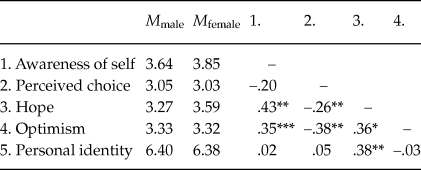
Preliminary analyses were first done to examine the means of each construct for males and females, as well as correlations among the constructs (see Table 1). With original data, MANOVA with Pillai’s trace statistics showed that male and female (i.e., only gender was entered as a fixed factor and all five constructs were entered as outcome variables) did not differ in any of the variables in the study, V = 0.04, F(6, 184) = 1.30, p = .26, partial η2 = 0.02. Based on the findings of this preliminary analysis, data from male and female were collapsed together.
Construct Means and Latent Construct Correlations

Note: *p < .05; **p < .01; ***p < .001.
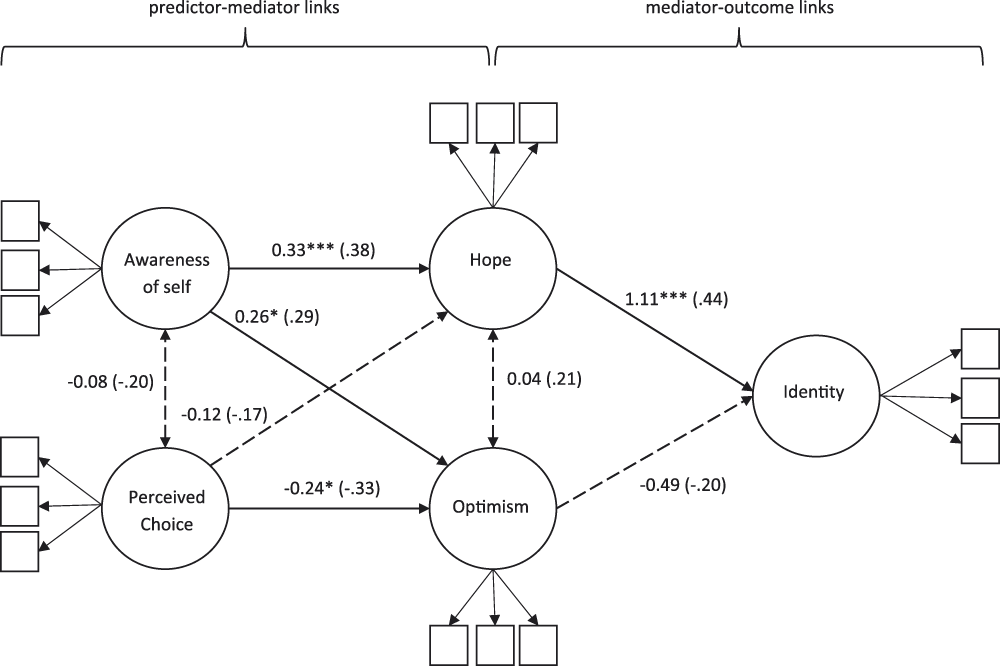
All subsequent CFA and SEM analyses were conducted with parceled indicators. We first conducted CFA and allowed the constructs to freely covary with each other. The fit of the CFA model was good, χ2 = 110.15, df = 80, p = .01, TLI = .94, CFI = .95, RMSEA = .04, 90% CI [.02, .06]; SRMR = .05. The standardized factor loadings for parceled indicators were highly significant (all ps < .001). The loadings were .66, .81, and .43 for awareness of self; .78, .82, and .59 for perceived choice; .69, .68, and .62 for hope; .60, .88, .48 for optimism; and .84, .84, and .75 for personal identity. We then examined the proposed mediation model, and found that the model continued to fit closely with the data, χ2 = 113.04, df = 82, p = .01, TLI = .94, CFI = .95, RMSEA = .05, 90% CI [.02, .06]; SRMR = .05. For the predictor-mediator links (see Figure 1), both awareness of self and perceived choice predicted optimism, Zs > 2.24, ps < .03, but only awareness of self predicted hope, Z = 3.39, p = .001. Perceived choice did not predict hope significantly, Z = –1.75, ns. For the mediator-outcome links, hope predicted identity significantly, Z = 1.11, p < .001, while optimism did not, Z = –1.78, ns. As a result, the only significant pathway with a complete mediation link was from awareness of self through hope to identity (see Figure 1). Optimism failed to mediate the link between the predictors and the outcome. Although one may argue that the non-significant relationship from optimism to identity, β = –.20, and from perceived choice to hope, β = –.17, was due to our sample size, the sample size does not bias against the magnitude of these regression weights, which were found to be quite weak. Interestingly, there is a slight suppression effect for the relationship between optimism and identity: The correlation between optimism and identity was found to be weak, r = –.03 in Table 1, but the standardized regression weight becomes stronger (though non-significant) for the same relationship, β = –.17. This was likely because of the correlation between optimism and hope, r = .36, when both optimism and hope predicted identity simultaneously. Hope explained 26.11% of the variance in personal identity, while optimism only explained 1.72% of the variance in identity.
Proposed model. Single-headed arrows represent regression paths. Double-headed arrows represent covariance (correlation). Numbers outside parenthesis represent unstandardized regression weights. Numbers inside parenthesis represent standardized regression weights. A significant path is shown as a solid line. A non-significant path is shown as a dotted line. *p < .05, ***p < .001.

To further illuminate the relationships among the variables, we examined the absolute magnitude of the (unstandardized) regression coefficients. The direction of the regression signs (positive and negative) was ignored in this set of analyses. The results showed that the regression weight of awareness of self on hope tended to be stronger than that of perceived choice on hope, B = |.33| vs. |–.12|), ∆χ2 = 2.95, ∆df = 1, p = .09, although the magnitude did not reach the traditionally accepted level of statistical significance. For optimism, the regression weight of awareness of self was not different from that of perceived choice (B = |.26| vs. |–.24|), ∆χ2 = 0.01, ∆df = 1, p = .90. Finally, when we constrained the regression weight of hope and the regression weight of optimism to be identical, the model failed to converge satisfactorily, indicating model misspecification. In other words, the two regression weights failed to be of the same magnitude, meaning that hope can predict identity better than optimism (B = 1.11 vs. |–.49|).
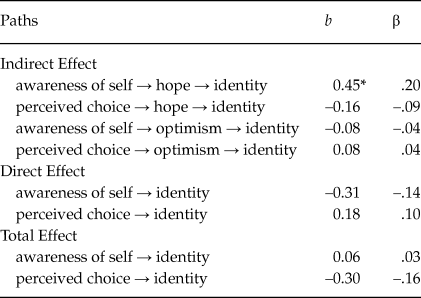
Finally, we attempted to add the direct paths from each of the two predictors (awareness of self and perceived choice) to the outcome (identity), but these two direct paths failed to reach statistical significance. Therefore, the full mediation model was found to be incomplete due to the absence of the direct effect. We then conducted bootstrapping analysis (with 2,000 draws) to examine the magnitudes of the indirect and direct effects in the mediation model, and the results are shown in Table 2. Not surprisingly, the only significant mediation pathway was the indirect effect between awareness of self and identity through hope, Z = 2.06, p = .04, which was the same result as in the aforementioned analysis. Optimism again failed to provide mediating effects.
Magnitude of Mediation Effects

Note: b = unstandardized regression weight; β = standardized regression weight.
* p < .05
Discussion
The focus of this research was the study of the distal-proximal framework of personal identity by examining self-determination, future orientation and their effects on personal identity. The results showed that students’ self-determination (as represented by awareness of self) explained personal identity, via future positive expectation (as represented by hope), with no direct effects between self-determination and personal identity.
Future Orientation and Personal Identity
The significant role played by hope in the hypothesized model extended the growing evidence that students’ hopeful thinking contributes to stronger personal identity. Consistent with past studies wherein hope, rather than optimism, was shown to positively predict the level of identity development (Moe, Dupuy, & Laux, Reference Moe, Dupuy and Laux2008), our results further suggested that when students had a clearer sense of self and, in turn, were more hopeful about their future, they were more likely to develop a stronger sense of being different from others. Tracing these findings back to the conceptual bases of hope and optimism, hope is a form of goal-directed thinking whereby individuals believe that they can produce the routes to their desired goals (Bryant & Cvengros, Reference Bryant and Cvengros2004). The emphasis of both the sense of determination one has to reach one’s goals as well as the ability to develop successful plans to reach these goals (Snyder, Reference Snyder2002) leads an individual to behave so as to attain his or her goals. Along a similar vein, if identity construction is considered an important goal, hope can be seen as facilitating goal-specific planning and behaviors, which can lead to the construction of desired identity. Indeed, scholars in the field of vocation have claimed that adolescents’ hope played a crucial role in their vocational identity formation (Diemer & Blustein, Reference Diemer and Blustein2007; Newman, Reference Newman, Graber, Brooks-Gunn and Petersen1999). Hence, hope contains the beliefs that the individual has the means and competence to cope with different life demands, and this in turn promotes identity development (the belief that desired goals or expectations can be fulfilled) (see Umaña-Taylor, Reference Umaña-Taylor2004).
In contrast, the non-significant relationship between optimism and identity revealed again the differences in these two future orientation constructs. Optimism involves a generalized expectation that positive events will occur, regardless of whether the individual is able to clearly see how or why they will occur (Scheier, Carver, & Bridges, Reference Scheier, Carver and Bridges1994). In this vein, an individual may have high optimism but low hope for the future if he or she does not know the actual pathway for attaining a desirable outcome. Constructing personal identity is an essential desired outcome for younger adults (Erikson, Reference Erikson1968). Altogether, this suggests that hope has the potential to be an important consideration in personal identity construction, while optimism may or may not be sufficient to establish one’s identity, although this needs to be examined by future research.
Self-determination and Personal Identity
SDT researchers (Soenens & Vansteenkiste, Reference Soenens, Vansteenkiste, Schwartz, Luyckx and Vignoles2011) have posited that self-awareness and perceived choice are important for recognizing the differentiation between the self and others, and the integration of self-values and the values of others. Nonetheless, in contrast to previous findings (Luyckx et al., Reference Luyckx, Vansteenkiste, Goossens and Duriez2009; Strachan et al., Reference Strachan, Fortier, Perras and Lugg2013), neither awareness of self or perceived choice was significantly directly related to personal identity in this study. One plausible reason could be related to the characteristics of the current sample. Although Chinese youth are now becoming stronger in pursuing individuality, they possibly only perceived themselves to be different from others on the emotional basis of feeling positive about the future (e.g., hope) by pursing individual hopes and goals. The awareness of self or sense of choice alone may not have been as critical in defining who they were as it would have been as to their Western counterparts. This clearly warrants further investigations.
Mediation Role of Future Orientation
Despite the missing direct effect between self-determination and identity, we found that awareness of self was indirectly related to personal identity via hope. This finding demonstrated the salient value of awareness of self, when configured with hope as the mediator in explaining personal identity. Individuals with higher levels of awareness would be more hopeful for their future, which in turn, have a stronger identity. Partly consistent with our expectation, our mediation model was a distal model, in which the predictors (i.e., awareness of feeling and perceived choice) did not directly predict the outcome of identity but only through the mediator. Shrout and Bolger (Reference Shrout and Bolger2002) have suggested that if the predictors are distal predictors, it is likely that they will not directly predict an outcome but only through a mediator. An empirical example of distal mediation was found in Yang, Kim, and McFarland’s study (Reference Yang, Kim and McFarland2011) which examined how conscientiousness affected objective sales performance through self-efficacy. Conscientiousness had an extremely weak relationship with objective sales performance, r = .11, but a fairly strong relationship with self-efficacy, r = .61. As a result, the authors concluded that conscientiousness predicted objective sales performance through self-efficacy through distal mediation. Similar models were also found in Mcllroy, Poole, Ursavas, and Moriarty’s (Reference Mcllroy, Poole, Ursavas and Moriarty2015) study.
There are some limitations to our findings. A potential limitation is the use of self-reports which introduce the possibility of common method bias. Because perceptions are virtually impossible to measure except through self-response, future studies may reduce this potential bias by using alternative indicators of identity (such as behavioral measures) or by applying a perceived self-efficacy scale (e.g., Schwarcer, Reference Schwarcer1992). A second limitation relates to the cross-sectional design, which does not allow for an assessment of causality. Possibly, another explanation is that people with a strong sense of uniqueness are more likely to feel positive about themselves and have a clearer sense of self. Future studies should examine the relationships between SDT variables, future orientation, and personal identity using a longitudinal design to determine the extent to which SDT variables and related affective processes are responsible for the trajectories of identity growth and variation over time.
Finally, the university students in our sample were still in the process of identity development (Erikson, Reference Erikson1968). Although this sample is appropriate for studying identity development, confirmation of our model with other age groups would be desirable because the magnitude of the path coefficients in the model may be a function of age. For example, we would expect the relationship between future positive expectations and identity in the model to be different among older adults as their preferred problem-solving strategies may switch from coping with the problem directly to dealing with emotions (Carstensen, Reference Carstensen2006). Hence, older adults may not rely on the belief that they can fulfil their desired goals (hope) but instead use their generalized positive expectations (i.e., optimism) to maintain a positive self-image. In this vein, this study opens a fruitful avenue for future research in the areas of self-determination and identity development.
In conclusion, the findings of this study contribute to the previous research that has recognized the importance of self-determination in personal identity development (Luyckx et al., Reference Luyckx, Vansteenkiste, Goossens and Duriez2009; Strachan et al., Reference Strachan, Fortier, Perras and Lugg2013). Our findings emphasized the need for hopeful thoughts in order to positively reinforce identity construction processes, and the non-significant direct effect of optimism on personal identity provides extra evidence of the distinction between these two constructs. The role of future orientation was also highlighted in developing personal identity and students’ awareness of self affected their personal identity indirectly via hope. These findings have significant implications for education practitioners and school leaders to develop targeted interventions to assist with student identity construction. Flum and Kaplan (Reference Flum and Kaplan2006) suggested that classroom teachers can support identity construction via enhancing students’ skills at relating school content and experiences to self-knowledge, and initiating discussions with students about the value of school learning. School leaders could consider integrating such dialogues into daily curriculum as a way to immerse students in defining self. In this manner, teachers can create classroom cultures wherein “students discover who they are and negotiate connections between who they are and what they do in school” (Faircloth, Reference Faircloth2012, p.187).
Given the role of hope in the relation between self-awareness and personal identity, strategies to successfully raise hope can be applied in relation to identity development. For example, learning to understand the self and to seek personal growth could be nurtured through modeling and positive reinforcement, which can promote a sense of hope and in turn strengthen identity formation. Without the hope that good things will happen, students have difficulties in building a strong sense of identity, even when they possess a clear sense of self-awareness.