The South Korean Candlelight Protests of 2016–17 succeeded in achieving what many considered improbable: impeaching President Park Geun-hye for corruption and abuse of power and replacing her with a more liberal government. A jubilant mass media account would suggest that the Candlelight Protests drew from the historical legacies of pro-democracy movements and previous waves of uprisings and protests, not only demonstrating the power of peaceful mass mobilization but also reinvigorating popular forms of decentralized collective action. A more sobering account, however, would caution against such a triumphant narrative of singular purpose. In the years leading up to the first Candlelight Protest on October 29, 2016, countless protests, small and large, had called for Park's resignation, for reasons too numerous to list in full: to take responsibility for election tampering and the use of national security apparatuses to further her political aims, for abandoning the Sewŏl ferry and covering up dereliction of duty on multiple scales, for receiving corporate donations in exchange for political favors, for deepening inequality, and so on. When the activist farmer Baek Nam-gi died on September 25, 2016, after being in a coma for nearly a year—following his injury the previous year by a high-velocity water cannon at a large national protest led by the Korean Confederation of Trade Unions (KCTU)—the stage was set for a large-scale mass mobilization that, in actuality, was not a single uprising but a momentary convergence of many forces and many movements, replete with conflicts and contradictions.
In this article, I discuss queer and transgender dissenting voices that took part in the Candlelight Protests but were sidelined during the special election that followed Park's impeachment. Drawing from theories of queer temporality and feminist critiques of homogenous time, I focus on the idioms of postponement (najunge) and prematurity (sigisangjo) that sparked an important series of political discourses regarding the timing and timeliness of social change and minority politics in South Korea. What kinds of spatiotemporal normativities are produced through these idioms? What are the stakes of being out of place in time?
Disruption: The Najunge Incident
To begin, I want to recount how the word najunge (later) became synonymous with the suppression of minority dissent, especially queer and transgender protest.Footnote 1 In February 2017, during the latter part of the Candlelight Protests, news reports revealed that the presidential front-runner and self-proclaimed “Candlelight president” Moon Jae-in had assured conservative Protestant leaders that he, too, “opposed homosexuality.” Moon wasted no time after officially registering as a presidential candidate and met with the leaders of the Christian Council of Korea (Han'gich’ong or CCK), the Communion of Churches in Korea (Han'gyoyŏn or CCIK), and the National Council of Churches in Korea (Han'gyohyŏp or NCCK), in that order. Though they were three separate private meetings behind closed doors, Moon reportedly expressed his position with clarity and consistency: he personally did not “support homosexuality,” though he did not think sexual minorities should be discriminated against (S. Yi Reference Yi2017; Y. Yi Reference Yi2017). Moon reassured the Christian conservatives that neither the current Korean laws nor the majority public sentiment would tolerate the legalization of same-sex marriage, and that he and his party had no intention of creating change in this regard (Kim Yun Reference Na-yŏng2017). Similar to other rhetorical declarations of pandongsŏngae—which literally means “antihomosexuality”—that conflate same-sex desire, cisgender male homosexuality, nonbinary or variant gender identities, and nonnormative family forms, all under the umbrella of deviant “homosexuality” that is to be opposed, Moon's position was understood as undeniably negative toward LGBTQ+ equality in a broad sense.Footnote 2
Appalled by Moon Jae-in's disavowal of his earlier commitments—since he had previously supported comprehensive antidiscrimination legislation that included protection for gender and sexual minorities—and alarmed by this conservative turn during a swell of optimism for political change, the activist group Rainbow Action Against Sexual Minority Discrimination promptly held a press conference in front of the Minjoo Party headquarters to denounce Moon Jae-in and his party (Hyŏnsŏn Reference Hyŏnsŏn2017). I remember vividly the solemn mood at the press conference on that cold, brisk morning in February. It stood in contrast to the lively, hopeful political mood during the Candlelight Protests that were still going strong after fifteen consecutive weeks. This press conference was among the first signs I saw of minority political dissent breaking away from the unifying rhetoric of the Candlelight Protests, which kept the overall focus on demanding in unison the impeachment of Park Geun-hye. The press statement by Rainbow Action instead implored the public to consider a politics of difference:
People who are holding up the candlelight have held back their tears over the years . . . They are sexual minorities, disabled people, migrants, women, precarious workers, unmarried mothers, divorced families, people without much education, poor people, and people who are ill. The people's candlelights have created enormous streams of equality and democracy, and they demand fundamental social change and human rights and dignity for all. But instead of listening to these voices on the street, Moon Jae-in has thrown cold water on the fire for change.Footnote 3
Queer and transgender activists and supporters at this press conference made it clear that they considered themselves to be a constitutive part of the Candlelight Protests. And they aligned themselves with other minoritized and marginalized groups in asserting themselves as agents of historical change.
After the press conference, a small group of activists rushed over to another event—a public forum on gender equality where Moon Jae-in was scheduled to appear in person. He was to announce his so-called blueprint for gender equality policy at this event, addressing issues such as paid maternity leave and wage equity. The small group of queer and transgender activists, human rights attorneys, and disability justice activists initially sat quietly in the front rows and waited for Moon Jae-in to finish the main part of his speech, during which he unironically declared himself a “feminist president.” When the moment seemed right, they stood and held up the protest signs they had brought from the press conference earlier, shouting: “Human rights equal life for sexual minorities!” “Sexual minority rights are not up for negotiation!” “We do not need a presidential candidate who excludes sexual minority rights!”
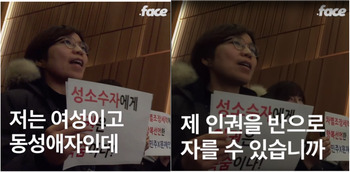
A short video recording of this protest went viral soon afterward. Edited and distributed by an independent online media project called Dot Face (.Face), the now-famous video featured labor activist Kwak I-kyŏng (Kwak Ekyeong) at the center of this protest disruption, as she shouted with her voice slightly breaking, “I am a woman and a lesbian! How is that you can slice my human rights in half? How is that my right to equality can be sliced in half? As the front-runner for the presidency, please answer! Why is it that in this policy of gender equality, you cannot include equality for sexual minorities?” (see figure 1).
Kwak I-kyo˘ng. “I am a woman and a lesbian. How is that you can slice my human rights in half?”Footnote 4

The video attracted a great deal of public attention, not only because of the emotional sway of Kwak's outcry but perhaps more so because of what immediately followed the disruption. “I will give you a chance to speak later,” Moon Jae-in can be heard telling Kwak when she pressed him for a response. Then, in the midst of a chaotic exchange as the event organizers and security personnel tried to quiet the protesters and remove them from the venue, a few voices from the audience began to shout Najunge! (Later!). Soon, the audience began chanting loudly together: Najunge! Najunge! Najunge! In this striking scene in the video, Kwak and the other protesters appeared aghast as they turned to face the audience shouting at them, their protests drowned out by the louder calls for “later.” The video ends with collective chants for postponement reverberating in the auditorium, in what I would describe as a chilling act of epistemic violence (Dotson Reference Dotson2011; Spivak Reference Spivak, Nelson and Grossberg1998).
Some, no doubt, disapproved of the tactic of disruption itself. The protesters were indeed speaking out of turn, and thus they were accused of being disrespectful and rude. In this view, the protest was fundamentally untimely, and the disruption itself was inherently inappropriate; the chants for “later” were simply an attempt to maintain procedural decorum. “Later,” after all, did not mean “never,” and queer and transgender activists would supposedly have a chance to ask their questions to Moon Jae-in at a later time. But to those who were troubled by the emerging shape of Moon Jae-in's position on LGBTQ+ politics and empathized with the urgency of the protesters at this forum, the scene of the audience calling for postponement left a searing impression as an encapsulation of everyday violence that gender and sexual minorities routinely face—the enforcement of normativity in the guise of civility, the dominant majority silencing minority dissent, the denigration of LGBTQ+ concerns as out of place and out of order, and institutions that continually promise but perpetually defer change. With the Candlelight Protests ongoing and the special election campaign underway, the national time of political upheaval revealed itself to be disappointingly familiar, unsurprisingly heteronormative, and fundamentally unchanged, conjuring up the previous failures of systemic transformation (Kim Reference Kim, Shin and Chang2011).
This protest—since then referred to as the “najunge incident”—has become emblematic of the political stakes of the queer and transgender critique of the Candlelight Protests in 2016–17 and the subsequent liberal government headed by President Moon Jae-in. Change? Maybe later. The word najunge emerged as a telling sign of temporal displacement. It signified postponing LGBTQ+ emancipation and excluding gender and sexual equality from the horizon of social change. In turn, a rejection of najunge meant a refusal to simply wait, a refusal to wait with no guarantee. This resonated also with the understanding that Sewol passengers were repeatedly instructed to stay still and wait for help—rescue that never came. The emphasis on not waiting thus became a defining rhetorical feature of LGBTQ+ activism in South Korea. Countless events and political campaigns have since invoked the rejection of najunge as a politics of refusal, instead emphasizing the urgency of the now. For instance, the annual Seoul Queer Culture Festival in 2017 adopted as its slogan “Right now! Not later!” Others have deployed slogans demanding labor rights now, antidiscrimination laws now, an increase in the minimum wage now, climate justice now, and so on.
This has continued. In a 2020 op-ed, Nam Ung, an activist with Solidarity for LGBT Human Rights of Korea, admonished the Moon Jae-in administration as a “najunge government,” criticizing Moon's dismal record on gender and sexual equality and human rights (Nam Reference Nam2020). Queer and transgender critiques have similarly continued to reject postponement and to refuse to accept the promise of a future that appears only at the expense of the present. They insist on living now—transforming the terrains of the present in order to build a different future—but what is possible on the horizon?
Sigisangjo: A Textbook Idiom of Chrononormativity
While postponement defers and pushes away the future, producing a chronic condition of dislocation for queer and transgender individuals in the present, the najunge incident also pointed to what is perhaps a more complex quandary about the (dis)order of temporal nonconformity: sometimes the future is seen as already here, premature and unwanted in the present. The following excerpt from a Korean language textbook is translated from Korean to English. The dialogue captures perfectly a predicament of temporal nonalignment (Textbook Compilation Committee Reference Committee, Institute and University2013, 110).
Ŭn-hŭi: I hear that these days in other countries, there are movements calling for the legal recognition of homosexuality.
Myŏng-suk: Don't you think South Korea would soon follow?
Ŭn-hŭi: Given our reality, I think that would be _________________.
The correct answer provided for this vocabulary exercise is sigisangjo (時機尙早), a commonly used idiom that refers to being untimely and premature; it is the equivalent of saying “too early for that.” Something or someone has arrived too early. The term is typically used disparagingly toward reformist aspirations or to discourage nonnormative gestures that surface against good timing, taking place earlier than when they might be welcome. It is one of the most popular four-syllable idioms (sajasŏng’ŏ) in the modern Korean language and among the most commonly given reasons for opposing same-sex marriage or postponing LGBTQ+ equality in the law.Footnote 5
The object of disdain in the textbook exercise remains tellingly ambiguous. The word used is tongsŏngae (homosexuality), a term that in common usage does not refer narrowly to same-sex desire but implies all nonnormative gender and sexual identities and practices, including bisexual, transgender, agender, and intersex. The term tongsŏngaeja (homosexual) was used widely by LGBTQ+ activists in the 1990s to refer to lesbian and gay identities, practices, and community formations, but in recent years, it has been replaced by more capacious and inclusive terms, including LGBTQ+ or LGBTI, iban, k'wiŏ (queer), and sŏngsosuja (sexual minority), all of which have become preferred over tongsŏngaeja. The opponents of LGBTQ+ equality, on the other hand, continue to use the word tongsŏngae. It makes sense that the textbook dialogue would use the less favorable and somewhat outdated term tongsŏngae, since using one of the preferred terms like “sexual minority” would imply tolerance and even acceptance, which would contradict the lesson's underlying message of unacceptability.
While this vocabulary lesson singles out the “legal recognition of homosexuality” as an exemplary instance of sigisangjo, there are certainly many other nonnormative practices and policy proposals that have historically been labeled as premature and untimely. Allowing openly gay men or transgender soldiers to serve in the Korean military has been described as sigisangjo, and likewise for any suggestions to lift travel or communication restrictions between South and North Korea. Calls to abolish compulsory military service or repeal the dreaded National Security Law predictably spark charges of sigisangjo, seen as inconceivable as long as the two Koreas are still technically at war with one another. The end of the patriarchal household registry system (hojuje) in 2005 and the decriminalization of adultery in 2015 were opposed by critics who insisted that these policy changes were sigisangjo—too soon and “not yet” the right time—and calamitous for the traditional institutions of marriage and family, society and nation. It is common in fact for any controversial reform effort to be accused of being sigisangjo.
I do not presume to know, of course, why the writers of this particular Korean language textbook chose “legal recognition of homosexuality” as the best illustration of sigisangjo, an instance of something that is supposedly impossible today in South Korea but perhaps possible in the future. On the one hand, it is not surprising to find troubling exercises like this in language textbooks, since they often contain norm-reinforcing lessons on culture, tradition, and history. Other gender and heteropatriarchal norms appear throughout this textbook. For example, in a grammar lesson, we find a stereotypical scenario of a young man starting his military service with worries about leaving behind his girlfriend and, a few pages later, a duty-bound housewife lamenting that she is exhausted from housework and child care.
What I find especially intriguing in the sigisangjo example here, though, is that the dialogue acknowledges two things simultaneously: that there are other countries where struggles for LGBTQ+ rights might be more fitting, and that it is not yet the case in South Korea. Put differently, sigisangjo is rendered in both spatial and temporal terms. “Not now” is equated with both “not here” and “not yet.” The lesson thus establishes the prevailing normativity in spatiotemporal terms, inscribing homophobia and heterosexism as constitutive of “our reality” in South Korea. Considering the intended audience of the textbook—students of Korean as a foreign language—the lesson serves multiple pedagogical purposes. It proffers intolerance as a social consensus in South Korea and positions LGBTQ+ activism as incompatible with this purported norm. It territorializes gender and sexual nonconformity as exterior to the norm and as out of place in time and space. It is a remarkable illustration of how sigisangjo concurrently demarcates the temporality and spatiality of heteronormativity.
I thus suggest that we think of sigisangjo as a spatiotemporal idiom of chrononormativity, which Elizabeth Freeman (Reference Freeman2010, 3) calls the process whereby “naked flesh is bound into socially meaningful embodiment through temporal regulation” for the purposes of “maximum productivity.” While Freeman is primarily concerned with how temporal regulation, inextricably intertwined with capitalist economic regulation, subordinates reproduction to production, what I see here as chrononormative is the temporal regulation of gender and sexual difference, marked as subordinate to “nation time.” Here I echo several writers in the volume Feminist Time against Nation Time who situate “the present moment in and through a problematization of temporality” and argue that “as a project that acts on the present in order to enact a different future, feminism necessarily operates in a different temporality from that of the nation” (Hesford and Diedrich Reference Hesford and Diedrich2008, 5). In thinking further about feminist temporalities of dissent, Chandra Mohanty's (Reference Mohanty, Nicholson and Seidman1995, 81) foundational discussion of the politics of location and “temporality of struggle” bears quoting at length here:
[A] temporality of struggle . . . not only disrupts and challenges the logic of linearity, development, and progress which are the hallmarks of European modernity . . . [T]he notion of a temporality of struggle defies and subverts the logic of European modernity and the “law of identical temporality.” It suggests an insistent, simultaneous, non-synchronous process characterized by multiple locations, rather than a search for origins and endings which, as Adrienne Rich says, “seems a way of stopping time in its tracks.”
Indeed, the LGBTQ+ activism that I trace in this essay is connected to a robust nexus of queer feminist temporality of struggle taking place in contemporary South Korea (Kwŏn Kim et al. Reference Kim, Hyŏn-yŏng, Son, Han, Na, Hong and Chŏn2017; Chŏn, Ru-in, and To-gyun Reference Chŏn, Ru-in and To-gyun2018; Han et al. Reference Han, Po-myŏng Kim and Hwang2018). Their articulations are fueled by the continuing outrage against rampant misogyny and violence against women and pervasive bigotry and violence toward ethnic and sexual minorities. They center trenchant critiques of heteropatriarchal nationalism and male-dominated nation time and cultivate insurgent spaces of critique and antinormativity that are diverse and multiple, nonmonolithic and heterogeneous, radical and sometimes, controversial. They contradict the hallowed grounds of the so-called 1987 Generation, which claims to represent the project of national democratization as a singular fait accompli. My point here is not that queer feminist time and nation time are somehow mutually exclusive or perpetually irreconcilable with one another, but rather that queer and feminist critiques pose serious challenges to the primacy of nation time as represented by Moon's “Candlelight presidency.”
To accept the terms of sigisangjo would be to accept the normative timeline of national democratization and social change, arranged in a sequential order of political priority. This chrononormativity prioritizes economic development and political democratization and sidelines gender equality, sexual liberation, and minority rights. This nation time places the nationalist political longing for South-North reunification—as expressed by the 1987 Generation's classic phrase of utopian promise, kŭnari omyŏn (when the day comes)—as the single most significant milestone before which all other dreams and aspirations for social change would be stalled in the waiting room, postponed to najunge. The chrononormative logic of sigisangjo structures this waiting. It refuses to accept the viability of dissent and nonconformity in the present. It simultaneously attributes noncompliance as originating from the future and demands that dissent in the present find its resolution elsewhere in time and space—that is, in actuality, nowhere.
Queers from the Future
The claim that nonconforming genders and sexualities do not belong in the present in fact complements the conjuring of the future as an intrinsically more hospitable territory than the present. This should not be surprising—under the teleological auspices of progressive social change, it is typically expected that LGBTQ+ rights would march, or at least inch, toward a field of better circumstances. Such sequential outlook is behind the well-known—and subsequently much-criticized—US-based “It Gets Better” campaign in 2010, which promised inevitable progress and highlighted a trajectory of upward mobility and neoliberal aspirations, promises that ultimately relied on a great deal of cisgender, race, and class privilege (Nyong'o Reference Nyong'o2010; Puar Reference Puar2010, Reference Puar2011). The improvement trajectory promised by “It Gets Better” is different from the revolutionary futurity of the aforementioned sentiment of kŭnari omyŏn—a reference to an assumed inevitability of South-North Korea reunification—but they are similar in that they both project, conditionally, a utopic vision of happiness and well-being. Interestingly, in both cases, the future serves as an alibi, offered in advance to justify or at least pacify the discontent in the present.
Put differently, the chrononormative logic of sigisangjo depicts gender and sexual minorities as if they have been transported from the future in a time machine. The salience of time in both the najunge incident and sigisangjo discourse becomes even more remarkable when we consider the extent to which temporal discordance has been an important theme in queer and transgender studies, fields long concerned with questioning and problematizing temporality. Being at odds with normativity has been theorized as “temporal disorientations and disorienting feelings” (Moore, Brintnall, and Marchal Reference Moore, Brintnall, Marchal, Brintnall, Marchal and Moore2018, 2; italics in original), “disorderly narratives” (Halberstam Reference Halberstam2005, 187), and “unruly visions” (Gopinath Reference Gopinath2018) in a “state of permanent dislocation” (Halberstam Reference Halberstam2005, 124). Queer temporalities and futurities have in fact been among the most productive threads of inquiry in queer theoretical scholarship, discussed extensively in works such as No Future (Edelman Reference Edelman2004), In a Queer Time and Place (Halberstam Reference Halberstam2005), Feeling Backward (Love Reference Love2007), Cruising Utopia: The Then and There of Queer Futurity (Muñoz Reference Muñoz2009), Time Binds: Queer Temporalities, Queer Histories (Freeman Reference Freeman2010), Queer Times, Black Futures (Keeling Reference Keeling2019), and many others.
A key discussion in queer temporalities concerns “unscripting”—or “going off script”—involving antinormative queries into the “potentiality of a life unscripted by the conventions of family, inheritance, and child rearing” (Halberstam Reference Halberstam2005, 2). This fundamentally signals a temporal disruption. Building on the critique of time that is conventionally scripted as linear and progressive, “across which the history of nations supposedly marches forward,” Freeman in Time Binds: Queer Temporalities, Queer Histories (Reference Freeman2010, xxii) rejects the notion of time as “seamless, unified, and forward moving.” Rather, she focuses on “textual moments of asynchrony, anachronism, anastrophe, belatedness, compression, delay, ellipsis, flashback, hysterion-proteron, pause, prolepsis, repetition, reversal, surprise, and other ways of breaking apart what Walter Benjamin calls ‘homogeneous empty time.’” To this list I would add sigisangjo as an idiom of heteronormative temporality.
Building on Benedict Anderson's classic argument in Imagined Communities (Reference Anderson1983) and Partha Chatterjee's writings, especially in “The Nation in Heterogeneous Time” (Reference Chatterjee and Özkırımlı2003), I suggest that the temporality of sigisangjo points to heteronormative national time. Interestingly, the discontent rendered through the idiom of sigisangjo is not about “coming out of humanity's past, something people should have left behind but somehow haven't,” as Chatterjee (Reference Chatterjee and Özkırımlı2003, 33) writes. Instead, queer discontent springs prematurely from the future, a realm of aspirations that lies beyond the territory of the present. Sigisangjo posits, after all, that the anomaly is from the future elsewhere, that it has not existed in the past here, and that the present is not yet ready for it.
Insofar as these temporal disturbances trouble the path of linear progress and create something of a jumbled mess—bodies and practices out of order, the past, present, and future entangled with one another—I am also reminded of Martin F. Manalansan's (Reference Manalansan2015) writing about the conjuring of “queerness through disorder, clutter, and the chaos of things gone awry.” He writes, “Queer as mess refers to material and affective conditions of impossible subjects as well as an analytical stance that negates, deflects, if not resists the ‘cleaning up’ function of the normative.” This applies well to the normative intention behind the use of the idiom of sigisangjo—to diagnose an anomaly, to deny its timeliness, and to attempt to remove the mess from the present by displacing it out of sight. Asserting chronological and spatiological scripts to arrange bodies through the regulation of time and space, the deployment of sigisangjo aims to “clean up” the timeline by designating an “appropriate” place in time.
Sigisangjo as Denialism
There are three particular ways in which the cultural logic of sigisangjo relies on the rhetoric of denial. First, it characterizes nonconforming gender and sexual identities and practices as an ontological oddity and spatiotemporal noncorrespondence, a misalignment against the current of time—that is, “they do not belong” in the here and now. Thus diagnosed as out of place in time, the anomalous object of sigisangjo is considered aberrant, improper, and untimely. To list just two examples: campaigns to pass antidiscrimination laws that include protection for LGBTQ+ individuals and efforts to decriminalize conscientious objection to military conscription are typically dismissed as premature. This has a spatial dimension. By suggesting, as the Korean Language Institute textbook example does, that the protection of LGBTQ+ rights might be tolerated in other countries but not in South Korea, sigisangjo reinforces a developmentalist timeline in which South Korea is “not yet” ready for social change, either behind other nations in degrees of social tolerance or underdeveloped in terms of legal mechanisms to protect minority rights.
An important second step in deploying sigisangjo is thus to deny the dignity, humanity, and, in a sense, the very existence of queer and transgender individuals as rights-bearing citizens in contemporary South Korea. What is simultaneously being denied is that the present is changeable, and that there are popular and counterhegemonic social movements already underway, in and beyond the national spectacles such as the Candlelight Protests of 2016–17. Advocates and allies have been expanding the bounds of contemporary queer and trans activism beyond narrowly defined identity politics, addressing policy concerns in the workplace, schools, and religious institutions. The logic of deferral—one that denies the capacity of the present to change and casts out nonconformity to the realm of a future located elsewhere—reveals itself as an exercise in denialism, an ideological position based on a systematic refusal while elevated as a “morally sanctioned form[s] of denial” (Fassin Reference Fassin2007, 115).
A third denial in the idiom of sigisangjo concerns the past—a denial that gender and sexual minorities have already been part of South Korean society. LGBTQ+ activism has already contributed to human rights and minority coalitions and political discourse in South Korea, most notably since the 1990s, diversifying and growing as part of dynamic and interwoven networks of dissent and solidarity that helped shape several moments of political upheaval, including the Candlelight Protests of 2016–17 (Kim Reference Kim2020). There are queer and transgender people already active in dissent, already present in movements. Since the 1990s, a distinct queer left formation in South Korea has grown out of progressive-left activism and social movements that included student, labor, antipoverty, antiwar, and antimilitarism, as well as a variety of feminist and disability justice groups (Han Reference Han, Arrington and Goedde2021). Self-identified gender and sexual minority activists can be found across a wide range of progressive human rights advocacy spaces, and there is growing recognition of LGBTQ+ politics as dissident minority politics, a necessary part of a functioning participatory democracy. The idea that South Korea is not yet ready for a greater degree of gender equality and sexual liberation obscures this historical present. To deny that LGBTQ+ politics has a place in the present by calling it sigisangjo undermines the dynamism of the present and the richness of historical contingencies.
To illustrate in a more concrete way, let me return to the najunge incident discussed at the start of this essay and elaborate on the figure of Kwak I-kyŏng, who was at the center of the video. It would be a mistake to characterize the incident as merely a beginning. Kwak is part of a small but influential cohort of left-leaning lesbian and gay activists organizing since the late 1990s, a founding staff member of Solidarity for LGBT Human Rights Korea, and a longtime movement leader who has mentored countless queer activists over the last two decades. At the time of the najunge incident, Kwak was also the director of external relations and solidarity for the KCTU, a position that prioritizes building political ties among a wide range of issues and constituent communities. Her office in KCTU could be described as the face of South Korea's social movement unionism, a practice in which labor unions engage not narrowly in workplace concerns or class mobilization but also connect organized labor with broader political struggles for human rights and social justice.
Though Kwak is certainly not the only out lesbian or gay activist in the labor movement today, she is among the best-known out lesbian activists who traverse across a wide range of queer-labor solidarity movement spaces. During the Candlelight Protests of 2016–17, Kwak served on the core coordinating committee for the Emergency National People's Action for the Dismissal of Park Geun-Hye, working behind the scenes week after week to organize programs and coordinate the protests attended by hundreds of thousands of participants. It is with a sense of irony that I point out that Kwak I-kyŏng played a key role in creating the space of the Candlelight Protests, but when she confronted Moon Jae-in—who embraced the label “Candlelight president”—to demand that her rights as a sexual minority be included in the broader human rights platform, she was told that she was out of line and out of place, that there was no space for her on this timeline of political change. The event effectively exposed that multiple and contradictory temporal regimes are in operation.
Conclusion
One could perhaps argue that both najunge and sigisangjo are simply idioms of pragmatism. After all, deferral is not the same as outright refusal. Postponement could and should be distinguished from the blanket refusal of conservative anti-LGBTQ+ political formations that plainly assert “never” to the possibility of gender and sexual equality or liberation. With the heightened pitch of anti-LGBTQ+ politics today, especially led by Christian conservatives who leave no room for even the possibility of later—or for whom “later” might signal an apocalyptic end times—the idioms of najunge and sigisangjo could perhaps be taken generously as dangling signs of hope. But I have emphasized in this essay that “later” is hardly harmless or unconditional. Political idioms of postponement and denial engage in a heteronormative ranking of life that compels dissenting subjects to acquiesce to the toxic fate of premature death and lives deemed premature, forcing an acceptance of unlivable and ungrievable lives as inevitable. We must recognize that to be out of place—or to be denied a place in time—is an affliction of inconvenience, discomfort, pain, and far worse.
At the same time, to desire otherwise, to desire alignment with straight time would constitute what Lauren Berlant (Reference Berlant2011, 126) calls “stupid optimism,” by which she means “the faith that adjustment to certain forms or practices of living and thinking—for example, the prospect of class mobility, the romantic narrative, normalcy, nationality, or a better sexual identity—will secure one's happiness.” To abide by the liberal promise of najunge and to wait for sigisangjo to sort itself out would constitute a “cruel optimism,” what Berlant (Reference Berlant2011, 24; italics in original) describes as “a relation of attachment to compromised conditions of possibility whose realization is discovered either to be impossible, sheer fantasy, or too possible, and toxic.” The insistence on the now in LGBTQ+ politics is a refusal to wait for tolerance, or acceptance, in perpetuity.
My intention here is not to rewrite the narrative of the Candlelight Protests or to dismiss their significance, but to highlight one important aspect of discontent and raise questions about the temporalities of political transformation that are taken for granted. To paraphrase the brilliant queer theorist José Esteban Muñoz (Reference Muñoz2009, 1), I would argue that the Candlelight Protest participants dreamed and enacted other ways of being in the world, rejecting a here and now and insisting on the potentiality for another world. Queer and transgender protesters joined tens of thousands of others week after week, throwing their bodies into the collectivity and intervening in the conduct of conduct in the defiant and creative spaces that dared to imagine a different future. Especially alongside feminist and youth activists, gender and sexual minorities advocated for conscientious speech and a public culture of mutual respect and accountability, seeking to build inclusive spaces that did not condescend toward youth or stigmatize mental illness or disability. This included helping institute policies against misogyny and hate speech on stage and in the public square, putting a stop to degrading criticisms of even President Park on the basis of gender, no matter how despised she was as a political despot. Gender and sexual minority activists pushed for a conscious effort to include more minorities in decision-making leadership and programming and carried the rainbow flag every week at the Candlelight Protests to project inclusive visions of political transformation that would encompass an end to anti-LGBTQ+ bigotry and gender-based discrimination—not later, but now. These transformative experiences and political subjectivities cultivated through the Candlelight Protests will likely outlast the specific outcome of the protests, namely the liberal government that was elected to replace the old.
To be sure, there are notable differences between conservatives and liberals. Anti-LGBTQ+ conservatives have not only resisted but actively blocked social change, mounting counterprotests against queer and transgender gatherings in public space. They have reversed human rights protection laws and repealed ordinances, and expanded their own base for political mobilization. Liberals on the other hand have largely postponed change in important ways, determining sexual minority rights to be sigisangjo, untimely and premature, rather than permanently impossible (see Han Reference Han, Arrington and Goedde2021).
Two years into his presidency, Moon nominated his close aide and human rights legal scholar Cho Kuk as a new minister of justice, a welcome choice for those who valued Cho Kuk's record as a progressive legal scholar especially on the subject of political prisoners and conscientious objectors to the military service. During the highly polarized and contentious confirmation hearing in September 2019, the full details of which are beyond the scope of this essay, Cho stated that he does not think of homosexuality as a matter for one to support or oppose. But echoing the Moon administration's position, he also said that he believes same-sex marriage recognition would be premature—sigisangjo (Heo Reference Heo2019). Responding to Cho Kuk's statement, an activist group known as the Trans Liberation Front (Tŭraensŭ haebang chŏnsŏn) stated, “Sexual minorities’ human rights keep getting deferred to the future, [but] this is about life and survival to some of us. We live in the present and cannot postpone survival to later.”Footnote 6
What has become abundantly clear since the Candlelight Protests is that queer and transgender activists today face challenges not only from the intensifying conservative bigotry and backlash, but also from the reluctance and indifference of liberals in relative proximity. Contending with deferral and difference may be nothing new, but contemporary LGBTQ+ activism lays bare how critical it is to imagine deeply transformative political change beyond the megaevents of protests and national elections and how difficult it is to forge capacious political imaginaries that reach beyond the limits of liberalism.
Acknowledgments
I thank Jennifer Jihye Chun, Hyun Ok Park, and Michelle Williams for the enriching exchange of ideas and political analyses, and Youngju Ryu and Albert Park for their work in organizing this forum. My gratitude also extends to the anonymous reviewers who kindly took the time during the pandemic to review the manuscript and offer helpful comments. I have benefited tremendously from questions and discussions that followed presentations of parts and earlier versions of this essay at the University of Michigan, University of Chicago, Johns Hopkins University, University of California, Los Angeles, Indiana University, Princeton University, Columbia University, and George Washington University.
Author Bio
Ju Hui Judy Han is Assistant Professor in Gender Studies at the University of California, Los Angeles.