INTRODUCTION
In May 2004, the African Union (AU) officially launched its new Peace and Security Council (PSC). At the launch, Africa's leaders emphasised the PSC's potential significance, claiming that its establishment ‘marks an historic watershed in Africa's progress towards resolving its conflicts and the building of a durable peace and security order’ (AU 2004: para.1). Outside Africa, however, the PSC has attracted precious little scholarly attention.Footnote 1 This is in spite of a growing literature exploring regional arrangements and their roles in security policies. The PSC therefore remains an understudied institution in an undervalued part of the world. This neglect is unfortunate because the PSC is a relatively new international institution with a remit dedicated to promoting peace, security and stability on the African continent, which can shed significant light on several important debates, not least the limits of conflict management in contemporary Africa, the processes of norm diffusion and socialisation within African international society, and how regional arrangements operate and relate to the foreign policies of their member states.
This article seeks to help fill this gap by addressing some of these important questions. It does so in three main parts. The first section provides an overview of the immediate origins of the PSC. In the second section, I deploy Acharya and Johnston's (Reference Acharya, Johnston, Acharya and Johnston2007) framework to discuss five elements of the PSC's institutional design: its membership, scope, formal rules, norms and mandate. The third section evaluates the PSC's activities until March 2009 in the light of Edward Luck's (Reference Luck2006) framework for assessing the UN Security Council. Specifically, it assesses the significance of the PSCs deliberations and official statements; its political relevance; its efficiency and productivity; and the extent to which it should be considered the best placed institution to deal with Africa's security challenges. The evidence suggests that many AU member states have yet to take the PSC seriously. Consequently, the Council's future will hinge on whether more African governments can be persuaded to devote more serious levels of resources (human and financial) to it. Nevertheless, even in its suboptimal state, the PSC has had a significant impact on security dynamics within Africa. It is therefore important to analyse how and to what extent the AU PSC matters, and for whom.
HISTORICAL BACKGROUNDFootnote 2
The PSC was not part of the AU Constitutive Act (adopted in Lomé, Togo in July 2001). Rather, it grew out of an ad hoc process to reform the Mechanism for Conflict Prevention, Management and Resolution, which had been adopted by the Organisation of African Unity's (OAU) Assembly of Heads of State and Government in June 1993. The Mechanism's primary objective was the anticipation and prevention of conflicts (see Muyangwa & Vogt Reference Muyangwa and Vogt2000). This focus on prevention emerged after a series of intra-African debates in Kampala (1991), Dakar (1992) and Addis Ababa (early 1993), when OAU members took a conscious decision not to involve the organisation in peacekeeping operations. Rather optimistically, they hoped that a focus on preventive diplomacy would dramatically reduce the need for subsequent peacekeeping on the continent. The consensus proved short-lived, however. The mass killings in Burundi and Rwanda (1993–4) in particular caused the OAU to revisit its self-imposed ban on peacekeeping. This began with a series of internal debates organised by the OAU secretariat and the circulation of a background paper summarising the issues. These discussions, in turn, led to the organisation's 1995 summit in Addis Ababa endorsing the idea that ‘ready contingents’ should be earmarked within African armies for deployment on peacekeeping operations. Despite this change in principle, throughout the 1990s the OAU continued to define its priority as conflict prevention, arguing that primary responsibility for peacekeeping in Africa lay with the UN.
The problem with this position became increasingly evident as the UN proved reluctant to take the lead in resolving African conflicts. In Liberia, Sierra Leone and Guinea-Bissau, groups of West African states used the Economic Community of West African States (ECOWAS) as a vehicle to respond to these conflicts. In 1998, factions within the Southern African Development Community (SADC) did the same in relation to the conflicts in Lesotho and the Democratic Republic of the Congo (DRC). Although they had their supporters, such ad hoc sub-regional initiatives were increasingly viewed as problematic by the OAU's membership, and within a few years two main views had begun to coalesce. The first suggested that the OAU was still an important organisation, and called for it to be reformed by giving it new structures and resources. The second view, however, viewed the OAU as a defunct and anachronistic institution that should be closed down. Libya proved to be a particularly vocal advocate for this position, although it did so relatively late in the day, and primarily to expedite African integration as a way of providing Gaddafi with a more protective umbrella from Western criticism.Footnote 3 Other states supported this second position for very different reasons and it soon gained the upper hand within the OAU, culminating in the decision taken at the 37th Ordinary Session of the Assembly in Lusaka in July 2001 to review the structures and working methods of the OAU Mechanism in the light of the establishment of a new African Union. The next step was taken when the OAU Secretary General produced a report, Background Document on the Review Structures, Procedures and Working Methods of the Central Organ (Levitt Reference Levitt2003: 114). This served as the conceptual starting point for the drafting of the PSC Protocol (see below).
The weight of opinion within the OAU eventually concluded that the organisation's old approach involved little more than symbolic meetings with very little concrete action taken on the ground. In particular, it was felt that this approach suffered from some important problems. First, because conflict parties were members of the organisation, this raised the problem that they could often be their own judges. Second, the OAU's meetings lacked a clear set of appropriate rules and procedures. As a consequence, the meetings were plagued by poor attendance, weak chairmanship, the unavailability of comprehensive data and often unclear itineraries. In addition, because documents were usually only received at the meetings, the opportunity to hold in-depth discussion was almost zero. A third set of problems resulted from the very conservative conception of sovereignty held by many members. This stemmed largely from fear of foreign domination, including that by sub-regional hegemons within the continent.
The difficulty of trying to hold substantive debates between all fifty-three OAU members encouraged the new Union to construct what one official called a ‘smaller committee of big minds’.Footnote 4 After some debate, it was recommended that a committee of fifteen states should be established, and that a protocol should be drawn up outlining its rules and mandate. To work towards this objective, a committee of states was created to consider the options. Chaired by South Africa, this comprised one state from each of the continent's five regions. This was supplemented by the work of three ‘brainstorming retreats’ (held in 1998, 2002 and 2004) to discuss the Union's peace and security agenda.
After mooting a range of alternative names, including Peace Council, African Security Council, and Council for Security, it was unanimously agreed at the second ‘brainstorming retreat’ in South Africa in March 2002 to refer to the new organ as the Peace and Security Council. The initial substantive proposal had been for a council of seventeen states, ten of which would be permanent members. Although this position was supported by the continent's ‘great powers’ – South Africa, Nigeria, Algeria, Egypt and Libya – it was rejected by other states, notably Tanzania, which rejected the idea of permanent membership and any potential veto power conferred upon individual states (Franke Reference Franke2009: 97). The resulting compromise was that the draft Protocol Relating to the Establishment of the PSC discussed by the Council of Ministers prior to the Durban Summit set out three options concerning the council's composition: (1) fifteen members elected for a term of two years; (2) fifteen members of whom five would be permanent and ten elected for a term of two years; and (3) ten members elected for a term of two years, and an additional five members for a term of three years (Franke Reference Franke2009: 97). The third proposal was carried (see below).
The outcome of these discussions was the adoption of the Protocol Relating to the Establishment of the Peace and Security Council of the African Union (hereafter PSC Protocol) in Durban on 9 July 2002 (AU 2002). The PSC Protocol came into force on 26 December 2003 (after ratification by twenty-seven of the fifty-three AU members), and the Council officially began its work on 16 March 2004, at the ministerial level, at the margins of the 4th Ordinary Session of the AU Executive Council. By March 2009, the PSC had held over 180 meetings, issued over 100 communiqués, imposed sanctions against regimes in several African states (including Togo, Mauritania, Guinea and Madagascar), and authorised peace operations in Sudan, the Comoros (three times) and Somalia.Footnote 5
INSTITUTIONAL DESIGN
As Acharya and Johnston (Reference Acharya, Johnston, Acharya and Johnston2007: 15–16) have noted, regional arrangements vary considerably in their institutional design, that is, ‘those formal and informal rules and organizational features that constitute the institution and that function as either the constraints on actor choice or the bare bones of the social environment within which agents interact, or both’. In particular, they identify five major features of institutional design: membership (i.e. the actors allowed to participate); scope (i.e. the range of issues that the institution is designed to handle); formal rules (i.e. regulations governing how decisions are made); norms (i.e. the formal and informal ideology of the institution); and mandate (i.e. the institution's overall purpose). This section provides an overview of the PSC's institutional design using these features as a guide.
Membership
As noted above, the PSC has fifteen members elected by the AU Executive Council: five elected for terms of three years, and ten for terms of two years. According to Article 5 of the PSC Protocol, the Council's membership is to be decided according to the principle of ‘equitable regional representation and rotation’ (thus the five regions of north, west, central, east and southern Africa present candidates for election).Footnote 6 The article also lists criteria on which to judge prospective candidates. These include an assessment of whether the state in question is in good standing (whether it has paid its dues, and respects constitutional governance and the rule of law etc.), and whether it is willing and able to shoulder the responsibilities that membership would place upon it. Retiring members of the PSC are eligible for immediate re-election.
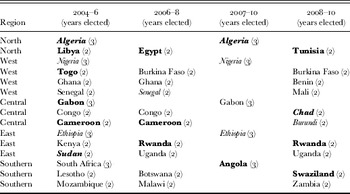
Table 1 lists the twenty-nine states elected to serve as PSC members between 2004 and 2010. Several points are apparent. First, some of these states clearly did not show much respect for constitutional governance, the rule of law and human rights. In addition, several of them experienced violent conflicts during their period as Council members. Second, the five regions have adopted different approaches to the question of PSC membership. For example, southern Africa has rotated seats on the PSC among its members. As a result, South Africa has been the only state to give up its three-year membership status on the PSC – although it apparently continues to exercise considerable influence from behind the scenes (Sturman & Hayatou forthcoming). Such automatic rotation also appears to undermine the Protocol's emphasis on specific criteria for membership. The other four regions have all undergone some change in representation for the two-year seats but, to date, all the three-year members have retained their seats (Algeria, Gabon, Ethiopia and Nigeria).
Membership of the Peace and Security Council of the African Union, 2004–2010

Italic: States experiencing a ‘severe crisis’ or ‘war’ according to the Heidelberg Conflict Barometer, 2004, 2006, 2007, 2008, available at: http://hiik.de/en/konfliktbarometer/index.html.
Bold: States declared ‘not free’ by Freedom House, Freedom in the World 2004, 2006, 2007, 2008, available at: http://www.freedomhouse.org. The survey measures freedom – the opportunity to act spontaneously in a variety of fields outside the control of the government and other centres of potential domination – according to two broad categories: political rights and civil liberties.
In addition to the fifteen members, some other states and entities may be invited to participate in certain PSC meetings, at least for the open session. These include the AU commissioner(s), interested heads of division within the Commission, desk officers and other members of the AU secretariat, the AU legal counsel, delegations, and invited parties such as representatives of governments affected by conflicts and crisis situations or outside entities such as representatives of Africa's sub-regional organisations, the UN or NGOs.Footnote 7
Scope
Pursuant to Article 5.2 of the AU Constitutive Act, Article 2.1 of the Protocol established the PSC as ‘a standing decision-making organ for the prevention, management and resolution of conflicts’ that should be ‘a collective security and early-warning arrangement to facilitate timely and efficient response to conflict and crisis situations in Africa’.
In practice, the PSC has devoted relatively little attention either to the prevention of conflict or to structural issues that encourage ‘bad governance’. As one PSC official put it, ultimately, the organisation needs to decide whether it wants to focus on developing a more efficient fire service or building better, fire-proof, houses.Footnote 8 To date, the Council has clearly chosen to act as a fire extinguisher, dealing only with issues after they erupt. Most of the countries that have become the focus of the Council's deliberations have experienced a coup or armed insurgency – although clearly the existence of an armed rebellion did not guarantee PSC attention, as the conflicts in the Niger Delta, the Ogaden region of Ethiopia and northern Uganda testify.Footnote 9 Authoritarian governments that managed to successfully prevent coups and insurgencies, such as Robert Mugabe's ZANU-PF regime in Zimbabwe, have not occupied much space on the Council's agenda. Viewed in this light, the PSC's response to the violent aftermath of Kenya's elections in December 2007 may indicate a softening of this approach.
In terms of conflict management, unlike its predecessor, the PSC is in principle able to authorise the entire spectrum of peace operations, from small peacemaking missions to large-scale interventions envisaged in Articles 4(h) and 4(j) of the AU Constitutive Act. The different types of operations are set out in the six potential crisis management scenarios envisaged for the African Standby Force (ASF) (see AU 2005a: para. A-1):
1. AU/regional military advice to a political mission.
2. AU/regional observer mission co-deployed with a UN Mission.
3. Stand-alone AU/regional observer mission.
4. AU/regional peacekeeping force for Chapter vi and preventive deployment missions (and peacebuilding).
5. AU peacekeeping force for complex multidimensional peacekeeping missions, including those involving low-level spoilers.
6. AU intervention, e.g. in genocide situations where the international community does not act promptly.
Missions for scenarios 1–3 should be self-sustainable for up to thirty days, and operations dealing with scenarios 4–6 for up to ninety days. In the absence of an African defence alliance akin to the North Atlantic Treaty Organisation (NATO), scenario 6 would have to rely on individual AU member states to provide the capabilities. For other scenarios the UN's Standby High Readiness Brigade (SHIRBRIG) offers a useful model.
One early area of controversy related to the AU's relationship with the UN Security Council, specifically over which body had the primary legal authority to sanction the use of military force. The issue initially arose because Articles 16 and 17 of the PSC Protocol adopted a somewhat contradictory stance on the issue: while Article 16.1 stated that the AU had ‘the primary responsibility for promoting peace, security and stability in Africa’, Article 17.1 acknowledged that the UN Security Council ‘has the primary responsibility for the maintenance of international peace and security’. One analyst suggested that this obvious ambiguity may be explained by the fact that the PSC Protocol was never formally reviewed by a committee of legal experts (Levitt Reference Levitt2003: 136). Regardless of the reasons why the PSC Protocol reads as it does, it is clear that the issue of which organisation had the primary authority with regard to sanctioning the use of military force was the source of considerable debate among AU members. As the AU's legal adviser, Ben Kioko (Reference Kioko2003: 821; see also Levitt Reference Levitt2003: 125–6) acknowledged:
When questions were raised as to whether the Union could possibly have an inherent right to intervene other than through the Security Council, they were dismissed out of hand. This decision reflected a sense of frustration with the slow pace of reform of the international order, and with instances in which the international community tended to focus attention on other parts of the world at the expense of more pressing problems in Africa. Furthermore, the process of drawing up the Constitutive Act took place not long after the OAU Assembly of Heads of State and Government had adopted the Ouagadougou decision defying the sanctions imposed by the UN Security Council on Libya in connection with the Lockerbie crisis … [African] leaders have shown themselves willing to push the frontiers of collective stability and security to the limit without any regard for legal niceties such as the authorisation of the Security Council.Footnote 10
This is an extraordinary insight into the AU's deliberations, given that the Union is officially classified within the UN system as a regional arrangement, and that the preamble to Article 4 (Principles) of the PSC Protocol explicitly states that the Council ‘shall be guided by the principles enshrined in the … Charter of the United Nations’.Footnote 11
By March 2005, the Union was still claiming that it did not need to abide by the letter of Article 53 of the UN Charter, although it did soften its stance somewhat. In the ‘Ezulwini Consensus’ document, the AU agreed with the UN Secretary-General's High-Level Panel on Threats, Challenges and Change ‘that intervention of Regional Organisations should be with the approval of the Security Council; although in certain situations, such approval could be granted “after the fact” in circumstances requiring urgent action’ (AU 2005b: 6). Less than two weeks later, however, at a meeting of experts on the relationship between the AU and the Regional Mechanisms for Conflict Prevention, Management and Resolution, a ‘roadmap’ was produced that offered yet another position on the issue of military intervention. The roadmap stated that ‘the AU will seek UN Security Council authorisation of its enforcements actions. Similarly, the RECs/Regions will seek AU authorisation of their interventions’ (AU 2005a: 5). Thus it appears that after a period of severe discontent with the international legal framework governing the use of military force, the AU's members eventually accepted the UN Security Council's primacy on the matter.
In practice, however, the PSC has yet to recommend that the Assembly authorise military intervention of the type envisaged in Article 4(h) of the Union's Constitutive Act. Instead, it has tended to focus on managing armed conflict through constructive engagement with the parties concerned, although it has imposed sanctions in response to what the AU refers to as ‘unconstitutional changes of government’.Footnote 12 The PSC has devoted little attention to the non-military dimensions of security, such as environmental degradation and disease.Footnote 13 However, discussions within the Commission have raised the possibility of broadening the Council's remit in this regard. As one interoffice memorandum written in April 2007 put it, ‘the PSC might also see the need to reflect on how to broaden its mandate to cover new issues (i.e. fighting pandemics, measures to counter global warming, measures to counter environmental degradation, etc) that up to now were not considered conventional threats to peace and security, but which will increasingly challenge the existing AU thinking and strategies on the promotion of peace, security and stability’ (AU 2007: 1; see also p. 18).
Formal rules
The rules of procedure are set out in Article 8 of the PSC Protocol. According to Article 8.12, each member of the Council shall have one vote. Article 8.13, however, states that decisions of the Council ‘shall generally be guided by the principle of consensus’. If consensus cannot be reached, the Council ‘shall adopt its decisions on procedural matters by a simple majority, while decisions on all other matters shall be made by a two-thirds majority vote of its Members voting’. To date, all decisions within the PSC have been taken by consensus, and details of the deliberations have not been made public. While on the one hand this approach provides all members with a relatively easy opportunity to block Council action, the process of debate and deliberation means that the PSC can be understood as a ‘social environment’ within which the micro-processes of socialisation (persuasion and social influence) operate both among the PSC members, and between them, the wider group of AU member states and the AU Commission (see Johnston Reference Johnston2001, discussed below).
Although the PSC is officially in permanent session and able to assemble at any time, it is required to meet a minimum of two times a month at the ambassador level and once a year at the ministerial level. It may also convene at Head of State level. In 2007, 2008 and 2009 it also held joint meetings with the UN Security Council. Most meetings are conducted at the AU headquarters in Addis Ababa, although occasionally the PSC has met elsewhere, including Libreville (2005), New York (2007, 2008), Abuja (2007) and Sharm el-Sheikh (2008). Meetings are led by the PSC Chairperson, a position which rotates on a monthly basis in alphabetical order according to the state's name in the English language.Footnote 14 The agenda for a meeting may be determined in light of on-going conflict and crisis situations, proposals from a PSC member (usually in consultation with the Chair), or via a proposal from the Commissioner for Peace and Security.
Until late 2007, the Council held three different but loosely structured types of meeting:
• Formal meetings. The primary purpose of such meetings was to examine a report from the AU Commission. The PSC may invite the concerned party for the open part of the meeting. For example, when discussing the civil war in Côte d'Ivoire, the government was invited to participate but not representatives from the rebels. In practice, regional members of the PSC tend to take the lead on issues within their own region.
• Briefing sessions. In these meetings, Commission staff present talking points to update the PSC about specific issues rather than a full report. After hearing the briefing the PSC members chose whether to produce a statement. If so, this statement is normally delivered by the Chair. If PSC members consider the matter to be extremely serious, they may produce a communiqué. By late 2007, the PSC had held thematic sessions on topics including terrorism and post-conflict reconstruction and development.
• Consultations. Initially, these took the form of closed consultations of the PSC members to develop a clear understanding of an issue without taking a decision. Since early 2007, however, the PSC has also invited certain actors for open informal consultations within its meeting room. These include representatives of governments involved in conflict situations which may have challenged a Commission report, or representatives from the UN Security Council and regional arrangements. Following consultations, there is then a closed session when all invited guests have to leave the chamber.
In August 2007, in the light of the discussions held at the Council's sixty-eighth meeting (December 2006) and its fourth brainstorming retreat in Dakar (July 2007), the PSC adopted a new set of working methods as contained in the conclusions of the Dakar brainstorming retreat. These suggested that the PSC should convene four types of session: public meetings (which the media may observe); private or closed meetings (involving only AU member states or AU organs); consultations (discussing briefings from the Commission and draft decisions); and ‘Arria-type meetings’ where Council members hold informal discussions with non-state entities outside the official meeting chamber (Sturman & Hayatou forthcoming).Footnote 15
Norms
Article 4 of the PSC Protocol sets out the institution's guiding principles, which are enshrined in the AU Constitutive Act, the Charter of the United Nations, and the Universal Declaration of Human Rights. In particular, it emphasises eleven principles. Principles (a) through (i) cover the usual bases of pluralist international society and much the same ground as the AU's predecessor, the OAU (see van Walraven Reference van Walraven1999). These relate to the peaceful and early settlement of disputes, non-interference, and the recognition of the territorial integrity of member states. Principles (j) and (k), however, break new ground in recognising the right of the Union to intervene ‘in respect of grave circumstances, namely war crimes, genocide and crimes against humanity, in accordance with Article 4(h) of the Constitutive Act’, and ‘the right of Member States to request intervention from the Union in order to restore peace and security, in accordance with Article 4(j) of the Constitutive Act’ (see Williams Reference Williams2007a).
Mandate
Article 3 of the PSC Protocol outlines six objectives for the institution. These are to promote peace, security and stability in Africa; anticipate and prevent conflicts; promote and implement peacebuilding and post-conflict reconstruction activities; coordinate and harmonise continental efforts in the prevention and combating of international terrorism in all its aspects; develop a common defence policy for the Union; and encourage democratic practices, good governance and the rule of law, as well as protect human rights and fundamental freedoms. In order to achieve these objectives, the PSC Protocol sets out eighteen ‘powers’, ranging from assisting in the provision of humanitarian assistance to military intervention. Moreover, the organisation is to be supported by a variety of institutions, most notably the AU Commission, a Panel of the Wise, a Continental Early Warning System (CEWS), an African Standby Force (ASF), and a Special Fund. All of these instruments experienced significant problems and delays in their development. For example, the Framework for the Operationalisation of the CEWS was only endorsed in January 2007, the individuals comprising the Panel of the Wise were only named in July 2007 and the Panel inaugurated in December, and the ASF remains a work-in-progress.
EVALUATING THE PEACE AND SECURITY COUNCIL
How should analysts evaluate the PSC's activities? A useful place to start is with the questions used by Edward Luck (Reference Luck2006: 4–7) to assess the performance of the UN Security Council. This is not an unreasonable starting point for several reasons. First, as noted above, the architects of the PSC drew some of their inspiration from the UN Security Council, although they modified its structure for the African context. Second, UN Security Council staffers apparently acted as advisers during the process of drafting the PSC Protocol (Levitt Reference Levitt2003: 116), and have continued to help PSC officials through various assistance initiatives. Third, like the UN Security Council, the PSC is an international institution that is simultaneously a collective actor and an arena in which its members interact (see Duffield Reference Duffield2007). In the former role, it has taken policy decisions requiring action, whether in the form of mediation, peace operations, or sanctions regimes. In the latter role, much of its activity is aimed at setting regulatory rules for members and authorising, legitimising or condemning actions taken by them (see Claude Reference Claude1966). It is important to remain aware of both these roles when trying to evaluate its activities.
How important are the PSC's deliberations?
In Luck's view, the first question to ask is whether states are interested in participating in the PSC's deliberations and in influencing its decisions. Do, for instance, states send their ‘top diplomatic talent’ to the PSC? Here the results are mixed. On the one hand, the PSC has clearly had no problem attracting states to compete for its elected positions – twenty-nine of fifty-three AU members have now served on the PSC – and there is evident interest in participating in the Council's deliberations. As one member of the secretariat put it, ‘there is virtually never an empty seat at Council meetings’.Footnote 16 This represents a significant improvement over the old OAU. In addition, it is worth recalling that non-members, particularly African governments involved in conflict or crisis situations or the subjects of PSC activities, have also been keen to participate in PSC deliberation and influence its decisions. The same is true for non-African entities such as the UN and the EU, as well as the continent's sub-regional arrangements. On the other hand, however, it remains fair to say that few African governments consistently send their ‘top diplomatic talent’ to the AU, and many PSC members do not invest the resources necessary for their delegations to remain up to speed with the key issues.Footnote 17
How important is the content of the PSC's official statements?
Do states care about the content of the PSC's communiqués and official statements, and do African leaders look to the Council ‘for more than photo-ops and political grandstanding’? Here the answers to Luck's second set of questions are generally positive. First of all, the PSC's emphasis on consensus does not present individual members with easy opportunities to use the Council as a platform for grandstanding. Indeed, the closed nature of the deliberations makes it very difficult to pinpoint where the Council's positions originate from. In this sense, the Council operates with a significant degree of collective responsibility with any rifts among its members generally kept hidden from public view.
Second, PSC communiqués and reports are consistently subjected to significant scrutiny, indicating that its members do care about the content of its statements. The Council's reports on particular conflict or crisis situations originate within the PSC secretariat and are passed around the relevant Commission staff for input, comment and revision. This process produces a draft report which is then passed from the technical staff to the Commissioners. While the established facts of the situation are rarely altered, a great deal of attention goes into drafting the precise language used in the report. The final draft report is then passed to the PSC members who may call for further revisions in light of their deliberations. For example, the initial drafts of the reports produced by the AU staff in Darfur were considered particularly frank and were usually subjected to several rounds of revision by the Council.Footnote 18 By early 2008, the PSC had only rejected outright one draft report, on Western Sahara. A similar process occurs when the PSC issues its communiqués. These are based on recommendations in the submitted Commission Report but the precise text will usually be redrafted several times to reflect the deliberations in the Council meeting.
There is a third sense in which the content of the PSC's official statements are carefully scrutinised, namely, to ensure a degree of coherence in the message. This is important because official statements are assembled with an eye to multiple audiences, most of whom have different agendas and priorities and look to the Council for different things. The main audiences for PSC statements are AU member states, the parties to the conflict or crisis in question, the Commission (as a key player in the implementation of decisions), the larger international community and affected populations, as well as the media (AU 2007: 14).
How relevant is the PSC politically?
Luck's third cluster of questions revolves around the organisation's political relevance, whether it elicits substantial and sustainable commitments from member states to support its decisions, and whether it makes a real difference to the maintenance of peace and security.
In the medium to long term, the PSC has the potential to become an important institutional environment for socialisation among African governments. Socialisation refers to ‘a process by which social interaction leads novices to endorse “expected ways of thinking, feeling, and acting”’ (Johnston Reference Johnston2001: 494). By articulating the AU's voice on issues related to peace and security, and through the strategic use of official statements and instruments such as mediation, sanctions and peace operations, the PSC attempts to persuade and/or influence its intended audiences, especially parties involved in conflict or crisis situations. Further, what Johnston refers to as the micro-processes of socialisation also operate within the PSC, especially when new members enter this particular environment and are socialised into the norms of behaviour associated with the institution. Understood from the perspective of socialisation theory, the fact that the AU has such a large number of members (fifty-three) is useful because ‘larger institutions generate a greater amount of status and opprobrium markers which can elicit cooperation from actors who are sensitive to maximizing social image’ within the group they identify as their peers (Acharya & Johnston Reference Acharya, Johnston, Acharya and Johnston2007: 22; see also Johnston Reference Johnston2001: 512).
In the future, there may also be some scope for the AU Commission to develop as a significant source of ‘autonomous power’. As Barnett and Finnemore (Reference Barnett and Finnemore1999, Reference Barnett and Finnemore2004) have shown, in certain circumstances international organisations may develop a degree of autonomy from the states that created them. Any autonomous power derives from the legitimacy of the rational–legal authority they embody, their control over technical expertise and information, and overseeing administrative processes and procedures. In their schema, international organisations may possess three types of power flowing from their ability to structure knowledge claims: they can classify the world, creating categories of actors and action; they can fix meanings in the social world; and they can articulate and diffuse ideas, norms and principles around the globe.
The key to developing such power lies in the organisation's ability to create a well-resourced cadre of bureaucrats. Some analysts have already suggested that ‘as the custodian of AU documents, as well as the maker and interpreter of rules, procedures and regulations, [the Commission] acquired unlimited and overwhelming power’ (Makinda & Okumu Reference Makinda and Okumu2008: 51). This overstates the point, but it is certainly worth recalling that the new AU envisaged an enhanced role for the Chair of the Commission compared with that of the previous Secretary General of the OAU. These legal changes were strengthened by the election in July 2003 of an active former president, Alpha Oumar Konaré of Mali, to head the Commission. On 1 February 2008, however, Konaré was replaced by former Gabonese foreign minister, Jean Ping, a long-standing and well-respected representative at the UN. It remains to be seen whether Ping's four-year term will see a reduction in the Commission's autonomous power, given that he is not a former head of government.
In relation to the PSC, Commission personnel undoubtedly have the ability to exercise some leverage, both through their role in drafting reports and recommendations, and in their ability to influence how the member states view particular issues.Footnote 19 The ability to influence the way issues are perceived and defined is arguably greatest in the Commission's dealings with the PSC at the ambassadorial and ministerial levels. It is much more restricted when dealing with the heads of government. As far as the latter group is concerned, it was arguably only Commissioner Konaré, himself a former president, who could regularly succeed in significantly altering their perspective. In this respect, Ping's appointment may reduce the Commission's power. Overall, however, it is clear that AU member states have kept the Commission in general and the PSC's secretariat in particular in an emaciated condition. These bureaucrats are thus unlikely to wield high levels of autonomous power in the foreseeable future.
Has the PSC elicited substantial and sustainable commitments from member states to support its decisions? Luck suggested that this should be measured by analysing whether governments have altered their policies in substantial ways to conform to the PSC's edicts, and what level of material, political and human assistance members have provided for PSC-mandated activities. Levitt (Reference Levitt2003: 135) similarly concluded that while the PSC's ‘aspiring principles and operational objectives are indeed progressive, they are useless absent the will to act by AU member states’.
Here again the answers are mixed. In negative terms, many African states have not taken the PSC seriously, in the sense that they have not provided the organisation with the human and financial resources it requires to achieve its stated objectives. Financially, there are aspects of a general nature and some specific to the PSC. In general terms, the AU has suffered from what can only be described as a perpetual and chronic financial crisis. At the AU's summit in early 2008, only twenty-nine of the Union's fifty-three members were up to date with the payment of their contributions to the regular budget (AU Executive Council 2008). It is important to recall that this is in a context where, since 1 January 2006, 75% of the Union's regular budget has been paid for by just five countries: Algeria, Egypt, Libya, Nigeria and South Africa (each paying 15% of the total). Nor is this is a recent problem. Between June 1993 and July 2003, for instance, the OAU Peace Fund managed to gather a total of just over US$49 million. Not only is this a rather pitiful sum when viewed in terms of funding peacekeeping operations, but over US$29 million of these funds came from the OAU's partners rather than African states (AU n.d.). In sum, therefore, the PSC is just one piece of a generally underfunded institution. The same problem can be identified in relation to human resources. For example, while the UN Security Council has over sixty bureaucrats supporting its work, at the time of writing the PSC had hired just four of a planned ten (Sturman & Hayatou forthcoming).
Viewed in more positive terms, however, the PSC has received more resources than the previous OAU mechanism ever did. The Peace and Security Department is also the largest of the eight substantive divisions within the AU Commission. In resource terms, the largest items on the PSC agenda have been the peace operations conducted by the AU in Burundi (2003–4), Sudan (2004–present), the Comoros (2006, 2007, 2008) and Somalia (2007–present). Together, these operations have involved a combined total of approximately 17,350 uniformed personnel (troops, military observers and police: Burundi c. 3,000; Sudan c. 8,000; Comoros c. 2,050; Somalia c. 4,300).Footnote 20
Before judging these operations as evidence of general African support for the PSC, however, several caveats are in order. First, the majority of these peacekeepers came from a handful of African states: South Africa provided almost all the troops for the mission in Burundi and two of the operations in the Comoros; the Somalia mission had only two troop-contributing countries, Uganda and Burundi; and the bulk of the AU's biggest operation, in Sudan, came from Nigeria, Rwanda, Senegal and South Africa. In this sense, the PSC has failed to elicit significant troop contributions from a large number of its elected members. Second, these troops were supported by the AU's external partners in several crucial respects, including financially and in terms of intelligence,Footnote 21 transport, logistics and training. In short, African states have not provided the PSC with enough funds to fully equip the Commission in Addis Ababa, let alone active peace operations in the field. Indeed, the situation was so bad that the UN Security Council commissioned an expert panel to look into ways of using external funds to support AU peace operations (UN 2008). In this regard, it was noticeable that the peace operation in Darfur was given its own relatively well-staffed administrative home (the Darfur Integrated Task Force, DITF), separate from the Peace Support Operations division. While the relatively high level of resources attached to the Darfur mission can be attributed to the attention the crisis received in Western capitals, its functional separation from the Peace Support Operations division has probably not helped the PSC develop a coherent approach across its operations, and has created an impression of double standards.Footnote 22 This is unlikely to aid the development of organisational learning discussed below.
Has the PSC worked in an efficient and productive fashion?
On the question of whether the PSC has carried out its operational activities and missions competently and efficiently, overall, there are more positives than negatives. The big negative, of course, is the lack of appropriate resources, which has clearly hampered the ability of the organisation's peace operations to meet their objectives (see Williams, forthcoming). That said, even under severely strenuous conditions, individual AU peacekeepers have often performed admirably. The Council's record on implementing sanctions has been much more positive. Most of these cases have come in response to coups d'état, notably in Togo (2005), Mauritania (2005, 2008), Guinea (2008) and Madagascar (2009). For example, when Mauritania was suspended from the AU in August 2005, no sooner had the PSC adopted this position than the AU's deputy legal counsel went into the Assembly summit meeting and told the delegation from Mauritania to leave the chamber immediately. Similarly, when Togo experienced a coup in early 2005, it was an elected member of the PSC; nevertheless, Togolese representatives were quickly instructed to leave the PSC chamber in conformity with the decision.
In contrast, the PSC's response to the war in Somalia from late 2006 provides an example where the Council failed to enforce its proper procedures.Footnote 23 The problem came after Ethiopian forces and those loyal to Somalia's Transitional Federal Government (TFG) forcibly ejected the Union of Islamic Courts from Mogadishu, killing many of their fighters in the process. Ethiopia's official justifications fluctuated between self-defence and assisting the TFG assume its rightful status (see Yihdego Reference Yihdego2007). Either way, Ethiopia's military operations were undertaken without a mandate from the PSC. The first sign that Ethiopia's seat on the Council might cause problems came when Commissioner Konaré initially contacted representatives of the Arab League and the Inter-Governmental Authority on Development rather than turning to the PSC, apparently because of Addis Ababa's presence on the Council. Given that Ethiopia was clearly a party to the conflict in Somalia, its representative should have withdrawn from the PSC's deliberations on the subject after the briefing session.Footnote 24 As it turned out, the Ethiopian representative not only remained in the meeting but sought to chair it, arguing that her country was not a party to the conflict. This statement was apparently greeted with open laughter within the meeting chamber, and prompted one representative to ask what protocol the Ethiopian representative had been reading. After an hour of argument, it was decided that the representative from Gabon would chair the final part of the meeting, but the Ethiopian representative continued to participate. It is unlikely that any other state (with the exception of Sudan) could get away with such behaviour.Footnote 25
Another dimension of efficiency turns on whether the PSC has developed working methods that facilitate the achievement of its stated objectives. The short answer is that after a very poor start, by late 2007 the PSC secretariat had designed and at least partially implemented an appropriate set of working methods. Although the PSC Protocol provided for a secretariat, it took about fifteen months for the AU to recruit the first person, and nearly two years for it to hire the head of the division (who started in September 2006). Before the creation of even this minimally staffed PSC secretariat, the Conflict Management Division had looked after the running of the PSC's business on an ad hoc basis. Not surprisingly, this resulted in meetings conducted without formal agendas and without relevant documents. Of course, it is reasonable to expect any organisation to undergo teething problems, but this was clearly a predictable hurdle that should have been rectified much earlier. Overall, therefore, this constitutes another example of the AU member states' failure to equip the PSC with the necessary resources. Time will reveal whether the AU Commission will be able to ensure that these new working methods are adhered to.
A central issue for the future will be whether the PSC can use these new working methods to develop what Howard (Reference Howard2008: 19) has called ‘second-level organizational learning’, that is, ‘change in the organization's overall means, structures, and goals, in response to new understandings of problems and their causes’. Based on her study of UN peacekeeping in civil wars, Howard concluded that unlike first-level learning, which takes place on the ground within specific missions, second-level organisational learning is a relatively rare occurrence that goes beyond incremental adaptation.Footnote 26 It takes place between and across missions at the organisation's nerve centre, in this case AU headquarters in Addis Ababa. According to Howard (Reference Howard2008: 20), ‘it begins with post-mission evaluation and organizational change at headquarters in response to evaluation’. With this in mind, the decision to create the DITF as a separate body operating outside the Peace Support Operations division may retard the prospects for second-level organisational learning within the PSC. At the time of writing, it is difficult to evaluate the extent to which second-level learning has occurred within the PSC. The Council is clearly developing a more consistent and organised approach to conflict situations on the continent, but it is hard to see strong evidence of such learning in its peace operations, which have remained largely ad hoc measures to particular problems.
Is the PSC the best-placed institution to deal with the problems at hand?
Luck's final question asks whether, relative to each of the policy tasks addressed, the PSC is the best placed and equipped institution for dealing with the problem at hand. Once again, the answer depends on the situation concerned and the type of response that is required. The first point to note is that the PSC is not meant to act alone or in a vacuum. Rather, it is one institution among several tasked with playing a role in promoting peace and security on the continent. Nevertheless, it is supposed to play a leading role in several respects. In some conflict situations, however, the AU in general and hence the PSC in particular are not well placed to act. Two important examples are the conflict over the status of Western Sahara, and the border dispute between Ethiopia and Eritrea. In the former case, the OAU became heavily involved in the issue and sided with the Sahrawi cause, even permitting the Sahrawi Arab Democratic Republic (SADR) to become a member of the organisation in 1982. In 1984, Morocco withdrew from the OAU in protest at SADR's inclusion, with the subsequent result that the OAU was forced to hand the problem over to the UN. In the latter case, the Eritrean government was always suspicious of the degree of influence Ethiopia wielded over the OAU/AU. Once again, the result was that the dispute required a UN lead. The PSC has also taken a back seat in relation to some prominent cases of mediation and peacemaking, notably Zimbabwe (where after 2002 South Africa and SADC took the lead) and Kenya (where after election-related violence in late 2007 Kofi Annan and an ad hoc mediation effort assumed point position).
The PSC also remains ill-equipped to take the lead on conflict situations that require the deployment of a large peace operation (i.e. 20,000–30,000 uniformed personnel). To date, peace operations of the size seen in Liberia, Sierra Leone, Côte d'Ivoire, the DRC and most recently southern and western Sudan are simply beyond its capacities (see UN 2008). In such situations, the PSC may well provide political support and legitimacy but will inevitably play a secondary role to the UN.
It is in circumstances where peace operations at the smaller end of the spectrum are appropriate (as in the Comoros), and cases of unconstitutional changes of government (as in Togo and Mauritania), that the PSC is likely to be the best-placed institution to respond. In the latter circumstances, the PSC may come to occupy a particularly important place in African efforts to deter unconstitutional changes of government. For this to happen, it would need to promote the kind of socialisation processes (persuasion and social influence) described above. And here, the AU's large membership may actually help elicit cooperation and norm compliance.
* * *
Ultimately, any evaluation of the PSC must take a stance on whether it has made a real difference to the maintenance of peace and security in Africa.Footnote 27 In this regard, it is reasonable to assume that despite the obvious problems, the security situation in Africa would probably have been worse without the PSC. To use a clichéd phrase, if the PSC didn't exist, it would be wise to invent it. Most obviously, the PSC has played significant roles in some of the more positive recent examples of conflict management on the continent, notably in Burundi and the Comoros. At a local level, some of the AU's under-resourced peacekeepers have also made some significant contributions to maintaining stability in Darfur, although it is hard to find much positive evidence from the AMISOM mission in Somalia, where peacekeepers have employed indiscriminate force against the local population. At the strategic level, however, it is difficult to see the peace operations in Darfur and Somalia as anything other than serious failures. This is in large part a failure of conception, but it is made worse by the Council's big problem: how to convince the AU's members to give it the resources it so desperately needs. With such a small budget and so few staff, the PSC cannot be expected to cope with the huge security problems facing Africa. In the short to medium term, therefore, a key issue will be developing the PSC's relationship with the UN Security Council and other sources of external funding and assistance such as the G8 and European Union.
In terms of the PSC's institutional design, it is starting to make some headway, not least by putting some flesh on its institutional bones and by tentatively starting to address the non-military dimensions of security. Given the nature of Africa's major security challenges, addressing the relationship between the military and non-military elements is a necessary step in the right direction (see Williams Reference Williams2007b). The PSC's personnel have also taken a significant step forward by devising a new set of working procedures. Of course, these alone will not overcome some of the serious remaining obstacles but they will contribute significantly to the Council's importance as a crucial forum for socialisation within African international society. Over time, the processes of socialisation and a few more success stories in the field may encourage more African states to increase the resources they commit to the PSC. Let us hope so, because if Africans don't take this institution to heart, who else will?