Surgical site infections (SSIs) are associated with increased morbidity, mortality, impaired quality of life, and increases in the usage of medical and financial resources.Reference Dimick, Chen, Taheri, Henderson, Khuri and Campbell1–Reference Whitehouse, Friedman, Kirkland, Richardson and Sexton7 They are a common complication of surgery, with a broad range of incidence, depending on the type of surgery. In Switzerland, SSI incidences varied between 0.7% in laminectomies and 18.8% in rectal surgery, according to 2017 national SSI surveillance data.8 Swiss data on the SSI incidence in plastic surgery and hand surgery, however, are missing. In the United States, SSI rates in the range of 0.5% have been reported in aesthetic surgery,Reference Kaoutzanis, Gupta, Winocour, Shack, Grotting and Higdon9 whereas in outpatient hand surgery, SSI occurred in 0.33% of patients.Reference Menendez, Lu, Unizony, Choi and Ring10
Already in 2011, Umscheid et alReference Umscheid, Mitchell, Doshi, Agarwal, Williams and Brennan11 estimated that 55% of SSIs could be averted with current evidence-based strategies, and their results were confirmed in a recent meta-analysis.Reference Schreiber, Sax, Wolfensberger, Clack and Kuster12 Studies have shown, however, that discrepancies between evidence-based strategies and day-to-day medical practice are common.Reference Lenfant13,Reference Pronovost, Berenholtz and Needham14 The comprehensive unit-based safety program (CUSP) and the translating evidence into practice (TRIP) model aim to address this problem.Reference Pronovost, Berenholtz and Needham14–20 A CUSP aims to promote safety culture in hospital units, to enhance staff perception of safety risks, and to encourage staff to redress and speak up regarding observed safety risks.Reference Pronovost, Weast and Rosenstein15–Reference Wick, Hobson and Bennett18 Several studies have shown the effectiveness of CUSPs, demonstrating that the incidence of various types of healthcare-associated infections could successfully be reduced.Reference Wick, Hobson and Bennett18,Reference Berenholtz, Pham and Thompson21,Reference Pronovost, Needham and Berenholtz22
In an attempt to reduce SSI rates, the Department of Plastic Surgery and Hand Surgery at the University Hospital Zurich intended to optimize its adherence to SSI prevention guidelines by further developing its safety culture through the introduction of a CUSP. The primary aim of this study was to determine whether a CUSP in a surgical discipline with predominantly clean surgical procedures succeeded in further reducing SSI incidence. Other aims were to assess the extent to which evidence-based strategies to reduce SSI were successful and to explore the risk factors for SSI in this population.
Methods
Study setting, design, and procedures
A prospective, single-center, uncontrolled before-and-after study was performed at the University Hospital Zurich, a 980-bed tertiary-care center.23 The Department of Plastic Surgery and Hand Surgery performs >3,300 surgical interventions per year.24 All consenting patients undergoing surgery in the Department of Plastic Surgery and Hand Surgery between January 1, 2016, and April 30, 2018, with a complete 30-day follow-up and/or a surgical site infection (SSI) were included, with the exception of burn patients. SSIs were diagnosed according to the Swiss national SSI surveillance method,25 which applies the Centers of Disease Control (CDC)/National Healthcare Safety Network (NHSN) SSI definition criteria and includes a 30-day follow-up period.Reference Horan, Gaynes, Martone, Jarvis and Emori26 The study period was divided into a 14-month baseline period (January 1, 2016, to February 28, 2017), including a baseline assessment, a planning phase, implementation of project steps, and a 14-month intervention period (March 1, 2017, until April 30, 2018) when the project was fully implemented.
Data collection was performed according to Swiss national SSI surveillance standards.25 Clinical data (including patient characteristics, American Society of Anesthesiologists (ASA) score, wound contamination level, antibiotic prophylaxis (antibiotic substance and time of administration), date of surgery, length of hospital stay, destination after discharge, surgeon, operating room, surgical procedure time, and lowest intraoperative body core temperature) and SSI prevention checklist data (description provided below) of all patients was extracted and entered into a Microsoft Access database (Microsoft, Redmond, WA). A study nurse contacted the patients 30 days after surgery by telephone and performed standardized phone interviews. The data from the phone interviews (infection, readmission, reoperation, mortality) were also included in the database. A board-certified infectious diseases specialist (S.P.K.) verified cases with a suspected infection and applied surveillance criteria for SSI diagnosis.
Intervention
The CUSP- and TRIP-based project with the main goal to reduce SSI was implemented in the main operating room of the Department of Plastic Surgery and Hand Surgery at the University Hospital Zurich, where ~80% of surgical procedures are performed.Reference Pronovost, Berenholtz and Needham14–20 The project core team included physician and nurse opinion leaders of plastic surgery and hand surgery, anesthesiology, and infection prevention, and the team was supported by an external coach with extensive experience in the implementation of CUSP (H.H.). Meetings were then held with team leaders of all involved staff, in which the importance of reducing SSI was emphasized and the projects course of action was discussed. The team leaders were also educated about the concept of CUSP and safety culture. They were then instructed to communicate the information to their staff and to act as role models. Simultaneously, the project team collected evidence-based strategies to reduce SSIs, and performed audits to capture current compliance to guidelines and evidence-based strategies. In the audits, project team members accompanied patients through the entire surgical procedure including preparation and postsurgical care. They also interviewed staff and team leaders on their experiences with noncompliance to guidelines and offered suggestions for improvement. The project core team gathered all inputs, drafted new measures, checked their feasibility, and defined new measures with help of the team leaders.
After the audits, monthly observations and interviews with the involved employees were conducted by a core team member throughout the study period to gain knowledge of unresolved issues and to collect improvement suggestions from frontline staff. Immediate feedback was given if noncompliance was observed. Based on the experiences from the observations and interviews, the project team discussed, established, and adjusted the new measures if necessary. In a kick-off event, staff were informed about the importance of reducing SSIs and the realization of the project with the new measures and a new checklist. They were also encouraged to give direct feedback to their colleagues irrespective of rank. The following measures that were implemented during the study period in the main operating room of the Department of Plastic Surgery and Hand Surgery:
1) Patient information letter. Prior to hospital admission, elective surgical patients were instructed to quit smoking 30 days or more prior to surgery, to not shave the surgical site within 7 days before surgery and to shower with soap on the night before or on the morning of hospital admission.
2) Introduction of an SSI prevention checklist. A checklist accompanied the patient from ward to operating room and back. It was designed to check whether the following conditions were met: smoking cessation 30 days prior to surgery,Reference Sorensen27–Reference Warner29 correct timing of antibiotic prophylaxis,Reference Allen, David and Veerman30–Reference Anderson, Podgorny and Berrios-Torres34 normothermia (body core temperature >36°C),Reference Kurz, Sessler and Lenhardt35,Reference Melton, Vogel, Swenson, Remzi, Rothenberger and Wick36 correct surgical hand antisepsisReference Sax, Uckay and Balmelli37,Reference Dohmen38 preoperative skin antisepsis,Reference Pereira, Lee and Wade39,Reference Parienti, Thibon and Heller40 preoperative bathing,Reference Poirot, Le Roy, Badrikian and Slim41–Reference Berrios-Torres, Umscheid and Bratzler44correct application of sterile drapes,45,Reference Rutala and Weber46 and hair clipping instead of shaving, if hair removal was necessary.Reference Poirot, Le Roy, Badrikian and Slim41,Reference Lefebvre, Saliou and Lucet42 The new checklist was meant to promote compliance, to raise staff awareness of safety risks, and to encourage staff to communicate their concerns when observing a possible threat to a patient’s health. The introduction of the checklist was accompanied by 2 coaching days that 2 members of the project core team spent in the main operating room, the postanesthesia care unit, and wards. They supported staff with handling of the new checklist, gave feedback on noncompliance, and answered questions. Nursing staff and anesthesiologists were accountable for completion of the checklist. During the monthly audits and interviews, the accuracy of the data entered in the checklists was validated.
3) Train-the-trainers program in surgical hand antisepsis. Training of surgeons and nurse team leaders in correct surgical hand preparation by infection prevention and control (IPC) practitioners. Subsequently, the team leaders educated their staff, and successful completion by all staff was ensured by filling in attendance lists.
4) Timers for feedback of duration of surgical hand preparation. To encourage full endurance of surgical hand preparation, tablets with individualized ring tones that announced successful completion of the 2-minute countdown were installed in the scrub room. Additional tablets, portraying the same countdown as the screens in the scrub room, were installed in the operating room, so that staff already in the operating room could supervise their colleagues in the scrub room and observe whether someone finished surgical hand preparation prematurely.
5) Limiting operating room door opening to 30 seconds at a time.Reference Andersson, Bergh, Karlsson, Eriksson and Nilsson47–Reference Roth, Juchler, Dangel, Eckstein, Battegay and Widmer51
The implementation period started on October 1, 2016, and all measures were fully implemented by February 28, 2017.
Ethical considerations
The necessity of a formal ethical evaluation was waived by the ethics committee of the Kanton of Zurich, Switzerland (Kantonale Ethikkommission Zürich), based on the Swiss law on research on humans (Req-2018-00427).
Statistical analysis
In this study, patients who underwent surgery in the baseline period were compared to those in the implementation period. The primary outcome of this single-center, uncontrolled before-and-after study was cumulative SSI incidence within 30 days of surgery. Secondary outcomes were the 30-day mortality rate and length of hospital stay.
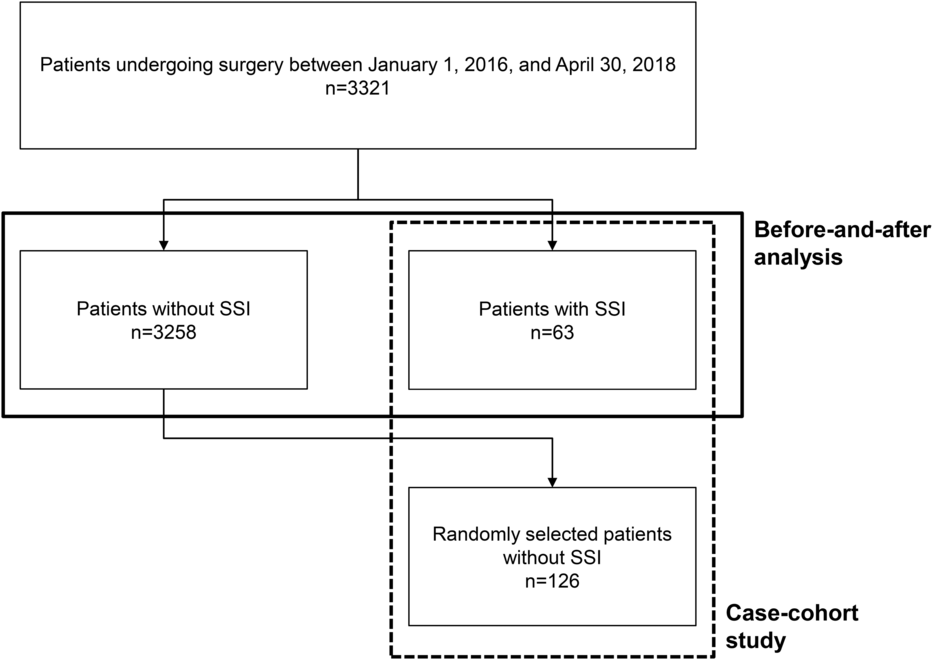
To analyze further risk factors and to evaluate the implementation of the SSI prevention checklist, a case-cohort study was conducted. The case-cohort study included all case patients who developed an SSI and a random selection of twice as many patients from the entire cohort without SSI, which were included as controls (Fig. 1).
Populations of patients undergoing plastic surgery or hand surgery at the University Hospital Zurich between January 1, 2016, and April 30, 2018, analyzed in a before-and-after analysis and a case-cohort analysis, respectively.

For univariable analysis of categorical variables, χ2 tests and 2-tailed Fisher exact tests were used, as appropriate. Wilcoxon rank-sum tests and Student t tests were conducted for univariable comparison of medians and means, respectively. Multivariable logistic regression methods were used to calculate risk factors for SSI. Potential confounders among patient characteristics with P-values <.05 in univariable analyses and established risk factors for or predictors of SSI that were considered relevant based on prior studies were considered for inclusion in multivariable models based on clinical judgment, with final models representing those that best balanced parsimony and fit.Reference Isik, Kaya, Dundar and Sarkut52 The limited number of outcomes was factored in when building the models to prevent overfitting.Reference Harrell53 All statistical analyses were performed using Stata version 15.1 software (StataCorp, College Station, TX). A 2-sided P-value <.05 was considered statistically significant.
Results
Effect of CUSP on overall SSI incidence
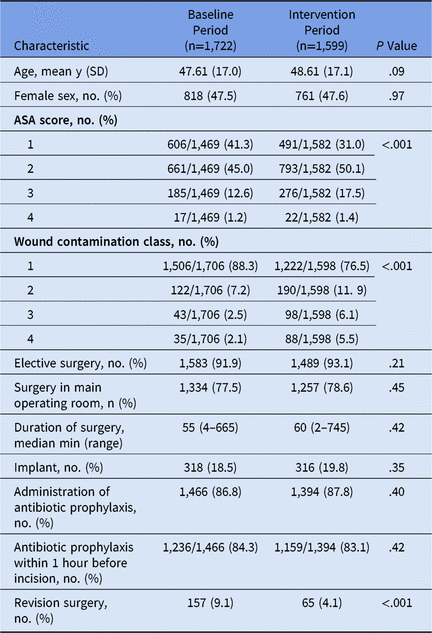
In total, 3,321 patients who underwent surgery in the Department of Plastic Surgery and Hand Surgery between January 2016 and April 2018 were included in the analysis. The baseline group, with a surgical intervention between January 1, 2016, and February 28, 2017, consisted of 1,722 patients (51.9%). The remaining 1,599 patients (48.1%) were part of the intervention group and underwent surgery between March 1, 2017, and April 30, 2018, when the project had been fully implemented. The 2 groups were comparable in age and sex, but ASA scores (P < .001) and wound contamination class (P < .001) were significantly higher in the patients of the intervention group, whereas revision surgery rates were lower (P < .001; Table 1). The proportion of patients who had surgery in the main operating room, where the project had its main focus, was similar in the 2 periods.
Patient Characteristics of 3,321 Patients who Underwent Surgery Before and After CUSP Implementation at the Department of Plastic Surgery and Hand Surgery, University Hospital Zurich

Note: ASA, American Society of Anesthesiologists; SD, standard deviation. Some denominators are lower than the overall patient population due to missing data.
Overall, 63 SSIs were detected in 3,321 (1.9%) patients: 38 (60.3%) in the baseline group and 25 (39.7%) in the intervention group. Accordingly, crude SSI incidence was 2.2% (38 of 1,722 patients) in the baseline group and 1.6% (25 of 1,599 patients) in the intervention group (P = .20). Of 63 patients, 42 (66.7%) had a superficial incisional SSI, 16 (25.4%) had a deep incisional SSI, and 5 (7.9%) had an organ-space infection. The distribution of depth of infection was not different between the baseline group and the intervention group (P = .21; detailed data not shown).
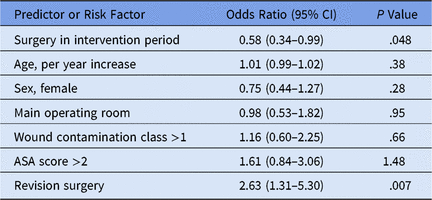
Multivariable logistic regression analysis with adjustment of patient characteristics revealed that the study period was independently associated with the occurrence of an SSI. The odds for an SSI were significantly lower in the intervention period than in the baseline period (odds ratio [OR], 0.58; 95% confidence interval [CI], 0.34–0.99; P = .048) (Table 2). The need for revision surgery increased SSI risk (OR, 2.63; 95% CI, 1.31–5.30; P = .007), whereas surgery in the main operating room did not decrease SSI risk (OR, 0.98; 95% CI, 0.53–1.82; P = .95). The adjusted relative risk reduction of having surgery during the intervention period compared to the baseline period was 41% (95% CI, 0.4%–65%; P = .048).
Predictors for Surgical Site Infection Derived From Multivariable Logistic Regression Analysis of 3,321 Patients Who Underwent Plastic Surgery or Hand Surgery Between January 2016 and April 2018, University Hospital Zurich

Note. CI, confidence interval; ASA, American Society of Anesthesiologists.
More than half of the patients (33 of 63, 52.4%) with an SSI were readmitted to hospital, and 43 (68.3%) had to have revision surgery as a result of SSI. Readmission rates (44.7% vs 64.0%; P = .20) and revision surgery rates (65.8% vs 72.0%; P = .78) of patients with SSIs did not differ between the baseline and the intervention period. The mortality rates within 30 days of surgery were 0.06% in the intervention period and 0.00% in the baseline period (P = .48).
Case-cohort study assessing adherence with and risk factors based on the SSI prevention checklist
All 63 patients with SSI and 126 randomly selected controls without SSI from the baseline and intervention periods were included in a case-cohort study for an in-depth analysis of risk factors associated and adherence with items from the SSI prevention checklist.
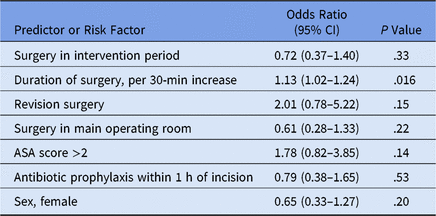
We detected no association of SSI infection with intervention period, age, sex, elective surgery, implants, contamination class and timing or choice of antibiotic prophylaxis in univariable analysis (Supplementary Table S1 online). Similarly, we found no difference in lowest intraoperative body temperature or the proportion of patients with intraoperative normothermia between patients with and those without SSI. However, patients with SSI had longer durations of surgery (P = .018), had higher ASA scores (P = .044), and were more likely to have had revision surgery (P = .035). Multivariable analysis of risk factors from the case-cohort study only revealed the duration of surgery as an independent risk factor for SSI (OR per 30 minutes increase in surgery duration, 1.13; 95% CI, 1.02–1.24; P = .016) (Table 3).
Predictors for Surgical Site Infection Derived From Multivariable Logistic Regression Analysis of a Case-Cohort Study of 189 Patients Undergoing Plastic Surgery or Hand Surgery Between January 2016 and April 2018, University Hospital Zurich

Note. CI, confidence interval; ASA, American Society of Anesthesiologists.
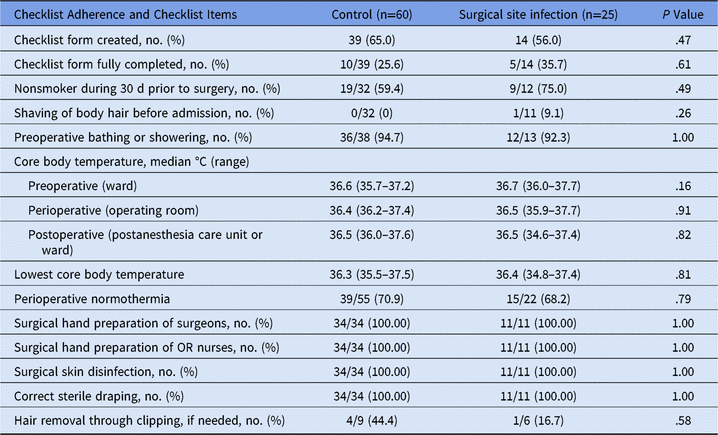
Moreover, checklist forms were created for 39 of 60 control patients (65.0%) and 14 of 25 patients with an SSI (56.0%) who had surgery after full project implementation (P = .47). Checklist forms for 10 of 39 (25.64%) of the control patients and 5 of 14 (35.71%) patients with SSI were fully completed (P = .61) (Table 4). No differences were observed in patients with and those without an SSI after project implementation for the following factors: nonsmokers during the 30 days prior to surgery, shaving of body hair before admission, preoperative bathing or showering, perioperative normothermia or body temperature, surgical hand preparation, surgical skin disinfection, sterile draping or hair removal through shaving, if needed. Interestingly, a 100% compliance rate with surgical hand preparation, surgical skin antisepsis and sterile draping was reported in all 34 control patients and all 11 patients with SSI according to the checklist forms that had these items completed (P = 1.00).
Adherence With Checklist Completion and Risk Factors According to SSI Prevention Checklist in 85 Patients Undergoing Plastic Surgery or Hand Surgery in the Intervention Period Between March 2017 and April 2018, University Hospital Zurich

Note: OR, operating room. Some denominators are lower than the overall patient population due to missing data.
None of the patients of the case-cohort study died within 30 days after surgery. Length of hospital stay after surgery was shorter in patients without SSI (median, 2 days; range, 0–92) compared to patients with SSI (median, 3 days; range 0–81; P = .003).
Discussion
In a large, prospective, uncontrolled before-and-after study of the impact of a CUSP implementation in a surgical discipline with many clean surgeries and thus a low incidence of SSI, we were able to detect an effect on SSI incidence in the entire surgical patient cohort, even though the program focused on the main operating room only, adherence with checklist completion was low, and detailed analyses still detected room for improvement in potentially modifiable SSI risk factors, such as antibiotic prophylaxis or normothermia. The CUSP implementation resulted in an adjusted relative risk reduction for SSI of 41% in our patient population. Furthermore, we confirmed the effect of revision surgery and duration of operation on SSI risk in this population and an increase in length of stay in patients with SSI, which is remarkable in light of the short durations of hospital stay in this population in general.Reference Whitehouse, Friedman, Kirkland, Richardson and Sexton7,Reference Isik, Kaya, Dundar and Sarkut52,Reference Amri, Dinaux, Kunitake, Bordeianou and Berger54
It has been suggested that a significant proportion of SSI could be averted if evidence-based strategies were strictly put into practice, even in high-income settings with presumably high IPC standards.Reference Umscheid, Mitchell, Doshi, Agarwal, Williams and Brennan11,Reference Schreiber, Sax, Wolfensberger, Clack and Kuster12 Rather than just a bundle of IPC measures, we selected a CUSP because this initiative allowed us to put evidence-based measures in the context of a change in the overall safety culture. Similar to our results, several other hospitals have shown the beneficial effects of CUSPs on SSI incidence.Reference Wick, Hobson and Bennett18,Reference Lin, Carson, Lubomski, Wick and Pham55 Consequently, our study confirms that SSI rate can be further reduced by promoting realization of evidence-based strategies. We could even show that this CUSP was able to further decrease SSI incidence in a department with an already low SSI rate that was not perceived to be higher than expected, whereas other studies focused on reducing SSI in procedures with higher SSI rates like colorectal surgery, where improvements may have been easier to achieve.Reference Astagneau, Rioux, Golliot and Brucker3,Reference Wick, Hobson and Bennett18,Reference Lin, Carson, Lubomski, Wick and Pham55,Reference Anthony, Murray and Sum-Ping56 In contrast, a recent systematic review by Lavallée et alReference Lavallee, Gray, Dumville, Russell and Cullum57 questioned the effectiveness of care bundles and concluded that care bundles may be effective but certainty of the evidence was deemed low. Other studies were unable to show a reduction of SSI, even though compliance with evidence-based practices increased.Reference Anthony, Murray and Sum-Ping56,Reference Pastor, Artinyan, Varma, Kim, Gibbs and Garcia-Aguilar58 Variable bundle components and implementation strategies in different settings may explain the discrepant outcomes across studies, emphasizing the need for evaluation of each new safety program or care bundle.Reference Lavallee, Gray, Dumville, Russell and Cullum57
A common problem in change management is the level of uptake of new program components.Reference Lavallee, Gray, Dumville, Russell and Cullum57 Direct observations and review of checklist adherence confirmed that this problem was also evident in our program. In our project, 4 of 10 patients had no checklist completed after checklist implementation, and only ~1 in 4 patients had a fully completed checklist, despite continuous observation and immediate feedback during audits by project team members. Nevertheless, although adherence with checklist completion was only moderate, the introduction of CUSP still had an effect on SSI incidence in our study. The fact that the effect was not associated with the main operating room, where the project was focused, may strengthen the hypothesis that the effect on SSI incidence may be attributed to the safety initiative overall that probably had a spillover effect on all teams of the department rather than the checklist per se.
This study has several limitations. Similar to other studies with bundled interventions, it was not possible to deduct the contribution of each element to SSI reduction because several measures were implemented simultaneously and compliance with individual elements did not change over time. An unmeasured effect that lays in the change in safety culture itself may be more relevant for the intervention effect. Furthermore, not all known possible risk factors for SSI were routinely extracted for all patients in our surveillance form and thus were not accounted for in multivariable analyses (eg, obesity, diabetes, and alcohol abuse).Reference Amri, Dinaux, Kunitake, Bordeianou and Berger54,Reference Martin, Kaye and Knott59 Insulin-dependent diabetes mellitus has been associated with SSI in plastic surgery patients.Reference Goltsman, Morrison and Ascherman60 Second, the interpretation of our results is limited by our study design. An uncontrolled before-and-after study can only detect association, not causation. Thus, our results should ideally be confirmed in a randomized controlled trial. Third, our findings may not be generalized to other settings. Our results were obtained in a single center with a selected patient population of only 1 department. Last, our evaluation ended 1 year and 2 months after project implementation. To further assess sustainability of the project, with or without a repeated intervention to further increase checklist compliance, a follow-up study should be conducted.
In conclusion, we demonstrate the successful implementation of CUSP and its effectiveness in reducing SSI incidence in plastic surgery and hand surgery, a surgical discipline with low SSI rates in general. Other departments and hospitals should consider implementing their own CUSP, customized to their needs, to improve quality and patient safety. Appropriate studies should be conducted to confirm our results, assess the association between the level of adherence to change and the desired effect of the program, to explore CUSP sustainability and to find strategies for increasing compliance with change.
Supplementary material
To view supplementary material for this article, please visit https://doi.org/10.1017/ice.2019.279
Acknowledgments
We thank our study nurse Ulla Holzer and our infection prevention and control practitioners Alexandra Ebert and Heidi Giger for data collection, and we thank Hans Härting (AssekuRisk Safety Management GmbH, Vienna, Austria) for coaching through the CUSP methodology.
Financial support
No financial support was provided relevant to this article.
Conflicts of interest
S.P.K. received travel grants from Astellas and Pfizer and speaker’s honoraria from Mepha.