


Currently, the main determining factor in the progress and development of countries is the development of efficient and creative human resources, which in turn depends on their level of knowledge and education. The superiority of a country depends more on the extent to which it benefits from developments in science and technology rather than on natural resources or existing industrial capacities, and therefore there is a close relationship between the development of a society and higher education. Due to the general popularity of higher education in Iran, the national university entrance exam is the most decisive test that is held every year, and many applicants for university admission compete in the hope of success (Geramipour et al., Reference Geramipour, Rezaei, Ramwzan and Nourouzi2016). Assessing students’ academic aptitude to enter higher education is the main goal of this examination. Such intense competition, which takes place in a short time, in addition to becoming a social phenomenon has a high psychological burden for students.
Students, especially those who intend to continue their education at university, must seriously engage in school education and spend considerable time studying to acquire the knowledge and skills necessary for successful transfer to university or business (Wang & Eccles, Reference Wang and Eccles2012). One of the concepts that has been challenged by researchers in recent years is the concept of academic engagement, which plays a vital role in students’ academic achievement (Stewart, Reference Stewart2007). Engagement is a multidimensional structure that has four distinct but completely interrelated aspects. Making a judgment of how actively concerned the student is in a learning activity involves assessments of concentration, attention and effort (behavioural engagement), the presence of task-facilitating emotions such as interest, and the absence of task-withdrawing emotions such as distress (emotional engagement), usage of sophisticated learning strategies rather than superficial ones (cognitive engagement), and the extent of trying to enrich the learning experience rather than just passively receiving it as a given (agentic engagement; Reeve, Reference Reeve2012). Also, given that the vast majority of postsecondary applicants are adolescents and young people, and because of the importance of education during this period, it is necessary to examine the relationships between individual and environmental factors that may cause students to become more engaged with education. In this regard, academic hope is one of the individual variables that seems to play a key role in academic engagement.
Hope has been introduced as a process of thinking about a goal with a motivation to move towards that goal (agency), and ways to achieve it (pathway; Silverman, Reference Silverman2016). As one of the structures in positive psychology, it has many desirable effects in various fields, including education (Snyder et al., Reference Snyder, Shorey, Cheavens, Pulvers, Adams and Wiklund2002). The theory of hope has been introduced as one of the new motivational models for educational research. Adolescents need to think about and be ‘hopeful’ for the future. To be hopeful requires that an adolescent focus on future goals and achievement (Bryce et al., Reference Bryce, Alexander, Fraser and Fabes2020). One of the most important gaps between developed countries and other societies is related to the number of years of education that a child is expected to achieve, and a significant part of this variety is the years that the student hopes to study in higher education (Okpala & Okpala, Reference Okpala and Okpala2014). Many studies have shown that hope among adolescent students has a positive relationship with various academic and psychological indicators of school adjustment (Gilman et al., Reference Gilman, Dooley and Florell2006); and academic hope, in particular, is associated with students’ hard work and academic activity (Trautwein et al., Reference Trautwein, Köller, Schmitz and Baumert2002). For example, Feldman and Kubota (Reference Feldman and Kubota2015) showed that hope, both public and academic hope, was positively and significantly correlated with academic achievement and success. Further, to summarise the extant research in a meta-analysis study, Marques et al. (Reference Marques, Gallagher and Lopez2017) synthesised findings from 45 primary studies using meta-analysis for the relationship between students’ hope and academic outcomes; their results revealed that the link between hope and academic outcomes was stronger for elementary, middle and high school students than for undergraduate and graduate students. Concerning the results of Kiafar et al. (Reference Kiafar, Kareshki and Hashemi2014), hope is a variable correlated to academic motivation and must be emphasised in academic contexts. Bryce et al. (Reference Bryce, Alexander, Fraser and Fabes2020) recently introduced hope as a multidimensional positive motivational state that is particularly salient with adolescents in the school setting. Cognitive hope focuses on goal attainment cognitions whereas behavioural hope focuses on actions required for goal attainment. Bryce et al. found that cognitive hope significantly predicted achievement, school engagement, anxiousness and stress; however, aspects of behavioural hope only predicted school engagement.
The relationship between hope and academic engagement may be mediated by some other factors. The education process presents challenges, obstacles and stress for the learner that is unavoidable in school life and affects academic outcomes (Martin & Marsh, Reference Martin and Marsh2006). With the development of positive psychology, the construct of academic buoyancy was reformed. This term was formed in the context of an academic resilience structure but differs from it in terms of positive processes of academic behaviour and students’ academic success (Martin & Marsh, Reference Martin and Marsh2008). Academic buoyancy refers to students’ capability to effectively deal with challenges, adversity and setbacks in the school setting (Martin & Marsh, Reference Martin and Marsh2006). While resilience refers to a person’s potential to deal with acute or chronic problems, academic buoyancy seeks to explain how students cope with the pressures, problems and challenges of everyday academic life, such as scoring more poorly than expected in an exam (Collie et al., Reference Collie, Ginns, Martin and Papworth2017). The educational journey, especially when students are preparing to enter university, is a challenging process, so an adaptive response to academic opportunities and challenges is important, and failing to manage to school effectively is associated with long-lasting negative effects, which is why the student must be able to overcome such challenges (Colmar et al., Reference Colmar, Liem, Connor and Martin2019). Academic buoyancy is recognised as a key social-emotional construct relevant in examining students’ progress, particularly in terms of how students deal with academic adversity (Martin, Reference Martin2014). For instance, the results of previous research indicate that academic buoyancy has a positive relationship with academic adjustment, motivation and academic engagement factors such as self-efficacy, planning and perseverance (Martin, Reference Martin2014; Martin et al., Reference Martin, Colmar, Davey and Marsh2010; Martin et al., Reference Martin, Yu, Ginns and Papworth2017).
Aligning with prior work demonstrating buoyancy as a mediator, and features of this structure, have made academic buoyancy, in addition to its direct impact on academic output, a potential mediator variable to mediate the effect of individual sources such as hope on academic engagement. The results of some studies have verified the mediating role of academic buoyancy, including Collie et al. (Reference Collie, Ginns, Martin and Papworth2017), who examined and confirmed the mediating role of academic buoyancy in the relationship between academic anxiety and learning strategies. Sadat and Setayeshiazhari (Reference Sadat and Setayeshiazhari2019) showed that academic buoyancy has a significant mediating role in the relationship between academic emotions and academic engagement. Similarly, the results of Sharif Mousavi (Reference Sharif Mousavi2014) indicate the mediating role of academic resilience in transformational academic engagement.
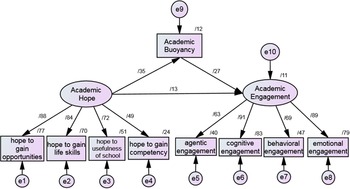
Therefore, considering the importance of examining the factors affecting students’ academic engagement, in the present study an attempt has been made to design a new model to explain the framework of theoretical concepts (Figure 1). Accordingly, two research questions guided the study:
-
(1) To what extent does academic buoyancy play a mediating role in the association between academic hope and academic engagement?
-
(2) To what extent is academic hope directly associated with academic engagement in this mediation model?
Initial model in standard mode.

Methods
Participants and Procedures
This cross-sectional and correlational research study was conducted during the academic year of 2018–2019. Analyses were conducted using 353 (54.2% males, 45.8% females) 12th-grade high school students in Ahwaz/Iran, who were university applicants. The mean and standard deviation of the age of the participants were 18.06 and 1.4 respectively. The sample was selected by multistage cluster random sampling. After obtaining written permission from Education Management, two schools were randomly selected from one of the Ahwaz educational districts in Iran. After the purpose of the research was explained and assurance of confidentiality given, the students completed the permission form and questionnaires. Project personnel were present during data collection to answer questions. No student names or identifying information were included.
Statistical Analyses
In the present study we tested hypotheses using structural equation modelling, and analysed data using Statistical Package for Social Scientists (SPSS) version 23 and Analysis of Moment Structures (AMOS) version 23. We performed data analyses in two distinct phases: preliminary and structural model analyses. The preliminary analyses focused on checking the accuracy of data entry, examining characteristics of study participants, and exploring study variables and statistical description of the data. First, we used SPSS to process data from the questionnaires. Second, we calculated the descriptive and correlation analysis of study variables. This phase of data analysis is of crucial importance as structural equation modelling (SEM) requires certain assumptions, and data-related problems seriously affect model-fitting procedures and thus cause failure to achieve final solutions (Kline, Reference Kline2015). During the structural model analyses, we tested the relationships among variables via SEM using AMOS software (Byrne, Reference Byrne2010). SEM is an excellent tool to simultaneously analyse hypothesised models with multiple independent, mediating and dependent variables. Measurement errors were considered during the analyses (Byrne, Reference Byrne2010). The structural model analyses aimed to establish a good-fitting structural model (Schreiber et al., Reference Schreiber, Nora, Stage, Barlow and King2006). Several criteria were used to evaluate the model fit, including (a) goodness-of-fit index (GFI), comparative fit index (CFI), and Tucker-Lewis index (TLI) greater than 0.95; (b) root mean square error of approximation (RMSEA) less than 0.05; possibility of close fit (PCLOSE); and (c) narrow 90% confidence interval around RMSEA (Kenny et al., Reference Kenny, Kaniskan and McCoach2015). To test the direct effects of academic hope on academic engagement, we submitted the initial hypothesised model (Figure 1) to AMOS. Using the bootstrap method of Preacher and Hayes (Reference Preacher and Hayes2008), the process program was used to examine the mediating effects.
Measures
Academic Hope Scale (Khormaee & Kamari, Reference Khormaee and Kamari2017). This 27-item scale measures academic hope in four dimensions (hope to gain opportunities, hope to gain life skills, hope for the usefulness of school, and hope to gain competency) based on a 5-point Likert-type scale (5 = strongly agree to 1 = strongly disagree). Higher scores indicate higher academic hope. The validity of this scale has been investigated using exploratory factor analysis. The results indicate the presence of four factors in this scale that explain 58% of the total variance of the sample. Cronbach’s alpha for subscale hope to gain opportunities was .90, for hope to gain life skills it was .90, for hope for the usefulness of school it was .84, for hope to gain competency it was .76, and for the total scale it was .94. (Khormaee & Kamari, Reference Khormaee and Kamari2017). Cronbach’s alpha for the reliability of this scale in the present study was .91, and content validity has been reported as desirable by experts of educational psychology.
Academic Buoyancy Scale (Martin & Marsh, Reference Martin and Marsh2008). This scale has four items rated on a 5-point Likert-type scale (5 = strongly agree to 1 = strongly disagree). The minimum and maximum scores on this scale are 5 and 20 respectively. Cronbach’s alpha for the reliability of the scale was estimated to be .80 using a coefficient (as cited in Rabiei, Reference Rabiei2016). In Dehghanizadeh and Hoseinchari’s (Reference Dehghanizadeh and Hoseinchari2012) research, this scale was standardised for the Iranian student community, and results showed that Cronbach’s alpha coefficients with the removal of one item were 80% and the tested coefficient was 73%. Correlation coefficients of items with the total score ranged from 51% to 68%. Results show that the items have internal consistency and satisfactory stability, and to investigate the validity using principal component analysis with varimax orthogonal rotation at the item level showed that omitting an incremental question resulted in a test reliability coefficient of 75%. In the present study, the reliability of this tool was .82 with Cronbach’s alpha method and content validity has been reported as desirable by experts in educational psychology.
Reeve Academic Engagement Questionnaire (Reeve, Reference Reeve2012). This questionnaire consists of 17 questions that the respondents rate on a 7-point, Likert-type scale (1 = strongly disagree 1 to7 = strongly agree). The questionnaire consists of four subscales: agentic, behavioural, cognitive, and emotional. Questions 1–5 measure agentic engagement, 6–9 behavioural engagement, 10–13 cognitive engagement, and 14–17 emotional engagement. Reeve (Reference Reeve2012) obtained four factors in exploratory factor analysis based on principal factors with a tilting rotation and eigenvalue higher than 1. Also, the reliability of the subscales was achieved for agentic at .86, behavioural at .86, emotional at .90, and cognitive at .84, indicating good internal consistency. Ramazani and Khamesan (Reference Ramazani and Khamesan2017) showed that the questionnaire has good reliability (.92) and confirmatory factor analysis showed that it can be used as a suitable tool for measuring academic engagement in Iran. In the present study, Cronbach’s alpha for the reliability of this scale was .86 and content validity has been reported as desirable by experts in educational psychology.
Results
Table 1 presents the results of descriptive indicators as well as the correlation matrix of the variables.
Descriptive indices and correlation coefficients between variables (N = 353)

Note: VIF, variance inflation factor.
**p < .01.
Table 1 shows the descriptive indices (means and standard deviations) of the participating sample. It also shows the results of Pearson’s correlation coefficients that examine the relationships between predictor, mediator and criterion variables. All variables significantly correlate at the .01 level. Before data analysis using SEM, we tested and confirmed normal assumptions, linearity and multiple nonlinearities. Skewness and kurtosis tests showed that all variables had an absolute magnitude of the skewness coefficient less than 3 and the kurtosis coefficient was less than 10, so there was no violation of the data normality and it confirmed the assumption of normality. We used the tolerance level statistic and variance inflation factor (VIF) to examine multicollinearity for all variables; the VIF statistic was less than 10 and tolerance statistic was more than 0.1; therefore, the assumption of multiple nonalignments was observed (Table 1). The Durbin-Watson test statistics of 1.80 showed no correlations between the residuals.
Given the mediating role of academic buoyancy, an initial model for explaining academic engagement based on academic hope is presented in Figure 1.
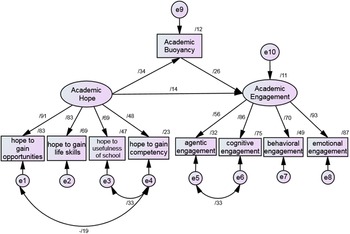
As seen in Table 2, all the fit indexes are more than .90, but the RMSEA of .10 indicated that the initial model needed modification. Correlations in the errors of variables subscales and the fit indices of the final modified model were re-evaluated. In the final model, the RMSEA had an acceptable value (.06). According to the aforementioned indexes, it can be concluded that the final model has a good fit (Figure 2).
The goodness of fit indices of the structural model proposed tested model and the final modified model

Note: IFI, incremental fit index; TLI, Tucker-Lewis index; CFI, comparative fit index; GFI, goodness-of-fit index; RMSEA, root mean square error of approximation; PCLOSE, possibility of close fit.
final modified model in standard mode.

Table 3 presents the results of calculating path coefficients to test direct hypotheses. As seen in Table 3, all direct paths in the final model were significant. As there was a direct, positive and significant relationship between academic hope and academic engagement (p < .05, β = .14), it means that as academic hope increases, students’ academic engagement increases, and vice versa. There was a direct, positive and significant relationship between academic hope and academic buoyancy (p < .01, β = .34), which means that more academic hope will be associated with more academic retention. And there is a positive and significant relationship between academic buoyancy and academic engagement (p < .01, β = .26). This means that students with more academic buoyancy are more engaged in the learning process.
The path coefficients of direct effects between research variables in the final model

We used a bootstrap test to demonstrate an indirect relationship and to explain the mediating role of academic buoyancy (Table 4). To this end, the overall effect of the predictor variable on the criterion without the presence of a mediator was determined. The results showed that there was a significant relationship between academic hope and academic engagement (p < .01, β = .24) without the presence of a mediator.
Bootstrap mediation test

If the mediator variable is entered into the model, the direct relationship between the predictor and the criterion becomes nonsignificant, in which case the mediator is complete, and if this relationship remains significant in the presence of the mediator variable, the role of the mediator variable will be partial (Zhao et al., Reference Zhao, Lynch and Chen2010). The mediation test showed that although the indirect relationship was significant, the direct relationship between academic hope and academic engagement was still significant (Table 3), so academic buoyancy was a partial mediator in this model. It means that part of the effect of academic hope on academic engagement depends on the presence of academic buoyancy, and academic buoyancy located between the two variables causes their indirect relationship with each other.
Discussion
The results of this study showed that there was a direct, positive and significant relationship between academic hope and academic engagement (p < .01, β = .19). The results obtained for this hypothesis are consistent with the results of Feldman and Kubota (Reference Feldman and Kubota2015), Ghadampour et al. (Reference Ghadampour, Heidaryani, Barzegar-Bafroui and Dehghan-Menshadi2018) and Kiafar et al. (Reference Kiafar, Kareshki and Hashemi2014). In explaining this finding, it can be said that hope is a construct that has a positive and significant correlation with the positive outcome. Students who are more hopeful about education and educational outcomes will spend their efforts on achieving academic goals (Snyder et al., Reference Snyder, Shorey, Cheavens, Pulvers, Adams and Wiklund2002). In other words, students who have high academic hope feel that they can control their academic challenges and thus are able to regulate their behaviour, and this sense of control provides a basis for motivation and more academic engagement. The significance of hope in the current study extended the growing evidence that students’ academic hope promotes hopeful thinking via the prediction of students’ effort investment and contributes to higher academic engagement (Levi et al., Reference Levi, Einav, Ziv, Raskind and Margalit2014). Certainly, hope will not be the only factor in school success, but hopeful thinking with psychological mechanisms will anticipate greater effort in education. So, academic hope can be considered as a strong motivating force that leads to academic engagement. Regarding the results of the present study, if students entering college are more hopeful about the benefits of higher education and the opportunities that continuing education will create for them, they will be more cognitively, emotionally and behaviourally engaged with education. Because they are highly motivated, agentic engagement can also be explained by increased academic hope.
Before explaining the role of mediation, it is necessary to explain that according to the research results, the path of academic hope to academic buoyancy as well as academic buoyancy to academic engagement was significant. The role of mediation in these two paths has also been described. Concerning mediation, the researcher was looking for a theory-based variable to explain the relationship between the predictor variable and the criterion. In the present study, academic buoyancy was a partial mediator of the relationship between academic hope and academic engagement. This means that academic hope, in addition to directly affecting students’ academic engagement, also indirectly increases students’ engagement in education through increased academic buoyancy.
The mediating role of academic buoyancy and its consistency with other research cannot be commented on because the researcher did not find research that specifically examined such a role for academic buoyancy. But, in line with earlier research findings (Martin, Reference Martin2014; Martin et al., Reference Martin, Colmar, Davey and Marsh2010; Martin et al., Reference Martin, Yu, Ginns and Papworth2017; Sadat & Setayeshiazhari, Reference Sadat and Setayeshiazhari2019), it means that hope is one of the most effective coping strategies to deal with stress, in that hopeful people keep their motivation and use alternative paths when dealing with obstacles, but those who have low levels of hope are more likely to lose motivation and face negative emotions when faced with obstacles such as minor educational problems and daily stress (Ghadampour et al., Reference Ghadampour, Heidaryani, Barzegar-Bafroui and Dehghan-Menshadi2018). Considering previous findings support the effect of increased hope on academic buoyancy (Yavari et al., Reference Yavari, Dartaj and Asadzadeh2017), it can be demonstrated that a student who has higher academic hope has higher academic buoyancy. The hopeful student has clear goals and can frame problems and obstacles as challenges to overcome, according to previous findings (Collie et al., Reference Collie, Ginns, Martin and Papworth2017; Colmar et al., Reference Colmar, Liem, Connor and Martin2019). As a result of increased academic buoyancy, students’ academic engagement increases. Academic hope enables students, especially university entrants who face the challenge of university entrance exams, to be more resilient in the face of academic difficulties and obstacles. In such a situation, one may have more academic engagement through academic buoyancy.
The researchers note that it is necessary to interpret and generalise the findings of the present study within their limitations. These limitations include using mere reporting tools and not studying the behaviour and research community of high school students who are facing the challenge of university entrance exams; and generalising and interpreting the results requires special caution. Complementary research with experimental and causal-comparative methods, especially with students’ gender control, as well as longitudinal research such as a time panel study, is suggested in the framework of structural equation modeling in this research field.
Conflict of interest
The authors declare that they have no competing interests.