Many international relations scholars argue that elite political dynamics shape the foreign policy behavior of democratic states.Footnote 1 Elites, particularly members of Congress, have a variety of formal and informal tools to constrain the president's use of force. Members of Congress can refuse to appropriate funds, call for the return of troops, and launch investigations into the executive branch.Footnote 2 Likewise, they have the equally potent ability to shape the public's understanding and response to political events. Because members of the public are typically uninformed about world politics, they rely upon elite cues—particularly the nature of conflict among political elites—to craft their position. When elites are unified in support of a leader, that leader has tremendous policy latitude. Conversely, when elite support is divided, public support becomes fractured and the president's power is limited.Footnote 3 Because political elites have so much influence over the nature of US public opinion, presidents are forced to accommodate their preferences to accomplish foreign policy objectives.Footnote 4
Despite the growing consensus that elite dynamics constrain democratic leaders, this literature has remained noticeably silent on the role of elites in constraining polices that are conducted secretly. This omission is consequential, since most scholars of US foreign policy assume that secrecy allows leaders to sidestep elite political constraints by limiting elites’ access to information. For example, Milner and Tingley highlight that Congress is usually left in the dark when it comes to the president's use of intelligence agencies.Footnote 5 This information asymmetry implies that presidents can easily substitute covert operations for military force since there is little need to accommodate elite preferences. Even if elites have the ability to limit the use of overt military force, their importance may have been drastically overstated if presidents can simply choose the covert route. Given the frequency of back-door bargaining and covert operations during the Cold War, the scope conditions of elite constraints on foreign policy need to be more carefully examined. Do elite political dynamics constrain the ability of presidents to act secretly or do they affect only the overt use of force?
I argue that constraints imposed by members of Congress extend to the initiation of covert operations. Specifically, the partisan composition of Congress moderates both the intensity of congressional investigations and the potential costs of mission exposure. During periods of divided government, Congress is most likely to investigate the president and to politicize covert operations in ways that hurt the president's electoral fortunes. Additionally, I contend that constraints on the president's use of covert operations extended to periods of unified government and increased as a result of oversight reforms in 1974 that strengthened the minority party in Congress. To test these hypotheses, I analyze the effect of congressional opposition on a US sample of overt military force and covert operations. Results indicate that elite political opposition constrains covert operations and show that there is no distinguishable trade-off between covert operations and overt military force during periods of divided government. Finally, the results provide evidence that the oversight reforms instituted in the mid-1970s further inhibited the use of covert operations. Following the passage of the Hughes-Ryan Act in 1974, the difference between periods of unified and divided government becomes statistically insignificant, indicating that the effect of elite constraints became uniform across all levels of congressional support.
US Covert Operations
Since the creation of the Central Intelligence Agency in 1947, covert operations have played a central role in US foreign policy. Covert operations are used primarily to support foreign political groups whose goals are amenable to US national interests or to remove foreign actors who pose a threat to the United States.Footnote 6 Recently de-classified primary and secondary source documents from the Cold War link the CIA with numerous attempts to covertly influence the domestic politics of foreign states. Famous examples of covert action include operations in Italy (1947–1948), Greece (1947–1964), Korea (1945–1953), Iran (1953), Guatemala (1953–1954), Syria (1956–1957), Indonesia (1957–1958), Cambodia (1955–1973), Brazil (1961–1964), Jamaica (1976–1980), and Grenada (1979–1983).Footnote 7 The common trait of these operations is that they were implemented secretly in a way that enabled government officials to plausibly deny their existence to domestic constituents and foreign governments. According to the 1991 Intelligence Authorization Act, covert operations are formally defined as any “activity or activities conducted by an element of the United States government to influence political, economic, or military conditions abroad so that the role of the United States government is not intended to be apparent or acknowledged publicly.”Footnote 8 (When practitioners and intelligence scholars discuss covert operations, they are referring to “operations carried out clandestinely by US intelligence agencies” rather than to more general political acts that are conducted secretly).Footnote 9
The CIA uses four main types of covert operation.Footnote 10 These operations include propaganda operations “where the CIA uses its media assets to help or hurt foreign political leaders,” political operations that “take the form of financial aid to friendly politicians and bureaucrats abroad,” economic actions where the CIA attempts to disrupt the economies of foreign adversaries (such as US actions in Chile during the 1960s), and paramilitary actions wherein the CIA provides support for insurgent groups through the use of specialized training and the allocation of military equipment.Footnote 11 In many cases, these methods were used simultaneously to influence foreign political processes. As part of ongoing operations in Guatemala to depose Jacobo Arbenz, for example, the CIA provided military arms and training to opponents of the Arbenz government, disseminated anticommunist rhetoric through Catholic churches, planted a shipment of military supplies to falsely implicate the Soviet Union, bombed strategic targets, and ultimately persuaded Guatemalan military officers to force Arbenz to resign.Footnote 12
The Existing Literature
Covert Operations as a Substitute for Military Force
Within the literature on US foreign policy, most accept the premise that Congress has the ability to influence the US decision to use military force.Footnote 13 Presidents must account for the policy preferences of Congress because it has a wide array of powers at its disposal. First, Congress can dismantle the president's military ventures through its ability to cut funding for military operations. Notable examples include the prohibition of funding to US military advisers in Cambodia, the cancellation of funds for US security forces in Somalia, and the cessation of support for Operation Support Hope in Rwanda.Footnote 14 Second, Congress has the authority to oversee and investigate the executive branch. As part of its oversight role, Congress can actively examine samples of executive-agency activities to detect deviations from legislative intent and it can “establish a system of rules, procedures, and informal practices that enable individual citizens and organized interest groups to examine administrative decisions.”Footnote 15 Third, Congress shapes public opinion with its ability to inform the public's understanding of events.Footnote 16 When Congress is unified in support of the president, the president has great latitude with respect to policy choices. Conversely, when Congress opposes a presidential initiative, it can undermine the president's political support and punish him or her domestically.Footnote 17 Often it is the case that these latter two powers—Congress's investigative powers and its ability to frame political events—work in tandem. Congressional investigations have brought down a few presidents, and politically neutralized several others.Footnote 18
Because Congress can obstruct presidential initiatives and undermine their support, presidents must weigh the importance of their political objective with the potential costs imposed by members of Congress. When the costs of the favored policy exceed the expected benefits, the president must substitute the desired policy with another or choose not to act at all.Footnote 19 Several prominent papers suggest that congressional opposition may cause presidents to substitute covert operations for overt force since Congress can magnify domestic political costs when an intervention goes badly.Footnote 20 Because covert operations are designed to be plausibly denied, they are a more appealing policy tool than overt military force, particularly during periods of high political opposition.Footnote 21 Howell and Pevehouse's empirical findings support the idea that covert operations could be used as a substitute for military force since they show that divided government reduces the incidence of major uses of force, but not minor uses of force.Footnote 22 Their findings suggest that Congress can influence highly visible decisions but is less effective at constraining operations that are less obvious or hidden from public scrutiny. When faced with potential opposition, it is plausible that presidents might substitute minor uses of force for major ones, and covert operations for overt force since covert operations allow presidents to avoid scrutiny.
To summarize, proponents of the substitution argument make two separate but related claims.
H1
Presidents are more likely to use covert operations during periods of divided government than unified government.
H2
During periods of divided government, presidents are relatively more likely to use covert operations than overt military force during periods of divided government than during periods of unified government.
A Theory of Elite Constraints on Covert Operations
Although some research suggests that covert operations are used to circumvent elite constraints on the use of military force, I argue that opposition from Congress—specifically, its partisan composition—constrains the president's ability to act covertly. Because covert operations commonly involve actions that would be embarrassing to the executive branch, presidents are reasonably concerned that mission exposure will lead to backlash among voters.Footnote 23 For example, public revelations following the Bay of Pigs (1961)—when the CIA trained 1,500 Cuban exiles to overthrow Fidel Castro—led to widespread embarrassment for the executive branch. In a candid admission to his political rival Richard Nixon, Kennedy admitted that the Bay of Pigs was the “worst experience of his life.”Footnote 24 Similarly, in response to prolonged attempts by Senator Joseph McCarthy and later Senator Mike Mansfield to investigate the CIA, President Eisenhower expressed concerns about the executive branch's ability to plausibly deny covert operations so that blowback would not hurt and embarrass the president.Footnote 25 According to this case, presidents should initiate covert operations only under either one of two conditions: first, when they believe that the probability of mission exposure is low or second, when they expect the blowback from exposed operations to be minimal. The partisan composition of Congress affects both the probability of mission exposure and the expected level of blowback.
Incentives for Oversight
The probability of mission exposure is higher during periods of divided government because the majority party has political incentives to actively police the president's foreign policy to expose executive wrongdoing. Conversely, the majority party has disincentives to reveal information that could harm the president during periods of unified government since the revelation of information that undermines the party's leader in the White House has the potential to damage the collective fortunes of the party in power during the next election cycle.Footnote 26 Kriner and Schickler find that for more than a century, “the House of Representatives has investigated the president more aggressively when the partisan opposition controls the committee gavels than when the president's co-partisans wield them.”Footnote 27 While this finding is less robust in the senate, Kriner and Schickler find evidence in their sample of high-profile investigations that investigations conducted during periods of divided government were broader in scope and more aggressive. We should expect presidents to be wary during periods of divided government since they have reason to expect that congressional investigations will be more likely to stumble upon compromising information that could damage the president's party.
The Costs of Exposure
The partisan composition of Congress moderates the potential political harm caused by the details of exposed operations. Scandals are not exogenous events that result simply from the disclosure of “official misbehavior”; instead, the size and damage of a scandal are influenced by a number of political factors such as elite cues and the duration of media exposure.Footnote 28 In order for an event to grow into a scandal, the media and American public have to take notice. Congress plays an important role in determining whether or not presidential wrongdoing grows into a political scandal since they can call attention to damaging information and frame events in ways that attract unwanted attention from the media and the general public. During periods of unified government, members of the majority party have strong incentives to ignore allegations of executive wrongdoing and staunchly defend the executive branch.Footnote 29 During periods of divided government, the president's political opponents frame events in ways that highlight evidence of wrongdoing to damage public perception of the president's party.Footnote 30
Congressional investigations into the Iraq War provide an illuminating example of how partisan factors shape the incentives of members of Congress. When Republicans controlled the house, “they quashed most calls for investigations of alleged misconduct in the Bush administration's handling of the war.”Footnote 31 Even in the wake of the Abu Ghraib scandal, House Republicans held an average of 3.4 days of hearings between 2003 and 2006.Footnote 32 In contrast, investigative hearings occurred over three times more frequently during the period of divided government between 2007 and 2008 when Nancy Pelosi served as Speaker of the House.Footnote 33 The incentives of the majority party to ignore damaging information about presidential wrongdoing and to limit serious investigations of the executive branch mean that the president can accept more risks when initiating covert operations since he does not have to worry about exposed information growing into a scandal. Without the bright lights of a prolonged congressional investigation to provide concrete information about executive wrongdoing, the likelihood that a particular event grows into a scandal is negligible. Because operations are intended to be plausibly denied, exact operational details are difficult to obtain and paper trails are scarce. Members of Congress have the ability to resolve this information asymmetry by launching investigations into the executive branch's activities that expose information the media can latch onto. Without concrete allegations or evidence of particular operations, reporters are reluctant to cover news stories because of a lack of sources and the risk of damaging their reputations and credibility.Footnote 34
Both factors—Congress's willingness to oversee the president and its incentives to capitalize on the exposure of compromising information—moderate the risk of acting covertly. Because the anticipated costs of covert operations are higher during periods of divided government than during periods of unified government, presidents should be less likely to initiate covert operations when the opposition party holds the majority position than when their party is in control. Additionally, covert operations should not become more likely relative to overt operations during periods of divided government.
H3
Presidents are less likely to use covert operations during periods of divided gov ernment than unified government.
H4
During periods of divided government, presidents are not more likely to use covert operations than overt military force.
The Effect of Changes in Congressional Oversight
Scholars of US foreign policy will be aware of important changes that took place during the mid-1970s concerning the oversight of covert operations. Prior to 1975, it was well known that Congress preferred a hands-off approach to CIA oversight. According to Cold War historians, members of Congress tended to agree with Senator Leverett Saltonstall's 1956 statement that “It is not a question of reluctance on the part of CIA officials to speak to us. Instead, it is a question of our reluctance, if you will, to seek information and knowledge on subjects which I personally, as a member of Congress and as a citizen, would rather not have.”Footnote 35 Historians have referred to this period as a time of “benign neglect” and an “era of trust.” But starting in the 1970s, this period of benign neglect began to wane. A combination of the widely reviled war in Southeast Asia, news of the Watergate scandal, and details of US covert operations that had been made public in the press—such as the famous piece published by Seymour Hersh in the New York Times on 22 December 1974 that included details concerning the CIA's covert action programs to assassinate and subvert foreign leaders—prompted Congress to take a more active role in oversight.Footnote 36 In 1974, the Hughes-Ryan Amendment was passed which “prohibited the use of appropriated funds for [covert operations] unless and until the President issues an official finding that each such operation is important to the national security and submits these findings to the appropriate Congressional committees.”Footnote 37 When combined with the pressure for intelligence reform created by the Church and Pike Committees, 1975 marked a significant shift in the oversight of US covert operations.
As a result of changes in oversight requirements, minority party members in the House and Senate oversight committees were provided access to information on the conduct of covert operations for the first time. This reduction in information asymmetry between members of the majority and minority party suggests that constraints on the president's ability to initiate covert operations during periods of unified government grew stronger after 1974. When members of the opposition party are uncomfortable with a proposed operation, disagree with the manner in which an operation is being implemented, or suspect that the details of an operation could hurt the opposition party, they can threaten to leak information to the media. These leaks, commonly referred to as “leak-item vetoes,” can kill presidential initiatives.Footnote 38 Several historical examples illustrate the potency of these threats. In the most famous example of a leak-item veto, Senator Joseph Biden—who is well known within the intelligence community for boasting to be “the single most active Democrat on the Intelligence Committee”—famously bragged about forcing the Reagan administration to scuttle two operations that he deemed “harebrained” by threatening to leak information before the operations could be initiated.Footnote 39 In other words, the importance of divided government should decrease after 1974 and the likelihood that covert operations are initiated should become more uniform between periods of unified and divided government.
H5
Because of changes in congressional oversight, the importance of divided government on the onset of covert operations should decrease after 1974.
Research Design
Data
To understand how presidents choose between covert and overt policy instruments, I analyze a dyad-year data set that contains information about CIA-initiated covert operations during the Cold War and US-initiated Militarized Interstate Disputes (MIDs).Footnote 40 The data set's dyad-year format makes it possible to test the probability of covert and overt operations against each potential target state. Although the CIA is not the only agency that conducts covert operations—there are famous instances, for example, in which the Department of Defense acted covertly such as in Vietnam, Korea, and Chad—I focus exclusively on CIA-initiated operations since data are currently unavailable for other agencies. The first data set, compiled by O'Rourke, identifies CIA-initiated covert operations initiated during the Cold War that were designed to overthrow a foreign regime and to install a new government. This data set was compiled using a number of primary and secondary sources that include, “declassified CIA and National Security Council reports, declassified documents from the Church and Pike Committees, National Security Archival readers, the Foreign Relations of the United States (FRUS) series, the White House tapes and other declassified executive branch documents, the Pentagon Papers, reports from the Senate's Select Committee on Intelligence and the Houses Foreign Affairs Committee memoirs of influential policymakers and intelligence officials.”Footnote 41 In total, this data set includes sixty-two covert operations initiated between 1947 and 1989.Footnote 42
Because O'Rourke's data set is limited to cases of foreign-imposed regime change and covert efforts to prop up and support foreign governments, I create a second dependent variable that combines the research of O'Rourke and Berger and colleagues.Footnote 43 In studying the impact of US covert operations on foreign markets, Berger and colleagues document CIA operations that the United States initiated to prevent an embattled government from losing power or to overthrow the government in power and to install a new government. To ensure that no operations were referenced more than once in the combined dependent variable, primary and secondary sources were used to deduplicate operations.Footnote 44 In total, there are 109 covert operations identified within the combined measure. The combined dependent variable includes forty-seven more operations than O'Rourke's measure because Berger, and colleagues use a more expansive coding criteria. There are serious concerns about their coding practices given their reliance on secondary sources. Cold War scholars have disputed the coding of some of their cases.Footnote 45 For example, O'Rourke asserts that the CIA was not instrumental in planning or implementing coups in Ecuador (1963), Greece (1967), and Panama (1981) that Berger and others consider to be examples of US covert operations.Footnote 46 O'Rourke also argues that Berger incorrectly identifies CIA operations in the Philippines (1946) and in Grenada (1983) as examples of regime change that were actually examples of “regime maintenance.”Footnote 47 While concerns about Berger and colleagues' coding choices are warranted, the similarity of the results when using the O'Rourke and combined measures suggests that coding discrepancies are not driving the results.
To model the determinants of overt military force, I rely upon the recently updated MIDs data set compiled by Gibler, Miller, and Little.Footnote 48 This data set makes a number of important corrections to the original MIDs data set. Noteworthy among these changes is the removal of 251 cases (over 10% of the original data set) and modifications to the originally coded dispute level and number of fatalities. Additionally, numerous MIDs that were originally included as “costly” uses of force have been corrected to reflect their more minor historical nature. In total, twenty-eight US MIDs were affected by these changes. Following the precedent set by Howell and Pevehouse, the initiation of major and minor MIDs are modeled separately.Footnote 49 Only MIDs that were initiated by the United States are in the population of cases.Footnote 50
Empirical Tests
To test the relationship between congressional support and the choice to initiate covert operations, I specify a series of logistic regression models.Footnote 51 The dependent variable in each model is the onset of US covert operations or a US-initiated MID. In each model, the dependent variable is coded as a 1 if a covert operation or MID was initiated during a particular country-year and as a 0 if no use of force or covert operation was initiated. Dyad-years are dropped during years in which operations remain ongoing. All of the models include p-values calculated using pairs cluster bootstrapped t-statistics (PCBSTs) that are clustered by dyad.Footnote 52 Finally, peace year terms are included in each of the models. These terms measure the time since the United States last intervened in a country and account for temporal dependence in the data.Footnote 53 Peace year terms are not reported in the final models but are available in the supplementary appendix.
To assess whether or not covert operations are used as a substitute for military force during periods of divided government, I calculate the average marginal effect (AME) of divided government on the choice to initiate covert and overt operations. Average marginal effects are produced by calculating the marginal effect of unified government at every observed value of X and then averaging across the resulting effect estimates.Footnote 54 Ultimately, there are two ways of providing evidence against the substitution argument. First, by demonstrating that on average, presidents are less likely to initiate covert operations during periods of divided government than they are to initiate overt military operations, and second, by showing that there is no statistically significant difference between the two marginal effects. To determine whether the difference between AMEs is statistically significant, I bootstrap the average marginal effect estimates and use independent sample Welch's t-tests.
The primary concern with using AMEs to test the substitution argument is that covert and overt operations might be initiated simultaneously. Two important pieces of evidence show that such fears are unwarranted. First, cross-tabulations included in the appendix show that covert and overt operations are almost never initiated simultaneously. Based on the O'Rourke data, there is only one country-year in which the United States initiated a covert operation and major use of force. Likewise, there are only three instances in which major MIDs and covert operations are initiated simultaneously when the pooled measure is used. Second, a series of bivariate probit models—which jointly model the decision to initiate covert operations and military force—show that the direction of parameter estimates are consistent with those of the logistic regression models I presented earlier. Because covert operations and overt military force are almost always initiated independently, average marginal effects provide a simple and intuitive way of capturing the effect of divided government on the choice to initiate covert operations and military force respectively.
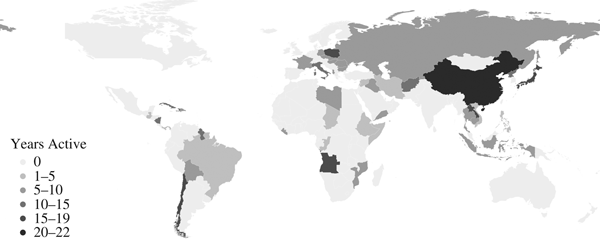
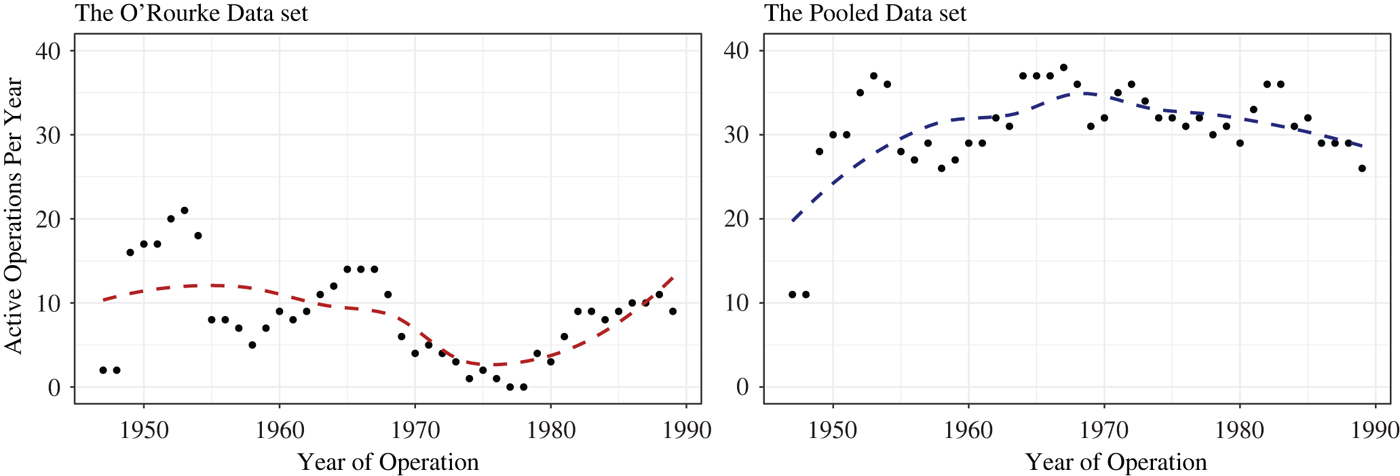
The number of years with active US covert operations by country

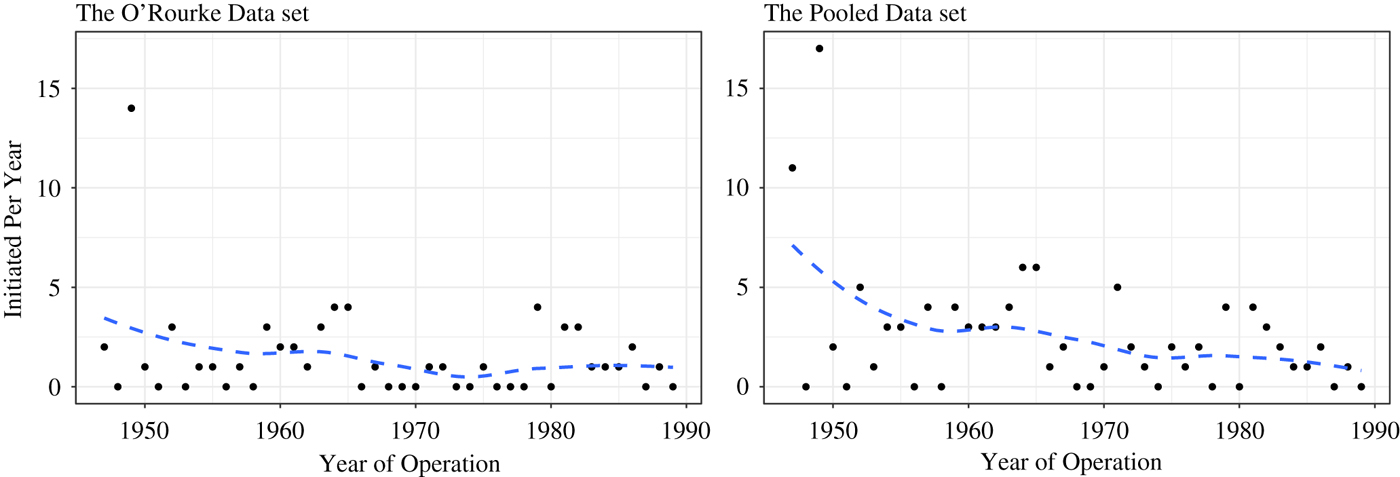
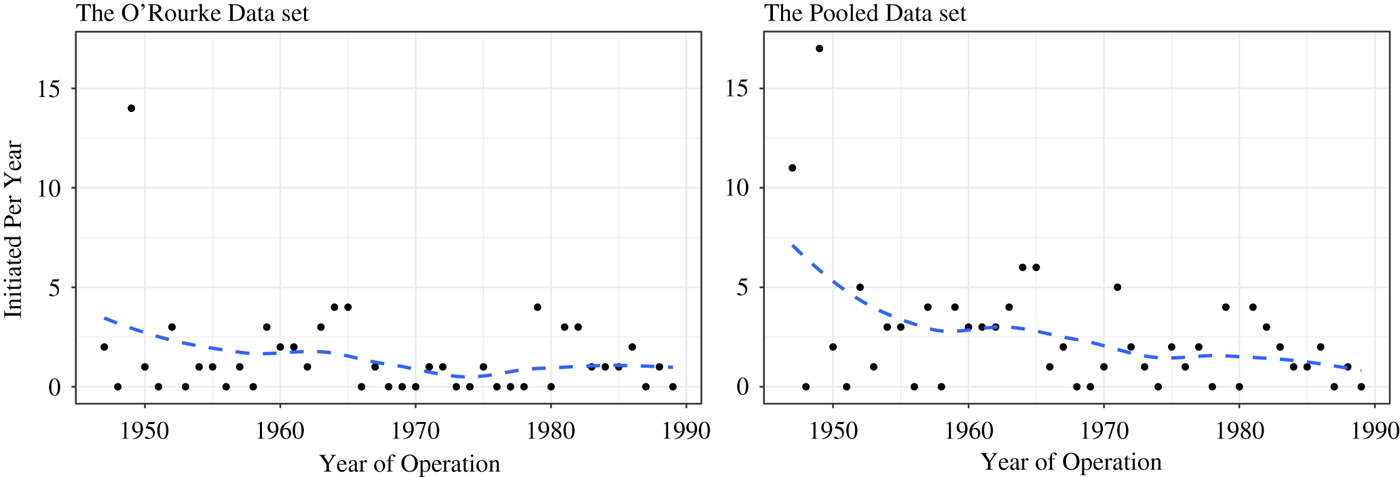
The number of US covert operations initiated per year
Explanatory Variables
The indicator, divided government, is the primary explanatory variable included in each of the models. This variable is coded as a 0 when the majority party in Congress is the same as the president's party in both the House and the Senate, and as a 1 when the opposition party maintains the majority position in Congress. Alternative measures of congressional support, such as the percent of the president's party in Congress, are not included since they do not adequately capture the proposed theoretical mechanism: oversight in the House of Representatives is controlled by the majority party.Footnote 55 Once the president's party has a majority in Congress, additional increases in the percent or strength of the majority party do not confer a significant advantage.
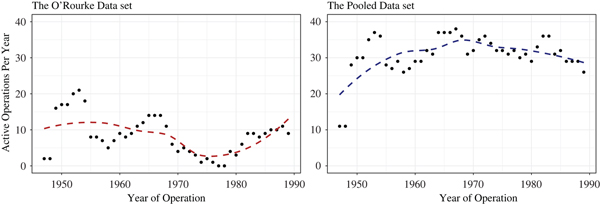
The number of US covert operations active per year
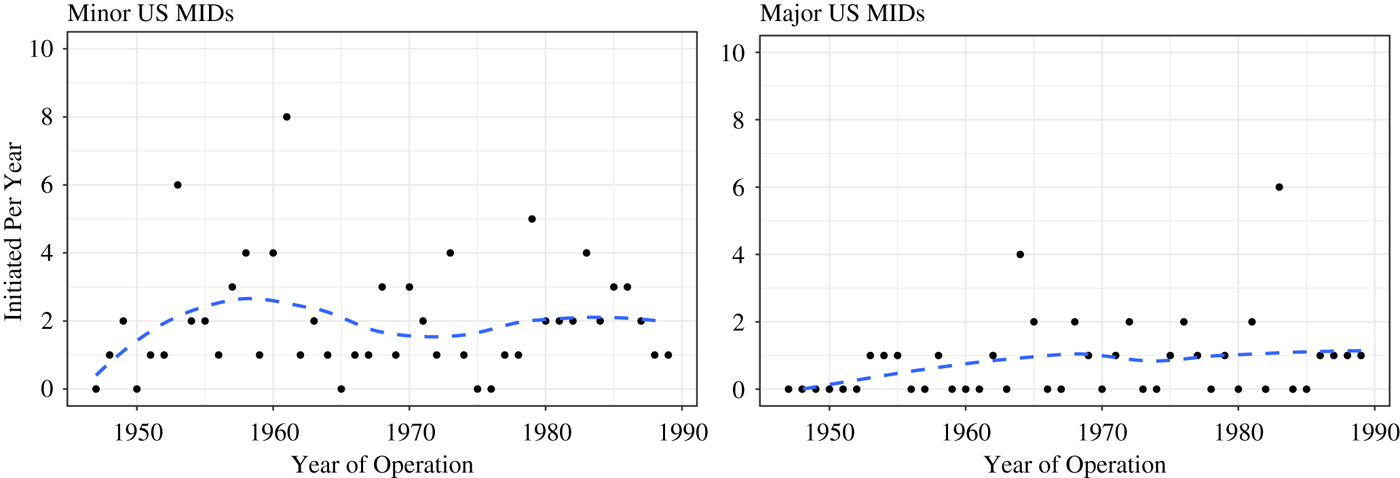
The number of US MIDs initiated per year

To assess the impact of changes in congressional oversight, I have included a dummy variable, oversight change, that controls for the change in the CIA's congressional oversight between the pre/post 1975 period. Years before 1975 are coded as a 0 while the years 1975 and after are coded as a 1. To determine whether not the substantive effect of the divided dovernment variable is dependent on the change in oversight, an interaction term is included in several of the model specifications.
Background Controls
Control variables frequently associated with the use of military force and covert operations are also included in the final models. These control variables are designed to deal with the potential confounding effects of both domestic and international political factors. The first of these control variables, qtr. 1 approval, is a measure of public support for the president during the first three months of each calendar year taken from Gallup approval ratings for the president in each quarter. While it is assumed that the public can learn about the initiation of covert operations through only elite cues, many have argued that public opinion plays an important part in a president's consideration to use force.Footnote 56 The use of first-quarter approval ratings—rather than a more exact measure of public approval that varies by month or quarter—is used because the data on covert operations lack specificity. For many US covert operations, it is impossible to identify the exact time that they were initiated.Footnote 57
The second domestic control variable, election year, indicates whether or not a presidential election occurred within a given year. Research on overt uses of force suggests that a president's incentives to use force change during election years because their focus shifts to getting re-elected.Footnote 58 When it comes to decisions to initiate a covert operation, it is reasonable to expect that presidents will become more risk averse and less willing to initiate a covert operation since blowback has the potential to hurt their electoral fortunes.
The third set of domestic controls, presidential fixed effects, account for the fact that presidents have specific policy proclivities.Footnote 59 It is well known for example, that President Carter—at least during the early years of his administration—had a strong bias against covert action.Footnote 60 During his presidential campaign, Carter famously promised to limit the use of covert action. As further proof of his bias against covert operations, President Carter signed Executive Order 12036 which created two new oversight committees—the Policy Review Committee (PRC) and the Special Coordination Committee (SCC)—and imposed a number of new restrictions on the CIA and the broader intelligence community. The amount of the CIA budget allocated for covert action fell to less than 5 percent of the total CIA budget during Carter's early years in office.Footnote 61
The remaining control variables account for important facets of international politics that may be driving the choice to intervene covertly. The first international control variable is an indicator for joint democracy. In addition to the well-known finding that democracies are significantly less likely to go to war against other democracies, there are important reasons to believe that an opponent's regime type also influences the choice to initiate covert operations. Some have theorized that covert operations give policymakers the ability to avoid normative restraints on the use of force against other democratic states and will thus be used as a substitute for military force when a president wants to engage with another democratic state.Footnote 62
The second international control variable, cinc ratio, provides a measure of the proportion of national power that the United States has within a particular dyad.Footnote 63 It is likely that variations in military capabilities are an important determinant of covert activity. If, for example, the choice of policy adheres to an expected utility argument, the use of covert operations may become increasingly more likely as the adversary becomes stronger in order to reduce the material costs of going to war against a strong opponent.
The final international control variable, active russian operation, is a dummy variable that indicates whether or not a Russian covert operation was active during a particular dyad-year. A 1 indicates that a Russian covert operation was active during a particular country-year and a 0 indicates that no operation was ongoing.Footnote 64 US covert operations were often triggered by fears of increasing communist influence arising from the concern that Soviet meddling would help communism spread throughout the world.Footnote 65 The fear that the Soviet Union was gaining a foothold in a particular country often provoked action by the CIA. Additionally, some evidence suggests that covert operations have been used to conceal coercive activity from outside audiences. By limiting the external visibility of their actions, states can avoid political pressure to go to war and ultimately avoid spirals of escalation that would be impossible to avoid when using overt military force.Footnote 66 In other words, past research predicts that the United States should have been more likely to use covert operations as a substitute for overt military force when they were aware of Soviet covert operations in another country since they had strong interest in halting the spread of communism while limiting dangerous levels of escalation between the United States and the Soviet Union.
Results
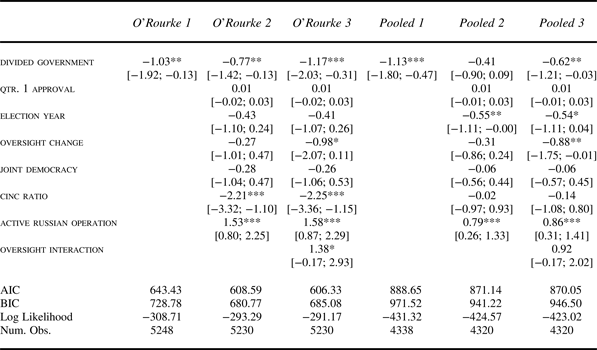
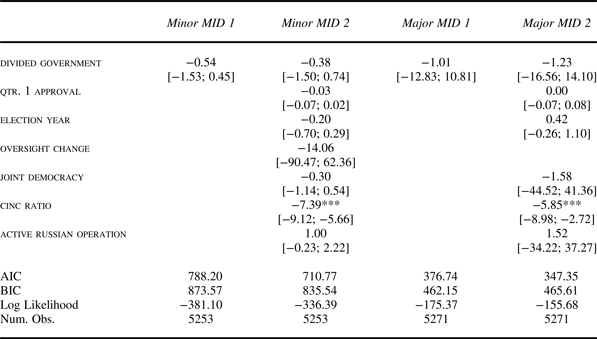
In contrast to the expectations of the substitution argument, expressed in Hypothesis 1, results show that presidents are constrained by elite political dynamics, as H3 predicts. The coefficient for divided government is negative in every model specification and statistically significant in all but one model. When the interaction between divided government and oversight change is included, however, divided government is always statistically significant. This is a noteworthy result since the inclusion of the interaction term changes the interpretation of the divided government coefficient. When the interaction term is included, the coefficient measures the effect of divided government in the pre-1975 period. This specification is consistent with the logic behind H5, which suggests that the effect of divided government is not only conditional, but should be strongest in this period. The fact that the divided government variable is always negative and statistically significant when this interaction term is included provides strong support for the proposed theory. Surprisingly, divided government is not a statistically significant predictor of the use of overt military force in any of the model specifications, though the sign of divided government is always negative. While the null finding does not mean that Congress has no effect on the choice to use military force, it does challenge the robustness of the results presented by Howell and Pevehouse.Footnote 67
The determinants of US covert operations

Notes: Peace years have been suppressed but are displayed in the appendix. Models O'Rourke 1 and Pooled 1 contain presidential fixed effects. *p < .10; **p < .0; ***p < .01.
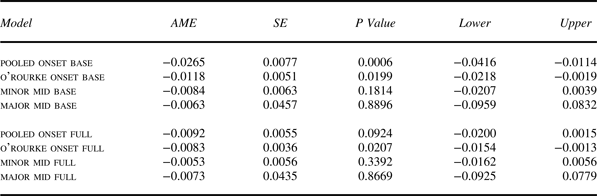
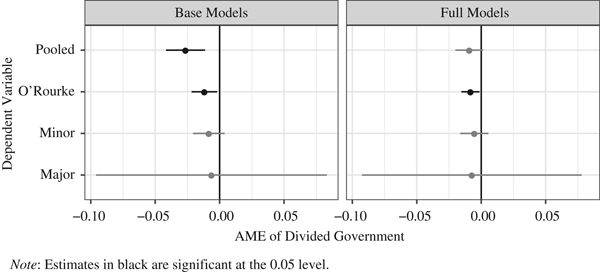
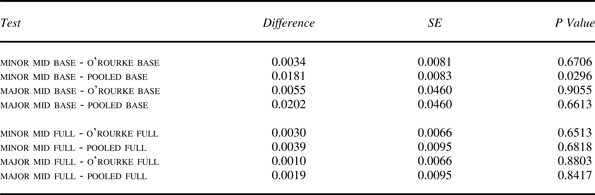
The average marginal effects indicate that covert operations are not used as a substitute for military force during periods of divided government. On average, presidents are actually less likely to initiate covert operations than overt military force during periods of divided government although the confidence interval around the AME for major force suggests that the effect of divided government on overt force varies widely. Within the base models, for example, the presence of divided government decreases the probability that a covert operation is initiated by 1.18 percent according to the O'Rourke sample and by 2.6 percent according to the pooled sample. By comparison, divided government reduces the likelihood that major and minor MIDs are initiated by less than 1 percent. Seven of the eight t-tests are not statistically significant. The lack of statistical significance indicates that we cannot reject the null hypothesis that there is no difference between the average marginal effect samples.
The determinants of minor US-Initiated MIDs

Notes: Peace years have been suppressed but are displayed in the appendix. Every model contains presidential fixed effects. *p < .10; **p < .05; ***p < .01.
The average marginal effects of divided government

Likewise, the results from the bivariate probit models included in the appendix provide additional evidence that there is no empirical support for the substitution argument. One of the strengths of bivariate probit models is that they allow researchers to model four potential outcomes: the P (y 1 = 0, y 2 = 0), the P (y 1 = 0, y 2 = 1), the P (y 1 = 1, y 2 = 0), and the P (y 1 = 1, y 2 = 1) where y1 and y2 refer to the related policies of interest. If the substitution argument is correct, divided government should increase the probability of (y 1 = 1, y 2 = 0) relative to the probability of (y 1 = 0, y 2 = 1). The results show that in each of the model specifications, when covariates are held at their means, presidents are less likely to initiate covert operations than overt military force, though all but two of the marginal effects fail to reach statistical significance.Footnote 68 Because the majority of marginal effects lack statistical significance, there is not enough evidence to support the claim that divided government induces substitution between overt and covert operations. Ultimately, the AMEs, t-tests, and bivariate probit models support the theory's prediction that presidents are no more likely to use covert operations than overt military force during periods of divided government.
Average marginal effect plot

Welch's T-tests

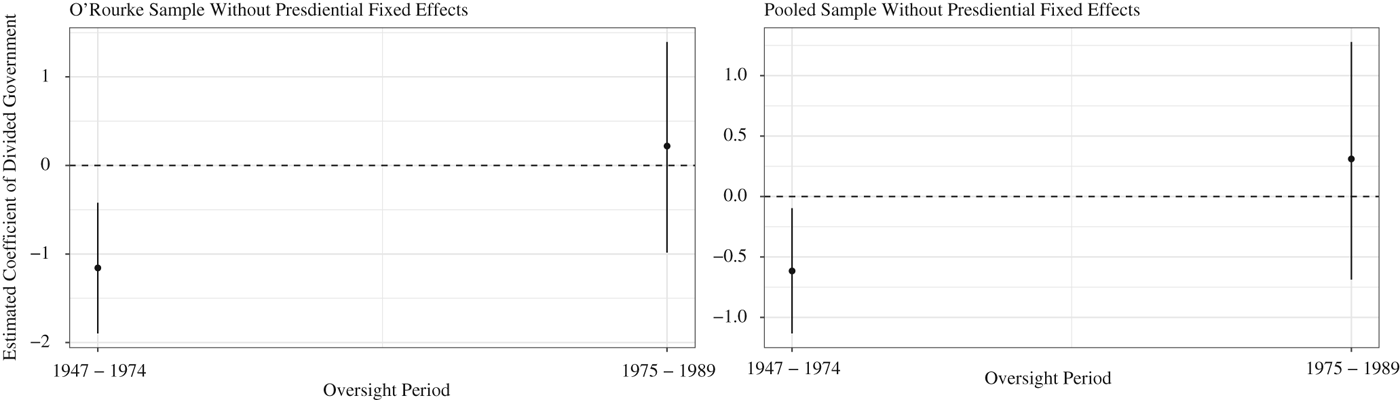
Finally, the statistical significance of the coefficient divided government decreases, as expected, following changes in congressional oversight (see Figure 6). This finding adds credibility to my central thesis—that covert operations are constrained by Congress—since the result coincides with oversight changes that were instituted during the mid-1970s. The decrease in the coefficient divided government for the covert sample suggests that constraints on covert operations became more uniform across levels of congressional support after 1974 and that congressional oversight of the executive branch became more effective. Thus, before 1974, presidents were constrained by opposition from Congress only during periods of divided government, and after 1974, the constraints became more uniform across periods of unified and divided government.
The estimated coefficient of divided government conditional on oversight period

While I find that elite opposition constrains covert operations and is thus not a substitute for overt military force, policy substitution may be driven by international political factors. A particularly interesting finding from the analysis is that the presence of an active Russian covert operation significantly increases the likelihood that the United States chooses to initiate a covert operation but does not have a significant relationship on the decision to use major or minor force. This result lends support for the idea that covert operations can be used as a form of “back-door bargaining” that allows US foreign policymakers to intervene in a way that conceals evidence of foreign involvement when the danger of unintended conflict escalation is acute.Footnote 69 Carson's argument coincides nicely with the finding that the United States is more likely to use covert operations than overt military force against strong states. These findings suggest that covert operations are an attractive substitute when policymakers want to avoid dangerous escalation.
Conclusion
Previous research assumes that covert operations allow leaders to evade elite political opposition and frequently assumes that covert operations are used as a substitute for overt military force to circumvent elite political opposition. I challenge that view by showing that political opposition from members of Congress reduces the likelihood that covert operations are initiated and that there is no distinguishable trade-off between covert operations and overt military force. During periods of divided government, members of the majority party are likely to investigate the president and to publicize instances of executive wrongdoing in ways that hurt the president's electoral fortunes while during periods of unified government, they have incentives to maintain the strength of their party. The results here also show that changes in congressional oversight increased the effectiveness of elite political constraints faced by the president during periods of unified government. After 1974, the difference between unified and divided government becomes statistically insignificant.
The findings have important ramifications for international relations theory. The majority of research in international relations assumes that the public plays an integral role in leaders' ability to convey their resolve.Footnote 70 Typically, scholars assume that the possibility of public backlash and the threat of being voted out of office are what allow state leaders to credibly convey their resolve in a crisis. The assumption that a public audience is necessary to convey resolve implies that leaders are unable to send credible signals when relying upon covert operations.Footnote 71 However, the finding that congressional opposition constrains covert operations suggests that the hypothesized signaling advantages of overt over covert uses of force have been overstated. Even when acting covertly, leaders should be able to signal their resolve.
Supplementary Material
Supplementary material for this research note is available at <https://doi.org/10.1017/S0020818319000171>
Acknowledgments
I thank Bear Braumoeller, Derick Fan, Liwu Gan, Christopher Gelpi, Andrew Goodhart, Adam Lauretig, William Minozzi, Iku Yoshimoto, the two anonymous reviewers, and participants at Ohio State's Research in International Politics workshop for their helpful comments.