Introduction
In recent years, the growing scientific interest in knowledge about Emotional Intelligence (EI), its characteristics, and its applications has been reflected in the development of various theoretical perspectives, as well as different definitions of EI and ways to operationalize it. The term EI is defined in the literature as the set of skills used to perceive, express, comprehend, and regulate one's emotions and those of others, promoting emotional and intellectual growth (Salovey and Mayer, Reference Salovey and Mayer1990).
Currently, two different perspectives try to conceptualize EI. On the one hand, the skills models argue that EI consists of a range of emotional and cognitive skills that unify these two dimensions. These skills consist of accurately perceiving, valuing, and expressing emotions, accessing and/or producing feelings that facilitate thought, understanding these emotions, and regulating them to foster emotional-intellectual growth (Salovey and Mayer, Reference Salovey and Mayer1990; Mayer and Salovey, Reference Mayer, Salovey, Salovey and Sluyter1997). On the other hand, the mixed models consider EI to be a multidimensional construct that includes cognitive skills, personality traits, and affective and motivational dispositions.
The model that has had the most influence is the skills model by Mayer and Salovey (Reference Mayer, Salovey, Salovey and Sluyter1997), reflected, in turn, by the predominance of the TMMS, which evaluates an individual's perception of his or her emotional skills, or perceived emotional intelligence (PEI). The Trait Meta-Mood Scale (TMMS) is a 48-item self-report measure designed to assess a person's general beliefs about attending to moods (Attention), the clarity of one's experiences of mood (Clarity), and the effort made to repair mood states (Repair) (Salovey et al., Reference Salovey, Mayer, Goldman, Turvey, Palfai and Pennebaker1995). The importance of this construct in aging is revealed by the presence of high levels of emotional clarity and regulation in this population, with levels of repair skill being especially noteworthy (Extremera and Fernández-Berrocal, Reference Extremera and Fernández-Berrocal2005; Hay and Diehel, Reference Hay and Diehl2011). However, although age has been shown to be a modulator variable of levels of EI, with higher general levels in older adults (Extremera et al., Reference Extremera, Fernández-Berrocal and Salovey2006), there is no adaptation of the TMMS in the older Spanish population that can be used to properly explore the changes experienced with age. Therefore, there is a need for a valid EI instrument for the older population with previously demonstrated validity in the general population and widespread acceptance by the scientific community.
Once this assessment instrument is available, it is necessary to find out to what extent EI is linked to other psychological variables that are indicators of positive mental health, in order to analyze the possibilities and benefits of developing it. Two variables related to EI are life satisfaction (Palomera and Brackett, Reference Palomera and Brackett2006) and psychological well-being (Carmeli et al., Reference Carmeli, Yitzhak-Halevy and Weisberg2009).
Life satisfaction refers to cognitive and affective judgments about satisfaction with different aspects of life (Diener et al., Reference Diener, Suh, Lucas and Smith1999), and the domains closest to the individual's personal life will have the greatest influence on personal well-being. Psychological well-being is a complex, multidimensional construct that has been associated with obtaining personal goals and the process of achieving those values that make us feel alive and evolve as people (Ryff, Reference Ryff1989). Thus, the construct represents aspects of positive functioning, which, according to Ryff (Reference Ryff1989), has six dimensions: self-acceptance, personal growth, purpose in life, positive relations with others, environmental mastery, and autonomy. Despite the widespread interest in Ryff's theoretical framework, there has been some controversy about its six-factor structure (e.g. Springer and Hauser, Reference Springer and Hauser2006). Some authors have proposed that there may be fewer than six dimensions underpinning Ryff's model (Springer and Hauser, Reference Springer and Hauser2006). For instance, when the original six-factor model (Ryff, Reference Ryff1989) was explored in Spanish older people, a better fit was found for a four-factor model (without the autonomy and positive relations with others dimensions) (Tomas et al., Reference Tomás, Sancho, Melendez and Mayordomo2012).
Keyes et al. (Reference Keyes, Shmotkin and Ryff2002) indicate that subjective well-being (SWB) and psychological well-being (PWB) represent related but distinct conceptions of well-being. They found that PWB and SWB correlated at 0.84, but their constituent components both loaded in separate and distinct higher order factors. Diener et al. (Reference Diener, Suh, Lucas and Smith1999) argued that SWB is a necessary condition for the “good life,” but not sufficient. Whereas SWB focuses on pleasure, pain avoidance, and overall satisfaction, PWB is based on a broader approach that includes identity, meaning, and relatedness. PWB has to do with human potential and living well; rather than an outcome or end state, it is more a process of fulfilling or realizing one's true spirit or nature (Grant et al., Reference Grant, Langan-Fox and Anglim2009).
Palomera and Brackett (Reference Palomera and Brackett2006) find significant relationships between EI and life satisfaction, specifically r = 0.29 with the emotional clarity dimension and r = 0.25 with the emotional repair dimension. Later studies show that EI may be an important predictor of life satisfaction (Carmeli et al., Reference Carmeli, Yitzhak-Halevy and Weisberg2009). The results of the relationship between EI and psychological well-being suggest that emotionally intelligent individuals are likely to experience a higher level of PWB and a lower level of emotional impairment than individuals with a low level of EI (Carmeli et al., Reference Carmeli, Yitzhak-Halevy and Weisberg2009), possibly because the former have the ability to maintain positive mental states, due to their emotion management skills.
The first objective of this study is to validate the TMMS questionnaire in the population over 60 years old; this adaptation would offer a specific instrument to evaluate the older population and study possible changes associated with age. The second objective is to test a structural equations model where EI predicts psychological well-being, mediated by life satisfaction. As hypotheses, we consider, first, that the TMMS will be a valid instrument to measure EI in the older adult population. Second, we expect EI to be a good predictor of psychological well-being in older people, mediated by the psychological variable life satisfaction. In addition, we intend to test these models with the four- and six-factor versions of the psychological well-being scales.
Method
Participants
The sample was composed of 215 older adults, 153 women and 62 men. The ages ranged from 60 to 90 years (M = 69.56, SD = 6.42). Regarding the sociodemographic data, 74.8% were married, 8.1% single, and 17.1% widowed. With regard to their education level, 11.6% read and write, 54.3% completed elementary school, 16.6% completed secondary school, and 17.6% had attended university.
Instruments
In addition to the sociodemographic data, the assessment protocol contains different questionnaires to assess the psychological variables under study: EI, life satisfaction, and psychological well-being.
TMMS (Salovey et al., Reference Salovey, Mayer, Goldman, Turvey, Palfai and Pennebaker1995
The 24-item version, adapted to the Spanish population (Fernández-Berrocal et al., Reference Fernández-Berrocal, Extremera and Ramos2004), was applied. This self-report scale offers a measure of PEI based on the theoretical model by Salovey and Mayer (Reference Salovey and Mayer1990). The scale contains three key dimensions: attention to feelings, emotional clarity, and repair and regulation of the emotions, evaluated on a five-point Likert-type scale (1= strongly disagree, 5= strongly agree). The attention dimension refers to the degree to which people pay attention to their emotions and feelings. The clarity dimension refers to how people perceive their emotions. Finally, the repair dimension refers to the subject's belief about his/her capacity to interrupt and regulate negative emotional states and prolong positive ones. Fernández-Berrocal et al. (Reference Fernández-Berrocal, Extremera and Ramos2004) obtained alphas of 0.90, 0.90, and 0.86, respectively.
Satisfaction with Life Scale (SWLS; Diener et al., Reference Diener, Emmons, Larsen and Griffin1985)
This brief five-item scale measures overall cognitive judgments about satisfaction with one's life. The SWLS has been administered to diverse samples, and different versions have been carried out in different languages, so that the normative data are quite varied. In addition, according to Pavot and Diener (Reference Pavot and Diener1993), this scale has shown high internal consistency, with Cronbach's α ranging from 0.89 to 0.79, item-total correlations between 0.80 and 0.51, and temporal stability ranging between 0.83 for two-month periods and 0.50 for longer periods.
Ryff's scales of psychological wellbeing (Ryff, Reference Ryff1989)
These scales conceptualize and measure well-being in six dimensions: self-acceptance, positive relations with others, autonomy, environmental mastery, purpose in life, and personal growth; all of the items are scored from 1 (strongly disagree) to 6 (strongly agree). Moreover, these scales have been adapted and validated for elderly people in Spain (for example, Tomás et al., Reference Tomás, Meléndez and Navarro2008). In this research, the 29-item version was used (Díaz et al., Reference Diaz2006).
Procedure
The researchers contacted various associations of healthy older people in the city of Valencia (Spain) to ask for their participation in the study. Through them, they contacted participants who participated in activities offered by these associations. Participants who decided to voluntarily participate were informed of the study protocol and gave their written informed consent to participate in the study. They were then evaluated individually. The study was approved by the ethics committee of the University of Valencia. The inclusion criteria were the following: (a) participants had to be more than 60 years old; and (b) they could show no evidence of dementia or mild cognitive impairment, determined by a score of 23 or higher on the Spanish version of the Mini-Mental State Examination (“Mini Examen Cognitivo”; Lobo et al., Reference Lobo, Saz and Marcos2002).
Data analyses
Analyses were organized around the study aims. First, descriptive statistics were calculated for the TMMS-24 items. Second, in order to examine the internal structure of the TMMS-24, confirmatory factor analyses (CFAs) were conducted on the covariance matrix, using the maximum likelihood method (MLM), which is robust to non-normality. The goodness-of-fit indices employed were Comparative Fit Index (CFI), Tucker–Lewis Index (TLI), Root Mean Square Error of Approximation (RMSEA) and its 90% confidence interval (CI), and Standardized Root Mean Square Residual (SRMR). Hu and Bentler (Reference Hu and Bentler1999) suggested that RMSEA should be 0.06 or less for a good model fit, and CFI and TLI should be 0.95 or more, although any value over 0.90 tends to be considered acceptable. For SRMR, values less than 0.08 indicate good model fit. Finally, Cronbach's α was calculated as an estimation of the reliability of the TMMS-24 scores.
For the second study aim, structural equation modeling (SEM) was used to test the mediating role of life satisfaction between EI (measured through TMMS-24) and psychological well-being. We employed the same estimation method and adjustment indices as for the previous CFA. To evaluate improvement in fit between models, the Akaike Information Criterion (AIC) was compared: the smaller the index, the better the model. Prior to this, descriptive statistics and Pearson correlations were calculated for all the SEM variables.
The software packages used for data analysis and processing were IBM SPSS Statistics 22.0 (Statistical Package for the Social Sciences, 2013) and Mplus 7.
Results
Psychometric properties of the TMMS-24
Descriptive statistics
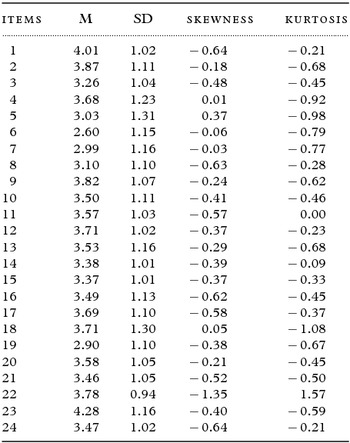
Table 1 shows the descriptive statistics for the TMMS-24 scores (mean, standard deviation, skewness, and kurtosis). The highest mean score was for item 23 (M = 4.28; SD = 1.16) “I have a lot of energy when I'm happy,” whereas the lowest was for item 6 (M = 2.60; SD = 1.15) “I think about my mood constantly.” Item 22, “I worry about being in too good a mood,” had values of skewness and kurtosis outside the −1 to 1 range.
Descriptive statistics for the TMMS-24 items

Evidence of internal structure
Based on the Salovey et al. (Reference Salovey, Mayer, Goldman, Turvey, Palfai and Pennebaker1995) original model and guided by previous research on the TMMS-24 dimensionality in the Spanish population (Fernández-Berrocal et al., Reference Fernández-Berrocal, Extremera and Ramos2004), the three-factor structure of the TMMS-24 scale was tested: attention to feelings, clarity of feelings, and repair. This model fitted the data reasonably well: CFI = 0.882, TLI = 0.870, RMSEA = 0.061, 90% CI [0.052, 0.070], SRMR = 0.079, although the CFI and TLI values were slightly lower than recommended. A review of the modification indices (MIs) revealed two residual covariances that showed the largest values: one between items 1 (I pay a lot of attention to my feelings) and 2 (I usually care a lot about what I'm feeling), and the other between items 6 (I think about my mood constantly) and 7 (I often think about my feelings); both pairs of items belonged to the attention factor. Such covariances can result from overlapping item content (Byrne, Reference Byrne2012), which appears to be the case here. Thus, a second three-factor model was specified in which these two parameters were freely estimated. Fit indices for this model were as follows: CFI = 0.914, TLI = 0.904, RMSEA = 0.053, 90% CI [0.043, 0.062], SRMR = 0.077, showing an improvement in model fit.
Reliability estimation of the TMMS-24 scores
Cronbach's α coefficient for the total score on the TMMS-24 scale was 0.90, for both the attention and clarity dimensions, 0.85, and for the mood repair dimension, 0.84. Discrimination indices for each subscale individually and for the total score were all higher than 0.30.
Mediation analysis
Preliminary analysis
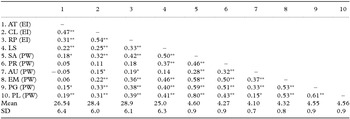
Table 2 shows the descriptive statistics (mean and standard deviation) and correlations among the study variables. As the table shows, most variables were significantly and positively associated. However, some exceptions were found: Positive relations with others (psychological well-being) was not associated with any of the three EI dimensions and attention (EI) was not related to environmental mastery or autonomy, both from the psychological well-being domain. The largest associations were between five of the six psychological well-being dimensions (autonomy was the only exception), and between these five dimensions and life satisfaction, with all Pearson correlation values greater than 0.37. The correlations between the three EI dimensions ranged from 0.31 (attention–repair) to 0.54 (clarity–repair). The association between life satisfaction and the three EI dimensions were smaller, ranging from 0.22 (life satisfaction–attention) to 0.33 (life satisfaction–mood repair).
Correlations, means, and standard deviations of SEM variables

Note: AT (EI): Attention (Emotional Intelligence); CL: Clarity; RP: Repair; LS: Life satisfaction; SA (PW): Self-acceptance (Psychological well-being); PR: Positive relations with others; AU: Autonomy; EM: Environmental mastery; PG: Personal growth; PL: Purpose in life. *p < 0.01; **p < 0.001.
Mediation model
SEM was conducted to test the indirect effects of EI on psychological well-being through life satisfaction. Thus, the tested structural model comprised three factors, one observable variable (life satisfaction, consisting of a single indicator) and two latent factors: EI and psychological well-being. EI had three indicators: attention, clarity, and repair; and psychological well-being had six indicators: self-acceptance, positive relations with others, autonomy, environmental mastery, personal growth, and purpose in life. The fit indices for the structural model indicate a reasonable model fit: CFI = 0.927, TLI = 0.900, RMSEA = 0.081, 90% CI [0.055, 0.107], SRMR = 0.062, with the RMSEA value slightly higher than recommended.
Based on previous studies on the internal structure of Ryff's scales of psychological well-being (Springer and Hauser, Reference Springer and Hauser2006; Tomás et al., Reference Tomás, Sancho, Melendez and Mayordomo2012), which found a better fit of the four-factor model than the original six-factor model (Ryff, Reference Ryff1989), we tested another structural model without two of the six indicators of psychological well-being: autonomy and positive relations with others. The fit indices for this structural model revealed an improvement in the model fit: CFI = 0.967, TLI = 0.949, RMSEA = 0.066, 90% CI [0.043, 0.082], SRMR = 0.050. In addition, the AIC value was also lower for this model than for the previous one (5933.75 vs. 6784.46, respectively), indicating the superiority of the structural model with four factors of psychological well-being. Figure 1 shows this estimated structural model with the standardized coefficients. This model explained 45.7% of the variance in psychological well-being.
Structural equation model. Values are standardized coefficients. AT: Attention; CL: Clarity; MR: Mood repair; EI: Emotional Intelligence; LS: Life satisfaction; PW: Psychological well-being; SA: Self-acceptance; EM: Environmental mastery; PG: Personal growth; PL: Purpose in life. *p < 0.01; **p < 0.001.

In this structural model, EI had a significant, positive, and direct relationship with life satisfaction (β = 0.337; p = 0.001) and psychological well-being (β = 0.431; p < 0.001). The indirect effect of EI on psychological well-being through life satisfaction turned out to be positive and significant (β = 0.133; p = 0.001). Thus, we can say that part of the total effect of EI on psychological well-being was mediated by life satisfaction, although the existing direct and significant relationship between EI and psychological well-being suggests only partial mediation.
Discussion
This study aims to confirm the factorial structure of the TMMS-24 through CFA, and develop a model of the relationship between EI and well-being in older adults. The CFAs confirmed the three-factor structure obtained in previous research on TMMS-24 dimensionality (Salovey et al., Reference Salovey, Mayer, Goldman, Turvey, Palfai and Pennebaker1995; Fernández-Berrocal et al., Reference Fernández-Berrocal, Extremera and Ramos2004). Moreover, the proposed prediction model obtained adequate fit indices; when evaluating the model, a direct effect of EI on PWB was observed, as well as an indirect effect mediated by life satisfaction. The clarity and repair dimensions showed the greatest weight.
The first goal of this study was to analyze the internal structure of the TMMS-24 in an elderly Spanish sample to contribute to a better understanding of the nature of the EI construct using the TMMS-24. With this end in mind, we examined the three-factor model proposed in the original instrument (Salovey et al., Reference Salovey, Mayer, Goldman, Turvey, Palfai and Pennebaker1995) and in the Spanish version used here (Fernández-Berrocal et al., Reference Fernández-Berrocal, Extremera and Ramos2004). The results confirmed the three-factor structure, especially when two residual covariances between two pair of items that loaded in the attention to feelings dimension were freed up. These covariances can be due to content similarities in these item pairs (Byrne, Reference Byrne2012). In addition, the three-factor structure had acceptable psychometric properties in the sample, with acceptable to good scale-score reliability and adequate construct validity, revealed by the correlations among the three dimensions. The reliability coefficients obtained in our elderly sample were similar those from previous studies (Extremera et al., Reference Extremera, Fernández-Berrocal and Salovey2006), where dimensions of emotion attention and emotion repair displayed the highest and lowest coefficients, respectively. Together, these results provide support for the TMMS-24 as a valid and reliable measure for use in elderly samples.
The study of EI during aging is relevant because age has been shown to be a modulator variable of this construct (Carstensen et al., Reference Carstensen2011; Hay and Diehl, Reference Hay and Diehl2011), providing strategies for adaptation to this process. The second aim of our study was to use SEM to examine the mediating role of life satisfaction in the relationship between EI and PWB. Regarding the structural model, the latent variable EI is explained by the three proposed constructs, attention, clarity, and repair, with a moderate relationship in the case of the attention to emotions dimension and higher levels in the clarity and emotional repair dimensions. Individuals who can clearly perceive their feelings and believe they can repair negative mood states may turn their attentional resources toward coping and minimizing the impact of stressful events (Salovey et al., Reference Salovey, Stroud, Woolery and Epel2002). Aging is a process in which important changes occur in different areas of development. Individuals who are able to identify and interpret emotional signals and regulate their actions independently may foster positive affect, avoid negative affect, and experience a sense of satisfaction with their lives (Mayer and Salovey, Reference Mayer, Salovey, Salovey and Sluyter1997).
Theory suggests that emotionally intelligent individuals are likely to experience a higher level of well-being and a lower level of emotional impairment than those with a low level of EI (Carmeli et al., Reference Carmeli, Yitzhak-Halevy and Weisberg2009). As in previous studies (Carmeli et al., Reference Carmeli, Yitzhak-Halevy and Weisberg2009), the results point out that the relationship between EI and PWB is mediated by different psychological variables, such as life satisfaction. Palomera and Brackett (Reference Palomera and Brackett2006) found that life satisfaction is positively related to emotional clarity (r = 0.29) and emotion repair (r = 0.25). Sánchez-Álvarez et al., (Reference Sánchez-Álvarez, Extremera and Fernández-Berrocal2015) showed that clarity and repair were positively correlated with life satisfaction, indicating that high PEI tends to result in more positive experiences and fewer negative experiences. EI can be a necessary prior condition for adaptive control of the emotions and mood and, therefore, a determinant in life satisfaction (Salovey et al., Reference Salovey, Mayer, Goldman, Turvey, Palfai and Pennebaker1995), especially in the case of the clarity. This dimension would possibly explain the absence of ruminative processes, thus facilitating fluid thinking and adaptive action. In this regard, it could also serve as a protective factor against different emotional disorders, such as depression (Lloyd et al., Reference Lloyd, Malek-Ahmadi, Barclay, Fernandez and Chartrand2012).
With regard to the relationship between life satisfaction and PWB, various studies point out the predictive nature of life satisfaction (Meléndez et al., Reference Meléndez, Tomás, Oliver and Navarro2009). The results indicate that the level of life satisfaction will considerably influence the process and achievement of the values that make the person feel alive and authentic, that is, PWB.
Finally, the direct relationship between EI and PWB has been observed in previous studies (Carmeli et al., Reference Carmeli, Yitzhak-Halevy and Weisberg2009) where EI skills predict the level of PWB. Of the four dimensions of PWB selected in the final model, environmental mastery presented the least explanatory weight. This dimension tends to show a decline during old age (Meléndez et al., Reference Meléndez, Tomás, Oliver and Navarro2009), as it has to do with the effective use of opportunities creating adapted contexts, and aging is characterized precisely by difficulty in controlling certain situations. However, through EI, the person could adopt accommodating strategies to deal with these situations, by modifying their objectives or establishing alternative comparison parameters to evaluate their current situation. The skills of clarity and emotion repair would not only foster the necessary psychological state to face these circumstances, but they would also make it possible to manage all the emotions and feelings that can appear in critical situations and interfere with efficacious coping.
As possible limitations of the study, we should mention that it is a cross-sectional study that only considers the characteristics of a certain population, people over 60 years old; future studies should implement experimental designs and collect data longitudinally to further explore the relationship between EI and life satisfaction. The sample is mostly made up of women, although the statistics reveal that there is enough homogeneity in the variances to be able to carry out the analyses. In addition, because the work is limited to a convenient Spanish sample, we cannot establish comparisons with other races or cultures. Furthermore, the study did not consider the possible intervention of other related variables, such as depression physical health, or social isolation, among others. Further studies should mainly consider two aspects: on the one hand, they should examine the relationship between EI and depression. For instance, previous studies have shown that older adults with higher levels of IE may have a reduced risk for depression (e.g. Lloyd et al., Reference Lloyd, Malek-Ahmadi, Barclay, Fernandez and Chartrand2012). On the other hand, given the importance of emotional competencies in social interaction, future studies should also explore the relationship between EI and other variables such as social support and social isolation (Lopes et al. Reference Lopes, Brackett, Nezlek, Schütz, Sellin and Salovey2004). In addition, it would be interesting to investigate the role of physical health on these relationships. Future studies should consider these variables and also perform a more in-depth study of the possible overlap between PWB and life satisfaction.
Despite its limitations, we believe the present study provides important insights into the links between EI, PWB, and life satisfaction in older adults. Taking into account the importance of EI in older adults in aspects as relevant as life satisfaction and PWB, it is necessary to design and test interventions to develop this skill, as it shows its potential for fostering mental health. Furthermore, it should be kept in mind that the study of this construct during aging has not acquired the role it should have, as it has been addressed especially in adolescents and young people. Therefore, as future lines of research, we propose more in-depth study of EI during aging in order to create and implement interventions to develop it.
Conflict of interest
None.
Description of authors’ roles
Margarita Gutierrez and Iraida Delhom were responsible for the assessment and data collection. Juan C. Melendez and Beatriz Lucas were responsible for the statistical analyses performed. Finally, all four authors contributed to the writing and revising of the paper.