Introduction
Swede midge, Contarinia nasturtii Kieffer (Diptera: Cecidomyiidae), is an invasive alien insect of Eurasian origin that was first identified in North America from Ontario, Canada Brassicaceae vegetable fields in 2000 (Hallett and Heal Reference Hallett and Heal2001). Swede midge injury to canola crops (Brassica napus Linnaeus, B. rapa Linnaeus, and B. juncea (Linnaeus) Czernajew) was first recognised as such in Ontario in 2005 (Canadian Food Inspection Agency 2009). It is now severe enough in some northern agricultural regions of Ontario to warrant an industry-initiated recommendation to cease canola production in these regions for three years (Phillips Reference Phillips2015). Adult swede midge males were first found in western Canada in in low numbers in sex pheromone traps at three sites in Saskatchewan, Canada in 2007 (Canadian Food Inspection Agency 2008). Populations in the region were assumed to be low at that time, given that no midges were recovered from a network of sex pheromone traps operated at two locations in northeastern Saskatchewan from 2006 to 2011 (J.S., unpublished data). Midge-like injury was first seen in multiple canola fields in north eastern Saskatchewan in 2012 (W. Annand, Ag Grow Consulting, Nipawin, Saskatchewan, Canada, personal communication). The possible economic impact of the pest on canola production has become of great concern to the eight million hectare, multi-billion Canadian canola industry, which is concentrated in the prairie provinces (Canola Council of Canada 2017).
The natural history of swede midge has been described by a number of authors. Swede midge overwinter as larvae in cocoons in the soil. With warming spring temperatures and increased soil moisture, larvae rise in the soil profile and pupate near the soil surface (Readshaw Reference Readshaw1966). In response to favourable ambient moisture levels, adult flies emerge from the soil and mate. Female midge search for suitable host plants (Yukawa and Rohfritsch Reference Yukawa and Rohfritsch2005), and lay eggs in contact with meristematic plant tissue such as vegetative apical meristems or young buds, which become misshapen as the larvae feed (Barnes Reference Barnes1950). After developing through three instars, larvae drop down to the soil and construct cocoons from which adults will emerge in the current summer. Conversely, larvae may remain in cocoons to overwinter, a situation more common with season progression or with relatively lower soil moisture or temperature (Readshaw Reference Readshaw1966). In Ontario, the first swede midge adults emerge in late May or early June, with a delayed phenotype of this overwintering generation emerging two to several weeks later; three to four overlapping generations develop within a season, and the last adult flight occurs in late September to early October (Hallett et al. Reference Hallett, Goodfellow and Heal2007, Reference Hallett, Goodfellow, Weiss and Olfert2009).
While most cecidomyiids are monophagous or narrowly oligophagous in nature (Carneiro et al. Reference Carneiro, Branco, Braga, Almada, Costa, Maia and Fernandes2009), C. nasturtii has a relatively broad range of host plants in the family Brassicaceae. Since first described by Kieffer (Reference Kieffer1888) as feeding on Nasturtium palustre de Candolle (=Rorippa islandica (Oeder ex Murray) Borbás), over 40 different taxa of Brassicaceae have proved to be suitable hosts for the midge, including many cruciferous vegetables, field crops, and weeds (Dry Reference Dry1915; Barnes Reference Barnes1946, Reference Barnes1950; Stokes Reference Stokes1953a, Reference Stokes1953b; Hallett Reference Hallett2007; Chen et al. Reference Chen, Shelton, Wang, Hoepting, Kain and Brainard2009). This host range includes virtually all lines of cultivated Brassica species evaluated, although different susceptibilities have been found in cultivars of crops such as broccoli (Hallett Reference Hallett2007). Conversely, several common brassicaeous weed species, while selected for oviposition by swede midge females, appear to be less suitable for larval development than cauliflower (Chen et al. Reference Chen, Shelton, Wang, Hoepting, Kain and Brainard2009). Thus, a determination and understanding of the resistance of brassicaceous species to C. nasturtii could aid in our breeding efforts in crop resistance to the pest.
New information has revealed the presence of an unidentified congeneric species co-occurring with swede midge in Saskatchewan canola (B. Sinclair, Canadian Food Inspection Agency, Ottawa, Ontario, Canada, personal communication). Male midge from our laboratory colony, which originated from larvae obtained from canola flowers near Carrot River, Saskatchewan in 2013, were positively identified as swede midge C. nasturtii (B. Sinclair, personal communication). However, the occurrence of very low numbers of swede midge adult males in a network of pheromone traps across the three prairie provinces from 2013 onward, concurrent with the more frequent detection of midge larvae and distinctive injury in canola fields in recent years, led to the re-evaluation of the identification of the midge (B. Mori, Saskatoon Research Centre, Agriculture and Agri-Food Canada, Saskatoon, Saskatchewan, Canada, personal communication). The result was the determination of a second, closely related but as yet undescribed Contarinia Róndani occurring in canola that is not attracted to the swede midge pheromone lure. The natural history of the new midge and the proportion of the two midge species in canola fields in the region are presently under investigation.
Management of the midge complex affecting canola production in western Canada could be difficult. Both swede midge and its undescribed congener appear to be multigenerational, allowing for rapid population growth. Determination of population densities is difficult because adults live for a very short time and the larvae are cryptic, either hidden within the plant or in the soil. Further, canola is susceptible to midge injury for an extended period of time, biological control agents of swede midge are uncommon and do not control the pest in eastern Canada, and chemical control may not be consistently effective (Hallett Reference Hallett2017). Swede midge attacks a range of plant species with different levels of resistance. Host plant resistance could become a valuable component of midge management in canola, but nothing is known about preferences of the swede midge or the new midge species to Brassicaceae in western Canada. The objective of the current investigation was to determine the resistance to midge injury of a range of lines and species of Brassicaceae grown in the field in northeastern Saskatchewan, for potential future use in breeding and integrated pest management programmes for the insects.
Materials and methods
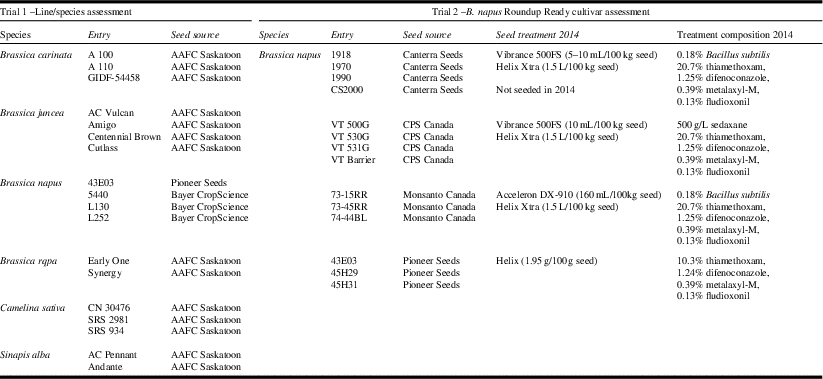
Two field trials were established in 2014 and 2015 at Agriculture and Agri-Food Canada Melfort Research Farm (52°49'N, 104°36'W, dark grey chernozemic soil) in northeastern Saskatchewan, the area on the Prairies currently with the highest incidence of midges (J.S., unpublished data), to assess the resistance of various Brassicaceae to Contarinia midge complex injury in the field. Plots were seeded on canola stubble on the south side of a mature Manitoba maple (Acer negundo Linnaeus; Sapindaceae) shelterbelt in an area where injury by Contarinia midge complex was seen in 2013. The trials were seeded on 21 May 2014 and 14 May 2015, in four replicates of four-row plots, 6.1 m in length with 0.30 m row spacings and 200 seeds per row, using a randomised complete block design. Trial 1 assessed growth stage of and midge injury to 18 lines in six brassicaceous species: three Ethiopian mustard Brassica carinata Braun lines, four Oriental or brown mustard B. juncea lines, four Argentine canola B. napus lines, one of which had Roundup Ready (Monsanto, St. Louis, Missouri, United States of America) herbicide technology and three had Liberty Link (Bayer, Langenfeld, Germany) herbicide technology, two Polish canola B. rapa lines, three camelina Camelina sativa (Linnaeus) Crantz lines, and two yellow mustard Sinapis alba Linnaeus lines (Table 1). For seedling control of flea beetles (Coleoptera: Chrysomelidae), all seed in this experiment was treated with Helix (Syngenta, Guelph, Ontario, Canada) (10.3% thiamethoxam, 1.24% difenoconazole, 0.39% metalaxyl-M, 0.13% fludioxonil) in 2014 and Helix Xtra (20.7% thiamethoxam, 1.25% difenoconazole, 0.39% metalaxyl-M, 0.13% fludioxonil) in 2015, both at 1.5 L/100 kg seed. Trial 1 was entirely hand-weeded.
Lines of six brassicaceous species evaluated for damage by swede midge complex (Contarinia species) in two experiments at Melfort Research Farm, Melfort, Saskatchewan in 2014–2015.

AAFC, Agriculture and Agri-Food Canada.
Trial 2 consisted of an assessment of midge injury to 13 contemporary cultivars of Roundup Ready B. napus canola, one of which was also assessed in the brassicaceous species trial. In 2014 the seed of these cultivars had various seed coatings for early season flea beetle control depending on the seed source (Table 1), but the insecticide component of all lines was thiamethoxam. In 2015 all seed was treated with thiamethoxam as Helix Xtra, and a 14th entry, CS2000 from Canterra Seeds, was added to the trial. Trial 2 was sprayed with Roundup herbicide post-emergence for weed control and also was hand-weeded as necessary.
Midge monitoring
Four white Jackson traps housing swede midge pheromone lures (PheroNet, Distributions Solida, Saint-Ferreol-les-Neiges, Québec, Canada) were set 50 m apart in an east-west line along the shelterbelt, about 5 m north of the first replicate of plots, and suspended 20 cm above the soil surface. The sticky trap liners were replaced weekly, and the pheromone lures were changed every four weeks. In 2014, the traps were deployed on 21 May and removed on 18 September. In 2015, the traps were deployed 6 May and removed 28 August. Further, four emergence cages (BugDorm, Taichung, Taiwan), with a base of 60×60 cm, were dug into the soil of nearby canola stubble on 21 May 2014 and 6 May 2015. On 30 July 2014 and 22 July 2015, four more emergence traps were put in place within a stand of canola (B. napus cultivar 45H29) seeded next to the species trial. In each year, two of the four cages deployed in May had white Jackson traps with swede midge pheromone lures inside, as did two of the cages deployed in July. The contents of a collection jar at the top of each cage along with the Jackson trap sticky liners were replaced weekly for processing in the laboratory.
Damage assessment
Plant density in both trials was assessed by counting plant numbers per randomly selected 6.1-m middle row about two weeks after seeding. Plant growth stage was determined at all assessments of midge injury by rating 10 consecutive seedlings in a randomly selected area in one of the two centre rows of each plot, according to the canola growth rating system of Harper and Berkenkamp (Reference Harper and Berkenkamp1975).
Starting on 4 July in 2014, 25 June in 2015, and weekly thereafter until and including the first week in August, 10 randomly selected plants in one of the middle two rows of each plot were assessed for swede midge-complex injury on a scale from 0 to 3, which was adapted slightly from that developed for assessing C. nasturtii injury to canola in Ontario (Williams and Hallett Reference Williams and Hallett2017). The injury scale used depended on the canola growth stage of the plant assessed. Up to vegetative growth stage 3.3 (Harper and Berkenkamp Reference Harper and Berkenkamp1975), plants received a single rating per assessment date using the following ratings:
0=no damage;
1=mild twisting of foliage or slight crumpling of leaves, or up to 1/3 of buds on primary raceme misshaped, small, not developing normally;
2=severe twisting and/or crumpling of leaves, or more than 1/3 of buds on primary raceme misshaped, small, developing abnormally;
3=death of meristem; including bud clusters that were initiated but did not develop; swelling of buds, rot of bud cluster, bouquet of leaves but no elongation of stem.
For reproductive stages 4 and 5 the ratings of the primary raceme were:
0=no damage; including racemes in which stem is elongate with flower stalks, even if no flowers are left and no pods have formed;
1=stem of raceme may be slightly twisted, but still elongate; up to 1/3 of flowers fused; or, up to 1/3 of buds swollen and closed;
2=either (i) stem of raceme slightly twisted but still elongate; more than 1/3 of flowers fused; or, more than 1/3 of buds swollen and closed; or, (ii) distorted pod bunches – i.e., stem not elongate, pods in a bunch on a short length of stem (palm tree or umbrella effect);
3=death of meristem; including bud clusters that were initiated but did not develop; swelling of buds, rot of bud cluster, bouquet of leaves, no elongation of stem, no signs of flowers opening, no pod formation.
Ratings of secondary and tertiary racemes were based on amount of racemes injured and the level of injury as described for the primary raceme:
A=all ratings are 0;
B=⩽50% of racemes are damaged;
C=>50% of racemes are damaged; level 1 or 2 most common;
D=>50% of racemes are damaged; level 3 is most common.
Statistical analyses
Plant density per row data were analysed using the generalised linear mixed model of SAS (SAS Institute 2010), with plant lines and species as fixed effects. When significant differences were found among lines at P⩽0.05, Tukey’s studentised range test was used to distinguish among means (SAS Institute 2010). Plant growth stage and midge injury responses have multiple ordered response categories, and were analysed using PROC GLIMMIX (SAS Institute 2010) multinomial cumulative logistic regression analysis to predict the log odds of each category. Log odds were then converted to probabilities to allow for determination of the rate at which midge injury to the primary raceme accumulated. Where treatment effects were statistically significant, treatment mean pairs were compared using P⩽|t| values of ESTIMATE statements (SAS Institute 2010). Feeding damage on secondary racemes was rated as present or absent, a dichotomous response variable, with the counts of yes responses having a negative binomial distribution. Such damage was analysed with PROC LOGISTIC logistic regression analysis (SAS Institute 2010), using the events/trials syntax, with the Williams option to correct for overdispersion where poor model fit warranted (SAS Institute 2010).
Results
Insect monitoring
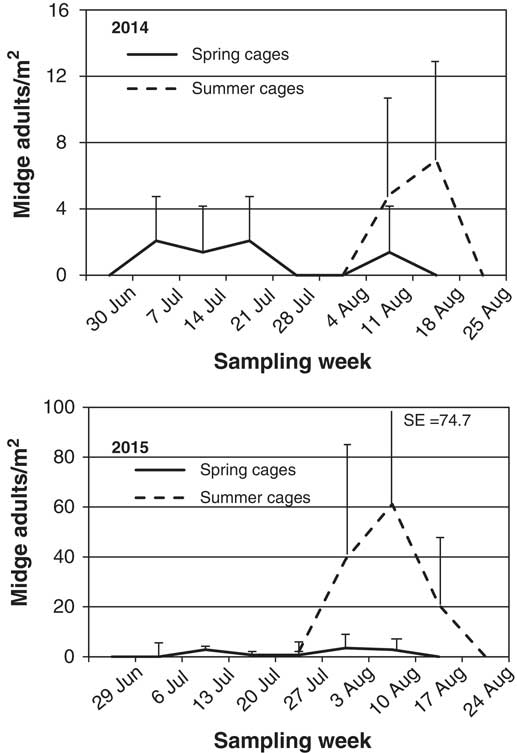
In the four Jackson traps baited with swede midge pheromone set alongside the Manitoba maple shelterbelt, three male Contarinia species midges were caught in 2014: one on the traps examined on 4 July, and two on the traps examined on 10 July. Five Contarinia males were captured in 2015: three on 9 July; one on 23 July; and one on 1 August. In 2014 Contarinia midge adults were first found in the collection bottles of emergence cages in the week of 7 July, one week earlier than in 2015 (Fig. 1 presents catch numbers standardised per unit area). In both years there was evidence of a second generation, with emergence beginning around 3–4 August, peaking about 10 days later, and ceasing by 10 days after that (Fig. 1). Total numbers of Contarinia midges collected in spring emergence cages were 13 in 2014 and 15 in 2015; total numbers collected in summer emergence cages were 17 in 2014 and 177 in 2015. There were no male Contarinia midges found on the pheromone traps within the emergence cages at Melfort in 2014. One male Contarinia midge was caught on a pheromone trap in a summer cage on 31 July 2015.
Number of Contarinia midges (mean+standard error) collected from four emergence cages placed on canola stubble in spring and solid-seeded canola in summer near Melfort, Saskatchewan in 2014 and 2015. SE, standard error.

Trial 1: six species comparison
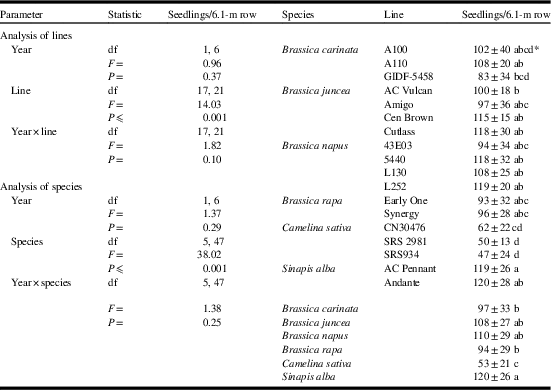
Plant density was similar between years and year by line interactions were not significant; therefore, density data were combined over years. Within plots, all lines and species except C. sativa had approximately similar plant counts (Table 2); all C. sativa lines had about half the number of plants as the other species. Small seed size and dry surface soil moisture conditions decreased germination of this species.
Analysis of variance statistics and mean plant density±standard error of 18 lines in six species of Brassicaceae grown at Melfort, Saskatchewan, combined over years 2014 and 2015.
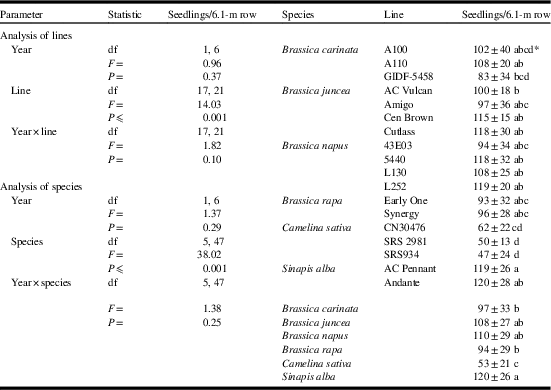
* Means within the column followed by the same letters do not differ significantly at P⩽0.05, Tukey’s studentised range test.
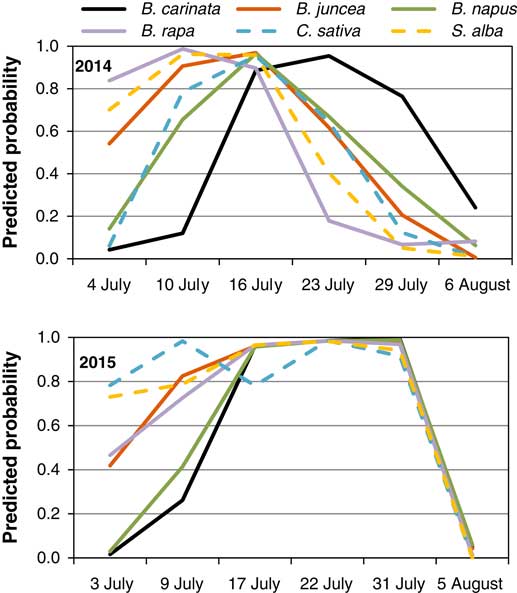
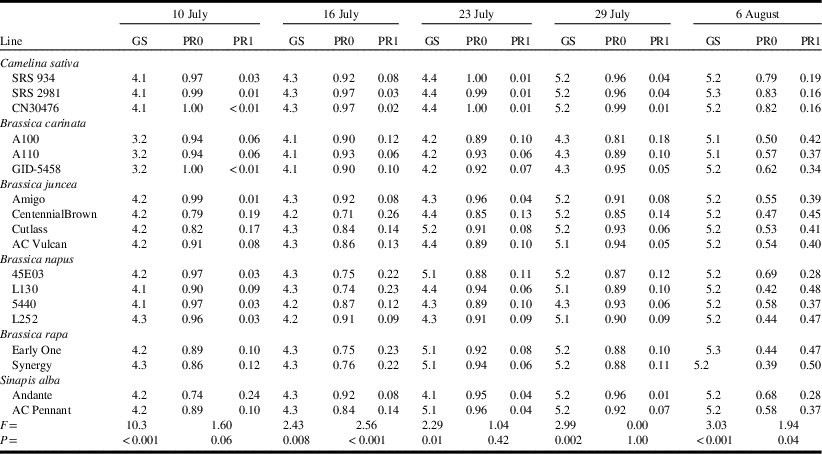
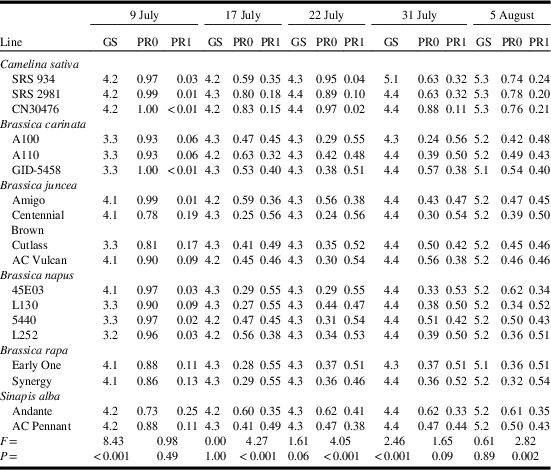
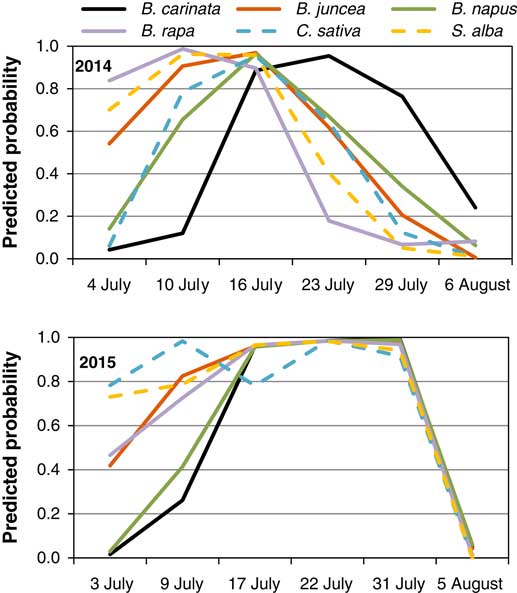
Plant growth stage among lines and species varied at each sampling date in 2014 (Table 3) (3.47⩽F⩽33.4, 0.001⩽P⩽0.02 for species), and three assessment dates, 3, 9, and 31 July, in 2015 (Table 4) (0.90⩽F⩽21.1, 0.001⩽P⩽1.00 for species). Probability curves indicated that B. carinata lines were the slowest to mature, and flowered last in both years (Fig. 2). In 2014 B. rapa and S. alba cultivars consistently were the fastest growing species throughout the six-week sampling period, while in 2015 lines of S. alba and C. sativa matured faster than other species in early July (Fig. 2).
Mean predicted probability of attaining flowering, growth stage 4, in six species of Brassicaceae on six sampling dates at Melfort, Saskatchewan, 2014 and 2015, derived from logistic regression models.
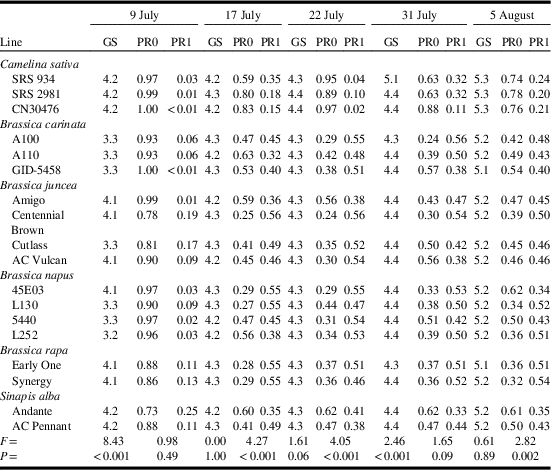
Median growth stage (GS) of 18 lines of six species in the family Brassicaceae, and injury ratings of 0 (PR0): no feeding, and 1(PR1): up to one-third of buds and flowers affected, by Contarinia midge complex to primary racemes on five sampling dates at Melfort, Saskatchewan, 2014, derived from logistic regression models.

Median growth stage (GS) of 18 lines of six species in the family Brassicaceae, and injury ratings of 0 (PR0): no feeding, and 1 (PR1): up to one-third of buds and flowers affected, by Contarinia midge complex to primary racemes on five sampling dates at Melfort, Saskatchewan, 2015, derived from logistic regression models.
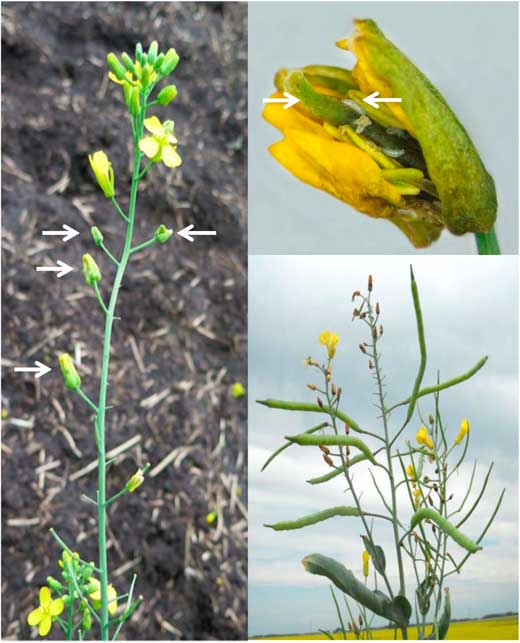
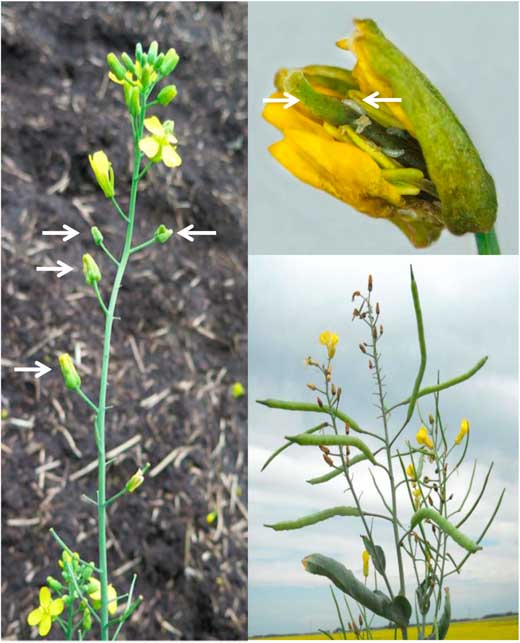
The level of damage to plants varied with plant growth stage. Vegetative injury from midge feeding was uncommon, with very few plants per season exhibiting crumpled, twisted, or improperly expanded leaves. Therefore, we recorded but did not analyse vegetative injury. On the other hand, many plants exhibited injured buds and flowers, and when these were opened, some contained tiny yellow cecidomyiid larvae. Small brown necrotic feeding spots remained on the pistil after the larvae left the plant, distinguishing injury due to Contarinia midge from that caused by thrips (Thysanoptera) to buds and flowers. The most common and easily recognisable symptom was fused flowers or “bell-flowers” as described by Stokes (Reference Stokes1953a), wherein the flower bud remained closed and swollen to form a gall, then subsequently dried up but remained attached to the raceme (Fig. 3). Although bell-flowers were readily found, in general their frequencies per plant were not high, and damage ratings uncommonly exceeded 1 on primary racemes in either year.
Symptoms of injury by Contarinia midge complex to canola flowers in northeastern Saskatchewan. Left: left side of raceme has three bell-shaped fused flowers with larvae inside (arrows); right side has flower gall initiated but not completed (photograph: L. Andreassen). Top right: fused flower opened to show midge larvae, and brown feeding scars on pistil (photograph: L. Grenkow). Bottom right: dry fused flowers with larvae no longer present (photograph: O. Olfert).
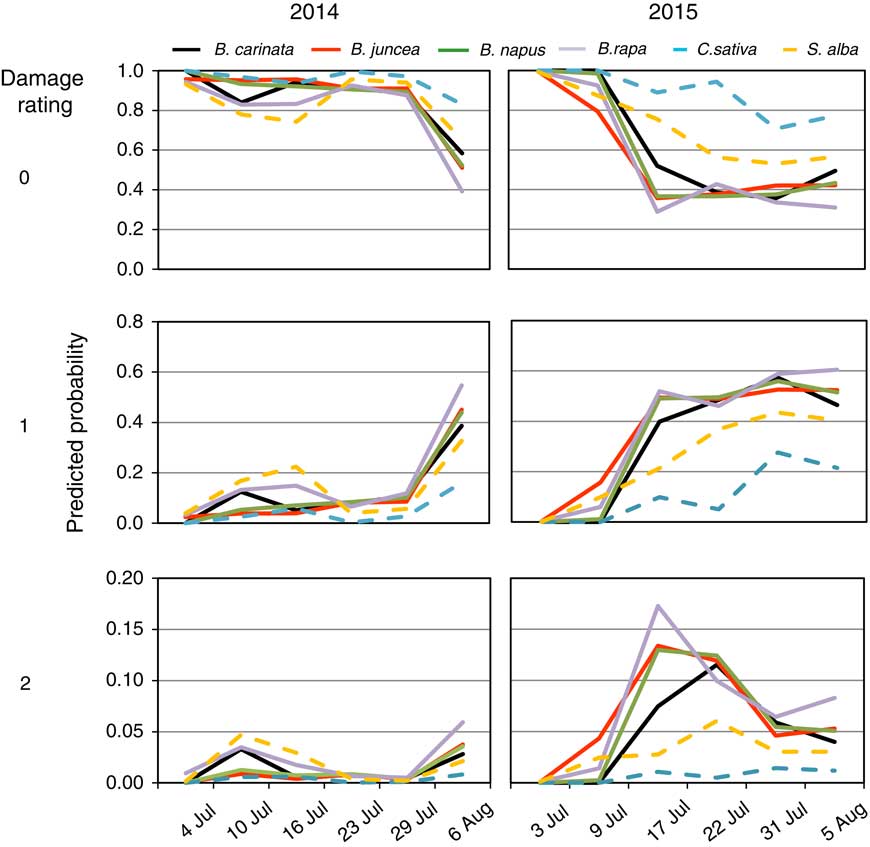
Although midge infestations were low, significant differences were found in damage among brassicaceous lines and species. Injury from midges was not found on any entries before the first week in July in either year. On 4 July 2014, slight injury was seen on three plants of the B. juncea line Cutlass, two plants of B. rapa line Early One and one plant of Synergy, and four plants of the S. alba line AC Pennant. On 3 July 2015, one plant of the B. juncea line Centennial Brown exhibited level 1 midge injury on the primary raceme. On subsequent sampling dates in both years significant differences were found in midge injury to the primary raceme of lines and species. No fused flowers containing midge larvae were found on any C. sativa plants, while all of the other species were observed with midge larvae in flower galls. All three C. sativa lines had the lowest predicted probability levels of midge injury in both years, while the two S. alba lines had consistently lower levels of injury than the Brassica lines in 2015 (Tables 3–4). Levels of feeding within and among Brassica lines were variable. When data were combined over species and years, significant differences in probability of damage to primary racemes among species occurred on each of the last four sampling dates (F=2.68, 10.11, 10.59, and 4.62, and P=0.05, <0.001, <0.001, and 0.003 for sampling dates 3–6, respectively). The pattern of feeding injury among species was consistent between years: C. sativa had injury levels significantly lower than any of the brassicaceous species, followed by S. alba, which had feeding injury lower than up to three of the Brassica species, depending on sampling date, with all four of the Brassica species having similar levels of midge injury on all sampling dates (Fig. 4).
Mean predicted probability of injury by Contarinia midge complex to primary racemes of six species of Brassicaceae at Melfort, Saskatchewan, 2014 and 2015, derived from logistic regression models. Damage rating 0: no damage, to 2: more than 1/3 of reproductive structures attacked.
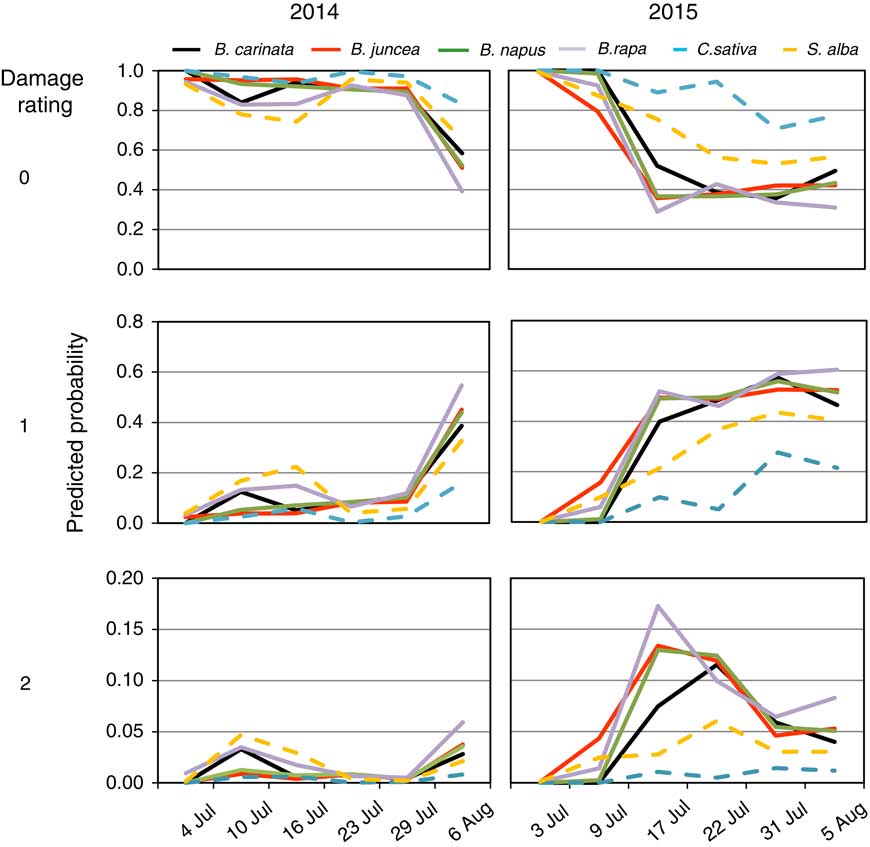
More plants with primary raceme damage levels greater than 1 were found in 2015 than in 2014 (Fig. 4). The patterns of probability of greater damage were similar to those seen for damage rating 1, with very few C. sativa and a few S. alba plants displaying damage ratings of two or more (Fig. 4).
There were significant differences between years in the pattern of midge injury to primary racemes of both lines and species for the 16–17 July, 22–23 July, and 5–6 August sampling periods (6.45⩽F⩽12.8, 0.001⩽P⩽0.01 for lines, and 6.25⩽F⩽289, 0.01⩽P⩽0.001 for species). There was no significant line×year interaction for 22–23 July, and no significant species×year interactions for the last two sampling periods. Injury reached peak levels earlier in 2015 than in 2014; the highest probability of injury occurred on the last sampling period in 2014, 6 August, when most plants were approaching ripening. In 2015, on the other hand, the greatest change in probability of midge injury occurred on 17 July, when most plants were flowering (Fig. 4; Tables 3–4).
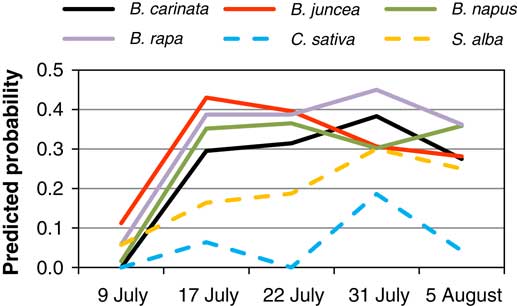
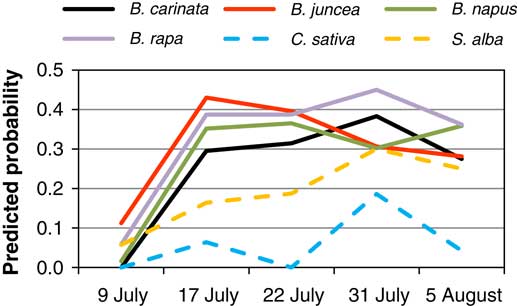
As with primary racemes, injury to secondary racemes was greater in 2015 than 2014. There were no differences among species in the low number of secondary racemes exhibiting midge damage on any date in 2014 (data not presented). Throughout the summer of 2015 fewer secondary racemes of C. sativa received injury from swede midge-complex than any of the four Brassica species, significantly less on 17 July (χ 2=22.3, P⩽0.001) and 5 August (χ 2=22.1, P⩽0.001) (Fig. 5). On 17 July S. alba had fewer secondary racemes with swede midge-complex damage than B. juncea, B. rapa, or B. napus, but similar numbers as B. carinata and C. sativa. On 5 August the levels of damage to secondary racemes of S. alba were the same as those on all Brassica species, higher than on C. sativa (Fig. 5).
Mean predicted probability of injury by Contarinia midge complex to secondary racemes of six species of Brassicaceae at Melfort, Saskatchewan, 2015, derived from logistic regression models.
Trial 2: comparison of Brassica napus cultivars
Differences among the 14 cultivars evaluated in the B. napus trial were not statistically significant for most parameters tested. There were no differences among cultivars in seedling plant count in either year, or in years combined (Supplementary Material Table 1). There were significant differences in growth stage among B. napus cultivars when the first midge injury was noted on 4 July 2014 (F=3.6, P=0.002) and on two other dates in 2014 and one date in 2015 (Supplementary Material Tables 2–3). However, there were no differences in level of Contarinia midge injury to the primary raceme of B. napus cultivars as measured by probability of particular damage rating levels on any sampling date within years, between years on specific sampling dates, or on all sampling dates combined over both years (cultivar F=0.92, P=0.53; year F⩽0.01, P=1.00) (Supplementary Material Tables 2–3). There were significant differences between years in the pattern of midge injury on three sampling dates 16–17 July to 29–31 July (F=37.2–85.9, ⩽0.001, P⩽0.002), similar to those seen in Trial 1. In 2014, the greatest probability of injury for most cultivars occurred in the 29 July to 6 August samplings, while in 2015 the dates were 17–22 July.
Discussion
This investigation is the first to examine host plant resistance to Contarinia midge complex in brassicaceous lines in the field in western Canada. Because the presence of the new species of midge was not detected until after the study was completed and reference specimens were not kept after the first official identification, host resistance determined in this investigation must be considered a response to Contarinia midge complex, rather than to a specific midge species. The low number of male midge collected in the swede midge pheromone traps in contrast with the numbers of midge caught in emergence traps suggests that the proportion of C. nasturtii was considerably lower than that of the new species in the area. Both the phenology and morphology of the two species appear to be very similar. Although collection of overwintering midges was later in the summer than is usually seen in eastern Canada (Hallett et al. Reference Hallett, Goodfellow and Heal2007, Reference Hallett, Goodfellow, Weiss and Olfert2009), the appearance of two spring emergence peaks is similar to the phenology of swede midge in eastern Canada (Hallett et al. Reference Hallett, Goodfellow, Weiss and Olfert2009). Only one midge generation, however, affected canola production at Melfort in the study period, unlike the situation in eastern Canada. Definitive similarities and differences between the two midge species await further research.
The patterns of resistance of host plants to Contarinia midge complex found in this investigation were similar to ones found for crucifer-feeding flea beetles Phyllotreta Chevrolat (Coleoptera: Chrysomelidae) (Palaniswamy and Lamb Reference Palaniswamy and Lamb1992; Palaniswamy et al. Reference Palaniswamy, Lamb and McVetty1992; Pachagounder et al. Reference Pachagounder, Lamb and Bodnaryk1998; Soroka and Grenkow Reference Soroka and Grenkow2013), wherein lines of C. sativa, and to a lesser extent S. alba, were less injured than B. carinata, B. juncea, B. napus, or B. rapa lines. This similar pattern may be related to the presence or absence of host secondary compounds, especially of glucosinolates and their degradation products. Over 120 glucosinolates, which are secondary anionic thioglucoside compounds with variable side chains (Halkier and Gershenzon Reference Halkier and Gershenzon2006), have been identified from Brassicaceae (Fahey et al. Reference Fahey, Zalcmann and Talalay2001; Berhow et al. Reference Berhow, Polat, Glinski, Glensk, Vaughn and Isbell2013). Glucosinolate composition and concentration vary among different brassicaceous species, within organs, developmental stages, and ages of plants of the same species, with environment, and with biotic and abiotic stresses (Sang et al. Reference Sang, Minchinton, Johnstone and Truscott1984; Brown et al. Reference Brown, Tokuhisa, Reichelt and Gershenzon2003; Bohinc and Trdan Reference Bohinc and Trdan2013; del Carmen Martínez-Ballesta et al. Reference del Carmen Martínez-Ballesta, Moreno and Carvaja2013; Variyar et al. Reference Variyar, Banerjee, Akkarakaran and Suprasanna2014). Glucosinolates and their degradation products can act as allomones that protect crucifers against a wide range of herbivores and insect generalist feeders, or kairomones that stimulate aggregation, feeding, oviposition, and defence for insect specialist feeders (Chew Reference Chew1988; Giamoustaris and Mithen Reference Giamoustaris and Mithen1995; Hopkins et al. Reference Hopkins, van Dam and van Loon2009; Soroka and Grenkow Reference Soroka and Grenkow2013; Soroka et al. Reference Soroka, Olivier, Wist and Grenkow2017).
The glucosinolate composition of C. sativa is relatively unique. It accumulates significant levels of three unique sulfinyl glucosinolates in its seeds (Berhow et al. Reference Berhow, Polat, Glinski, Glensk, Vaughn and Isbell2013 and references therein), but contains very low levels of the glucosinolates typically found in crucifer field crops, including indole and hydroxybutyl glucosinolates that are most common in B. napus (Soroka and Grenkow Reference Soroka and Grenkow2013). It is possible that Contarinia midge complex, like flea beetles (Pachagounder et al. Reference Pachagounder, Lamb and Bodnaryk1998; Henderson et al. Reference Henderson, Hallett and Soroka2004; Onyilagha et al. Reference Onyilagha, Gruber, Hallett, Holowachuk and Soroka2012; Soroka and Grenkow Reference Soroka and Grenkow2013; Soroka et al. Reference Soroka, Olivier, Grenkow and Seguin-Swartz2015), does not recognise C. sativa as a potential host, either because secondary compounds in the plant act as deterrents, or because there are not sufficient positive chemosensory stimuli to initiate oviposition and/or maintain larval feeding on C. sativa.
The location, type, and quantity of secondary compounds in plants play a pivotal role in host determination. Åhman (Reference Åhman1982) found that infestation of the cecidomyiid brassica pod midge Dasineura brassicae Winnertz did not vary between lines of B. napus with high and low levels of glucosinolate in the seed; however, determination of the glucosinolate types or levels in reproductive tissue other than mature seed was not made.
Camelina sativa is listed as a host of C. nasturtii and the cabbage pod midge Dasineura napi (Loew) in Europe (Ellis Reference Ellis2014), but there are few reports of injury by either midge species to the plant. When Hallett (Reference Hallett2007) tested a congeneric species, Camelina microcarpa Andrzejowski ex de Candolle against C. nasturtii in Ontario, this weed exhibited no damage from the midge. Historically, another cecidomyiid pod midge, possibly D. brassicae, was reported infesting about 10% of the pods of Camelina in the district of Tambov, Russia, southeast of Moscow (Rakhmaninov and Vuirzhikovskaya Reference Rakhmaninov and Vuirzhikovskaya1930). While D. brassicae is a serious pest of oilseed rape crops throughout much of Europe (Alford et al. Reference Alford, Nillson and Ulber2003), Andersson and Olsson (Reference Andersson and Olsson1950) found no evidence of Camelina infestation by D. brassicae in Sweden.
Little vegetative infestation by Contarinia midge complex occurred on any of the lines tested in this study, yet attack on vegetative tissues of many hosts by C. nasturtii is common in Ontario (Hallett Reference Hallett2007). Similarly, in the laboratory it is extremely difficult to produce injury to vegetative tissues using colonies of the new Contarinia species, while such developments are relatively common using C. nasturtii (J.S., unpublished data). Different responses by the two midge species to variation in the levels of glucosinolates or other secondary compounds in vegetative and reproductive structures may be one reason for this pattern of feeding.
Other factors that may influence host selection by the Contarinia midge complex could include bud and flower phenology, size, colour, and hairiness. In this study, S. alba and C. sativa lines developed rapidly and flowered over a short period of time in one year or the other, and were damaged to a lesser extent than Brassica lines. However, if length of flowering period is a principal factor in host selection by the midges, differences between infestation of lines of B. rapa, a relatively rapidly growing Brassica, and those of B. carinata, which flowered later and longer, should have occurred, but did not. The multiple generations and very rapid developmental period of the Contarinia midge complex may cause length of flowering period to be a minor component of midge host selection. Many brassicaceous specialist feeders such as flea beetles (Phyllotreta) and pollen beetles, such as Brassicogethes aeneus (Fabricius) (Coleoptera: Nitidulidae), are attracted to the colour yellow (e.g., Vincent and Stewart Reference Vincent and Stewart1986; Giamoustaris and Mithen Reference Giamoustaris and Mithen1996; Demirel and Cranshaw Reference Demirel and Cranshaw2006). The Brassica lines in our trial all had comparatively large yellow flowers, as did the S. alba lines. It remains to be seen if the small white flowers of C. sativa contribute to its antixenosis towards the Contarinia midge complex. Trichomes or plant hairs on young leaves of “hairy” B. napus decrease feeding by flea beetles and diamondback moth Plutella xylostella (Linnaeus) (Lepidoptera: Plutellidae) larvae (Alahakoon et al. Reference Alahakoon, Adamson, Grenkow, Soroka, Bonham-Smith and Gruber2016). Although we did not examine trichomes in the current investigation, their presence on terminal growth and buds could deter Contarinia midge complex oviposition and feeding. Kolesik (Reference Kolesik1993) found that the long trichomes of older lentil (Lens esculenta Moench; Fabaceae) buds obstructed access to the bud tip and deterred oviposition by lentil midge Contarinia lentis Aczel.
There was little relationship between the agronomic traits investigated in this study and the pattern of midge injury noted. Although C. sativa plants had poor germination and low stand densities, some of the Brassica, especially B. carinata, lines also had low stand count, yet did not exhibit decreased midge injury compared to other lines with greater plant counts per row. Sinapis alba lines in both years and C. sativa lines in 2015 grew rapidly, suggesting that this may be a factor in their relatively low injury ratings, but B. rapa lines also grew quickly, yet expressed midge injury levels similar to the other Brassica species. Injury by Contarinia complex midge larvae followed host patterns similar to those of flea beetle defoliation, but there was no indication of a direct relationship between the two insect complexes. This lack of a relationship is not surprising given the considerable length of time between expressions of damage by the two pest groups in the area.
No differences in Contarinia midge complex injury were found among the 14 commercial B. napus cultivars tested in this study. In a preliminary study in Ontario, Hallett (Reference Hallett2017) found differences in susceptibility of B. napus cultivars to C. nasturtii but no strong sources of host plant resistance. Similarly, host plant resistance does not appear to be present for the midge complex on B. napus cultivars or cultivars of other Brassica species commonly grown in western Canada.
This investigation raised more questions than it answered. Foremost, it is necessary to clarify the identity, natural history, and bionomics of the new species of Contarinia in the region and determine its interaction with C. nasturtii. Continued examination of the host range of both species is required to fully evaluate their impact on production of canola in the Canadian prairie provinces. The study serves as a first step in determining the factors influencing host selection by Contarinia midge complex on the prairies.
Acknowledgements
Funding for this project was provided through AIP CL-08 Canola/Flax Agri-Science Cluster agreement between Agriculture and Agri-Food Canada and the Canola Council of Canada, including its member partners Alberta Canola Producers Commission, SaskCanola, and Manitoba Canola Growers Association; the Alberta Crop Industry Development Fund; and the Canola Agronomic Research Program of Canola Council of Canada. The authors thank Bayer CropScience, Canterra Seeds, Crop Production Services Canada, Monsanto Canada, and Pioneer Seeds for donation of seeds for the project. Bradley Sinclair, National Identification Service of Agriculture and Agri-Food Canada, Ottawa; James Heal, University of Guelph; and Boyd Mori, Agriculture and Agri-Food Canada Saskatoon Research and Development Centre, were instrumental in determining that there were two species of Contarinia in the investigation. The authors extend thanks to Cecil Vera and the crew at the Melfort Research Farm, and to their indefatigable summer students for assistance. The authors appreciate the valuable statistical advice of F. Craig Stevenson, and the helpful suggestions of two anonymous reviewers for improvements to the manuscript.
Supplementary material
To view supplementary material for this article, please visit https://doi.org/10.4039/tce.2018.20