Introduction
For the second time in the history of the French Vth Republic, the first
having led to the resignation of Charles De Gaulle in 1969, a president
lost a national referendum1
Opinion polls
foresaw a negative response on the part of the electorate for
the first time in early March and the “no” vote gathered the
majority of the respondents throughout the March–May period
except for a couple of surveys at the end of April.
. On
May 29, 2005, 54.7% of French voters rejected the European
Constitutional Treaty, even though France was one of the major
proponents of the European Convention which led to the Constitution's
drafting. The victory of the “no” vote had been foreseen,
1 but neither the margin of victory, nor the high turnout (almost
70.5%) were expected. The rejection of the Constitution raised two
concerns: the first related to the position of France in Europe, the
second to its domestic impact. Why did the French electorate vote as it
did? Did voters make up their minds based on national cues, the European
issue being generally of little importance even in European elections
(
Franklin, Marsh, and McLaren 1994;
Van der Eijk and Franklin 1996)? Is the
referendum result the consequence of a growing anti-European attitude,
which could cause considerable damage to the process of EU integration?
Will a new cleavage grounded on attitudes to Europe and capable of
altering the traditional left-right organization emerge in the French
political system?
The 2004 European parliamentary elections were characterized by a
relative decline for the anti-EU parties, which gained barely 25% of
votes cast (see Cautrès and Tiberj 2005: Perrineau 2005). Furthermore, the anti-EU
coalition in France remains somewhat heterogeneous, bringing together
extreme-left parties, the Communists, a minority of the Socialist Party,
several Gaullists and the extreme-right. Nevertheless, the failure of
the referendum gave a new impulse to the anti-EU faction, which is now
suggesting a re-composition of the traditional French political order
along the lines of the European cleavage. The impact of the referendum
result has fast become a burning issue both in academic circles and
politically for the future of France and Europe.2
Competing Explanations for the Rejection of the ECT
Several sometimes contradictory theories have been put forward to explain
the result of the referendum. They can be broadly divided into four
hypotheses.
First, was the result of May 29 in some way similar to that of April 21
2002, when the extreme-right candidate, Jean-Marie Le Pen, qualified for
the second round of the presidential election instead of Socialist Prime
Minister Lionel Jospin? Some politicians and journalists have stressed
the features common to both these electoral events, in particular,
arguing that by voting against the positions advocated by the ruling
parties (the Socialist Party, UDF, UMP) French voters have once again
voiced their dissatisfaction with the political elites, their lack of
responsiveness, and their inability to solve the major problems facing
the nation. According to this hypothesis, therefore, the rejection of
the ECT is a vote of distrust connected to national issues directly
rather than to the European issue itself. So the first hypothesis—“the
political distrust hypothesis”—states that the rejection of the ECT is
first a rejection by the people of their political elites.
Second, was the May 29 result a vote against Europe? Thirteen years after
the French adoption of the Maastricht Treaty by a narrow margin (51%),
positions on Europe among the electorate have not changed. According to
a certain viewpoint, France is still divided along a major value
cleavage which directly affects the level of anti-European attitudes and
which does not correspond to the traditional left-right divide. Some
French scholars describe it as the open/closed cleavage (Chiche, Le Roux, Perrineau, and Rouanet 2000).
On the one hand, an open-minded constituency supports multiculturalism,
tolerance toward immigrant populations and others minorities, and
European integration. These attitudes flourish among the highly
educated, younger generations, and the upper class. On the other hand,
the lower classes and less educated represent a more culturally
conservative electorate, which is characterized by a rejection of
European integration, homophobia, and ethnocentrism.3
In some way the open/closed cleavage is related to the
materialist/post-materialist tradition of research (Inglehart
1977; 1990), but this theory stresses that voters are
simultaneously aligned both on the left/right axis (which more
or less matches social and economic materialist issues) and on
the open/closed cleavage (which matches cultural
post-materialist issues).
According to this hypothesis,
the “yes” vote would be “open” and the “no” vote “closed” the “yes” vote
pro-European and the “no” vote anti-European. It posits that the French
electorate has become more closed in the last decade. Consequently, the
“no” vote has increased to the extent that it now prevails in France.
The second hypothesis—“the anti-Europe hypothesis”—explains the
rejection of the ECT as a rejection of the process of European
integration itself.
The third hypothesis suggests that the May 29 vote was a rejection of a
particular Europe. It would be misleading to consider the “no” vote an
expression of global anti-European attitudes only. Already in the 2004
European elections, the Socialist Party focused its campaign on the
struggle for a Europe sociale, against globalization and
economic liberalism. These were the issues voiced by the left opponents
to the ECT one year later. In fact, during the 2004 elections, the lower
classes returned to the pro-integration position of the Socialist Party,
expressing their demands for social protection and their concerns about
rising inequalities in France (see Cautrès and Tiberj
2005). Through the referendum, voters may not have been
expressing a rejection of Europe as a whole, but condemning a particular
Europe, a Bolkenstein's Europe (named after the former EU-commissioner
who proposed an increased liberalization of services). This could
explain why the “yes” vote lost ground among public servants,
irrespective of their level of education, many of whom expressed the
fear that Europe is a direct threat toward the French public sector and
welfare system. The image of an economically liberal Europe was also
mobilized to convince the more vulnerable in society, blue-collar and
office workers for example, about the process of economic globalization.
Given the growing Europeanization of policies, a policy oriented
EU-skepticism exists alongside a rejection of European integration
itself. Voting against an EU-policy does not automatically imply an
anti-European stance, but could be a criticism of a specific policy
orientation. So, the third hypothesis—“the EU-criticism
hypothesis”—explains the rejection of the ECT as a policy-disagreement
and not an anti-European attitude.
According to the fourth hypothesis, the May 29 result can be seen as a
vote against President Jacques Chirac. Referenda in France are
unfortunately often associated with the plebiscite tradition created by
Napoleon the Third and enhanced by De Gaulle (see Morel 1996; 2005). This instrument
of direct democracy has often been used by a president to strengthen his
own power. The lack of popularity of the President Chirac and his
government might therefore be taken into account, particularly after the
major electoral defeats of 2004 (for the first time since 1988, the left
won a majority of votes cast during regional elections). Furthermore,
the link between the result of a referendum and the level of popularity
of the politicians in office becomes even stronger with the complexity
of the issues, and European integration is a very complex issue (Franklin, van der Eijk, and Marsh 1995). Under
this assumption, Europe becomes the collateral damage of national
politics, which says a lot about the importance of European integration
for French voters. This last hypothesis—“the executive popularity
hypothesis”—explains the rejection of the ECT as an indicator of the
president's and government's popularity.
This paper evaluates the relevance of these four hypotheses for the
electorate as a whole and for particular segments of the French public
arguing that the rejection of the European Constitution by French voters
was motivated by different factors. More importantly, the failure of the
referendum raises concerns about the future of French politics and the
process of European integration. Finally, we use data from two
pre-election surveys to evaluate whether a new political space is rising
out of the ashes of the May 29th vote.4
The data come from two pre-electoral surveys conducted
by Sylvain Brouard under the “European issues and referendum”
project. The two pieces of fieldwork were conducted by
TNS-Sofrès for the first wave between the 13th and
the 21st of April (n = 1006) and for the second
between the 11th and the 17th of May 2005
(n = 1009). The Ministry of the Interior and the Governmental
Information Service (SIG) provided a substantial part of the
funding. Results consist mostly of a secondary analysis of a
combined dataset of both waves of this survey Using
pre-electoral surveys for this kind of analysis is often
troublesome, but our data are confirmed by post-electoral polls
conducted by the major polling firms in France. For more
details, please contact the authors directly.
Where Do the Nays Come from? A First Overview
A study of the socio-political profile of the “no” vote is a necessary
step before attempting to analyze the relevance of the different
hypotheses.
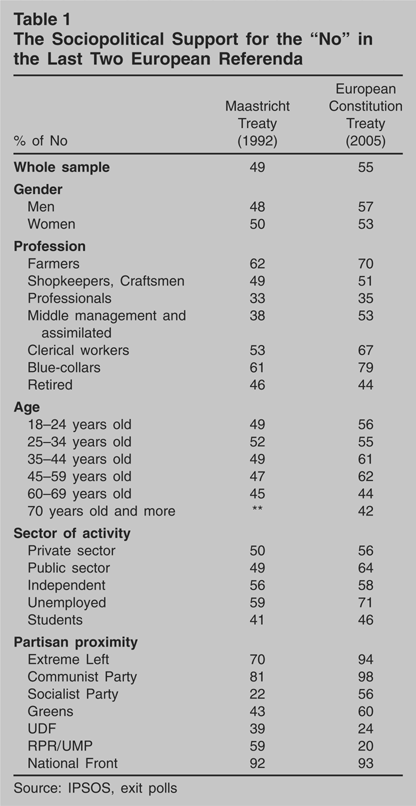
The “no” vote made progress in virtually all social groups (see Table 1) when comparing the results of the
previous two referenda on Europe. If one looks to occupation as an
explanatory factor, voting distributions in 1992 and in 2005 follow the
same trend: the higher the class level of the individual's profession,
the higher the probability that they will support the European Treaties
(35% of nays among professionals, 79% among blue-collar workers in
2005). Two facts must be pointed out. First, the progress of the “no”
vote differs in the various occupational groups ranging from −2 among
the retired and +2 among shopkeepers, craftsmen, and professionals, to
+14 and more among the middle and lower classes. In 2005, the different
social groups were more polarized on the subject of Europe than in 1992.
Second, the social basis of the “yes” vote diminished during this same
period: majority support for the ECT was visible only among
professionals and the retired in 2005, whereas in 1992 middle
management, shopkeepers, and craftsworkers also supported it. The
increase of the “no” vote was not limited to the private sector, though
this is the sector most endangered by globalization and lay-off plans,
one of the most hotly debated issues among the public and in the media
during the campaign (see Piar and Gerstlé
2005). Public servants were more likely to vote against the ECT
than their private sector counterparts, thus showing their concern about
EU policies on public services and public companies (such as railroads,
phone, and electricity operators, all of which are under state control).
They therefore fall into the category of the EU-criticism
hypothesis.
The Sociopolitical Support for the “No” in the Last Two European
Referenda
Age also plays a role. In 1992, age groups split more or less in similar
proportions between the “yes” and the “no” camps. In 2005, the “no” vote
gained ground amongst all age groups except for individuals aged 60 or
more. The “no” vote reached its highest point among individuals in the
middle of their professional careers (aged 35 to 59). It is also among
this age group that negative perceptions of the state of the economy are
the most widespread and that the vote for the moderate right has
decreased the most in the 2004 regional and European elections. The
economic and political features sustaining the political distrust, the
EU-criticism, and the executive popularity hypotheses are found in
individuals in this age group.
But even if social variables such as occupation, sector of activity, or
age provide clues to understanding the referendum result, one cannot
neglect the importance of politics. Voting distribution by partisan
proximity shows both permanent features and dynamics: at the extremes of
the French political space, large numbers of both extreme-right- and
extreme-left-wing party supporters voted “no” in 1992 and in 2002. UDF
voters continue to demonstrate their attachment to European integration
and constitute the only political group to support both the European
treaties. For the remaining three political groups the changes are
dramatic: Socialists and Greens said “yes” in 1992 and “no” in 2005, the
Gaullists (RPR and UMP) changed direction completely, going from
rejecting the Maastricht Treaty to supporting the ECT.
Hence, all four hypotheses set forth above are potentially valid. For
example levels of ethnocentrism (Mayer 1999)
and of Euro-skepticism (Belot and Cautrès
2004) reach their highest point among the lower classes, but so
too do feelings of economic threat related to European policies (Cautrès and Tiberj 2005) and dissatisfaction
with the political process and the government (Schweisguth 2002; Bréchon, 2004).
It is important to determine which of these factors precisely incited
blue-collar and office workers to vote “no”. Which of our four
hypotheses correspond to them? Did the professionals vote “yes” because
they are further to the right than other social groups and therefore
more supportive of President Chirac's policies (the executive popularity
hypothesis) or because they feel less threatened by economic
globalization and therefore more open to Europe (the anti-Europe
hypothesis)? The executive popularity hypothesis seems relevant since
the only voters to support the ECT were those aligned with the moderate
right-wing currently in office, just as the left-wing voters aligned
with President François Mitterrand in 1992. We must therefore use a
multivariate analysis to offer a coherent explanation for the various
causes of the negative vote.
5
6
Whether the Prime Minister Jean-Pierre Raffarin should campaign
was publicly addressed even by political figures within his own
party, the UMP. For some, he was so unpopular at that time that
he would crystallize all the resentments against him and his
unpopularity would translate into a negative vote for the
referendum. However, it was quite hard to disentangle the
unpopularity of the prime minister from the unpopularity of the
president, as they were highly correlated. Whatever the variable
chosen, it would be a very good proxy for the other.
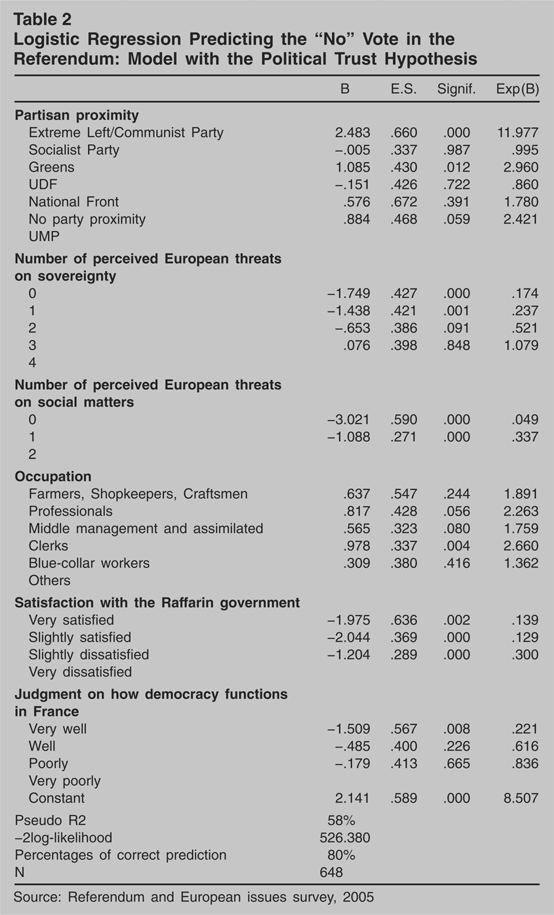
Logistic Regression Predicting the “No” Vote in the Referendum:
Model with the Political Trust Hypothesis
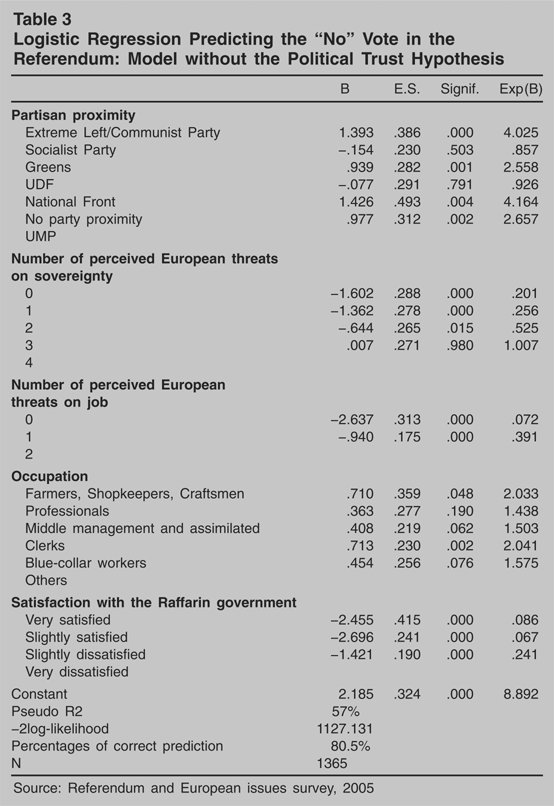
Logistic Regression Predicting the “No” Vote in the Referendum:
Model without the Political Trust Hypothesis
Results
A lot has been said about the role of political parties in the referendum
result. Divisions within the Socialist Party, for example, were said to
be a reason behind the high number of “no” votes among left-wing voters.
With an internal poll in December 2004 showing 59% of the militants
opting for the “yes” vote but a minority of leaders campaigning actively
for the “no” vote, the vote on May 29th is considered a major
defeat for the Socialist Party's Secretary-General François Hollande. It
is also assumed that this defeat will have a negative impact on the
performance of the Socialist candidate in the next presidential
election. What the model demonstrates is, ceteris paribus, that
Socialist leaning did not provide a significant push in favor of the
“no” vote. Socialist leaners were as likely to vote “yes” as UMP or UDF
voters, when their level of political and governmental dissatisfaction
or their perception of Europe as a national or a social threat are taken
into account.
A rather different picture emerges from the other left-wing parties.
Among the Trotskyist and Communist voters, the “no” vote appeared
certain. Even among the Greens, the “no” vote was always by far the most
probable choice. But for the extreme left and Communist leaners, the
explanation for their electoral behavior lies in the consensus of their
political and social leaders. All the extreme-left organizations—whether
partisan, trade-unionist, or associative (like, for example,
ATTAC)—openly rejected the ECT and for the first time effectively used
the Internet to mobilize voters. Their proven consistency on the
topic—strongly advocating for a rejection of the Maastricht treaty—was
also crucial, though in 2005 they did not express their opposition to
Europe as a whole, but rather they argued in favor of Europe “but not
this one.” Their goal is a Europe capable of developing strong
protection against globalization and the promotion of a continental
version of the French social model.
Like the Socialists, the Green party's internal consultation revealed
proponents of and opponents to the ECT. In this case, the significant
tendency toward the “no” vote reveals the weak relationship between this
organization and its constituency.7
If we
take only the raw frequencies of responses, the Greens would
rank third in importance (with 13.5% of respondents, 21.5% for
the UMP, and 32.5% for the Socialist Party), although an
electoral success for them consists of gaining more than 5% of
the popular vote.
Most of its supposed sympathizers
made their partisan choice as a refuge (believing that by so doing they
were not choosing between the left and the right). In fact, the Green
voters are the least ideologically positioned among left-wing party
sympathizers (58% are neither left nor right, in comparison with 29% of
those with socialist leanings and 22% of those with an extreme left
leaning). In this, members of the Green party show a similar disinterest
in politics as such with Independents. The likelihood that they would
vote “no” was therefore not connected to any specific party stance but
to
other factors, as will be demonstrated later.
The “return of class voting” theory was also highly publicized, both by
left- and right-wing opponents to the treaty, who described the
phenomenon as a protest of working class France against the country's
economically liberal elites. Taking all the other independent variables
into account, this idea is not so clear. In fact, a gap exists between
retired and active citizens, while differences in behavior between the
lower classes (blue-collar or office workers) and the upper classes are
insignificant. This is not to say that professionals and blue-collar
workers have the same perception of Europe as a threat (in fact, 75% of
working class citizens as compared to 44% of professionals see Europe as
a threat both to the social welfare and health system and the level of
unemployment), but class, the social networks, and their accompanying
values were not a supplementary factor.
The political distrust hypothesis might have been pertinent, particularly
after what happened on April 21, 2002. It might also have provided a
clue for a better understanding of the social distribution of the “no”
vote, since the greatest opposition to the ECT was by the unemployed and
other economically disadvantaged groups. However, this has not proved to
be the case. Whether one takes political distrust into account in the
model only adds or subtracts one percentage point to the explained
variance. For example, among lower class voters, whatever their judgment
on the way democracy works in France, the “no” vote was the more
probable choice. Among upper class individuals, the average probability
of a “no” vote varies by as much as −/+7%. Last but not least, 45.5% of
those who voted “no” believe that democracy works well in France. If
political distrust was predictive of a particular type of behavior
during the referendum, this would have been relevant for the level of
turnout but not for a particular vote.
The executive popularity hypothesis is a more acute explanation, though
only for some parts of the electorate. The government's unpopularity
reached a historical high during this period. Only 22% of interviewees
had confidence in Prime Minister Jean-Pierre Raffarin in May 2005
(TNS-Sofrès). Simultaneously, the level of confidence in Chirac barely
reached 37%. This is not a contextual effect of the referendum since
confidence in Raffarin fell below 40% in October 2003 and has stayed
under this level since then. Lack of popularity was also one of the main
reasons for the electoral failures of the right in 2004, particularly
since large numbers of right-wing voters did not mobilize to support
their favored party during the regional and European elections (Cautrès and Tiberj 2005).
Taken alone as a predictor, the percentage of explained variance reaches
30% and taken with the other variables, is still significant. For
respondents satisfied with the government (33% of the sample), the
average probability of a “no” vote is estimated at nearly 22%. Among
those dissatisfied with the government, the “no” vote reaches an average
probability of 65%. Even among the rare left-wing voters with a positive
attitude toward the government, only 8% are more likely to support the
ECT. However, dissatisfied left-wing voters are present in both the
“yes” and “no” electorates. In the former, 85% of the leftists
criticized the policies implemented by Raffarin and his team, in the
latter 96% did. Among socialist sympathizers, 56% is the average
probability for the “no” vote among those dissatisfied by the
government, in comparison with 90% among the extreme left and communist
sympathizers. An explanation other than the executive popularity
hypothesis must therefore be found to explain why the left split on the
ECT.
Results are clearer for right-wing and “neither left nor right” voters.
Among the right-wing, 62% of “no” voters criticized the government,
while 82% of “yes” voters responded favorably to it. Among the neither
left nor right voters, 85% of the “no” voters judged the executive
negatively, while 55% of “yes” voters viewed it positively.8
This relatively low level of satisfaction
with the government within this particular sector of the
electorate is explained by the high proportion of UDF
sympathizers among them, simultaneously critics and strongly
pro-European.
Attitudes toward the government
per
se played a role in the results, but only among non-left
voters.
The anti-European hypothesis is the first to explain the outcome of the
referendum. Since the Maastricht Treaty referendum, Europe has been
framed together with multiculturalism and immigration as a threat for
France and its cultural identity. It is not a coincidence that this
anti-European attitude is more common among the lower classes and the
less well-educated: these sections of the population are also more
prejudiced against immigrants and more culturally conservative, and
therefore constitute the most closed-minded segment of the French
public. Since 1992, several political entrepreneurs (such as Jean-Pierre
Chevènement on the left or Philippe de Villiers and Charles Pasqua on
the right) have tried to capitalize on the anti-European trend. However,
apart from the European elections of 1994 and 1999, these attempts have
not been successful. Politicians have rarely been able to convert
anti-European attitudes into electoral success, but this does not mean
that this issue disappeared after the Maastricht treaty referendum, as
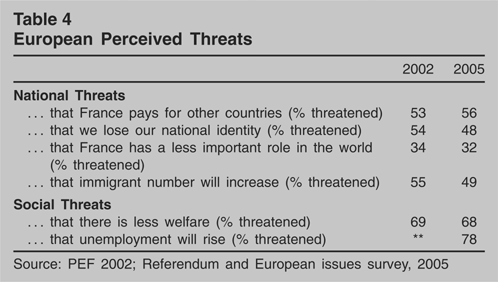
shown in Table 4. Comparing the public's
perception of Europe as a threat between 2002 and 2005 clearly indicates
that this perception is latent among the French electorate. The novelty
of 2005 was the distinction between traditional perceptions of threats
fuelled by nationalistic concerns and perceived threats to the social
fabric. Europe is linked to questions of national identity, inter-member
state solidarity, and sovereignty, particularly after EU-enlargement in
2004 to mostly East-European countries9
In
an experiment we carried out on attitudes toward particular
groups of immigrants, 41% of interviewees perceived East
Europeans as a direct threat for people like them, whereas only
35% responded the same for Maghrebian immigrants (see Brouard and Tiberj 2005).
—i.e.
threats to national sovereignty—and simultaneous threats to the French
socio-economic system, which resonate strongly within the context of the
social and economic insecurity France has experienced since 2003. The
perceived threat questions therefore offer a relevant empirical test for
the anti-European hypothesis (threats to national sovereignty) and for
the EU criticism hypothesis (threats to the socio-economic system).
European Perceived Threats
A closer look at the perception of Europe as a whole is useful to
underline the difference between anti-European attitudes and EU
criticism. The survey asked four questions to measure the perceived
threat to national sovereignty caused by Europe. Among the respondents
who answered threatened four times, 42% said that European membership
was positive for the country, 33% would regret and 32% would be relieved
to see the European project withdrawn. Among those who felt more
socially threatened by the EU, 56% believed membership in the EU was
positive for France, 47% would regret and only 23% would be relieved
should the European Project be withdrawn. It is clear that threats of a
national and social order stem from two very different attitudes.
In any case, the model confirms this distinction. Both indicators are
simultaneously significant and tell different stories when analyzed by
the ideological position of individuals. Several scholars have argued
that, regardless of party preference, there is one explanation for the
“no” vote: a nationalistic rejection of Europe. The model presents a
more complicated picture when the anti-European hypothesis is taken into
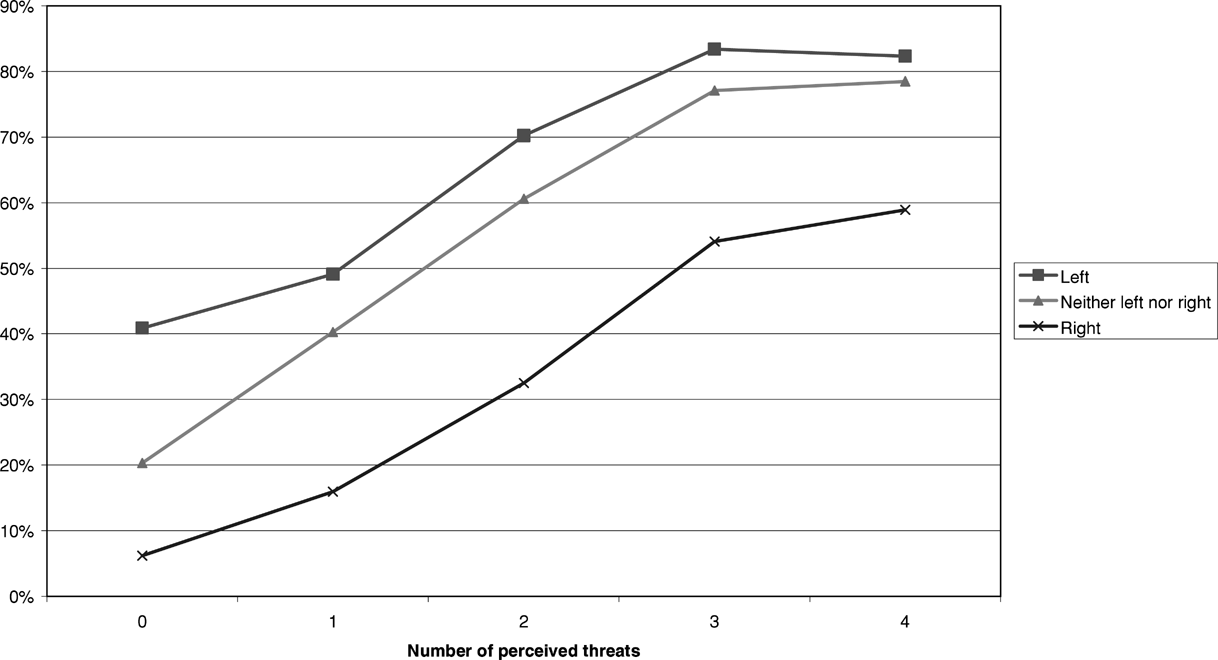
account. True, the more Europe is perceived as a threat to national
sovereignty, the greater the chance of a “no” vote, regardless of
political alignment. This is particularly true among the neither left
nor right faction and among the leftists who feel threatened by Europe.
Those who feel more threatened by integration into the European Union
are virtually certain to vote “no” (Figure 1).
But a comparison between these two threatened groups and their
equivalents on the right-wing provides another clue: among those less
concerned by a perceived threat to the nation (the 54% who perceive no
or only one threats), the probability of voting “no” is roughly four
times greater than for the right-wing voters. Among the neither left nor
right unthreatened by Europe (36% of this group) the probability of a
“no” vote doubles or even triples in comparison with their rightist
counterparts. This is to say that among the pro-European left, another
type of logic, one which is neither distrust nor anti-governmental
feelings, leads to a “no” vote.
Nay Average Probability by Number of Nationalistic Threats and
Ideology
Before going any further, another point must be made on reasons for the
left-wing “no” vote. The right could have joined forces with the nays,
but loyalty to the government strongly undermined the influence of the
anti-European attitude on the right-wing “no” vote: for the more
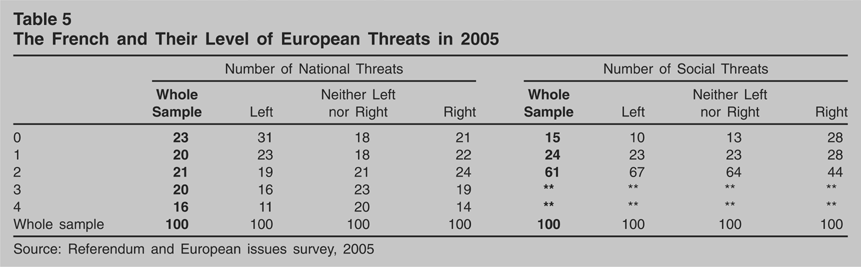
anti-European right-wing, which accounts for 33% of the right-wing
electorate (Table 5), the average probability
of a “no” vote remained low in comparison with the rest of the
anti-European electorate. Chances are high that with a Socialist
president their choice would have been different.
The French and Their Level of European Threats in 2005
One explanation remains: the EU criticism hypothesis (i.e., threats to
the social system). In fact, this hypothesis provides the needed
complement to the anti-European hypothesis. Among the leftists, and to a
lesser extent among the neither left nor right, it was difficult to
explain such a high level of “no” votes among the pro-European
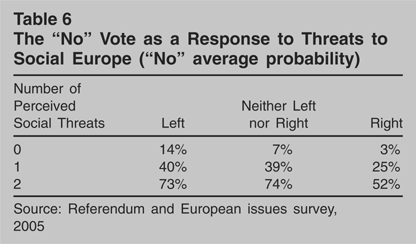
electorate. An average probability of 73% and 74% (Table 6) of nays among the most socially threatened in these
groups provides the last clue: among right-wing voters, social threats
had a minor influence. This is not the case for the rest of the
electorate: its average probability ranges from a virtually impossible
nay to the overwhelming likelihood of such a choice. This also
demonstrates that the “no” was a vote against a particular Europe, an
economically liberal Europe, which we call EU-criticism, but which is
not against the principle of the EU itself. For the left, where no
nationalistic threat is perceived, 35% of voters still worry about
levels of unemployment or social security and 42% worry about both of
these issues. For neither left nor right voters, the percentages on
these issues are respectively 29% and 22%.
The “No” Vote as a Response to Threats to Social Europe (“No”
average probability)
Conclusion
The French rejection of the European Constitutional Treaty stemmed from a
sort of worst case scenario. Several reasons along the left-right axis
led to this majority of nays, among which concerns about the social
protection system played a particular role. Similarities between the
1992 and 2005 referenda exist. The perceived national threat existed 13
years ago, as did dissatisfaction with the government (Socialists at
that time) and politics in general. The desire to vote against President
Mitterrand explained quite well why the “no” vote was so important among
his opponents. However, in 2005, the governmental frame was mobilized
mostly among the right-wing and the neither left nor right factions, but
not among the leftist voters; otherwise the European Constitution would
have suffered a considerably higher nay. The novelty is clearly the
perceived threat to the social fabric produced by European integration,
which has also involved citizens who previously approved of this process
and who do not fear for the future of the nation among a multicultural
community.
We have rejected only one hypothesis: the political distrust hypothesis.
The anti-European, EU-criticism, and executive popularity hypotheses are
therefore relevant. Nevertheless their impacts vary among the French
public. Anti-European attitudes come into play in virtually every
political segment of the electorate (though their influence is greater
among non-right-wing voters). EU-criticism brought voters who might
otherwise have approved the ECT to the nay side. This is particularly
the case for left-wing voters. The influence of the executive popularity
question varies from a minor impact on the left to a strong impact for
the rest of the electorate. If President Chirac had not been in office,
several nationally-threatened right-wing voters would have voted
nay.
Nevertheless, these heterogeneous electoral types of logic produced
France's second political earthquake in the last three years (Sauger, Brouard, and Grossman 2006). On the
left, preoccupation with social issues played the biggest factor for a
negative vote, followed by, and to a lesser extent, the perceived
nationalistic threat, and finally, and marginally, dissatisfaction with
government. For neither left nor right voters, social and nationalistic
preferences came together, reinforced each other, and was the main
reason for their “no” vote, followed by dissatisfaction with the
government. On the political right, the social threat was marginal in
its influence; this was not the case with the nationalistic threat.
What consequences must be drawn, for Europe but also for French politics?
Will the alliance forged in the referendum campaign, particularly among
ECT opponents, reshape an already fragile French political equilibrium?
The nays, particularly on the left, are attempting to capitalize on the
rejection of the ECT by demanding new electoral alliances. Within the
Socialist Party, factions are fighting for the leadership (and the
presidential candidacy) by competing both on the interpretations and the
consequences of the vote. But, so far, the May 29th vote has
only had consequences for the political elite. The French public has
gone back to its usual concerns, since the European issue is no longer
on the agenda. Nays and yeas on the left are still potentially capable
of rallying behind the same flag: the socialist flag.10
When asked how likely they were to vote
socialist, 77% of the yeas thought it probable and 18% thought
it possible, whereas 64% of the nays thought it probable and 22%
possible.
Neither left nor right voters would also vote
for the Socialist Party. For the moment, political investment on the
yes/no cleavage seems quite a risky choice to make, left/right issues
are still more profitable.
Will France step back from the process of European integration? The
French electorate remains divided on the topic but several indicators
leave us with a nuanced picture. On the one hand, 65% of our respondents
still judge retrospectively that French membership in the EU benefits
the country. Fifty-eight percent would regret if the European project
were abandoned. Sixty-six percent feel strongly or slightly committed to
European integration. Among citizens with a positive attitude toward
Europe, “no” voters are not marginal.11
45% of French citizens with a positive attitude toward
Europe judge French EU-membership positively, 37% would regret
if the project were abandoned, and 33% would feel
relieved.
This underlines the fact that this referendum was
about a particular treaty, rather than about the place of France in
Europe (although some ECT proponents tried to frame the referendum in
this way). On the other hand, as far as the future is concerned, only
37% of interviewees ask for more power for European institutions to
allow them to deal with future; 58% prefer to rely on national
institutions. French voters do not reject Europe but ultimately would
not want its prerogatives on policy to be reinforced, at least under the
conditions proposed in the ECT. But, what if Europe finds another way?
What if Europe became the social safety net both opponents and
proponents asked for during the campaign? The result of the referendum
might have been dramatically different if perceived social threats had
been lessened and if Europe had not been perceived as “liberal” but as
“social.” The question must be asked whether such a social policy change
could be implemented and whether, indeed, such an option would be
desirable. This is another debate, but part of what the French
electorate gave voice to on the May 29
th is the demand for
another Europe, capable of protecting and guaranteeing the French social
protection model.