

Introduction
Climate change has long been considered a driving force in the evolution of ecosystems (Scholze et al. Reference Scholze, Knorr, Arnell and Prentice2006; Blois et al. Reference Blois, Zarnetske, Fitzpatrick and Finnegan2013). Plants and insect herbivores are two major components of terrestrial communities, and their interactions play an important role in structuring ecosystems (Schoonhoven et al. Reference Schoonhoven, van Loon and Dicke2005). Consequently, there is considerable interest in the evolution of plant-insect herbivore interactions in response to climate change (Bale et al. Reference Bale, Masters, Hodkinson, Awmack, Bezemer, Brown, Butterfield, Buse, Coulson, Farrar, Good, Harrington, Hartley, Jones, Lindroth, Press, Symrnioudis, Watt and Whittaker2002; Brooker Reference Brooker2006; Futuyma and Agrawal Reference Futuyma and Agrawal2009; Labandeira and Currano Reference Labandeira and Currano2013). Most work on the evolution of plant-insect interactions has studied only the present-day state, using phylogenies derived from DNA and/or morphology (Nyman et al. Reference Nyman, Linder, Peña, Malm and Wahlberg2012; Whitfeld et al. Reference Whitfeld, Novotny, Miller, Hrcek, Klimes and Weiblen2012). The fossil record could potentially provide more direct observations of past processes that have shaped ecosystems (Louys et al. Reference Louys, Wilkinson and Bishop2012). In recent years, a series of studies have documented plant-insect interactions in response to climate change in geological time with evidence of insect damage on fossil leaves (Wilf Reference Wilf2008). Insect damage on fossil leaves relates not only to plant-insect interactions, but also to the evolution and diversity of the herbivorous insect fauna (Currano Reference Currano2009; Carvalho et al., Reference Carvalho, Wilf, Barrios, Windsor, Currano, Labandeira and Jaramillo2014). Fossil evidence of insect damage from different regions worldwide indicates that climate change has shaped plant-insect interactions in the past (Wilf and Labandeira Reference Wilf and Labandeira1999; Wilf et al. Reference Wilf, Labandeira, Johnson, Coley and Cutter2001; Currano et al. Reference Currano, Wilf, Wing, Labandeira, Lovelock and Royer2008; Prokop et al. Reference Prokop, Wappler, Knor and Kvaček2010; Knor et al. Reference Knor, Prokop, Kvaček, Janovský and Wappler2012). However, there remains a fundamental disconnect from the present, in terms of understanding how climate change in geological time has shaped the present plant-insect interactions.
The evergreen sclerophyllous oak (Quercus section Heterobalanus [HET]) is at present mainly distributed in southwestern China, occurring as the dominant species in many forests of this region. HET has a long history, dating back to 15 Ma in Namling, southern Tibet (Li and Guo Reference Li and Guo1976). Forests dominated by HET have existed since the late Pliocene in southwestern China. In this study, we were able to document insect herbivore damage in a 3-Ma flora in Yongping County of Yunnan Province, on fossil HET leaves subject to exceptional preservation. Because HET still exists in southwestern China (Yang et al. Reference Yang, Chen, Xia and Zhou2009; Su Reference Su2010), we were able to compare the range of herbivore damage types within a narrow plant lineage on an evolutionary time scale, in a way that has never been possible before.
Here, we mainly focus on the evolution of plant-insect interactions in HET forests in response to Quaternary climate change. The Quaternary (~2.588 Ma to present) is a worldwide cool period marked by a series of glaciations (Pillans et al. Reference Pillans and Gibbard2012). Owing to the changes of global ice volume, southwestern China experienced climate fluctuations during the Quaternary, generally characterized by the variations of the monsoon intensity (An et al. Reference An, Clemens, Shen, Qiang, Jin, Sun, Prell, Luo, Wang, Xu, Cai, Zhou, Liu, Liu, Shi, Yan, Xiao, Chang, Wu, Ai and Lu2011). Both the Indian monsoon and East Asian monsoon converge in southwestern China, giving a pronounced winter dry season-summer wet season pattern (Wang Reference Wang2006). Variations in the monsoon system during the Quaternary have had a significant influence on the pattern of precipitation, and consequently on the pattern of temperature. Meanwhile, the continuous orogenic uplift of this region has also helped to shape the spatial distribution patterns of both temperature and precipitation during the Quaternary (Su et al. Reference Su, Jacques, Spicer, Liu, Huang, Xing and Zhou2013).
Climatic change during the Quaternary has likely had a direct influence on the evolution of modern communities as well as whole ecosystems. It is therefore of great interest to have an ancient plant-herbivore system where the direct descendant of the fossil plant taxon remains extant and can be studied in detail in the present-day world, and the differences over time can be carefully compared.
Our detailed observations here allow the testing of three hypotheses for the evolutionary history of plant-insect interactions:
1. The climate bottleneck hypothesis. Repeated, dramatic climate fluctuations have suppressed damage diversity by causing population bottlenecks of both the host tree and its associated insect herbivores, resulting in herbivore extinctions (Adams and Woodward Reference Adams and Woodward1989; Labandeira et al. Reference Labandeira, Johnson and Wilf2002). Thus we may expect to see a reduction in damage diversity over time.
2. Accumulation of herbivores over evolutionary time. As a plant species ages since its time of origin, it will accumulate more species of herbivores that successfully adapt to overcoming its defenses, and consequently an increase of damage diversity will be observed (Southwood Reference Southwood1973; Feeny Reference Feeny1976). According to this hypothesis, an increase in damage diversity over time can be expected.
3. Null hypothesis (Coope Reference Coope1979). Neither mechanism has been an overriding influence, resulting in stability of damage diversity and composition over time.
Based on the evidence of insect damage from the same vegetation type and within a narrowly defined taxon lineage, this study for the first time combines the fossil record with contemporary samples to test these hypothetical scenarios stated above, providing important evidence for the resilience of ecosystems in response to long-term climate change, something that cannot be tested by ecological studies from modern samples alone.
Materials and Methods
Evergreen Sclerophyllous Oak
Our study material is evergreen sclerophyllous oak (Quercus section Heterobalanus [HET]; Figs. 1, 2). This type of oak is mainly distributed in the Qinghai-Tibet Plateau (Working Group on Yunnan Vegetation 1987). Heterobalanus “sensu lato” consists of various populations with minor morphological differences, and even though these populations have sometimes been divided off as separate species, it is clear that Heterobalanus s.l. is monophyletic and of recent origin, without a strong basis for distinguishing separate species (Nixon Reference Nixon1993; Denk and Grimm Reference Denk and Grimm2010). In this study, we treat the fossil species as Q. preguyavaefolia (Tao et al. Reference Tao, Zhou and Liu2000) and the extant species as Q. guyavaefolia. Fossil HETs have leaves and cupules that are morphologically indistinguishable from the extant ones (Fig. 2). Forests dominated by HETs are one of the main vegetation types ranging from 2000 to 4500 m in altitude in southwestern China (Working Group on Yunnan Vegetation 1987). It is not until the late Pliocene that fossil floras dominated by HET are found in sediments from southwestern China (Tao et al. Reference Tao, Zhou and Liu2000). Among these floras, leaf fossils of Q. preguyavaefolia in the Longmen flora of Yongping, western Yunnan, are the most abundant and have the best quality of preservation (Su Reference Su2010), allowing detailed examination of damage type (DT) morphologies on fossil leaves.
Localities of the late Pliocene Longmen flora and eight samples from living Quercus guyavaefolia forests. Information on each site is listed in Table 1.

Fossil Q. preguyavaefolia and living Q. guyavaefolia in this study. A, C, Fossil Q. preguyavaefolia from the late Pliocene Longmen flora. A, Leaf; C, Cupule. B, D, E, F, Living Q. guyavaefolia in southwestern China. B, Leaf; D, Cupule; E, Scene of an HET forest dominated by Q. guyavaefolia (trees in brown) in Mt. Xiaoxue, Shangri-La County, northwestern Yunnan Province; the elevation range is 3400–3500 m; F, Fruit-bearing branch of Q. guyavaefolia.
The Late Pliocene Longmen Flora
The Longmen flora is situated in Yongping County of western Yunnan Province (25°31′N, 99°31′E; 1715 m a.s.l.; Table 1, Fig. 1). The plant-fossil-bearing sediment in this study belongs to the Sanying Formation, which is widely distributed in western and northwestern Yunnan. The geological age of the fossil flora is about 3 Ma according to a recent paleomagnetic study (Li et al. Reference Li, Deng, Yao, Huang, Liu, He, Pan and Zhu2013). Detailed information on this stratum is summarized in Su et al. (Reference Su, Jacques, Liu, Xiang, Xing, Huang and Zhou2011). Fossil specimens in this study were uncovered from the fine gray clay in the upper layer of this lacustrine sediment. The fossils are all from the same site with sample size spanning 0.5 m in depth, 2 m in width, and 10 m in length. It may have received leaves washed or blown in from a wide area of forest around (Ellis and Johnson Reference Ellis and Johnson2013). All specimens are deposited in Paleoecology Laboratory, Xishuangbanna Tropical Botanical Garden, Chinese Academy of Sciences.
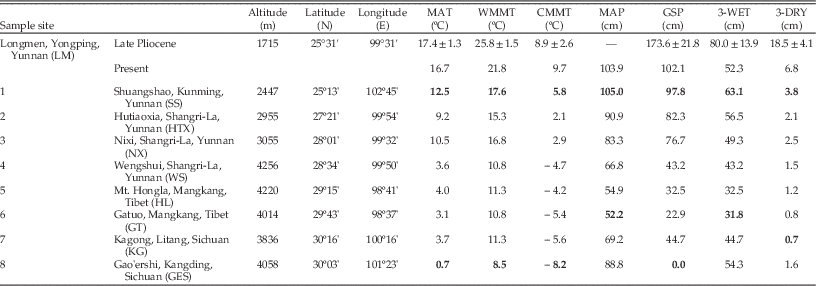
Information on positions and climates of the late Pliocene Longmen flora and eight modern sampling forests. Data on climate parameters of the Longmen flora are from Su et al. (Reference Su, Jacques, Spicer, Liu, Huang, Xing and Zhou2013); present climatic data were acquired from a global climate model in 1-km spatial resolution (Hijmans et al. Reference Hijmans, Cameron, Parra, Jones and Jarvis2005). MAT=mean annual temperature; WMMT=warmest-month mean temperature; CMMT=coldest-month mean temperature; MAP=mean annual precipitation; GSP=total precipitation with mean monthly temperature being more than 10ºC; 3-WET=precipitation during the three consecutive wettest months; 3-DRY=precipitation during the three consecutive driest months. Data in bold are the upper and lower limits of each climate parameter in modern sample sites.
Contemporary Samples
Eight primary HET forests with low human activity in southwestern China were chosen as sample sites to be comparable with the vegetation type of the Longmen flora (Table 1). Samples were collected during October and November in 2011, after the rainy season had ended. These modern sample sites cover almost the entire range of climate and elevational distribution of HET forests in southwestern China (Yang et al. Reference Yang, Chen, Xia and Zhou2009). For each sample site, three replicates were taken in order to sample as wide a range of herbivory types on leaves as possible within the same forest. The distance between replicates within each site was 200 to 500 m in horizontal distance, but with an elevational difference of no more than 100 m. These replicates were all collected in forests located more than 100 m away from any main road to exclude the influence of human activity on herbivory. For each replicate site, we collected the fallen leaves of HET on the ground with rubber gloves along a horizontal line at a distance of 100 m. In our sampling transects, we stopped every five meters and randomly grabbed five handfuls of fallen leaves. This process was done repeatedly at 20 stops along the transect. All leaves from a replicate site were put in one plastic bag and labeled with a number. In total, more than 5000 leaves were collected from each replicate. We believe fallen leaves are a more representative sample than leaves sampled directly from parts of the canopy, because fallen leaves integrate the whole canopy. Also, this sampling strategy should make the modern samples more closely comparable to fossil samples, because all the fossil leaves are formed by fallen leaves. HET is not deciduous during autumn; therefore, samples we collected might be fallen leaves from the current year or from the previous year.
Climatic Settings
The paleoclimate of the late Pliocene Longmen flora has been quantitatively reconstructed by leaf physiognomy-based methods in Su et al. (Reference Su, Jacques, Spicer, Liu, Huang, Xing and Zhou2013). It was concluded that climate in western Yunnan at that time was slightly warmer and much wetter than the present day (Table 1). These results are generally in agreement with other evidence such as modeling (Li et al. Reference Li, Berger, Loutre, Maslin, Haug and Tiedemann1998) and isotope records (Zachos et al. Reference Zachos, Pagani, Sloan, Thomas and Billups2001). The climate data of modern sample sites could not be directly obtained from weather stations, because HET forests with low human disturbance are usually far from the cities where most climate stations are set up in China. To infer climate parameters, we used a high-resolution global climate model with a scale down to one square kilometer (Hijmans et al. Reference Hijmans, Cameron, Parra, Jones and Jarvis2005). Data were referenced with the geospatial processing software ArcGIS, version 9.3 (ESRI, Redlands, USA). Seven temperature and precipitation related parameters were calculated for these modern sample sites in order to keep these consistent with climate parameters calculated for the Longmen flora (Table 1).
Scoring of Insect Damage
We used the Damage Type Guide (Labandeira et al. Reference Labandeira, Wilf, Johnson and Marsh2007) to assess insect damage types from the Pliocene Longmen locality and modern samples (Fig. 3). For the Longmen flora, we used fossil leaves of Q. preguyavaefolia s.l. with very good quality of preservation as the research materials to observe the presence/absence of insect damage. These were fossil leaves with at least half of the blade preserved, and very clear anatomical detail of the leaf structure (e.g., clearly defined venation, leaf margin, and petiole). Damage types were identified under a dissecting microscope (Leica S8APO). In total, 1028 fossil leaves of Q. preguyavaefolia s.l. were checked and scored in the Longmen flora (Supplementary Table 1). For modern collections, we scored 500 leaves for each replicate and three replicates were lumped as one forest sample. For each replicate, all leaves were put into a box and gently mixed; leaves were chosen randomly to score the insect damage types. In this procedure, leaves that were not heavily decayed by microbes (i.e., not bearing fungal strands or falling to pieces when lightly pulled) were used. Both sides of each leaf were carefully checked to categorize damage types. Eighteen distinctive and diagnostic insect DTs are found in the total data set. The data set of insect damage types for 1028 leaves from the Longmen flora and 12,000 leaves from eight extant HET forests are deposited in Supplementary Table 1. The percentage of each damage type for every sample is given in Supplementary Table 2.
Damage diversity on leaves of fossil Quercus preguyavaefolia (A–E) and living Q. guyavaefolia (F–J). DT01 (hole feeding), DT 12 (marginal feeding), DT36 (mining), and DT45 (mining) are found in both Q. preguyavaefolia and Q. guyavaefolia; DT 33 (galling on the main vein) is observed only in Q. preguyavaefolia, and DT163 (galling on the secondary vein) is only in Q. guyavaefolia. See morphologies of all damage types in Supplementary Figure 1. Scale bar in each figure, 2 mm.
Data Analyses
Insect folivory was examined using three damage-type metrics: frequency, diversity, and distribution. Damage diversity, or the number of DTs present at each locality, was normalized for the number of leaves sampled, as in previous studies (Wappler Reference Wappler2010; Knor et al. Reference Knor, Prokop, Kvaček, Janovský and Wappler2012). The percentage of explained variability was computed by means of Nagelkerke pseudo-R 2 measure as implemented (Harrell Reference Harrell2009) in the software R, version 2.13.1 (R Development Core Team, 2011). Where necessary, overdispersion was treated by refitting to the quasibinomial family of generalized linear models. To understand the correlation between damage diversity/frequency and climate in living HET forests, the single linear regression was used with the software R. Data on the percentage of every damage type in each sample were clustered with the package “vegan” (Oksanen Reference Oksanen2009) in the software R by using the method of Bray-Curtis distance.
Results
Indicators of Adequate Sample Quantity and Quality
Bootstrap curves derived from the census data obtained in this study indicate that the modern and fossil leaf sample sizes used here are large enough to cover all damage types (DTs) present at each sample site (Fig. 4). In each case, the bootstrap curve levels off well before the total sample number of leaves has been reached (Fig. 4). Furthermore, we have carefully checked the morphology of each damage type under a dissecting microscope: all damage types present on modern leaves could be preserved if they existed in fossil leaves, judging by the morphology of each damage type and extremely good preservation of the fossils (Fig. 3, Supplementary Fig. 1). For example, DT 168 belongs to the piercing scar, which is similar to a fungal fruiting body. However, the smooth and convex surface of DT 168 along the adaxial side of the leaf blade makes it readily distinguishable from the fungal fruiting body. Besides, DT 168 could be preserved as fossils judging by the prominent convex surface (Supplementary Fig. 1AB).
Bootstrap curves of insect damage diversity for the late Pliocene Longmen flora (LM) and eight modern forests. A total of 1028 leaves from the Longmen flora and 1500 leaves from each modern forest were scored for damage types. Abbreviation and detailed information on each sample site are given in Table 1.
Patterns of Damage Diversity in Modern Oak Populations
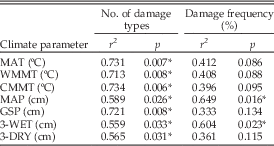
In our extant evergreen sclerophyllous oak (HET) forest samples, the diversity of damage types significantly correlates with all the investigated temperature-related parameters (Table 2), such as mean annual temperature (MAT; r 2=0.73, p<0.05) and warmest-month mean temperature (WMMT, r 2=0.71, p<0.05). Regarding precipitation-related parameters, the diversity of damage types significantly correlates only with growing season precipitation (GSP, r 2=0.72, p<0.05). The damage frequency does not significantly correlate with any of the seven investigated climate parameters (Table 2), further supporting the conclusion that the strongest signal in insect-folivore damage is for diversity, not frequency (Currano et al. Reference Currano, Wilf, Wing, Labandeira, Lovelock and Royer2008). The damage frequency varies widely among sites, with 46.1% of leaves damaged in Wengshui (Site 4) to 96.1% in Hutiaoxia (Site 2). The number of damage types ranges from 13 (Gatuo, Site 6) to 17 (Hutiaoxia, Site 2). Among the broad categories of damage types, hole-feeding and marginal feeding, both belonging to generalized feeding categories, are the most abundant (Fig. 5). In the hole-feeding category, six damage types were found in total, and for marginal feeding there were five damage types. Among all hole-feeding damage types, DT4 and DT5 could not be observed in sites 4-8. All modern samples show a lower percentage of leaf damage from likely host-specific damage categories, occurring in less than 25% of leaves. Galling has the lowest frequency in all modern samples (Supplementary Table 2).
Heat map and cluster analysis showing the composition and similarity of damage types (DTs) among sample sites. The number and abbreviation of each sample site are given in Table 1. HF, hole feeding; MF, marginal feeding; SK, skeletonization; MI, leaf-mining; GA, galling; PS, piercing-and-sucking.
Single linear correlations among climate parameters and number of damage types/damage frequency in living Quercus guyavaefolia forests. See Table 1 for climate parameter abbreviations.
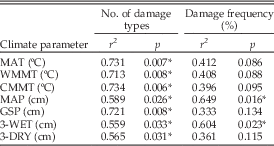
*Statistically significant at 0.05 level.
Damage Diversity of the Late Pliocene Longmen Flora
In the late Pliocene Longmen flora, the total damage frequency on HET leaves is 58.9 %, which is within the range of modern damage percentages in the sites we sampled (Supplementary Table 2). Twelve damage types in total are recognized in the Longmen flora, with three feeding types that are likely to be host specific: two in mining and one in galling (Fig. 5). Only one galling damage type (DT33 in Fig. 3E) occurs in the Longmen flora, characterized by circular to ellipsoidal galls occurring on primary veins of the leaf. This type is not observed in any modern sample, but it is abundant in the Longmen flora, being present in 5.9% of leaves. This is much higher than the percentage of other types of galling in any of the extant samples (Fig. 5).
Among all damage categories, leaf margin feeding and hole feeding are the most abundant in the Longmen flora, with five and three damage types, respectively at 39.4% and 17.4% in terms of frequency. Although the temperature estimated by leaf physiognomy in the Longmen flora is the highest among all samples (Table 1), the number of damage types is unexpectedly the lowest among all investigated samples (Fig. 5). Three damage types belonging to putatively host-specific categories are lacking in the Longmen flora, but found in modern forests: DT195 (mining; Supplementary Fig. 1Y), DT163 (galling; Supplementary Fig. 1AD), and DT168 (piercing-and-sucking; Supplementary Figs. 1AB and 1AC). According to cluster analysis based on the abundance of each damage type, the sample from the Longmen flora falls within the scatter of modern samples, and is the closest to samples from Hutiaoxia (Site 2) and Nixi (Site 3) in northwestern Yunnan (Fig. 5), which are also the closest in terms of spatial distance between modern samples from the fossil locality.
Discussion
The saturation of the bootstrap curve for damage diversity, in the large sample of leaves studied here, makes a strong case that the lower damage diversity in the Longmen flora is not merely an effect of taphonomy. Instead it appears to represent a genuine difference in damage diversity (Fig. 4). Comparison of plant-insect interactions from widely scattered modern-day sites in our study makes it clear that leaf damage diversity in HET forests is higher in warmer climates (Table 2). This result agrees with a pattern previously observed from other plant species (Hódar and Zamora Reference Hódar and Zamora2004) and whole forest communities (Adams et al. Reference Adams, Ahn, Ainuddin and Lee2011) in the present-day world. Additionally, our result shows higher leaf damage diversity in wetter climates (Table 2). This is unsurprising, because temperature and precipitation have been recognized as the major abiotic factors influencing the development, survival, abundance, and range of insects (Bale et al. Reference Bale, Masters, Hodkinson, Awmack, Bezemer, Brown, Butterfield, Buse, Coulson, Farrar, Good, Harrington, Hartley, Jones, Lindroth, Press, Symrnioudis, Watt and Whittaker2002). Therefore, more leaf damage morphologies are likely formed in regions under warmer and wetter climates, because of the higher herbivore diversity. Despite the evidence that the climate of the Longmen flora was warmer and wetter than the climates that modern-day HET populations inhabit (Su et al. Reference Su, Jacques, Spicer, Liu, Huang, Xing and Zhou2013), the damage diversity is unexpectedly lower than for the present day (Fig. 6).
Correlation of the damage diversity and mean annual temperature among eight living Quercus guyavaefolia forests. Solid/hollow squares represent the estimated/observed damage diversity of the late Pliocene Longmen flora. See Table 1 for sample site abbreviations.
We assume that in HET forests, the damage diversity is associated with the diversity of insect herbivores. Among all 18 observed damage types in this study, 11 of them belong to leaf-chewing damage types (Supplementary Table 2). In the Damage Type Guide (Labandeira et al. Reference Labandeira, Wilf, Johnson and Marsh2007), most leaf chewing damage types are described as generalized feeding, meaning that many different types of insects could make the same leaf-chewing damage type. However, there is still apparently a relationship between herbivore diversity and chewing damage diversity of leaves. Recently, Carvalho et al. (Reference Carvalho, Wilf, Barrios, Windsor, Currano, Labandeira and Jaramillo2014) studied leaf-chewing damage types in 24 host-plant species at two lowland tropical rainforest sites of Panama. They concluded that the number of leaf-chewing damage types within one host plant species correlates closely with the diversity of insect species feeding on leaves of the host plant (Carvalho et al. Reference Carvalho, Wilf, Barrios, Windsor, Currano, Labandeira and Jaramillo2014). Therefore, the number of leaf-chewing damage types present on leaves of HET likely reflects the diversity of damage makers. Other forms of damage types in this study, i.e., skeletonization, mining, galling, and piercing-and-sucking, require specific mouthpart structures, and they tend to be created by particular insect species.
During the Quaternary, southwestern China was affected by a series of colder and drier episodes associated with glacial-interglacial cycles (An et al. Reference An, Clemens, Shen, Qiang, Jin, Sun, Prell, Luo, Wang, Xu, Cai, Zhou, Liu, Liu, Shi, Yan, Xiao, Chang, Wu, Ai and Lu2011). The apparent increase in insect damage diversity over the last 3 Myr since the Longmen flora was deposited (Fig. 5) therefore indicates that the climate fluctuations of the Quaternary period did not have an overwhelming effect on the damage diversity through causing massive extinctions among the insect fauna in HET forests of southwestern China. It is always possible to argue that the damage diversity might have risen still higher had it not been for the Quaternary climate instability, but one can at least conclude that no effect is evident. It seems that in the HET lineage, factors other than climate-induced extinction have dominated the trend.
There is, however, one instance of extinction of a common damage type present in the fossil flora, a distinctive type of gall (DT33; Fig. 3E). This type of gall is the most frequently occurring (5.9%) among all specialized damage types in the Longmen flora, but it is not found in any of the modern-day samples that span the modern climate range of HET. We also checked more than 200 modern-day herbarium specimens of Quercus guyavaefolia without finding this galling type. Galls are often formed with species-specific morphology and narrow host-plant range (Stone et al. Reference Stone, van der Ham and Brewer2008; Knor et al. Reference Knor, Prokop, Kvaček, Janovský and Wappler2012). Shifts in range and bottlenecks in both the host species and insect caused by climate variation might have led to this particular gall-making insect’s extinction. It is possible that the apparent shift in the climate range of this oak, from a climate around MAT 17ºC in the Pliocene to a maximum MAT around 14ºC in the present day, has led to an evolutionary niche shift toward cooler climates in the present day, perhaps induced by responses to the trend of regional cooling during the late Pliocene time.
Although there is no evident effect of the Quaternary climate change in depressing damage diversity in this species, it is important to note that southwestern China suffered much less plant extinction during the Quaternary than other temperate regions in the Northern Hemisphere such as Europe (Lang Reference Lang1994). Because HET forests have existed and been widespread in southwestern China since the late Pliocene (Tao et al. Reference Tao, Zhou and Liu2000; Yang et al. Reference Yang, Chen, Xia and Zhou2009; Su Reference Su2010), insects in HET forests would have been able to migrate to areas within the same vegetation, where the climate was suitable for their survival. Thus good opportunities might have occurred for survival and migration of both herbivores and host during the Quaternary. This would be plausible considering the generally higher rainfall of southwestern China, and the presence of many relatively warm mountain valleys that would have provided refugia enabling the resilience of both plants and insects (Huang et al. Reference Huang, Lei and Qiao2008), as well as whole ecosystems, under cooling and drying of the Quaternary. The much more severe contraction of tree ranges that occurred in North America and Europe during the Quaternary (Comes and Kadereit Reference Comes and Kadereit1998) might have resulted in more extinctions of associated insect herbivores and a substantial reduction in damage diversity. This hypothesis could be further tested in these regions, such as in North America by using California oaks (McElwain Reference McElwain2004).
The fact that damage diversity in this oak lineage has increased over time is consistent with the evolutionary accumulation hypothesis for herbivore diversity. This could be through the process of evolutionary adaptation to the host plant, analogous to that seen on a much shorter time scale in the apple maggot fly in eastern North America (Bush Reference Bush1969). In a sense, a plant species may be seen as an “island” habitat, which can accumulate successful colonists over time (Opler Reference Opler1974), except through adaptation rather than dispersal (Berg et al. Reference Berg, Kiers, Driessen, Van Der Heijden, Kooi, Kuenen, Liefting, Verhoef and Ellers2010). Viewed from this perspective, the diversity of herbivores attacking the plant may become a balance between new evolutionary arrivals and extinction during population bottlenecks. Evolutionary colonization, and lack of extinction, may be aided by the plant’s having a very large overall population—with a wide climate range and high population density. This is effectively the concept of “apparency” proposed by Feeny (Reference Feeny1976). In the time since its earliest record in the Qinghai-Tibet Plateau, the HET lineage appears to have become more abundant in areas where it occurs. At the earliest fossil localities from 15 Ma, the HET lineage was mixed with a large diversity of other tree species (Li and Guo Reference Li and Guo1976). Since the late Pliocene, HET has become dominant, forming almost monospecific natural forests (Tao et al. Reference Tao, Zhou and Liu2000; Su Reference Su2010). If the “apparency” of the HET lineage has increased, it is unsurprising that its damage diversity has been increasing, reflecting a more diverse insect herbivore community.
As might be expected, if indeed a plant is an “island” to be colonized and occupied in evolutionary time, we find evidence of turnover for insect damage in HET. A common galling type in the late Pliocene Longmen flora is now absent, presumably reflecting extinction of this particular herbivore in the intervening period. Conversely, the increase of damage types in modern HET forests might reflect new “colonizations” of the host plant by herbivores. Our results indicate that overall insect folivory in southwestern China was not heavily perturbed by the Quaternary climate cycles. Although turnover through extinction has apparently been present, it has not prevented the damage diversity on the HET lineage from increasing over time.
Acknowledgments
We thank G.-F. Li, L. Wang, Q.-S. Yang, Y. Yang, W.-T. Yu, and F.-M. Zhang for their assistance in sample collections; M. Sun and H. Xu for preparing the clearing leaves of Quercus guyavaefolia; P. Wilf, M. T. J. Johnson, and M. Donovan for constructive suggestions; and E. D. Currano and B. Jacobs for reviewing the manuscript. This work is supported by National Natural Science Foundation of China (31100166, 41030212, and 41272007), the 973 Project (2012CB821900), the Foundation of the State Key Laboratory of Paleobiology and Stratigraphy (Nanjing Institute of Geology and Paleontology, Chinese Academy of Sciences [CAS]) (123106, 143107), the West Light Foundation of CAS, the CAS 135 program (XTBG-F01), the U.S. National Science Foundation (EAR-0746105), and a Heisenberg grant (WA1492/8-1) from the Deutsche Forschungsgemeinschaft. This work is a contribution to Neogene Climate Evolution in Eurasia (NECLIME).
Supplementary Material
Supplemental materials deposited at Dryad: doi:10.5061/dryad.0hq44