I. INTRODUCTION
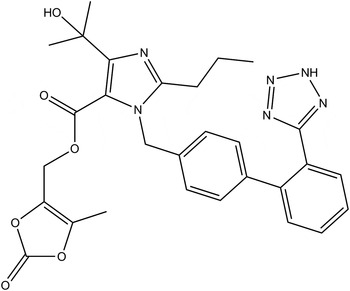
Olmesartan medoxomil (OLM, Figure 1) [systematic name (5-methyl-2-oxo-2H-1,3-dioxol-4-yl)-methyl-4-(2-hydroxypropan-2-yl)-2-propyl-1-(-[2-(2H-1,2,3,4-tetrazol-5-yl)-phenyl]phenylmethyl)-1H-imidazole-5-carboxylate] is an ester prodrug of olmesartan, which shows excellent pharmacological actions and good tolerance in clinical trials performed on hypertensive patients (Makoto et al., Reference Makoto, Toshio, Masahiro, Norio, Masaaki, Hiroaki and Hiroyuki1995; Smith et al., Reference Smith, Dubiel and Jones2005).
Structural formula of OLM.

The unit-cell parameters determined by single-crystal methods were reported by Hiroaki et al. (Reference Hiroaki, Yoshiya, Takuro, Yasuo, Koichi, Yoshiko, Toshio, Makoto, Masahiro, Shuichi, Youji and Hiroyuki1996) and Richard et al. (Reference Richard, Eric, Thomas, Alaloor, Hemmige and Thomas2013). The average values of cell parameters are a = 12.358(8), b = 21.232(9), c = 10.909(7) Å, α = γ = 90°, β = 101.05(5)°, unit-cell volume V = 2809.48 Å3, Z = 4, and space group P21/c. Until now, the detailed X-ray powder diffraction data have not been reported.
II. EXPERIMENTAL
A. Sample preparation
OLM (99.2% purity) was obtained from Wuhan Biocar Biology Technology Co., Ltd. The single crystal of OLM was obtained in acetone–water solution (V/V = 2:1) at room temperature. The crystal was then grinded into powder (T melt = 173 °C) and sieved through a 200-mesh screen. The experimental density of the title compound is 1.338 g cm−3 at 25 °C. The elemental analysis showed that the content of C, N, and H was 15.06, 62.36, and 5.04%, respectively.
B. Diffraction data collection and reduction
An X'Pert PRO diffractometer (PANalytical Co., Ltd., The Netherlands) equipped with a PIXcel one-dimensional (1D) detector and CuKα 1 radiation (generator setting: 40 kV and 40 mA) was used to obtain the X-ray powder diffraction data. The diffractometer was operated in the angular range from 4° to 50°, 2θ with a step size of 0.013 13°2θ, and a counting time of 30 ms step−1. All data were collected at relative humidity of 60% and temperature of 25 °C.
Data evaluation was carried out using the software package Material Studio 4.2 (Accelrys Co., Ltd., USA). The diffractogram was indexed by discover tools (Xu et al., Reference Xu, Liang, Wu, Zhang, Tang and Li2014; Zhang et al., Reference Zhang, Pan, Xiao, Wu, Wang and Li2014) and refined according to the Pawley methods (Engel et al., Reference Engel, Wilke, König, Harris and Leusen1999). After refinement, the final R wp was converged at 5.59%.
III. RESULTS
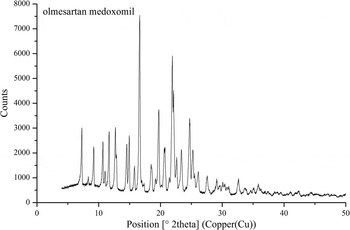
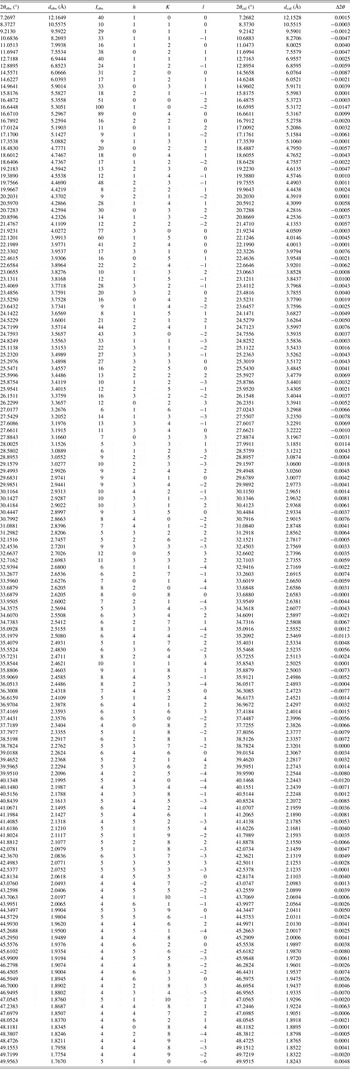
The experimental powder diffraction pattern is depicted in Figure 2. Indexing results confirmed that OLM is monoclinic with space group P21/c and unit-cell parameters: a = 12.3969(7), b = 21.2667(3) Å, c = 10.9603(5) Å, α = γ = 90°, β = 101.38(9)°, unit-cell volume V = 2832.72 Å3, and Z = 4 (Table I). Using Pawley refinement, the powder pattern of OLM was successfully indexed. These results are in good agreement with those single-crystal data of OLM.
X-ray powder diffraction pattern of the OLM recrystallized in acetone–water solution, using CuKα 1 radiation (λ = 1.540 56 Å).

Indexed X-ray powder diffraction data of OLM, C29H30N6O6. Only the peaks with I obs of 1 or greater are reported [a = 12.3969(7), b = 21.2667(3), c = 10.9603(5) Å, α = γ = 90°, β = 101.38(9)°, unit-cell volume V = 2832.72 Å3, Z = 4, and space group P21/c]. All measured lines were indexed and are consistent with the P21/c space group. The d-values were calculated using CuKα 1 radiation (λ = 1.5406 Å).

SUPPLEMENTARY MATERIAL
To view supplementary material for this article, please visit http://dx.doi.org/10.1017/S0885715615000925