Introduction
Cognitive and intellectual impairment have been consistently shown to be both a risk factor and a core manifestation of schizophrenia (SZ) and other related psychotic disorders. There is strong evidence from cohort studies that a decline in cognitive functioning (verbal reasoning in particular) precedes the onset of psychosis by almost a decade. However, a post-onset neurocognitive decline remains controversial. Thus, it seems that a cognitive reserve deficiency is considered a core component of the disorder and implies a worse neuropsychological and functional outcome in first-episode psychosis (FEP) (Kahn & Keefe, Reference Kahn and Keefe2013).
The relationships between antipsychotic drugs (AP) and cognitive impairment in SZ are under current debate. Previous studies had suggested a beneficial effect of AP on cognition in SZ patients (Harvey & Keefe, Reference Harvey and Keefe2001; Karson, Duffy, Eramo, Nylander, & Offord, Reference Karson, Duffy, Eramo, Nylander and Offord2016), but there is now agreement on their detrimental cognitive effects, even in studies using low doses (Karson et al., Reference Karson, Duffy, Eramo, Nylander and Offord2016). Moreover, AP may be initially beneficial only due to the amelioration of positive symptoms (Faber, Smid, Van Gool, Wiersma, & Van Den Bosch, Reference Faber, Smid, Van Gool, Wiersma and Van Den Bosch2012). In addition, over-treating FEP patients in the early remission stages appear to be problematic; we previously found in a cross-sectional study that moderate impairments in processing speed, verbal memory and global cognition were associated with high dopaminergic receptor blockade burden (Ballesteros et al., Reference Ballesteros, Sánchez-Torres, López-Ilundain, Cabrera, Lobo and González-Pinto2018). Clinicians must also take anticholinergic burden into account at this stage of the illness as this burden is also associated with verbal memory impairment (Ballesteros et al., Reference Ballesteros, Sánchez-Torres, López-Ilundain, Cabrera, Lobo and González-Pinto2018). In addition to these factors, and regarding chronic administration of AP, it has been demonstrated that anticholinergic burden has a negative impact on the outcomes of psychosocial treatment, and this effect appears to be specifically mediated through impaired cognitive capacity (O'Reilly et al., Reference O'Reilly, O'Connell, Donohoe, Coyle, O'Sullivan, Azvee and Kennedy2016).
Accumulated evidence supports the efficacy of AP in acute episodes of SZ and psychosis, accounting for a partial or full remission of acute symptomatology and recovery of short term psychosocial function (Kane, Leucht, Carpenter, & Docherty, Reference Kane, Leucht, Carpenter and Docherty2003; Strålin, Skott, & Cullberg, Reference Strålin, Skott and Cullberg2018). However, we may hypothesise that cognitive AP impairment affects long term prognosis rather than positive amelioration. Thus, recent authors have raised concerns regarding the long term detrimental effects due to AP in long term functional recovery for people with FEP (Wunderink, Nieboer, Wiersma, Sytema, & Nienhuis, Reference Wunderink, Nieboer, Wiersma, Sytema and Nienhuis2013). When studying the literature about the cumulative effects of AP over time on social function, we have found that the evidence has been analogous to the effects on cognition according to a recent controlled trials systematic review. The systematic review showed that during the initial stages (1-year follow-up period), a greater improvement in social function was found in the medicated group of FEP patients compared to the dose reduction/discontinuation group. However, no group differences were observed with 3-year and 10-year follow-up periods (Omachi & Sumiyoshi, Reference Omachi and Sumiyoshi2018). On the other hand, it was particularly interesting that a 7-year follow-up study found superiority for the dose reduction/discontinuation regimen compared to the maintenance group in terms of social outcomes, and interestingly, relapse rates between the two groups were equal after 3 years (Alvarez-Jimenez et al., Reference Alvarez-Jimenez, O'Donoghue, Thompson, Gleeson, Bendall, Gonzalez-Blanch and McGorry2016).
Hence, taking pharmacological and psychosocial steps to ameliorate this burden at the early stages of the illness may be helpful to prevent cognitive and the consequent functional decline (Amoretti et al., Reference Amoretti, Bernardo, Bonnin, Bioque, Cabrera, Mezquida and Torrent2016). The PEPs project previously confirmed the hypothesis of a detrimental effect of dopaminergic and anticholinergic AP burden on cognition in partially stabilised patients (Ballesteros et al., Reference Ballesteros, Sánchez-Torres, López-Ilundain, Cabrera, Lobo and González-Pinto2018).
Aims of the study
In the present study, we will address whether the above-mentioned effects were longitudinally confirmed over 2 years. We hypothesise that cognition may serve as a mediator of a deleterious effect of dopaminergic and anticholinergic burden on social functioning in stabilised FEP patients.
Subjects
This study is part of a project called ‘Phenotype-genotype and environmental interaction. Application of a predictive model in first psychotic episodes’ (also called the PEPs project) (Bernardo et al., Reference Bernardo, Bioque, Parellada, Saiz Ruiz, Cuesta and Llerena2013). This is a 2 year longitudinal, multicentre and naturalistic study of 157 patients with FEP (age range: 16–35 years) recruited from inpatient units and outpatient clinics of 16 psychiatry centres throughout Spain.
The exclusion criteria included major medical and neurological illnesses, history of head injury with cognitive sequelae and mental retardation according to the Diagnostic and Statistical Manual of Mental Disorders, 4th edition (DSM-IV) criteria (American Psychiatric Association, 1994). Patients with suicidal ideation or a substance use disorder, who are frequently excluded from FEP studies, were allowed to participate (Bernardo et al., Reference Bernardo, Bioque, Parellada, Saiz Ruiz, Cuesta and Llerena2013). Our study inclusion criteria were having present positive/negative symptoms for at least 1 week in duration and less than 1 year and be 16 to 35 years old, to avoid excluding the population with early-onset psychosis.
Patients were clinically assessed on five occasions: at recruitment (baseline) and then at 2 months, 6 months, 1 year and 2 years. The patients’ cognitive assessments were performed at the 2-month and 2-year visits. Cognitive assessments were carried out when acute symptomatology was remitted or was notably improved to ensure the cooperation of the patients.
For the purposes of the present study, we included only those patients who completed seven or more of the 10 neuropsychological tests used in the study and this represented more than 50% of the sample. The patients agreed to cooperate in all clinical and cognitive assessments during the 2-year follow-up. The final sample comprised 157 patients after removing those with missing data for statistical analyses.
Methods
Clinical assessments
The scales included in the PEPs project protocol were administered by expert clinicians with the exception of those that were self-administered [see (Bernardo et al., Reference Bernardo, Bioque, Parellada, Saiz Ruiz, Cuesta and Llerena2013) for detailed information]. All subjects gave written informed consent in accordance with local institutional review board guidelines.
Demographic and premorbid data were collected for all participants, including age, sex, years of education, current occupation and living arrangements. Psychopathological assessments were carried out with the Positive and Negative Symptom Scale (PANSS) (Kay, Fiszbein, & Opler, Reference Kay, Fiszbein and Opler1987; Peralta & Cuesta, Reference Peralta and Cuesta1994). We used the functioning assessment short test (FAST), which is a scale designed to assess the main functioning problems experienced by psychiatric patients. FAST comprises 24 items that assess impairment or disability in six specific areas of functioning: autonomy, occupational functioning, cognitive functioning, financial issues, interpersonal relationships and leisure time. The rater asks the patient about areas of difficulty in functioning and scores according to the following scale: (0) no difficulty, (1) mild difficulty, (2) moderate difficulty and (3) severe difficulty (Rosa et al., Reference Rosa, Sánchez-Moreno, Martínez-Aran, Salamero, Torrent, Reinares and Vieta2007). Considering our hypothesis, we used FAST score excluding cognitive items. Diagnoses were determined with the structured clinical interview for DSM-IV axis I and II disorders (SCID-I and II).
In this study, the antipsychotic dosage was measured using equivalents of chlorpromazine (CPZ score). We used the equivalences of Gardner as their findings provided broad, international, expert consensus-based recommendations for most clinically employed antipsychotic drugs (Gardner, Murphy, O'Donnell, Centorrino, & Baldessarini, Reference Gardner, Murphy, O'Donnell, Centorrino and Baldessarini2010).
We also measured the anticholinergic burden as part of the drug treatment plan assessed at the same time as the cognitive/clinical evaluation by using the Drug Burden Index (DBI) Scale for the anticholinergic component. The DBI is a quantitative method used to measure the extent of anticholinergic burden of all medications used by our participants. Each medication drug was scored depending on its rates of anticholinergic effects and dose. The DBI was used to calculate the anticholinergic burden of psychopharmacologic drugs as it is associated with important negative outcomes, such as cognitive and functional decline (Welsh, van der Wardt, Ojo, Gordon, & Gladman, Reference Welsh, van der Wardt, Ojo, Gordon and Gladman2018). To account for the cumulative CPZ and anticholinergic equivalent doses, we used a proxy measure by averaging/weighting the baseline, 2-month and 2-year medication values with the CPZ score and DBI burden.
Cognitive assessments
Cognitive functioning was assessed using a comprehensive battery of 10 standardised neuropsychological tests validated in the Spanish population. The battery was designed to encompass 6 of the 7 cognitive domains assessed in the MATRICS battery: attention, processing speed, working memory, verbal memory, executive functions and social cognition (Green & Nuechterlein, Reference Green and Nuechterlein2004; Green et al., Reference Green, Nuechterlein, Gold, Barch, Cohen, Essock and Marder2004). Handedness and premorbid IQ (PIQ) were also assessed. We administered the same battery of neuropsychological tests in our previous study assessing cognition (Ballesteros et al., Reference Ballesteros, Sánchez-Torres, López-Ilundain, Cabrera, Lobo and González-Pinto2018) at 2 months and 2 years. The cognitive battery was applied following the clinical stabilisation of acute psychotic symptoms to maximise collaboration and avoid acute psychosis state effects of acute psychosis according to previous literature (González-Blanch et al., Reference González-Blanch, Pérez-Iglesias, Rodríguez-Sánchez, Pardo-García, Martínez-García, Vázquez-Barquero and Crespo-Facorro2011).
The tests were administered by experienced neuropsychologists in two sessions of 1–1.5 h and were conducted sequentially in the same order from the lowest to the highest level of difficulty to reduce as much as possible the effect of fatigue and to facilitate cooperation. A good to excellent inter-rater reliability among psychologists was indicated by intraclass correlation coefficients >0.80 for two of the tests in the battery: the Wechsler Adult Intelligence Scale vocabulary subtest and Wisconsin card-sorting test, in which the final scores may partially depend on the judgement of the psychologist administering and correcting the test.
Statistics
All neuropsychological variables were transformed into standard equivalents (z-scores) (Ballesteros et al., Reference Ballesteros, Sánchez-Torres, López-Ilundain, Cabrera, Lobo and González-Pinto2018), which are hereafter used when we describe psychopathological, cognitive, functioning and 2-year weighted drug variable (CPZ equivalents and DBI scores) values. The scores were standardised against the healthy control group of the PEPsCog study (Cuesta et al., Reference Cuesta, Sánchez-Torres, Cabrera, Bioque, Merchán-Naranjo and Corripio2015).
Pearson product-moment correlation coefficients were computed to assess the relationship between cognitive functioning in different domains and weighted daily doses of AP quantified by the CPZ scores and the weighted DBI scores. All comparisons were two tailed and Bonferroni corrected (Grove & Andreasen, Reference Grove and Andreasen1982).
Six specific mediation analyses were carried out to test the specificity of the relationship between the dopaminergic receptor blockade burden of APs, PANSS score, cognition and IQ at 2 years and patients' functioning measured by the FAST scale. We examined whether cognitive performance across dimensions and PANSS score mediated the relationship between CPZ burden and FAST score at 2 years. We repeated the same analyses for anticholinergic burden. For CPZ models, the anticholinergic burden variable was added as a covariate as it was considered a potential confounding variable and, conversely, although not depicted in online supplementary Table S1, we added the CPZ score as a covariate for the DBI models.
SPSS PROCESS macro model 4 with parallel mediators (Bolin, Reference Bolin2014) was used to analyse the mediation relationships between anticholinergic burden measured by the DBI scale and dopaminergic receptor blockade burden measured by CPZ score (we used the weighted pharmacologic values for all mediation analyses). Outliers were detected by calculating and examining Mahalanobis’, Levene's and Cook's distance. Linear regressions in SPSS were performed to produce plots of residuals and assumptions of additivity, normality, linearity and homogeneity were also checked prior to all mediation analyses. Unstandardised effect sizes were generated for the mediation models using 10.000 bootstrap samples as a random resampling process for databases with missing data (Hayes, Reference Hayes2018). Probe interactions significance was adjusted to <0.01 due to multiple comparisons and 95% bias-corrected confidence intervals (CI) were calculated. Statistical procedures were carried out using IBM SPSS 21st version.
Results
Descriptive data of the sample
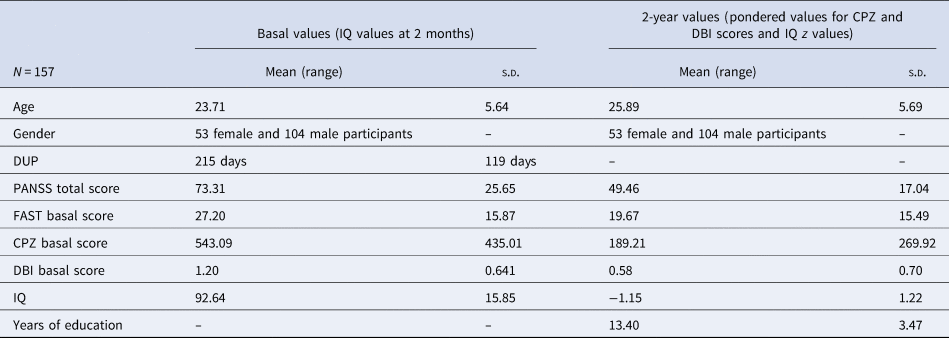
Of the patients who could be included in our study, 157 FEP patients gave informed consent to participate in this study for 2 years. Among them, 71 patients received a diagnosis of SZ, whereas the remaining sample was diagnosed with affective disorders (30 patients) and other/non-specified psychosis (56 patients). Clinical severity across different psychopathological dimensions, PIQ and other descriptive variables between both groups are depicted in Table 1. The PEPsCog study sample and inclusion criteria are described by Cuesta et al. (Reference Cuesta, Sánchez-Torres, Cabrera, Bioque, Merchán-Naranjo and Corripio2015).
Socio-demographic variables

s.d., standard deviation; DBI, anticholinergic drug burden index; CPZ score, chlorpromazine equivalent values; PANSS, Positive and Negative Symptom Scale; IQ, Intelligence Quotient; FAST, functioning assessment short test.
Second, we compared demographic, clinical and cognitive variables between patients included in the study and those who had not completed seven or more cognitive tests at the 2-year visit or withdrew from the study during the follow-up. Participants were significantly younger than patients who were not included (mean ages of 23.65 ± 5.64 and 25.07 ± 5.34 years; t = 2.05, p = 0.041, respectively). No differences were found in sex or parental socioeconomic status or in any clinical or cognitive measure.
Bivariate analysis: effects of dopaminergic and anticholinergic burden across cognitive domains and on social functioning
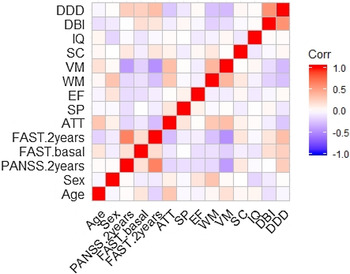
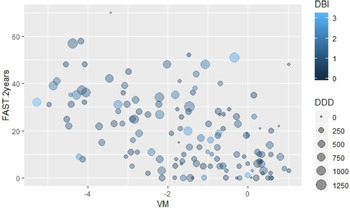
CPZ was significantly and negatively associated with IQ at 2 years and performance in 3 cognitive domains (attention, working memory and verbal memory) after Bonferroni correction. We did not find significant results for anticholinergic burden comparisons. On the other hand, the FAST total score showed significant results in the hypothesised direction only for CPZ (but not with the anticholinergic variable). The significant results showed small to moderate strength according to the Cohen criteria (Rice & Harris, Reference Rice and Harris2005) in both cases (r values ranged from −0.24 to −0.31 regarding CPZ and the significant cognitive domain correlations, whereas the r value was 0.34 for the correlation between CPZ burden and the 2-year FAST total score). See Figs 1 and 2 (and also online supplementary Table S1 in supporting information for r and p values of bivariate analysis).
Correlation matrix bivariate analyses showing coefficient scores. ATT, attention; SC, social cognition; IQ 2y, intellectual quotient at 2 years; VM, verbal memory; WM, working memory; SP, speed processing; EF, executive functions; Panss, PANSS values measured at 2 years.

Bubble and scatter chart showing the relationship between verbal memory (VM) and FAST at 2 years (FAST.2 years). Data is plotted as bubbles of varying sizes and intensity of colour depending on CPZ scores (represented as DDD) and DBI values respectively. All the participants with no missing data in these four variables are represented in the chart.

Cognition as a mediator between dopaminergic/anticholinergic burden and social functioning
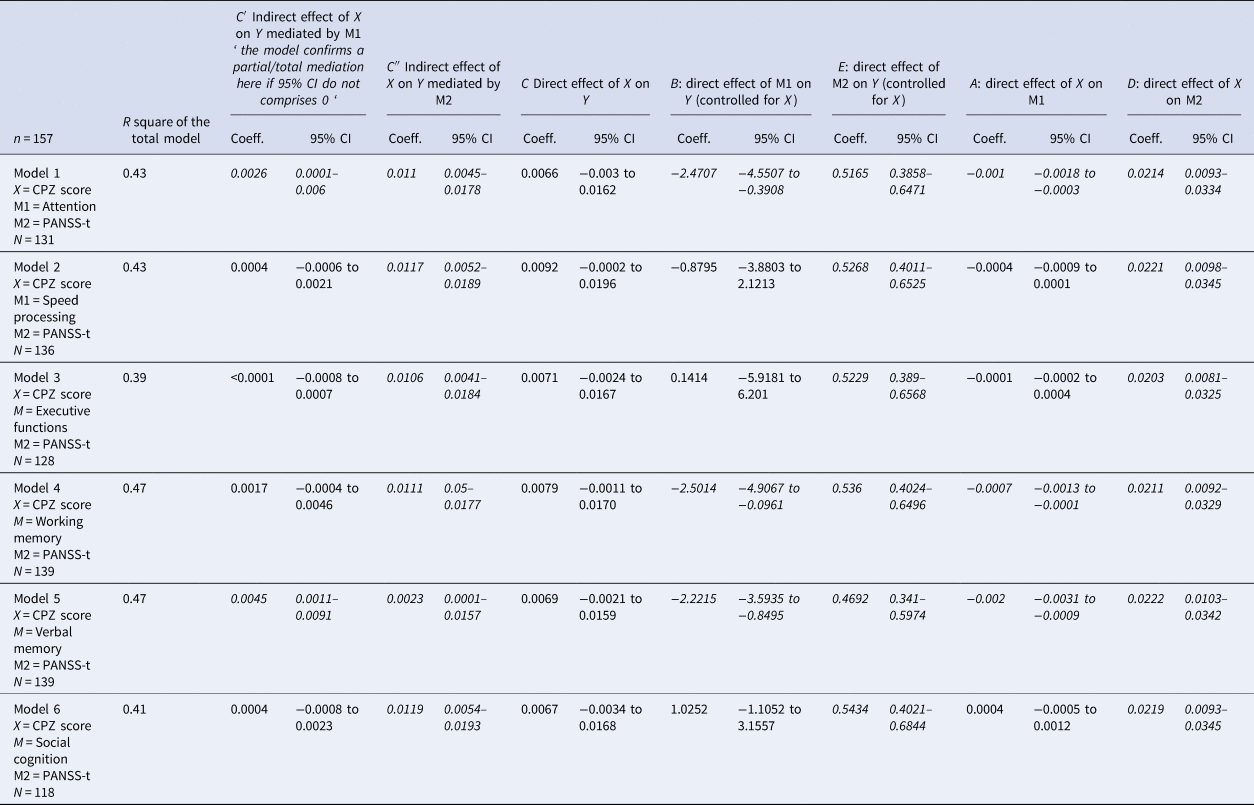
To test the hypothesis that the CPZ score had an effect on the mediators, each of the cognitive MATRICS domains and PANSS total score, which in turn influenced the 2-year FAST total score, we performed ‘PROCESS macro model 4 with parallel mediators’. In the models numbered from 1 to 6 in Table 2, DBI score was entered as covariate for all coefficients. CPZ was added as covariate in the anticholinergic model, respectively.
PROCESS model analyses for FAST total score as Y variable

CI, confidence interval; DBI, anticholinergic drug burden index; CPZ score, chlorpromazine equivalent values; PANSS, Positive and Negative Symptom Scale; IQ, Intelligence Quotient; FAST, functioning assessment short test.
In all cases, the outcome (Y) is ‘FAST total score at 2 years’. X is the hypothesised determinant factor and M1 and M2 are the hypothesised mediating factor.
For CPZ models DBI was added as covariate and, inversely but not depicted in the table, we added CPZ as covariate for DBI models.
Significant values are shown in italics (p < 0.008).
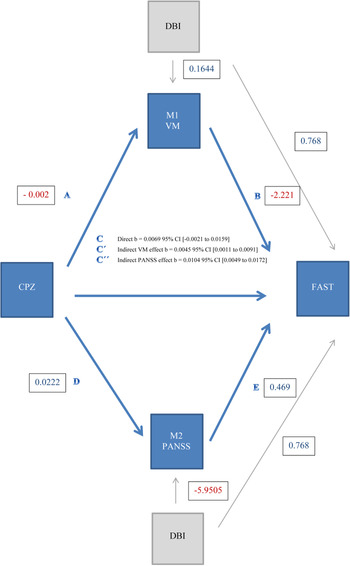
There was evidence of mediation for the attention domain (M variable) as an indirect effect of CPZ (X variable) on the 2-year FAST total score (Y variable). The indirect effect of X on Y had a coefficient value of 0.0026 (95% CI 0.0001–0.0006). Analogous results were found for verbal memory and (b = 0.0045, 95% CI 0.0011–0.0091), see Table 2, online supplementary Tables S2–S7 and Fig. 3 for details.
Model 4 of PROCESS with parallel mediator analyses for verbal memory as M1. C, direct effect of X on Y, before mediation via M1 and M2; C′, indirect effect of X on Y after mediation via M1; C″, indirect effect of X on Y after mediation via M2; X:is CPZ as independent variable; M1 and M2: are verbal memory and PANSS as variables that serve as mediators; Y: FAST score as dependent variable.

The anticholinergic burden did not show partial or complete mediation via cognition regarding the effects of DBI on the 2-year FAST total score when controlling for CPZ score and other variables (data not depicted in Table 2).
Post hoc analyses
Subgroup analyses of anticholinergic burden
As higher anticholinergic burden is associated with negative brain effects, poorer cognitive and functional outcomes and its adverse effects are dose dependent (9), we performed mediation analyses in obtained in the high anticholinergic subgroup at 2 years (a group of patients with DBI scores in the highest quartile of our sample). Again, there were also no significant results.
Controlling premorbid IQ as covariate
We performed the same mediation analyses exploring the mediation relationship between CPZ as independent variable, cognition and PANSS-t as mediators and FAST functioning as dependent variable without covariates was also conducted finding similar results. Additionally, we also performed the same analysis entering as covariates DBI and premorbid IQ as the latter has been considered an outcome predictor of social functioning in FEP (Amoretti et al., Reference Amoretti, Cabrera, Torrent, Mezquida, Lobo and González-Pinto2018). This analysis again used PROCESS and 10.000 bootstrapped samples. In total the model accounted for 47.95% of the variance of functioning (FAST) when verbal memory was entered as a mediator. We found that entering premorbid IQ as covariant did not substantially alter the statistical mediation for verbal memory. The total effect of CPZ on functioning (FAST) was significant (b = 0.017, 95% CI 0.0059–0.028). Secondly, there was a significant effect between CPZ and the mediator verbal memory (b = −0.0012, 95% CI −0.0023 to −0.0001). There is also an indirect effect via verbal memory (b = 0.009, 95% CI 0.033–0.0151). The direct effect of CPZ on functioning (FAST) was not significant (b = 0.0057, 95% CI −0.034 to 0.0149) showing full mediation for verbal memory. Analogously, post hoc analyses with attention as a mediator variable did not show significant results (see supporting information online supplementary Tables S8 and S9 for details).
Discussion
The main results of this study were that the higher the 2-year dopaminergic receptor blockade burden of antipsychotic drugs, the poorer the psychosocial functioning in FEP patients. In addition, the strength of the effect of CPZ on the 2-year FAST outcome was statistically moderate and completely mediated by verbal memory impairment (but not the remaining five cognitive domains). These results could not be replicated for anticholinergic burden, as shown in our mediation models. Nevertheless, the clinical relevance of the dopaminergic receptor blockade burden mediated by verbal memory impairment over 2-year functioning was very modest since for every 600-point CPZ score of the AP, the 2-year FAST total score increased only 1.38 points out of the maximum range of 72 points.
In line with our results, the discontinuation of AP does not seem to improve or worsen functionality at this stage of the intervention (3 years) (Alvarez-Jimenez et al., Reference Alvarez-Jimenez, O'Donoghue, Thompson, Gleeson, Bendall, Gonzalez-Blanch and McGorry2016; Omachi & Sumiyoshi, Reference Omachi and Sumiyoshi2018). We also controlled for factors that may have impaired functionality at this stage as clinical symptomatology (Mayoral-van Son et al., Reference Mayoral-van Son, de la Foz, Martinez-Garcia, Moreno, Parrilla-Escobar, Valdizan and Crespo-Facorro2016). Some authors have found a beneficial effect of reduction/discontinuation of AP on functioning in a 7-year follow-up RCT (Wunderink et al., Reference Wunderink, Nieboer, Wiersma, Sytema and Nienhuis2013). Our results found this association in the same direction at 2 years, but its magnitude was clinically less relevant. However, in addition to the different length of follow-up evaluation across the two studies, we cannot compare the magnitude of these effects for several reasons. First, the approach was different (RCT v. naturalistic study), but there were also important differences in the clinical features of the sample, e.g. a lower duration of untreated psychosis (DUP) and higher baseline symptomatology. Supporting this notion, the Wunderink trial found that severe negative symptoms, usually associated with higher DUP, predicted worse functional recovery (Galderisi et al., Reference Galderisi, Mucci, Bitter, Libiger, Bucci and Fleischhacker2013).
Verbal memory and symptomatology were factors that mediated the effect of dopaminergic receptor blockade burden on functioning in our study. Regarding the first factor, previous studies have also highlighted how impairments in verbal memory slightly worsened functioning in patients with FEP (Jordan et al., Reference Jordan, Lutgens, Joober, Lepage, Iyer and Malla2014). Moreover, this cognitive domain serves as a predictor of relapse in the early stage of SZ (Chang et al., Reference Chang, Ming Hui, Yan Wong, Wa Chan, Ming Lee and Hai Chen2013). Our study also suggested that clinical improvement due to AP may be mildly beneficial for better psychosocial functioning of patients with FEP in the short term, but the nature of this mediation is likely relatively weaker than in later stages of the illness, such as acute stabilisation. The relation between these variables is consistent with previous literature, as poor functional outcomes and cognitive impairment are also strong predictors of AP clinical refractoriness (Chiliza, Asmal, Kilian, Phahladira, & Emsley, Reference Chiliza, Asmal, Kilian, Phahladira and Emsley2015).
It is worth mentioning that, as our FEP sample also comprised patients with affective and SZ spectrum disorders, our findings cannot be generalised to chronic SZ patients. Previous literature has shown that AP made modest improvements in psychosocial functioning in chronic SZ (Swartz et al., Reference Swartz, Perkins, Stroup, Davis, Capuano and Rosenheck2007) compared to bipolar disorder (Deckersbach et al., Reference Deckersbach, Nierenberg, McInnis, Salcedo, Bernstein, Kemp and Kamali2016) patients. Nevertheless, ongoing studies such as the ‘OPTiMiSE trial’ seem necessary, as they will add practical evidence by establishing an algorithm of switching AP based on clinical responses and psychosocial functioning (Leucht et al., Reference Leucht, Winter-van Rossum, Heres, Arango, Fleischhacker, Glenthøj and Sommer2015).
Regarding our anticholinergic hypothesis, our results are in partial disagreement with those of O´Reilly et al. in a chronic SZ sample (O'Reilly et al., 2016). However, the treatment regimen may account for these differences, as our patients had lower dopaminergic and anticholinergic burdens. Taking into account the results of O'eilly et al. and our previous findings of anticholinergic-based impaired cognition in the initial stages of FEP (Ballesteros et al., Reference Ballesteros, Sánchez-Torres, López-Ilundain, Cabrera, Lobo and González-Pinto2018), we may speculate that the weight of this effect on functioning depends on the stage of remission in FEP patients. It is worth mentioning that we did not individually study the deleterious effects of anticholinergic treatment on cognition in the context of movement disorders. Moreover, diminishing this kind of medication would be clinically relevant in adult (Ogino, Miyamoto, Miyake, & Yamaguchi, Reference Ogino, Miyamoto, Miyake and Yamaguchi2014) and geriatric samples (Drimer, Shahal, & Barak, Reference Drimer, Shahal and Barak2004). Nevertheless, our results are consistent with previous literature in which statistical findings are translated to practical or meaningful results for patients. Thus, a cross-sectional study of 705 SZ participants showed that a higher cumulative anticholinergic burden was associated with poorer executive functioning, memory/fluency, processing speed and global cognition, but its impact was doubtful in clinical terms (Ang et al., Reference Ang, Abdul Rashid, Lam, Rapisarda, Kraus, Keefe and Lee2017).
However, several limitations should be considered. First, only a portion of the potential mediating factors were controlled for in this model of mediation, as we did not control others as side effects such as metabolic syndrome or the ‘still controversial’ deleterious effects on the brain structure (Murray et al., Reference Murray, Quattrone, Natesan, van Os, Nordentoft, Howes and Taylor2016; Salimi, Jarskog, & Lieberman, Reference Salimi, Jarskog and Lieberman2009). Another argument sustaining the idea that our study only approximates a causal design is that PROCESS model 4 is used for mediation but not to study potential moderators (such as age or sex) and, therefore, they were not included in statistical analyses. Furthermore, our study did not follow a fixed dose design so we cannot rule out channelling bias where severe patients receive larger doses (Petri & Urquhart, Reference Petri and Urquhart1991). However, our results are consistent by several reasons as we may conceptually assume time and causal order for PANSS and verbal memory to test our hypothesis. Both variables also fit with the definition of mediators as they ‘describe the process by which the intervention achieves its effects’ (Mackinnon, Reference Mackinnon2011). In addition to this, we may argue that the main potential mediating factors probably were controlled, as some authors have stated that psychopathology explains between 29% and 36% of the treatment effect on functioning, whereas they did not observe sizeable increases in weight gain (Zou et al., Reference Zou, Zhu, Jackson, Bellavia, Fitzmaurice, Centorrino and Valeri2018). In the future, ongoing dose reduction v. drug-naïve controlled trials in patients with FEP will better define the nature of this association (O'Donoghue et al., Reference O'Donoghue, Francey, Nelson, Ratheesh, Allott, Graham and McGorry2018). Lastly, channelling bias problem regarding clinical severity could be overcome by including control group and, additionally, path mediation analysis would be required to study other potential explanations of this relationship such as emotional numbing or sedation due to AP (Read & Williams, Reference Read and Williams2019).
Second, the duration of the study was 2 years. Thus, we cannot clarify the long-term effects of AP in chronic samples. It would clarify if this effect becomes more significant as some concerns have been raised regarding AP's contribution to work functioning over decades of treatment (Harrow, Jobe, Faull, & Yang, Reference Harrow, Jobe, Faull and Yang2017). However, it is worth to mention that there is evidence that supports the idea of maintaining AP administration, at least at low doses, as their long-term efficacy and effectiveness, including impacts on life expectancy, outweighs the evidence against AP medication (Correll, Rubio, & Kane, Reference Correll, Rubio and Kane2018). In other words, considering reduced dosing regimen of AP administration in stable patients is a favourable option in terms of the benefit-to-risk ratio.
Third, we did provide a weighted average of medication dosage throughout the period of time of the study (2 years) which represents a rough estimation where adherence was based on patient report. However, previous studies showed that adherence as measured by patient report were in good agreement with other measures such as pill count (Cassidy, Rabinovitch, Schmitz, Joober, & Malla, Reference Cassidy, Rabinovitch, Schmitz, Joober and Malla2010). Additionally, our data may have showed the effect of medication from early stages in our sample as it had shorter DUP (215 ± 119 days) compared to previous studies regarding the objectives of this manuscript (Wunderink et al., Reference Wunderink, Nieboer, Wiersma, Sytema and Nienhuis2013).
Finally, but not least, we did not control baseline cognitive measurements in multivariate analyses (the earliest time point of cognitive assessment is 2 months). Hence, our study did not addressed cognitive impairments that have already occurred by the 2 month time-point but post hoc analysis controlling baseline cognition related variables (such as premorbid IQ) was not contradictory.
Conclusions
The data presented in this naturalistic study support the notion that CPZ during the first 2 years of FEP is significantly associated with lower psychosocial performance, and this effect is significantly mediated by impairments in verbal memory. However, the clinical relevance in terms of the magnitude of change is functioning was doubtful.
These results represent a valuable contribution with regard to assessing the pros and cons of discontinuing AP medication in patients with FEP considering the consensus regarding the risk of relapse for those who undergo this strategy (Taylor, Cavanagh, Hodgson, & Tiihonen, Reference Taylor, Cavanagh, Hodgson and Tiihonen2012; Thompson et al., Reference Thompson, Winsper, Marwaha, Haynes, Alvarez-Jimenez, Hetrick and Sullivan2018). Moreover, AP discontinuation has been considered regardless of the risk of the underlying disorder (Moncrieff, Reference Moncrieff2006) but gradual reduction is generally recommended in FEP stabilised patients rather than abrupt 4 weeks discontinuation as it reduces relapse rates (Landolt et al., Reference Landolt, Rössler, Ajdacic-Gross, Derks, Libiger and Kahn2016; Viguera, Baldessarini, Hegarty, van Kammen, & Tohen, Reference Viguera, Baldessarini, Hegarty, van Kammen and Tohen1997; Wunderink et al., Reference Wunderink, Nieboer, Wiersma, Sytema and Nienhuis2013). We may conclude that the clinician should put into balance patient's preferences and risk of relapse considering that patients value social functioning over reduction of their positive symptoms (Gunnmo & Bergman, Reference Gunnmo and Bergman2011) while recent literature has suggested reviewing current recommendations for AP lengths of 2–5 years to more than a decade in some cases (Andreasen, Liu, Ziebell, Vora, & Ho, Reference Andreasen, Liu, Ziebell, Vora and Ho2013; Weller et al., Reference Weller, Gleeson, Alvarez-Jimenez, McGorry, Nelson, Allott and Killackey2018). Although speculative, this length would likely depend on risk predictors detected in the initial stages (Suvisaari et al., Reference Suvisaari, Mantere, Keinänen, Mäntylä, Rikandi, Lindgren and Raij2018) or present prior to the illness onset (Fusar-Poli et al., Reference Fusar-Poli, Byrne, Valmaggia, Day, Tabraham, Johns and Team2010).
In conclusion, our findings support the idea of maintaining low AP doses, among other recommendations in FEP early case intervention, such as intensive recovery, psychosocial treatments and intensive monitoring (Carpenter, Appelbaum, & Levine, Reference Carpenter, Appelbaum and Levine2003). However, regarding clinical recovery, ongoing AP trials focused on risk predictors and other mediating factors will enhance the approach of AP management in the forthcoming years.
Supplementary material
The supplementary material for this article can be found at https://doi.org/10.1017/S003329172000080X
Acknowledgements
We thank our patients for participating in this study.
Financial support
This study is part of a coordinated, multicentre project funded by the Ministerio de Economía y Competitividad (PI08/0208; 08/1026; 11/02831; PI08/1161; PI14/1621), Instituto de Salud Carlos III-Fondo Europeo de Desarrollo Regional, and European Union. Una manera de hacer Europa (FEDER Funds). The Health Department of the Government of Navarra (87/2014). CERCA Programme/Generalitat de Catalunya; Secretaria d'Universitats i Recerca del Departament d'Economia i Coneixement (2014|SGR1636, 2014SGR441) and Fundación Alicia Koplowitz.
Conflict of interest
Dr R. Rodriguez-Jimenez has been a consultant for, spoken in activities of, or received grants from: Instituto de Salud Carlos III, Fondo de Investigación Sanitaria (FIS), Centro de Investigación Biomédica en Red de Salud Mental (CIBERSAM), Madrid Regional Government (S2010/ BMD-2422 AGES; B2017/BMD-3740 AGES CM 2-CM), JanssenCilag, Lundbeck, Otsuka, Pfizer, Ferrer, Juste, Takeda. Dr Miguel Gutiérrez Fraile has been on the speakers/advisory board of Janssen-Cilag.
Appendix 1
*PEPs Group: Clemente García-Rizo, Rafael Penadés, Covadonga M. Diaz-Caneja, Jessica Merchan-Naranjo, Anna Alonso-Solís, Mireia Rabella, Itxaso González-Ortega, Sainza García, Fe Barcones, Pedro Modrego, Julio Sanjuán, Carlos Cañete, Dani Bergé, Clara Montserrat, Joaquin Gil-Badenes, Susana Gomes Da Costa, Josefina Castro-Fornieles, Olga Puig Navarro, Fernando Contreras Fernández, Cristina Saiz-Masvidal, Leticia García Álvarez, Teresa Bobes Bascarán, Miguel Gutiérrez Fraile, Arantzazu Zabala Rabadán, Mónica Dompablo, Roberto Rodriguez-Jimenez, Judith Usall, Anna Butjosa, Salvador Sarró, Ramón Landín-Romero, Ángela Ibáñez, Gustavo Gil Berrozpe, Vicent Balanzá-Martínez.