


Credibility lies at the heart of many strategic questions. When credible signals cannot be sent, bad outcomes, including war (Fearon Reference Fearon1995), can arise. The problem is that a person cannot credibly signal her private information when others know she has an incentive to bluff. The most famous solution to the problem is costly signaling.Footnote 1 When a resolved person sends a costly signal that an unresolved person is unlikely to send due to the costs, the resolved person may separate herself from the unresolved.
Two general mechanisms of costly signaling are known in international relations (IR): sinking costs and tying hands (Fearon Reference Fearon1997). In the first, the costs incurred by the signaler are sunk and irrecoverable. In the second, the signal is costly in the future if the signaler reneges but costless otherwise. Almost all subsequent work on costly signaling in IR have worked off Fearon’s (Reference Fearon1997) canonical mechanisms. This paper proposes two additional mechanisms that are equally general as the canonical two.
The paper contributes on three fronts. Theoretically, I establish the existence of four mechanisms of costly signaling. Leveraging the dimensions of time horizon and cost contingency that define sunk and tied-hands costs, I derive the two new mechanisms of installment and reducible costs. Substantively, I develop the new mechanisms by analyzing their signaling logic and illustrating their relevance in international politics. Empirically, I provide experimental evidence on whether and how the signaling mechanisms shape the perception of credibility. I find that sunk, tied-hands, and installment costs produce kinked credibility curves, whereby credibility does not improve across costless and low-cost signals but spikes for a high-cost signal. Reducible costs are the exception, whereby credibility improves significantly across costless, low-cost, and high-cost signals.
I proceed as follows. First, I provide the theoretical framework and develop the substantive implications. Further, I describe a series of controlled experiments that test the credibility effects of the four signaling mechanisms. Finally, I discuss the potential implications and unresolved questions for future research.
FOUR MECHANISMS
Spence (Reference Spence1976, 593) proposed “two qualitatively different types” of signaling mechanisms in economics: “exogenously costly signaling,” which is formalized in Spence’s (Reference Spence1973) pathbreaking paper, and “contingent contract,” which is discussed in Spence (Reference Spence1976). Defined in market terms, the exogenously costly signal is “an activity engaged in by the seller, which has a cost that varies with product quality, independent of the buyer’s response to the activity”; and the “contingent contract” is “a menu of options for the seller that are created by virtue of the buyer’s subsequent ability to observe the product quality directly, and, to transact with the seller at that point” (Spence Reference Spence1976, 593). These ideas were clarified and adapted into IR by Fearon (Reference Fearon1997) as two general mechanisms of costly signaling: sinking costs and tying hands.
Fearon (Reference Fearon1997, 70) defined sunk-cost signals as “actions that are costly for the state to take in the first place but do not affect the relative value of fighting versus acquiescing in a challenge.” Tied-hands signaling involves “an action that increases the costs of backing down if the would-be challenger actually challenges but otherwise entails no costs if no challenge materializes.” Almost all subsequent work on costly signaling in IR have worked off these two mechanisms (reviewed in Gartzke et al. Reference Gartzke, Carcelli, Andres Gannon and Zhang2017).
A large body of research has applied costly signaling across diverse domains. Directly relevant domains in IR include diplomacy, deterrence, and reputation (reviewed in Dafoe, Renshon, and Huth Reference Dafoe, Renshon and Huth2014 and Trager Reference Trager2016; see also Sartori Reference Sartori2005). Examples include the recent work on leader-specific reputation (e.g., Lupton Reference Lupton2018; McManus Reference McManus2018; Wu and Wolford Reference Wu and Wolford2018), covert communication (e.g., Carson and Yarhi-Milo Reference Carson and Yarhi-Milo2017; McManus and Yarhi-Milo Reference McManus and Yarhi-Milo2017), alliance commitments (e.g., Fang, Johnson, and Leeds Reference Fang, Johnson and Leeds2014), cyberwarfare (e.g., Gartzke and Lindsay Reference Gartzke and Lindsay2017), and fait accompli (e.g., Altman Reference Altman2017; Tarar Reference Tarar2016). Scholars have also applied costly signaling to better understand the conditions that sustain peace after civil wars (e.g., Hartzell and Hoddie Reference Hartzell and Hoddie2007; Mattes and Savun Reference Mattes and Savun2009; Mattes and Vonnahme Reference Mattes and Vonnahme2010; see also Reiter Reference Reiter2009), the implications of trade interdependence (e.g., Gartzke and Westerwinter Reference Gartzke and Westerwinter2016), the dynamics of trust and reassurance (e.g., Acharya and Ramsay Reference Acharya and Ramsay2013; Blankenship Reference Blankenship2020; Chan Reference Chan2012; Haynes and Yoder Reference Haynes and Yoder2020; Kydd Reference Kydd2005; Kydd and McManus Reference Kydd and McManus2017), and the signaling functions of international institutions such as the International Monetary Fund and United Nations (e.g., Dai, Snidal, and Sampson Reference Dai, Snidal and Sampson2017; Fang Reference Fang2008; Simmons Reference Simmons2000; Tago and Ikeda Reference Tago and Ikeda2015; Voeten Reference Voeten2005). Scholars have also applied costly signaling across the social sciences, from economics and sociology to anthropology and archaeology (reviewed in Bliege Bird and Smith Reference Bliege Bird and Smith2005; Gambetta Reference Gambetta, Hedstrom and Bearman2009; Quinn Reference Quinn and Prentiss2019; Riley Reference Riley2001).
Previous research has sharpened our understanding of costly signaling in important ways, but several puzzling aspects have also emerged. Conceptually, if sunk costs are sunk and have no time horizon by definition, how do we interpret situations where the signaler is committed to fixed costs over a future time horizon? Practically, we rarely see policymakers citing the logic of sinking costs when they send costly signals. Are there other logics of signaling that are more salient to policymakers? Empirically, recent research provides mixed evidence on the effectiveness of costly signaling (e.g., Fuhrmann and Sechser Reference Fuhrmann and Sechser2014; Quek Reference Quek2016; Snyder and Borghard Reference Snyder and Erica2011; Trachtenberg Reference Trachtenberg2012; Yarhi-Milo, Renshon, and Kertzer Reference Yarhi-Milo, Kertzer and Renshon2018). Yet, costly signaling is ubiquitous and governments often send costly signals to one another in the real world. Are there important theoretical aspects of costly signaling that have yet to be uncovered?
These puzzles raise the question of whether our existing theory of costly signaling is complete. Specifically, are there only two general mechanisms of costly signaling?
I check the logical completeness of the system in three steps. The first step returns to first principles: the nature of a costly signaling mechanism depends on the nature of the costs of the signal.
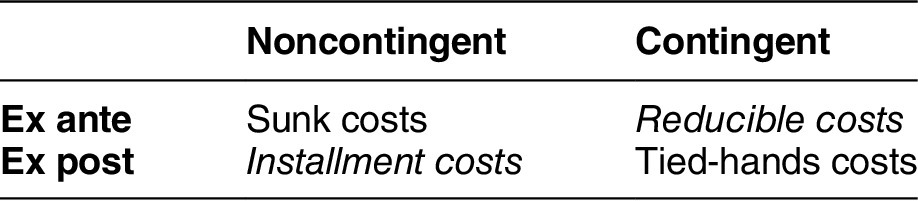
Next, I identify and generalize the nature of the costs that define each signaling mechanism. Fearon’s (Reference Fearon1997) sunk-cost mechanism is defined by costs with two properties: the costs are ex ante because they are already incurred in the present and noncontingent because they are incurred regardless of whether the signaler fulfills the threat. The tied-hands mechanism is also defined by two properties: the costs are ex post because they are incurred in the future and contingent because they are only incurred if the signaler does not fulfill the threat.Footnote 2 The dual properties of time horizon and cost contingency are the theoretical pivots in Fearon’s (Reference Fearon1997) mechanisms that lend each mechanism its particular character. These properties not only differentiate one mechanism from the other but also provide the common denominators that unify both into the same framework.
Finally, I check whether this framework is complete with only two signaling mechanisms. Because there are two properties, and because each property is binary, there are four equally general mechanisms in the family. A two-by-two yields four possibilities, but only sunk and tied-hands costs are discussed in the literature (Table 1).
Four Costly Signaling Mechanisms

The theoretical universe for costly signaling is therefore larger than what the literature has assumed. Beside sunk costs and tied-hands costs, there are also installment costs and reducible costs. I define the new mechanisms and explain their signaling logic below.
INSTALLMENT COSTS AND REDUCIBLE COSTS
Installment Costs
Installment costs (IC) are fixed costs that will be incurred in the future. They can be incurred in one installment in the short- or long-term future or in a stream of installments over a definite or open-ended time horizon. These costs are ex post because they are paid in the future (which differentiates them from sunk costs) and noncontingent because they are incurred even if the receiver does not respond or challenge (which differentiates them from tied-hands costs).Footnote 3
Let’s deploy an example to make things concrete. Suppose the United States builds a nuclear base in a foreign country to signal its resolve to defend that country. The ex ante costs of building the base are sunk costs; the ex post costs of maintaining the nuclear base are installment costs. At the point of signaling, the credibility perception of the receiver would be based on two different types of costs incurred by the signaler: sunk costs and installment costs.Footnote 4 Because the signal involves costs of two kinds, the overall credibility effect can be broken up into two parts: a credibility effect that comes from the ex ante costs, which we know as sunk costs, and a credibility effect from the ex post costs, in the form of installment costs. As we will see later, the two have different theoretical properties and should not be conflated as one.
In reality, the U.S. has been maintaining nuclear weapons in several foreign countries since the Cold War. These weapons can help to signal U.S. commitment to defend those countries, even though they are militarily superfluous in that they are unlikely to change the outcome of a nuclear war, given long-distance delivery capabilities and mutually assured destruction (see Fuhrmann and Sechser Reference Fuhrmann and Sechser2014, 924; O’Neill Reference O’Neill1990; Slantchev Reference Slantchev2011, 36). To maintain these weapons, costs are incurred in installments on a recurrent basis over time. The installment costs include material costs—for example, what the U.S. must pay to protect the nuclear base, ensure the operational effectiveness of the weapons, and remunerate the specialized personnel. These costs are not trivial. In the case of U.S. bases in Western Europe, the ex post installment costs should be at least comparable to the ex ante sunk costs.Footnote 5 In addition, installment costs can also include nonmaterial costs—such as the risks of nuclear accident, abuse, misuse, and the loss of control.Footnote 6 These may be more salient to the receiver (see, e.g., Schelling Reference Schelling1966) than are the simple monetary costs of creating a nuclear base.
This example is a mixed case: the same signal can contain different cost components with each invoking a different mechanism. Here, sunk costs and installment costs co-occur in the same case, with each contributing a separate effect that combine into the overall credibility of the signal. That a signal has a sunk-cost component does not preclude it from having an audience-cost or installment-cost component. In fact, real-world cases of sinking costs in IR are usually mixed cases. Troop mobilization is a commonly cited example of sinking costs, but it is clearly a mixed case (Fearon Reference Fearon1997; Slantchev Reference Slantchev2005). Fearon (Reference Fearon1997, 70) argued there are “few examples of the pure case.” Slantchev (Reference Slantchev2005) developed the argument further, showing mobilization not only sinks costs but also ties hands by increasing the probability of victory. And unless mobilization is conducted in perfect secrecy, it will also involve international and domestic audience costs (Fearon Reference Fearon1994).Footnote 7
Installment costs have not been systematically studied in the IR signaling literature. Unlike sunk costs, which are by definition ex ante (sunk), installment costs are by definition ex post. It is important to analyze them separately because their underlying logics differ. As Fearon (Reference Fearon1997, 70) argued on differentiating sinking costs from tying hands—despite that the two are often coupled together in reality—“[i]t is important to see … that two distinct mechanisms are at work, and we need to analyze them separately as ideal types to understand the strategic logic of mixed cases.”Footnote 8
It is important to see that installment costs and sunk costs differ, so we can analyze their effects separately to understand the true character of mixed cases. A convenient way to distinguish installment costs from traditional sunk costs is to formulate the former as a form of “expected future sunk costs” at the point of signaling. But this formulation creates a logical contradiction. Sunk costs, by definition, are sunk. Future sunk costs are therefore future past costs, which is a contradiction: the same costs cannot be already sunk (ex ante) and yet paid in the future (ex post). One might ignore the contradiction and apply an expected utility framework nonetheless. Notice, however, the expected utility framework falls into the economics and psychology of time horizon that define installment costs but not sunk costs (since there is no future time horizon in sunk costs).
There are several remarkable points to note about installment costs. First, although the costs would be incurred in the future, they affect the receiver’s credibility calculation in the present. The subtlety is that whereas sunk costs are calculated as given (because they are ex ante), installment costs are calculated on beliefs about the future (because they are ex post). As a consequence, the credibility effect of installment costs is qualitatively different from that of sunk costs. The IC signal opens a time horizon in the receiver’s credibility assessment. In fact, all costly signals of a continuous nature will have some time horizon—only a pure sunk-cost signal such as “burning money” is of a one-shot discrete nature. But because the existing literature has worked from the idealized model of a pure sunk-cost signal (which is discrete), many costly signals of a continuous nature in the real world have been taken as discrete, and their time-horizon effects on credibility omitted from view.
Second, IC signaling changes the structure of interaction as we move from the one-shot nature of standard sunk-cost signaling to a time-horizon structure in IC signaling. This allows us to examine the intertemporal dynamics whereby beliefs and time discounts evolve with time. We will return to this later; the key point is that thinking dynamically about signaling costs is useful in many realistic settings where the costs are not incurred at the point of signaling but committed over a future time horizon. In many cases of state-to-state signaling, there is a time gap between announcement and realization, signaling and implementation.Footnote 9
Third, the time horizon is a central element in installment costs, and it opens a gradation of possibilities that are not open to sunk costs. An ex ante cost has no future time horizon. However, the ex post nature of installment costs can have varying degrees of gradation, based on the varying shape and duration of the time horizon. Thus, two actions can fall into the same signaling ideal-type, but their effects on credibility can differ in degree. The ideal types are distinct, but real-world cases can have gradations in degree within. Just as sunk costs and tied-hands costs are “a distinction between two ‘ideal types”’ (Fearon Reference Fearon1997, 69), so are the distinctions between the four mechanisms.
Finally, there are two types of installment costs. One is a pure type that does not involve a commitment problem because the sender is irrevocably committed to those costs. For example, there is a physical object that simply cannot be dismantled in the short term. Or dismantling it is more expensive than just maintaining it in the foreseeable future, so there is no incentive to renege. For this kind of installment costs, there are time-horizon effects on the receiver’s credibility calculation but no time inconsistency. The second type of installment costs involves time inconsistency—there is a positive probability that the installments may not be fully paid in the future. Unlike the first type of installment costs, the second type is not completely noncontingent if the exact amount of costs incurred varies according to the receiver’s probabilistic beliefs.Footnote 10 Installment-cost signals of this kind open up new possibilities in the intertemporal interaction. One implication is that the sender may need some form of tying-hands mechanism to support IC signaling of this type. So, very interestingly, this form of IC signaling can be distinguished from sunk-cost signaling by the need for an exogenous tying-hands mechanism.Footnote 11 It is remarkable that while tying hands solves commitment problems, installment costs of this kind create commitment problems, which in turn need tying hands to solve.
To summarize, an IC signal differs from a sunk-cost signal in at least three ways:
-
1. Installment costs have a time horizon but sunk costs do not. Because the economics and psychology of time horizons apply to installment costs but not to sunk costs, the two mechanisms should have different substantive effects on credibility.
-
2. Time inconsistency is possible for installment costs but impossible for sunk costs. It is not possible for sunk costs to have a commitment problem because they are already sunk.
-
3. Installment costs and sunk costs are distinct by definition. A logical contradiction arises if we take them as equivalent: it means that the same cost is both ex ante and ex post, which is contradictory.
Reducible Costs
Reducible costs (RC) are costs that have been paid but can be offset in the future contingent on the signaler’s action.Footnote 12 These costs are ex ante because they are paid at the point of signaling but contingent because they can be offset if the signaler fulfills her threat or promise. Because the signaler can offset the costs incurred in the past if the threat is fulfilled in the future, the threat becomes more credible.Footnote 13
Many cases of real-world signaling involve some degree of reducible costs, which we will see later when we discuss the specific pathways of RC signaling. Because RC signaling is quite ubiquitious in practice, some of its features have been discussed by scholars and applied by policymakers; the literature did not actually ignore it. Rather, because only two signaling mechanisms were known, the literature has conflated it with sunk-cost and tied-hands signaling. It is useful to disaggregate these different classes of signal and explore the distinct implications of each.
While both involve contingent costs, an RC signal is an ex ante cost whereas a tied-hands signal is an ex post cost.Footnote 14 While both are ex ante costs, an RC signal involves contingent costs and benefits, but a sunk-cost signal does not.Footnote 15 Reducible costs are costs that have been paid in the past but can be offset in the future. The signaling costs are reducible in that they are offsettable. What RC signaling does is to intentionally change the cost calculation for fulfilling the threat or promise.
RC signaling only requires changing the ex post cost calculation for the signaler; the mechanism does not require changing the balance of power or probability of winning. In crisis diplomacy, RC signaling works by changing the signaler’s ex post cost calculation by making it cheaper to fight, but it does not need to change the probability of victory (which will in turn change the receiver’s war payoff). Reducible-cost signaling differs from existing ways of conceptualizing military signals such as mobilization, which involve changing the probability of winning.Footnote 16
In the context of crisis diplomacy, the ex ante costs of the RC signal can be offset ex post through three pathways:
1. The costs are reduced computationally. The signaler prepays a part of the total cost of fighting, making it cheaper to fulfill its threat to fight in the future.Footnote 17 Because one part of the total cost is prepaid in advance, the total cost is reduced computationally—by simple calculation in a purely accounting sense. Prepaying some of the costs of fighting allows a state to signal its willingness to fight, and a state that prepays a fraction of the cost of fighting (e.g., by buying weapons) is more credible than one that doesn’t. If a war occurs, weapons would be needed anyway—the costs that would have been paid later are prepaid in advance with RC signaling. An important difference is that prepaying the costs can transmit informational value toward credible deterrence but “postpaying” the same costs in a war has no such informational value. Indeed, a good way to show that one is willing to pay the costs of fighting is to have already paid some of the costs upfront—just as a good way to show that one is serious about doing a PhD is to have already taken graduate courses as an undergraduate; and a good way to threaten to break up and move out after a quarrel is to have already packed the bags. The same signaling logic is used by some leaders in real-world crises. For example, in the 1962 Sino-Indian border crisis, Premier Zhou Enlai argued to his colleagues that “to fight a bit … would cause some people to understand things more clearly” (Garver Reference Garver, Johnston and Ross2006, 115). Here, the cost of fighting is reduced in a computational or accounting sense: fighting becomes cheaper simply because some of the costs were already paid in advance. Note that here fighting becomes cheaper—and the informational value of the signal holds—even if the probability of victory and balance of power are unchanged.
2. The costs are reduced substantively. The signaler pays for particular preparations or investments in the present that would substantively (rather than computationally) reduce the cost of fighting in the future—even though these expenditures may not change the probability of victory. This can apply in several ways. First, there are types of investments that decrease the cost of war but do not affect success in the battlefield. Examples include launching a civil defense program, building bomb shelters for civilians, or evacuating people living near the border during a territorial crisis. Civil defense programs may contribute little to military success in the battlefield, but they have an important signaling function—“one little recognized and much underrated, that could prove enormously important in a crisis … if one wants demonstrations” (Schelling Reference Schelling1966, 239). Likewise, as U.S. Air Force Chief of Staff Carl Spaatz argued, “whether the Soviet Union is building civilian shelters for its own people [can] be one of the most significant indicators of its intentions” (United States Congress House Committee on Armed Services 1963, 3044). The underlying mechanism here is RC signaling, whereby the costs of fulfilling the threat of war are reduced through these moves. Second, there could be cases where military investments—whether early or late—lead to a similar fighting capacity, but early investment can substantively reduce the total costs incurred. For instance, it could be that mobilizing troops today or tomorrow would lead to a roughly similar tactical situation or fighting capacity (and thus a comparable probability of victory), but an early mobilization is less costly than a late mobilization. Finally, there are situations where a change to the balance of power by one side triggers a strategic response by the other side that neutralizes the change. If one’s action puts the opponent at a disadvantage, the opponent may respond with a counteraction to eliminate the disadvantage and return the probability of victory back to the previous status quo. In short, even if the probability of winning is held constant, RC signaling can make the threat to fight more credible because it makes it cheaper for the signaler to fulfill her threat. And because it does not shift the posterior balance of power and the probability of winning, RC signaling may communicate resolve without increasing the risk of war as much as in existing models of military signaling based on a tied-hands logic (Fearon Reference Fearon1997; Slantchev Reference Slantchev2005).Footnote 18
3. The costs are reduced indirectly. The net costs of fighting can also be reduced in an indirect way by increasing the benefits of fighting at the domestic level, even when these benefits do not change the probability of winning a war. For example, a government that increases taxes for military defense spending may suffer domestic political costs at the first instance, but these domestic costs may be offset in the future if indeed a war occurs (affirming the foresight of the government doing the right thing). Like before, because the net costs of exercising the option to fight are reduced, the threat to fight becomes more credible.
A recurrent puzzle in signaling research is that states sometimes signal resolve with actions that do not seem too costly or likely to improve military outcomes. Jervis (Reference Jervis1970) highlighted the puzzle, observing that the actions chosen by President Kennedy during the Berlin crisis in 1961 “did not put the US in an appreciably better military position and they were cheap” (23); and his naval blockade in the Cuban Missile Crisis in 1962 was a “signal which could have been a bluff and did not involve any strong proof” (22). Thus, “receivers can be expected to at least partially discount them and one might therefore expect signals to be relatively rare or unimportant. But in fact a great deal of modern international relations consists of signals” (Jervis Reference Jervis1970, 23).
Installment-cost and RC signaling may shed light on this puzzle. First of all, many signaling actions are mixed cases. They involve more than one signaling mechanism. For example, Kennedy’s announcement of the blockade in the Cuban Missile Crisis did not only involve sunk costs and audience costs. It also involved IC signaling in the form of the costs and risks of maintaining the naval blockade in the foreseeable future. The ExComm expected the crisis to continue over time (Naftali and Zelikow Reference Naftali and Zelikow2001). Robert Kennedy believed the blockade could last for months (Fursenko and Naftali Reference Fursenko and Naftali1997, 231); President Kennedy’s announcement of the blockade warned of “many months of sacrifice … months in which both our patience and our will will be tested” (Kennedy Reference Kennedy and Kennedy1962).
The blockade was not the only signal sent by President Kennedy—nor did it seem to be sufficient on its own.Footnote 19 Kennedy announced three military moves on October 22: the first was the blockade and the second was the surveillance of Cuba by the United States Air Force. The third reinforced the U.S. base at Guantanamo and “evacuated today the dependents of our personnel there” (Kennedy Reference Kennedy and Kennedy1962)—an instance of RC signaling that would substantively reduce the ex post costs of war. And the GRU (Soviet Main Intelligence Directorate) report of an order issued to mobilize U.S. hospitals to prepare for taking casualties—another instance of an RC signal—was one of the key pieces of intelligence Khrushchev received right before he decided to write his October 26 letter proposing a peaceful settlement,Footnote 20 as he found “today’s batch of intelligence … too unequivocal to ignore” (Fursenko and Naftali Reference Fursenko and Naftali1997, 262).
In a similar vein, President Kennedy in the 1961 Berlin crisis “reaffirmed the Western resolve to remain in Berlin [when he] asked Congress to expand American military forces, inaugurated a civil defense program, and made plans for fall-out shelters” (Palmer, Colton, and Kramer Reference Palmer, Colton and Kramer2002, 956).Footnote 21 The shelters, the civil defense program, and the announcement to increase military defense spending were unlikely to improve battlefield outcomes in the current crisis itself—they are, as Jervis (Reference Jervis1970, 22) put it, “gestures which would have little impact on the outcome of hostilities should they occur.” But these gestures also involve reducible costs, which can make the threat to fight more credible despite the limited sunk costs and tied-hands costs.
In short, many signaling actions may involve more than one signaling mechanism. Sunk costs or tied-hands costs alone may not suffice to separate a signal of resolve from a bluff. However, a signal may also include installment costs or reducible costs that augment its credibility. Installment-cost and RC signaling may help explain why states can sometimes achieve credibility with actions that do not seem too costly (in terms of sunk costs or audience costs)Footnote 22 or with gestures that seem to have little direct implication on military success. Understanding that four costly signaling mechanisms exist will allow us to decompose a mixed case more precisely and to uncover the additional sources of credibility latent in the case.
FOUR EXPERIMENTS
The previous section explained the mechanics of how installment costs and reducible costs work. In this section, I turn to the empirical tests.Footnote 23 I will test the effects of installment costs and reducible costs on credibility, since credibility is the central concern in signaling.Footnote 24 For completeness, I will also test the credibility effects of sunk costs and tied-hands costs (Kertzer, Renshon, and Yarhi-Milo Reference Kertzer, Renshon and Yarhi-Milo2019; Quek Reference Quek2016; Yarhi-Milo, Renshon, and Kertzer Reference Yarhi-Milo, Kertzer and Renshon2018).
I use experiments to test the credibility effects. A randomized experiment can isolate causal effects cleanly (Holland Reference Holland1986; Morton and Williams Reference Morton and Williams2010; Mutz Reference Mutz2011). Experimentation is especially useful for studying signaling because real-world information environments are often noisy and saturated with a large number of different information variables, many of which are unobservable or unmeasurable.
I fielded four experiments with 1,707 American adults on December 5–6, 2017, on Amazon Mechanical Turk (AMT). Past studies have used AMT to test theories of signaling and reputation.Footnote 25 Similar to past experiments, a national sample is used. How humans make sense of costly signaling in general is an important question in itself. Answering this question is also a necessary first step to establishing a baseline, so that we can subsequently compare how different subpopulations respond similarly or differently to costly signaling. A recent study found that a super-elite sample responded similarly to costly signaling as a national sample (Yarhi-Milo, Renshon, and Kertzer Reference Yarhi-Milo, Kertzer and Renshon2018), which suggests that elites may process costly signals not too differently from normal human beings.
Costly signaling experiments in IR include Quek (Reference Quek2016), Yarhi-Milo, Kertzer, and Renshon (Reference Renshon, Dafoe and Huth2018), Kertzer, Renshon, and Yarhi-Milo (Reference Kertzer, Renshon and Yarhi-Milo2019), and Kertzer, Rathbun, and Rathbun (Reference Kertzer, Rathbun and Rathbun2020). Three of these studied the credibility of a costly threat. Quek (Reference Quek2016) used game-theoretic experiments to show that signalers are more likely to sink costs when they are randomly assigned with high resolve, but receivers are equally likely to acquiesce with or without the sunk-cost signal. Yarhi-Milo, Kertzer, and Renshon (Reference Renshon, Dafoe and Huth2018) and Kertzer, Renshon, and Yarhi-Milo (Reference Kertzer, Renshon and Yarhi-Milo2019) used survey experiments with vignettes to show that sinking costs and tying hands can improve credibility.
The experiments here differ from previous work in that they investigate new signaling mechanisms. They also differ with a design that can identify how credibility changes when the costs of costly signals change. Past experiments on costly signaling have used binary comparisons of a costly signal with a costless signal or no signal (Kertzer, Renshon, and Yarhi-Milo Reference Kertzer, Renshon and Yarhi-Milo2019; Quek Reference Quek2016; Yarhi-Milo, Kertzer, and Renshon Reference Yarhi-Milo, Kertzer and Renshon2018), which prevent identification of how credibility perception evolves when the signal cost changes across levels of costliness.
Design
I designed four experiments to investigate the four signaling mechanisms. Each participant was randomly assigned to only one of the four, in a between-subjects design. All experiments began with the same scenario: “Two countries—Country X and Country Z—have a dispute over a piece of territory. Country X sends a Signal to Country Z threatening to go to war if Z does not withdraw from the territory.”
Because our objective is to identify the effect of each distinct mechanism of signaling, the experiments will be confounded if we use real-world signals that conflate the different mechanisms (see the previous section). To cut through the identification problem, the experiments here are designed to approximate “pure signaling”: the information environment is sterilized by design to eliminate noise, and a third-person perspective with generic countries is used to remove the effects of national identities, prior beliefs, and reputation. While highly stylized, the pure-signaling baseline is the priority for a first investigation. Upon identifying how signal cost shapes credibility, we can test how credibility changes when the signal cost co-occurs with specific identities, relative capabilities, and prior beliefs, where these effects can be identified separately from the effect of the costly signal.
As a formal definition will not be comprehensible to most people, each experiment distills a signaling mechanism into its most basic form, using simple language: Experiment 1 (sunk-cost signal): In sending the signal, “X has paid a cost of [0/2/10]. The cost cannot be recovered regardless of whether X fulfills its threat.”Footnote 26
Experiment 2 (tied-hands signal): In sending the signal, “X will pay a cost of 0 if X fulfills its threat, and a cost of [0/2/10] if X does NOT fulfill its threat.”
Experiment 3 (IC signal): In sending the signal, “X will pay a total cost of [0/2/10] in installments over time. Once the cost is paid it cannot be recovered regardless of whether X fulfills its threat.”Footnote 27
Experiment 4 (RC signal): In sending the signal, “X has paid a cost of [0/2/10]. X gets back a value of [0/2/10] if X fulfills its threat, and 0 if X does NOT fulfill its threat.”Footnote 28
Respondents were randomly divided into three conditions in a between-subjects design: costless (cost = 0), low-cost (cost = 2), and high-cost (cost = 10).Footnote 29 Respondents interpreted these conditions on a scale from “costless” (0) to “extremely costly” (10). Thus, respondents responded to the same standardized scale and were made aware of the spectrum of costly signals that the signaler could send instead of evaluating a costly signal in isolation without a relative comparison of costliness. To hold constant the signal type (threat), the experimental comparison is between costly and costless threats rather than a costly threat and no threat.
After reading the scenario, respondents were asked whether they thought X was likely or unlikely to fulfill the threat if Z did not withdraw, yielding a credibility score on a seven-point scale from 0 (“very unlikely”) to 6 (“very likely”). Appendix 1 shows the wording of the experimental instrument. Appendix 2 shows that the experimental groups are identical in their demographic characteristics upon randomization.
This experimental design enables us to answer three interrelated questions on signal effectiveness:
-
1. Do installment and reducible costs change the perception of credibility?
-
2. Are the credibility effects significant only when the costs are high?
-
3. Do people respond to installment and reducible costs in the same way?
Results
Because the treatments are randomized, confounding by omitted variables is ruled out by design. To identify treatment effects, we can simply look at the difference in means between the randomized groups. We will consider each experiment and signaling mechanism separately before discussing them in conjunction.
Sunk-cost signal (Experiment 1). For respondents randomly assigned to the high-cost condition, the average credibility score is 4.27 on a seven-point scale (0 to 6) compared with 3.42 in the costless condition (p < 0.001, n = 288).Footnote 30 The credibility score in the low-cost condition is 2.99 compared with 4.27 in the high-cost condition (p < 0.001, n = 282). These results show that the credibility of the signal sharpens when it carries high sunk costs.
Experiment 1 also found that a costless threat can still be slightly credible in itself. This result is consistent with what previous experiments found on cheap talk (Tingley and Walter Reference Tingley and Walter2011) and sinking costs (Quek Reference Quek2016). In the existing literature, the only other research that explicitly specified a threat of cost = 0 are the sunk-cost signaling experiments in Quek (Reference Quek2016). Using incentivized signaling games over the Internet and in the laboratory, Quek (Reference Quek2016) found that among those who received a costless threat, 51% (in the Internet experiment with an AMT sample) and 56% (in the laboratory experiment with an MIT sample) were successfully deterred by the threat. Despite a different instrument and setting, the outcome from Experiment 1 is remarkably consistent: 54% of respondents in the costless condition found the threat credible.
Tied-hands signal (Experiment 2). The average credibility score in the high-cost condition is 4.91 compared with 4.45 in the costless condition (p = 0.035, n = 275). The credibility score in the low-cost condition (4.18) is also significantly lower than that in the high-cost condition (4.91) (p = 0.001, n = 298). These results show that tying hands can improve credibility.
The results also suggest that the credibility effect is nonmonotonic, whereby there is no significant difference in credibility between costless (4.45) and low-cost signals (4.18) (p = 0.257, n = 287). In fact, although their effects on credibility differ, tying hands and sinking costs generate credibility curves with a similar kinked pattern, whereby credibility does not increase across costless and low-cost levels but spikes at the high-cost level. Similar to the case for tying hands, there is no significant difference in credibility between the costless (3.42) and low-cost (2.99) conditions for sinking costs (p = 0.111, n = 284).Footnote 31 The finding is consistent with the results from two earlier sunk-cost signaling experiments (Quek Reference Quek2016), which compared a costless signal (cost = 0) with a (low) sunk-cost signal (cost = 2) that generated a unique separating equilibrium.
IC signal (Experiment 3). The average credibility score is 4.35 in the high-cost condition compared with 4.00 in the costless condition, with no statistically significant difference (p = 0.147, n = 286). The difference between the credibility scores in the low-cost condition (3.85) and the high-cost condition (4.35) is marginally significant (p = 0.040, n = 279). The lack of sharpness in the statistical evidence suggests that the credibility of installment costs is discounted to some extent.
Departing from previous signaling experiments that compared one costly signal with either a costless signal or no signal, these experiments measured credibility effects at three different cost levels. Figure 1 shows how the credibility of each type of costly signal changes across different levels of costliness.
Perceived Credibility in the (a) Sunk-Cost, (b) Tied-Hands, (c) Installment-Cost, and (d) Reducible-Cost Signaling Experiments

Across the three mechanisms (Figures 1a–1c), one interesting commonality stands out: costless signals are as credible as low-cost signals.Footnote 32 If the receiver knows the sender is deliberately choosing to incur less costs than more, the costly signal would not improve perceived credibility, and low-cost signals are no better than costless signals. This result supports Fearon’s (Reference Fearon1997) conjecture that sending a smaller, half-hearted signal may demonstrate that one’s resolve is insufficient to support the larger signal and thus reveals a lack of resolve.Footnote 33 Some leaders in the past seem to share a similar conjecture, though the hypothesis has not been systematically tested in previous work to my knowledge.Footnote 34
Credibility of RC signals (Experiment 4). In contrast, Figure 1d shows that the credibility curve for the RC signal has a positive slope. First, the average credibility score is 3.11 in the costless condition compared with 4.04 in the low-cost condition (p < 0.001, n = 286). Further, there is also a sharp difference between the high-cost (4.95) and costless (3.11) conditions (p < 0.001, n = 291). Finally, the RC signal is also more credible in the high-cost condition than in the low-cost condition, with a credibility score of 4.95 in the former compared with 4.04 in the latter (p < 0.001, n = 277).
Low-cost signals can significantly improve credibility under RC signaling, unlike in the other mechanisms. Future research may test the different reasons for why the mechanism is effective for both low- and high-cost signals. One conjecture is that the prospect of the sender recovering the costs (whether low or high) from fulfilling the threat makes it reasonable to believe the threat. The costs are already paid, but they can be recovered if the sender fulfills the threat regardless of whether ex ante costs were low or high. This cost-recovery paradigm might be particularly salient to receivers.Footnote 35 Future work may test this conjecture against alternative explanations.
To conclude, we turn back to the big picture. I designed the experiments to answer three questions. We close by summarizing the answers:
-
1. Reducible costs have a strong and significant effect on credibility. However, the credibility effect of installment costs is more subdued, which implies a time discount in credibility.
-
2. Reducible-cost signals are credible at both low- and high-cost levels. For IC signals, there is no change in credibility between costless and low- or high-cost signals, despite a marginally significant difference between low- and high-cost signals.
-
3. The evidence suggests that people do not respond to installment and reducible costs in the same way. The credibility curve for the RC signal has a positive slope, whereas the credibility curve for the IC signal is kinked.
This is a first investigation into whether the new signaling mechanisms are effective in shaping assessments of credibility. While some tentative interpretations are offered, why the patterns of credibility differ the way they do is a deeper question that would require more research and replication studies.
DISCUSSION
This paper proposes the existence of four mechanisms of costly signaling, develops the new mechanisms of installment costs and reducible costs, and tests their effectiveness in shaping credibility. Existing research assumes that only two costly signaling mechanisms exist. I show there are four mechanisms that are logically distinct and equally general, with a unified framework that brings together what would otherwise be unrelated mechanisms. Existing research has not examined the implications of installment and reducible costs on signaling and credibility. I develop these mechanisms and show how they differ from sunk and tied-hands costs. Existing research has not identified empirically how credibility effects change when costly signals change across levels of costliness. I identify the credibility effects that emerge from the four signaling mechanisms, both new and old.
For scholars studying signaling, it is useful to recognize that a signaling action may invoke more than one signaling mechanism and then decompose the different sources of credibility in the signal. Does the signal have different cost components? For each component, in which of the four cells of the 2 × 2 matrix (Table 1) does it fall? If IC signaling is involved, what are the time-horizon effects on credibility? If RC signaling is involved, are the signaling costs reducible computationally, substantively, or indirectly if the signaler fulfills the threat? The four signaling mechanisms provide ideal-type differentiations that can help us organize and extend our understanding of empirical cases. In cases where the sunk and tied-hands costs appear to be limited, scholars can check whether installment and reducible costs are present. By breaking down the signal into different cost components and analyzing the mechanism in each component, the different sources of credibility that are latent in the signal can be identified precisely.
Many unresolved questions remain. Because the mechanisms are identified here for the first time, there is still much about them that we do not know. Signaling theory is complex; its implications sometimes subtle. The purpose of this paper is not to establish final conclusions, but to present possibilities and implications for future research.
The new mechanisms have many potential implications. It is useful to note that while costly signaling was first formalized in economics, the idea has been adopted across the social sciences and applied in different ways. Some researchers apply costly signaling in the rationalist tradition, while others explore instead its behavioral and psychological aspects (e.g., Acharya and Grillo Reference Acharya and Grillo2019; Hall and Yarhi-Milo Reference Hall and Yarhi-Milo2012; Herrmann and Fischerkeller Reference Herrmann and Fischerkeller1995; Jervis, Lebow, and Stein Reference Jervis, Lebow and Stein1985; Kertzer, Rathbun, and Rathbun Reference Kertzer, Rathbun and Rathbun2020; Larson Reference Larson2000; O’Neill Reference O’Neill1999; Quek Reference Quek2016; Yarhi-Milo, Kertzer, and Renshon Reference Yarhi-Milo, Kertzer and Renshon2018). The new mechanisms are relevant not only for researchers in the rationalist tradition but also for those in the psychological and behavioral tradition. We shall consider both the rationalist and the behavioral significance of the new signaling mechanisms.
Reducing costs. These signals double-dip into credibility through the effect of the initial costs incurred and the effect of the reduction of these costs by fulfilling the threat. Their influence on credibility should be stronger than that from a single determinant of credibility. From a rationalist perspective, credibility can be enhanced, but depending on the game variant, there may or may not be a trade-off similar to that found in IR models of tied-hands signaling, where the risk of war also increases (Fearon Reference Fearon1997; Slantchev Reference Slantchev2005).Footnote 36 Future research may explore how the formal implications of this mechanism change across different models. As an example of one way by which the strategic setting might shift, Appendix 3 illustrates how the game and payoffs in Fearon (Reference Fearon1997) change when we move from sunk-cost or tied-hands signaling to RC signaling.Footnote 37
From a behavioral perspective, prospect theory and the endowment effect would predict that signalers place greater weight on recovering losses and take greater risks to do so (Butler Reference Butler2007; Kahneman and Tversky Reference Kahneman and Tversky1979; Levy Reference Levy1992; McDermott Reference McDermott2004). Even if the absolute value of the costs and gains are the same, recovering costs has a different psychological salience compared with making gains. The cost-recovery paradigm implies that signalers should be more likely to fulfill their threats in order to offset the costs incurred. Reducible-cost signaling may thus not only rationally reveal the signaler’s ex ante resolve but also make her psychologically more resolved ex post. This behavioral effect can reinforce the rationalist effect on the likelihood of the signaler fulfilling the threat, amplifying further the salience of the RC signal.
Installing costs. These signals differ from sunk-cost signals because they have a time horizon. The time horizon is a vibrant subject of research in psychology and economics, generating many implications for IC signaling. The classic rationalist implication, following the discounted utility paradigm (Samuelson Reference Samuelson1937), is that an IC signal (with costs incurred over a future time horizon) suffers a time discount, whereas a sunk-cost signal (with costs incurred in the present) does not. As cost magnitude affects signal credibility, the IC signal will be discounted in credibility depending on the degree of the time discount. Another rationalist implication is that the IC signal can involve a commitment discount to credibility, if there is a probability that the signaler may not pay the installment costs in the future. Obviously, because the costs are already sunk for sunk-cost signaling, time and commitment discounts cannot apply.
From a rationalist perspective, it is therefore apparent that installing costs differs substantively from sinking costs. However, the specific differences can take many forms. Scholars have modeled the economics of time horizons in many variants,Footnote 38 and installment costs with and without commitment problems can be formulated in different ways. The combination of the economics of time horizons and time inconsistencies will generate many possibilities. This is a complex but very interesting area for research. Appendix 3 offers some suggestions on how to think about installing costs in its basic form. The dynamic nature of installing costs may be especially relevant for general deterrence.
From a behavioral perspective, the story becomes more nuanced. Hyperbolic discounting theory in behavioral economics suggests that signalers and receivers would not apply a linear time discount (Frederick, Loewenstein, and O’Donoghue Reference Frederick, Loewenstein and O’Donoghue2002). Instead, future cost and value fluctuate over the time horizon, falling quickly for earlier periods and slowly for later periods. Since the credibility of costly signaling depends not on real costs but perceived costs, the credibility of an IC signal should also fluctuate depending on the shape and duration of the time horizon. Psychological research on temporal construals offers a different behavioral interpretation (Krebs and Rapport Reference Krebs and Rapport2012; Streich and Levy Reference Streich and Levy2007; Trope and Liberman Reference Trope and Liberman2003). This research suggests that people tend to think about near-term phenomena in concrete terms and long-term phenomena in abstract terms. Abstract thinking produces more optimistic perceptions because it can transcend uncomfortable details. One implication is that optimism—at both the sender and receiver ends—is more likely when installment costs are spread over a longer time horizon. Senders may be more optimistic that their signals are credible, whereas receivers may be more optimistic that their priors (whether true or false) are correct. The effect on credibility will thus be influenced by the initial priors held by the receivers.
Our discussion suggests there are many open questions that require investigation. Future work may find it useful to think about both rationalist and behavioral implications rather than one in isolation from the other. This can help formulate more robust predictions based on whether the implications move in similar directions. It also opens up new hypotheses for each signaling mechanism. Which implications are right under what circumstances—how they combine with one another and to what degree—are empirical questions that need more research. Addressing them involves hard work, but it will clarify our understanding of whether and when costly signaling matters, and why.
SUPPLEMENTARY MATERIALS
To view supplementary material for this article, please visit http://dx.doi.org/10.1017/S0003055420001094.
Replication materials can be found on Dataverse at: https://doi.org/10.7910/DVN/P6N636.




Comments
No Comments have been published for this article.