Introduction
Traditional metal alloying involves adding small amounts of secondary elements to a principal parent metal. Understanding of the resulting material properties is based on the obtained solid solution or presence of secondary phases. Inclusion of further elements typically results in brittle intermetallic compounds, but a novel alloying technique allows the introduction of multiple principal elements in equiatomic or near-equiatomic composition to form a solid solution referred to as high-entropy alloy (HEA). This new class of alloys has shown many superior mechanical properties that can outperform traditional binary, ternary, and even superalloys.
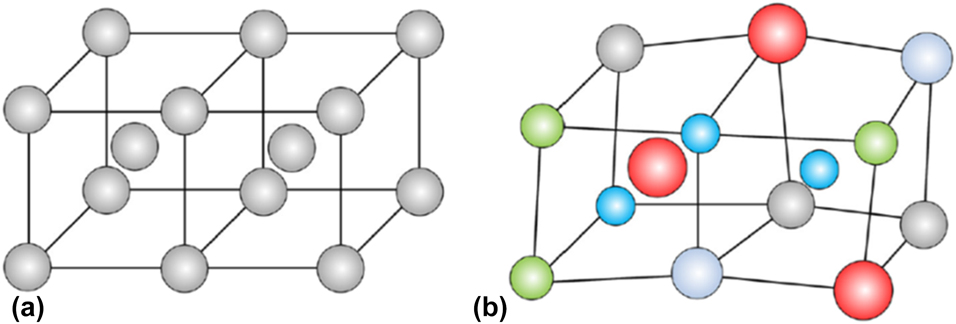
Since some of the earlier successful reports on fabrication of HEAs [Reference Yeh, Chen, Lin, Gan, Chin, Shun, Tsau and Chang1, Reference Cantor, Chang, Knight and Vincent2, Reference Huang, Yeh, Shun and Chen3], several reviews have been written on their microstructure and material properties [Reference Tsai and Yeh4, Reference Zhang, Zuo, Tang, Gao, Dahmen, Liaw and Lu5, Reference Zhang, Yang and Liaw6, Reference Senkov, Miracle, Chaput and Couzinie7], including focused reviews on mechanical [Reference Diao, Feng, Dahmen and Liaw8] and corrosion properties [Reference Qiu, Thomas, Gibson, Fraser and Birbilis9]. The original application of the name “high-entropy alloy” was intended to imply the proposed stabilizing force of the high mixing entropy over the enthalpy in forming a solid solution. Attempts have been made to apply a set of compositional guidelines to define a HEA, although a strict definition remains elusive and the term used in the literature today refers to a broad class of alloys. Originally a HEA was defined as an alloy with five or more principal elements, with each element having a concentration between 5 and 35 at.% [Reference Tsai and Yeh4], although it has been shown that some of the alloying effects of HEAs are present in alloys with fewer principal components [Reference Wu, Bei, Pharr and George10, Reference Laplanche, Kostka, Reinhart, Hunfeld, Eggeler and George11]. It is also important to point out that for a given set of alloying elements, nonequiatomic compositions can show improvement in some mechanical properties over their equiatomic composition [Reference Deng, Tasan, Pradeep, Springer, Kostka and Raabe12]. In accordance with the majority of literature, we refer to alloys containing multiple principal components as HEAs. Figure 1 provides a comparison between a pure monatomic lattice and an analogous HEA with the same crystalline lattice.
(a) Diagram showing a pure BCC metal, and (b) a HEA with a BCC lattice structure showing the chemical heterogeneity and the resulting lattice distortion. Adapted from [Reference He and Yang163] under Creative Commons Attribution License.

Among reported experimental data, one of the notable trends in the mechanical properties of HEAs is their atypical temperature dependence. The face-centered cubic (FCC) equiatomic CoCrFeMnNi HEA has displayed increasing strength, ductility, and fracture toughness with decreasing temperatures [Reference Gludovatz, Hohenwarter, Catoor, Chang, George and Ritchie13]. The increasing ductility of such HEAs is believed to be an instance of dynamic strain hardening caused by the formation of deformation twins [Reference Gludovatz, Hohenwarter, Catoor, Chang, George and Ritchie13, Reference Laplanche, Kostka, Horst, Eggeler and George14] which act as barriers to dislocation motion as similarly observed in twinning-induced plasticity (TWIP) steels [Reference Qin and Bhadeshia15, Reference Grässel and Frommeyer16, Reference Bouaziz and Guelton17]. Along with mechanical twinning, dissociated dislocation pairs are reported to be a dominant deformation mechanism in FCC HEAs [Reference Laplanche, Kostka, Reinhart, Hunfeld, Eggeler and George11, Reference Deng, Tasan, Pradeep, Springer, Kostka and Raabe12, Reference Laplanche, Kostka, Horst, Eggeler and George14, Reference Otto, Dlouhý, Somsen, Bei, Eggeler and George18, Reference Smith, Hooshmand, Esser, Otto, McComb, George, Ghazisaeidi and Mills19, Reference Okamoto, Fujimoto, Kambara, Kawamura, Chen, Matsunoshita, Tanaka, Inui and George20, Reference Kireeva, Chumlyakov, Pobedennaya and Vyrodova21, Reference Kireeva, Chumlyakov, Pobedennaya, Vyrodova, Kuksgauzen, Poklonov and Kuksgauzen22, Reference Kireeva, Chumlyakov, Pobedennaya, Kuksgausen and Karaman23]. FCC HEAs also tend to show much greater strengthening at cryogenic temperatures as compared to their pure FCC counterparts [Reference Varvenne, Leyson, Ghazisaeidi and Curtin24, Reference Varvenne, Luque and Curtin25]. Refractory body-centered cubic (BCC) HEAs have shown thermal stability and high-temperature strength retention comparable to or even exceeding superalloys [Reference Zhang, Zuo, Tang, Gao, Dahmen, Liaw and Lu5, Reference Senkov, Miracle, Chaput and Couzinie7, Reference Senkov, Scott, Senkova, Meisenkothen, Miracle and Woodward26, Reference Tsai, Chen, Tsai, Yeh, Shun and Chen27, Reference Senkov, Wilks, Scott and Miracle28, Reference Senkov, Senkova, Miracle and Woodward29]. The AlxCoCrFeNi HEA system shows a transition from FCC, to multiphase, to a BCC microstructure with increasing Al content [Reference Wang, Wang, Wang, Tsai, Lai and Yeh30], and Al0.5CoCrFeNi exhibits an improved fatigue resistance as compared to conventional alloys [Reference Tang, Yuan, Tsai, Yeh, Lundin and Liaw31, Reference Hemphill, Yuan, Wang, Yeh, Tsai, Chuang and Liaw32].
While there are many well-studied mechanisms for alloying effects in traditional metal alloys (e.g., dilute alloys), the physical mechanisms underlying material properties in HEAs are still not clearly understood. Several possible mechanisms have been proposed to explain the mechanical properties of HEAs, including large lattice distortion and sluggish diffusion [Reference Tsai and Yeh4]. However, atomistic details of lattice structure, defect structure, and deformation mechanisms are uncommon in the experimental literature. According to the structure–property paradigm, such structural information is essential to our understanding of the mechanical properties of HEAs, in particular the mechanisms of plastic deformation in HEAs. Atomistic simulation techniques, including first-principles simulations and molecular dynamics (MD), which allow atomistic-level resolution of structure, defect configuration, and energetics, can provide the required information. There have been a number of atomistic studies on HEAs, but there is no comprehensive review on state-of-the-art techniques or a systematic evaluation of the results from such simulations for HEAs.
Existing atomic simulation results can help understand the experimental observations of the mechanical response of existing HEAs and guide the design of new HEAs. Novel simulation methodologies, which are currently being developed, will inevitably enable a much broader application of atomistic simulations of HEAs. This review article is intended to provide an overview of prevailing atomistic simulations and assess corresponding simulation techniques. We then discuss the prevailing problems for such simulations and how atomistic simulations of HEAs may elucidate the atomistic mechanisms underlying the outstanding mechanical properties of HEAs.
Simulation methods
First-principles methods for HEAs
Density functional theory (DFT) is a versatile computational tool, based on quantum mechanics, broadly applied in modeling of HEAs. It can be used in principle to compute any property of HEAs, including the electronic structure, phase stability, and thermodynamic and mechanical properties [Reference Ikeda, Grabowski and Körmann33]. The limitations of the first-principles method arise from the approximations required to deal with the high computational cost that increases exponentially with the size and complexity of simulated high-entropy alloys. One of the major limitations of DFT is the limited number of atoms it can handle, and the chemical disorder in HEAs poses an especially difficult problem. Since HEAs are chemically (and often magnetically) disordered, a statistical averaging over local atomic environments is required. This is a particularly challenging problem to first-principles calculations, since either a very large sample (up to ∼10,000 atoms) or a large number of dissimilar small samples (up to ∼1,000,000 samples) are required for proper statistical averaging over chemical randomness in HEAs. At present, there are two different ways to deal with the sampling problem: the first one is based on the coherent potential approximation (CPA) developed to simulate random media [Reference Vitos, Abrikosov and Johansson34], and the second one is based on a meticulous construction of computational supercells capable of accurately reproducing the chemical disordering in HEAs. There exist several techniques for construction of the supercells, namely special quasirandom structures (SQS) [Reference Zunger, Wei, Ferreira and Bernard35], small set of ordered structures (SSOS) [Reference Jiang and Uberuaga36], and similar local atomic environment (SLAE) structures [Reference Song, Tian, Hu, Vitos, Wang, Shen and Chen37]. The two methods (discussed in detail below) have their advantages and disadvantages, and only the problem-specific knowledge allows us to choose the more appropriate methodology.
CPA + Exact Muffin-Tin Orbitals (EMTO)
The CPA method, which was developed to simulate random media, relies on the mean field approach to consider the chemical disorder in HEAs. In most cases, DFT calculations based on CPA are implemented with exact muffin-tin orbitals (EMTO) [Reference Tian, Varga, Chen, Delczeg and Vitos38] (although the Korringa–Kohn–Rostoker technique [Reference Kohn and Rostoker39] has also been applied occasionally [Reference Tian, Wang, Irving and Vitos40]). Within the muffin-tin approach, the potential for each atom is assumed to be spherically symmetric in the muffin-tin region (around lattice sites) and constant in-between [see Fig. 2(a)]. Wave functions are obtained by matching solutions of the Schrödinger equation within each muffin-tin sphere with plane-wave solutions in the intermediary region.
(a) Schematic diagram of muffin-tin potential technique. The muffin-tin regions around every atom are outlined by circles. (b) CPA for the equiatomic HEAs. The symbol P represents the real alloy potential,  $\tilde{P}$ represents the coherent potential, and P A, P B, P C, P D, and P E are the potentials of the constituent alloying elements. Adapted from [Reference Tian41] under Creative Commons Attribution License. (c) SQS cell for quinary Mo20Nb20Ta20V20W20 BCC HEA. Reprinted from Wang et al. Computation of entropies and phase equilibria in refractory V–Nb–Mo–Ta–W high-entropy alloys, Acta Materialia, 143, 88–101, Copyright (2018), with permission from Elsevier [Reference Wang, Yan, Zhu, Wang, Wu, Hui, Otis, Shang, Liu and Chen164]. (d) SLAE cell for equiatomic BCC (top) and FCC (bottom) HEAs. Reprinted from [Reference Tian41] under Creative Commons Attribution License.
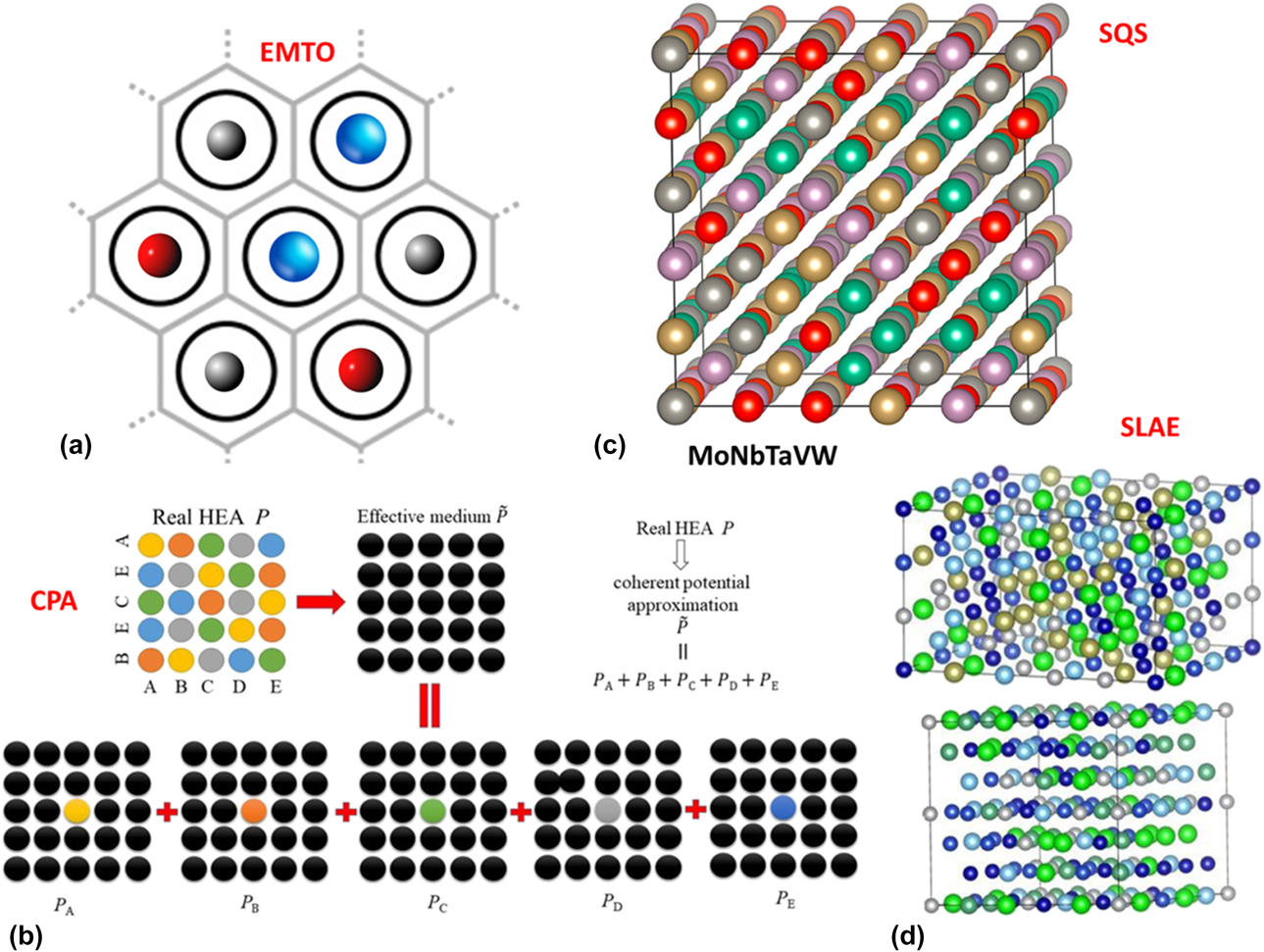
In the CPA approach, each alloy atom is considered to be embedded in an ordered effective lattice, the properties of which are determined self-consistently using the mean field approach. An average occupation of lattice sites by each type of alloying atoms is calculated, and the local potentials for each type of constituent atom are presumed to be the same throughout the sample lattice; thus, all the local effects and variations in the atomic environment are lost [see Fig. 2(b)].
The CPA-based DFT calculations effectively mimic the chemical and magnetic disorder. They have a relatively low computational cost in comparison with the supercell method as described below [Reference Vitos, Abrikosov and Johansson34]. The list of advantages of CPA also includes its efficiency in handling of point and linear defects. The ground-state properties (lattice parameters, bulk moduli, and mixing enthalpies) of many HEAs can be calculated accurately using the CPA method. Since extraction of the energetics for HEA samples is relatively easy, this method is suitable for multiscale simulations. In particular, it can be efficiently coupled with atomistic simulations based on the Monte-Carlo sampling algorithm [Reference Vitos, Abrikosov and Johansson34]. The main disadvantage of the CPA method is its inability to include the local lattice distortions, since all the local atomic variations are ignored within CPA, and the difficulty in computing of interatomic forces, which hinders accurate modeling of alloy dynamics with DFT-based MD simulations [Reference Ikeda, Grabowski and Körmann33].
Supercell method
Special quasirandom structures (SQS)
Chemical disorder in HEAs is the main challenge, since it requires calculation of average quantities and their distributions. Direct sampling over a very large number of small samples (or over a very large sample) is prohibitively difficult for the DFT method. One approach is to construct a representative HEA supercell based on special quasirandom structures (SQS) [Reference Zunger, Wei, Ferreira and Bernard35]. SQS are constructed by using a set of physically relevant pair and multisite correlation functions of fully disordered HEAs. Using the SQS method, a good representation of chemical randomness in HEAs can often be realized with a supercell containing just a few tens of atoms; however, the larger the supercell, the higher the quality of representation of the chemical randomness. Using this method, SQS supercells have been generated for HEAs with FCC [Reference Tian41], HCP [Reference Shin, Arróyave, Liu and Van De Walle42], and BCC [Reference Jiang, Wolverton, Sofo, Chen and Liu43] lattice structures [see Fig. 2(c)].
DFT calculations with SQS supercells produce accurate results when the interatomic interactions in HEAs are relatively short range, and the calculated properties are mostly dependent on the local atomic arrangements (local lattice distortions, equilibrium bond lengths, density of states, band gap, charge transfer, mixing, and formation enthalpies). However, this approach fails severely when a property depends on long-range interactions [Reference Tian, Wang, Irving and Vitos40, Reference Tian41, Reference Tian, Varga, Shen and Vitos44].
DFT calculations with SQS supercells are typically performed within generalized-gradient approximation (GGA) using the Perdew–Burke–Ernzerhof (PBE) exchange-correlation functional [Reference Perdew, Burke and Ernzerhof45] as implemented in the VASP [Reference Niu, Zaddach, Koch and Irving46, Reference Kresse and Furthmüller47, Reference Tian, Hu, Yang, Zhao, Johansson and Vitos48]. A plane wave basis is typically chosen. The translation symmetry of the underlying HEA lattice is taken into account by application of periodic boundary conditions.
Small set of ordered structures (SSOS)
SQS supercells are traditionally constructed by an exhaustive enumeration of all possible occupations of the supercell sites using an algorithm with an exponential order of complexity [Reference Zunger, Wei, Ferreira and Bernard35]. This is computationally tractable only for relatively small supercells (up to ∼50 atoms), which makes the exhaustive enumeration inadequate when larger supercells are required. Another serious drawback is that the number of correlation functions, which have been taken into account for a multicomponent HEA, grows rapidly with an increase in the number of constituent elements. It quickly becomes impossible to find a small-size SQS supercell capable of accurately representing the chemical disorder in multicomponent HEAs.
To overcome these problems, Jiang and Uberuaga [Reference Jiang and Uberuaga36] developed an alternative approach: the small set of ordered structures (SSOS) method that is especially efficient for modeling random multicomponent HEAs with a reasonably large number of alloying atoms, which is quite a challenging problem for other approaches. The key idea of SSOS is the calculation of the target physical properties using a weighted average over a small set of sampled ordered structures. The construction of the small set of ordered structures is based on a generalized cluster description of multicomponent systems [Reference Jiang and Uberuaga36]. By using equiatomic quinary BCC HEAs as examples, they proved that the SSOS approach can achieve the same accuracy as a large SQS supercell for a fraction of the SQS computational cost.
Similar local atomic environment (SLAE)
The most recent approach to construct HEA supercells is based on the idea of a SLAE structure [Reference Song, Tian, Hu, Vitos, Wang, Shen and Chen37]. A SLAE supercell [see Fig. 2(d)] can be constructed by setting the local atomic environments of all the lattice sites similar to each other. The local atomic environments are defined according to the radial distribution functions for each type of alloying atoms in the HEA. Using an iterative scheme, in which atomic pairs within the supercell are rearranged, the SLAE conditions can be progressively approximated to the desired accuracy. Song et al. [Reference Song, Tian, Hu, Vitos, Wang, Shen and Chen37] used SLAE supercells to study local lattice distortion induced by the large atomic size mismatch in FCC and BCC HEAs. They found that the local lattice distortion of the BCC HEAs is much more significant than that of FCC HEAs.
Comparison between first-principles techniques
In conclusion, the main advantage of the SQS, SSOS, and SLAE supercell techniques is that they explicitly include local lattice distortion in HEAs. However, the computational cost is relatively higher in comparison with the CPA approach, which is orders of magnitude less expensive [Reference Vitos, Abrikosov and Johansson34]. Furthermore, as the number of alloying elements in HEAs increases, it becomes increasingly problematic to find a small-sized SQS or SLAE cell adequately representing their chemical randomness. Consequently, size effects become evident in the calculated results; for example, Tian et al. [Reference Tian, Hu, Yang, Zhao, Johansson and Vitos48] found that the elastic constants of the studied BCC HEAs computed using the SQS method depended on the supercell size. Lastly, an introduction of defects into a HEA supercell can break the perfectly matched correlation functions since the atomic arrangements around the hosted defects are strongly affected, and these effects are not captured by the correlated functions for the defect-free bulk.
MD simulation methods for HEAs
As discussed above, first-principles techniques are accurate, but computationally expensive. MD allows us to simulate much larger system sizes and longer time scales. The key to MD’s efficient implementation is the use of empirical interatomic potentials to calculate the energies and forces. The quality of MD simulations is then determined chiefly by the accuracy of the empirical potential. Below we discuss existing interatomic potentials used for MD simulations of HEAs and review methodologies to develop new interatomic potentials.
Existing interatomic potentials
The most important aspect of MD simulations is the interatomic potential. Without construction of novel interatomic potentials, HEA MD simulations must solely rely upon existing potentials. This can be challenging because of the large number of alloying elements in HEAs. Only a few ternary potentials are available for MD, much less quaternary or greater. Early MD studies of HEAs used the COMPASS force field to simulate scratch tests of equiatomic AlCoCrFeNi [Reference Huang49]. A mixture of EAM and Lennard-Jones potentials has also been used to investigate chemical heterogeneity in an Al0.1CrCoFeNi HEA [Reference Sharma, Singh, Johnson, Liaw and Balasubramanian50].
A strategy to study HEAs via MD has thus been to use a combination of existing binary and ternary potentials. Elements that compose common HEAs include Co, Cr, Fe, Mn, Ni, Al, Cu, Ti, Ta, Mo, Nb, V, W, and Zr. The most readily available potentials are for the CoCrFeMnNi system as several of its suballoys have been developed to study Co- [Reference Dong, Kim, Ko, Lee and Lee51] and Ni-based superalloys [Reference Kim, Jung and Lee52], as well as high-Mn steels [Reference Kim, Shin and Lee53]. Second nearest-neighbor modified embedded-atom method (2NN MEAM) interatomic potentials have been developed for unary Co [Reference Dong, Kim, Ko, Lee and Lee51], Fe [Reference Lee, Baskes, Kim and Koo Cho54], Cr [Reference Lee, Baskes, Kim and Koo Cho54], Mo [Reference Lee, Baskes, Kim and Koo Cho54], W [Reference Lee, Baskes, Kim and Koo Cho54], V [Reference Lee, Baskes, Kim and Koo Cho54], Nb [Reference Lee, Baskes, Kim and Koo Cho54], Ta [Reference Lee, Baskes, Kim and Koo Cho54], Mn [Reference Kim, Shin and Lee53], Cu [Reference Lee, Shim and Baskes55], Ag [Reference Lee, Shim and Baskes55], Au [Reference Lee, Shim and Baskes55], Ni [Reference Lee, Shim and Baskes55], Pd [Reference Lee, Shim and Baskes55], Pt [Reference Lee, Shim and Baskes55], Al [Reference Lee, Shim and Baskes55], and Pb [Reference Lee, Shim and Baskes55]; for binary Co–Cr [Reference Choi, Kim, Seol and Lee56], Co–Fe [Reference Choi, Kim, Seol and Lee56], Co–Mn [Reference Choi, Kim, Seol and Lee56], Cr–Mn [Reference Choi, Kim, Seol and Lee56], Mn–Ni [Reference Choi, Kim, Seol and Lee56], Co–Al [Reference Dong, Kim, Ko, Lee and Lee51], Fe–Mn [Reference Kim, Shin and Lee53], Ni–Co [Reference Kim, Jung and Lee52], Fe–Cr [Reference Lee, Shim and Park57], Fe–Ni [Reference Wu, Lee and Su58], and Cr–Ni [Reference Wu, Lee and Su58]; and for ternary Ni–Al–Co [Reference Kim, Jung and Lee52] and Fe–Cr–Ni [Reference Wu, Lee and Su58]. These potentials cover all interactions in equiatomic CoCrFeMnNi (also referred to as the Cantor alloy) and have been used to study diffusion and lattice stability in it [Reference Choi, Jo, Sohn, Lee and Lee59]. A FeNiCr interatomic potential has previously been developed to study plasticity [Reference Bonny, Terentyev, Pasianot, Poncé and Bakaev60] and aging under irradiation [Reference Bonny, Castin and Terentyev61] in stainless steels. This potential has been applied to study the critical stress for dislocation motion in HEAs [Reference Varvenne, Luque and Curtin25] as well as to study the separation distance of dissociated, mixed dislocations and stacking fault energy [Reference Smith, Hooshmand, Esser, Otto, McComb, George, Ghazisaeidi and Mills19].
A study [Reference Zhou, Johnson and Wadley62] in 2004 provided a new framework, which forms the basis for construction of an arbitrarily complex interatomic potential. This framework was originally created to model misfit dislocations in multilayered structures. It is an EAM-type potential containing modified pair potential energy and embedding energy functions that vary smoothly between atomic neighbors of different species. The original elemental set contained Cu, Ag, Au, Ni, Pd, Pt, Al, Pb, Fe, Mo, Ta, W, Mg, Co, Ti, and Zr, but has been extended to include Cr [Reference Granberg, Nordlund, Ullah, Jin, Lu, Bei, Wang, Djurabekova, Weber and Zhang63, Reference Lin, Johnson and Zhigilei64]. This potential has been used to simulate dislocation behavior in a FCC Co30Fe16.67Ni36.67Ti16.67 alloy [Reference Rao, Woodward, Parthasarathy and Senkov65] and a BCC Co16.67Fe36.67Ni16.67Ti30 alloy [Reference Rao, Varvenne, Woodward, Parthasarathy, Miracle, Senkov and Curtin66]. It has also been used to simulate HEA thin film growth [Reference Xie, Brault, Thomann, Yang, Zhang and Shang67] and HEA cluster annealing on a Si substrate [Reference Xie, Brault, Thomann and Bauchire68]. The quantitative accuracy of these potentials has not been verified and the original authors cautioned against applying the potential to metal compound formation, but the ability to create interatomic potentials of arbitrary complexity offers an opportunity to explore multiple principal component alloys, where traditional alloying models do not apply.
Machine learning for potential development
To expand the set of available elements and ensure accurate potentials to simulate HEAs in MD, new interatomic potentials need to be developed. Among the proposed frameworks to develop new interatomic potentials, the most prominent ones feature incorporation of machine learning (ML) techniques to guide potential development. All ML frameworks share two fundamental features: representation of atomic configurations that obeys required symmetries (descriptor) and an independent covariate or controlled variable to model the potential (regressor). Along with this framework, a robust set of high-fidelity reference data to train the regressor and validate the model is required. Below we review several approaches, focusing mainly on bulk metallic systems that are most relevant to HEAs (interested reader may refer to [Reference Sosso, Deringer, Elliott and Csányi69, Reference Behler70, Reference Handley and Behler71] for a more detailed review of ML-based research in interatomic potential development).
There are commonalities in the choice of the descriptor among the different frameworks that must address required symmetries and other conditions. These include: invariance with respect to chemical permutation, translations, rotations, and smoothness of atomic density near neighborhood cutoff boundary (smooth variation in atomic density is able to avoid large numerical errors when training the regressor). The descriptor also must be a continuous one-to-one mapping between the atomic configurations and points on the potential energy surface. In classical potential models, these descriptors include quantities such as bond length, dihedral angle, coordination number, bond type, atomic species, etc.
It must also be noted that any ML model of the potential energy surface cannot be accurately extrapolated to regions of configuration space that have not been included in the training dataset. This requires atomic configuration data to train the ML-based potential that covers all expected atomic configurations, including bulk, surface, liquid configurations, and all possible chemical environments for heterogeneous systems.
Artificial neural network potentials
Artificial neural networks (ANNs) are among the most developed approaches to modeling the potential energy surface of atomic systems with several reviews available [Reference Behler72, Reference Behler73, Reference Behler74, Reference Handley and Popelier75]. ANNs are models consisting of layers of connected nodes. Each layer is connected to adjacent layers via weights (i.e., the fitting parameters) by training on the reference dataset. It has been suggested that the flexibility of ANNs can be used to model the potential energy surface of atomic configurations [Reference Behler72, Reference Behler and Parrinello76]. In the case of ANN-based potentials, the input includes an atomic configuration and the output yields the energy of such configuration. The layers of nodes between the input and output represent the complex, nonlinear relationship between the atomic configuration of the system and the system energy. Because the input nodes include every atom in the system, this potential is limited to small systems and is not easily transferable to other systems. These potentials have been successfully used for molecular systems and to a smaller extent for bulk metallic systems [Reference Behler73].
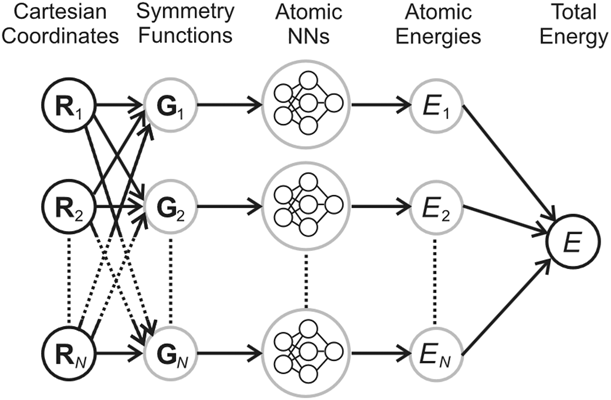
To address these difficulties of system size, Behler and Parrinello [Reference Behler and Parrinello76] proposed to use an atomic-level ANN (in contrast to a system-level ANN discussed above), to predict the local atomic energy (and thus is independent of system size). The atomic-level ANN takes a set of descriptors that account for all atomic interactions within a given cutoff radius and include radial and angular functions. The atomic potential energy is then predicted by evaluation of this trained atomic-level ANN for each atom in the system. The total energy of the system is obtained by summing up the evaluated atomic potential energies. Figure 3 provides a diagram for such an ANN. To cite an example, 8200 DFT simulations were used to train an ANN potential for bulk Si [Reference Behler and Parrinello76]. With regard to large systems, ANN potentials have also been used to simulate TiO2 [Reference Artrith and Urban77], bulk Si [Reference Behler and Parrinello76, Reference Behler, Martoňák, Donadio and Parrinello78, Reference Behler, Martoňák, Donadio and Parrinello79], Cu [Reference Artrith and Behler80], C [Reference Khaliullin, Eshet, Kühne, Behler and Parrinello81, Reference Khaliullin, Eshet, Kühne, Behler and Parrinello82], Na [Reference Eshet, Khaliullin, Kühne, Behler and Parrinello83, Reference Eshet, Khaliullin, Kühne, Behler and Parrinello84], zinc oxide [Reference Artrith, Morawietz and Behler85], Cu on zinc oxide [Reference Artrith, Hiller and Behler86], and GeTe [Reference Sosso, Miceli, Caravati, Behler and Bernasconi87, Reference Sosso, Donadio, Caravati, Behler and Bernasconi88, Reference Sosso, Behler and Bernasconi89, Reference Sosso, Miceli, Caravati, Giberti, Behler and Bernasconi90]. Evaluation of ANN potentials may be slower than classical force fields, but they are orders of magnitude faster than DFT.
Diagram describing the implementation of an atomic-level ANN potential to calculate the system energy in an atomic simulation. Reprinted figure with permission from Artrith and Behler, Physical Review B, 85, 045439, 2012, Copyright (2012) by the American Physical Society, https://doi.org/10.1103/PhysRevB.85.045439 [Reference Artrith and Behler80].

Gaussian approximation and spectral neighbor analysis potential
The Gaussian approximation potential (GAP) [Reference Bartók, Payne, Kondor and Csányi91, Reference Bartók and Csányi92] and Spectral neighbor analysis potential (SNAP) [Reference Thompson, Swiler, Trott, Foiles and Tucker93] are constructed by using the local neighbor density as a descriptor for atomic configurations. They differ in their choice of the regressor: the GAP uses Gaussian regression, while the SNAP utilizes least-squared linear regression.
The descriptor is constructed by first expressing the neighbor density in terms of spherical coordinates. These coordinates are then expanded using the four-dimensional hyper-spherical harmonics. These expansion coefficients are used to define the bispectrum, which is real valued and invariant to rotation. This choice of the descriptor respects all required symmetries [Reference Bartók, Payne, Kondor and Csányi91, Reference Bartók and Csányi92]. The practice is to then determine the values of the interpolation coefficients of potential energy expressed in terms of this bispectrum. The coefficients are determined via the chosen regressor using a set of reference training data of energy, forces, and stresses, obtained from first-principles simulations.
Interatomic potentials have been developed for W [Reference Szlachta, Bartók and Csányi94], C [Reference Bartók, Payne, Kondor and Csányi91, Reference Deringer and Csányi95], Si [Reference Bartók, Payne, Kondor and Csányi91], Ge [Reference Bartók, Payne, Kondor and Csányi91], Fe [Reference Bartók, Payne, Kondor and Csányi91, Reference Maillet, Denoual and Csányi96], and GaN [Reference Bartók, Payne, Kondor and Csányi91] using the GAP methodology. A SNAP has been generated for Ta [Reference Thompson, Swiler, Trott, Foiles and Tucker93], InP [Reference Thompson, Schultz, Crozier, Moore, Swiler, Stephens, Trott, Foiles and Tucker97], SiO2 [Reference Thompson, Schultz, Crozier, Moore, Swiler, Stephens, Trott, Foiles and Tucker97], and Ni–Mo [Reference Li, Hu, Chen, Deng, Luo and Ong98].
An attractive feature of GAP and SNAP is that they have available implementations in LAMMPS software package [Reference Plimpton99], allowing them to be validated and compared to classic potentials. Scaling studies have shown that the SNAP can be efficiently parallelized [Reference Trott, Hammond, Thompson, Kunkel, Ludwig and Meuer100], and it can be scaled to arbitrary alloy composition (which is attractive for HEAs). Similar to ANN potentials, the GAP and SNAP are at least an order of magnitude more computationally expensive than classic potentials, but they are orders of magnitude faster than DFT, and they scale linearly with the number of atoms [Reference Bartók, Payne, Kondor and Csányi91, Reference Bartók and Csányi92, Reference Trott, Hammond, Thompson, Kunkel, Ludwig and Meuer100].
One of the drawbacks of the SNAP is the presence of the delta function in the expression for neighbor density, which can result in strong numerical differences with slight deviations in atomic position [Reference Bartók, Kondor and Csányi101]. To address this issue, the smooth overlap of atomic positions (SOAP) methodology has been developed, which replaces the delta functions with Gaussians [Reference Bartók, Kondor and Csányi101]. The neighbor density, as expressed in the SOAP approach, is not rotationally invariant and thus requires a normalized average over all possible rotations.
Force field methods
In the preceding examples, models are intended to capture the potential energy surface, while atomic forces are obtained as its derivatives. It has been argued that direct prediction of atomic forces can be a more effective approach [Reference Huan, Batra, Chapman, Krishnan, Chen and Ramprasad102, Reference Li, Kermode and De Vita103, Reference Botu and Ramprasad104, Reference Botu and Ramprasad105, Reference Botu, Batra, Chapman and Ramprasad106, Reference Suzuki, Tamura and Miyazaki107, Reference Botu, Chapman and Ramprasad108, Reference Glielmo, Sollich and De Vita109]. Because these methods predict a vector quantity, the choice of a descriptor involves definition of an internal reference frame for each atom based on the position of its neighbors. The choice of a regressor for these methods has included Bayesian inference [Reference Li, Kermode and De Vita103], kernel ridge regression [Reference Huan, Batra, Chapman, Krishnan, Chen and Ramprasad102], and Gaussian process regression [Reference Glielmo, Sollich and De Vita109]. In contrast to methods that use ML to predict the potential energy surface and then obtain forces from analytical derivation, here the energies are obtained via integration of the predicted atomic forces. Such force fields have been developed for Al [Reference Huan, Batra, Chapman, Krishnan, Chen and Ramprasad102, Reference Botu and Ramprasad104, Reference Botu and Ramprasad105, Reference Botu, Batra, Chapman and Ramprasad106, Reference Botu, Chapman and Ramprasad108], Ni [Reference Glielmo, Sollich and De Vita109], Cu [Reference Huan, Batra, Chapman, Krishnan, Chen and Ramprasad102], Ti [Reference Huan, Batra, Chapman, Krishnan, Chen and Ramprasad102], W [Reference Huan, Batra, Chapman, Krishnan, Chen and Ramprasad102], Si [Reference Huan, Batra, Chapman, Krishnan, Chen and Ramprasad102, Reference Li, Kermode and De Vita103, Reference Suzuki, Tamura and Miyazaki107, Reference Glielmo, Sollich and De Vita109], C [Reference Huan, Batra, Chapman, Krishnan, Chen and Ramprasad102], and Fe [Reference Glielmo, Sollich and De Vita109]. For example, an AGNI force field (a ML-model-based on a training dataset selected from the reference data) [Reference Huan, Batra, Chapman, Krishnan, Chen and Ramprasad102] focuses on predicting atomic forces as their primary quantity.
Moment tensor and least absolute shrinkage and selection potentials
Below we briefly discuss two other approaches. Another approach includes a class of potentials proposed to represent the interatomic potential as a combination of polynomials [Reference Shapeev110, Reference Podryabinkin and Shapeev111]. These “moment tensor potentials” use a set of moment polynomials as descriptors, and linear regression as their training method. One of such potentials has been currently developed for bulk Li [Reference Podryabinkin and Shapeev111].
To address the problem of descriptor choice, the least absolute shrinkage and selection operator (LASSO) technique has been proposed to automatically select pairwise basis functions representing the potential energy surface [Reference Seko, Takahashi and Tanaka112]. As a demonstration, the authors used a linear regression to train such potentials for Na and Mg [Reference Seko, Takahashi and Tanaka112].
It is noted that these novel methods of using ML to construct interatomic potentials is an area of research that is rapidly developing and may open up the ability for efficient atomic simulations of HEAs. It remains to be seen what methodology is most relevant to HEAs.
Applications to nanoscale plasticity of HEAs
The role of defects in the plastic deformation of HEAs is difficult to underestimate. They can have a profound effect on the deformation mechanisms at the nanoscale. Besides the point defects (vacancies and self-interstitials), there are also line (dislocations) and planar (twin, grain and interface boundaries) intrinsic defects. In this section, we discuss how first-principles calculations and atomistic simulations can be used to study the structure, energetics and behavior of vacancies, self-interstitials, dislocations, and planar defects in HEAs.
Point defects
Vacancies
According to the second law of thermodynamics, the existence of vacancies is inevitable in an equilibrium state at finite temperatures. High configurational entropy in HEAs leads to greatly enhanced concentration of vacancies at equilibrium. Vacancy concentration in HEAs is substantially larger than those in pure metals and simple binary alloys since it increases exponentially  $\left( {\sim{{\exp \left( {n - 1} \right)} \over n}} \right)$ with the number, n, of alloying elements [Reference Wang, Liu and Dou113]. This unusually high vacancy concentration changes both the thermodynamics and kinetics of HEAs, and, in particular, explains their extraordinary high radiation tolerance [Reference Wang, Liu and Dou113].
Vacancy formation energy
The presence of chemical disorder in HEAs, manifested in significant variation of the local atomic environment, makes theoretical description of vacancies and interstitials in HEAs very challenging. Definitions of defect structure and energetics are less clear for HEAs than for simple metals and their binary alloys. Since the defect structure and energetics as well as defect behavior depend on the local environment, which varies from atom to atom, a statistical approach based on sampling and averaging is required.
One of the fundamental characteristics of point defects is their formation energy. For example, vacancy formation energy (VFE) provides the essential information on the phase stability and tendency of HEA atoms to segregate to form nanosized inclusions. Since each atom in a HEA has its own specific local atomic environment, VFE exhibits a distribution, rather than a single value as in a simple metal. The distribution of VFE and its average value can be calculated either by using DFT or MD. The vacancy formation energy, E v, is calculated by summing the energy, E df, of a defective supercell containing a vacancy (where one of the constituent atoms is removed) with the value of the chemical potential for the removed atom, μa, and subtracting the energy of a perfect supercell, E pf : E v = E df + μa − E pf. The chemical potential μa is a measure of variation in the total energy of the supercell when the atom is removed. The value of the chemical potential can be obtained by using Widom-type substitution techniques [Reference Zhao, Stocks and Zhang114]. In particular, an atom A in a perfect supercell is substituted by an atom B, and the energy, E A→B of the modified supercell is calculated. The difference between the chemical potentials of the selected atoms is calculated as: μA − μB = E A→B − E pf [Reference Zhao, Stocks and Zhang114], where E pf is the energy of the perfect supercell. The difference is calculated for the all possible pairs of different atoms in the supercell. The energy of the perfect supercell can also be written as  ${E_{{\rm{pf}}}} = \sum\limits_a^M {{N_a}{\mu _a}}$, where a indicates a specific type of constituent HEA atom, N a is the number of atoms of the selected type in the supercell, and μa is the corresponding chemical potential. To obtain the chemical potentials of the constituent atoms in HEAs, one has to solve the combined set of the equations [Reference Zhao, Stocks and Zhang114], and average over all constituent atoms of the same type located within the supercell. In contrast, in pure metals, one can take energy of an isolated atom as its chemical potential in VFE calculation.
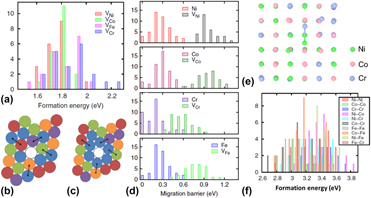
The vacancy formation energies in equiatomic Cr25Co25Fe25Ni25 were studied by using first-principles calculations [Reference Middleburgh, King, Lumpkin, Cortie and Edwards115, Reference Zhao, Egami, Stocks and Zhang116, Reference Chen, Ding, Feng, Liu, Liu, Lu, Li, Li, Liu and Chen117]. The obtained distributions of VFE for the specific atomic vacancies are shown in Fig. 4(a). The VFE for atoms of Cr25Co25Fe25Ni25 varies over a wide range from 0.72 to 2.89 eV for Fe, from 0.88 to 2.9 eV for Co, from 0.78 to 3.09 eV for Cr, and from 0.91 to 2.95 eV for Ni due to large lattice distortions and evident chemical disorder. The average value of VFE from least to greatest is: Fe (1.58 eV) < Cr (1.61 eV) < Co (1.7 eV) < Ni (1.89 eV). The VFEs for specific atomic vacancies are all higher than those in their pure metallic counterparts (in contrast, the formation energies of self-interstitials are lower than in pure metals [Reference Middleburgh, King, Lumpkin, Cortie and Edwards115, Reference Zhao, Egami, Stocks and Zhang116, Reference Chen, Ding, Feng, Liu, Liu, Lu, Li, Li, Liu and Chen117]). For example, the formation energy for a Ni vacancy in pure Ni (1.45 eV) is lower than in Cr25Co25Fe25Ni25 (1.89 eV). The relatively high values of VFE in HEAs are in agreement with the experiments in which Cr25Co25Fe25Ni25 exhibited an outstanding radiation tolerance in comparison with pure nickel [Reference Chen, Ding, Feng, Liu, Liu, Lu, Li, Li, Liu and Chen117]. Due to the high VFE values, void formation in the irradiated samples was significantly suppressed even at elevated temperatures [Reference Chen, Ding, Feng, Liu, Liu, Lu, Li, Li, Liu and Chen117].
(a) Distribution of vacancy formation energies for Ni, Co, Cr, and Fe vacancies in Cr25Co25Fe25Ni25 HEA. Reprinted figure with permission from Zhao et al., Physical Review Materials, 2, 013602, 2018, Copyright (2018) by the American Physical Society, https://doi.org/10.1103/PhysRevMaterials.2.013602 [Reference Zhao, Egami, Stocks and Zhang116]. (b, c) A schematic depiction of a random (b) and an energetically favorable (c) packing around a vacancy in HEAs. Reprinted figure with permission from Wang et al., Physical Review Materials, 1, 043601, 2017 Copyright (2017), by the American Physical Society [Reference Wang, Liu and Dou113]. (d) Distribution of vacancy and self-interstitial migration barriers for Ni, Co, Cr, and Fe in Cr25Co25Fe25Ni25 HEA. Reprinted figure with permission from Zhao et al., Physical Review Materials, 2, 013602, 2018, Copyright (2018) by the American Physical Society, https://doi.org/10.1103/PhysRevMaterials.2.013602 [Reference Zhao, Egami, Stocks and Zhang116]. (e) Self-interstitial in Ni33.3Co33.3Cr33.3 HEA: a [010] Ni–Cr dumbbell viewed from (100) plane. Reprinted figure with permission from Zhao et al., Physical Review Materials, 2, 013602, 2018, Copyright (2018) by the American Physical Society, https://doi.org/10.1103/PhysRevMaterials.2.013602 [Reference Zhao, Egami, Stocks and Zhang116]. (f) Formation energies of interstitial dumbbells in Cr25Co25Fe25Ni25 HEA. Reprinted figure with permission from Zhao et al., Physical Review Materials, 2, 013602, 2018, Copyright (2018) by the American Physical Society, https://doi.org/10.1103/PhysRevMaterials.2.013602 [Reference Zhao, Egami, Stocks and Zhang116].

Sluggish diffusion
Sluggish diffusion, which is one of the four core effects of HEAs, is essential for high-temperature thermal stability, exceptional high-temperature strength, and outstanding radiation tolerance of HEAs [Reference Miracle and Senkov118]. Relatively low rates of diffusion stabilize HEAs against precipitation of new phases at elevated temperatures by helping them to retain chemical randomness in the distribution of atomic species, which otherwise tend to segregate and precipitate on the surface or in the bulk [Reference Tong, Chen, Chen, Yeh, Shun, Tsau, Lin and Chang119].
Sluggish diffusion and the effect of alloying
Sluggish diffusion is another unusual characteristic of vacancies in HEAs. Sluggish diffusion is a result of interplay of a variety of different factors including lattice distortion, trapping lattice sites, and interatomic correlations. Early experimental studies by Tsai et al. [Reference Tsai, Tsai and Yeh120] of vacancy diffusion in HEAs demonstrated its ‘sluggishness’ in comparison with pure metals and their binaries. The sluggish diffusion reflects the strong variations in the vacancy migration energies due to chemical disorder, as well as the frustrated nature of vacancy migration in HEAs. It was also found in these experiments that the sluggishness of vacancy diffusion increases with an increasing number of alloying elements in the HEA. The greater the number of constituent atoms, the slower the vacancy migration [Reference Tsai, Tsai and Yeh120], although the validity of this result has been recently challenged [Reference Vaidya, Trubel, Murty, Wilde and Divinski121, Reference Vaidya, Pradeep, Murty, Wilde and Divinski122]. More recent diffusion experiments [Reference Vaidya, Trubel, Murty, Wilde and Divinski121, Reference Jin, Zhang, Zhang and Bei123] have demonstrated that diffusion in quinary equiatomic Ni20Co20Fe20Cr20Mn20 is faster with respect to the absolute temperature than that in four-element Ni25Co25Fe25Cr25, although it is slower at the same homologous temperature (which expresses the temperature of a material as a fraction of its melting point temperature). Also the diffusion coefficient in Ni20Co20Fe35.5Cr20Mn0.5 is higher than that of austenitic steels at the same absolute temperatures [Reference Vaidya, Trubel, Murty, Wilde and Divinski121]. New experiments have demonstrated that a greater number of alloying elements do not necessarily slow down the diffusion process even with respect to homologous temperatures [Reference Vaidya, Trubel, Murty, Wilde and Divinski121, Reference Vaidya, Pradeep, Murty, Wilde and Divinski122]. Hence, sluggish diffusion in high-entropy alloys is still a controversial topic.
Trapping lattice sites
One of the key reasons for sluggish vacancy diffusion is a trapping effect of the distorted HEA lattice. It was first suggested by Tsai et al. [Reference Tsai, Tsai and Yeh120] that specific low-energy lattice sites entrap the migrating vacancies. Each lattice site in a HEA is surrounded by atomic neighbors of different types; therefore, it has the different lattice potential energy. Among the different lattice sites exist trapping sites (with a relatively low potential energy) surrounded by high-energy migration barriers. According to Wang et al. [Reference Wang, Liu and Dou113], the types of atoms surrounding a vacant lattice site play the most important role in the creation of the trapping lattice sites. When a vacant site is enclosed by the same type of atoms, especially by atoms with high average vacancy migration barrier, a deep-well trapping site can be formed [see Fig. 4(b)]. This is a very energetically favorable close-packed atomic configuration in comparison with a random packing of different type of atoms around a vacant spot [see Fig. 4(c)]. The lattice distortion around the compact packing configuration is minimal; hence, the binding energy of the vacancy to this lattice site is maximal, and this is a perfect trapping spot [Reference Wang, Liu and Dou113]. A vacancy, once captured by the trapping site, spends a relatively long time there, before it escapes and diffuses away. For that reason, the activation energies for vacancy migration in HEAs are significantly higher than in pure metals [Reference Wang, Liu and Dou113, Reference Tsai, Tsai and Yeh120]. Moreover, there is a high probability for the vacancy to return back and be trapped again: atomistic simulations demonstrated that the vacancies jump forward and back near the lattice trapping sites most of the time [Reference Wang, Liu and Dou113]. This pinning effect of the trapping lattice sites considerably slows vacancy diffusion in HEAs.
Energy barriers for vacancy migration in HEAs
Vacancy migration barriers are usually calculated by directly optimizing the saddle-point structures, located at the midpoints of the corresponding diffusion paths. The diffusion paths are generally identified by the nudged elastic band (NEB) method [Reference Zhao, Stocks and Zhang114], which can be carried out with first principles (as implemented in VASP [Reference Kresse and Furthmüller47]) or MD (as implemented in LAMMPS [Reference Plimpton99]). The height of the migration barrier is calculated as the energy difference between the intermediate saddle structure and the original defective structure. Since in HEAs the local chemical environment is specific for each atom, the value of migration energy barriers varies substantially. Therefore, a distribution of values for vacancy migration barriers and the corresponding average for each type of alloying elements are usually reported. The same approach is used for another type of point defects in HEAs: self-interstitials.
The following order in the calculated energies for vacancy migration barriers was found in Cantor alloy [Reference Choi, Jo, Sohn, Lee and Lee59]: Mn < Fe < Cr < Co < Ni, which exactly corresponds to the experimentally observed order of diffusivity of individual constituent atoms [Reference Tsai, Tsai and Yeh120]: Ni < Co < Fe < Cr < Mn (the lower the diffusivity, the higher the value of migration barrier). Choi et al. [Reference Choi, Jo, Sohn, Lee and Lee59] used MD simulations to prove the existence and to estimate the number of trapping sites in a Cantor HEA. The authors reported a large variation in the energy barrier for migration, which reflects the variety of different neighborhoods surrounding lattice sites. The fraction of trapping sites was calculated by counting lattice sites whose migration energy barrier exceeds a certain threshold. The fraction of trapping sites in Co20Cr20Fe20Mn20Ni20 HEA is ∼30% [Reference Choi, Jo, Sohn, Lee and Lee59].
First-principles calculations in conjunction with the NEB method [Reference Wang, Liu and Dou113, Reference Middleburgh, King, Lumpkin, Cortie and Edwards115, Reference Zhao, Egami, Stocks and Zhang116] were used to obtain the distribution of values for vacancy migration barrier in equiatomic, four-element Co25Cr25Fe25Ni25 (Cantor alloy minus Mn atoms). The calculated values were averaged over a sufficiently large set of randomly generated defective samples. The obtained distributions for the different atomic vacancies (and self-interstitials) are shown in Fig. 4(d). The calculated order of the average vacancy migration energy barrier in Co25Cr25Fe25Ni25 [Reference Zhao, Egami, Stocks and Zhang116] is: Cr < Co < Fe < Ni. The lowest average value of migration barrier is for Cr vacancies; this indicates a preferable diffusion of Cr vacancies in Co25Cr25Fe25Ni25 alloy. The obtained values of vacancy migration barriers of HEA elements are of the same order of magnitude as in pure metals; however, the average values in HEA are lower [Reference Jin and Bei124]. Fe atoms exhibit the largest disparity in the activation barrier energy between HEA and the corresponding pure Fe with a FCC lattice structure. As can be seen in Fig. 4(d), there is a large overlap region between the migration energies for vacancies and self-interstitials, especially for Cr and Fe vacancies and self-interstitials [Reference Granberg, Nordlund, Ullah, Jin, Lu, Bei, Wang, Djurabekova, Weber and Zhang63, Reference Zhao, Egami, Stocks and Zhang116, Reference Lu, Niu, Chen, Jin, Yang, Xiu, Zhang, Gao, Bei, Shi, He, Robertson, Weber and Wang125].
Besides single vacancies, double, triple, or even larger clusters of vacancies can be intentionally introduced in HEAs by irradiation. Using MD simulations, Lu et al. [Reference Lu, Niu, Chen, Jin, Yang, Xiu, Zhang, Gao, Bei, Shi, He, Robertson, Weber and Wang125] examined the magnitude of migration energy barriers for the various clusters of vacancies in Co25Cr25Fe25Ni25 and Co20Cr20Fe20Ni20Mn20 HEAs. Remarkably, they found that the magnitude of migration energy barrier for clusters of vacancies can be smaller than that of a single vacancy. In particular, the value of energy barrier for double vacancies is lowest. They also found that vacancies tend to merge forming voids at elevated temperatures [Reference Lu, Niu, Chen, Jin, Yang, Xiu, Zhang, Gao, Bei, Shi, He, Robertson, Weber and Wang125].
Toward application in nuclear environments, the radiation tolerance of several HEAs was investigated using MD simulations [Reference Granberg, Nordlund, Ullah, Jin, Lu, Bei, Wang, Djurabekova, Weber and Zhang63]. Ni50Fe50 and Ni33.3Co33.3Cr33.3 equiatomic alloys were constructed and subjected to simulated radiation collision cascades at typical subcascade energy (5 keV). The simulations showed that in contrast to other metallic alloys, these HEAs were resistant to amorphization and ordering under irradiation. These HEAs also showed a lower number of point defects at saturation as compared to their pure constituent metals. Clustering of individual vacancies showed that there were fewer large damage clusters in the HEA as well as a lower average diameter of damage cluster in the irradiated HEAs as compared to the pure metal.
Interstitials
Structure and energetics
Besides vacancies, another important type of point defect in HEAs, namely self-interstitials, has been recently studied by first-principles technique. In comparison with vacancies, the formation energy of self-interstitials is relatively high; hence, self-interstitials are likely to emerge only under specific nonequilibrium conditions, for example under intensive radiation.
The fundamental characteristic of self-interstitials is their formation energy, E i, which is calculated in a similar way to vacancy formation energy, by summing the energy, E df, of a defective supercell containing a self-interstitial (where the alloying atom is inserted in a perfect HEA supercell) and subtracting from this the value of chemical potential for the inserted atom, μa, and the energy of the perfect supercell, E pf,: E i = E df − μa − E pf. The value of μa can be obtained using the same Widom-type substitution techniques as described previously for vacancies [Reference Zhao, Stocks and Zhang114, Reference Zhao, Egami, Stocks and Zhang116].
Using DFT, Middleburgh et al. [Reference Middleburgh, King, Lumpkin, Cortie and Edwards115] and Zhao et al. [Reference Zhao, Egami, Stocks and Zhang116] calculated the distribution of formation energy values for various self-interstitials in equiatomic four-element Co25Cr25Fe25Ni25. They found that Co self-interstitials possess the lowest average formation energy. The resulting order in the calculated average energies for self-interstitial formation was found to be: Co (−2.63 eV) < Fe (−2.38 eV) < Ni (−2.18 eV) < Cr (−0.91 eV) [Reference Middleburgh, King, Lumpkin, Cortie and Edwards115]. As in pure metals with a FCC lattice, a split interstitial dumbbell is formed in the Co25Cr25Fe25Ni25 HEA when an extra atom is embedded in its FCC lattice. For example, a [010] Ni–Cr split interstitial dumbbell obtained by Zhao et al. [Reference Zhao, Egami, Stocks and Zhang116] is shown in Fig. 4(e). In contrast to the vacancy formation energies, which are higher in HEAs than in corresponding pure metals, the formation energies of self-interstitials are lower. As can be seen in Fig. 4(f), the formation energies of the split interstitial dumbbells containing Ni atom in the Co25Cr25Fe25Ni25 HEA are smaller than in pure Ni (3.96 eV), while the formation energies of Ni vacancy are higher in HEAs than in pure Ni (1.45 eV) [see Fig. 4(a)].
Diffusion
In addition to the formation energy of self-interstitials, first-principles calculations can be used to obtain the distribution of migration energy barriers for self-interstitials hosted in HEAs. According to DFT calculations [Reference Zhao, Egami, Stocks and Zhang116], the average values for the interstitial migration energy barriers in HEAs are higher than in pure metals of the alloy’s constituent elements. In particular, the migration barriers in Co25Cr25Fe25Ni25 are higher than in pure Ni (0.15 eV) [Reference Zhao, Egami, Stocks and Zhang116]; therefore, diffusion of self-interstitials is notably slowed down relative to pure Ni. In addition, the distributions of values for migration energy barriers of different self-interstitials in Co25Cr25Fe25Ni25 considerably overlap [see Fig. 4(e)]; hence, the diffusion rates for different self-interstitials are rather similar. Besides split interstitial dumbbells, a larger cluster of self-interstitials can be formed in HEAs under irradiation. Lu et al. [Reference Lu, Niu, Chen, Jin, Yang, Xiu, Zhang, Gao, Bei, Shi, He, Robertson, Weber and Wang125] used MD simulations to study the magnitude of migration energy barriers for clusters of self-interstitials in Co25Cr25Fe25Ni25 and Ni20Co20Fe20Cr20Mn20 alloys. They found that the average magnitude of migration energy barriers increases directly with the interstitial cluster size in HEAs, while it is almost independent of the cluster size in pure Ni.
Atomistic simulations of self-interstitial diffusion in Co25Cr25Fe25Ni25 and Ni20Co20Fe20Cr20Mn20 revealed that self-interstitials and their small clusters migrate randomly in all possible directions in HEAs, while in pure Ni (and NiCo binary alloy) they exhibit relatively fast quasi-one-dimensional diffusion along the close-packed rows of atoms [Reference Lu, Niu, Chen, Jin, Yang, Xiu, Zhang, Gao, Bei, Shi, He, Robertson, Weber and Wang125]. The directional migration in HEAs is prevented by the lattice distortion. The lattice distortion is related to the differences in the atomic size of the alloying elements: the atomic radius of Co deviates from Ni only by +1.8%, while Cr by +10.3%, Fe by +10.6%, and Mn by sizable +23.2% [Reference Lu, Niu, Chen, Jin, Yang, Xiu, Zhang, Gao, Bei, Shi, He, Robertson, Weber and Wang125]. The lattice distortion enhances atomic scattering, which randomizes the focused directional motion of self-interstitials along the preferable directions in HEAs, and reduces their mobility. In contrast to vacancies, most of the self-interstitials were immobile and remained in defective regions created during irradiation [Reference Lu, Niu, Chen, Jin, Yang, Xiu, Zhang, Gao, Bei, Shi, He, Robertson, Weber and Wang125]. The suppressed migration of self-interstitials in HEAs prevents them from leaving defective regions; hence, they recombine at a high rate with relatively mobile vacancies. The combined effect of the lattice distortion, sluggish vacancy diffusion, and relative immobility of self-interstitials is mainly responsible for outstanding radiation tolerance of HEAs.
Recently, a novel HEA containing carbon interstitials has been experimentally developed by Li et al. [Reference Li, Tasan, Springer, Gault and Raabe126] relying on first-principles calculations. The addition of carbon interstitials into the Mn30Fe49.5Co10Cr10C5 alloy increased its stacking fault energy and therefore its phase stability. The newly designed HEA benefits profoundly from additional interstitial-induced strengthening, which is linked to much higher lattice distortion (caused by the carbon interstitials) and the interaction between extrinsic defects and dislocations. The new Mn30Fe49.5Co10Cr10C5 unified all known metallurgical strengthening effects in single bulk material [Reference Li, Tasan, Springer, Gault and Raabe126].
Line defects
Dislocations
Post-deformation experimental investigations have indicated that plasticity in HEAs is chiefly dislocation dominated, but there are currently no reported in situ observations of dislocation behavior in HEAs. Transmission electron microscopy (TEM) studies also have not yet provided atomistic-scale details of dislocation structures in HEAs. Theories of strengthening in HEAs [Reference Wu, Bei, Pharr and George10, Reference Varvenne, Luque and Curtin25, Reference Toda-Caraballo and Rivera-Díaz-del-Castillo127] are built upon the heterogeneous environment in HEAs. Atomistic simulations include techniques by which we can provide atomistic-level details of dislocation structures and their dynamic behavior and also allow us to investigate the physical mechanisms underlying these proposed strengthening theories. Here, we provide an overview of those published atomistic studies on dislocations in HEAs.
Dislocation structure
Several experimental reports indicate the presence of planar, dissociated dislocations in deformed FCC HEAs [Reference Laplanche, Kostka, Reinhart, Hunfeld, Eggeler and George11, Reference Otto, Dlouhý, Somsen, Bei, Eggeler and George18, Reference Smith, Hooshmand, Esser, Otto, McComb, George, Ghazisaeidi and Mills19, Reference Okamoto, Fujimoto, Kambara, Kawamura, Chen, Matsunoshita, Tanaka, Inui and George20, Reference Kireeva, Chumlyakov, Pobedennaya and Vyrodova21]. In these reports, a commonly noted feature is the high variability of the dislocation dissociation distance. To study the dislocation dissociation distance and core structure in a HEA, a relatively larger number of atoms have to be included in a computational supercell. Therefore, MD method is the most suitable. Atomistic simulations of dislocations in HEAs show similar results of stable equilibrium configuration and provide insight into the atomistic nature of the variability in separation distance and core characteristics.
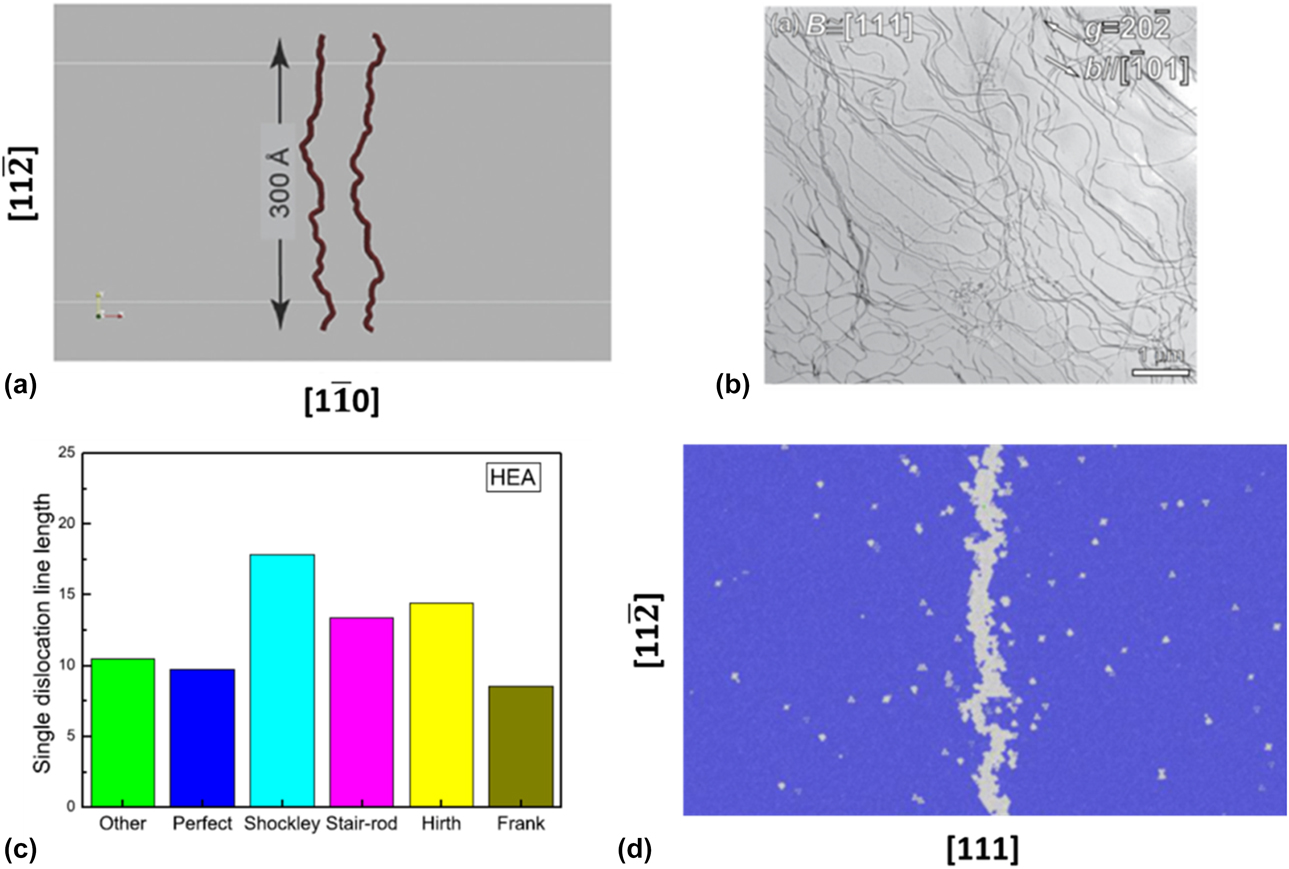
The core structure of edge and screw dislocations in the four-element Co30Fe16.67Ni36.67Ti16.67 FCC alloy was examined by Rao et al. [Reference Rao, Woodward, Parthasarathy and Senkov65] using atomistic simulations. The obtained equilibrium configuration of an edge dislocation core is illustrated in Fig. 5(a). The most striking feature of the core structure is its irregular shape. As can be seen in Fig. 5(a), the distance between the two Shockley partials varies significantly along the dislocation line (in pure metals, the distance between Shockley partials is constant). The large variation in the separation distance (with an amplitude of ∼0.3 nm) is due to chemical disorder and lattice distortion in the HEA [Reference Rao, Woodward, Parthasarathy and Senkov65]. The average separation distance between Shockley partials in the Co30Fe16.67Ni36.67Ti16.67 is ∼8 nm for the edge dislocations, and ∼4.5 nm for the screw dislocations.
(a) The relaxed core of 1/2 [Reference Shapeev110] edge dislocation in FCC HEA Co30Fe16.67Ni36.67Ti16.67. The substantial fluctuations in Shockley partial splitting distance along the dislocation are shown. Reprinted from Rao et al. Atomistic simulations of dislocation behavior in a model FCC multicomponent concentrated solid solution alloy, Acta Materialia, 134, 188–194, Copyright (2017), with permission from Elsevier [Reference Rao, Woodward, Parthasarathy and Senkov65]. (b) Mixed, edge, and screw dislocations in a Cantor equiatomic FCC HEA (Cr20Mn20Fe20Co20Ni20) observed at cryogenic temperatures (T = 77 K). Reprinted from [Reference Okamoto, Fujimoto, Kambara, Kawamura, Chen, Matsunoshita, Tanaka, Inui and George20] under Creative Commons Attribution 4.0 International License. (c) A variety of dislocation types in Cr20Mn20Fe20Co20Ni20 FCC HEA. Reprinted from Wang et al. Investigation into nanoscratching mechanical response of AlCrCuFeNi high-entropy alloys using atomic simulations, Applied Surface Science, 416, 470–481, Copyright (2017), with permission from Elsevier [Reference Wang, Li, Fang, Liu and Zhang129]. (d) The core of 1/2 [Reference Podryabinkin and Shapeev111] screw dislocation in BCC HEA Co16.67Fe36.67 Ni16.67Ti30. The screw dislocation core spreads on several (110) planes. Reprinted from Rao et al. Atomistic simulations of dislocations in a model BCC multicomponent concentrated solid solution alloy, Acta Materialia, 125, 311–320, Copyright (2017), with permission from Elsevier [Reference Rao, Varvenne, Woodward, Parthasarathy, Miracle, Senkov and Curtin66].

To compare against experimental TEM analysis of mixed dissociated dislocations in the Cr20Mn20Fe20Co20Ni20 alloy, atomistic simulations on mixed dislocations in Ni, NiFe2% and NiFe20%Cr26% were performed [Reference Smith, Hooshmand, Esser, Otto, McComb, George, Ghazisaeidi and Mills19]. It was reported that fluctuations in the dislocation line and dissociation distance increased with the number of alloying elements, while the local stacking fault energy decreased. Atomistic calculations indicated that the variable separation distance of dissociated dislocations was correlated with the local stacking fault energy. The variable separation distance agreed well with TEM observations [Reference Laplanche, Kostka, Horst, Eggeler and George14, Reference Otto, Dlouhý, Somsen, Bei, Eggeler and George18, Reference Smith, Hooshmand, Esser, Otto, McComb, George, Ghazisaeidi and Mills19, Reference Okamoto, Fujimoto, Kambara, Kawamura, Chen, Matsunoshita, Tanaka, Inui and George20, Reference Kireeva, Chumlyakov, Pobedennaya, Kuksgauzen, Karaman and Sehitoglu128] although the atomistic level fluctuations would be difficult to detect using diffraction contrast imaging. A high variability in the distance between partials was reported for mixed dislocations in the Cantor FCC HEA, which dissociated into Shockley partials [see Fig. 5(b)], whose separation distance varies within 5–8 nm range [Reference Okamoto, Fujimoto, Kambara, Kawamura, Chen, Matsunoshita, Tanaka, Inui and George20]. The observed dislocations are smoothly curved without any specific line orientation, which indicates an isotropy in the mobility of their edge and screw segments [see Fig. 5(b)].
The core structure of dislocations in FCC HEAs is planar since all the core atoms are located within a single (111) plane [Reference Rao, Woodward, Parthasarathy and Senkov65]. The fraction of perfect dislocations in FCC HEAs is relatively low in comparison with simple metals with a FCC lattice. Recent MD simulations have revealed a large variety of dislocation types [Shockley, Hirth, Frank, stair rods, and others as shown in Fig. 5(c)] in FCC HEAs [Reference Wang, Li, Fang, Liu and Zhang129].
Simulations on 1/2 [Reference Podryabinkin and Shapeev111] screw dislocations in the Co16.67Fe36.67 Ni16.67Ti30 BCC HEA showed that the dislocation core is nonplanar and spreads on several (110) planes [see Fig. 5(d)], similar to pure BCC metals [Reference Rao, Varvenne, Woodward, Parthasarathy, Miracle, Senkov and Curtin66]. Although the shape of the BCC screw dislocation is visibly irregular, it lacks the significant waviness along the length of the dislocation as observed in the FCC screw dislocations. The edge dislocation in the BCC HEA displays a planar core for the majority of the dislocation line although it has been reported that spreading on successive (110) planes does occur along some segments of the BCC HEA edge dislocation [Reference Rao, Varvenne, Woodward, Parthasarathy, Miracle, Senkov and Curtin66]. Further, the edge dislocation in the BCC HEA shows waviness similar to the observed dislocations in FCC HEAs.
Dislocation shearing simulations
There are still open questions as to the role that chemical and structural heterogeneity plays in the observed strengthening of HEAs. MD simulations of dynamic shearing of isolated dislocations can be used to examine strengthening in HEAs, reveal how dislocations interact with the HEA lattice and local heterogeneity, and inform proposed theories of strengthening in HEAs. MD and molecular statics (MS) simulations have been used to study the critical shear stress of isolated dislocations in FCC and BCC HEAs [Reference Varvenne, Leyson, Ghazisaeidi and Curtin24, Reference Varvenne, Luque and Curtin25, Reference Choi, Jo, Sohn, Lee and Lee59, Reference Rao, Woodward, Parthasarathy and Senkov65, Reference Rao, Varvenne, Woodward, Parthasarathy, Miracle, Senkov and Curtin66]. Common results among these studies are that dislocations in HEAs have critical stresses that are significantly greater than their pure element counterparts, and this strengthening correlates with the atomic-scale fluctuations in the dislocation line.
MD has been used to perform shear simulations on isolated edge and screw dislocations in a FCC Co30Fe16.67Ni36.67Ti16.67 HEA [Reference Rao, Woodward, Parthasarathy and Senkov65]. Based on the beginning of dislocation motion at 0 K, the reported Peierls stress for screw dislocations is 0.0025–0.00375μ, which is at least an order of magnitude greater than that in pure FCC metals. Similarly for edge dislocations, the reported Peierls stress is 0.00375–0.005μ, which is at least one to two orders of magnitude higher than that in pure FCC metals. The dislocations are observed to maintain their wavy morphology, and glide occurred by continuous expansion and contraction of local stacking fault splitting widths. The authors note that some portions of the dislocation can move a significant amount before attaining the critical stress. By increasing the temperature from 5 to 300 K, the average critical stress for motion of a screw dislocation decreased from 0.0028μ to 0.0015μ and the average critical stress for motion of an edge dislocation decreased from 0.0046μ to 0.0028μ.
Similar MD shearing simulations have been performed on isolated edge and screw dislocations in BCC Co16.67Fe36.67Ni16.67Ti30 [Reference Rao, Varvenne, Woodward, Parthasarathy, Miracle, Senkov and Curtin66]. The reported Peierls stress for a screw dislocation in Co16.67Fe36.67Ni16.67Ti30 was between 0.035μ to 0.04μ at 0 K. As for screw dislocations in pure BCC metals, the high Peierls stress is attributed to the nonplanar core. At 0 K, the Peierls stress of the edge dislocation in the BCC HEA is 0.025μ, several orders of magnitude higher than edge dislocations in a typical BCC metal. With increasing temperature from 0 to 300 K, the critical resolved shear stress of a screw dislocation decreased from 0.035–0.04μ to 0.02–0.027μ while the average critical resolved shear stress of an edge dislocation decreased from 0.015μ to 0.01μ.
It was reported that at a subcritical resolved shear stress, there are several kink segments in the HEA BCC screw dislocation that lie on (110) and (112) planes [Reference Rao, Varvenne, Woodward, Parthasarathy, Miracle, Senkov and Curtin66]. Collision of these kinks resulted in immobile jogs, which serve as barriers to slip and also leave behind debris as the dislocation glides. This is in contrast to typical BCC screw dislocation motion that proceeds via double-kink nucleation and kink propagation. Using a standard BCC kink-pair model, the authors estimated that the BCC HEA has a kink-pair activation energy between 7.25 and 9.89 eV. It is interesting to note that the high critical resolved shear stresses (CRSS) of the screw and edge dislocations in this BCC HEA gives a ratio of CRSS significantly lower than that in pure BCC metals. This is important because the anisotropy of dislocation strength and mobility plays the dominant role in dislocation evolution in BCC metals. Experimental observations of BCC HEAs subjected to uniaxial strain indicate that screw dislocations mainly control plastic deformation [Reference Couzinié, Lilensten, Champion, Dirras, Perrière and Guillot130, Reference Lilensten, Couzinié, Perrière, Hocini, Keller, Dirras and Guillot131, Reference Feuerbacher, Heidelmann and Thomas132]. Screw dislocations in various BCC HEAs appear as straight lines, and their mobility is relatively low compared to pure BCC metals and their binary alloys. They form localized bands of high dislocation density separated by dislocation-free zones. Furthermore, the presence of dislocation debris (loops, dipoles) suggests strong pinning effects in BCC HEAs [Reference Couzinié, Lilensten, Champion, Dirras, Perrière and Guillot130, Reference Lilensten, Couzinié, Perrière, Hocini, Keller, Dirras and Guillot131, Reference Feuerbacher, Heidelmann and Thomas132]. Therefore, a high resolved shear stress is required to move them [Reference Feuerbacher, Heidelmann and Thomas132].
To identify the role that chemical and structural heterogeneity plays in these reported simulations, a methodology to create an analogous pure, “average” interatomic potential from a more complex potential has been proposed [Reference Varvenne, Luque, Nöhring and Curtin133]. Such a potential reproduces bulk properties such as elastic constants, stacking fault energies, and lattice constant of the HEA, but contains a single atomic species. Comparison between this “average” alloy and its HEA counterpart has shown that waviness observed in the dislocation line in the true random alloy arises due to the atomic heterogeneity within the HEA [Reference Varvenne, Luque, Nöhring and Curtin133]. Dislocations in the “average” alloy remain atomically straight. Furthermore, an “average” alloy that shows a stable, dissociated dislocation with constant dissociation distance of 15 Å, while the dissociated dislocation in the true random alloy shows a variable dissociation distance along the dislocation line [Reference Rao, Woodward, Parthasarathy and Senkov65]. An average potential created to compare against the FCC Co30Fe16.67Ni36.67Ti16.67 HEA showed that the critical stress for both screw and edge dislocations in the average alloy is less than <10 MPa, which is similar to simple FCC metals [Reference Rao, Woodward, Parthasarathy and Senkov65]. Correspondingly, the critical stress for a screw dislocation in the average BCC analogue of the BCC Co16.67Fe36.67Ni16.67Ti30 HEA displays shear stresses between 0.02μ to 0.025μ, nearly a factor of 2 less than in the random alloy. The results from atomistic simulations suggest that in both FCC and BCC HEAs, compositional fluctuations play an important role in the strengthening of HEAs.
An extension of the Labusch model [Reference Okamoto, Fujimoto, Kambara, Kawamura, Chen, Matsunoshita, Tanaka, Inui and George20, Reference Toda-Caraballo and Rivera-Díaz-del-Castillo127] for solid solution strengthening in a random alloy has been proposed to explain strengthening in FCC HEAs [Reference Varvenne, Luque and Curtin25]. To compare against the proposed theory, molecular statics simulations were performed on dislocations in a FeNiCr alloy [Reference Varvenne, Leyson, Ghazisaeidi and Curtin24, Reference Varvenne, Luque and Curtin25]. The MS simulations show a good agreement with theoretically predicted shear strength as a function of dislocation glide distance, and match well with the theoretically predicted shear strength at 0 K as a function of Cr content. By comparing to the average alloy [Reference Varvenne, Luque, Nöhring and Curtin133], which displays Peierls stresses similar to single-element FCC metals, it was concluded that strengthening in the HEAs arises from the structural heterogeneity and chemical disordering.
The effect of alloying element has also been demonstrated through atomistic simulations of edge dislocations in equiatomic FCC Co25Cr25Fe25Ni25, Co25Cr25Mn25Ni25, Co20Cr20Fe20Mn20Ni20, Fe50Ni50, Co25Fe25Mn25Ni25, and Co50Ni50 [Reference Choi, Jo, Sohn, Lee and Lee59]. By interpolating between the strengthening effects of different alloying elements, they derived an empirical equation to predict the CRSS and used this empirical equation to design a nonequiatomic HEAs with yield strengths greater than the equiatomic Co20Cr20Fe20Mn20Ni20.
MD simulations of defect growth in irradiated alloys observed that HEAs display a reduction in defect sizes as compared to their pure elemental and binary alloy analogues [Reference Granberg, Nordlund, Ullah, Jin, Lu, Bei, Wang, Djurabekova, Weber and Zhang63]. This reduction in defect sizes was attributed to the mobility of dislocations and their ability to combine. Dynamic dislocation shearing simulations revealed that the mobility of dislocations in the HEA decreased with increasing the number of constituent elements in a Ni-based FCC alloy. Mobility of edge dislocations in Ni-based ternary alloy (Ni33.3Co33.3Cr33.3) is less than that in binary (Ni50Fe50), which is lower than in pure Ni, but the lowest dislocation mobility was found in equiatomic four-component Mn25Ni25Co25Cr25 FCC HEA [Reference Granberg, Nordlund, Ullah, Jin, Lu, Bei, Wang, Djurabekova, Weber and Zhang63].
Dislocation mechanisms
There have not been any systematic studies on dislocation mechanisms such as cross-slip, dislocation–planar defect interaction, dislocation reactions, etc., but in context of the reported low SFE in HEAs, it is expected that these mechanisms may depend on or be influenced by SFE.
It has been noted that cross-slip can occur spontaneously in dislocation shearing simulations [Reference Rao, Woodward, Parthasarathy and Senkov65]. Based on the simulation at a temperature of 300 K, it was estimated that the cross-slip activation energy is on the order of 0.3 eV. Considering that the predicted cross-slip energy for the “average” alloy was 3.8–4.3 eV, this suggested that local chemical fluctuations in the HEA can result in an effectively low cross-slip energy for certain segments of the dislocation. Cross-slip in FCC solid solutions has been studied through atomistic simulations and has shown that the cross-slip energy can be significantly decreased in a random alloy [Reference Nöhring and Curtin134].
Nanopillar simulations
The studies discussed above focus on existing dislocations in an isolated environment. Atomistic simulations can also be used to explore such phenomena as dislocation nucleation and dislocation interaction. Nanopillar experiments provide a technique to study the mechanical properties of small volumes and isolated microstructural features at nanoscale [Reference Greer and De Hosson135]. They also provide a system that comes closest to bridging the length-scale gap between MD simulations and experiments.
Atomistic simulations of quasistatic tension of a single-crystalline FCC CoCrFeMnNi nanopillar have been performed to investigate dominant deformation mechanisms in a representative FCC HEA [Reference Choi, Jo, Sohn, Lee and Lee59]. Tension was applied along the high-symmetry 〈110〉 direction of a nanopillar with cross-section dimensions of ∼5000 Å2 and a length of ∼300 Å. It was noted that dislocations formed most easily in the FCC HEA rather than in the binary or unary alloy, and this was attributed to the “severe lattice distortion” of the HEA.
Small-scale compression experiments allow characterization of the mechanical properties of individual phases of a multiphase HEA. Micro-pillar compression experiments have been performed on the FCC and BCC phases of the Al0.7CoCrFeNi HEA at room temperature [Reference Giwa, Liaw, Dahmen and Greer136].
Planar defects
In the previous sections, we discussed the role of point and line defects in HEAs. In this section, we discuss planar defects in HEAs: stacking faults, twin structures, grain boundaries, and interfaces between different phases. The main emphasis is on their structure, energetics, and role in plastic deformations. A substantial number of first-principles calculations and atomistic simulations are focused on the study of stacking fault energy and examination of nanotwinning mechanism in HEAs. The investigation of grain and phase boundaries in HEAs and their effects on the materials properties is an important, ongoing topic.
Stacking faults
A stacking fault (SF) is a type of planar defect characterizing an irregularity in the periodic sequence of crystalline planes (typically the close-packed planes) affecting a finite region of crystal. This is seen as insertion of a plane into the stacking sequence (creating an extrinsic stacking fault) or removal of a plane from the stacking sequence (creating an intrinsic stacking fault). Stacking faults are also closely related to twinning as successively faulted planes can result in a twinned microstructure. The main characteristic of SF is the stacking fault energy (SFE), γsf, calculated according to:
 $${\gamma _{{\rm{sf}}}} = {{{E_{{\rm{SF}}}} - {E_{{\rm{PF}}}}} \over A}\quad ,$$
where E SF is the energy of the lattice structure with a stacking fault, E PF is the energy of the perfect lattice, and A is the cross-sectional area of the stacking fault, i.e., the interface area over which the stacking fault extends in the specific plane [(111) for FCC lattice, (112) for BCC]. The main challenges related to the calculation of SFE in HEAs by ab initio or atomistic simulations are the following: first, a relatively large supercell is required due to the inherent multielement character and accompanying chemical randomness in HEAs; second, a relatively high accuracy in SFE calculation is required since even small variation of the order a few ∼1 mJ/m2 in SFE may affect the dominant mechanism of plastic deformation, especially at low temperatures [Reference Li, Körmann, Grabowski, Neugebauer and Raabe137]; third, the value of SFE can strongly depend on temperature [Reference Li, Körmann, Grabowski, Neugebauer and Raabe137]; and finally, contributions associated with lattice vibrations [Reference Zhao, Stocks and Zhang138] and magnetic moments of constituent atoms [Reference Huang, Li, Lu, Tian, Shen, Holmström and Vitos139] must be properly taken into account.
A stacking fault structure in four-component equiatomic FCC HEA (Ni25Co25Cr25Fe25) is illustrated in Fig. 6(a). One of the most intriguing characteristics of stacking faults in HEAs is its relatively low value, especially at cryogenic temperatures. DFT calculations revealed that the values of SFE drop with an increase in the number of alloying atoms in equiatomic FCC HEAs [Reference Beyramali Kivy and Asle Zaeem140]. Moreover, in nonequiatomic HEAs, SFE can be further reduced: for example, Co20Cr26Fe20Mn20Ni14 shows a lower SFE than its equiatomic counterpart Co20Cr20Fe20Mn20Ni20 [Reference Niu, Zaddach, Koch and Irving46]. Introduction of interstitial atoms (especially carbon and nitrogen atoms) further reduces the value of SFE [Reference Li, Tasan, Springer, Gault and Raabe126]. The SFE is also sensitive to temperature [Reference Huang, Li, Lu, Tian, Shen, Holmström and Vitos139] and element-specific segregation around SF [Reference Abbasi, Dick, Hickel and Neugebauer141, Reference Medvedeva, Park, Van Aken and Medvedeva142].
(a) Staking fault configuration in four-element equiatomic Co25Cr25Fe25Ni25 FCC HEA. Reprinted from Huang et al. Temperature-dependent stacking fault energy of FeCrCoNiMn HEA, Scripta Materialia, 108, 44–47, Copyright (2015), with permission from Elsevier [Reference Zhang, Zhuang, Hu, Kai and Liu143]. (b) Stacking fault energy in quinary equiatomic Co20Cr20Fe20Mn20Ni20 FCC HEA as a function of temperature (left panel). The chemical, magnetic, and strain energy contributions to the stacking fault energy of Co20Cr20Fe20Mn20Ni20 as a function of temperature (right panel). Reprinted with permission from [Reference Huang, Li, Lu, Tian, Shen, Holmström and Vitos139].

According to first-principles calculations, the SFE value of equiatomic Cantor HEA is γsf = 3.4 mJ/m2 at low temperatures [Reference Huang, Li, Lu, Tian, Shen, Holmström and Vitos139], and it is even negative at zero temperature [Reference Zhang, Zhuang, Hu, Kai and Liu143]. In FCC HEAs, the stacking fault can be considered as a local HCP stacking sequence embedded in an FCC lattice. The SFE value is related to a free energy difference between FCC and HCP lattice structures. The negative SFE value at T = 0 K indicates the instability of the FCC lattice, which is less energetically favorable than the HCP one. The low SFE value of the Cantor HEA is due to the significant contribution of lattice distortion at low temperatures [Reference Bhattacharjee, Sathiaraj, Zaid, Gatti, Lee, Tsai and Yeh144], and the presence of specific atoms near the stacking fault (e.g., Co atoms located near a SF reduces its SFE value by ∼55% compared to when they are located away from it [Reference Patriarca, Ojha, Sehitoglu and Chumlyakov145]). The value of the SFE gradually rises with an increase in temperature and reaches γsf = 21 mJ/m2, (which is comparable to SFE in stainless steels [Reference Whelan, Hirsch, Horne and Bollmann146]), at room temperature. The slope of SFE as a function of temperature slightly decreases with temperature showing a tendency to even out at high temperatures [see the left panel of Fig. 6(b)].
The contribution of chemical, magnetic, and strain effects to the SFE value of the Cantor HEA was studied by Huang et al. [Reference Huang, Li, Lu, Tian, Shen, Holmström and Vitos139] using DFT calculations. They found that the chemical, magnetic, and strain contributions to the value of SFE are comparable. The chemical contribution is calculated as the free energy difference between the faulted and perfect lattice divided by the area of the stacking fault, and it is routinely obtained by first-principles calculations and atomistic simulations. The chemical contribution to SFE increases almost linearly with temperature [see the right panel of Fig. 6(b)]. The magnetic contribution can only be obtained by first-principles calculations since it includes the magnetic entropy of a FCC HEA containing a stacking fault. The magnetic contribution is at the same order of magnitude as the chemical one, and it rapidly increases at low temperatures, while slightly decreasing at high temperatures [see the right panel of Fig. 6(b)]. The strain effect contribution is related to the structural relaxation around a stacking fault. The strain effect contribution is relatively small in comparison with the chemical and magnetic ones [see the right panel of Fig. 6(b)], and it slightly decreases with increasing temperature [Reference Huang, Li, Lu, Tian, Shen, Holmström and Vitos139].
Another intriguing characteristic of SF in HEAs is that the SFE value varies across the HEA samples due to chemical disorder and local lattice distortion associated with it. It has been proposed that the value of SFE varies throughout the HEA [Reference Smith, Hooshmand, Esser, Otto, McComb, George, Ghazisaeidi and Mills19]. To show the local variation in SFE in atomistic simulations, the cross-sectional area of SF was partitioned into columns [Reference Smith, Hooshmand, Esser, Otto, McComb, George, Ghazisaeidi and Mills19]. For each of the columns, the excess energy was calculated and divided by its area. Based on this measure, it was demonstrated that the stacking fault energy in these alloys can have a standard deviation that is almost ∼158% of the mean value. This clearly indicates heterogeneity in the local planar SFE within the HEA and explains why dissociated dislocations show a wavy structure along their length. DFT calculations also revealed that the SFE can display a standard deviation of 75.5% of the mean value [Reference Liu and Wei147].
Twinning
Deformation twinning has been proposed as the deformation mechanism underlying the increasing strain hardening and fracture toughness of the Cantor HEA at cryogenic temperatures [Reference Gludovatz, Hohenwarter, Catoor, Chang, George and Ritchie13, Reference Laplanche, Kostka, Horst, Eggeler and George14]. Deformation twins are assumed to act as barriers to dislocation slip leading to dynamic strain hardening. TEM of deformed samples suggests that the primary deformation mechanisms in BCC HEAs are both dislocations and mechanical twinning [Reference Senkov, Scott, Senkova, Miracle and Woodward148]. Twinning has also been suggested to contribute to increased ductility in BCC refractory equiatomic TiNbMoTaW HEA [Reference Han, Chen, Zhao, Fan, Yang, Shao and Yao149] and an equiatomic TaNbHfZrTi HEA [Reference Senkov, Scott, Senkova, Meisenkothen, Miracle and Woodward150]. Twinning in FCC HEAs is assisted by the formation of successive neighboring faulted planes and hence dependent on the value of SFE. For the FCC HEA, the stacking fault plane is (111) and the displacement direction is  $\left\langle {11\bar{2}} \right\rangle$ [Reference Choi, Jo, Sohn, Lee and Lee59]. It has been observed experimentally that the number of formed twin boundaries decreases with increasing the number of the constituent alloying elements in HEAs [Reference Wu, Song, Ni, Wang, Liu, Liu and Liao151] since the high-entropy effect reduced the twin boundary energy.
Atomistic simulations of quasistatic tension of a single-crystalline equiatomic FCC CoCrFeMnNi nanopillar reported the formation of twins along the planes of extended partial dislocations [Reference Choi, Jo, Sohn, Lee and Lee59]. Formation and growth of deformation twins in these simulations is shown in Fig. 7(a). Twinning is experimentally observed in a CoCrFeMnNi FCC HEA during tensile deformation [Reference Otto, Dlouhý, Somsen, Bei, Eggeler and George18, Reference Joo, Kato, Jang, Moon, Tsai, Yeh and Kim152] typically at cryogenic temperatures [see Fig. 7(b)]. The formation of twins in this FCC HEA was attributed to the negative energy difference between HCP and FCC stacking at 0 K. This implies that the HCP crystal structure is more stable than the FCC crystal at 0 K, thus giving the HEA a low stacking fault energy. The reported low stacking fault energy in FCC HEAs and the experimental presence of deformation twins and stacking faults suggest that twinning in FCC HEAs follows typical FCC twin formation mechanisms.
(a) MD simulations of tension in a FCC CoCrFeMnNi HEA showing the formation of deformation twins, reprinted from [Reference Choi, Jo, Sohn, Lee and Lee59] under Creative Commons Attribution 4.0 International License. (b) High resolution TEM images showing the existence of deformation twins in a deformed HEA, reprinted from Otto et al. The influences of temperature and microstructure on the tensile properties of a CoCrFeMnNi high-entropy alloy, Acta Materialia, 61, 5743–5755, Copyright (2013), with permission from Elsevier [Reference Otto, Dlouhý, Somsen, Bei, Eggeler and George18].

Deformation twinning in BCC HEAs has been observed experimentally [Reference Senkov, Scott, Senkova, Miracle and Woodward148, Reference Han, Chen, Zhao, Fan, Yang, Shao and Yao149, Reference Senkov, Scott, Senkova, Meisenkothen, Miracle and Woodward150], but no crystallographic information of active twinning systems has been reported.
Grain boundaries
A grain boundary (GB) is an interface between two adjacent grains with the same lattice structure in a polycrystalline material, but with two different lattice orientations. GBs in HEAs are commonly formed in the interior of a material during crystallization or processing of HEAs when there is a large misfit between crystal lattices in adjacent grains. However, in some HEAs (e.g., in equiatomic Co25Cr25Fe25Ni25 and Co20Cr20Fe20Mn20Ni20 alloys [Reference Wu, Song, Ni, Wang, Liu, Liu and Liao151]), twin boundaries, formed during twinning deformation, can gradually transform into high-angle GBs [Reference Wu, Song, Ni, Wang, Liu, Liu and Liao151]. It may be one of the reasons why, unlike in simple metals and their binaries, the fraction of high-angle GBs dominates in HEAs [Reference Wu, Song, Ni, Wang, Liu, Liu and Liao151].
GBs in polycrystalline HEAs strongly affect their mechanical properties. Overall, GBs are weak spots, where GB sliding occurs or intergranular fracture initiates. However, GBs can also be the sources and sinks of dislocations, and barriers disrupting their motion. Thus, a systematic reduction in the average grain size is a proper way to strengthen HEAs according to the Hall–Petch relation [Reference Pande and Cooper153]. In experiments, HEAs with nanosized grains exhibit high strength and superior hardness [Reference Zhou, Hu, Huang and Luo154].
The most interesting special feature of GBs in HEAs is their low grain boundary energy (GBE) compared to simple metals and their binary alloys. The value of GBE in HEAs is significantly reduced by the inherent high-entropy effects [Reference Zhou, Hu, Huang and Luo154, Reference Zhou, Hu and Luo155, Reference Liu, Wu, He, Nieh and Lu156]. The remarkable thermal stability of polycrystalline HEAs, exhibiting strong resistance to grain coarsening during thermal annealing, is an apparent manifestation of the low value of GBE. This sluggish grain coarsening was experimentally observed in Cantor and other Ni-based HEAs [Reference Zhou, Hu, Huang and Luo154, Reference Zhou, Hu and Luo155, Reference Liu, Wu, He, Nieh and Lu156]. The sluggish migration of GBs in HEAs is a result of the slow cooperative diffusion of many atoms limited by the diffusion rate of the slowest ones [Reference Liu, Wu, He, Nieh and Lu156]. Ideally, grain coarsening in HEAs at elevated temperatures can be further reduced or even prevented. GB migration can be hindered by Zener pinning [Reference Novikov157] or by adsorption of specific atoms (Zr, Mo, Nb) at GBs, which further reduces GBE, thus decreasing the corresponding driving force for grain coarsening in HEAs (Ni29Fe23Co23Cr23Zr2 and Ni25Fe23Co23Cr23Mo2Nb2Zr2) [Reference Zhou, Hu, Huang and Luo154,Reference Zhou, Hu and Luo155].
In addition, GBs in HEAs also provide new pathways for fast atomistic diffusion [Reference Paul, Belova and Murch158, Reference Skouras, Burganos and Payatakes159] since they are usually characterized by an increased free volume and lower density. The density of GBs declines with an increase in the number of alloying elements in multicomponent HEAs since the high-entropy effects reduce GBE [Reference Wu, Song, Ni, Wang, Liu, Liu and Liao151]. Thus, HEAs exhibit a low GB density, low GBE, and slow GB migration [Reference Wu, Song, Ni, Wang, Liu, Liu and Liao151].
An incomplete list of the interesting questions related to GBs in HEAs, which can be studied by first-principles and atomistic simulations, includes: the structure, energetics and migration of grain boundaries, and diffusion along the grain boundaries. Triple and multiple junctions can be investigated. A great deal can be learned about the interaction of GBs with dislocations and their role in mechanical deformation, creep, thermal resistance to coarsening, strengthening, and hardening of HEAs. Evidently, the research in this promising field is still in its initial phase.
Phase boundaries
Most HEAs contain only a single phase in their as-cast state due to high cooling rates; however, at elevated temperatures during prolonged thermal annealing, new phases (BCC, σ, η, LI1, etc.) may arise [Reference Miracle and Senkov118]. Since long-range diffusion, required for phase separation in HEAs, is sluggish, whereas the interaction between the inter-diffusing atoms is strong, only a few ultrafine crystallites of secondary phase nucleate [Reference Miracle and Senkov118]. A typical microstructure of a dual-phase HEA is a host matrix with uniformly dispersed embedded inclusions (nanocrystalline grains of secondary phase).
Early research was almost exclusively focused on single-phase HEAs since high configurational entropy of alloys makes a single phase preferable. It was also subtly assumed that single-phase HEAs possess superior mechanical properties, while the availability of multiple phases may lead to the formation of brittle intermetallic compounds and reduce the solid solution hardening effect in HEAs [Reference Li, Tasan, Pradeep and Raabe160]. However, recent experiments have revealed that the mechanical properties of single-phase HEAs are not necessarily superior [Reference Li, Tasan, Springer, Gault and Raabe126, Reference Li, Tasan, Pradeep and Raabe160, Reference Li, Pradeep, Deng, Raabe and Tasan161].
It is well known that FCC HEAs exhibit low strength and high plasticity, while BCC HEAs show high strength and low plasticity. Therefore, a dual-phase HEA containing both FCC and BCC phases may display an unprecedented combination of high tensile ductility and fracture strength. An interesting example is AlxCoCrFeNi HEA, which transforms from a FCC phase to a mixture of FCC and BCC phases with increasing Al content (0.5 < x < 0.8) [Reference Miracle and Senkov118, Reference Basu, Ocelík and De Hosson162]. This dual-phase HEA possesses the benefits of both constituent phases: the ductility of the FCC phase along with the strength of the BCC phase. Another example includes dual-phase nonequiatomic HEAs (Co20Cr20Fe34Mn20Ni6 [Reference Li, Körmann, Grabowski, Neugebauer and Raabe137], Fe50Mn30Co10Cr10 [Reference Li, Pradeep, Deng, Raabe and Tasan161], Fe49.5Mn30Co10Cr10C0.5 [Reference Li, Tasan, Springer, Gault and Raabe126]), which are also capable of overcoming the strength–ductility trade-off. The extraordinary properties and phase stability of these HEAs had been initially predicted by DFT calculations, and then they were subsequently synthesized experimentally. These HEAs contain two constituent phases (FCC matrix and laminate HCP inclusions) and exhibit multiple strengthening mechanisms (strengthening due to multiple principal elements, strain-induced transformation from FCC to HCP phase, formation of stacking faults and dislocation slip in FCC phase, increase in grain and interphase boundary density, mechanical twinning, dislocation hardening, and formation of stacking faults in HCP phase), which are sequentially activated during mechanical loading [Reference Li, Tasan, Pradeep and Raabe160].
The presence of interphase boundaries between different compositional and crystallographic phases may serve as an additional strengthening mechanism in multiphase HEAs. As a general rule, the strain transfer between two adjacent BCC and FCC phases depends on the geometric structure of the interphase between them. Some BCC–FCC interfaces in Al0.7CoCrFeNi HEA permit easy strain transfer, which results in abundant dislocation slip, while others act as barriers to dislocation motion, which completely blocks the strain transfer and generates sharp stress gradients between adjacent phases [Reference Basu, Ocelík and De Hosson162]. The reduction in ductility and hence the strengthening effect at the BCC–FCC phase boundary are predominantly due to misfit stresses, lattice parameter, and chemical mismatch between nearby phases. The interfacial strengthening effect in the Al0.7CoCrFeNi HEA is at least four times larger than that of conventional BCC–FCC interfaces [Reference Basu, Ocelík and De Hosson162].
On the other hand, phase boundaries can reduce hardness of multiphase HEAs. For example, BCC–FCC interfaces in Al0.6CoCrFeNi are incoherent interfaces with relatively low interfacial shear strengths [Reference Basu, Ocelík and De Hosson162]. The incoming gliding dislocations passing from BCC to FCC grains in HEAs frequently dissociate into in- and out-of-plane components: the in-plane ones glide freely along the interface and subsequently shear it, while the out-of-plane components contribute to vacancy climb mechanisms and gradually lead to normal displacement of the interphase boundary into the BCC grain. The in-plane segments of dislocations absorbed at the interphase boundary subsequently lead to a local drop in hardness near the phase interface. The presence of the regions around phase interfaces with lower values of hardness was experimentally confirmed [Reference Basu, Ocelík and De Hosson162]. Thus, the mechanism of interfacial shear by lattice dislocations is the key mechanism behind the weakening effect due to phase interfaces in HEAs.
Both first-principles and atomistic simulations can contribute significantly to our understanding of phase boundaries: their structure and energetics, as well as their role in deformation and failure of multiphase HEAs. It is noted that the research of interphase boundaries based on computer simulations is in its early stages.
Conclusions and outlook
We have provided an overview of atomistic simulation techniques as applied to HEAs and given an overview of atomistic modeling of nanoscale plasticity in HEAs that have been reported. In this final section, we provide a summary of the current atomistic simulation studies of HEAs and identify areas in atomistic simulations that hopefully greatly contribute to our understanding the physical mechanisms underlying the mechanical properties of HEAs.
Accurate modeling of HEAs via DFT presents difficulties due to the length scale limitations for the required statistical averaging. The discussed first-principles approaches (mean-field CPA and supercell methods) dealing with the required statistical averaging of chemical disorder in HEAs have their advantages and disadvantages. Applications of mean-field techniques allow efficient computations but cannot capture the local lattice distortions in HEAs while supercell methods that capture the local heterogeneity are computationally expensive. Techniques capable of addressing this computational cost will prove useful for future DFT calculations of HEAs. The primary challenge for MD simulations of HEAs remains the availability of an accurate interatomic potential.
We have shown that existing DFT techniques as applied to HEAs allow the calculation of the formation and migration energies of vacancies. These techniques have also been used to calculate the formation energies of interstitials and interstitial diffusion in HEAs. One example of an outstanding problem in diffusion of point defects in HEAs is the phenomenon of Suzuki locking. This has been proposed to be a source of strengthening of dislocations in HEAs. Atomistic simulations of interactions between point defects and the strain field of a dislocation would elucidate any contribution to the strengthening of point defects in HEAs.
We have shown that atomistic simulation techniques provide equilibrium configurations of dislocations in FCC and BCC HEAs. Such simulations are able to capture the atomistic fluctuations along the dislocation line and the experimentally reported variability in dislocation dissociation distance. MD has also been used to perform dislocation shearing simulations. Beyond simulation of equilibrium dislocation structure and Peierls stress calculation, MD can also be used to simulate dislocation mechanisms, such as cross-slip. Post-deformation TEM investigations of deformed HEAs indicate that dislocation structures are highly planar, yet it has been observed in MD simulations that cross-slip can occur spontaneously at 300 K. Atomistic simulations could be useful to better understand these observations. Other dislocation interactions, such as dislocation–dislocation interactions, would also be useful in understanding the evolution of dislocation structures and strengthening mechanisms in deformed HEAs.
We have shown that atomistic simulations can be useful in studying planar defects, such as stacking faults, twin boundaries, grain boundaries, and phase boundaries. There are several opportunities available for atomistic simulations to investigate the structure and energetics of grain and phase boundaries, which is an area that has not yet been explored much via simulations. Interaction between such boundaries and point and line defects are of particular interest for nuclear applications of HEAs.
Future synergy between experiments and atomistic simulations will also prove highly useful. There is a great opportunity for more detailed atomistic experimental investigations of HEAs. High-resolution TEM may provide more accurate details of atomistic heterogeneity and fluctuations in dislocations and planar defects that can be compared with atomistic simulations. Crystallographic information regarding active dislocation and twinning systems will stimulate future atomistic simulations.
Multicomponent HEAs, whose attractive material properties arise from their atomic heterogeneity, are a materials system that can be well studied by atomistic simulations. Experimental reports have revealed a reasonably accurate picture of plasticity in HEAs, but insights into the atomistic nature of the plasticity remain rare. Some atomistic simulations have begun to reveal these details, and future development of computational techniques will make such simulations more frequent. Such simulations can certainly improve our understanding of the materials properties of HEAs and guide the design of new HEAs.
Acknowledgment
The authors gratefully acknowledge the financial support from the Agency for Science, Technology and Research (A*STAR), Singapore, through Grant No. A1898b0043 and use of computing resources at the A*STAR Computational Resource Center, Singapore.