Introduction
Communication is recognized as a key component of quality cancer care. Patients and their families depend on clinicians’ skills in communicating the initial cancer diagnosis, the treatment options, subsequent changes in the patient's condition, and transitions, until the time of death (Paice, Reference Paice, Ferrell and Paice2019). In fact, studies have documented that effective communication by clinicians may help patients maintain a sense of control, provide assistance in determining goals of care, find meaning in their lives, maintain hope, and ask for and receive relief when experiencing pain or other cancer symptoms [National Consensus Project for Quality Palliative Care, Clinical Practice Guidelines for Quality Palliative Care (NCP Guidelines), 2018; Stajduhar and Dionne-Odom, Reference Stajduhar, Dionne-Odom, Ferrell and Paice2019]. In addition, effectively communicated information may help patients and their families verbalize fears and emotions, make informed choices, and encourage patients to create advance healthcare directives.
The National Consensus Project for Quality Palliative Care (NCP) created guidelines for healthcare professionals to follow in providing care for patients with serious illness, including cancer (NCP Guidelines, 2018). The guidelines contain eight domains of care, and communication is recognized as intrinsic to each of the domains. Effective communication skills with patients, families, and other team members are essential to provide quality care.
The field of palliative care has made communication a key principle and priority because of the important role it plays in the delivery of quality care (Donesky et al., Reference Donesky, Anderson and Joseph2020). Communication training for all members of the interdisciplinary team (IDT) is recognized as a common goal of all healthcare providers (Donesky et al., Reference Donesky, Anderson and Joseph2020). For example, in the NCP Guidelines, Domain 2 pertains to physical care and states that the palliative care IDT works together to relieve suffering by reducing (a patient's) physical symptoms of serious illness by effective communication, collaboration, and coordination of all team members involved in a patient's care (NCP Guidelines, 2018). Communication is also cited in other domains, such as its importance in spiritual care, bereavement support, and at the end of life.
There has been extensive literature over previous years related to communication in serious illness care with most studies reporting deficiencies in communication skills by clinicians who have also received limited communication training (Dahlin and Wittenberg, Reference Dahlin, Wittenberg, Ferrell and Paice2019; Ferrell et al., Reference Ferrell, Buller and Paice2019; Burgunder-Zdravkovski et al., Reference Burgunder-Zdravkovski, Guzman and Creech2020; Fliedner et al., Reference Fliedner, Halfens and King2021). Studies have documented the need for improved communication in areas such as discussing diagnosis or prognosis (Lamore et al, Reference Lamore, Montalescot and Untas2017; Riba et al., Reference Riba, Donovan and Andersen2019; Burgunder-Zdravkovski et al., Reference Burgunder-Zdravkovski, Guzman and Creech2020), goals of care conversations, and conducting family meetings (Gentry, Reference Gentry, Dahlin, Coyne and Ferrell2016; Singer et al., Reference Singer, Ash and Ochotorena2016). Communication has been recognized as an essential skill across oncology disciplines (Glajchen et al., Reference Glajchen, Berkman and Otis-Green2018; Head et al., Reference Head, Peters and Middleton2019; Middleton et al., Reference Middleton, Head and Remke2020), and the effectiveness of communication skill has been correlated with patient-reported outcomes including satisfaction with care (Kavalieratos et al., Reference Kavalieratos, Corbelli and Zhang2016; Pfaff and Markaki, Reference Pfaff and Markaki2017). Numerous training programs have been evaluated, and communication skill training has evolved to include behavioral strategies and tools such as communication guides for use in clinical settings (Kurtz and Cooke, Reference Kurtz, Cooke, Kissane, Bolt and Butow2017; Burgunder-Zdravkovski et al., Reference Burgunder-Zdravkovski, Guzman and Creech2020).
Communication training has often focused on psychosocial aspects of care with less emphasis on spiritual concerns (Puchalski et al., Reference Puchalski, Vitillo and Hull2014, Reference Puchalski, Jafari and Buller2020). Numerous studies have cited spiritual assessment and responding to spiritual distress as the areas clinicians feel least prepared for. Increasingly, clinical practice guidelines emphasize the importance of all team members increasing their competence in providing spiritual care, rather than seeing this aspect of care limited only to chaplains (NCP Guidelines, 2018; Riba et al., Reference Riba, Donovan and Andersen2019).
In recognition of the importance of interprofessional communication skills and with the support of the National Cancer Institute, a curriculum was created to teach interprofessional healthcare teams important communication skills, with the intent of making effective communication a quality improvement measure in cancer care. The Interprofessional Communication Curriculum (ICC) Project is a national train-the-trainer communication training program for interprofessional oncology clinicians from multiple disciplines led by the City of Hope Comprehensive Cancer Center (COH) and designed to enhance communication skills in oncology. The first ICC course was held virtually in January 2021.
The ICC course builds upon the investigators’ previous curriculum, the End-of-Life Nursing Education Consortium (ELNEC) — communication project. The ELNEC course was focused on nurses, but the investigators identified a need for an interdisciplinary training program given the nature of communication in serious illness requiring an interdisciplinary approach. The ICC curriculum was developed, and a pilot course was held that was open to all disciplines. Based on the pilot, the participants and investigators determined that a more focused approach was needed, and a decision was made to limit the ICC course to nurses, chaplains, and social workers and disciplines with shared communication learning needs and clinical experiences.
Methods
Course recruitment and application
Participants were selected in a competitive process and recruited from social work, nursing, and chaplaincy departments in cancer centers across the USA. Participants were required to apply in interprofessional dyads (e.g., nurse and chaplain; nurse and social worker; or chaplain and social worker). To qualify, participants were required to work in adult oncology settings only, as communication content and practices are distinct in pediatrics and would require a separate curriculum to address the needs of children across developmental stages and their parents’ needs. The course application collected demographic information on the applicants and their institutions. In addition, participants were asked to complete a pre-course assessment tool to rate the perceived effectiveness of their communication skills and their colleagues’ receptiveness to communication training. They were also asked to report their institution's greatest challenges to improving communication. During the application process, each team developed three goals for institutional change highlighting their plans for post-course training. In addition, a letter of support was required from their administrators for their participation in the course and the execution of their goals after the training.
Training course
The ICC was taught by lectures, discussion sessions, role plays, and other experiential learning organized by the eight domains of the NCP Guidelines. The domains include Structure and Processes of Care; Physical Aspects of Care; Psychological and Psychiatric Aspects of Care; Social Aspects of Care; Spiritual, Religious, and Existential Aspects of Care; Cultural Aspects of Care; Care of the Patient Nearing the End of Life; and Ethical and Legal Aspects of Care. The curriculum modules were made available to participants prior to the course in an online format, with the assistance of an online provider, Relias Learning. The three course objectives were to (1) identify the eight domains of quality palliative care applicable across all stages of cancer; (2) demonstrate skills in key clinical areas of communication through four lab sessions; and (3) develop goals for implementing communication skills training in practice through process improvement, staff education, and clinical care.
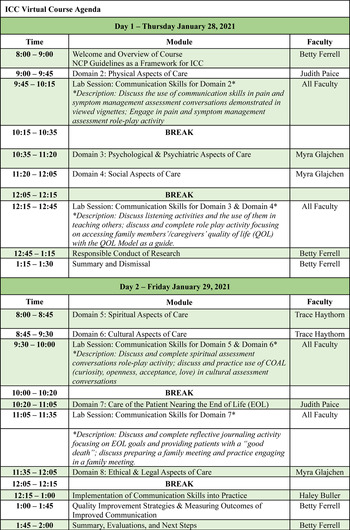
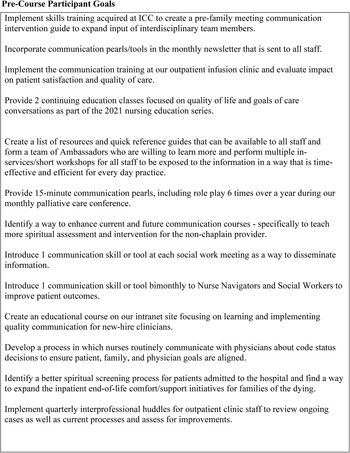
The course was designed as an in-person training, but due to COVID-19 travel restrictions, the instruction was converted into a virtual format. Figure 1 displays the virtual course agenda. The general framework for the course was to provide lectures by leaders in the three targeted disciplines (nursing, social work, and chaplaincy) to summarize the key evidence-based content and then to divide into small groups of approximately 15 people per group to apply the content in lab sessions. The lab sessions were intended as a time for networking, sharing experiences, using experiential learning such as role plays, and viewing video clips of communication scenarios, followed by discussion, self-assessment tools, and other methods to reinforce the content. Both lectures and lab sessions also included a focus on how to use the ICC materials to teach others, as each participant was expected to share the curriculum with colleagues in their home settings (Figure 2).
ICC virtual course agenda.

Pre-course participant goals.

Results
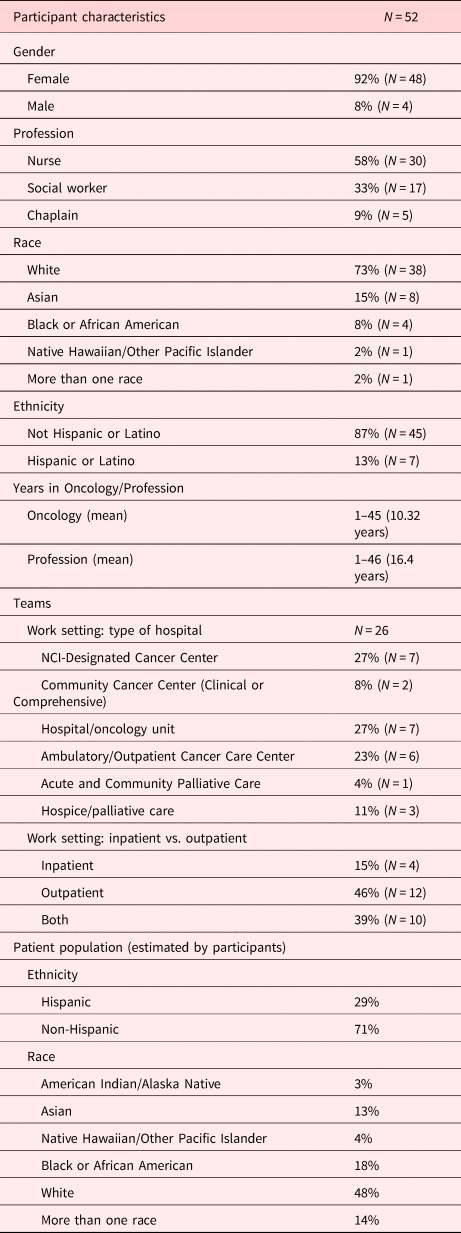
Fifty-two participants in interprofessional dyads (nurses, psychologists, and chaplains) attended the January 2021 ICC virtual course. Ninety-two percent (N = 48) of participants were female, 58% were nurses (N = 30), 33% social workers (N = 17), and 9% chaplains (N = 5). Twenty-seven percent (N = 7) worked in an NCI-designated cancer center and another 27% (N = 7) worked in a hospital/oncology unit. (Table 1) The participants include a diverse group with 52% representing non-Caucasian ethnicities, which is valuable as the course also focused on cultural aspects of communication and the need to improve communication for underrepresented populations.
Participant and patient characteristics

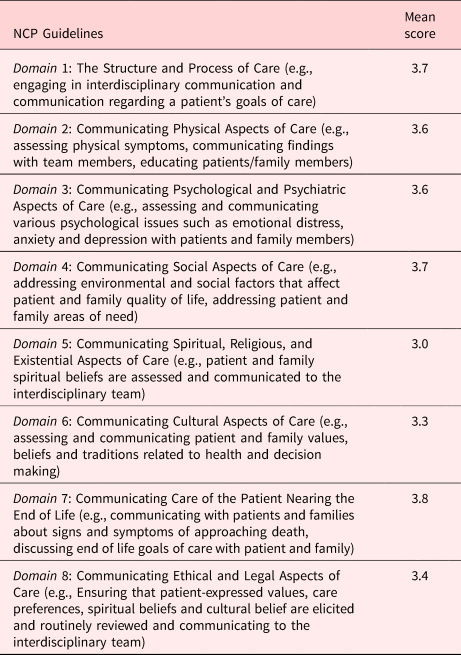
Participants completed pre-course assessment tools to rate how effective they were in communicating with patients at their institutions during key points in treatment: diagnosis, during treatment, survivorship, at recurrence, when facing the end of life, at time of death, and during bereavement (Table 2); and particularly, in relation to the eight NCP domains of care. Overall, using a scale of 1 = not effective to 5 = very effective, participants rated their own effectiveness moderately high with items ranging from a mean of 3.0–3.8. Communication related to spirituality (Domain 5) and culture (Domain 6) were rated as least effective areas. Communication for patients at the end of life was rated as most effective.
Pre-course: rate your effectiveness in communicating in each of the eight NCP guideline domains

(1 = not effective and 5 = very effective).
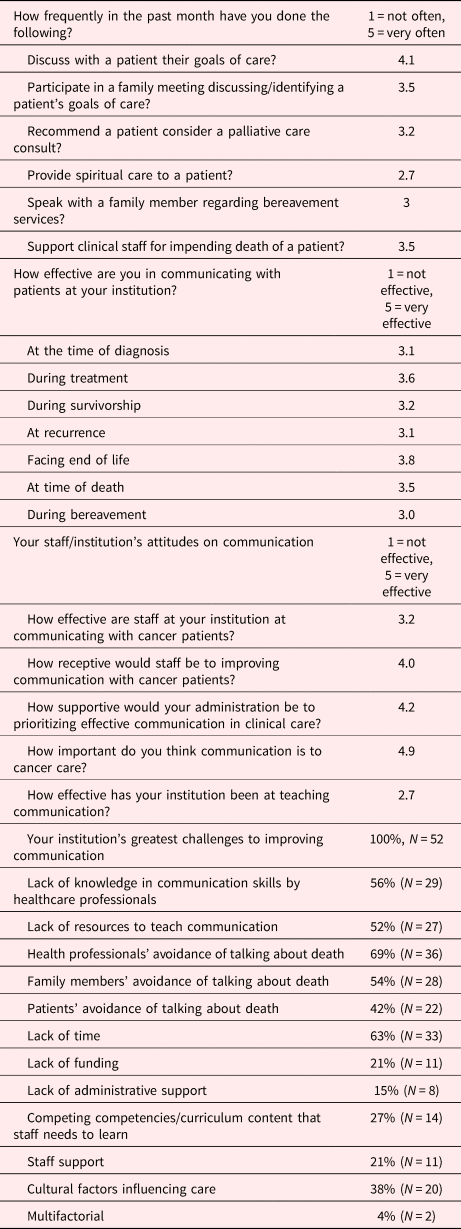
Participants were also asked how effective they and their colleagues were in specific areas of communication (Table 3), and whether they would be receptive to communication improvement efforts. Participants reported “providing spiritual care” as their least frequent aspect of care, and they reported least effectiveness in communication at times of initial diagnosis, recurrence, and during bereavement (Table 3). Finally, they were queried about their institution's greatest challenges to improving communication, and 69% (N = 36) reported the barrier of “Health professionals’ avoidance of talking about death.” When asked about specific barriers to communication improvement efforts, 63% (N = 33) of participants said lack of time, and 38% (N = 20) said cultural factors influencing care (Table 3).
Pre-course questionnaire data

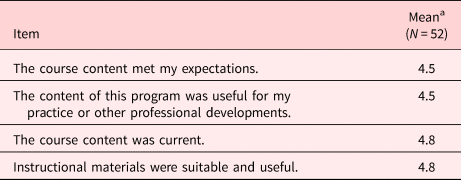
Following the course, the participants rated the course's effectiveness on a scale of 1 = lowest to 5 = highest. Participants rated the course on meeting their expectations and usefulness for their practice or professional development as 4.5 on the 5-point scale. When asked if the context was current and whether the instructional materials were suitable or useful, participants rated both items as 4.8, on a 1 = lowest to 5 = highest scale (Table 4).
Post-course evaluation

a 1 = lowest and 5 = highest.
During and after the course, participants were given the opportunity to revise their goals, as they often gained new ideas from the course sessions and from their interactions with other participants. The goals represent a range of activities with many addressing staff education, as well as specific areas of communication such as improving the processes of family meetings or advance care planning.
Follow-up evaluation will be conducted at 6 and 12 months for each cohort in which participants will report on their activities guided by the goals they established. Participants are also invited to engage in monthly webinars for 1 year following the course. The 1-h webinars are presented on different days and times to facilitate attendance by participants in various time zones. The time is divided between providing additional content on requested topics and having participants continue to share their experiences and network with others. Examples of scheduled webinars include communication when caring for patients in the LGBTQAI+ community and family meetings during the COVID-19 pandemic.
Discussion
This NCI-supported training program addresses a key aspect of quality cancer care, the use of communication across all domains of care. The course is innovative in its focus on oncology and in bringing together three disciplines that are key members of oncology teams who provide essential communication to patients and families. In addition, the ICC course materials and the supplemental online learning modules provide a cost-effective approach to communication training for institutions with limited financial resources or in rural communities.
Four additional ICC courses will be held in the future in various geographical regions in the USA, with a total of five courses including 450 professionals serving as models for integrating the evidence base regarding communication into clinical settings.