Bilingual speakers have knowledge of two language systems.1 Does their experience of their native language (L1) affect the way in which they process their non-native language (L2), or is their processing of their L2 dependent entirely on their experience of the L2?
One potentially important factor is the extent to which the two language systems overlap or differ along a particular dimension. For example, English, German, and Spanish all share some aspects of syntactic structure. Thus, they all allow a structure in which a dative verb is followed by a noun phrase (NP) and a prepositional phrase (PP), as in English The cowboy sells the apple to the nun, German Der Cowboy verkauft den Apfel an der Nonne, and Spanish El vaquero vende la manzana y la monja (a Prepositional Object or PO structure).2 However, English and German differ from Spanish in additionally allowing a structure in which a dative verb is followed by two NPs, as in English The cowboy sells the nun the apple and German Der Cowboy verkauft der Nonne den Apfel (a Double Object or DO structure). For English and German but not Spanish speakers, describing a dative event therefore involves choosing between a PO and a DO structure. In this paper we investigate whether the presence or absence of a structure in the L1 of late bilinguals (i.e., bilinguals who acquired their L2 after early childhood) affects their preferences for structural alternatives in their L2, and consider the implications for models of bilingual sentence production.
There is much consensus among researchers on the basic architecture of L1 speech production (e.g., Bock & Levelt, Reference Bock, Levelt and Gernsbacher1994; Garrett, Reference Garrett and Bower1975, Reference Garrett and Butterworth1980; Levelt, Reference Levelt1989; Levelt, Roelofs & Meyer, Reference Levelt, Roelofs and Meyer1999), and specifically on the levels of processing that are involved: a conceptual level, at which the message to be expressed is formulated; a grammatical level, at which individual lexical items are retrieved and built up into grammatical structures; and a phonological level, at which the sound structure of the utterance must be processed before the utterance can then be articulated. Psycholinguistic accounts of the syntactic component of L2 production have extended L1 models to L2 speakers (e.g., de Bot, Reference De Bot1992; Poulisse & Bongaerts, Reference Poulisse and Bongaerts1994; Truscott & Sharwood Smith, Reference Truscott and Sharwood Smith2004). De Bot adapted Levelt's (Reference Levelt1989) model of production to account for sentence production in bilinguals (or multilinguals). He hypothesized that monolingual and bilingual linguistic systems – including syntactic representation and processing – should be broadly similar (with some additional features to account for phenomena specific to bilinguals). He proposed that a speaker might represent some elements of grammatical information separately for an L1 and L2, and other aspects together, depending on factors such as the similarity of the L1 and L2 grammars. Specifically, he suggested that speakers would be more likely to use shared syntactic representations for their L1 and L2 when the L1 and L2 grammars were similar than when they were dissimilar.
In fact, recent evidence using structural priming paradigms has suggested that bilingual speakers who are proficient in both of their languages do have shared representations for syntactic structures that are sufficiently similar between their two languages (see Pickering & Ferreira, Reference Pickering and Ferreira2008). Structural (or syntactic) priming is the phenomenon whereby comprehension or production of an utterance is facilitated by previous comprehension or production of an utterance with the same (or a related) structure. Bock (Reference Bock1986) found that participants were more likely to describe a picture using an active construction (e.g., Lightning is striking the church) if they had just repeated an unrelated active sentence (e.g., One of the fans punched the referee) than if they had just repeated the equivalent passive sentence (e.g., The referee was punched by one of the fans). The effects occur in the absence of the repetition of lexical items (Bock, Reference Bock1989), thematic roles, or metrical structure (Bock & Loebell, Reference Bock and Loebell1990). This implies that speakers have representations of abstract syntactic rules within a language, with use of a particular syntactic rule (or rules) in the production of a sentence facilitating use of that rule in a subsequent sentence. Priming is widespread, occurring in children (e.g., Huttenlocher, Vasilyeva & Shimpi, Reference Huttenlocher, Vasilyeva and Shimpi2004), Broca's aphasics (Hartsuiker & Kolk, Reference Hartsuiker and Kolk1998), and amnesiacs (Ferreira, Bock, Wilson & Cohen, Reference Ferreira, Bock, Wilson and Cohen2008), as well as within L2 speakers (e.g., Bernolet, Hartsuiker & Pickering, Reference Bernolet, Hartsuiker and Pickering2007; Kantola & Van Gompel, Reference Kantola and Van Gompel2011; Schoonbaert, Hartsuiker, & Pickering, Reference Schoonbaert, Hartsuiker and Pickering2007).
In addition, structural priming occurs between languages. For example, Loebell and Bock (Reference Loebell and Bock2003) found that German–English bilinguals tended to use a PO or DO form in German after using the structurally equivalent form in English. Similarly, Hartsuiker, Pickering and Veltkamp (Reference Hartsuiker, Pickering and Veltkamp2004) found that participants were more likely to use an English passive after a Spanish passive than a Spanish active (see also Fleischer, Pickering & McLean, Reference Fleischer, Pickering and McLean2012; Heydel & Murray, Reference Heydel, Murray, De Vincenzi and Lombardo2000; Kantola & Van Gompel, Reference Kantola and Van Gompel2011; Meijer & Fox Tree, Reference Meijer and Fox Tree2003; Schoonbaert et al., Reference Schoonbaert, Hartsuiker and Pickering2007). On the basis of such findings, Bernolet et al. (Reference Bernolet, Hartsuiker and Pickering2007) proposed that bilinguals have shared syntactic representations for constructions that are sufficiently similar in both languages. Thus, using a construction in one language primes the use of the corresponding construction in the other language. However, syntactic constructions that differ between languages would have language-specific representations. For example, proficient bilingual speakers of German and English would have a shared representation of the PO structure, which they would use whenever processing a PO sentence in either language, and similarly would have a shared representation of the DO structure. In contrast, proficient bilingual speakers of Spanish and English would have a common representation of the PO structure, which they would use whenever processing a PO sentence in either language; but would have a representation of the DO structure that would be restricted to English (because this structure does not occur in Spanish).Footnote 3
The existence of priming between languages also demonstrates that experience of that structure in one language (i.e., processing the prime sentence) affects their use of that structure in their other language (i.e., when they process the target sentence). However, it is not informative about the precise way in which this occurs, and in particular how speakers’ preferences for one or other structure in one of their languages might relate to their experiences of those structures in their other language. Specifically, are bilinguals’ structural preferences in their L2 affected by their experiences of their L1, or are their structural preferences in their L2 dependent entirely on their experience of the L2? To investigate this question, we use structural priming to examine how recent experience of a structure in one language affects subsequent processing in the same language, and whether for bilingual speakers this is affected by structural characteristics of their L1.
Language-specific versus language-nonspecific processing
If speakers use language-specific mechanisms to produce sentences, their preferences for L2 should be affected by their experiences of L2 but not L1. Recall that English and German allow both the PO and DO forms of the dative alternation, whereas Spanish allows the PO but not the DO form. An L1 speaker of English has preferences for the English PO and DO forms that will depend on her experience of the frequency of the PO and DO forms in English. Under a language-specific account, this will also be the case for a German-L1 speaker and, importantly, for a Spanish-L1 speaker, as their experiences with datives in their native languages are irrelevant. Assuming that they have encountered roughly the same proportions of English PO and DO forms as each other, English-L1, German-L1, and Spanish-L1 speakers should all show broadly the same pattern of preferences for English PO and DO forms. Most likely, they will also show a slight preference for the PO form, as it appears to be slightly more frequent in (British) English (for example, Gries & Stefanowitsch, Reference Gries and Stefanowitsch2004, report 65% PO and 35% DO forms in a corpus study of eight frequent English dative verbs).
But if speakers use language-nonspecific mechanisms, their preferences for L2 should be affected by their experiences with both L2 and L1. Again, we assume that English-L1, German-L1, and Spanish-L1 speakers have encountered similar proportions of English PO and DO forms as each other. In addition, German-L1 speakers have encountered both forms in their L1 (for example, Gries & Wulff, Reference Gries and Wulff2005, report 51% PO and 49% DO forms in a corpus study of eight frequent German dative verbs). In contrast, Spanish-L1 speakers have encountered PO but not DO forms in their L1. That is, German-L1 speakers have encountered more DOs in their overall experience (based on their cumulative German and English experience) than Spanish-L1 speakers. German-L1 speakers should therefore tend to produce more English DOs than Spanish-L1 speakers. Assuming that the frequency of PO and DO forms in German is not dramatically different from those in English (as the corpus data reviewed above suggests), English-L1 and German-L1 speakers should produce fairly similar proportions of POs and DOs to each other. In contrast, Spanish-L1 speakers should produce more POs and fewer DOs than the other speakers (assuming that the Spanish-L1 speakers had not been exposed to dramatically more English than Spanish).
The two accounts also make different predictions about priming. There is good evidence that structural priming is subject to what has been termed the inverse preference effect, whereby moderately infrequent structures (e.g., English passives) tend to be primed more strongly or reliably than more frequent structures (e.g., English actives; Bock, Reference Bock1986; Hartsuiker & Kolk, Reference Hartsuiker and Kolk1998; Hartsuiker & Westenberg, Reference Hartsuiker and Westenberg2000; Scheepers, Reference Scheepers2003), though this effect does not occur when the structure is highly infrequent and presumably nearly impossible to prime under any circumstances (Pickering, Branigan & McLean, Reference Pickering, Branigan and McLean2002). The inverse preference effect is most clearly demonstrated by using a neutral or baseline prime that is unrelated to either form of the target sentence: Presentation of the less frequent alternative should lead to more priming (measured in relation to the baseline) than presentation of the more frequent alternate. For example, Bernolet and Hartsuiker (Reference Bernolet and Hartsuiker2010) found stronger priming of the less frequent DO form (in Dutch) relative to a transitive baseline than of the more frequent PO form. According to the language-specific account, all three speakers should show the same pattern of priming in English. Thus, an English-L1 speaker should tend to produce PO responses more often after PO primes and DO responses more often after DO primes to roughly the same extent, relative to the baseline (because both constructions are of fairly similar frequency in English). Again assuming that a German-L1 speaker and a Spanish-L1 speaker have experienced similar proportions of PO and DO sentences in English to an English-L1 speaker, the language-specific account predicts that they should demonstrate similar priming from PO and DO sentences relative to the baseline as an English-L1 speaker. Thus, the account predicts the same pattern of priming in all three speakers.
In contrast, the language-nonspecific account predicts that the three speakers should not show the same pattern of priming in English. Under this account, an English-L1 speaker and a German-L1 speaker should pattern in the same way, because they have both experienced similar proportions of PO and DO sentences overall (irrespective of the language in which those sentences occurred). They should therefore tend to show priming for PO and DO responses to approximately the same extent. But a Spanish-L1 speaker should show a different pattern of priming, because she will have considerably more experience of PO constructions (when her experience in both English and Spanish is considered together) than DO constructions. She should therefore experience more priming from DO sentences than from PO sentences, relative to the baseline.
For these arguments to hold, it needs to be the case that the German-L1 and Spanish-L1 speakers are susceptible to structural priming effects in English to a similar extent to English-L1 speakers. In theory, the structural choices of L2 speakers might be more malleable and susceptible to influences of recent linguistic experience, because L2 speakers have in general been exposed to the language less than L1 speakers. This would be consistent with accounts of structural priming that are based on strengthening of message-to-syntax mappings (e.g., Bock & Griffin, Reference Bock and Griffin2000; Chang, Dell & Bock, Reference Chang, Dell and Bock2006), which predict that the language system should be more susceptible to effects of experience when it has had less exposure to linguistic input than when it has had more exposure. Under these accounts, a single sentence would affect mappings within the system more strongly during earlier stages of acquisition than after the learner had been exposed to more input. Such differences might occur early in L2 acquisition (i.e., in low-proficiency L2 speakers), but are much less likely after extensive exposure (i.e., in high-proficiency L2 speakers).
In fact, surprisingly little research has addressed priming within L2. Some studies in applied linguistics have suggested that priming within L2 may be useful in facilitating language learning (e.g., Biria, Ameri-Golestan & Antón-Méndez, Reference Biria, Ameri-Golestan and Antón-Méndez2010; McDonough, Reference McDonough2006; McDonough & Chaikitmongkol, Reference McDonough and Chaikitmongkol2010; McDonough & Mackey, Reference McDonough and Mackey2008). In addition, research has shown priming within L2 in late bilinguals (e.g., Gries & Wulff, Reference Gries and Wulff2005), including three experimental studies of within- and between-language priming (Bernolet et al., Reference Bernolet, Hartsuiker and Pickering2007; Kantola & Van Gompel, Reference Kantola and Van Gompel2011; Schoonbaert et al., Reference Schoonbaert, Hartsuiker and Pickering2007). These studies suggest that priming within L2 in late bilinguals is similar in magnitude to priming from L1 to L2 (at least in the absence of lexical repetition). They also found similar L2 priming of English to L1 priming of their native language (Swedish or Dutch).
However, no study has directly compared L1 and L2 within-language priming with the same target language in late bilinguals (though see Cai, Pickering, Yan & Branigan, Reference Cai, Pickering, Yan and Branigan2011, regarding L1 and L2 priming in early balanced bilinguals). To examine this question, we compared the effects of structural priming in a group of L1 speakers and two groups of highly proficient L2 speakers of English: L1 German speakers (whose L1 allows both PO and DO sentences) and L1 Spanish speakers (whose L1 allows PO sentences but not DO sentences). We used a picture-matching and picture-description task, in which participants read (scripted) prime descriptions involving a PO structure, a DO structure, or an intransitive (baseline) structure. Participants decided whether or not these descriptions matched pictures depicting dative actions. They then described another dative picture (hence, produced a target description) on the immediately subsequent turn. We measured both speakers’ baseline structural preferences in a neutral context (i.e., following an intransitive baseline description), and structural priming: whether they were more likely to produce a target description that involved a particular syntactic structure immediately after comprehending a prime description with that structure, relative to the baseline. The target pictures were designed to induce PO and DO descriptions involving the same verb as the associated prime description: Verb repetition leads to enhanced priming in both L1 and L2 (Branigan, Pickering & Cleland, Reference Branigan, Pickering and Cleland2000; Pickering & Branigan, Reference Pickering and Branigan1998; Schoonbaert et al., Reference Schoonbaert, Hartsuiker and Pickering2007) and therefore makes it more likely that differences among the language groups will emerge. Intransitive prime descriptions of course involved different verbs from the target descriptions.
The language-specific account, in which bilingual speakers’ preferences are affected only by their experiences of a structure within a particular language, predicts that all three groups of speakers should show the same preferences for PO versus DO structures in the baseline condition. Similarly, they should show the same pattern of priming, producing PO responses more often after PO primes and DO responses more often after DO primes to roughly the same extent, relative to the baseline. In contrast, the language-nonspecific account, in which bilingual speakers’ preferences are affected by their experiences of a structure within both of their languages, predicts that Spanish-L1 speakers should show a different pattern of baseline preferences and structural priming to the English-L1 and German-L1 speakers. Specifically, Spanish-L1 speakers should show a lower baseline preference for the DO structure (and a correspondingly higher baseline preference for the PO structure) than the English-L1 and German-L1 speakers. In addition, they should show stronger priming from DO sentences, relative to English-L1 and German-L1 speakers.
Our experiment therefore tests whether L2 speakers’ structural preferences are affected by their experience of their L1, or are dependent entirely on their experience of the L2. Previous research has shown evidence for structural priming within L2 in late bilinguals, but has not resolved the influence of L1 versus L2 experience on L2 processing.
Experiment
Method
Participants
Fifty four participants were paid to take part. Of these, 18 were English-L1 speakers, without advanced knowledge of any other languages. The other participants were 18 German-L1 speakers and 18 Spanish-L1, all of whom spoke advanced L2 English. We refer to these groups as English, German, and Spanish, according to the L1 of those participants.
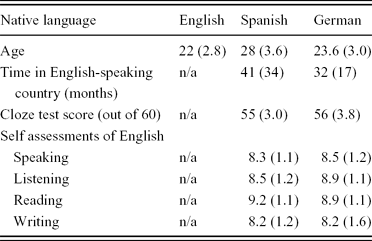
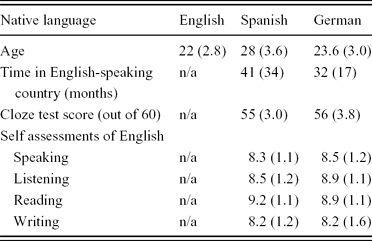
L2 speakers’ proficiency was assessed by asking participants to complete a multiple-choice Cloze test. This comprised 60 questions testing both grammar and vocabulary, obtained from a language school that used it to assess incoming students. Scores of 50 upwards were scored as advanced proficiency (corresponding to level C1 in the Common European Framework of Reference for Languages). L2 speakers reported their time in an English-speaking country, and rated their ability in English on speaking, listening, reading, and writing. Three Spanish participants were replaced in order to balance the Spanish and German proficiency levels. Independent-samples t-tests showed no significant differences between the two L2 groups on time spent in an English-speaking country, self-assessments of ability in English, and score on the Cloze test (all ts < 1.1). See Table 1 for participants’ details.
Participant details showing means (and standard deviations) of age, time spent in English-speaking country, score on Cloze test, and self-assessments of English proficiency.
Items
We constructed two sets of pictures. One set was matching pictures that the participant had to match to the prime description and the other set was description pictures for which the experimental participant would produce target descriptions. The verb corresponding to the depicted action was printed beneath each picture. The matching pictures comprised 36 pictures depicting a dative action involving an animate agent, an inanimate theme, and an animate goal, and 36 intransitive matching pictures depicting a single character performing an intransitive action. Dative matching pictures involved six ditransitive verbs (award, hand, lend, sell, send, and throw); intransitive matching pictures involved six intransitive verbs (cry, laugh, run, sleep, smile, walk). In half the pictures the goal was on the left of the theme, and in half the pictures the goal was on the right.
Each dative matching picture was paired with two prime sentences, one using a PO and one using a DO construction (e.g., (1a) and (1b)); each intransitive matching picture was paired with an intransitive prime sentence (e.g., (1c)).
- (1)


For half the matching pictures, these prime sentences matched the depicted event. For the other half, one of the characters differed from those depicted. In the dative sentences, the agent, theme, or goal was different to that shown in the picture (equally often); in the intransitive sentences, the entity was different to that shown in the picture.
The description pictures comprised 36 further pictures of dative actions, involving the same six dative verbs. Each description picture was paired with one dative matching picture (always involving the same verb), one intransitive matching picture, and their associated prime sentences. For example, the description picture in Figure 1 was paired with a dative matching picture of a cowboy selling an apple to a nun, an intransitive matching picture of a teacher laughing, and the three prime sentences in (1a–c).
Example description picture.

We constructed three lists, each comprising 12 items from each condition and one version of each item. We also constructed 108 filler description pictures and 108 filler matching pictures and phrases, all depicting (mono)transitive actions. In half of these pictures the object of the verb was animate and in half it was inanimate. In a quarter of the matching sentences the subject was different to that depicted in the picture and in another quarter the object was different. For each participant we prepared an individually randomised list, with the constraint that at least two fillers intervened between experimental items.
Procedure
Participants sat in front of a computer and were told that the experiment involved two tasks, matching descriptions to pictures and describing pictures. The experiment was presented using E-Prime software (Psychology Software Tools, Pittsburgh, PA). First, a matching phrase appeared on the screen (Font: Arial, point size 22). The participant read it silently and then pressed the space bar. It was replaced by the description picture and the participant was instructed to respond yes if the description matched the picture and no otherwise. The participant then pressed the space bar again and the target picture appeared on the screen with “. . .” underneath it to indicate a response was required. The participant described this picture using the verb and pressed the space bar to reveal the next matching phrase. There was no time limit. Target descriptions were recorded, transcribed, and scored.
Scoring
Each dative target picture description was scored as a PO, DO, or Other on the basis of its syntactic structure. A description was scored as a PO if an NP that expressed the theme immediately followed the verb, and was followed by the preposition to and an NP that expressed the recipient. A description was scored as a DO if an NP that expressed the recipient immediately followed the verb, and was followed by an NP that expressed the theme. Responses meeting these criteria were scored as PO or DO irrespective of any lexical or morphological infelicities. All other responses were scored as Other.
Results
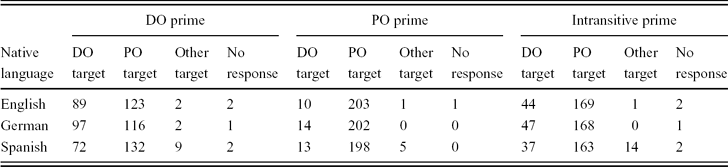
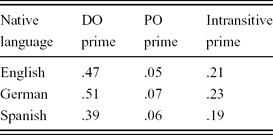
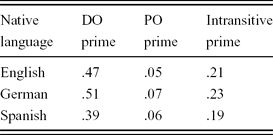
Each participant produced 36 target utterances, 12 in each of the three priming conditions defined by the Prime Construction (PO vs. DO vs. intransitive) factor. There were 423 DO responses, 1458 PO responses, and 51 Other responses (mostly monotransitive responses that mentioned only the theme of the action), with participants failing to produce a response on 12 trials (English participants: 5 trials; German participants: 2 trials; Spanish participants: 5 trials); see Table 2. Following previous studies (e.g., Pickering & Branigan, Reference Pickering and Branigan1998), our dependent measure was the proportion of DO target responses out of the sum of DO and PO target responses in each condition (see Table 3; note that proportions of PO responses are complementary, such that an increase in the production of DOs in a given condition corresponds to an equivalent decrease in the production of POs, and vice versa); prior to analysis, proportions were arcsine-transformed, with Greenhouse-Geisser corrections where relevant for violations of variance assumptions.
Frequencies of responses by condition.
Proportions of DO responses by condition (based on participants analyses).
We performed two-way ANOVAs with the factors Native Language (English vs. German vs. Spanish; between participants and within items) and Prime Construction (DO vs. PO vs. Intransitive; within participants and within items) on the arcsine-transformed proportions of DO target responses, treating participants (F1) and items (F2) as random factors.
We found a main effect of Prime Construction (F1(1.548,102) = 60.15, p < .001, MSe = 2.16; F2(2,70) = 98.73, p < .001, MSe = 3.75). Comparisons indicated that participants produced more DO target responses after DO primes (.45) than after intransitive primes (.21), t 1(53) = 6.87, p < .001; t 2(35) = 7.74, p < .001; and that they produced fewer DO target responses after PO primes (.06) than after intransitive primes (.21), t 1(53) = –5.73, p < .001; t 2(35) = 7.40, p < .001.
The main effect of Native Language did not approach significance by participants, although it was significant by items (F1 < 1; F2(2,70) = 7.41, p < .01, MSe = 0.16). The proportion of DOs (collapsed across priming conditions) was .25 for English participants, .27 for German participants, and .21 for Spanish participants. To further test the effect of native language, we examined participants’ baseline preferences by investigating the proportion of DOs in the intransitive conditions (in which participants had not encountered an immediately preceding dative prime sentence). One-way ANOVAs were not significant (Fs < 1), with the proportions of DOs being .21 for English participants, .23 for German participants, and .19 for Spanish participants. These results suggested that participants’ L1 did not affect their baseline preferences.
The interaction between Prime Construction and Native Language was significant by items only (F1 < 1; F2(4,140) = 1.96, p < .01, MSe = 0.06), suggesting that the magnitude of priming was not reliably affected by participants’ L1. We confirmed this by directly comparing the magnitude of both DO and PO priming to the baseline across the three language groups. We calculated DO priming as the difference in the proportion of DOs produced in the intransitive condition and after a DO prime, and PO priming as the difference in the proportion of DOs produced in the intransitive condition and after a PO prime. Planned comparisons showed no difference in the magnitude of DO or PO priming in the English group compared to the German group (ts < 1) or the Spanish group (ts < 1.3); nor did the two L2 groups differ from each other (ts < 1.6).
Finally, planned comparisons indicated that bidirectional priming occurred for English, German, and Spanish participants considered separately, with DOs being more frequent after DO primes than after intransitive primes (all ps < .01), and DOs being less frequent after PO primes than after intransitive primes (all ps < .01).
Discussion
The results of our experiment demonstrated that L1 speakers of English and advanced proficiency L2 speakers of English whose first language was Spanish or German showed structural priming for both PO and DO dative constructions. They were more likely to produce a PO target after reading a PO prime than after reading an intransitive prime, and more likely to produce a DO target after reading a DO prime than after reading an intransitive prime. The magnitude of this tendency was the same for the L1 and both L2 speaker groups, despite their different L1 backgrounds. In addition, the three language groups showed no difference in their tendency to produce DO structures following an intransitive prime.
Our results extend previous findings of structural priming in bilingual speakers. Previous studies have shown that structural priming occurs between languages (e.g., Loebell & Bock, Reference Loebell and Bock2003; Hartsuiker et al., Reference Hartsuiker, Pickering and Veltkamp2004), but only when the constructions are similar in both languages (Bernolet et al., Reference Bernolet, Hartsuiker and Pickering2007). Bernolet et al. (Reference Bernolet, Hartsuiker and Pickering2007) proposed on the basis of such evidence that bilinguals have shared abstract syntactic representations for constructions that are sufficiently similar in both languages, but language-specific representations for syntactic constructions that differ between languages. Our finding that the Spanish-L1 group showed reliable two-way priming for English PO and DO dative constructions suggests that L2 learners are able to acquire and instantiate such abstract language-specific representations for syntactic constructions that do not exist in their L1, on the basis of long-term exposure to the L2.
But more importantly, our results are informative about the extent to which bilingual speakers’ structural preferences are affected by their experience of their two languages. Previous research has demonstrated that structural priming occurs within L2 in late bilinguals, and thus that structural choices in L2 are affected by recent experiences of the L2; and moreover that such priming is similar in magnitude to that found between L1 and L2 (i.e., when primes are in L1 and targets are in L2), at least in the absence of lexical repetition (Bernolet et al., Reference Bernolet, Hartsuiker and Pickering2007; Kantola & Van Gompel, Reference Kantola and Van Gompel2011; Schoonbaert et al., Reference Schoonbaert, Hartsuiker and Pickering2007). But these studies did not examine whether bilingual speakers’ experiences of their L1 also play a role in their L2 structural preferences.
We identified two possible accounts of structural preferences in bilingual production. Under the language-specific account, speakers’ structural preferences are specific to particular languages, and experiences accrued in one language affect preferences for that language only. Under the language-nonspecific account, speakers’ structural preferences are not specific to particular languages, and experiences accrued in one language can affect preferences for the other language. Our results allow us to distinguish the two accounts. The language-nonspecific account predicted that Spanish-L1 speakers should show a stronger preference for the PO structure than English-L1 speakers and German-L1 speakers in a neutral context (i.e., following an intransitive), but stronger priming for the DO structure following a DO prime. We found neither of these effects. Hence, we find no evidence that L2 speakers transfer preferences from their L1 to their L2, nor that the inverse preference effect transfers over cumulative frequencies across languages. Our pattern of results is instead consistent with the language-specific account, which predicted that both groups of L2 speakers should show the same baseline preferences and the same pattern of priming as L1 speakers. These results therefore suggest that at least at these levels of proficiency, processing in L2 is unaffected by whether particular structural alternatives exist in a speaker's L1.
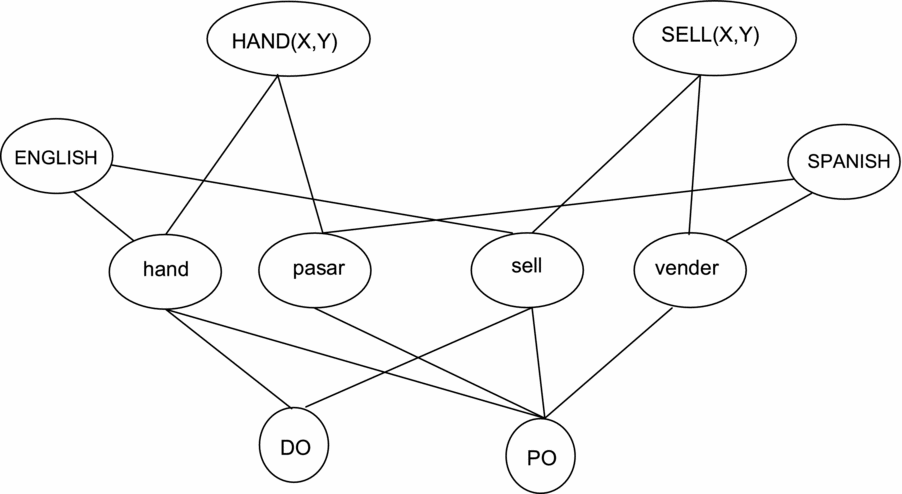
We now consider how these results can be accommodated within a processing model of L2 production. We consider our findings in the context of Pickering and Branigan's (Reference Pickering and Branigan1998) model, which was adapted by Hartsuiker et al. (Reference Hartsuiker, Pickering and Veltkamp2004) to account for cross-linguistic structural priming in bilinguals. Figure 2 shows our proposed extension of this model for an L1 English-L2 Spanish speaker. In this shared lexicon-shared syntax model, lemmas for both languages are connected to the same category node (e.g., Verb) and, for structures that have equivalent syntax, the same combinatorial nodes (e.g., PO in English and Spanish). Combinatorial information is unspecified for language, but individual lemmas are linked to English and Spanish language nodes (i.e., they are tagged for language; Dijkstra, Van Heuven & Grainger, Reference Dijkstra, Van Heuven and Grainger1998). Therefore, production of a PO utterance in L2 English requires the co-activation of the PO combinatorial node and a lemma (e.g., sell) which is linked to the English language node.
An adaptation of Hartsuiker, Pickering and Veltkamp's (Reference Hartsuiker, Pickering and Veltkamp2004) model of the bilingual architecture, showing English and Spanish lexical entries for SELL and HAND in an integrated (shared lexicon, shared syntax) account of bilingual language representation.
In Figure 2 we have extended Hartsuiker et al.'s (Reference Hartsuiker, Pickering and Veltkamp2004) model to include a combinatorial node associated with a structure that is grammatical in only one of the bilingual's languages: the DO, which is found in English but not Spanish. Because this DO node is not directly tagged for language (i.e., is not linked to either of the language nodes), constraints on the language in which the structure can be used arise from its connections to only English, and not Spanish, verb lemmas. However, the architecture does not explicitly prevent the use of the DO in Spanish, other than through the zero weightings of the connections between the DO node and Spanish lemmas. Of course, Spanish speakers might erroneously adopt a low but non-zero weighting between the DO node and Spanish lemmas (perhaps because of the influence of English). If so, they might occasionally produce (ungrammatical) DO Spanish sentences.
This model explains the language-specific structural preferences that we found in our experiment in the following way. The Spanish-L1 speaker has a shared (language-independent) PO node, which is linked to the sell, hand, vender and pasar lemmas. However, the connections between the lemmas and the PO node are different. Because the DO is not possible in Spanish, the weighting between vender and PO is (effectively) 1 (i.e., vender is always used in a PO structure). Because the DO is used in English with sell, the weighting between sell and PO is (roughly) .65 (and the weighting between sell and DO is .35); similarly, the weighting between hand and PO is (roughly) .65. The likelihood of using sell and hand in a PO sentence is directly determined by this value (i.e., .65).Footnote 4 Spanish-L1 speakers’ preferences for the use of the PO construction in English are therefore unaffected by their experiences of Spanish utterances (they depend on the strength of the link between the English lemma and the PO node, which is based on experiences of English utterances). The same holds for English-L1 speakers (who do not have the vender node or the link between it and the PO node). Thus, Spanish-L1 and English-L1 speakers (and indeed German-L1 speakers) show the same baseline preference for the PO structure in English.
This model therefore straightforwardly captures the fact that the same speaker may have different baseline preferences for alternative structures in their two languages. Although our findings do not provide evidence about this issue, recent research has shown that bilingual speakers’ preferences for the same structure may differ between their two languages. Cai et al. (Reference Cai, Pickering, Yan and Branigan2011) found that advanced bilingual speakers of Cantonese-L1 and Mandarin-L2 had a stronger preference for PO structures over DO structures in Cantonese than in Mandarin (see also Gries & Wulff, Reference Gries and Wulff2005, for evidence that verb-specific preferences for PO and DO structures differ between English and German translation-equivalents). Note that such cross-linguistic differences in preferences could not be captured in a language-nonspecific account, which would predict that in any given context, bilinguals should consistently show the same tendency to produce one structure rather than the other in both of their languages.
The model can also explain our finding that priming effects reflect language-specific experience (as well as explaining the existence of cross-linguistic priming effects such as Hartsuiker et al., Reference Hartsuiker, Pickering and Veltkamp2004). When a speaker hears an English PO sentence, this increases activation of the language-independent PO node. This in turn affects the weighting of the link between the PO node and the English lemma node (e.g., raising it from .65 to .75), increasing the likelihood of this structure being used subsequently (i.e., yielding structural priming). This weight-change, and thus the priming effect, is unaffected by the properties of the speaker's L1, since the links between the lemmas and the PO node are language-specific.
When a Spanish–English bilingual uses vender in a PO construction, this strongly activates the Spanish language node, the vender lemma node, and the PO node. Activation of the PO node leads to weaker activation of sell (and other verbs that allow the PO construction, e.g., hand). This temporarily strengthens the link between PO and sell, thus leading to cross-linguistic priming. But this activation is not great enough to lead to a long-term weight change between the nodes. When a monolingual English speaker (or presumably a Spanish–English bilingual using English) uses hand in a PO construction, this activates the English language node, the hand lemma node, and the PO node. Activation of the PO node leads to weaker activation of sell. This strengthens the link between PO and sell. But in addition, the English language node activates the sell node. Hence sell receives activation from two sources. This activation (together with the co-activation of the PO node) is sufficient to lead to a long-term weight change between sell and the PO node. See Cai et al. (Reference Cai, Pickering, Yan and Branigan2011) for a related account of short-term cross-linguistic priming in Cantonese–Mandarin bilinguals.
In summary, we have shown that highly proficient bilingual speakers’ experience of their native language does not affect the way in which they process their non-native language: When they process their L2, they do so on the basis of their experience of that language only. Bilinguals appear to share syntactic representations across languages, but their experiences using those representations seem to be language-specific.