




No CrossRef data available.
Article contents
L2 processing and memory retrieval: Some empirical and conceptual challenges
Published online by Cambridge University Press: 03 October 2016
Extract
Cunnings' keynote offers a new perspective on L2 processing by casting L1–L2 differences in terms of the memory system. One advantage of this approach is that it makes use of cue-based memory retrieval, a framework that has given rise to a wealth of research on L1 processing. However, there remain some questions about the evidence-base and predictions of the account, as well as conceptual challenges to its implementation.
Information
- Type
- Peer Commentaries
- Information
- Copyright
- Copyright © Cambridge University Press 2016
References
Hoshino, N., Dussias, P.E., & Kroll, J.F. (2010). Processing subject-verb agreement in a second language depends on proficiency. Bilingualism: Language and Cognition, 13, 87–98.Google Scholar
Foote, R. (2010). Age of acquisition and proficiency as factors in language production: Agreement in bilinguals. Bilingualism: Language and Cognition, 13, 2, 99–118.Google Scholar
Jacob, G., & Felser, C. (2016). Reanalysis and semantic persistence in native and nonnative garden-path recovery. Quarterly Journal of Experimental Psychology, 69, 5, 907–925.Google Scholar
Kırkıcı, B., & Clahsen, H. (2013). Inflection and derivation in native and non-native language processing: Masked priming experiments on Turkish. Bilingualism: Language and Cognition, 16, 776–794.Google Scholar
Lago, S., & Felser, C. (submitted). Agreement attraction in native and non-native speakers of German.Google Scholar
Lim, H. L., & Christianson, K. (2014). Second language sensitivity to agreement errors: Evidence from eye movements during comprehension and translation. Applied Psycholinguistics, 36, 1283–1315.Google Scholar
Nicol, J., & Greth, D. (2003). Production of subject–verb agreement in Spanish as a second language. Experimental Psychology, 50, 196–203.Google Scholar
Tanner, D., Nicol, J., Herschensohn, J., & Osterhout, L. (2012). Electrophysiological markers of interference and structural facilitation in native and nonnative agreement processing. In Biller, A., Chung, A., & Kimball, A. (eds.), Proceedings of the 36th Boston University Conference on Language Development, pp. 594–606. Somerville: Cascadilla.Google Scholar
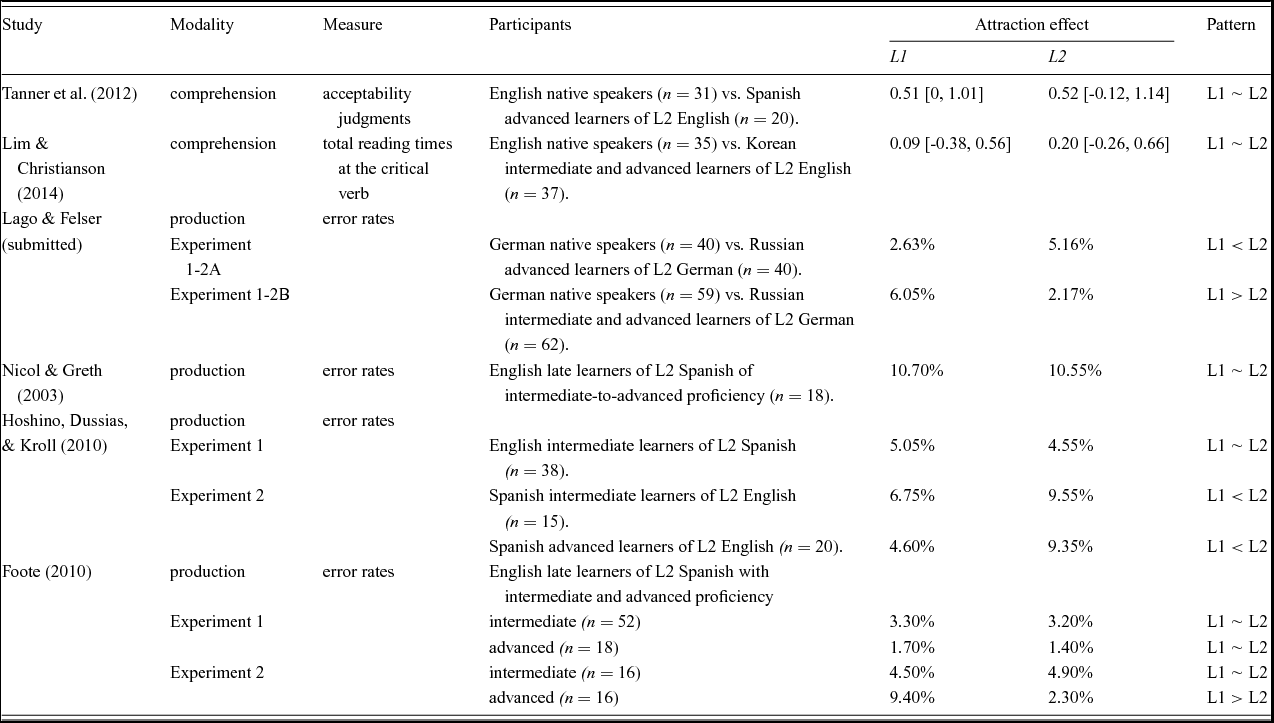
Table 1. Comparison of L1–L2 number interference effects in production and comprehension. Interference effects were quantified as the difference between interferer and non-interferer conditions (e.g., “the key to the cabinets” vs. “the key to the cabinet”). For comprehension studies, mean effect sizes are provided using Cohen's d and 95% confidence intervals. Of the twelve experiments, seven show similar interference effects in L1 and L2, two show larger L1 effects, and only three show larger L2 effects.
 You have
Access
- 4
- Cited by
Cunnings' keynote offers a new perspective on L2 processing by casting L1–L2 differences in terms of the memory system. One advantage of this approach is that it makes use of cue-based memory retrieval, a framework that has given rise to a wealth of research on L1 processing. However, there remain some questions about the evidence-base and predictions of the account, as well as conceptual challenges to its implementation.
One key tenet of Cunnings’ account is that L2 speakers over-rely on discourse cues during processing. Cunnings implements this notion by proposing that features such as [+/-TOPIC] influence retrieval jointly with morphosyntactic cues. However, while morphosyntactic features can be obtained from the lexical entry of nouns or from the structural representations created by the parser, cues to topichood are variable and may occur after the relevant discourse referent has been encountered. For example, in the sentence “When Sarah got home from work. . .”, Sarah becomes the topic only if the continuation is a coreferential pronoun but not if it is a name such as John. It is unclear how the features of she or John could be used within a cue-based architecture to (re)assign a [+/-TOPIC] feature to the chunk representing Sarah in memory. Further, the notion of discourse differs considerably between studies on pronoun resolution and structural ambiguity. In the former, discourse is associated with the notions of topichood and focus. In the latter, discourse is used to capture speakers' awareness of the pragmatic fit between a sentence and its preceding context. These two notions are not captured equally well with a [+/-TOPIC] retrieval cue.
Turning to the predictions of Cunnings’ account, it posits that L2 speakers should show larger interference effects than L1 speakers during processing. However, a descriptive survey of the literature on agreement attraction, which has focused on number interference effects, does not offer much support for this prediction (see Table 1). In fact, similar rates of attraction are often found in L1 and L2. Interestingly, when stronger L2 interference effects do occur, they arise for learners whose L2 is richer or as rich in agreement morphology as their L1. Thus, the magnitude of interference effects may be influenced by the morphological richness of agreement morphology across languages, rather than their native or non-native status.
Comparison of L1–L2 number interference effects in production and comprehension. Interference effects were quantified as the difference between interferer and non-interferer conditions (e.g., “the key to the cabinets” vs. “the key to the cabinet”). For comprehension studies, mean effect sizes are provided using Cohen's d and 95% confidence intervals. Of the twelve experiments, seven show similar interference effects in L1 and L2, two show larger L1 effects, and only three show larger L2 effects.
Further, the evidence discussed by Cunnings is not unambiguously supportive. For example, the eye-tracking study by Jacob and Felser (Reference Jacob and Felser2016) is cited as evidence for retrieval difficulty in L2s. But in that study, L1–L2 differences were specific to particular online measures, with similar effects for L1 and L2 in offline and other online measures. Explaining such data patterns through retrieval difficulty requires additional assumptions about how memory retrieval differentially affects particular measures. Similarly, Cunnings explains L1–L2 differences in both online and offline measures through memory retrieval during processing. But offline measures are traditionally assumed to reflect stable differences in how native and L2 speakers ultimately represent grammatical constraints. Should we attempt to capture online and offline differences using the same retrieval mechanism?
Despite these issues, Cunnings’ approach is promising and we hope to see it refined and extended to domains beyond sentence comprehension, as previous L2 accounts have done. For instance, some studies on morphological processing have suggested that L1–L2 differences are selective, such that they affect inflected, but not derived, words (e.g., Kırkıcı & Clahsen, Reference Kırkıcı and Clahsen2013). This selective pattern points more towards inherent representational differences than to memory retrieval issues and thus provides an interesting challenge and a rich area for further development.