When and why did Brazilian cotton become important for the Industrial Revolution in Britain? During the last two decades of the eighteenth century, exports of cotton manufactures from Britain increased from £355,060 in 1780 to £5,854,057 in 1800.Footnote 1 Higher cotton consumption after 1780 was the result of several technological improvements that increased productivity in textile production, which led to raw cotton progressively replacing sheep wool in Britain's textile industry.Footnote 2 Declining costs allowed the production of finer-quality fabrics and an increased growth in British industrial exports.Footnote 3 The British West Indies, and some Mediterranean regions, provided most of the raw cotton used in Britain throughout the eighteenth century. With the emergence of calico and muslin production, however, British producers started to look for cotton with longer staples than the Mediterranean could provide, and, through Portuguese mediation, Brazil was thus able to increase its relevance to the British textile sector.
During the 1780s and 1790s, with the increased use of the water frame and the spinning mule to spin cotton, both calicoes and muslins needed longer-stapled raw cotton. Cotton grown in South America had the characteristics necessary for producing finer yarns and, given this initial geographic advantage, Brazil provided 40 per cent of Liverpool's raw cotton imports between 1791 and 1801, rivalling important traditional suppliers such as the West Indies. The United States had only 10 per cent of the Liverpool cotton market at the time because exports of its upland (or short-staple) cotton were still constrained by ginning technology.Footnote 4 Moreover, upland cotton, despite having a longer staple than the ‘Asian’ species, was of lower quality compared to Brazilian cotton.Footnote 5
Scholars have previously highlighted the connection between Brazilian cotton and British textile production.Footnote 6 Roberto Simonsen, in 1937, and Caio Prado Jr., in 1942,Footnote 7 observed that the rise in cotton consumption by English factories fostered Brazilian cotton exports after 1770. Almost all Brazilian cotton came from Maranhão and Pernambuco (which originally occupied larger geographical areas than today). While cotton in Pernambuco was as important as sugar by the end of the eighteenth century, cotton was Maranhão's main export and launched a ‘golden age’ that lasted until the first quarter of the nineteenth century.Footnote 8 The increase in exports was part of Brazil's resurgence in agricultural production that helped reinvigorate Portugal's economy at the end of the eighteenth century. Through re-exports from Lisbon, Brazilian cotton went overwhelmingly to Britain and became the centrepiece in the reversal of the trade balance between the two countries, a desired economic outcome in the mercantilist age.Footnote 9 Manchester newspapers often advertised cotton from Maranhão, Pernambuco, or simply ‘Brazil’ in the 1790s.Footnote 10
Scholars have offered two complementary explanations for Brazil's rise as a cotton exporter to Britain. One of these explanations argues that the US War of Independence, between 1775 and 1783, enabled the rise of Brazilian cotton.Footnote 11 The problem with this argument is that North America did not export cotton to Britain before 1790.Footnote 12 Another (and more influential) explanation in the literature is related to the revolutions in the British and French Caribbean colonies in the last decade of the eighteenth century, combined with Portugal's neutral stance in Europe's political upheavals.Footnote 13 According to this argument, the revolutions disrupted production in the islands and Brazil became the short-term alternative replacement for the Caribbean supply. However, this article draws upon newly collected archival data on the British cotton trade and shows that Britain managed to acquire important territories from the Netherlands during the 1790s that allowed a continuous expansion of the cotton supply from the West Indies. As such, the Caribbean revolutions could not have had the effect on cotton exports from Brazil that some scholars have stated.
This article argues that rather than being connected to market shocks, the increase in Brazilian cotton exports was related to changes in the quality of the fabrics during the early stages of the Industrial Revolution.Footnote 14 Previous research by Giorgio Riello, John Styles and others has shown that innovation in textile production during the early period of the Industrial Revolution was evident not only in new machinery, but also in improved materials.Footnote 15 The lighter, better-quality fabrics that emerged after 1780 benefitted from the largest decline in textile prices at the end of the eighteenth century and required a different variety of cotton from the one previously used in Britain.Footnote 16
Evidence supporting these arguments comes from several archival sources, some of which deserve closer examination. The first of these is provided by the British Ledgers of Imports and Exports, which list trade figures between British ports and foreign countries until 1780.Footnote 17 The second source is contained in the statistical tables from the Inspector General of Imports and Exports, presented in the States of Navigation, Commerce and Revenue, which provide foreign trade data between 1772 and 1808.Footnote 18 The foreign trade books tabulate the quantity and the ‘official value’ for different products, although only the figures related to quantities are useful, since official values were recorded in fixed prices from 1696, not market prices.Footnote 19 Other documents were used to check for data consistency: Portuguese trade balances, reports from textile manufacturers in Manchester, as well as documents from the British Board of Trade, the Colonial Office, and the Foreign Office.
The following sections explain why Brazil became a key supplier of cotton to Britain during the early period of the Industrial Revolution. After presenting information on the suppliers of raw cotton to Britain, ‘Cotton Quality and Market Segmentation’ explains how the longer fibre of the Brazilian cotton gave it a natural advantage over species cultivated in other regions. ‘Portugal and the Beginning of Cotton Production in Brazil’ shows that, in terms of supply, cotton plantations in Brazil managed to rapidly respond to Britain's increasing demand after the 1780s by taking advantage of the policies adopted by the Portuguese government to promote Portugal's cotton industry in the 1760s. Finally, ‘West Indies Cotton’ provides new information that does not support previous explanations about the West Indies’ role in the rise of Brazilian cotton trade. Cotton from the West Indies was not a viable alternative to Brazilian cotton because it could not be used to produce finer calicoes, muslins, nor other high-quality products, such as hosiery.
Early Sources of Supply of Raw Cotton to Britain
The end of the eighteenth century saw cotton goods gradually replace woollens in British textile manufacturing. Cotton was already being imported by British producers at the beginning of the eighteenth century, but quantities remained low until the 1740s.Footnote 20 After a steady rise in the decades that followed, the emergence of new technology such as spinning machines produced an increase in raw cotton consumption ‘from 5 million [lb] in 1780 to 22 million in 1787’.Footnote 21 During the last two decades of the eighteenth century, cotton was the fastest-growing sector in the British economy, while other textile industries, such as woollens, stagnated.Footnote 22
Notwithstanding the textile industry's high output growth rate in the 1760s, increasing prices raised fears about cotton scarcity and alarmed the textile industry.Footnote 23 John Styles argues that this initial shortage created incentives to produce finer yarn that could reduce the amount of cotton required.Footnote 24 In 1766, before the adoption of better spinning technologies, the government, in order to mitigate possible shortages, enacted the Free Port Act, which allowed trade with some French and Spanish colonies. The Act – renewed in 1774 – contained a clause abolishing the duty of 4.5 per cent on raw cotton imports.Footnote 25 In the 1770s, both the mechanisation of cotton spinning and the end of laws requiring linen to be used in some cotton textiles were the first steps that increased production of finer yarns, turning cotton into a commercial success.Footnote 26 Before 1770, the use of linen had been a necessity, since the spinning technology could not produce a thread strong enough to serve as the warp (the yarn that is held stationary in tension on the loom).Footnote 27
The increased demand for British calicoes and muslins during the late eighteenth century was the result of higher domestic income and increasing foreign demand.Footnote 28 In addition to the sales of coarse cotton used by slaves in New World plantations, the expansion of cotton production in the final years of the eighteenth century was closely linked to the finer textiles which were in particular demand by the high wage economy of British North America.Footnote 29 Around 1790, foreign trade in cotton textiles was growing so fast that manufacturers were unable to meet overseas demand.Footnote 30
Figure 1 collates information on Britain's raw cotton imports before the productivity increase in cotton manufacturing during the 1780s and 1790s. Despite the rise in imports after the Free Port Act of 1766, the British textile industry increased its supply of foreign cotton not from the Caribbean but through Smyrna cotton, imported from Turkey. Between 1768 and 1777, the decade after the first Free Port Act, Turkey exported approximately 10 million lb of cotton, accounting for 56 per cent of total British cotton imports from foreign nations.Footnote 31 Italy, which re-exported cotton from the Levant (present-day Syria and Lebanon), was the second supplier of Mediterranean cotton. Even with an increase in exports, French and Spanish islands in the Caribbean represented only 6.6 per cent of the cotton supply. Throughout the decade, the British West Indies continued to be the main supplier of raw cotton, exporting around 30 million lb of cotton, with Dominica, Grenada and Jamaica accounting for 65.5 per cent of total trade.Footnote 32
Total Raw Cotton Imports into Britain, 1710–80

Before the 1780s, Brazil's participation in the British cotton market was still negligible. Britain first noticed Maranhão's economic potential in 1753 when the British consul in Lisbon, reporting on the departure of ships to Rio de Janeiro and Maranhão, stated that the latter was an ‘improving colony’ abounding with ‘coffee, cocoa, sugar, tobacco, and cotton’.Footnote 33 However, initial interest in Maranhão was focused on its rice production, rather than cotton. In a 1767 report, the British consul observed that the increase in rice exports from Maranhão could ‘render unnecessary the cargo supplies which this kingdom now receives from South Carolina’.Footnote 34 Cotton initially received scant attention from the British consul because it was not exported in the 1750s. Despite some evidence that Maranhão cotton was first exported in 1749, most accounts point to 1760 as the date of the first shipment to Portugal.Footnote 35 Exports of raw cotton from Pernambuco to Portugal began in 1778, but the volume was not significant until 1781.Footnote 36
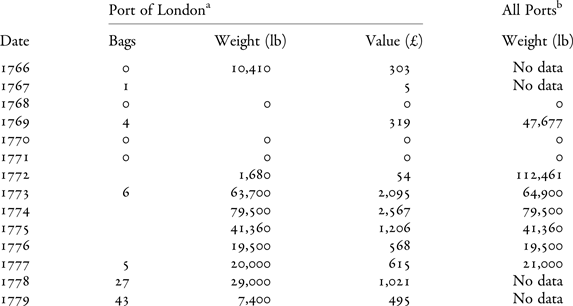
Nineteenth-century writers studying the cotton trade, such as Henry Smithers, Edward Baines and John Branner, dated Brazilian cotton's first exports to England to 1781.Footnote 37 Smithers noted that there was a very dirty cotton ‘from Maranham’.Footnote 38 Subsequent studies point to an even earlier date – 1767 – when Britain imported approximately £6-worth of cotton from Brazil.Footnote 39 James Lang, too, argued that much of Maranhão's cotton production between 1768 and 1778 was destined for England.Footnote 40 In the British trade ledgers from 1697 to 1780, the first entry for raw cotton of Portuguese provenance appears in 1766.Footnote 41 Moreover, a Treasury document entitled ‘An Account of All Cotton Wool of Foreign Growth Imported into England’, containing data on the period between 1768 and 1799, shows cotton coming from Portugal in 1769.Footnote 42 Table 1 compares the data from the Customs House with documents from Robert Walpole, the British consul in Lisbon in the 1770s, and shows that despite the existence of imports in the 1760s, it was only in the 1770s that cotton from Brazil became noticeable to British manufacturers.Footnote 43 Reports from British merchants listing the commodities that were exported from Maranhão and Pernambuco during the 1760s also show that cotton was not considered an important product.Footnote 44
Portugal's Raw Cotton Re-Exports to Britain, 1766–80

Sources: a Customs House data, TNA, ‘Ledgers of Imports and Exports’; b Data from Robert Walpole (British consul in Lisbon), TNA, ‘1767 Xmas–1777 Xmas Quantity of Cotton Wool of Foreign Growth Imported Each Year’.
Brazil's growing share in the British cotton trade after 1780 first came about following a realisation by the British that the British West Indies could not increase their exports at the rate demanded by the textile industry. Not only did cotton from islands in the Caribbean have to compete for agricultural space with other profitable commodities, such as sugar, but, in addition, the new production of muslins and calicoes required a different quality of cotton from that provided by Mediterranean sources. The demand for Smyrna cotton, which was used to produce fustians (heavy textiles) and coarser cloths, began to decline around the end of the eighteenth century because its short staple and strength were not suitable for the increasingly mechanised processing of yarns.Footnote 45 Levant cotton was also inferior to West Indies cotton, its fibres considered a ‘physical objection’ to the production of anything but coarse goods.Footnote 46
The increasing mechanisation of cotton textile production after 1780 led to a large increase in the demand for longer and more resistant fibres to be used as warp. Most of the new demand was for varieties from the Americas, initially from Brazil and later – with improvements in gins for processing the ‘fuzzy-seed’ upland cotton – from the United States.Footnote 47 Stimulated by the ‘representations of the English manufacturers’, traditional suppliers such as the East India Company initially attempted, without success, to improve the quality of cotton exported to England from Asian sources.Footnote 48 The adoption of British machinery by US manufacturers in the early days of industrialisation serves as an example of the importance of differences in cotton varieties in production. As spinning initially used mainly Cayenne and Surinam cotton (related to the Brazilian variety), cotton manufacturers in Massachusetts planned to petition Congress in 1791 for an additional duty on imported cotton goods, aiming to apply the duty for ‘raising […] cotton in the southern states, of a quality and clearness suitable to be wrought by machines’.Footnote 49
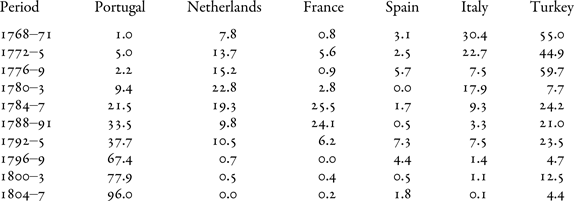
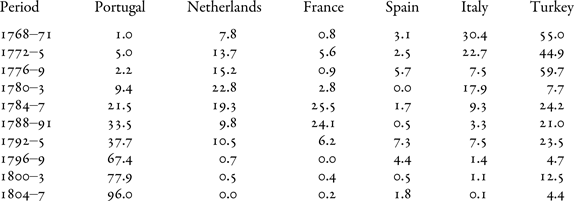
Table 2 presents re-exports to Britain of raw cotton from colonies of European nations and shows the decline after 1780 from ‘eastern sources’, such as Turkey and Italy. The Netherlands, with its colonies Demerara and Surinam, was also an important supplier before it went to war with Britain in 1781. France's re-exports from its colonies in the West Indies temporarily increased after 1780, until fierce disputes with Britain flared up again a decade later. By contrast, Portugal's continued growth in trade after 1783 stands out.
Share of Raw Cotton Re-Exports from Europe to Britain (%)
Sources: 1768–71, TNA, ‘1767 Xmas–1777 Xmas Quantity of Cotton Wool of Foreign Growth Imported Each Year’; 1772–1807, TNA, ‘States of Navigation, Commerce and Revenue’.
Note: Percentages do not total 100 owing to omissions, rounding and errors in the primary sources.
One aspect worth mentioning regarding trading data for the end of the eighteenth century concerns smuggling. Several authors argue that the Portuguese trade monopoly, in a period of increasing demand for raw cotton in international markets, led to an increase in illicit trade by British merchants on the Brazilian coast.Footnote 50 However, as smuggling was a widespread activity and affected other regions as well, it seems fair to assume that it did not create a significant bias in the data for cotton imports from Portugal.Footnote 51 Illegal trade was also rampant between English and Dutch colonies in the Caribbean and with the United States.Footnote 52 With this caveat, the next section explains in more detail the relation between cotton quality and the rise in the Brazilian cotton trade at the end of the eighteenth century.
Cotton Quality and Market Segmentation
The variety of cotton cultivated in Brazil is crucial for explaining the increase in imports by British textile manufacturers during the last two decades of the eighteenth century. British production of calicoes, previously imported from India, began in 1773 and rapidly affected the imports of raw cotton.Footnote 53 Smyrna cotton, which was the variety of cotton most in demand other than cotton from the West Indies, could not be used for the warp in the new cotton fabrics.Footnote 54 With the increases in mechanisation in textile production in the 1780s, Manchester's manufacturers required a fibre long enough and resistant enough not to break during cotton spinning.Footnote 55 For example, the records of the weaving business Cardwell, Birley and Hornby in Manchester show that they were buying cotton from Maranhão in the 1790s.Footnote 56 As for the West Indies, contemporary accounts from the late eighteenth century indicate that the islands supplied raw cotton used to manufacture items of lower quality, while the northern parts of South America supplied raw material for finer and lighter fabrics.Footnote 57
The quality of West Indies raw cotton, despite being superior to Smyrna's, was of increasing concern in the 1780s due to its weak fibre resistance.Footnote 58 Cotton manufacturers from Manchester expressed concern over the quality of cotton from the West Indies in 1787: in a document to the Lords Committee of Privy Council for Trade, a spokesman for the industrialists wrote that, while it was ‘extremely desirous’ that the government should promote the cultivation of cotton in British dominions ‘in order to prevent the great importations from other foreign powers’, the West Indies did not usually cultivate the finest cottons. The finest cottons near the Caribbean were grown in Cayenne and Tobago – ‘the former is very near the continent of South America and the latter much inferior in quality to Siam or Brazil’.Footnote 59
Of the different species used in textile production after 1781, most staples characterised as ‘superior’ were derived from the species G. barbadense, which was indigenous to South America.Footnote 60 One important advantage of the G. barbadense variety was its weak fibre attachment to the seed, which did not require the saw-gin technology later used on the ‘fuzzy-seed’ or ‘green-seed’ cotton (G. hirsutum) cultivated in the United States. Descriptions of different species stated that, before the widespread use of saw-gins, the wool in the green-seed cotton was so firmly attached to the seed that it was not profitable to have it prepared for the market. If this problem were solved (which did eventually happen), green-seed cotton would ‘doubtless be a valuable acquisition to the muslins manufactory’.Footnote 61
A 1798 description of different seeds grown in Brazil provides evidence that planters knew about the green-seed cotton, which produced a ‘strong yarn’, enabling the production of ‘delicate’ fabrics.Footnote 62 The most important cotton staple was known as ‘Maranhão cotton’ (which, despite its name, was cultivated more in Pernambuco than in Maranhão); this produced a longer staple and could be prepared by hand or simple roller gins.Footnote 63 As international seed exchange seemed to be fairly common, with cotton plants developing a range of characteristics in different regions, the ‘Maranhão’ cotton may have been the source of the US Sea Island cotton. The possible link between Pernambuco cotton and Sea Island is reinforced by records of Brazilian planters from the beginning of the nineteenth century stating that these staples had similar buyers in British markets.Footnote 64 The best samples were also used for high-end markets, such as lace in the case of Sea Island cotton and hosiery for Pernambuco cotton.Footnote 65
Various sources attest to the high quality of Brazilian cotton at the end of the eighteenth century.Footnote 66 Manchester cotton manufacturers classified raw cotton based on their ‘general estimation’ of the market. The most esteemed cotton was that from Malacca and the Kingdom of Siam; the next, such as Pernambuco and Maranhão, came from Brazil, and the third most favoured type was from Demerara, Surinam and Cayenne. The cotton that occupied the lowest position in the Manchester manufacturers’ evaluation was that from the West Indies.Footnote 67 A source from France in 1774 also graded different staples, classifying West Indian cotton in three grades: Cayenne (of which very little was produced), Saint Domingue and Guadeloupe.Footnote 68 According to ‘a Mr Bennet’, writing in the Transactions of the Society of Arts in 1777, the ‘superiority of Brazilian cotton over all others had been recognised’.Footnote 69 In his 1799 work entitled ‘A Memoir about the Cultivation of Cotton’, the Portuguese author Manuel Câmara wrote that cotton from Maranhão, which grew into a bigger bush than the ordinary cotton plant, was regarded as a superior kind.Footnote 70 For Câmara, the ‘stiffer and longer fibre’ characterised the quality of Maranhão's most common cotton plant.Footnote 71
Brazilian cotton maintained its prestigious position even when new suppliers entered the market. James Butterworth in the 1820s attributed a lower commercial value to the three main types of cotton from the United States – Bowed Georgia, Tennessee and New Orleans.Footnote 72 According to the author, inferior textiles used these staples, and they could not compete with the quality of cotton from Pernambuco. Among the 35 best-known cotton suppliers, Butterworth listed the varieties with greatest commercial value, in the following decreasing order: Sea Island Georgia, Bourbon (East Indies), Pernambuco, Cayenne (Surinam), Bahia and Maranhão. In 1822, Antônio Pereira do Lago stated that European markets preferred Pernambuco's cotton to Maranhão's, although the latter was superior to the ones from Guadeloupe and Saint Domingue.Footnote 73
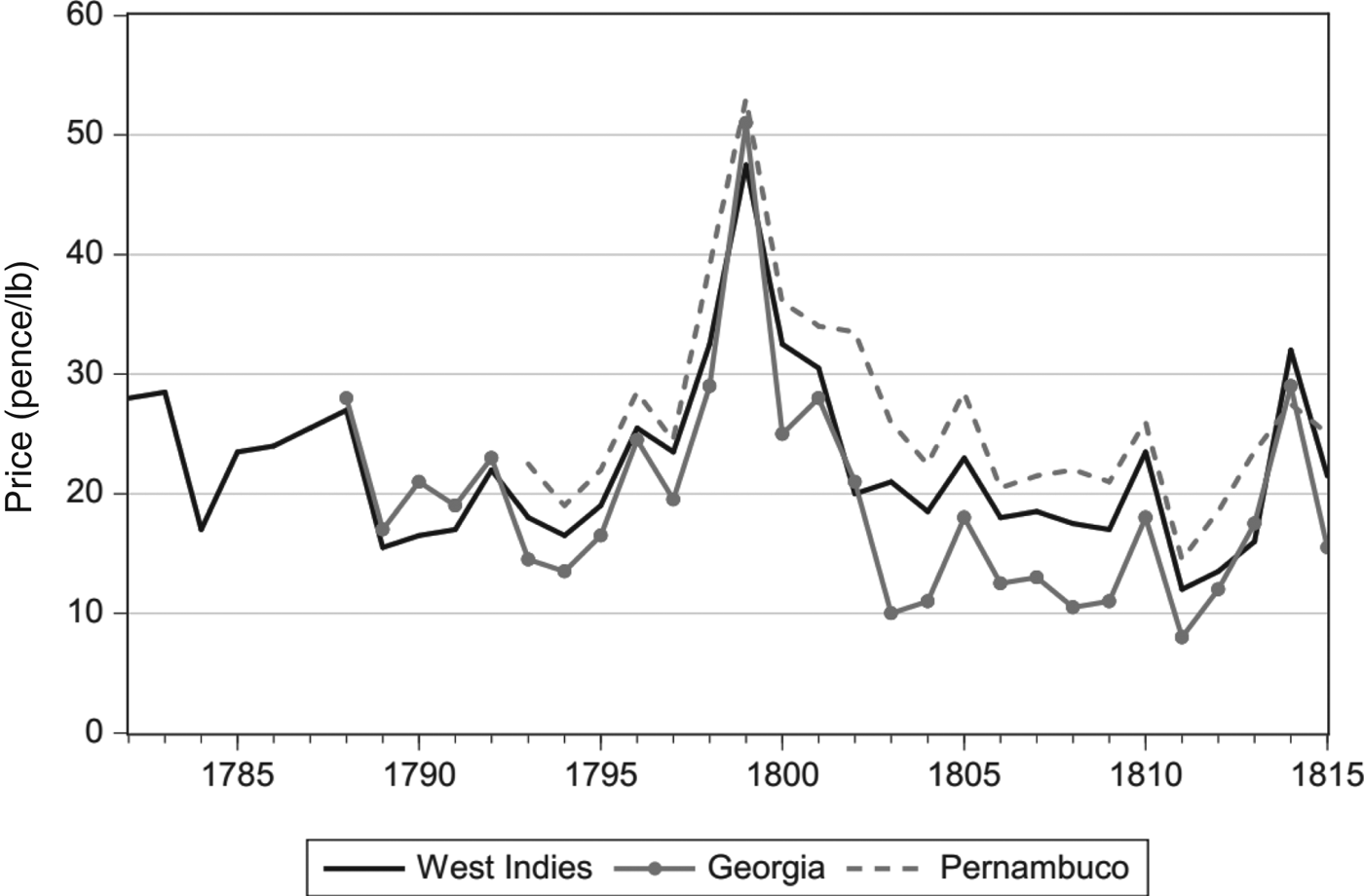
The quality of Pernambuco cotton is also mentioned by merchants: in a letter to England dated 1808, Guilherme Warren, a merchant in Rio de Janeiro, wrote that Pernambuco cotton was much esteemed in British markets, and had a quality comparable to cotton produced in the United States, and that other Brazilian regions could easily expand their production to meet the growing demand for cotton in Europe.Footnote 74 In a short pamphlet London cotton broker Roger Hunt stated that prior to 1800 Pernambuco cotton was estimated in Britain ‘chiefly for the fineness and silkiness of its staple’.Footnote 75 Such qualitative evidence is consistent with differences in prices in British markets. Figure 2 shows that Pernambuco's cotton received on average higher prices than did Georgia, Surinam and Demerara cottons, the latter two being among the highest-quality West Indies staples.
Average Prices of Cotton in Britain, 1782–1815

The commercial value of cotton varied according to the difference in the resistance and length of staple, given that spinning machines required a fibre that would not break easily and halt production. Shorter fibres were also more difficult to spin and resulted in a coarser product.Footnote 76 The way to measure the quality of textiles was through mass density – spinning count classified fabric fineness – and the metric was the number of hanks of yarn spun from a pound of cotton wool.Footnote 77 More rudimentary machinery, such as the spinning jenny, could not produce high-count yarns at a competitive price.Footnote 78 The first technological improvement that raised productivity in calicoes was the water frame, which had been employed in the manufacture of products with counts of up to 60 hanks/lb. After 1779, Crompton's mule combined elements from older spinning machines and the water frame and increased productivity of finer fabrics. Whereas there were still more water frame spindles than mules in use in the 1780s, the mule progressively replaced the water frame in the following decade, due to its superior technology.Footnote 79
Aside from making it possible to manufacture yarns finer than those made on water frames, Crompton's invention significantly reduced production costs: compared to the cost of manual processes from three decades earlier, the mule turned out finer yarns at one-twentieth of the price of 1749.Footnote 80 As Table 3 shows, yarns with higher counts also represented higher profits and, therefore, the mule allowed the market for cotton textiles to progressively move away from coarser products.Footnote 81 The significant decrease in production costs for high-count cotton textiles made the British industry competitive versus Indian production of calicoes and eventually even versus fine Bengal muslins.Footnote 82
Cotton Spinning Costs Using Crompton's Mule, 1779

Source: Mann, The Cotton Trade of Great Britain, p. 27.
Note: Costs are listed in shillings (s) and pence (d). Pre-decimalisation, 12d = 1s; 20s = £1.
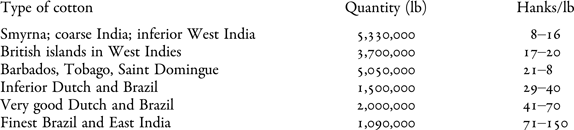
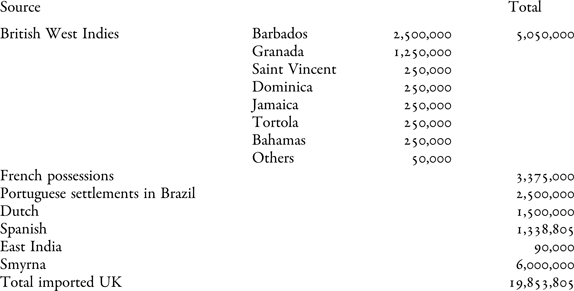
In 1788, with new markets in sight, Manchester producers – who already represented an important pressure group – lobbied the government for protection against foreign muslins.Footnote 83 In a document entitled ‘An Important Crisis in the Cotton Manufactory of Great Britain Explained’, Manchester industrialists argued that the infant industry already employed a considerable number of people and high-count textiles generated more income for the British economy than did lower-quality fabrics.Footnote 84 The document presents the distribution of different cotton staples according to different products, showing that Brazil was not competing with previous cotton suppliers because cottons from Turkey and the West Indies were used in lower-count products: calicoes were made with yarn between 20 and 40 count on average, while muslins used counts above 40.Footnote 85 Of the 19,828,805 lb of raw cotton imported in 1787, a staggering 18,670,000 lb was used in the cotton manufacturing industry.Footnote 86 The raw material was divided into four large groups: 1) 1,500,000 lb was used for hosiery; 2) 1,670,000 lb for silk and linen mixtures; 3) 5,000,000 lb in making fustians; 4) 10,500,000 lb went to make all types of muslins and calicoes (shawls, handkerchiefs, etc.). Based on this classification, Table 4 presents British cotton production broken down according to class – from the coarsest to the finest quality.
Cotton Manufacture in Great Britain, 1788

Source: TNA, Board of Trade: Miscellanea. Cotton: ‘An Important Crisis in the Cotton Manufactory of Great Britain Explained’, Ref.: BT 6/140.
The economic importance of fine textiles is evident when their revenue is compared with those generated by coarse fabrics. Even after following reports that the prices of the finest cotton wool had fallen by 40 per cent, the production of 1,090,000 lb generated £756,187. Since the cotton from East India totalled 90,000 lb, approximately 1,000,000 lb of high-quality cotton came from Brazil.Footnote 87 The hosiery branch accounted for the use of most counts above 100, and additional sources show that cotton from Pernambuco was extensively used in that branch.Footnote 88 Unlike the revenue from branches that used high-quality staples, the revenue from the Smyrna cotton products branch was only £536,172.Footnote 89 The manufacturers stated that muslins should be extensively promoted because, given the market value of fine cotton textiles, they returned ‘more for the labour of the people than any other article in the cotton manufactory’.Footnote 90
The increase in Brazilian exports during the 1780s was clearly due to the high quality of the products, as cotton from Brazil does not appear in products with counts below 29. Even if the count numbers are inflated – after all, the Manchester industrialists’ paper was a document to be used for lobbying purposes – the evidence suggests that cotton from Brazil was in a different league from that of cotton from former suppliers such as the West Indies. Moreover, Smyrna cotton, which had been the most important staple produced outside British dominions, was used only in products with very low counts. Therefore, the decline in Turkey's cotton exports was not related to better access to labour in Brazil compared to that in the Ottoman Empire, as Sven Beckert argues.Footnote 91 In the late 1780s, the average count for cotton fabrics in British factories was 27, higher than what Turkey and most British islands in the West Indies could produce.Footnote 92 Market segmentation among different cotton staples explains why British sources would inevitably have moved away from the Caribbean anyway, even if the violent political conflicts in the 1790s had not occurred. Cotton plantations were moving from islands to continental areas where cultivation of better staples was possible.
Nevertheless, continuous technological improvements ended up eliminating the competitive advantage enjoyed by the Brazilian fibre in the early days of spinning. During the 1810s, processes that mixed shorter staples with longer ones made it possible for manufactures to substitute their spinning mixture for more expensive cotton, reducing the price premium for Brazilian staples.Footnote 93 Upland cotton mixes with Egyptian or Pernambuco cotton could be spun into counts higher than 50.Footnote 94 Moreover, the increased use of mules after 1800 made it easier to use mixed staples, as the mule subjected the cotton fibre to less strain than previous machines and, therefore, could spin higher counts even with ‘inconsistent’ cotton.Footnote 95
Portugal and the Beginning of Cotton Production in Brazil
The increase in cotton exports from Brazil after 1780 represented an important change in Portugal's trade patterns in the eighteenth century. Before Brazilian cotton became Portugal's main export to Britain, wine dominated foreign sales; it accounted for almost three-quarters of British wine consumption around 1760.Footnote 96 In 1772, exports from Portugal to Great Britain amounted to £671,318, of which £474,447 derived from wine. The city of Porto produced the wine that accounted for half the Portuguese wine trade, and this increased to 60 per cent in 1785.Footnote 97 The predominance of port wine in British markets was a result of the Methuen Treaty (1703), which established that duties levied on Portuguese wine could not amount to more than a third of duties levied on French wines.Footnote 98
The Methuen Treaty, in turn, largely benefitted the British textile industry and the commercial privileges it accorded to the British caused resentment in Portugal.Footnote 99 But the decline in gold and diamond production in Brazil that set in in the 1750s led to worries about trade deficits and hence to changes in Portugal's trade policy with Britain.Footnote 100 Policies implemented by the Marquês de Pombal, the de facto ruler of Portugal between the 1750s and the 1770s, and a well-known critic of Anglo-Portuguese commercial relations, prohibited British merchants from negotiating directly with the colonies. One of his policy changes, the founding of the Douro Company in the 1760s, led to complaints by British merchants because it limited foreign participation in the wine trade.Footnote 101 Other trade restrictions with Brazil were imposed through the creation of two trade monopoly companies: the Company of Grão Pará and Maranhão, established in 1755, and the Company of Pernambuco and Paraíba, founded a year later. These companies limited the trade in commodities to Portuguese vessels and created the conditions for large-scale plantations by promoting imports of slave labour from Portuguese colonial ports in Africa.Footnote 102 Moreover, in 1756, the new governor of Maranhão, Pombal's brother, repealed a 1703 law that prohibited cotton exports.Footnote 103 The end of prohibition would eventually enable cotton to become a key part of Brazil's ‘agricultural renaissance’ during the last quarter of the eighteenth century.Footnote 104 With the increase in trade, annual slave imports in Maranhão tripled between 1783 and 1808, while in other north-eastern regions the annual average of arrivals remained stable.Footnote 105 In Maranhão's first census, in 1798, slaves represented half the population.Footnote 106
The reason behind the incentives to grow cotton in Maranhão was that Pombal wanted to promote textile production in Portugal.Footnote 107 The Methuen Treaty was initially an impediment to developing a domestic textile sector as it stopped Portugal from raising tariff barriers to favour local production. But as the treaty with Britain was restricted to woollen textiles, the increasing use of cotton to produce fabrics provided a loophole for stimulating textile production in Portugal without direct diplomatic confrontation.Footnote 108 Thus, with Brazilian trade companies transporting the raw materials, cotton enterprises began to develop in Portugal during the 1770s.Footnote 109 Moreover, data on the list of ships that entered the port of Lisbon as provided by two British consuls – W. H. Lyttleton in 1769 and Robert Walpole in 1774 – show that Maranhão was the only colonial region that exported cotton to Portugal at the time.Footnote 110 However, British merchants in Portugal began to react against being excluded from trading, complaining against the ‘destructive tendency of the exclusive companies’, which set off a diplomatic conflict between the two nations.Footnote 111 After reaching their peak of £1.3 million during the 1750s, British exports to Portugal declined to £600,000 between 1765 and 1785.Footnote 112
Trade records from the 1760s and 1770s, therefore, provide evidence that when Britain increased its demand for cotton in the 1780s, Brazilian cotton plantations had already existed for two decades. At the same time, during these two decades there was no resolution to the commercial dispute in the wine sector. Diplomatic conflict with Portugal continued with the ending of Anglo-French wars in 1783, when the British government sought to strengthen ties with France through a new commercial treaty. In their negotiations on the trade agreement, France requested most-favoured-nation status for their wines, which would give them parity with Portuguese wines and, therefore, violate the Methuen Treaty.Footnote 113 Yet the incentive not to terminate the treaty with Portugal was that woollen fabrics could enter it free of duty. By way of compromise, the Treaty of Navigation and Commerce (Eden Treaty), signed in Paris in 1786, gave Britain the future possibility of lowering duties on Portuguese wines in accordance with the Methuen Treaty.Footnote 114 London newspapers reported the conflict and, according to The Times, the ‘spirit of Methuen’ had to be preserved because Portugal was Britain's ‘best ally’.Footnote 115 The newspaper also reported complaints from the Portuguese consul in London that the new treaty harmed merchants trading with Spain and Portugal.Footnote 116
The conflict between Portuguese and French wine indirectly involved Brazilian cotton, too, a fact that came up in several public discussions. In a debate in the House of Lords on 28 February 1787, the Duke of Norfolk presented a defence against the violation of the Methuen Treaty, arguing that
the very existence of the leading branch of our manufactures depended on the importation of the cotton wool of Brazil, which we could only have through the medium of Portugal, which our pretend friends at this very minute were endeavouring to deprive us of.Footnote 117
The Duke of Norfolk's accusation was that the French, the ‘pretend friends’, were trying to benefit from Portuguese resentment over the Eden Treaty conditions. According to Robert Walpole and William Fawkener, who were British envoys in Lisbon at the time, in 1786, Portugal was induced to accept a commercial agreement under which France would buy all its cotton crops from Brazil.Footnote 118
The slowdown in the wine trade gave Portugal an additional incentive to use raw cotton to enhance its trade position with Britain. In 1788, following the death of Dom José, ‘Prince of Brazil’ and heir to the Portuguese throne, British newspapers reported concerns about the future of trade with Portugal because ‘the importation of Brazil cotton, and the wines of Portugal into Great Britain, constitute a very principal part of their [Portugal's] commerce’.Footnote 119 While Portugal continued to delay its answer to British diplomatic demands, its trade position began to improve and, in 1790, ‘for the first time in the century, bullion had to be exported to Lisbon’.Footnote 120 Change happened not only by means of a reduction in imports, but also because Brazilian cotton created a more balanced trade with Britain.Footnote 121 Much of this transformation in trade relations occurred in the 1780s, when British imports of Brazilian cotton increased almost sevenfold.
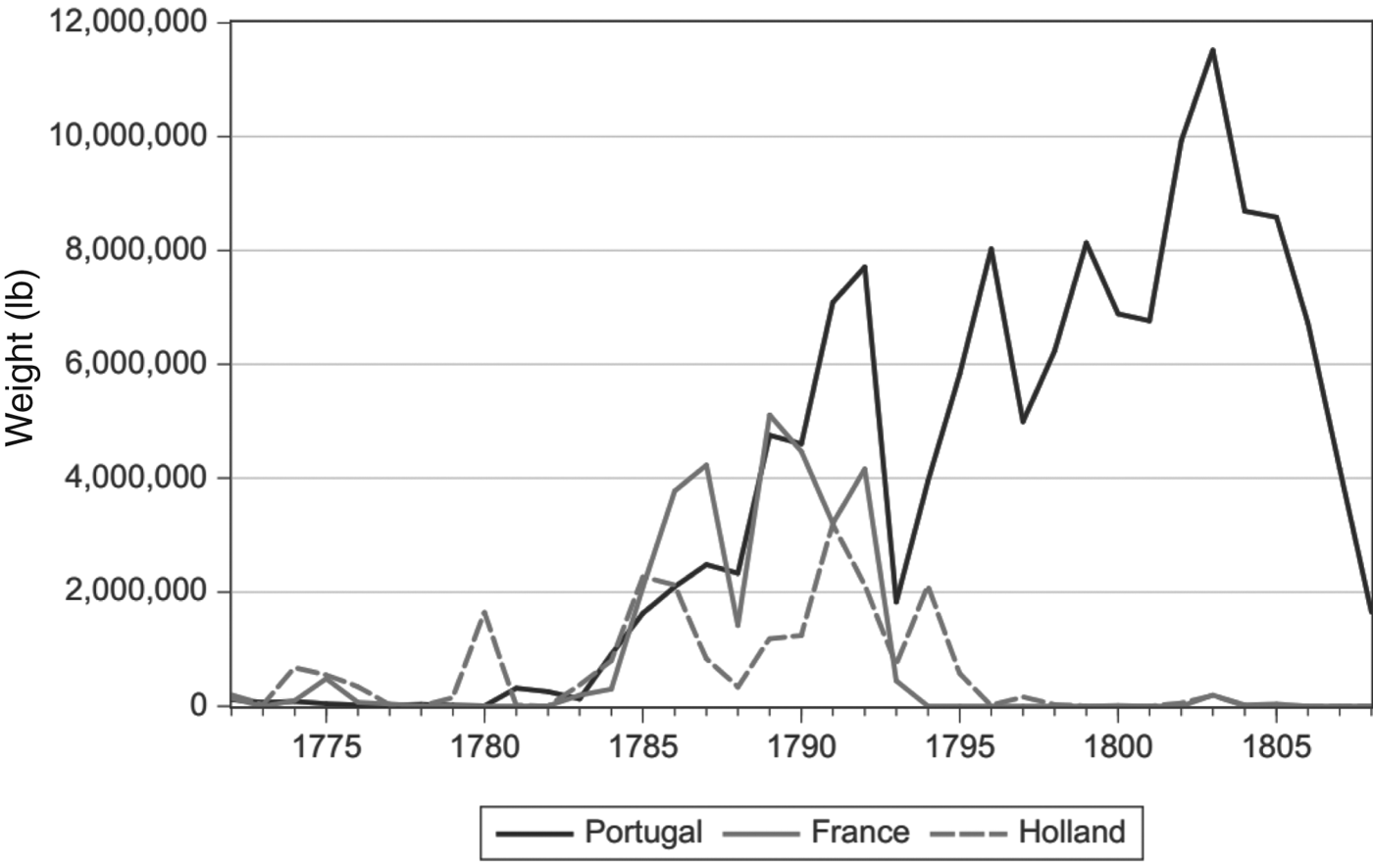
Figure 3 shows that the period of political stability after the Treaty of Paris (1783) coincides with the rise in Brazilian cotton exports. At first, higher demand for raw cotton benefitted other European empires that had possessions in the Americas, but after the declaration of war with France in 1793, important suppliers from the Caribbean faced a steep decline in their production. The continuous warfare between France and Britain between 1793 and 1815 had a dramatic impact on trade in Europe.Footnote 122 And yet, from the 1790s until Napoleon's invasion of Portugal at the end of 1807, Brazil's cotton continued to increase its share in British markets.
Raw Cotton Imports into Britain, 1772–1808

The conflict with France created several concerns for the British government, one of which was trade with Brazil. In a motion on the state of public affairs regarding the destination of fleets to protect British interests, launched in the House of Commons in 1805, Brazil was considered a key location. After Jamaica, Brazil was ‘the most probable’ destination of the fleets and ‘one every way of vast importance’. Brazil's importance was not restricted to its position as a military station on the British India trade route, but also because of the consequences on Brazilian trade resulting from a possible French attack on the Brazilian coast: if the enemy controlled the coast, it would deprive the British textile sector of Brazilian cotton, which was ‘essential in our manufactures’.Footnote 123
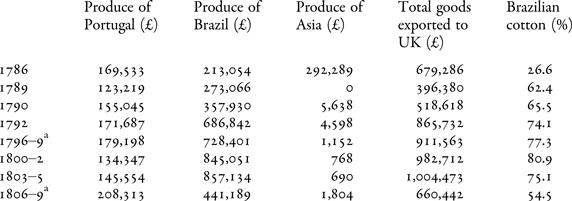
Between 1796 and 1806, commodities from Brazil represented 40 per cent of Portuguese exports to England. Moreover, by 1800, cotton accounted for 28 per cent of the total value of Portugal's re-exports from Brazil, second to sugar, which faced high tariffs in British markets.Footnote 124 Since production from within the Portuguese empire accounted for half of Portugal's trade with England, exports from other colonial possessions were marginal.Footnote 125 Britain received a considerable volume of products from the city of Porto, but colonial products were overwhelmingly exported through the port of Lisbon. In 1786, whereas Lisbon exported 1,800,360 lb of cotton to Britain, Porto exported only 6.5 per cent of that amount. Table 5 shows that, during the last years of the eighteenth century, cotton represented around three-quarters of the trade with Britain through Lisbon.
Trade between the Port of Lisbon and British Dominions and Share of Brazilian Cotton as Percentage of Total Goods Exported to Britain

Sources: 1786–92: TNA, ref. BT 6/63: Board of Trade. Miscellanea. Portugal: Trade with Great Britain. 1796–1809: Balança Geral do Commercio do Reino de Portugal. Arquivo Nacional da Torre do Tombo, Portugal.
a No data for 1798 and 1808.
West Indies Cotton
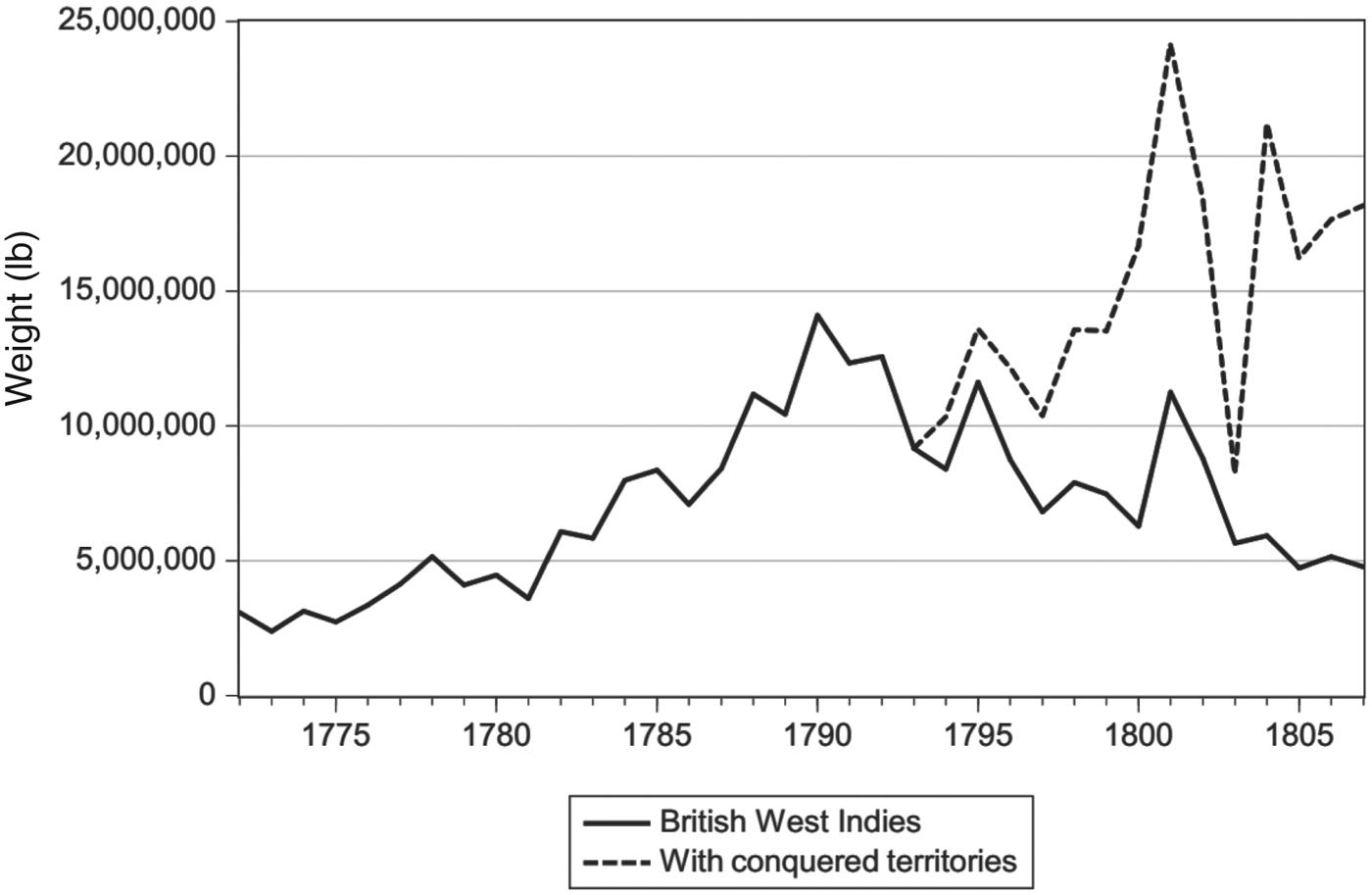
The literature identifies the decline in cotton exports from foreign possessions in the Caribbean during the 1790s as the main reason why Brazil became a major cotton supplier to Britain in the late eighteenth century. Although it is true that exports from the British West Indies were negatively affected by the Saint Domingue revolt in 1791 and declarations of war with France and the Netherland, this section presents evidence that, even with a decline in cotton imports from older possessions in the West Indies, newly-conquered territories allowed for the continued growth of cotton supply. Figure 4 shows that political instability favoured Britain's interests in the region, enabling her to increase her cotton imports from a series of territorial conquests, especially with respect to the former Dutch colony of Demerara in South America.
Britain, Imports of Raw Cotton from the West Indies, 1772–1807

The 1760s saw an increase in Britain's cotton consumption, requiring a ‘frontier expansion’ of its colonies in the West Indies, but for a while, British dominions shared two obstacles to expanding the cotton plantations. First, cotton had to compete for resources with sugar, the most profitable commodity in the West Indies: in 1770 cotton represented 3 per cent of the total value of West Indies exports, while sugar totalled 52 per cent.Footnote 126 The relatively limited size of the Caribbean islands compared to the frontier expansion possibilities available in areas both north and south of the American continent was also a concern.
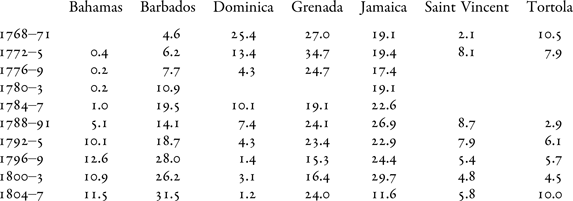
Table 6 shows that the increase in Caribbean cotton exports was directly related to territorial expansion. After the Seven Years’ War and through the 1763 Treaty, the former French possessions of Dominica, Grenada and Saint Vincent became British possessions and rapidly became important exporters of cotton.Footnote 127 The gaps in the data in Table 6 refer to periods during which the respective islands were not in British possession, the most important example being between 1778 and 1782, when the French seized Dominica, Grenada and Saint Vincent from Britain during the US War of Independence.Footnote 128 These territories returned to Britain when the war ended in 1783 and exports returned to their previous trend. Despite the repossession, the war renewed concerns about the West Indies as a reliable supplier of raw cotton. Furthermore, the Caribbean islands remained Britain's only possessions in the Americas after the United States became independent, and became the centre of British foreign trade in the Atlantic economy.Footnote 129
Share of Raw Cotton Exports from the British West Indies to Britain (%)

Sources: 1768–71: TNA, ref. T 64/275/143: ‘1767 Xmas–1777 Xmas Quantity of Cotton Wool of Foreign Growth Imported Each Year’; 1772–1807: TNA, ref. CUST 17: ‘States of Navigation, Commerce and Revenue’.
After the conflicts ended, Britain renewed its commercial ties with the French West Indies. Table 7 demonstrates that France became a substantial supplier to British cotton mills around the second half of the 1780s. The French possessions included the islands of Guadeloupe, Martinique and Saint Domingue (the latter was considered the richest of all European colonies in the 1770s and 1780s). The number of slaves present on each island is a good proxy for their economic importance. While Martinique's slave population numbered 83,000 in 1789 and Guadeloupe's 90,134 in 1790, Saint Domingue had a slave population of 465,000 in 1789 – compared to a population of 30,000 Caucasians. In Guadeloupe, half of the slaves worked on sugar plantations while the other half worked in cotton and coffee production.Footnote 130
Cotton Wool Imported into Britain, 1786–7 (lb)

Source: TNA, Board of Trade: Miscellanea. Cotton: ‘An Important Crisis in the Cotton Manufactory of Great Britain Explained’, Ref.: BT 6/140.
Table 7 indicates that most of Britain's raw cotton imports in 1787 actually originated from possessions of other nations, an issue that raised concerns among the British about foreign dependency, especially as to whether imports were predominantly controlled by France.Footnote 131 In addition to its history of warfare with England, France's re-export duties were another source of dissatisfaction among British producers, as the duties increased the price of the raw material. In the 1780s, cotton manufacturers became an influential pressure group to ‘acquaint the planters and the British government with their requirements’, and their actions aimed at reducing imports of raw cotton from foreign possessions.Footnote 132 While commercial negotiations with France were taking place in 1786, textile manufacturers presented a tentative solution to reduce foreign dependency to the Board of Trade.
Lord Sydney, President of the Committee on Trade and Foreign Plantations, sent a letter to Whitehall on 10 March 1786, addressing the ‘necessity of promoting in His Majesty's West India possessions the cultivation of cotton of the best seeds of Tobago, Cayenne, Saint Domingue, Berbice, Surinam, Demerara, and Brazil […]’.Footnote 133 None of these regions, however, was under British rule.Footnote 134 The letter was in response to a request made by Manchester manufacturersFootnote 135 to expand the supply of finer raw cotton, and it gave examples of seeds with higher prices on the Liverpool market. While British West Indies prices ranged from 19 to 22 pence/lb, seeds from Berbice, Surinam, Demerara and Cayenne reached 24 pence in 1780.Footnote 136 In 1787, Sydney notified the British government that the governor of Dominica – a British possession – had requested permission to grant land to persons ‘residing upon that island for the cultivation of cotton’.Footnote 137
Other colonies also benefitted from British government incentives for improvements in cotton cultivation and strove to raise their productivity. In 1788 a cotton gin was introduced in the Bahamas and proved ‘to be an important break-through since it cleaned large amount of cotton more quickly and efficiently than the traditional methods’.Footnote 138 Even islands which did not traditionally plant cotton, such as Bermuda, received incentives to promote its cultivation. The governor of Bermuda, William Browne, replied to Lord Sydney in 1787 stating he would notify the inhabitants of the island as to ‘his Majesty's pleasure respecting the cultivation of cotton’. Browne also described the problems of growing cotton on islands. While arguing that the experience of many planters proved that cotton could be grown with success, the strong winds that blew across Bermuda posed a threat to the crops. The winds destroyed the cotton plants during critical periods in their development.Footnote 139
Two years later, political events, not geographical limitations, reinforced Britain's ambitions to expand its cotton plantations throughout the Caribbean. British colonial governors reported ‘tumultuous reaction’ in the French colonies in the end of 1789, after the revolution in France. The political upheaval led the British government to devise a way of reaping the benefits of France's political uncertainty. The governor of Dominica, in a report of December 1790, argued that England could attempt to seize the French islands in view of the high probability of war in the region. Similarly, the British ambassador in Paris raised the possibility of British support for the separatist movement in Saint Domingue.Footnote 140
The Saint Domingue revolution was the most remarkable in a series of conflicts that swept the Caribbean during the 1790s. In the 1791 slave revolt, around 100,000 slaves destroyed sugar, coffee, cotton and indigo plantations, and destabilised French control of the West Indies. Soon, Guadeloupe and Martinique were also destabilised by slave insurrections. The disorder created a power vacuum of which the British government took advantage to promote territorial expansion. Through a series of negotiations between the French and British governments, an alliance was signed and the French islands became British colonies in 1793.Footnote 141 The French possessions of Guadeloupe, Martinique, Saint Domingue, Saint Lucia and Tobago appear in the British Ledgers of Trade as ‘conquered islands’ in 1795, representing almost 2 million lb of raw cotton exports to England.Footnote 142 Trinidad, which despite being a Spanish colony had a large French influence, appears in 1797 as a conquered island.Footnote 143 The most important territorial conquest in terms of cotton supply was the occupation of the former Dutch colonies of Demerara (1796) and Surinam (1799).Footnote 144
Charles Mackenzie, author of an 1811 work about the British colonies, argued that the Dutch settlements on the coast of Guyana had attracted interest from British cotton planters since the 1780s.Footnote 145 Table 8 shows that, with their annexation by Britain, Demerara and Surinam became important sources of raw cotton for Britain.Footnote 146 In 1804, at the peak of imports from the conquered territories, 14 million out of almost 15 million lb of raw cotton was grown in Demerara. The former Dutch colonies had three qualities valued by the British government. First, there were no limitations on their cultivation areas. Second, as already mentioned, cotton planted on the continent was of higher quality than the types grown on island plantations. Third, Surinam and Demerara were outside the conflict zone established after the declaration of war in 1793 between Britain and France.
Share of Raw Cotton Exports to Britain from Conquered Territories in the West Indies (%)

Source: TNA, ref. CUST 17: ‘States of Navigation, Commerce and Revenue’.
The decline in production suffered by Caribbean islands in the 1790s is cited by the historiography of the Brazilian cotton trade as an important reason for the geographical diversification of cotton plantations that took place at the time. For example, in Guadeloupe, many plantations were abandoned during the war and conflicts of the 1790s, and the area used for the cultivation of cotton dropped by 75 per cent between 1790 and 1799. In addition, with French naval incursions and continuous insurrections, the British soon lost the islands of Grenada, Saint Vincent, Saint Lucia and Saint Domingue, which suffered successive changes in governments.Footnote 147 At the same time, these accounts neglect to mention that, although it lost some of its territories, Britain also conquered larger ones on continental areas, which allowed production to increase.
In addition, the issue of competition for suitable land and labour with sugar plantations had been a concern for cotton growers in the West Indies islands since the beginning of the 1780s. It seems that this dispute over land and labour was a reason for interpretations that saw the fate of cotton as a result of competition with sugar growers for resources.Footnote 148 Yet, as previously shown, the quality of the staple became a much more important factor in deciding where cotton should be produced. After 1790, cotton plantations moved to Surinam and Demerara because they produced better-quality staple. The incorporation of former Dutch colonies into the British Empire helps us to understand why the growth of the Brazilian cotton trade was not a direct result of the Caribbean revolutions of the 1790s.
Conclusions
This study provides a new interpretation for the rise of Brazilian cotton exports to Britain during the early decades of the Industrial Revolution. The first export of Brazilian cotton to Britain occurred in the 1760s, but demand increased significantly only in the 1780s, when the use of the water frame and the mule allowed the production of calicoes and muslins at competitive prices. After 1780, British demand shifted to cotton with longer and more resistant staples, available in Brazil because of previous policies set up during the Pombal era to encourage cotton production. Northeast Brazil became the main source of raw cotton for Britain's high-quality textiles, which saw the highest increase in productivity and the largest decrease in prices – mostly in the yarn – at the beginning of the Industrial Revolution. Imports from Brazil accounted for 40 per cent of Liverpool's cotton trade at the end of eighteenth century, and the significant Brazilian presence in British markets continued at least until the end of the Napoleonic blockade, when international trade normalised and new processes enabled the production of high-count yarns by mixing long staples with shorter ones.
The initial increase in exports, therefore, took place before the revolutions in the Caribbean, contradicting interpretations that linked Brazilian cotton exports to an economic decline in the West Indies. In addition, cotton exports from the British West Indies did not decline following the Caribbean revolutions as some authors have claimed – production moved to South American territories previously owned by the Netherlands and continued to expand in the following years. Descriptions of cotton typologies show that cotton produced in Demerara was similar to types exported by Maranhão, suggesting that the preference for cotton grown in South America was not related to the conflict in the Caribbean. It was the longer staples from continental areas that moved cotton production away from the islands of the West Indies.
Trade data also contradict previous explanations that attributed the rise of Brazilian cotton trade to the US War of Independence. The South of the United States was not a major supplier to Britain prior to the nineteenth century. The increased use of saw-gins to process upland cotton, and the mixing of cotton staples, however, allowed the United States to overtake Brazil after the beginning of the nineteenth century. Nevertheless, even with the dominant position of cotton produced in the US South, Brazil continued to be the second largest exporter of cotton to Liverpool until the 1830s, when the cotton trade began to expand to other countries.