


1. INTRODUCTION
A significant anomaly was discovered at interaction of laser pulses of about ps duration at powers of TW up to more than PW (Hora et al., Reference Hora, Badziak, Read, Li, Liang, Liu, Sheng, Zhang, Osman, Miley, Zhang, He Xianto, Hanscheng, Jablonski, Wolowski, Skladanowski, Jungwirth, Rohlena and Ullschmied2007), which was explained (Hora et al., Reference Hora, Badziak, Boody, Höpfl, Jungwirth, Kralikova, Kraska, Laska, Parys, Perina, Pfeifer and Rohlena2002; Hora, Reference Hora2003) as nonlinear (ponderomotive) force acceleration of highly directed and quasi-neutral plasma blocks based on most exceptional measurements (Sauerbrey, Reference Sauerbrey1996; Zhang et al., Reference Zhang, He, Chen, Li, Zhang, Wong, Li, Feng, Zhang, Tang and Zhang1998; Badziak et al., Reference Badziak, Kozlov, Makowksi, Parys, Ryc, Wolowski, Woryna and Vankov1999). Usually and documented in a large number of experiments, laser pulses of this kind (Mourou & Tajima, Reference Mourou, Tajima, Tanaka, Meyerhofer and Meyer-Ter-Vehn2002) produce all kinds of relativistic effects (Limpouch et al., Reference Limpouch, Psikal, Andreev, Platonov and Kawata2008; Niu et al., Reference Niu, He, Qiao and Zhou2008; Ozaki et al., Reference Ozaki, Bom, Ganeev, Kieffer, Suzuki and Kuroda2007) but in contrast, the anomalous measurements were based on very clean laser pulses, i.e., where the prepulse was suppressed (Chen et al., Reference Chen, Unick, Vafaei-Najafabadi, Tsui, Fedosejevs, Naseri, Masson-Laborde and Rozmus2008; Varro, Reference Varro2007; Varro & Farkas, Reference Varro and Farkas2008; Zhang et al., Reference Zhang, Tang, Huang, Qu, Guan and Wang2008) by a contrast ratio above 108 up to less than 50 ps before the main pulse arrived at the target such that relativistic self focusing (Hora, Reference Hora1975) is avoided. The plasma blocks contain ion current densities above 1011 A/cm2 (Hora, Reference Hora2003; Badziak, Reference Badziak2007). These ion densities should be of interest for igniting low compression DT fuel for fusion energy similar to the ignition by extremely intense laser produced 5 MeV electron beams (Nuckolls & Wood, Reference Nuckolls and Wood2002) where gains of 104 times more fusion energy are expected per energy of the interacting laser pulse.
The problem considered here is of general interest for the fast ignition scheme of laser fusion (Tabak et al., Reference Tabak, Hammer, Glinsky, Kruer, Wilks, Woodworth, Campbell, Perry and Mason1994). When spherical laser irradiation compressed polyethylene-like polymers to 2000 times the solid state density (Azechi et al., Reference Azechi, Jitsuno, Kanabe, Katayama, Mima, Miyanaga, Nakai, Nakai, Nakaishi, Nakatsuka, Nishiguchi, Norrays, Setsuhara, Takagi and Yamanaka1991), however, a temperature of about 300 eV only was measured. In order to reach fusion conditions, it was proposed (Tabak et al., Reference Tabak, Hammer, Glinsky, Kruer, Wilks, Woodworth, Campbell, Perry and Mason1994)—initiated by Campbell (Reference Campbell2005)—to add a laser pulse of PW power and ps duration to the center of the compressed plasma, which pulses were just becoming available by chirped pulse amplification (CPA) (Mourou & Tajima, Reference Mourou, Tajima, Tanaka, Meyerhofer and Meyer-Ter-Vehn2002) or by the Schäfer-Szatmari (Schäfer, Reference Schäfer1986; Szatmari & Schäfer, Reference Szatmari and Schäfer1988) technique. When performing the first experiments with these pulses, it was surprising that all kinds of relativistic effects appeared, as generation of 100 MeV electrons, up to GeV ions, 20 MeV gammas with subsequent nuclear reactions, but just not the desired deposition of the pulse energy for spark ignition (Cowan et al., Reference Cowan, Parry, Key, Dittmire, Hatchett, Henry, Mody, Moran, Pennington, Phillips, Sangster, Sefcik, Singh, Snavely, Stoyer, Wilks, Young, Takahashi, Dong, Fountain, Parnell, Johnson, Hunt and Kuhl1999) to the center of the plasma pre-compressed to a density, which is 1000 times denser than solids. Modifications of the fast igniter scheme were developed of which the generation of 5 MeV intense proton beams is mentioned (Roth et al., Reference Roth, Brambrink, Audebert, Blazevic, Clarke, Cobble, Geissel, Habs, Hegelich, Karsch, Ledingham, Neely, Ruhl, Schlegel and Schreiber2005; Hoffmann et al., Reference Hoffmann, Blazevic, Ni, Rosemej, Roth, Tahir, Tauschwitz, Udrea, Varentsov, Weyrich and Maron2005) for depositing energy into the center of pre-compressed DT fuel for the aim of achieving spark ignition.
Another modification opens the possibility of the initial aim on how to ignite nearly uncompressed solid DT fuel. Based on the mentioned PW-ps laser pulses hitting 1000 times pre-compressed plasma, Nuckolls and Wood (Reference Nuckolls and Wood2002) expected that 5 MeV electron beams can be generated with such an extreme intensity that 100 MJ fusion energy may be produced by 10 kJ laser pulses (Teller, Reference Teller, Hora and Miley2005, p. 13). The requirement to produce these fusion gains above 10,000 in a fully controlled way is then fulfilled by using “large mass of low density compressed DT fuel” (Nuckolls & Wood, Reference Nuckolls and Wood2002). The advantage to use the pre-compression to 12 times the solid state DT fuel only is explained (fifth paragraph of second section of Nuckolls & Wood, Reference Nuckolls and Wood2002), and how even lower pre-compression is of advantage.
After conceptually opening the line of igniting nearly solid state density DT by PW-ps laser pulses driven electron beams for controlled fusion with gains of 10,000 (Nuckolls & Wood, Reference Nuckolls and Wood2002), this type of laser pulses may form the basis of a similar scheme for laser driven ion beams in quasi-neutral plasmas (Hora, Reference Hora2003, Reference Hora2007) by using the newly understood phenomenon of the nonlinear (ponderomotive) force driven directed plasma blocks.
2. THE PLASMA BLOCK GENERATION MECHANISM
In contrast to the usual relativistic interaction processes, it was completely surprising that Zhang et al. (Reference Zhang, He, Chen, Li, Zhang, Wong, Li, Feng, Zhang, Tang and Zhang1998) did not obtain in their experiments with the usual irradiated TW-ps laser pulses, the always observed very intense X-ray emission. Another anomaly was the fact (Badziak et al., Reference Badziak, Kozlov, Makowksi, Parys, Ryc, Wolowski, Woryna and Vankov1999) that the ions emitted from targets did not have the usually observed ion energies (expected that 22 MeV from the always involved relativistic self-focusing (Hora, Reference Hora1975)) but showed maximum energies of half MeV only. Further, it has to be realized in retrospect only, that there are the measurements of emitted directed plasma fronts, which were rather uniform and showed the very high values of acceleration (Sauerbrey, Reference Sauerbrey1996) in agreement with the newly understood nonlinear force interaction (Hora et al., Reference Hora, Badziak, Read, Li, Liang, Liu, Sheng, Zhang, Osman, Miley, Zhang, He Xianto, Hanscheng, Jablonski, Wolowski, Skladanowski, Jungwirth, Rohlena and Ullschmied2007). Following the discussion with one of the co-authors, Lang Wong, of the team of Zhang et al. (Reference Zhang, He, Chen, Li, Zhang, Wong, Li, Feng, Zhang, Tang and Zhang1998), it became evident that all these very unusual anomalous observations could be explained by nonlinear-force-driven skin-layer acceleration SLANF (Hora et al., Reference Hora, Badziak, Boody, Höpfl, Jungwirth, Kralikova, Kraska, Laska, Parys, Perina, Pfeifer and Rohlena2002; Hora, Reference Hora2003, Reference Hora2009).
This result was the starting point to understand the most anomalous ion emission measured by Badziak et al. (Reference Badziak, Kozlov, Makowksi, Parys, Ryc, Wolowski, Woryna and Vankov1999). Being aware of the different mechanisms for ion emission from laser produced plasmas including ponderomotive and relativistic self-focusing from the beginning (Hora, Reference Hora1975) and laser fusion with nonlinear force driven plasma blocks: threshold and dielectric effects (Hora, Reference Hora2009), or the hot electron ambipolar acceleration (Haseroth Hora, Reference Haseroth and Hora1996; Hora, Reference Hora2003; Badziak, Reference Badziak2007), and thermokinetic mechanisms, the result of Badziak et al. (Reference Badziak, Kozlov, Makowksi, Parys, Ryc, Wolowski, Woryna and Vankov1999) could not be explained by any of them. The fact that these measurements showed a constant number of the energetic ions when varying the laser power by a factor of 30 (Badziak et al., Reference Badziak, Kozlov, Makowksi, Parys, Ryc, Wolowski, Woryna and Vankov1999) led to a crucial hint that there is the same importance of the prepulse as in the X-ray measurements by Zhang et al. (Reference Zhang, He, Chen, Li, Zhang, Wong, Li, Feng, Zhang, Tang and Zhang1998). This was the basis to understand the experiments of Badziak et al. (Reference Badziak, Kozlov, Makowksi, Parys, Ryc, Wolowski, Woryna and Vankov1999): it was again the very good beam quality with very high contrast ratio preventing self-focusing and permitting only an acceleration of the nearly constant plasma volume in the skin depth. This was seen from the expected highly directed ion beam against the laser light in contrast to the wide angle ion emission measured under similarly conditions with longer pulses including self-focusing (Hora, Reference Hora2003; Badziak, Reference Badziak2007). The recoil of the nonlinear force driven plasma block results in a block (piston) of plasma moving into the target, as has been confirmed by measurements at irradiating very thin foils (Badziak et al., Reference Badziak, Glowacz, Jablonski, Parys, Wolowski and Hora2004, Reference Badziak, Glowacz, Hora, Jablonski and Wolowski2006; Glowacz et al., Reference Glowacz, Hora, Badziak, Jablonski, Cang and Osman2006; Badziak, Reference Badziak2007) and by computations (Cang et al., Reference Cang, Osman, Hora, Zhang, Badziak, Wolowski, Jungwirth, Rohlena and Ullschmied2005; Yazdani et al., Reference Yazdani, Cang, Sadighi-Bonabi, Hora and Osman2009; Hora, Reference Hora2009).
For the application of these results for the laser ignition of DT following the PW-ps laser produced electron beams (Nuckolls & Wood, Reference Nuckolls and Wood2002) or of the ion beams of the plasma blocks (Hora et al., Reference Hora, Badziak, Boody, Höpfl, Jungwirth, Kralikova, Kraska, Laska, Parys, Perina, Pfeifer and Rohlena2002, Reference Hora, Badziak, Read, Li, Liang, Liu, Sheng, Zhang, Osman, Miley, Zhang, He Xianto, Hanscheng, Jablonski, Wolowski, Skladanowski, Jungwirth, Rohlena and Ullschmied2007; Hora, Reference Hora2003), it is a crucial problem that for the mentioned kind of ignition of DT with solid state density or modest compression, the threshold E t* for the necessary energy flux density E* is unfortunately very high (Bobin, Reference Bobin1971, Reference Bobin, Schwarz and Hora1974; Chu, Reference Chu1972) based on a hydrodynamic analysis. Using the particle interpenetration at interaction of an energetic plasma block beyond hydrodynamic models, the threshold may be reduced by a factor of 20 (Hora, Reference Hora1983). But also for the hydrodynamic analysis, a number of phenomena was not yet discovered by 1972, which lead to a here presented revision of the threshold E t*. One of these not considered phenomena is the stopping power of the alpha particles from the fusion reaction in the target due to collective effects. After reviewing the background of the mentioned collective effect, the results of a revision of the hydrodynamic theory are reported.
3. COLLECTIVE EFFECT
The usual model for the treatment of the stopping power follows the Bethe-Bloch theory with several modifications by further authors as reviewed by Stepanek (Reference Stepanek, Schwarz, Hora, Lubin and Yaakobi1981), where binary collisions between the alphas, protons, or other charged particles from nuclear reactions with electrons are considered. A visible discrepancy appeared with the measurements by Kerns et al. (Reference Kerns, Rogers and Clark1972) where an electron beam of 2 MeV energy and 0.5 MA current of 2 mm diameter was hitting deuterated polyethylene CD2. The penetration depth of the electrons was measured by changing the thickness d of the CD2, and the saturation of the emission of fusion neutrons at d = 3 mm was a proof for the very much shorter stopping length of the electrons than binary collision theories predicted. An explanation of the value d is obtained (Bagge & Hora, Reference Bagge and Hora1974) when Bagge's theory of the stopping of cosmic rays was applied where the interaction of the charged energetic particles was to be taken by the whole electron cloud in a Debye sphere for the electrons and not by binary collisions should be strongly given as a result of the work by Ray and Hora (Reference Ray and Hora1976, Reference Ray and Hora1977) based on an analysis using the Fokker-Planck equation and quantum electrodynamics.
Figure 1 shows the results with the extreme discrepancy of the stopping length of the 3.5 MeV alphas from the DT-fusion reaction within DT plasma of solid state density for plasma temperatures above 100eV. The binary interaction results at the stopping length R BB given by the Winterberg approximation used by Chu (Reference Chu1972) or Lackner et al. (Reference Lackner, Colgate, Johnson, Kirkpatrick, Menikoff and Petschek1994) for the result of the Bethe-Bloch theory is valid for temperatures T above 0.1 keV

In strong contrast, the collective stopping length is nearly constant for higher temperatures. The more precise expression taken from Figure 1 is

taking into account the very slight decrease of R at higher temperatures T. For temperatures less than 0.1 keV, the Bethe-Block theory and the collective theory (Ray & Hora, Reference Ray and Hora1976, Reference Ray and Hora1977) resulted in nearly the same stopping lengths (Fig. 1).
Summary of the stopping length R for alpha particles depending on the plasma temperature T = T i = T e and a set of plasma densities including the liquid—close to the solid—state for deuterium tritium DT at 5 × 1022 cm−3 for different binary interaction models collected by Stepanek (Reference Stepanek, Schwarz, Hora, Lubin and Yaakobi1981) showing the strong difference to the collective model (Ray et al., 1976, 1977a, 1977b).

This result of the much shorter stopping length of the reaction products in laser fusion was the reason of the strong reheats in laser irradiated fusion pellets for DT at fully detailed inclusion of the adiabatic expansion dynamics of the spherical plasmas leading to the discovery of the volume ignition (Hora & Ray, Reference Hora and Ray1978; Hora et al., Reference Hora, Miley, Osman, Evans, Toups, Mima, Murakami, Nakai, Nishihara, Yamanaka and Yamanaka2003; Hora, Reference Hora2007). This was confirmed later by Kirkpatrick and Wheeler (Reference Kirkpatrick and Wheeler1981)—where the cooperation with John A. Wheeler should be underlined—and numerous other authors (Tahir & Long, Reference Tahir and Long1983; Tahir, Reference Tahir1986, Reference Tahir1994; Basko, Reference Basko1990; Martinez-Val et al., Reference Martinez-Val, Eliezer and Piera1994; Atzeni, Reference Atzeni1995) where the robustness of volume ignition was underlined by Lackner et al. (Reference Lackner, Colgate, Johnson, Kirkpatrick, Menikoff and Petschek1994) against spark ignition (Lindl, Reference Lindl1994) with nearly the same fusion gains, and using the ideal and natural adiabatic hydrodynamics of the reacting DT plasma was shown that only this volume process arrived at the highest measured fusion gains (Hora et al., Reference Hora, Azechi, Kitagawa, Mima, Murakami, Nakai, Nishihara, Takabe, Yamanaka, Yamanaka and Yamanaka1998, Reference Hora, Miley, Osman, Evans, Toups, Mima, Murakami, Nakai, Nishihara, Yamanaka and Yamanaka2003).
It should be mentioned that the Gabor theory (Gabor, Reference Gabor1933, Reference Gabor1952) of the stopping power of alpha particles for collisions with the whole collective of the electrons in the Debye sphere, in contrast to the binary collisions with electrons following from the Bethe-Bloch theory, needs some closer consideration in view of results of volume ignition of spherically compressed pellets for fusion energy. The stopping lengths of both theories are not very much different for plasma temperatures up to about 100 eV (Stepanek, Reference Stepanek, Schwarz, Hora, Lubin and Yaakobi1981) (see Fig. 1), while the collective effect arrives at very different values at higher temperatures (Ray & Hora, Reference Ray and Hora1976, Reference Ray and Hora1977) and the Gabor model was put into questions as being controversial.
After volume ignition was discovered (Hora & Ray, Reference Hora and Ray1978) it was first important to see the basic confirmation of this mechanism (Kirkpatrick & Wheeler, Reference Kirkpatrick and Wheeler1981; Lackner et al., Reference Lackner, Colgate, Johnson, Kirkpatrick, Menikoff and Petschek1994) and it could be ignored that the use of the collective effect (Gabor, Reference Gabor1933, Reference Gabor1952) arrived at two to three times higher nuclear fusion gains (Hora & Ray, Reference Hora and Ray1978, Hora et al., Reference Hora, Azechi, Kitagawa, Mima, Murakami, Nakai, Nishihara, Takabe, Yamanaka, Yamanaka and Yamanaka1998) than the binary stopping power (Kirkpatrick & Wheeler, Reference Kirkpatrick and Wheeler1981; Lackner et al., Reference Lackner, Colgate, Johnson, Kirkpatrick, Menikoff and Petschek1994). However, for comparing measured fusion gains from small-scale inertial fusion experiments with computations there was a significant discrepancy (Broad, Reference Broad1988). The measurements arrived at higher gains.
There may be the possibility that the binary stopping power model may have arrived with too low fusion gains from the reheat process. The experiments by Kerns et al. (Reference Kerns, Rogers and Clark1972) were a direct proof of the much shorter stopping length at very high intensity particle interaction, which could immediately and convincingly be explained by the Gabor collective model (Bagge & Hora, Reference Bagge and Hora1974). As an example of how differences up to a factor of about three are reached, some preliminary first results from volume ignition of hydrogen-boron(11) fusion reactions (MalekyNia, 2008; Azizi et al., Reference Azizi, Hora, Miley, Malekynia, Ghoranneviss and He2009) are shown in Figure 2.
Example of volume ignition gain computations for hydrogen-boron(11) fusion depending on the energy input of 105 times solid state compressed fuel using the alpha stopping from the Bethe-Bloch theory, from the approximation with a collective model (Hora-Ray: see Scheffel et al., Reference Scheffel, Stening, Hora, Höpfl, Martinez-Val, Eliezer, Kasotakis, Piera and Sarris1997) and the unrestricted Gabor theory.

A further crucial proof about the problems of the stopping power were given by the experiments of Hoffmann et al. (Reference Hoffmann, Weyrich, Wahl, Gardes, Bimbot and Fleurier1990) directly showing that the ranges of particle beams in laser produced plasmas are drastically different compared to the established theories. The complexity of the theories is well known (Deutsch & Popoff, Reference Deutsch and Popoff2007; Starikov & Deutsch, Reference Starikov and Deutsch2007; Bret & Deutsch, Reference Bret and Deutsch2008) and many studies have approached the problem (Hasegawa et al., Reference Hasegawa, Yokoya, Kobayashi, Yoshida, Kojima, Sasaki, Fukuda, Ogawa, Oguri and Murakami2003; Gericke, Reference Gericke2002; Ogawa et al., Reference Ogawa, Neuner, Kobayachi, Nakayama, Nishigori, Takayaman, Iwase, Yoshida, Kojina, Hasegawa, Oguri, Horioka, Nakajima, Miyamoto, Dubenkov and Murakami2000; Gerike et al., Reference Gericke, Schlanges and Kraeft1997; Morawetz, Reference Morawetz1997; Morawetz & Röpke, Reference Morawetz and Röpke1996; Hoffmann et al., Reference Hoffmann, Jacoby, Laux, Demagistris, Boggasch, Spiller, Stockl, Tauschwitz, Weyrich, Chabot and Gardes1994). There may be reservations in the following when the analysis is based on Gabor's (Reference Gabor1933, Reference Gabor1952) collective model, but at least for the discussed very high plasma densities, the experiments of Kerns et al. (Reference Kerns, Rogers and Clark1972) with the exact agreement to Gabor's results (Bagge & Hora, Reference Bagge and Hora1974) and the measurements by Hoffmann et al. (Reference Hoffmann, Weyrich, Wahl, Gardes, Bimbot and Fleurier1990) may be a basis for this use.
4. REVISED HYDRODYNAMIC MODEL OF BOBIN AND CHU
In order to see the importance of the collective effect of the stopping power in the hydrodynamic equations, first the results of Chu (Reference Chu1972) are going to be reproduced with a minimum of changes in the conditions used before the collective stopping length R, Eq. (2) will be used in the following section. It is to be underlined from the preceding section that the collective effect was not at all known at the time of Chu's treatment. The hydrodynamic equations are used as close as possible to the same assumptions of Chu (Reference Chu1972). The equations of continuity and of the reaction (D + T → α+ n) may be combined to yield the equation of mass conservation

and

where ρ is the mass density, u is the mass velocity, and Y is the fraction of material burned, defined by

W is the reaction rate function, given by

It is obvious that Eq. (3) is the same as the mass conservation equation, due to the small percentage (~0.35%) of mass transformed into energy. In the equation for Y, the n's are the particle densities, and the subscripts describe the different particle species. In the equation for W, the n stands for the total number density of the ions.
The equation of motion expressing the conservation of momentum is
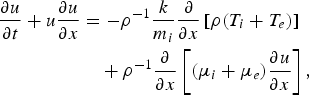
in which pressure and viscosity terms are included. µie are the viscosity coefficients whose values are taken to be

where ln Λ is the usual Spitzer logarithm.
The ion and electron temperature equations are expressing the conservation of energy

and

There are included on the right-hand side using the pressure, viscosity, thermal conductivity K a (a = e for electrons, a = i for ions), thermonuclear energy generation, temperature relaxation terms, and the energy transfer terms W e and W i following Chu (Reference Chu1972). The last term on the right-hand side of Eq. (7) is the bremsstrahlung term.
For the following reported computations the bremsstrahlung is based on the electron temperature Te working with Eq. (15) of Chu (Reference Chu1972) with the maximum at x = 0, thus,

Eq. (8) is a little different from Eq. (20) of Chu (Reference Chu1972) where T i = T e is assumed while the following computation with the collective stopping has to be performed for general temperatures. The α particles are assumed to deposit their energy in the plasma. They have a mean free path at solid state density DT according to Figure 1 for the Ray–Hora case of collective effects given by Eq. (2). The action of the stopping with the collective effect is expressed by the temperature T from Eq. (2). For the calculation of the collective effect, we added a term to right-hand side of Eq. (8). Thus

where P is the thermonuclear heating rate per unit time obtained from the burn rate and the fractional alpha particle deposition:


E α = 3.5 MeV and f is the fraction of alpha particle energy absorbed by electrons or ions, which has been given by

For the equations after Eq. (8), the temperature of the electrons and of the ions were used to be equal to T, as used in Eq. (2) for the following numerical evaluations.
5. REDUCED IGNITION THRESHOLD WITH COLLECTIVE EFFECT
The following numerical evaluations are reported where the development of the temperature with the time t is used in order to compare the ignition condition with the results of Chu given in his Figure 2 (Chu Reference Chu1972). Here Figure 3 shows a lower set of curves, which are very similar to that of Chu, where all his conditions are the same with the exception of the use of the temperature T e instead of the ion temperature T i because of dependency of the bremsstrahlung and thermal conductivity to T e. This causes very minor deviations in Figure 2 from the results of Chu. It should be underlined that in the work of Chu (Reference Chu1972), a one-fluid theory only is used. Figure 3 also contains the new results with inclusion of the collective effect leading to higher temperatures as expected from the shorter stopping length, using the same irradiation energy flux densities as in the cases of Chu for ignition given as E* in erg/cm2 to be conform with Chu's Figure 2. Chu found in agreement with Bobin (Reference Bobin, Schwarz and Hora1974) that ignition happens at E* = 4.3 × 10⁸ J/cm2 for the case without collective effect as seen from the time dependence of the curve continuing to be constant on time. For higher E*, the curves for the temperature are still increasing in time.
Temperature T of the plasma as function of time t at irradiation with various energy flux densities E* as parameter reproducing the lower set for ignition at 4.3 × 10⁸ J/cm2 reported first by Chu (Reference Chu1972, Fig. 2) using the Winterberg approximation for binary collisions—and reporting the results with using the collective effect for the stopping power.

The collective effect results in a much faster increase with the time and the flatter curves for larger values of the time cause a lower accuracy in finding the E* values for ignition. For a number of special cases, the final evaluation can be seen in Figure 4. Without collective effect, the temperature is decaying with the time showing that there is no ignition in agreement with the results of Chu. For the collective effect, one may conclude that the ignition is still possible for E* = 0.95 × 10⁹ J/cm2 or, to be sure, at least at 1.0 × 10⁸ J/cm2.
Results as in Figure 3 showing ignition of solid deuterium tritium with the collective effect being reduced by about a factor of 5 to E* = 0.95 × 10⁸ J/cm2.

6. CONCLUSIONS
Access to an alternative new scheme for low cost generation of nuclear fusion energy by lasers was opened (Hora, Reference Hora2003, Reference Hora2007; Hora et al., Reference Hora, Badziak, Read, Li, Liang, Liu, Sheng, Zhang, Osman, Miley, Zhang, He Xianto, Hanscheng, Jablonski, Wolowski, Skladanowski, Jungwirth, Rohlena and Ullschmied2007) from the application of PW-ps laser pulses to a modified fast ignition scheme (Tabak et al., Reference Tabak, Hammer, Glinsky, Kruer, Wilks, Woodworth, Campbell, Perry and Mason1994). Compared with a similar application of extremely intense electron beams to ignite a controlled fusion reaction in nearly uncompressed solid DT for a power station (Nuckolls & Wood, Reference Nuckolls and Wood2002), a similar process may be possible by irradiation of quasi-neutral directed plasma blocks with 1011 A/cm2 ion current densities, if the discovered anomaly (Hora et al., Reference Hora, Miley, Osman, Evans, Toups, Mima, Murakami, Nakai, Nishihara, Yamanaka and Yamanaka2003, Reference Hora, Badziak, Read, Li, Liang, Liu, Sheng, Zhang, Osman, Miley, Zhang, He Xianto, Hanscheng, Jablonski, Wolowski, Skladanowski, Jungwirth, Rohlena and Ullschmied2007) for acceleration by nonlinear (ponderomotive) forces is applied. A necessary condition is to highly suppress pre-pulses to avoid relativistic self focusing.
For the first initial studies about the feasibility of such modified fast ignition, the Bobin–Chu theory of 1972 is applied for the block ignition where an improvement of the otherwise extreme conditions may be possible due to later discovered plasma effects. After the inclusion of the inhibition factor for thermal conduction was studied (Ghoranneviss et al., Reference Ghoranneviss, Malekynia, Hora, Miley and He2008; Zhou et al., Reference Zhou, He and Yu2008), the detailed studies for the reduced stopping lengths for alpha particles are presented here including a detailed description of the hydrodynamic properties with application of the generally rather complex theory of the stopping power. Reasons were given, that the very high plasma densities and ion beam currents may permit application of the Gabor (Reference Gabor1933, Reference Gabor1952) theory of collective interaction. The result of the hydrodynamic analysis is that the threshold of ignition for the energy flux density E t* is reduced by a factor close to 5 due to the collective effect compared with the initial result of Chu (Reference Chu1972). This separate elaboration of the collective effect compared with the inhibition factor was needed for a detailed understanding in view of the complexity of the stopping power theory, after first results of the combination of both effects were summarized (Hora et al., Reference Hora, Malekynia, Ghiranneviss, Miley and He2008).



