

Introduction
Various research findings show that ethnoracially diverse communities have lower levels of social capital and public goods provision than homogeneous communities (Alesina, Baqir, and Easterly Reference Alesina, Baqir and Easterly1999; Costa and Kahn Reference Costa and Kahn2003; Habyarimana et al. Reference Habyarimana, Humphreys, Posner and Weinstein2007; Putnam Reference Putnam2007; Robinson Reference Robinson2016; Schaeffer Reference Schaeffer2014). A common reason that has been advanced to explain why ethnic heterogeneity may hinder the cooperative capacity of a community is racial prejudice (Allport Reference Allport1954; Oliver and Wong Reference Oliver and Wong2003): negative attitudes toward non-coethnics may negatively affect prosocial behavior. Even if no aversion toward non-coethnics exists, other factors may undermine cooperation in ethnically heterogeneous settings, such as differences with regard to norms of cooperation, disagreement over preferred outcomes, or weak social networks and difficulties in communication and social control across ethnic groups (Algan, Hémet, and Laitin Reference Algan, Hémet and Laitin2016; Enos and Gidron Reference Enos and Gidron2016; Habyarimana et al. Reference Habyarimana, Humphreys, Posner and Weinstein2009; Kimenyi Reference Kimenyi2006; Lieberman and McClendon Reference Lieberman and McClendon2013; Miguel and Gugerty Reference Miguel and Gugerty2005; Winter and Zhang Reference Winter and Zhang2018). However, others have cautioned that the relationship between diversity and cooperation may also be spurious. Ethnic minorities often have low social status, and ethnically diverse communities are often also poor communities. Thus, poverty, rather than ethnoracial diversity, might be at the basis of their lower cooperative capacity (Abascal and Baldassarri Reference Abascal and Baldassarri2015; Gereke, Schaub, and Baldassarri Reference Gereke, Schaub and Baldassarri2018; Lawrance Reference Lawrance1991; Sampson Reference Sampson2012; Sampson, Raudenbush, and Earls Reference Sampson, Raudenbush and Earls1997).
Research in psychology and economics suggests that poverty produces a specific mind-set: in particular, poor people are affected by “present-bias,” according to which they tend to discount the future more than people who do not live in conditions of chronic disadvantage. Namely, because they constantly face pressing needs (e.g., paying bills, repaying short-term loans) or more essential expenses (e.g., buying food for their children, paying for medical emergencies), poor people tend to value immediate rewards more highly compared to better-off people (Banerjee and Duflo Reference Banerjee and Duflo2011; Haushofer and Fehr Reference Haushofer and Fehr2014). Poor people have also been shown to disproportionally experience stress and cognitive burden/attentional capture (Banerjee and Duflo Reference Banerjee and Duflo2011; Mani et al. Reference Mani, Mullainathan, Shafir and Zhao2013; Mullainathan and Shafir Reference Mullainathan and Shafir2013; Shah, Mullainathan, and Shafir Reference Shah, Mullainathan and Shafir2012), which has been associated with lower saving rates (Karlan, Ratan, and Zinman Reference Karlan, Ratan and Zinman2014).Footnote 1
Extending this research to a new domain, we theorize that poverty may have negative effects on cooperative behavior. Community-level cooperation often generates from a series of small, repeated, reciprocal gestures that builds over time into more substantial forms of collective action (Baldassarri Reference Baldassarri2015; Gould Reference Gould1993; Kim and Bearman Reference Kim and Bearman1997). Poverty challenges this process. People experiencing poverty may be less prone to engage in cooperative behavior because they might discard the future benefits of cooperation, or might make commitments they cannot sustain. In addition, poverty may also affect expectations: poor people might be considered less reliable cooperation partners, and might have fewer opportunities to participate in cooperative endeavors in the first place because others anticipate poor people to be more present-bias and act accordingly (Bechtel and Scheve Reference Bechtel and Scheve2017).
In order to test this idea, we developed a novel experimental design. Our framework allows us to capture how cooperative decisions are made as a function of an interaction partner’s identity. We experimentally vary both the partner’s racial identity (Black or White) and their poverty status (rich or poor). In addition, we distinguish between non-strategic behavior due to aversion toward racial outgroups and the poor, and strategic discrimination based on expectations about others’ behavior. Strategic interactions are captured with a new two-player behavioral game – the cooperative investment game (CIG) – while non-strategic behavior is captured with a classic dictator game (DG).
We find evidence of strategic discrimination based on income: poor interaction partners elicit substantially lower cooperation rates. Much of this discrimination is due to participants who are low-income earners themselves. Race also matters, in particular when the interaction partner is poor. While high-income Blacks command similar levels of cooperation to high-income Whites, low-income Blacks are considered worse cooperation partners than low-income Whites.
Research Design and Methods
We conducted our experiment with 1,190 participants who we recruited in the online crowdsourcing marketplace Amazon Mechanical Turk.Footnote 2 The experiment was programmed using oTree (Chen, Schonger, and Wickens Reference Chen, Schonger and Wickens2016), and we pre-registered our research design and analysis plan with egap.org.Footnote 3 Here we present in detail the most important components of our research design. Additional information is available in the Supplementary Material.
Randomization of Partner’s Identity
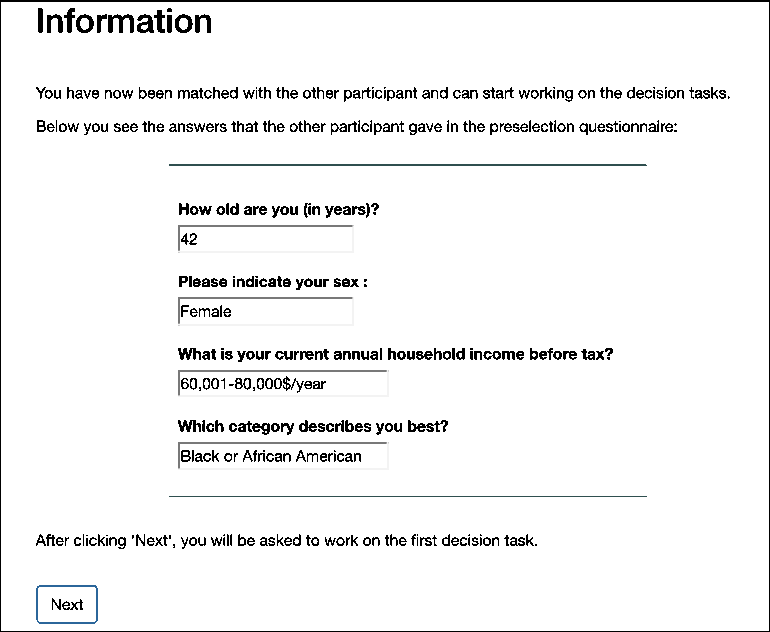
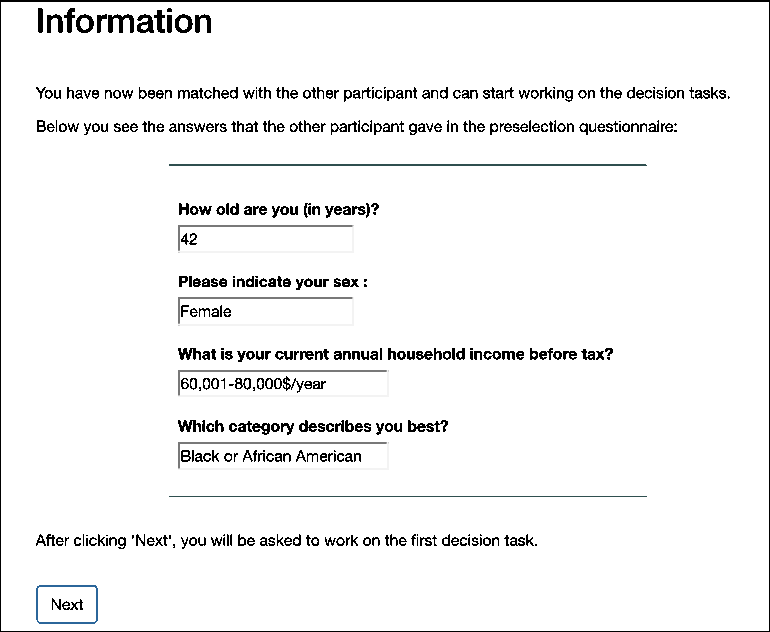
When relying on observational data, scholars have no control over the intersection of race and socioeconomic status, thus making it difficult to disentangle their effect on cooperative behavior. In our experimental framework, we systematically manipulated the identity of our participants’ interaction partners. Namely, we randomized the income (alternating between “10,000–20,000$ per year” and “60,001–80,000$ per year”), race (alternating between “White” and “Black or African American”), and gender of the interaction partner while keeping his/her age constant. In particular, participants were first asked to provide sociodemographic information about themselves: their age, sex, household income, and race. They were then matched with another participant and shown their partner’s demographic information in the same format that was used to collect their own information (Figure 1). Using the same format, we aimed at increasing the realism of the experiment while making explicit both the race and social class of the partner. Moreover, by adding information about gender and age, we reduced the emphasis on income and race, with the goal of making participants less suspicious about the experimental treatment. This novel procedure overcomes limitations of previous experiments on race, in which the race treatment (e.g., typical Black names) often goes hand in hand with perceptions of social class (Gaddis Reference Gaddis2014, Reference Gaddis2017). Thus, we adopted a 23 factorial design, in which the partner’s profile varied according to gender, economic status, and race.
Matching and visualization of partner’s profile. Screenshot from the experiment.
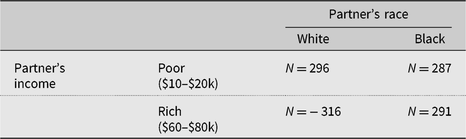
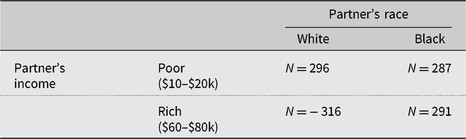
We are, however, mainly interested in the effect of the partner’s income and race on our participants’ decision, and thus focus our analysis on the four treatment conditions depicted in Table 1.
Treatment conditions of interest and associated sample size
The Cooperative Investment and Dictator Games
Participants engaged in two decision tasks with their assigned partner: the CIG and the DG. They were presented with these tasks in a random order and were informed about their payoffs only after making both decisions.
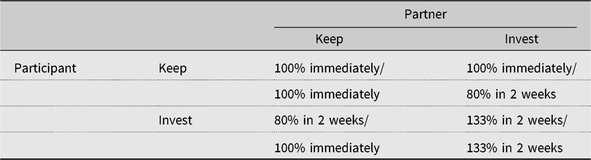
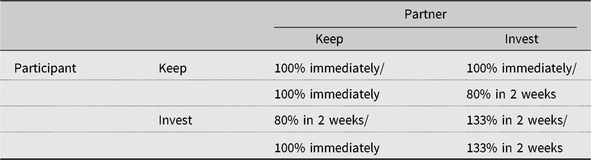
The CIG is a two-player (“participant” and “partner”), strategic cooperation game that has the structure of a stag hunt game (Skyrms Reference Skyrms2004), and includes a time dimension. In the CIG, participants are given an endowment (here, ccC 150),Footnote 4 and have to decide whether they want to keep the endowment or invest it. If they decide to keep the endowment, participants receive the amount immediately. Investing promises a 33% return on investment (here, a payoff of ccC 200) after a 2-week wait. However, this return is only realized if their interaction partner chooses to invest too. If the partner chooses not to invest, participants lose 20% of their endowment and still have to wait 2 weeks to receive their reduced payoff of ccC 120 (Table 2).Footnote 5
Payoff structure of the cooperative investment game
In the CIG, cooperation is the optimal solution if the participant is confident that their partner will cooperate (and believes that the other person also holds this belief). Cooperation tasks have been used before to study strategic discrimination of non-coethnics (Enos and Gidron Reference Enos and Gidron2016; Fershtman and Gneezy Reference Fershtman and Gneezy2001; Habyarimana et al. Reference Habyarimana, Humphreys, Posner and Weinstein2007). Notwithstanding, scholars have tended to consider games that capture the trade-off between individual and group interest, such as prisoner dilemma or public goods games. In a one-shot prisoner dilemma game the optimal solution is always to defect – defection maximizes individual payoff while inflicting a loss on the partner, while in the CIG, an individual’s optimal decision crucially depends on his/her expectations about their partner’s behavior. Cooperation is the best option if the partner cooperates, while non-cooperation is preferable if the partner does not cooperate. Finally, non-cooperation should not be considered a neutral choice, because it inflicts a cost on the partner in case she/he cooperates.
The time component likens the CIG to cooperation situations where the reward of a cooperative act accrues at a later point, and makes it sensitive to differences in “present-bias,” the main mechanism through which we expect poverty to affect cooperation. In an extreme scenario, for individuals with high time-discounting rates, the cooperation payoff (133% of the endowment) may be discounted to the point of being lower than the value of the endowment that is received immediately. For such individuals, it is optimal not to invest. Participants in the CIG should thus gauge their partner’s time-discounting rate, and how their partner will assess their own time-discounting rate. The game was intentionally constructed this way to provide a measure of cooperation that is sensitive to expectations about the partner’s willingness to cooperate, and to reflect the fact that many real-life cooperation situations take time to come to fruition.
The randomization of the partners’ profiles allows us to causally assess the impact of a partner’s racial identity and economic status on participants’ cooperative behavior. Comparing across the four cells of Table 1, we ask whether being matched with a poor Black partner, poor White partner, rich Black partner, or rich White partner makes a difference in the way in which people behave in this strategic cooperative situation.Footnote 6
In order to distinguish strategic considerations from aversion toward a partner’s economic class or race, we measured prosocial inclination toward the partner with a DG, a two-player allocation task that does not entail strategic interaction. This game is traditionally used to measure altruistic behavior (Camerer Reference Camerer2003), and varying the identity of the recipient makes it possible to assess “taste-based” discrimination (Adida, Laitin, and Valfort Reference Adida, Laitin and Valfort2014; Becker Reference Becker1957; Fershtman and Gneezy Reference Fershtman and Gneezy2001; Whitt and Wilson Reference Whitt and Wilson2007). In the DG, a pair of players is allocated a fixed sum (here, ccC 100). One person in the pair is then selected as the decider and has to decide, anonymously, how to split the amount between himself/herself and the other player. In our experiment, all participants were assigned the role of the decider. If our participants held negative sentiments toward Blacks or the poor, we would expect overall levels of contributions in the DG to be lower when participants are matched to partners from these categories.Footnote 7 Since participants were matched to the same partner for the DG and CIG, contributions in the DG can also be used as a control for prosociality in the analysis of CIG behavior, thus strengthening our interpretation of behavior in the CIG as driven by strategic considerations rather than non-strategic considerations.Footnote 8
Hypotheses and Results
Hypotheses
Our main hypotheses concern the causal effect of the partner’s identity – namely his/her race and economic status – on our participants’ cooperative behavior in the CIG. First of all, we expect that participants matched with a poor partner will be less likely to invest.
Hypothesis 1: Participants invest at lower rates in the CIG when matched with a low-income rather than high-income partner.
Based on arguments made in observational research on the negative effects of ethnoracial diversity, we also expect that:
Hypothesis 2: Participants invest at lower rates in the CIG when matched with a Black rather than White partner.
Apart from testing these general hypotheses, we seek to determine whether differences in behavior are likely to be driven by distaste/dislike, or by strategic considerations. If lower levels of cooperation with poor people and ethnic minorities are due to taste (e.g., dislike of Blacks, belief of poor people as undeserving, etc.), we would find evidence in terms of lower contributions to poor and Black partners in the DG. If, instead, cooperative behavior is mainly based on specific expectations about the strategic behavior of minorities and poors, then we would not see discrimination in non-strategic interactions like the DG, even though we would observe it in the strategic CIG.
Hypothesis 3: If differences in behavior are driven by “distaste,” participants will discriminate against poor or Black partners in the DG.
Results
We start our analysis by ruling out this last hypothesis (Hypothesis 3). In regressions of the amounts sent in the DG on the partner’s income status and race (reported in Table A1 in the Supplementary Material), we find little evidence for taste-based discrimination. In line with other studies of the US population that have used the DG (Abascal Reference Abascal2015; Fong and Luttmer Reference Fong and Luttmer2011), we find that our participants sent virtually identical amounts to Black and White partners. Along the income dimension, we find that our participants give slightly more to poor partners (3% points) – although this difference is only marginally statistically significant and does not hold up when controlling for pre-treatment controls. We therefore believe that taste-based discrimination plays a minor role in our experimental setting.
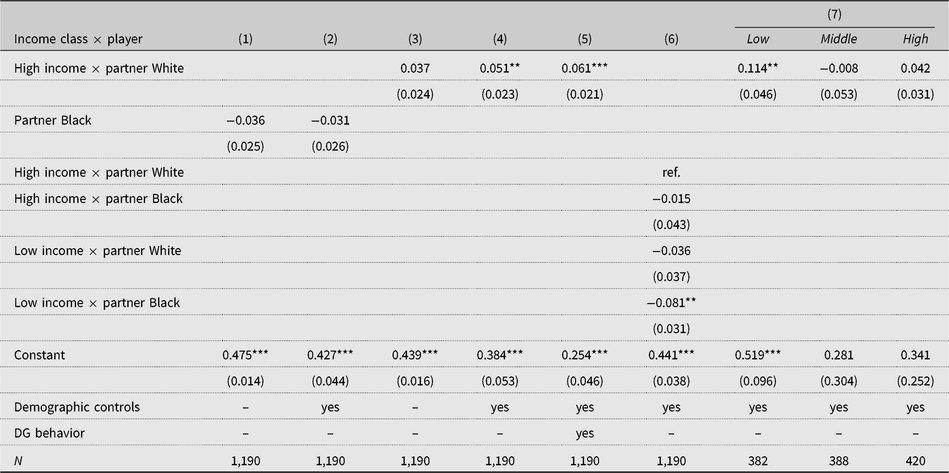
Next, we turn our attention to behavior in the CIG with the binary outcome “invest”/“not invest.” Unlike the DG, this is a strategic cooperation setting where expectations about the partner’s behavior factor in when deciding about one’s own behavior. Results from linear probability models are reported in Table 3.Footnote 9 Looking first at the race dimension (Hypothesis 2), we see that the proportion of participants who invest in the CIG when matched with a White partner is 47.5%. This proportion is somewhat lower (–3.6% points) when participants are matched with Black partners, but the difference is not statistically significant at conventional levels (Table 3; Model 1). Controlling for pre-treatment covariates of participants (sex, age, race, education, income, household size, occupation), as stipulated in the pre-analysis plan, does not improve the precision of the estimates (Table 3; Model 2).
Regression of investment behavior on treatment conditions
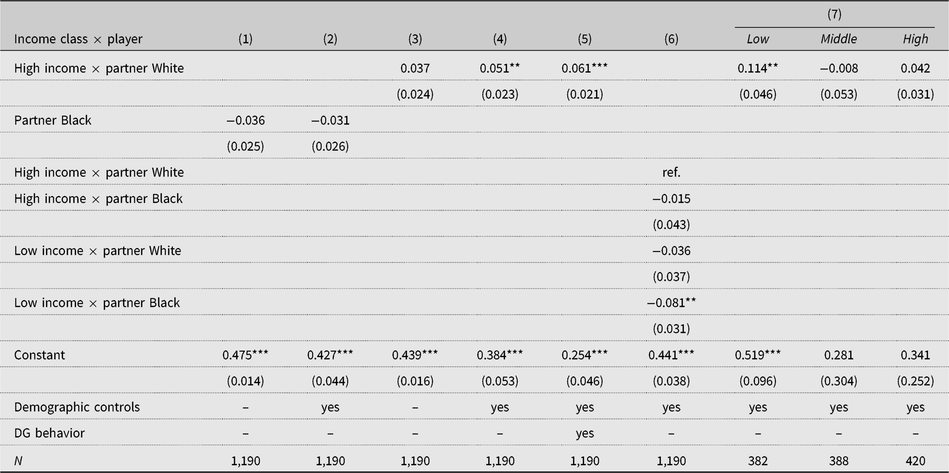
OLS regression; DV: participant invested in the CIG; models 1 and 3: no controls; models 2 and 4: demographic controls as per pre-analysis plan; model 5: demographic controls and prosocial behavior as recorded in DG; model 6: effects for the four combinations of poverty status and race; White high-income partners as reference category; model 7: treatment effects for different income groups; standard errors in parentheses, *p < 0.1, **p < 0.05, ***p < 0.01
In contrast, playing the game with a rich as compared to a poor partner is associated with a 3.7% points higher share of respondents that choose to invest – a difference that increases to 5.1% points and is statistically significant when controlling for pre-treatment demographics (Table 3; Models 3 and 4). Model 5 additionally controls for the amount passed on in the DG. DG donations are not strictly pre-treatment, so this estimate is merely exploratory. Nevertheless, it is conceptually informative: the estimate in Model 5 can be considered the effect of strategic considerations net of the effect of “taste.” As can be seen, the coefficient is larger in size and more precisely estimated, reinforcing the point that, if anything, “taste” reduces discrimination in the CIG.
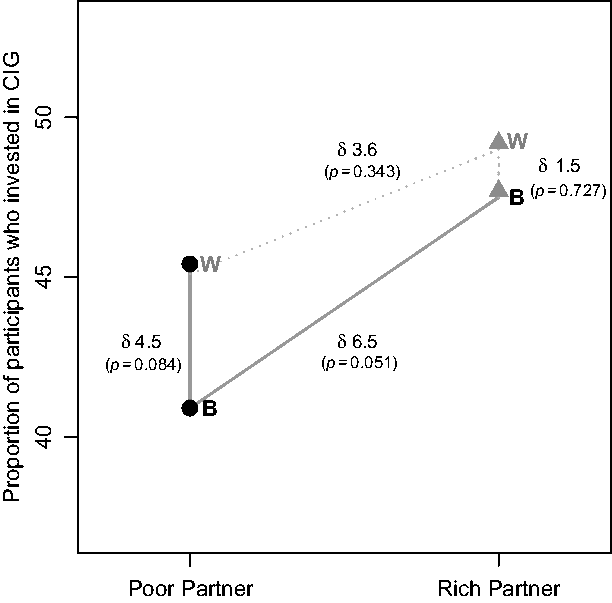
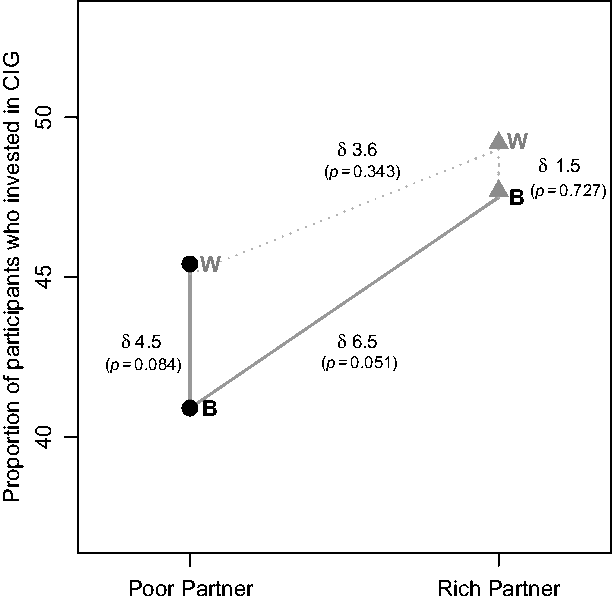
Both treatment conditions were randomly assigned, meaning our design allows us to provide causal estimates of the simultaneous effect of race and income. For this purpose, we coded a categorical variable that takes four values for White & high-income, White & low-income, Black & high-income, and Black & low-income interaction partners. White high-income partners serve as the reference category. Results are presented in Table 3, Model 6, and Figure 2, which plots margins for each partner category. Here we see that participants generally invest less when their partner is poor, but that this effect is amplified when the partner is Black. High-income Blacks elicit 6.5% points higher cooperation rates than low-income Blacks (p = 0.051), while for White partners, the difference is a more modest 3.6%, and not statistically significant at conventional levels (p = 0.343). That is, the cooperation-reducing effect of poverty is only fully visible when the partner is Black. The figure also shows that low-income Black participants elicit lower cooperation rates overall than low-income White participants. Low-income Blacks are 4.5% points less likely to elicit cooperation than low-income Whites, a difference that is marginally statistically significant (p = 0.084).
Effects of the combination of partner’s income and race on cooperation in the CIG. Marginal effects from OLS regression as in Table 3, Model 4. Investment decisions when matched with “poor partners” depicted as black circles, when matched with “rich partners” as grey triangles; W stands for “White partner,” B for “Black partner.” Indicated p-values are for pairwise comparisons. Solid lines indicate differences that are significant at p<0.1; dotted lines, differences that are not statistically significant at conventional levels.
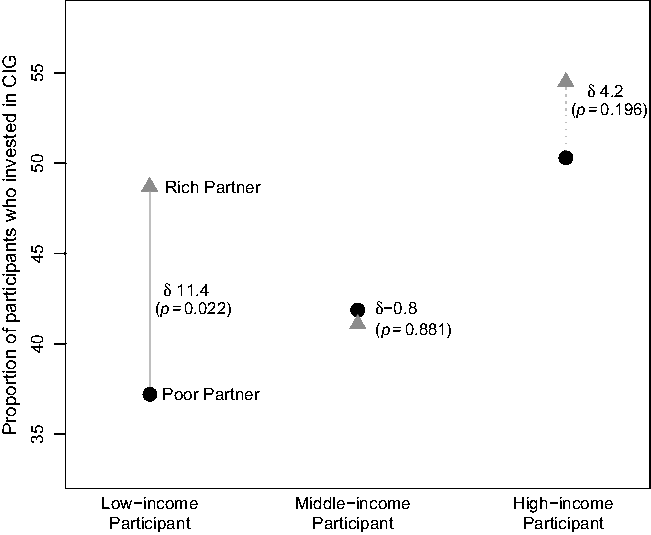
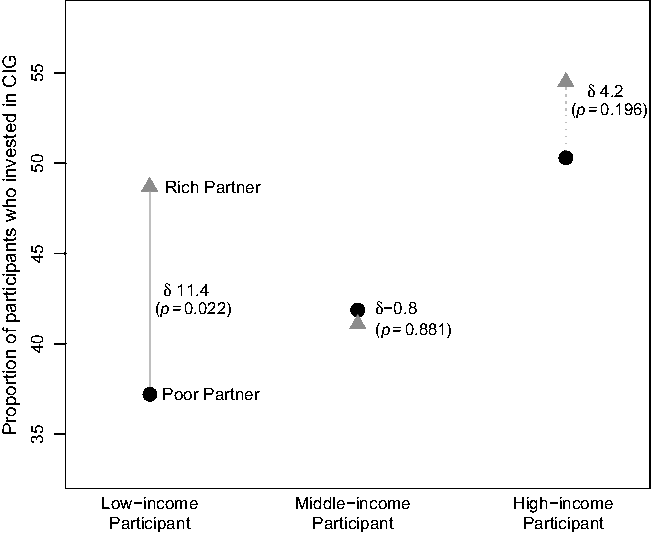
We conclude our analysis by looking at who is strategically discriminating against the poor. We divide our participants in three income categories: low income (no income to $30,000), middle income ($30,001–$60,000), and high income ($60,001–$100,000 or more), and analyze their respective behavior when matched with low- or high-income partners (Figure 3). We find that most of the discrimination against poor partners is enacted by participants who are low-income earners themselves: participants making less than $30,000 display a 11.4% points difference in cooperation levels when matched with a high- versus low-income partner (p = 0.022). The gap is much smaller, and non-significant, among middle-income (−0.8% points, p = 0.881) and high-income (4.2% points, p = 0.196) participants.Footnote 10
Effect of partner’s income status (rich or poor) on investment behavior in the CIG for different income categories of participants. Marginal effects from OLS regression as in Table 3, Model 7. Black circles report participants’ investment decisions when matched with “poor partners,” grey triangles for “rich partners.” Indicated p-values are for pairwise comparisons. Solid lines indicate differences that are significant at p < 0.1; dotted lines, differences that are not statistically significant at conventional levels.
We point out that the true effects of this finding are multiplicative. To calculate the probability for cooperation to take place in the CIG, the propensity to invest of both interaction partners has to be taken into account. Thus, in our game, if a high-income participant encounters another rich partner, the probability of a successful investment is 30%. If a high-income participant encounters a poor partner, this probability lowers to 24%. And if a low-income participant encounters another poor participant, it is 14% – less than half that of an encounter between two high-income participants.
Our experiment does not allow us to point to the exact source of this strategic discrimination of the poor against the poor. Our initial intuition was inspired by a literature that suggests that the poor are often present-biased. We find, however, that poorer participants do not invest less in general – indeed when they are paired with a rich interaction partner, their investment rates are no different from those of rich participants. Nonetheless, it appears that poorer respondents believe other poor people to be present-biased and therefore discriminate against them.
Tentative evidence for this interpretation comes from an additional test that we conducted on a reduced sample (n = 222).Footnote 11 We removed the time dimension from the CIG, holding all other aspects of the experimental setup constant. That is, in this version, players did not have to wait 2 weeks for the investment to be paid out. Removing the time dimension almost doubled the investment rate. More importantly, no discrimination against rich or poor partners was observable, neither among wealthier nor among poorer participants. It thus appears that participants take close notice of the time aspect of the game, and consider how the wait will influence the likelihood to invest by a specific partner.
While we can exclude that mere inter-group animus is at the root of the discriminatory behavior, and have produced evidence that perceptions of the partner’s cooperative inclinations are important, we cannot entirely rule out that other/additional reasons govern the behavior of our participants.Footnote 12 Teasing out the exact cause of the strategic discrimination behavior remains an important task for future research.
Discussion
What undermines cooperation in diverse communities? Understandably, scholars’ attention has converged on the factors that make inter-ethnic relationships difficult, from prejudice to weaker sanctioning capacity. Here we switched our attention to a factor that many diverse communities have in common: poverty. Building on findings on the effects of poverty, we explore the possibility that material distress may undermine cooperative efforts.
Through a strategic game that captures the nature of cooperative dilemma in multiethnic settings, we examined the effects of income and race on strategic cooperation. We find evidence for strategic discrimination against the poor, especially against poor Blacks, while rich Blacks command the same amount of cooperation than rich Whites. Intriguingly, strategic discrimination against the poor is enacted by other poor people. This discriminatory behavior does not seem to be motivated by a simple dislike of ethnic minorities or the poor. Rather, expectations and stereotypes about foresight and lower strategic outlook among the poor, and poor Blacks in particular, appear to explain the findings. This explanation is tentative, however, and in need of more rigorous testing.
What are the implications of our findings? First, economic disadvantage, more than ethnic diversity, might be at the basis of lower levels of cooperation in contemporary societies. Since minority status and economic disadvantage are often associated, it is possible that the lower levels of cooperation that we observe in ethnoracially diverse communities are not exclusively related to ethnicity, but rather due to expectations about the short time-horizon of poor people. However, we caution that our findings across racial lines (Black and White) in the USA may not extend to other ethnic groups or to immigrants, or to other countries with a different history of racial or ethnic marginalization. More work is needed to determine whether the mechanism we identified here also applies in other contexts where ethnicity and poverty are entwined.
Second, our research design highlighted the extent to which cooperation is contingent on the identity of interaction partners. Thus, to fully appreciate how individual actions scale up into group-level outcomes – that is, community-level cooperation – we must consider the social composition of the environment where individuals operate. In particular, the USA has remarkable and persisting levels of geographic segregation (Logan Reference Logan2013; Massey Reference Massey1990; Sampson Reference Sampson2012), and as a consequence, social interactions are very homogeneous along racial and income lines. That the strategic discrimination of the poor is mostly engendered by other low-income people is, therefore, a result that is particularly worrisome for cooperation, due to the multiplicative depressive effect that this might have on diverse communities. Growing levels of inequality (Piketty and Saez Reference Piketty and Saez2014) add to this scenario, enlarging the pool of people that might experience the negative consequences of poverty. In this perspective, policies oriented at lifting people from chronic poverty might improve not only their economic conditions but also the cooperative capacity of their communities.
Author ORCIDs
Max Schaub, https://orcid.org/0000-0003-2057-7002, Johanna Gereke, https://orcid.org/0000-0002-1058-9651, Delia Baldassarri, https://orcid.org/0000-0002-9264-035X
Supplementary Material
To view supplementary material for this article, please visit https://doi.org/10.1017/XPS.2019.19