I. Introduction
WHEREAS the switch from majoritarian electoral systems to proportional representation (pr) was the most common electoral reform of the twentieth century, the switch to a mixed-member electoral system is proving to be the most common of the twenty-first.Footnote 1 Mixed-member electoral systems are part of a broader class of multiple-tier electoral systems. In a multiple-tier system, seats are allocated in two or more overlapping sets of districts and voters are afforded either one or two votes to influence the allocation of seats in both tiers. For a multiple-tier electoral system to qualify as a mixed-member electoral system, one tier must allocate seats nominally, meaning that voters choose candidates by name and votes accrue to candidates, and the other must allocate seats to a party list, meaning that voters choose from among lists of candidates.Footnote 2 Most mixed-member systems use a first-past-the-post system in single-seat districts (hereafter, FpTP - ssd) in the nominal tier and closed-list pr in the list tier. Of the thirty-eight countries using mixed-member systems to choose members of their legislatures’ lower houses today, twenty-eight use a variant called mixed-member majoritarian (mmm). At first glance, mmm systems resemble the more well-known variant of mixed systems, mixed-member proportional (mmp) systems. There is a critical distinction between the two, however. Under mmm systems, the total number of seats a party wins is the sum of those it wins in both tiers, whereas under mmp systems, the number of seats is determined solely by the number it wins in the list tier. This means that under mmm systems, parties seeking control of the government must be able to win seats in both tiers, as opposed to parties under mmp systems that need only to concentrate on the list tier.Footnote 3
In this article, we explain how mmm electoral systems create a strategic environment in which a large party and a small party can increase the number of seats won by forming an alliance and trading votes in one tier for votes in the other tier. Specifically, they can assign the candidacy in each nominal-tier district to one party and have both parties’ supporters cast their nominal-tier votes for this candidate and their list-tier votes for the other party’s candidate. With this trade, the party fielding the nominal-tier candidate increases its chances of winning another seat in this tier. The party stepping back from this competition increases its chances of winning another seat in the list tier. We also explain how, when parties dependent on vote trading are in government, geographically targeted spending can be used to encourage their supporters to comply with their vote-trading strategy. We point out that changes in vote shares can be used to discern whether party supporters in a given geographic location complied.
To evaluate these propositions, we turn to Japan and Mexico. Together, these countries make up 20 percent of voters worldwide who elect members of their legislatures’ lower houses under mmm systems. We put together original data on voting behavior, government transfers, and other demographic and fiscal features of Japanese and Mexican municipalities. We use fixed-effect regressions to show that in both countries, municipalities in which supporters complied with the dominant coalition’s vote-trading strategy received more money after elections. Concretely, Japan’s Liberal Democratic Party (LDP)–Komeito governing coalition used transfers to reward ldp supporters for switching their list-tier votes to the Komeito in nominal-tier districts in which the parties were running an ldp candidate. In nominal-tier districts in which the parties were running a Komeito candidate, the reverse was true; the governing coalition used transfers to reward Komeito supporters for switching their list-tier votes to the ldp. In Mexico’s mmm system, voters cast a single fused vote that translates into a vote for the candidate in the nominal-tier district and a vote for the candidate’s party in the list tier. We find that the Institutional Revolutionary Party–Ecological Green Party of Mexico (pri-pvem) coalition devised a means of splitting this vote into two components. The coalition then used discretionary transfers controlled by Mexico’s Chamber of Deputies to reward pvem supporters for switching the list-tier component of their fused vote to the pri in nominal-tier districts in which the parties were running a joint candidate from the pvem.
Our study enriches our understanding of mmm systems and contributes to research on mixed-member systems, distributive politics, and the politics of Japan and Mexico. Existing research on coordination in mmm systems has mostly focused on parties’ decisions to field joint candidates in nominal-tier districts.Footnote 4 We extend this research by theorizing that fielding joint candidates in nominal-tier districts is likely part of a broader coordination strategy that encompasses trades in both tiers. Existing research has also presumed that parties do not pursue coordination in fused-vote mmm systems.Footnote 5 When voters cast a fused vote, the only way a party can receive list-tier votes is by fielding candidates in nominal-tier districts, which makes standing down unpalatable. We explain how parties interested in coordinating can get around this problem by fielding the same jointly supported candidate in a given nominal-tier district. This means that the candidate appears more than once, under the names of all the parties fielding her or him.Footnote 6 Parties can then assign the candidacy of the nominal-tier district to one party and have both parties’ supporters vote for this candidate on the other party’s list. In doing so, parties can channel nominal-tier votes to one party and list-tier votes to the other. This increases the chance that the party fielding the candidate wins another seat in the nominal tier while ensuring that whether or not the candidate wins, the other party gets all the list-tier votes.
Reflecting the fact that 33 percent of voters worldwide elect representatives via mixed-member systems, there is now a vast literature examining their effects.Footnote 7 We extend this work to consider the effects of mixed systems on distributive politics and on geographically targeted spending. The literature offers compelling theories about how majori-tarian and pr electoral systems influence whether and how governing parties use geographically targeted spending to increase their chances of staying in office.Footnote 8 But we do not yet have theories about how the combination of electoral rules in a mixed system influences how they do so. Research on distributive politics does address mixed systems, but scholars have tended to view them as laboratories in which propositions about a single electoral system can be tested in an environment where differences in the types of countries that tend to have each system are controlled for.Footnote 9 We show that the combination of electoral rules in an mmm system enables parties to win more seats by having their core supporters switch one of their votes to an allied party. Thus, parties can win more seats without having to win over new voters. Moreover, we show that when a large governing party is trading votes with a small party, it can make sense to direct spending to places where votes for the large party have declined. It is unlikely that we would observe either outcome–votes being traded in this manner or spending being directed in this manner–under any electoral system used in isolation. Our findings thus lend support to the idea that mixed-member systems are better conceptualized as distinct strategic environments in which outcomes are irreducible to either electoral system in isolation.Footnote 10
A large literature shows that majoritarian electoral systems encourage more pork-barreling than pr electoral systemsFootnote 11 and that in a ma-joritarian system, spending is likely to be directed at marginal districts where a large governing party needs a few extra votes to get over the finish line.Footnote 12 Under an mmm system, the presence of a second tier in which votes are also valuable gives large parties the option of using their core supporters to win them extra votes in marginal districts. By having their supporters as well as the small party’s supporters split their votes, large parties can win more votes in marginal districts without having to convince non-supporters to vote for them. Under an mmm system, then, geographically targeted spending is likely to be directed at both parties’ core supporters but will be a function of the degree to which they split their votes as instructed.
A central question in the electoral systems literature is the extent to which mixed-member systems offer voters the best of both worlds: legislators who are attentive to local concerns and capable of representing local interests, an advantage of majoritarian systems, and parties capable of aggregating broad, society-wide interests, an advantage of closed-list pr.Footnote 13 Our study implies that an mmm system might be closer to what Mazvydas Jastramskis labels the “worst of all worlds.”Footnote 14 Why? The way votes are converted into seats under an mmm system generates incentives for large parties and small parties to form alliances with each other based on the complementary nature of their support bases. That any small party with the right number of supporters in the right geographic area could be useful to a large governing party creates incentives for small parties to form and to function as mercenaries. The more mercenary parties in a system, the more options a large governing party has when choosing an alliance partner. Because large governing parties control state resources, mercenary parties will usually prefer to make a deal with a large governing party rather than with a large opposition party. Opposition parties may therefore face an uphill battle when trying to unseat the government.
Our findings also shed new light on the inner workings of the coalitions that dominated Mexican and Japanese politics during the periods of study. Beyond the fact that vote trading likely contributed to the dominance of the ldp and pri, it may also help to explain why the coalition’s policies do not always reflect the preferences of the smaller coalition partner. In Japan, the ldp-Komeito coalition has enacted changes to Japan’s security policy that have left pundits scratching their heads as to why the Komeito, a pacifist party, acquiesced. It is possible that in addition to facilitating vote trading, geographically targeted spending helps buy the smaller partner’s backing for policies it finds unpalatable. As evidence of this, we point out that the communities in which Komeito supporters switched their list votes to the ldp received considerably more spending than communities in which ldp supporters switched their list votes to the Komeito. The amount necessary to buy off the junior coalition partner may also vary with the availability of alternative small parties with which the large party could forge trades. We leave these important topics to future research.
II. Theory
Why Tier Linkage Matters
Mixed-member electoral systems vary according to the electoral systems used in the nominal and list tiers, the magnitude of the districts used in each tier, the number of legislators elected in each tier, the number of votes each voter casts, and other factors. A particularly important distinction is whether the results in each tier are kept separate or linked. When they are kept separate, a party’s seat tally is the sum of the seats it wins in both tiers.Footnote 15 If it wins 50 percent of votes in the list tier, it is entitled to 50 percent of the seats in that tier, plus the number of seats it wins in the nominal tier. This is an mmm electoral system. When results are linked across tiers, a party’s seat tally is determined primarily by its performance in the list tier, with seats won in the nominal tier functioning mostly as a mechanism to decide which of its candidates enter the legislature.Footnote 16 In a linked system, if a party wins 50 percent of votes in the list tier, it is entitled to 50 percent of seats overall, regardless of how many it wins in the nominal tier. In a hundred-seat parliament, then, it would be entitled to fifty seats. If, in addition to capturing 50 percent of list-tier votes, it captures thirty seats in the nominal tier, then its fifty seats would be filled by its thirty nominal-tier winners, plus twenty candidates from its list. The tiers are “linked” because the number of seats a party receives in the list tier is partially determined by the number it wins in the nominal tier. This is an mmp system.
Tier linkage corrects vote-seat distortions that arise from the nominal tier. Most mixed systems use an FPTP-ssd system in the nominal tier. Under this system, the country is divided into numerous geographically defined districts, voters each have one vote, and the candidate capturing the most votes wins the seat. Because votes cast for losing candidates are wasted, outcomes can be wildly disproportionate, with larger parties typically winning a much higher share of seats than ought to accrue to them based on vote share, with the opposite being true for smaller parties. A small party could capture a significant share of votes overall, but if none of its candidates place first, it would win no seats. By using list-tier votes to determine a party’s overall seat allocation, an mmp system dramatically reduces how much parties have to worry about outcomes in the nominal tier and produces seat shares that are more proportional to a party’s vote share.
Numerous scholars have pointed out that because parties in mixed systems without tier linkage (mmm systems) have to win seats in both tiers, they behave differently than parties in mixed systems with tier linkage (mmp systems), which can concentrate on winning votes in the list tier.Footnote 17 We agree that parties are likely to behave differently across the two systems, but highlight a new reason for them doing so. When tiers are linked, votes in the nominal tier matter so little for deciding a party’s seat allocation that a party could capture no votes in the nominal tier but still win a majority of seats if it captures enough votes in the list tier. Because votes in the list tier are vastly more valuable than votes in the nominal tier, parties are unlikely to be convinced to give them up. In contrast, when tiers are unlinked, votes in both tiers are valuable from the perspective of allocating seats, which creates a strategic environment in which it can pay off for a party to give up votes in one tier for votes in the other.
How Vote Trading Can Work
We expect that large parties will find trades with small parties particularly fruitful under an mmm system, and vice versa. The mechanics of how votes translate into seats in unlinked systems mean that large parties are likely to focus on winning additional seats in the nominal tier.Footnote 18 By virtue of being large, these parties will be capturing a significant share of votes in the list tier and placing first in an enviable number of districts in the nominal tier. For them, the marginal impact of additional votes is highest in marginal districts in the nominal tier.Footnote 19 The winner-take-all nature of the electoral systems used in nominal-tier districts means that in close races, a handful of additional votes can be sufficient to net the party an additional seat. Because votes translate into seats in a more proportional manner in the list tier, a similarly small number of additional votes will never net the party an additional seat. Large parties, then, will covet trades that will give them extra votes in close races in the nominal tier.
To solicit these additional votes, they can approach a small party. Small parties are likely to win the bulk of their seats in the list tier, where votes translate into seats in a more proportional manner than in the nominal tier. They will have supporters in nominal-tier districts, but those supporters will rarely be numerous enough to make the parties’ candidates competitive there. Knowing this, a large party could ask a small party to stand down in nominal-tier districts where its candidates are in close races and then ask the small party to instruct its supporters there to cast their nominal-tier ballots for the large party’s candidate.Footnote 20 Because small parties can expect extra list-tier votes in the nominal-tier districts in which they field candidates,Footnote 21 they are unlikely to stand down without receiving something in return. The large party could offer to ask its supporters in those districts to cast their list-tier votes for the small party. Such a trade would entail the supporters of both parties splitting their votes in these districts. If realized, such a trade would net the large party extra votes in close races in the nominal tier and the small party extra votes in the list tier. As a result, both could increase their seat share.
Thus far, we have presumed that voters have two votes to cast. But in some unlinked systems, voters cast a single (fused) vote. Under a fused vote, parties can only receive list-tier votes when they field nominal-tier candidates. Thus, stepping back from competition in a nominal-tier district also means stepping back from competition in the list tier in that district. Studying the conditions under which parties field joint candidates in the nominal-tier districts of mixed-member electoral systems, Federico Ferrara and Erik Herron reason that fused ballots will dampen any incentives to do so.Footnote 22 Subsequent work on coordination in mixed-member systems has focused on systems in which voters cast separate votes.Footnote 23
We posit, in contrast, that because unlinked systems with fused votes still allocate seats in two parallel tiers, large and small parties in those systems have incentives to trade votes in ways that increase the number of seats won. A large party and a small party can agree to field a joint candidate in a given nominal-tier district but present voters therein with separate party lists. Voters thus receive a ballot on which the name of a single candidate appears twice, next to the names of both coordinating parties. This gives voters who intend to vote for this candidate the ability to decide which of the two parties they want their fused vote to translate into a list-tier vote. If the parties strike a deal in which one party receives the candidacy in a nominal-tier district in return for both parties’ supporters voting for this candidate under the other party’s list, then they have effectively parsed the fused vote into two components, one of which is cast for each party. With such a trade, the party receiving the joint candidacy increases its chance of capturing an additional seat in the nominal tier, whereas the other party increases its chance of capturing an additional seat in the list tier.
In sum, regardless of whether voters cast one vote or two, the fact that votes in both tiers matter for allocating seats under an mmm system means that a large party and a small party can gain from trading votes. Large parties have reason to trade list-tier votes for nominal-tier votes, whereas small parties have reason to trade nominal-tier votes for list-tier votes. At minimum, whether such trades are realized will be a function not only of parties’ relative sizes, but also of synergies between their geographic distributions of support.
Why Geographically Targeted Spending?
Even though vote trading can pay off in terms of seats, it places a burden on voters who ordinarily support only one of the coordinating parties. These voters have to be told that to maximize their preferred party’s chances of winning the next election, they need to cast one of their votes for a different party. Further, vote trading carries risks for the coordinating parties. Each fears that the other will exploit them–that is, fail to hold up its end of the agreement.Footnote 24 Not only would this yield fewer seats for the exploited party, but it would also cause that party to lose credibility in the eyes of its supporters.
For these reasons, we expect that parties trading votes will use the material benefits under their control to encourage supporters to comply. A large literature shows that governing parties have recourse to geographically targeted spending and are adept at using it to further their chances of remaining in office.Footnote 25 We expect that governing parties dependent on vote trading will promise to deliver spending to supporters who comply and to withhold it from supporters who do not.Footnote 26 Withholding money until after votes have been counted eliminates the risk that supporters will pocket the money but not follow through on their promise to comply, and the risk that the coordinating partner will renege on the agreement.
If material benefits are needed to cement vote trading, then why would a large governing party not use those benefits to purchase the additional votes it needs in close races in the nominal tier from non-supporters? Simply put, mobilizing supporters is cheaper than mobilizing non-supporters, Footnote 27 which is why, where possible, parties prefer to work through their core supporters.Footnote 28 To gauge whether voters are splitting their votes as instructed, parties can observe changes in vote shares in particular geographic units. For example, a large party could verify that its supporters switched their list-tier votes to a small party by examining whether list-tier votes for itself decreased as those for the small party increased. Using change in vote shares to discern compliance rests on the assumption that perfect compliance–all supporters splitting their votes–has not yet been reached. Given that parties come together to supply each other with votes and not necessarily because of ideological affinity or policy congruence, we anticipate that voters may initially resist requests to split their votes. We anticipate this will diminish as the regime of rewards and penalties kicks in.
III. Cases of Mixed-Member Majoritarian Electoral Systems
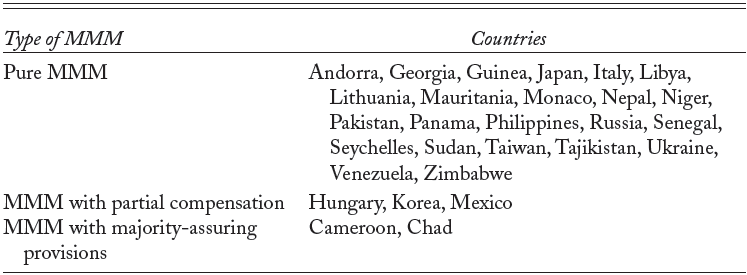
Table 1 lists countries using mmm electoral systems divided into three categories: pure mmm, mmm with partial compensation, and mmm with majority-assuring provisions. All mmm systems allocate seats in two separate tiers, but some mmm systems try to reduce the size of the bonus accruing to large parties by adopting what is known as “partial linkage” based on vote transfers.Footnote 29 These systems adjust the number of votes used to determine a party’s seat allocation in one tier by the number of votes it receives in the other, with the goal of redistributing seats away from larger parties toward smaller ones. Because partial linkage reduces large parties’ seat bonuses to a much lesser degree than linkage based on seats under mmp systems, Matthew Shugart and Martin Wattenberg call these systems “mmm with partial compensation.”Footnote 30
Countries using a Mixed-Member Majoritarian Electoral System for Lower House Electionsa

Sources: ACE 2013; International Institute for Democracy and Election Assistance 2017; Kollman et al. 2019; Inter-Parliamentary Union 2016; Carr 2021; Shugart and Wattenberg 2003b; Jastramskis 2019; and Hicken 2016.
a Note that until electoral reform in 2016, Italy employed vote transfers, which would have placed it in the mmm with partial-compensation category.
Among countries using pure mmm systems (no partial linkage), the electoral systems vary. In the nominal tier, Georgia, Guinea, Italy, Japan, Lithuania, Nepal, Niger, Pakistan, Panama, the Philippines, Russia, the Seychelles, Sudan, Taiwan, Tajikistan, Ukraine, and Zimbabwe use an FPTP-SSD system, with Georgia, Lithuania, and Tajikistan requiring runoffs if no candidate wins a majority in the first round. Libya, Mauritania, Senegal, and Venezuela use a combination of an FPTP-SSD system and other electoral systems in multi-seat districts.Footnote 31 Andorra’s nominal-tier districts are all two-seat districts for which it uses party bloc voting. In the list tier, Andorra, Georgia, Guinea, Italy, Japan, Libya, Mauritania, Monaco, Nepal, Niger, Pakistan, Panama, the Philippines, Russia, Senegal, the Seychelles, Sudan, Taiwan, Tajikistan, Ukraine, Venezuela, and Zimbabwe use closed-list PR.Footnote 32 Lithuania allows voters to cast preference votes for candidates on a party’s list. Niger reserves nominal-tier seats for underrepresented minorities, whereas Pakistan and Zimbabwe use list-tier seats for this purpose. In the Philippines, the number of seats parties can win in the list tier is limited, but approximately 80 percent of legislators are elected via an FPTP-SSD system in the nominal tier.Footnote 33
The three countries that have mmm systems with partial compensation, Hungary, Korea, and Mexico, use an FPTP-SSD system in the nominal tier and closed-list pr in the list tier. Hungary adjusts the votes used to determine a party’s seat allocation in the list tier by the number of votes it wins in the nominal tier. Korea has allocated thirty of its forty-seven list-tier seats on a compensatory basis since 2019, but these seats are a small fraction of the three hundred–member legislature. Mexico places caps on the number of seats parties can win, which we describe below.
Chad and Cameroon, the two countries using an mmm system with majority-assuring provisions, use an FPTP-SSD system in the nominal tier and closed-list pr in the list tier, but grant parties capturing a majority of votes in any list-tier district all available seats in that district.
What distinguishes these systems from mmp systems is that votes in both tiers are valuable from the perspective of allocating seats. All countries in Table 1, with the exception of Andorra, Lithuania, and Monaco, use an FPTP-SSD system, not always exclusively, in the nominal tier, and closed-list pr in the list tier. To evaluate our theory, we turn to two of these countries, Japan, where the lower house has used a separate-vote mmm system since 1994, and Mexico, where the lower house has used its current version of a fused-vote mmm system since 1996.
IV. A Separate-Vote mmm System in Japan
Japan is a bicameral parliamentary system in which the lower house, the House of Representatives, is more powerful than the upper house, the House of Councillors. Representatives serve four-year terms, but prime ministers can dissolve the House of Representatives at any time. As noted above, the House of Representatives has used a separate-vote mmm system to elect its members since an electoral reform in 1994.Footnote 34 Initially, three hundred members were chosen via an FPTP-SSD system and two hundred were chosen from party lists in eleven regional blocs according to closed-list PR. Over time, the number of members elected in both tiers has been reduced. As of 2017, 289 are chosen in ssds and 176 via PR, for a total of 465. The number of seats in each pr bloc has been adjusted over time for population changes and currently ranges from six to twenty-eight. Votes cast in each pr bloc are used to apportion seats in that bloc, which is done using the d’Hondt method (highest averages). In House of Representatives elections, voters receive two ballots. On one, they write the name of their preferred ssd candidate. On the other, they write the name or abbreviation of their preferred party.
Formed in 1955, Japan’s Liberal Democratic Party captured majorities in every House of Representatives election from 1958 to 1990, giving it uninterrupted control of government. In the 1993 election, it captured a plurality but lost control of government when other parties won enough seats among them to form a coalition government. In early 1994, this government introduced an mmm system. Midway through 1994, the ldp reentered government via a coalition of its own. Toward the end of 1999, the ldp convinced a small party, the Komeito, to join its coalition. The Komeito’s religious underpinnings made the parties unlikely bedfellows. Just three years earlier, ldp candidates made the slogan, “The Enemy is Komei,” the centerpiece of their campaigns.Footnote 35 And for years, ldp politicians argued that the Komeito’s existence threatened the constitutional principle that religious organizations could not exercise political authority.Footnote 36 Helpfully for the LDP, the Komeito had a history of preelectoral coordination.Footnote 37 The LDP-Komeito coalition has proved durable. The two parties have governed together since 1999, with the exception of 2009-2012.Footnote 38
The ldp and the Komeito began coordinating in 2000, the first election they faced as partners. Initially, leaders concentrated on how to divvy up ssds. The ldp reportedly floated the idea of standing down in as many as twenty-five ssds in favor of Komeito candidates.Footnote 39 It ended up running in 271 ssds, and the Komeito ran in eighteen. In four of the eighteen, both parties ran candidates. By the 2003 election, they had stopped competing against each other in any ssds. In this and all subsequent House of Representatives elections, ldp candidates have run in approximately 90 percent of ssds and Komeito candidates have run in approximately 3 percent of them.Footnote 40 Moreover, in the vast majority of ssds, the party standing down has given its supporters explicit recommendations to cast their ssd votes for the other party’s candidate. Whereas in 2000, the ldp recommended fourteen of the Komeito’s eighteen ssd candidates, since 2003 it has recommended all of them. In 2000, the Komeito recommended 156 (or 58 percent) of the ldp’s 271 ssd candidates. This percentage has risen since then, reaching 96 percent in 2017.Footnote 41
Newspaper articles from the 2000 election describe how the parties went about exhorting their supporters to split their votes. Around the country, local Komeito chapters held town halls, often attended by thousands, in which they explained to supporters that they needed to cast their ssd votes for the ldp candidate. The chapters invited prominent members of the ldp candidate’s camp to attend and had them publicly pledge to deliver pr votes to the Komeito in return for Komeito voters’ support of the ldp candidate.Footnote 42 As our theory predicts, ldp candidates in close races were especially solicitous of Komeito ssd votes and thus made more of an effort to deliver pr votes in return.Footnote 43 In many cases, ldp candidates relied on ldp-affiliated local assembly members and organizations to deliver these pr votes to the Komeito. Local assembly members held small meetings in which they asked their supporters to vote Komeito in the list tier.Footnote 44 Organizations like the Japan Trucking Association, prefectural hospitals, and agricultural cooperatives publicly pledged to deliver “every single one of [their] organization’s pr votes to the Komeito.”Footnote 45 On occasion, ldp candidates shared their supporters’ names and addresses with the local Komeito chapter, whose members proceeded to visit supporters’ homes to solicit their votes.Footnote 46 In other cases, ldp candidates attended a Komeito town hall with their supporters and had both sides publicly pledge to split their votes.Footnote 47
In ldp ssds, then, the Komeito instructs its supporters to cast their ssd votes for the ldp’s candidate and their pr votes for the Komeito in exchange for the ldp candidate instructing its supporters to cast their pr votes for the Komeito and their ssd district votes for the ldp’s candidate.Footnote 48 Less is known about Komeito ssds where ldp candidates stand down. We concentrate on explicating the benefits to a large party of having a small party stand down in nominal-tier districts in which its candidates need extra votes. As a result of differences in parties’ geographic distributions of support, however, it is possible that a small party’s candidate could be stronger than a large party’s candidate in certain ssds, such that the large party could decide to stand down in those ssds in exchange for pr votes from the small party. Our theory leads us to expect that in such ssds, ldp supporters will be instructed to cast their ssd votes for the Komeito’s candidate and their pr votes for the ldp in exchange for the Komeito instructing its supporters to cast their pr votes for the ldp and their ssd votes for their party’s candidate.
We expect that the LDP-Komeito coalition will try to elicit compliance by making the distribution of valued geographically targeted funding conditional upon it. In Japanese elections, votes are counted at the municipality level and almost every municipality is contained within one ssd.Footnote 49 Being able to observe how many pr votes were cast for each party in each municipality gives the coalition the tools to verify whether their supporters complied. In ldp ssds, compliance can be verified by examining whether pr votes for the ldp declined as those for the Komeito increased in municipality m relative to the previous election. In Komeito ssds, compliance can be verified by examining whether pr votes for the Komeito declined as those for the ldp increased.
Our claim that members of the House of Representatives make the distribution of government resources to municipalities contingent upon their voting behavior has support in the Japanese politics literature.Footnote 50 The literature credits a potent mix of conditions facilitating the tying of government resources to voting behavior: municipalities’ dependence on the central government for resources; the large pool of national treasury disbursements made available by the central government each year, which are allocated at the discretion of bureaucrats for funding projects in municipalities; and the ability of ldp incumbents to discern how municipalities vote and to lean on bureaucrats to allocate national treasury disbursements in ways that benefit certain municipalities more than others.Footnote 51 There is no question that national treasury disbursements are a valued resource. Approximately 16 percent of the average municipality’s revenue in 2015 came from this type of transfer.Footnote 52 We test the following hypotheses:
–H1. Municipalities in ldp ssds where ldp candidates run and Komeito candidates stand down are rewarded with more national treasury disbursements after elections when they increase pr votes for the Komeito and decrease them for the ldp.
–H2. Municipalities in Komeito ssds where Komeito candidates run and ldp candidates stand down are rewarded with more national treasury disbursements after elections when they increase pr votes for the ldp and decrease them for the Komeito.
V. A Fused-Vote mmm System in Mexico
Mexico is a presidential federal republic with a bicameral legislature. Parties seek a majority of seats in the five hundred–member Chamber of Deputies, the lower house, to shape the legislative process and lead negotiations over the federal expenses budget, which is proposed by the president but requires approval of the lower house. The upper house, the Senate of the Republic, is smaller, comprising only 128 members. Senators do not have the same influence over the federal expenses budget as deputies. A mixed-member system has been used to select deputies since 1964. The current version is mmm with partial compensation, which has been in place since 1996.Footnote 53 Its incorporation of a cap against overrepresentation disqualifies it from being pure mmm.Footnote 54 In the chamber, three hundred deputies are elected via an FPTP - ssd system and two hundred are elected via closed-list pr in five regional constituencies. Each of these constituencies elects forty deputies. Deputies serve three-year terms. Following an electoral reform in 2014, deputies elected in and after 2018 are, for the first time since the 1930s, permitted to seek consecutive reelection.Footnote 55 In elections, voters receive a single ballot on which appears a series of party-candidate combinations. They mark the combination for which they wish to vote. This translates into a vote for the candidate in the ssd race and a vote for the candidate’s party in the pr race.Footnote 56
Formed in 1929, Mexico’s Institutional Revolutionary Party (pri) controlled an absolute majority in the chamber until the 1997 election, when economic crisis and social unrest prompted enough voters to cast their ballots for other parties.Footnote 57 This proved the harbinger for the election in 2000 of Vicente Fox, the first president unaffiliated with the pri in more than seventy years. This result was widely credited as evidence of Mexico’s transition to democracy. The pri held onto a plurality in the chamber during Fox’s administration, only to lose it in 2006, when a presidential election held concurrently with legislative elections gave momentum to two opposition parties. The pri became the third-largest party, a position it held until 2009, when it regained a plurality. It controlled more than 40 percent of chamber seats until 2018, when another concurrently held election saw a coalition of parties excluding the pri regain the presidency and majorities in both houses.
At least since Mexico’s transition to democracy, coordination has been a staple among parties contesting elections at all levels.Footnote 58 In 2003, the pri convinced the Ecological Green Party of Mexico (pvem), a small party, to ally with it in the chamber and to coordinate with it in elections. But in the 2000 election, the pvem (founded in 1993) had allied with the National Action, which helped to facilitate the alternation of power. Although the pvem leans further right than the pri, its choice of coordinating partner appears to be motivated mainly by the desire to survive.Footnote 59 Since 2003, the pri - pvem coalition has coordinated in all elections.Footnote 60
As noted above, under a fused-vote mmm system, coordinating parties can field joint ssd candidates. Since 2007, parties fielding joint ssd candidates have also been permitted to present separate party lists. Doing so means that in alliance ssds, voters are presented with a ballot on which the same candidate appears under the names of all coordinating parties. Voters voting for the joint candidate thus have the option of choosing which of the candidate-party combinations they prefer. They can choose all or a subset of these. When a voter chooses the joint candidate under more than one coordinating party, one vote is recorded for the joint candidate in the ssd race and one vote is divided up among the chosen coordinating parties for the purpose of allocating pr votes.Footnote 61
Our theory leads us to expect that in this setting, the pri will propose fielding joint candidates with the pvem in ssds where it anticipates tough races. In such cases, it can offer the candidacies of some of those alliance ssds to the pvem in exchange for the pvem instructing its supporters in those ssds to vote for the joint candidate exclusively under the PRl’s list. With this strategy, the pvem benefits from having all votes cast for both parties count as votes for its ssd candidate and the pri insures itself against the possibility that the pvem-affiliated joint candidate will lose. When all votes for this candidate are cast under the PRl’s list, then regardless of whether the candidate wins, the pri gets to keep these votes, which translate into pr seats.Footnote 62
Studies of pri-pvem coordination have focused on coordinated entry into ssds.Footnote 63 Evidence that pri politicians incorporated pr votes into trades forged with other parties in previous periods comes from Jeffrey Weldon. He cites interviewees in 1985, when the Chamber of Deputies used a version of a separate-vote mmm system, who told him that voters were instructed to cast one of their ballots for the pri and the other for its coordinating partner.Footnote 64 More recently, local newspaper articles describe how the pri and the pvem exhort their supporters to comply. Their strategies include directly instructing supporters to cast their votes for the other party,Footnote 65 forming brigades to promote voting for one party but not the other in ssds where the parties have fielded joint candidates,Footnote 66 and distributing flyers encouraging supporters to vote for both parties.Footnote 67
Further evidence, albeit indirect, comes from the affiliations of the two parties’ joint candidates. In the first two elections in which joint candidates were fielded, 2003 and 2006, the pri kept more than 92 percent of the joint candidacies. After the 2007 electoral reform permitting coordinating parties to present separate lists,Footnote 68 we expect that the PRI would have begun to exchange ssd candidacies for pr votes. In every election since 2007, the number of joint candidacies that the pri has kept for itself has declined. Whereas it kept 90 percent in 2009, this share dropped to 78 percent in 2012 and to 77 percent in 2015.Footnote 69
When the pri-pvem coalition controlled enough seats to dominate the Chamber of Deputies, our theory leads us to expect that it tried to elicit compliance with its vote-trading strategy by making the distribution of geographically targeted spending conditional upon it. Votes in Mexican elections are counted and reported at the polling station and easily aggregated to the municipality. As noted above, the great majority of municipalities are nested within ssds.Footnote 70 Compliance can be verified by examining whether, in ssds with pvem-affiliated joint candidates, votes cast for the joint candidate under the pri label increased as votes cast for the joint candidate under the pvem label or under both parties’ labels decreased in municipality m relative to a previous election.
Beatriz Magaloni writes that for many years, government resources in the form of “patronage, pork and spoils” were the “glue” that bound voters to the pri’s “party-led hegemonic regime.”Footnote 71 Almost every study to date has focused on how presidents have wielded geographically targetable resources like allocations to municipalities under the poverty relief program Programa Nacional de Solidaridad (pronasol),Footnote 72 conditional cash transfers,Footnote 73 and other federal transfers.Footnote 74 Jonathan Hiskey provides evidence that these resources are distributed after elections, once vote shares have been verified.Footnote 75 The fact that a president’s budget requires approval from the Chamber of Deputies, however, creates room for deputies to add amendments furthering their interests. Yann Kerevel finds that deputies alter the president’s budget to “a substantial degree” and documents a relationship between the number of amendments targeted at ssds added by deputies and the tier from which they are elected.Footnote 76
We expect that the pri-pvem coalition used the Municipal and State Infrastructure Strengthening Fund (fortalece), which we are the first to study, to elicit compliance. Dubbed the “handouts fund” (fondo para moches) by the news media,Footnote 77 it fell under the Economic and Salary Provisions section of the federal budget and consisted of annual allocations to municipalities that deputies added as amendments.Footnote 78 Like national treasury disbursements in Japan, these allocations were awarded to fund specific projects that municipalities had to apply for.Footnote 79 In 2015, a total of MX $10 billion (approximately US $500 million) was allocated to municipalities under this fund.Footnote 80 Municipalities value fortalece allocations. In 2016, 70 percent of the average Mexican municipality’s income came from federal transfers.Footnote 81 Unlike Japan’s national treasury disbursements, which have been available for decades, fortalece funds appeared in the budget only in 2013-2017, which limits our analysis to this period.Footnote 82 We test the following:
–H3. Municipalities in ssds with pvem-affiliated joint candidates are rewarded with more fortalece allocations after elections when they increased votes for these candidates under the pri label exclusively and decreased votes for these candidates under the pvem label or both parties’ labels.
VI. Data
We assembled original data on all municipalities in Japan (1996-2013) and Mexico (2011-2016). For Japan, election returns come from the JED-M data setFootnote 83 and data on national treasury disbursements come from the Nikkei needs data set, supplemented where necessary with data from official government sources.Footnote 84 We also used Nikkei needs for the standard control variables used in research on transfers:Footnote 85 per capita income, population, fiscal strength, proportion of residents employed in agriculture, proportion of residents age fifteen and under, proportion of residents age sixty-five and over, and population density.Footnote 86 Mexican election data are from the National Electoral Institute.Footnote 87 For fortalece, we relied on the relevant section of the federal expenses budget for allocations in 2013Footnote 88 and on data collected by the Ministry of Finance and Public Credit’s Budget Transparency Project for allocations from 2014 through 2017.Footnote 89 We collected data on the following control variables: state of emergency declarations, population, poverty, area size, and designation as urban or rural.Footnote 90
VII. Rewarding Vote Trading in Japan
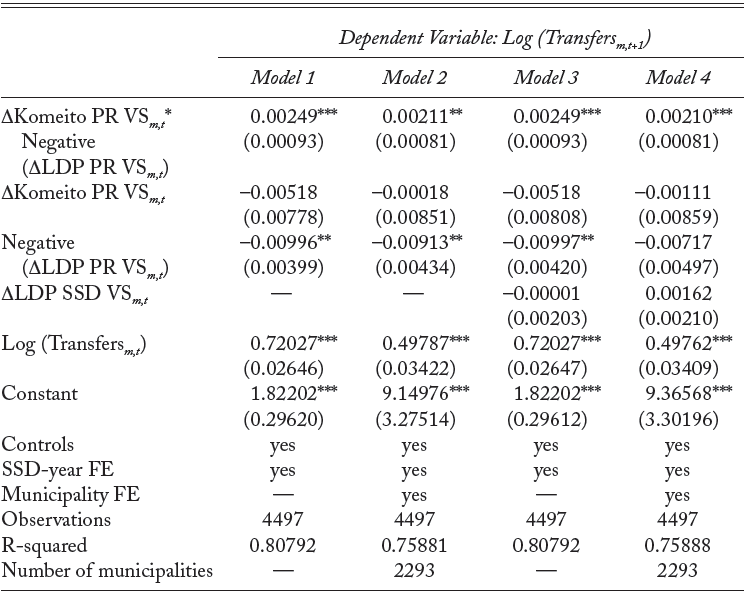
To examine hypothesis 1, we restricted our analysis to Japanese municipalities located entirely within ldp ssds (those with ldp candidates and without Komeito candidates) in the 2003, 2005, and 2012 House of Representatives elections.Footnote 91 Table 2 presents the results of fixed-effect regressions using this sample of 4,497 municipalities. In all four models, the dependent variable is Log(Transfersm,t;+1), the logarithm of per capita national treasury disbursement received by municipalities in the fiscal years following the 2003, 2005, and 2012 House of Representatives elections. We have three independent variables of interest. The first, ΔKomeito PR VSm,t, is the change in share of municipality m’s voting population who cast their pr votes for the Komeito at time t (the current election) relative to the previous election, with higher scores indicating greater increases in share of voting population who voted Komeito in the list tier. The second, Negative (ΔLDP PR VSm,t), is the change in share of municipality m’s voting population who cast their pr votes for the ldp at time t (the current election) relative to the previous election, multiplied by -1, with higher scores indicating greater decreases in share of the voting population who voted ldp in PR. The third variable, the interaction of ΔKomeito PR VS t and Negative (ΔLDP PR VSm,t), captures the effect of a simultaneous increase in the share of a municipality’s voting population who voted Komeito in pr and decrease in the share of its voting population who voted ldp in the list tier.Footnote 92
Rewarding Vote Trading in Japan: ldp ssdsa

***p < 0.01, **p < 0.05; robust standard errors clustered at the district level in parentheses
a In ldp ssds, municipalities that increased pr votes for the Komeito while decreasing them for the ldp were rewarded with more money after the 2003, 2005, and 2012 House of Representatives elections. Municipalities that decreased pr votes for the ldp (without changes to Komeito pr vote share) were penalized with less money, while municipalities that increased pr votes for the Komeito (without changes to ldp pr vote share) were neither penalized nor rewarded.
In all four models, ssd-year fixed effects control for features of a municipality’s ssd in a given election that could influence the amount of transfers received by all municipalities in that ssd. These could include whether the coalition’s candidate was victorious or whether the ssd ended up with two representatives due to a candidate from one party winning and a candidate from another party losing but then entering parliament via the pr tier.Footnote 93 Our inclusion of ssd-year fixed effects means that we are comparing the amounts of transfers received by municipalities in the same ssd-year. In models 2 and 4, we add municipality fixed effects, which controls for time-invariant features of a municipality that could influence the amount of transfers it receives, such as its ability to put together proposals for projects for which to seek funding and to build consensus around those projects. Municipality fixed effects enable us to leverage changes in the same municipality’s level of compliance with the coalition’s vote-trading strategy over time.
All models in Table 2 also include the following time-varying municipality-level controls: population (logged), per capita income (logged), proportion of residents employed in agriculture, proportion of residents who are dependent (ages fifteen and under or ages sixty-five and over), population density, and fiscal strength. All models also include the logarithm of per capita transfers received by the municipality the year of the election. The lagged dependent variable helps us to guard against the possibility that a municipality’s voting behavior has no independent effect on transfers once the transfers it received the year of the election are accounted for. If this was the case, it would suggest that another factor was causing municipalities to both exhibit greater compliance in elections and receive more transfers.Footnote 94 Models 3 and 4 include an additional control, ΔLDP ssd VSm,t, which captures the change in share of municipality m’s voting population who cast their ssd votes for the ldp candidate at time t relative to the previous election. This controls for the possibility that changes in electoral support for the ldp’s ssd candidate could be driving any observed effect of ΔKomeito PR VSm * Negative (ΔLDP PR VSm,t) on transfers. Because the nature of a municipality’s ssd determines how ldp and Komeito supporters are supposed to cast their pr votes, we cluster standard errors by ssd.
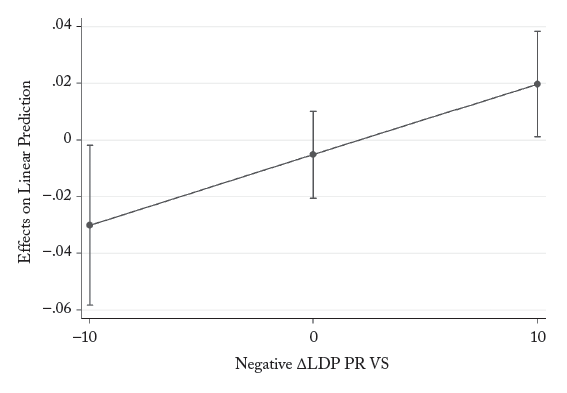
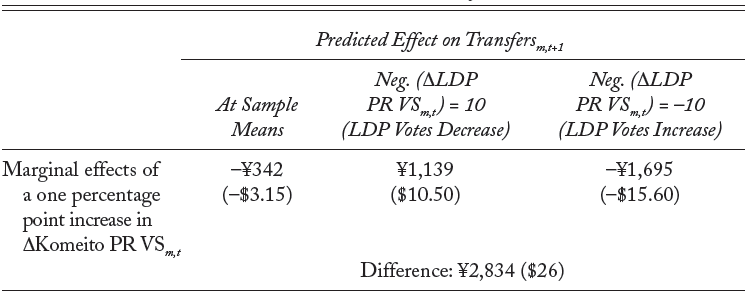
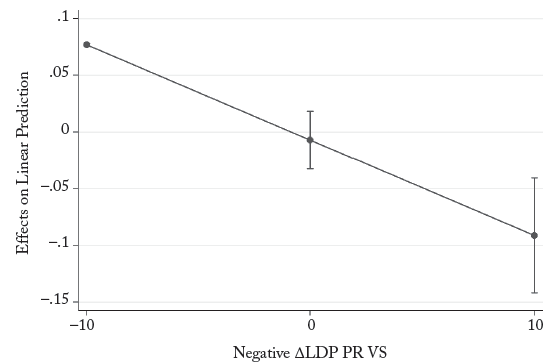
The positive, significant coefficients on ΔKomeito PR VSm * Negative (ΔLDP PR VSm,t) (all models) show that in ldp ssds, controlling for time-invariant and time-varying municipality-level features as well as features of the municipality’s ssd-year and changes in electoral strength of the ldp’s ssd candidate, municipalities that increased pr votes for the Komeito while decreasing them for the ldp in the 2003, 2005, and 2012 House of Representatives elections received more money after elections. Substantively, model 1 shows that a one percentage point increase in ΔKomeito PR VSm,t in a municipality where the share of eligible voters casting pr votes for the ldp declined by 10 percent (Negative (ΔLDP PR VSm,t) = 10) is predicted to increase the amount of national treasury disbursements received by ¥1,139 per person (approximately $10.50). In contrast, the same one percentage point increase in ΔKomeito PR VSm,t in a municipality where the share of eligible voters casting pr votes for the ldp increased by 10 percent (Negative (ΔLDP PR VSm) = -10) is predicted to decrease the amount of national treasury disbursements received by ¥1,695 per person (approximately $15.60). These average marginal effects, with their 95 percent confidence intervals, are displayed in Figure 1. Their substantive effects are summarized in Table 3.Footnote 95 Jens Hainmueller, Jonathan Mummolo, and Yiqing Xu explain why valid inferences as to the effects of an interaction with at least one continuous variable can be drawn only after researchers have verified that the interaction effect is linear and that there is sufficient common support for the moderator.Footnote 96 Section E of the supplementary material implements their diagnostics, which support both assumptions.Footnote 97
Average Marginal Effects of ΔKomeito PR VSm,t with 95 Percent Confidence Intervals in ldp ssdsa
aAverage marginal effects of a one percentage point increase in ΔKomeito PR VS m,t with 95 percent confidence intervals (shown with vertical lines) at different levels of Negative (ΔLDP PR VSm,t) in ldp ssds (see Table 2, model 1).

We also examined whether the effect of ΔKomeito PR VS * Negative (ΔLDP PR VSm,t) could be explained by other parties’ supporters switching their pr votes to the Komeito and the ldp ’s pr vote share declining for another reason. We created Negative (ΔNon-LDP/Komeito PR VSm,t), which is the change in the share of municipality m’s voting population casting their pr votes for neither the ldp nor the Komeito at time t relative to the previous election, multiplied by -1, with higher scores indicating greater decreases in share of the voting population who voted for another party in pr. We reran the models in Table 2 with Negative (ΔNon-LDP/Komeito PR VSm,t) instead of Negative (ΔLDP PR VSm,t), keeping everything else about the specifications identical. The results are in section F of the supplementary material. None of the coefficients (on ΔKomeito PR VSm,t, Negative (ΔNon-LDP/Komeito PR VS t), or ΔKomeito PR VS t * Negative (ΔNon-LDP/Komeito PR VSm,t)) are significant in any specification. This suggests that our results are not attributable to other factors bringing about changes in the two parties’ vote shares. In sum, these results support hypothesis 1.
Next, we examined whether a similar reward regime, but in reverse, operates in the small number of ssds where the ldp stands down and a Komeito candidate runs (hypothesis 2). In these ssds, we expected municipalities that decreased pr votes for the Komeito while increasing them for the ldp to receive more money. Table 4 presents the results of a regression on the sixty-three municipalities in Komeito ssds in the 2003, 2005, and 2012 House of Representatives elections. The specification is identical to that in model 1 of Table 2.Footnote 98 The negative, significant coefficient on ΔKomeito PR VSm * Negative (ΔLDP PR VSm,t) demonstrates that in Komeito ssds, controlling for time-varying municipality-level features and features of the municipality’s ssd-year, municipalities that increased pr votes for the Komeito while decreasing them for the ldp in the 2003, 2005, and 2012 House of Representatives elections received less money the year after the election. While this pattern of behavior is rewarded in ldp ssds, it is penalized in Komeito ssds.
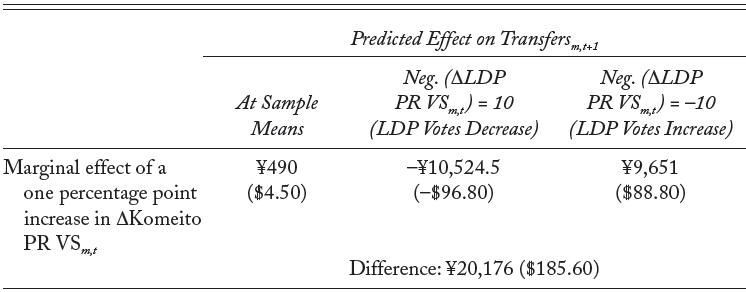
Substantive Effects on Transfers in Japan: ldp ssdsa

a Substantive effects on transfers of the average marginal effect of a one percentage point increase in ΔKomeito PR VSm,t at different values of Negative (ΔLDP PR VSm,t) in ldp ssds (from Table 2, model 1). Marginal effects are calculated with continuous variables held constant at sample means.
a Substantive effects on transfers of the average marginal effect of a one percentage point increase in ΔKomeito PR VSm,t at different values of Negative (ΔLDP PR VSm,t) in ldp ssds (from Table 2, model 1). Marginal effects are calculated with continuous variables held constant at sample means.
Substantively, we predict that in a Komeito ssd, a one percentage point increase in ΔKomeito PR VSm,t in a municipality where the share of eligible voters casting pr votes for the ldp declined by 10 percent (Negative (ΔLDP PR VS m,t) = 10) will decrease the amount of national treasury disbursements received by ¥10,525 per person (approximately $96.80). In contrast, we predict that the same one percentage point increase in ΔKomeito PR VSm,t in a municipality where the share of eligible voters casting pr votes for the ldp increased by 10 percent (Negative (ΔLDP PR VSm,t) = -10) will increase the amount of national treasury disbursements received by ¥9,651 per person (approximately $88.80). These average marginal effects, with their 95 percent confidence intervals, are displayed in Figure 2. Their substantive effects are summarized in Table 5.Footnote 99 Like Table 2, section G of the supplementary material reveals that the assumptions of linearity and common support for the moderator are met. It is striking that we observe a statistically significant coefficient on ΔKomeito PR VSm,t* Negative (ΔLDP PR VSm,t) in the expected direction and in a specification controlling for prior transfers and ssd-year fixed effects on a sample of only sixty-three observations. In sum, these results support hypothesis 2.
Average Marginal Effects of ΔKomeito PR VSm,t with 95 Percent Confidence Intervals in Komeito ssdsa
aAverage marginal effects of a one percentage point increase in ΔKomeito PR VS m,t with 95 percent confidence intervals (shown with vertical lines) at different levels of Negative (ΔLDP PR VSm,t) in Komeito ssds (see Table 4).

What else can our results tell us about transfers? In ldp ssds, municipalities where pr votes increased for the Komeito as they decreased for the ldp received more money after elections. In Komeito ssds, the reverse was true; municipalities where pr votes increased for the Komeito as they decreased for the ldp received less money after elections. This supports our claim that in our period of study, the LDP-Komeito governing coalition used transfers to motivate ldp supporters to switch their pr votes to the Komeito in ldp ssds and Komeito supporters to switch their pr votes to the ldp in Komeito ssds. The coefficients on the uninteracted variables can tell us more about how the coalition used transfers.
Rewarding Vote Trading in Japan: Komeito ssdsa

*** p < 0.01; robust standard errors clustered at the district level in parentheses a In Komeito ssds, municipalities that increased pr votes for the Komeito while decreasing them for the ldp were penalized with less money after the 2003, 2005, and 2012 House of Representatives elections. Municipalities that decreased pr votes for the ldp (without changes to Komeito pr vote share) were also penalized, while municipalities that increased pr votes for the Ko-meito (without changes to ldp pr vote share) were neither penalized nor rewarded.
To begin, we take a closer look at ldp ssds. In Table 2, the coefficients on ΔKomeito PR VSm,t are negative and insignificant. In other words, municipalities where pr votes increased for the Komeito and stayed the same for the ldp were neither penalized with less money nor rewarded with more. This suggests that the coalition rewarded ldp supporters for switching their pr votes to the Komeito (the positive, significant coefficient on ΔKomeito PR VSm,t* Negative (ΔLDP PR VSm,t), but did not reward Komeito supporters for mobilizing more pr votes for their own party. This implies that Komeito supporters were unable to get more money for their communities by mobilizing more pr votes for their party in ldp ssds.
Substantive Effects on Transfers in Japan: Komeito ssdsa

a Substantive effects on transfers of the average marginal effect of a one percentage point increase in ΔKomeito PR VSm,t at different values of Negative (ΔLDP PR VSm,t) in Komeito ssds (from Table 4). Marginal effects are calculated with continuous variables held constant at sample means.
The coefficients on Negative (ΔLDP PR VSm,t), by contrast, are negative and significant, except in model 4, where they are negative and insignificant. A negative, significant coefficient on Negative (ΔLDP PR VSm,t) means that municipalities in ldp ssds where pr votes decreased for the ldp and stayed the same for the Komeito were penalized with less money after elections. This implies that transfers may also have been used to encourage ldp supporters to cast their pr votes for the ldp. In the model that leverages over-time variation in the same municipality’s voting behavior and also controls for changes in the share of eligible voters casting ssd votes for the ldp candidate (model 4), however, ΔKomeito PR VSm,t* Negative (ΔLDP PR VSm,t) remains positive and significant, whereas Negative (ΔLDP PR VSm,t) loses its significance. This means that the coalition rewarded municipalities where ldp supporters switched their pr votes to the Komeito and not municipalities where they increased pr votes for the ldp.
Turning to Komeito ssds (Table 4), the coefficient on Negative (ΔLDP PR VSm,t) is negative and significant, which means that municipalities where pr votes decreased for the ldp and stayed the same for the Komeito were penalized. In Komeito ssds, then, transfers are used to motivate ldp supporters to mobilize more pr votes for the ldp. The coefficient on ΔKomeito PR VSm,t, by contrast, is negative and insignificant. This means that municipalities where pr votes increased for the Komeito and stayed the same for the ldp were neither penalized nor rewarded. In Komeito ssds, then, the coalition rewards municipalities in which Komeito supporters switch their pr votes to the ldp (as indicated by the negative, significant coefficient on ΔKomeito PR VSm,t* Negative (ΔLDP PR VSm,t)), but refrains from penalizing municipalities where pr votes for the Komeito increase. This implies that in Komeito ssds, Komeito supporters can gain more money for their community only by switching their pr votes to the ldp, not by casting them for the Komeito.
VIII. Rewarding Vote Trading in Mexico
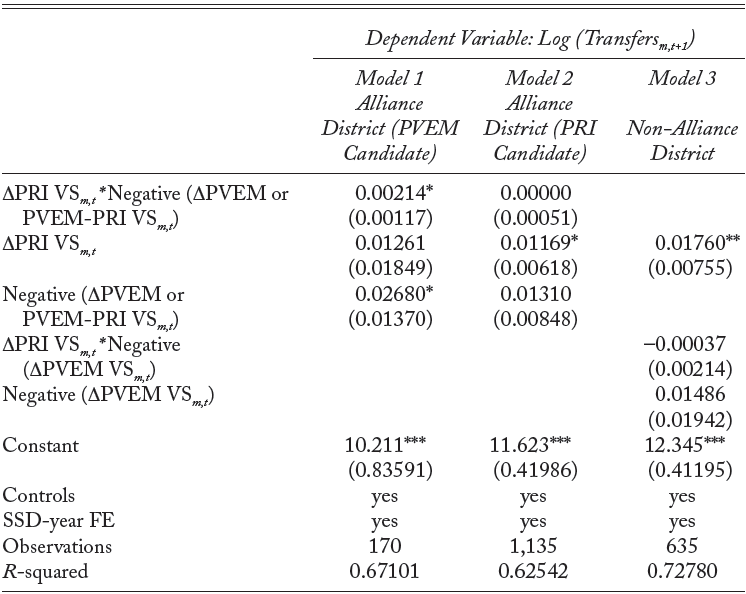
We next examine hypothesis 3. Table 6 presents the results of fixed-effect regressions. The dependent variable is Log(Transfersm t+1): the logarithm of per capita fortalece received by municipalities in the years following the Chamber of Deputies elections held in 2012 and 2015. Model 1 focuses on municipalities located exclusively within alliance ssds with pvem-affiliated joint candidates (that is, the type of municipalities hypothesis 3 addresses), model 2 focuses on municipalities located exclusively within alliance ssds with pri-affiliated joint candidates, and model 3 focuses on municipalities in nonalliance ssds, where each party fielded its own candidates.Footnote 100
Rewarding Vote Trading in Mexicoa

*** p < 0.01, ** p < 0.05, * p < 0.1; robust standard errors clustered at the district level in parentheses
a In alliance ssds with pvem-affiliated joint candidates, municipalities that increased votes for these candidates under the PRI’s label exclusively while decreasing them for these candidates under the pvem label or both parties’ labels were rewarded with more money after the 2012 and 2015 elections (model 1). In alliance ssds with pri-affiliated joint candidates (model 2) and in non-alliance ssds (model 3), municipalities that increased votes for the PRI (exclusively, in the case of model 2) were rewarded with more money.
In models 1 and 2, there are three independent variables of interest. The first is ΔPRI VSm,t, or change in share of municipality m’s voting population who selected the joint candidate under the pri label exclusively at time t (the current election) relative to the most recent similar election.Footnote 101 The second is Negative (ΔPVEM or pvem-PRI VSm,t), or change in share of municipality m’s voting population who selected the joint candidate under either the pvem label or both parties’ labels at time t relative to the most recent similar election, multiplied by -1. The third is the interaction of the two previous variables, which captures the effect of a simultaneous increase in votes for the joint candidate under the pri label exclusively and decrease in votes for the joint candidate under the pvem label or both parties’ labels. In model 3 (nonalliance districts), our three independent variables of interest are ΔPRI VSm,t, or change in share of municipality m’s voting population voting pri at time t relative to the most similar recent election; Negative (ΔPVEM VSm,t), or change in share of municipality m’s voting population voting pvem at time t relative to the most similar recent election, multiplied by -1; and the interaction between the first and second variables.
In all models, ssd-year fixed effects control for features of a municipality’s ssd in a given election that could influence the amount of transfers received by all municipalities therein after the election. Our inclusion of ssd-year fixed effects means that we are comparing amounts of transfers received by municipalities in the same ssd-year. All models include the following time-varying municipality-level controls: population (logged), a dummy variable indicating whether the municipality is rural or urban, population density, surface area of the municipality in square kilometers, poverty index, and a dummy variable indicating whether the municipality is in a state of emergency. We cluster standard errors by ssd.
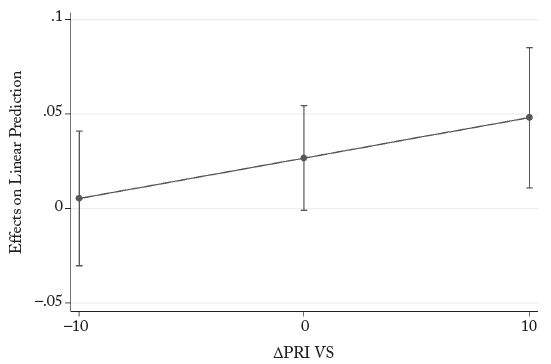
In model 1, the positive, significant coefficient on the interaction shows that controlling for features of a municipality’s ssd-year and other time-varying differences, municipalities in alliance ssds with pvem-affiliated candidates that increased votes for the joint candidate under the PRl’s label exclusively while decreasing them for this candidate under the pvem label or both parties’ labels received more money the year after elections. Substantively, model 1 shows that a one percentage point increase in Negative (ΔPVEM or pvem-PRI VSm,t)– which corresponds to a one percentage point decrease in the share of voters choosing the joint candidate under the pvem label or under both parties’ labels–in a municipality where the share of voters choosing the joint candidate under the pri label exclusively increased by 10 percent, the amount of fortalece the municipality received was increased by MX $9.9 per person (approximately US $0.50). The same one percentage point increase in Negative (ΔPVEM or pvem-PRI VSm,t) in a municipality where the share of voters choosing the joint candidate under the pri label exclusively decreased by 10 percent is predicted to increase the amount of fortalece received by MX $1.1 per person (approximately US $0.05). These average marginal effects, with their 95 percent confidence intervals, are displayed in Figure 3. Their substantive effects are summarized in Table 7.Footnote 102 Section H of the supplementary material shows that the assumptions of linearity and common support for the moderator hold.
Average Marginal Effects of Negative (ΔPVEM or pvem-PRI VS m,t) with 95 Percent Confidence Intervals in Alliance ssds with pvem Candidatesa
aAverage marginal effect of a one percentage point increase in Negative (ΔPVEM or pvem-PRI VSm,t) with 95 percent confidence intervals (shown with vertical lines) at different levels of ΔPRI VSm,t in ssds in which the PRI and pvem ran a joint candidate from the pvem (see Table 6, model 1).

Substantive Effects on Transfers in Mexicoa

a Substantive effects on transfers of the average marginal effect of a one percentage point increase in Negative (ΔPVEM or PVEM-PRI VSm,t) at different values of ΔPRI VSm,t in alliance ssds with pvem candidates. Marginal effects are calculated with continuous variables held constant at sample means.
The positive, significant coefficient on Negative (ΔPVEM or pvem-PRI VSm,t), by contrast, shows that decreases in votes for the joint candidate under the pvem label or both parties’ labels are, when ΔPRI VSm,t is zero, rewarded with more money after elections. Substantively, a one percentage point decrease in votes cast under the pvem label or both parties’ labels results in a per person gain of MX $5.44 (approximately US $0.30). The nonsignificant coefficient on ΔPRI VSm,t means that increases in votes for the joint candidate under the pri label exclusively are neither penalized nor rewarded. Viewed together, these results show that in alliance ssds with pvem-affiliated candidates, the coalition uses fortalece to encourage supporters choosing the joint candidate under the pvem label or both parties’ labels to switch to casting them under the PRl’s label only.
In Table 6, models 2 and 3 serve as placebo tests. In alliance ssds with pri-affiliated candidates (model 2), neither the coefficient on the interaction nor the coefficient on Negative (ΔPVEM or pvem-PRI VSm,t) is significant. In nonalliance ssds (model 3), neither the coefficient on the interaction nor the coefficient on Negative (ΔPVEM VSm,t) is significant. This means that only in alliance ssds where the pri has forfeited the joint candidacy to the pvem (model 1) does the coalition use fortalece to encourage voters to switch their votes from the joint candidate under the pvem label or under both parties’ labels to the joint candidate under the pri label. These results support hypothesis 3.
What else can our results tell us about transfers? In ssds where the two parties fielded a joint candidate who was pri affiliated (model 2), the coefficient on ΔPRI VSm,t is positive and significant, whereas the coefficient on Negative (ΔPVEM or pvem-PRI VSm,t) is insignificant. This means that the coalition rewarded increases in votes cast for the pri-affiliated joint candidate under the PRI label alone, but neither rewarded nor penalized increases in votes cast for the pri-affiliated joint candidate under the pvem label or under both parties’ labels. Substantively, a one percentage point increase in votes for the pri-affiliated joint candidate under the pri label translated into an extra MX $2.65 per person (approximately US $0.15). In these ssds, the allied parties used transfers to encourage supporters to cast both components of their fused vote for the pri. Presumably because votes cast for the joint candidate under the pvem label or under both parties’ label in ssds where the joint candidate was pri increased the chance of the PRl’s candidate winning the ssd, the pri did not dissuade voters from casting their votes this way. But neither did it encourage them to do so.
In model 3, the coefficient on ΔPRI VSm,t is positive and significant, revealing that the coalition rewarded increases in votes cast for the PRI. Substantively, a one percentage point increase in votes cast for the pri translated into an extra MX $4.41 per person (approximately US $0.25). Rewards for voting pri were largest in these nonalliance ssds. The coefficient on Negative (ΔPVEM VSm,t) is insignificant. Thus, in nonalliance ssds, the coalition used transfers to encourage supporters to cast both components of their vote for the pri.
IX. Conclusion
Our theory is in two parts. First, we explained how an mmm system creates a distinct strategic environment in which a large party and a small party can form an alliance and trade votes in one tier for votes in the other in a way that increases the number of seats won by both parties. Second, we posited that governing parties dependent on such trades can use geographically targeted spending to cement them. We used original data on Japanese and Mexican municipalities to show that the LDP-Komeito and pri-pvem coalitions, respectively, did exactly this in the period under study.
For scholars of comparative politics, we have identified a new pathway through which governing parties can remain in power under an mmm electoral system. A large governing party is likely to prefer this pathway when its policies make it unpopular with the median voter. Under most other electoral systems, this party would be forced to refine its policy positions to make them more palatable to the median voter or to provide enough targeted goods to overcome any resistance by the median voter. Under an mmm system, however, it can form an alliance with a small party, have both parties’ supporters split their votes, and use targeted goods as a reward for doing so. With this strategy, the only constituencies the large party has to please are its own supporters and its ally’s supporters. This strategy is likely to have far-ranging consequences for governance and representation. It may mean that non supporters are cut out of the spoils and find government unresponsive to their concerns. Although these voters will be drawn to the opposition, they will not necessarily find a viable alternative there. A large opposition party aiming to establish itself as a party capable of unseating the governing coalition would gain from realizing a similar trade, but will have to face the fact that small parties are likely to form and function as mercenaries, vying for inclusion in the governing coalition. Non-supporters may end up having to bandwagon with the governing coalition.
The first step to investigating whether our theory’s more dire implications are borne out is to see whether parties in the twenty-six other countries with mmm electoral systems use vote trading and geographically targeted spending to win elections. Political science literature and news reports reveal evidence of coordination in all but one of these countries (Tajikistan). Electoral autocracies and recently transitioned democracies tend to seek coordination among opposition parties with the goal of unseating the dominant parties.Footnote 103 Among established democracies, stand-down agreements in nominal-tier districts are common. The following four cases may be especially instructive to study: Italy, which since 2017 has used a fused-vote system similar to Mexico’s but without the cap on overrepresentation; Taiwan, which uses a system similar to Japan’s; Thailand, which used an mmm system until 2017, after which it introduced something closer to an mmp system;Footnote 104 and Korea, which transitioned from a pure mmm system to an mmm system with partial compensation in 2019. In Korea, large parties had the audacity to create small parties with which they could ally after the passage of an electoral reform that ruled that some list seats would be awarded on a compensatory basis.Footnote 105
After evaluating how common vote trading with geographically targeted spending is, future research should investigate how mmm systems stack up against alternative electoral systems in the ease with which governing parties are voted out of power, the alignment of government policies with the interests of the median voter, and the responsiveness of governments to crises and changes that influence the median voter. In addition, future work should flesh out how the distinct strategic environment created by mmm systems’ combination of electoral rules influences other outcomes.
For scholars of Japan and Mexico, our study shows that the longstanding governing coalitions of both countries contested elections by encouraging supporters to split their votes and by using government resources to facilitate this. Future research should focus on three questions. First, what role did this strategy play in perpetuating the dominance of the ldp-Komeito and pri- pvem coalitions? Central to this research would be investigating why the ldp-Komeito coalition lost the 2009 House of Representatives election, why the pri-pvem coalition lost the 2018 Chamber of Deputies election, and why, in the Japanese case, the parties that won in 2009 were unable to replicate the strategy to win again in 2012. Second, what, if any, relationship exists between the size of the payoffs supporters receive for splitting their votes and the policies implemented by the governing coalitions? Is Japan’s ldp neutralizing the Komeito’s opposition to its desired defense policies by increasing the size of the payoffs to Komeito supporters? Third, are the parties pursuing similar vote-trading strategies at other levels of government, such as for the upper houses, local governments, and, in the case of Mexico, the presidency? We urge scholars to tackle these questions.
Acknowledgments
For comments on earlier drafts, we thank John Campbell; Christina Davis; Shinju Fujihira; Makoto Fukumoto; William Godell; Sean Kates; Kyuwon Lee; Andrew Little; John Marshall; Charlie McClean; Gwyneth McClendon; Julia Payson; Susan Pharr; Alison Post; Massimo Pulejo; Pia Raffler; Steven Reed; Arturas Roze-nas; Yuki Shiraito; Tara Slough; Daniel M. Smith; David Stasavage; Steven Vogel; and participants at Harvard University’s U.S.-Japan Program Seminar Series; the
Noon Lecture Series at the University of Michigan’s Center for Japanese Studies; New York University’s Comparative Politics Speaker Series; the Comparative Politics Speaker Series at the University of California, Berkeley; Midwest Political Science Association 2019; and Harvard University’s Symposium on Japanese Politics.
Supplementary Material
Supplementary material for this article can be found at https://doi.org/10.1017/S0043887121000113.
Data
Replication files for this article can be found at https://doi.org/10.7910/DVN/PYZXLF.
Authors
Amy Catalinac is an assistant professor of politics at New York University. She studies the impact of electoral and political institutions on distributive politics, focusing mostly on the case of Japan. Her first book, Electoral Reform and National Security in Japan: From Pork to Foreign Policy, was published in 2016. She can be reached at amy.catalinac@nyu.edu.
Lucia Motolinia is a doctoral candidate in the Politics Department at New York University. In January 2022, she will be an assistant professor in the Department of Political Science at Washington University, St. Louis. Her research tries to better understand how electoral institutions affect political behavior, with an emphasis on the mechanisms driving the behavior of individual politicians and parties. She can reached at lucia.motolinia@nyu.edu.