Implications
In a commercial eating quality prediction model including muscle type, our results indicate that only IMF% or H2O%, unlike iron or collagen content, would add any precision. Alternatively, all biochemical measurements are strong predictors of eating quality when muscle type is not known. Therefore, for extrapolating sensory data derived from the six muscles tested in this study to other muscles with no sensory data, insoluble collagen content might indeed be useful for predicting the unknown muscle and therefore reduce the amount of future testing required.
Introduction
For beef to remain competitive in the market place, the product must satisfy the demands of consumers. Variable eating quality is seen as a major factor in the decline in beef consumption (Morgan et al., Reference Morgan, Savell, Hale, Miller, Griffin, Cross and Shackelford1991, Polkinghorne et al., Reference Polkinghorne, Thompson, Watson, Gee and Porter2008). A system that could guarantee beef eating quality would be well accepted by the European beef consumers (Verbeke et al., Reference Verbeke, Van Wezemael, de Barcellos, Kügler, Hocquette, Ueland and Grunert2010), and they would be likely to pay a premium if eating quality could be guaranteed (Lyford et al., Reference Lyford, Thompson, Polkinghorne, Miller, Nishimura, Neath, Allen and Belasco2010).
A large proportion of the research investigating the variability in the tenderness of beef has used either objective measures, such as Warner Bratzler shear force, or trained taste panels. Total collagen content has been found to be moderately associated with decreasing trained panel scores for tenderness, and this relationship has been demonstrated between different muscles and within a single muscle, that is, m. longissimus thoracis (Torrescano et al., Reference Torrescano, Sánchez-Escalante, Giménez, Roncalés and Beltrán2003; Chriki et al., Reference Chriki, Gardner, Jurie, Picard, Micol, Brun, Journaux and Hocquette2012). This is also true for insoluble collagen (Riley et al., Reference Riley, Johnson, Chase, West, Coleman, Olson and Hammond2005; Jurie et al., Reference Jurie, Picard, Hocquette, Dransfield, Micol and Listrat2007). Studies also indicate that age-related collagen cross-linking is an important determinant of insoluble collagen and therefore sensory tenderness (Bailey, Reference Bailey1985; Dransfield et al., Reference Dransfield, Martin, Bauchart, Abouelkaram, Lepetit, Culioli, Jurie and Picard2003; Chriki et al., Reference Chriki, Gardner, Jurie, Picard, Micol, Brun, Journaux and Hocquette2012). Chriki et al. (Reference Chriki, Gardner, Jurie, Picard, Micol, Brun, Journaux and Hocquette2012) reported that the ratio of soluble to total collagen content was positively correlated to tenderness when evaluated by trained French panellists. The more soluble collagen in comparison with insoluble collagen in beef the more tender the beef was scored by French trained taste pannelists. This indicates that increasing the proportion of soluble collagen will have a positive association with tenderness. There is very limited information in the literature comparing biochemical analysis and untrained consumer taste panel scores, which are the basis of the Meat Standards Australia (MSA) approach. In several countries, including France, MSA has been shown to be relevant (Legrand et al., Reference Legrand, Hocquette, Polkinghorne and Pethick2013). The degree of correlation between untrained consumer responses and both total and insoluble collagen contents is yet to be determined in beef.
Many Studies have shown that increased marbling level, or intramuscular fat (IMF%) was associated with greater tenderness, juiciness, flavour liking and overall liking (Lorenzen et al., Reference Lorenzen, Miller, Taylors, Neely, Tatum, Wise, Buyek, Reagan and Savell2003; Garmyn et al., Reference Garmyn, Hilton, Mateescu, Morgan, Reecy, Tait, Beitz, Duan, Schoonmaker, Mayes, Drewnoski, Liu and VanOverbeke2011; Chriki et al., Reference Chriki, Gardner, Jurie, Picard, Micol, Brun, Journaux and Hocquette2012; O’Quinn et al., Reference O’Quinn, Brooks, Polkinghorne, Garmyn, Johnson, Starkey, Rathmann and Miller2012). Furthermore Thompson (Reference Thompson2004) in cattle and (Pannier et al., Reference Pannier, Gardner, Pearce, McDonagh, Ball, Jacob and Pethick2014) in lamb found a positive relationship between IMF% and the flavour liking and juiciness scores of untrained Australian consumers. IMF% is also positively associated with the oxidative capacity (Jurie et al., Reference Jurie, Picard, Hocquette, Dransfield, Micol and Listrat2007; Kelman et al., Reference Kelman, Pannier, Pethick and Gardner2014) and therefore the haem iron content of muscles (Turkki and Campbell, Reference Turkki and Campbell1967; Lengyel et al., Reference Lengyel, Husvéth, Polgár, Szabó and Magyar2003; Kelman et al., Reference Kelman, Pannier, Pethick and Gardner2014) and has a strong negative association with the moisture content of beef and pork (Barlocco et al., Reference Barlocco, Vadell, Ballesteros, Galietta and Cozzolino2006; Pflanzer and de Felício, Reference Pflanzer and de Felício2011).
We hypothesise that decreasing IMF% or decreasing soluble collagen content, and increasing insoluble collagen and/or total collagen content will relate to a decrease in untrained consumer taste panel perception of tenderness, similar to those relationships seen with trained taste panels both across different muscles and within the same muscle. IMF% will have a negative correlation with moisture content and a positive correlation with haem iron content and both will function as a proxy for IMF% with similar predictive capacities for untrained consumer taste panel scores both across different muscles and within the same muscle.
Material and methods
Animals and sample source
As previously described (Legrand et al., Reference Legrand, Hocquette, Polkinghorne and Pethick2013), 18 Australian cattle were slaughtered at an abattoir in Northern New South Wales, Australia and a further 18 French cattle were slaughtered in an abattoir in the western part of France following French industry practice. The cattle were chosen to reflect the different commercial production practices of the two countries. The Australian cattle were Murray Grey steers, ∼18 months of age (Thompson et al., Reference Thompson, Polkinghorne, Gee, Motiang, Strydom, Mashau, Ng’ambi, deKock and Burrow2010), while the French cattle consisted of three young French Holstein bulls (age range 19–20 months, carcass weight range 275–304 kg), three young crossbred Prim’Holstein×Hereford cows (age range 24–31 months, carcass weight range 288–307 kg), six cull French Holstein or Normande dairy cows (age range 51–98 months, carcass weight range 314–370 kg) and six cull Limousine or Charolaise beef cows (age range 68–201 months, carcass weight range 321–373 kg). The French cows were culled for age-related reasons. All cattle were hormonal growth promotant free.
Muscle samples
Six muscles from each animal were selected to represent a wide range of eating qualities: outside (m. biceps femoris), topside (m. semimembranosus), striploin (m. longissimus thoracis), rump (m. gluteus medius), oyster blade (m. infraspinatus) and tenderloin (m. psoas major). The Australian samples had two ageing times, with half of the samples aged for 5 days and the other half aged for 21 days. All French samples were aged for 10 days, except for the tenderloin which was aged for 7 days only.
Demographic profile of consumers
French consumers (n=540) were involved in the sensory analysis, including 306 women (57%) and 234 men (43%). There was an even distribution between the six age classes, except for the oldest class (⩾65 years) which consisted of only 3.3% of the consumers. Women were most represented in the younger classes (average 35 years) and there was a higher proportion of men in the oldest class (⩾65 years). For a more detailed analysis of the consumer demographics, see Legrand et al. (Reference Legrand, Hocquette, Polkinghorne and Pethick2012).
Meat preparation and French consumer panels
Consumer assessment of eating quality was done according to the protocols for MSA testing described by Watson et al. (Reference Watson, Gee, Polkinghorne and Porter2008). Following the specific procedure also outlined in (Legrand et al., Reference Legrand, Hocquette, Polkinghorne and Pethick2013). Each sample (muscle) was sectioned into five steaks of 25 mm thickness. These steaks were halved after cooking making 10 portions available for tasting from each muscle (sample). Each consumer received seven portions: the first portion (a link sample) was a steak derived from either a generic striploin or rump muscle and designed to be of average quality – the sensory scores for this steak were not part of the final statistical analysis. The remaining six steaks were derived from the experimental samples collected. Grilled steaks were cooked on a Silex clamshell grill (Silex, Hamburg, Germany) set to 220°C for 4.75 min for ‘medium’ and to 200°C for 3.25 min for ‘rare’ (Watson et al., Reference Watson, Gee, Polkinghorne and Porter2008). There was a high correlation between medium and rare cooking for the consumer palatability scores (R 2>0.9) (Legrand et al., Reference Legrand, Hocquette, Polkinghorne and Pethick2013).
In total, 360 French consumers took part in the ‘medium’ cooking test, with each consumer first consuming a medium quality ‘link’ sample then eating three Australian beef samples and three French beef samples. French consumers (n=180) took part in the ‘rare’ cooking test, these portions were from French origin only and prepared as paired samples from the same muscles used for the ‘medium’ cooking test. Both medium and rare samples were 25 mm thick. Consumers scored portions for tenderness, juiciness, flavour liking and overall liking, by making a mark on a 100-mm line scale, with the left hand of the scale representing dislike and the right hand of the scale representing very liked. For a more detailed description of the testing procedures see Legrand et al. (Reference Legrand, Hocquette, Polkinghorne and Pethick2013).
Meat quality score (MQ4)
Values of consumer scores for tenderness, juiciness, flavour liking and overall liking were used to create a single MQ4 score that reflected the MSA star rating of the muscle. The weightings of the four sensory parameters (tenderness, juiciness, flavour liking and overall liking) to create the MQ4 score and hence the final rating (‘unsatisfactory’, 3*, 4* and 5*) were 0.31×tenderness, 0.04×juiciness, 0.30×flavour liking and 0.36×overall liking (Legrand et al., Reference Legrand, Hocquette, Polkinghorne and Pethick2013). The weightings were calculated using a discriminant analysis, as described by Watson et al. (Reference Watson, Gee, Polkinghorne and Porter2008). These weightings predicted the actual rating given by consumers for over 70% of the total number of samples, indicating that a high level of prediction is possible for French consumers.
Biochemical analysis
Proximate analyses were conducted to determine the chemical percentage of fat, moisture, protein, total and insoluble collagen of each muscle as previously described (Allais et al., Reference Allais, Levéziel, Payet-Duprat, Hocquette, Lepetit, Rousset, Denoyelle, Bernard-Capel, Journaux, Bonnot and Renand2010). A single 2.5×5×5 cm steak from each muscle was used for proximate analysis of Australian and French samples. Frozen French and Australian samples were thawed at 2°C to 4°C for 24 h before proximate analysis. All exterior fat and connective tissue were removed before proximate analysis, leaving only the lean meat.
Intramuscular lipid (IMF%) content was measured by the Soxhlet method using a Soxtherm apparatus (Gerhardt France SARL, Les Essarts Le Roi, France). Total and insoluble collagen content (%) were measured according to the INRA method (Listrat and Hocquette, Reference Listrat and Hocquette2004) on muscle samples that had undergone 2 h of heat treatment in a buffer solution at 90°C. Total and insoluble percentages were then estimated from the measurement of hydroxyproline content (collagen=8×l-hydroxyproline). Soluble collagen content was calculated as the difference between total and insoluble collagen. Haem iron was measured using the technique described by Hornsey (Reference Hornsey1956). The sample was ground and the pigments were extracted with HCl and acetone. The resulting liquid was stored in a light free environment for 24 h before the absorbance was measured at 510 nm with a spectrophotometer and the haem iron in mg/g of sample was calculated.
Statistical analysis
The sensory scores for tenderness, juiciness, flavour liking, overall liking and the composite score MQ4 were analysed using a linear mixed effects model (SAS v9.1). Initially, a core model was established with source country/ageing time (Aust5, Aus21, France10) and cooking ‘doneness’ (rare, medium) included as fixed effects. Cooking ‘doneness’ was fitted within source country/ageing time as only the French 10-day-aged samples were cooked rare. Animal ID was included as a random term to account for the samples being evaluated at two different degrees of cooking doneness. The same core model was then established with the same effects plus muscle type included as a fixed effect.
Biochemical measurements including total collagen, insoluble collagen, soluble collagen, iron, moisture and IMF contents were then incorporated one at a time as covariates into each of the core models (with and without muscle), as well as their interactions with all fixed effects to assess their association with the sensory scores. In all cases, non-significant terms (P>0.05) were removed in a step-wise fashion. The oyster blade was not used in the analysis of the collagen parameters due to erroneous sample selection for collagen determinations.
Results
There was a large range in both IMF% and collagen content (Table 1) across the muscles and cattle sampled. Moisture content had a small variation.
Descriptive statistics of the biochemical parameters measured on six different muscles taken from 18 French cattle and 18 Australian steers

n=number of muscles; IMF%=intramuscular fat; collagen measurements are expressed in g/100 g fresh meat.
All measurements are on a fresh meat basis.
Muscles sampled: outside (m. biceps femoris), topside (m. semimembranosus), striploin (m. longissimus thoracis), rump (m. gluteus medius), oyster blade (m. infraspinatus) and tenderloin (m. psoas major).
The number of muscles samples is reduced for the collagen measurements due to the oyster blade (m. infraspinatus) being excluded from the analysis as a result of erroneous sample selection.
Sensory scores
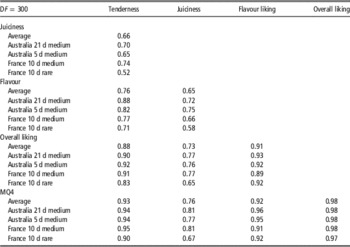
MQ4 is strongly correlated with all of the sensory parameters with average (across all muscles) correlations of ⩾0.91 for tenderness, flavour liking and overall liking. Juiciness had the lowest average corrleation with MQ4 (⩾0.76; Table 2). Tenderness, flavour liking and overall liking had strong correlations with each other. Flavour liking and overall liking had the strongest correlation averaged across each source country, ageing period and cooking doneness (⩾0.91). Juiciness and flavour had the weakest correlation averaged across each source country, ageing period and cooking doneness (⩾0.65; Table 2). Sensory score correlations were relatively consistent for the striploin, rump and topside, with averages between 0.83 and 0.87, while the tenderloin, outside and the oyster blade had correlations slightly lower with averages ranging between 0.77 and 0.78 (data not shown).
Correlation coefficients between the sensory scores from untrained French consumers tasting six different muscles from French and Australian beef for the two countries and each ageing period and doneness by country

DF=degrees of freedom; MQ4=a weighted combination (0.3, 0.1, 0.3, 0.3) of the other four sensory scores, tenderness, juiciness, flavour liking and overall liking.
The average is the correlation using all the different cooking doneness, ageing periods and countries.
21 d=muscle aged for 21 days post slaughter; 5 d=muscle aged for 5 days post slaughter; 10 d=muscle aged for 10 days post slaughter (except the tenderloin, which was aged for 7 days); medium=cooked to a medium doneness; rare=cooked to a rare doneness.
Prediction of sensory scores using biochemical measurements
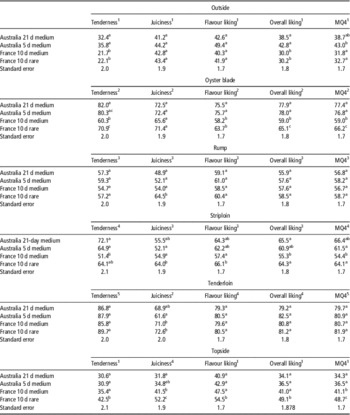
The tenderloin had the highest MQ4 of all the muscles for all of the different countries, degrees of doneness and ageing periods (Table 3). The outside had the lowest MQ4 for the French cattle and the topside had the lowest MQ4 for the Australian cattle. The standard error between the different countries, degrees of doneness and ageing periods was consistently higher for tenderness, with the highest being 2.1 for the topside.
Quality scores predicted from the core model for each muscle from the 36 cattle for the two countries and each ageing period and doneness by country

Rare=cooked to a rare doneness; Medium=cooked to a medium doneness; MQ4=a weighted combination (0.3, 0.1, 0.3, 0.3) of the other four sensory scores, tenderness, juiciness, flavour liking and overall liking.
Superscript numbers=different numbers in a column indicate the scores are significantly different per muscle (P<0.05); superscript letters=for each muscle different letters in a column indicate the scores are significantly different (P<0.05); 21 d=muscle aged for 21 days post slaughter; 5 d=muscle aged for five days post slaughter; 10 d=muscle aged for 10 days post slaughter (except the tenderloin which was aged for 7 days).
The core model comprised the fixed effects source country/ageing time (Australian samples aged 5 days, Australian samples aged 21 days and French samples aged 10 days) and cooking ‘doneness’ (rare, medium). Cooking ‘doneness’ was fitted within source country/ageing time as only the French 10-day-aged samples were cooked rare. Muscle type was included as a fixed effect. Animal ID was included as a random term.
Analysis without ‘muscle’ as a fixed effect
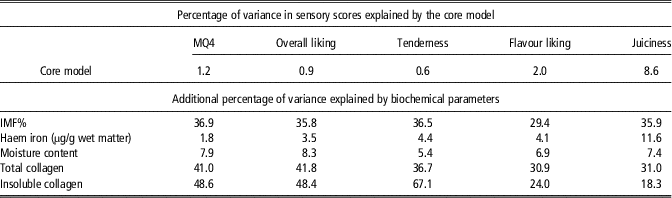
The core model alone (source country/ageing time (Australian aged 5 days, Australian aged 21 days, French aged 10 days) and degrees of doneness (rare, medium) as fixed effects, and animal identification number as a random term) explained from 0.6% to 8.6% of the variation (Table 4) for each of the sensory traits (Table 4). When insoluble collagen (g/100g fresh meat) was included in the core model, it accounted for the greatest amount of variation of all the biochemical parameters for all the sensory scores and described from 18.3% to 67.1% of the variation (Table 4). This was followed closely by total collagen content and IMF% (Table 4). The biochemical parameter that described the least amount of the variance for all of the sensory scores was haem iron content (Table 4).
The percentage of the variation in the sensory scores of French untrained consumers evaluating six different muscles taken from 18 French cattle and 18 Australian steers prepared at medium or rare cooking doneness and aged for 5, 10 or 21 days, which is explained by the core models and biochemical parameters

IMF%=intramuscular fat; collagen measurements are expressed in g/100g fresh meat; MQ4=a weighted combination (0.3, 0.1, 0.3, 0.3) of the other four sensory scores, tenderness, juiciness, flavour liking and overall liking.
All measurements are on a fresh meat basis.
Muscles sampled: outside (m. biceps femoris), topside (m. semimembranosus), striploin (m. longissimus thoracis), rump (m. gluteus medius), oyster blade (m. infraspinatus) and tenderloin (m. psoas major).
The core model comprised the fixed effects source country/ageing time (Australian samples aged 5 days, Australian samples aged 21 days and French samples aged 10 days) and cooking ‘doneness’ (rare, medium). Cooking ‘doneness’ was fitted within source country/ageing time as only the French 10-day-aged samples were cooked rare. Animal ID was included as a random term.
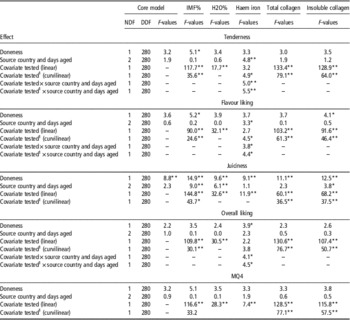
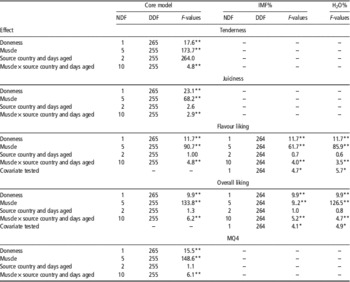
Total collagen had the greatest F-values for tenderness, flavour liking, overall liking and MQ4. Insoluble collagen had the greatest F-values for juiciness (Table 5). There were no effects on the biochemical measurements between source country and ageing period except for haem iron, where there was a greater, positive, impact of haem iron on the eating quality of the Australian beef than the French beef (data not shown). Haem iron also had the smallest F-values for all the sensory scores (Table 5).
F-values for the core model and the impact of six biochemical measurements on untrained French consumer perceptions of tenderness, juiciness, flavour liking and overall liking, and on the combined consumer MQ4 score of six muscles taken from 18 cattle from France and 18 steers from Australia prepared at medium or rare cooking doneness and aged for 5, 10 or 21 days

NDF=numerator degrees of freedom; DDF=denominator degrees of freedom; IMF%=intramuscular fat; collagen measurements are expressed in g/100 g fresh meat; haem iron measurements are expressed as µg/g fresh meat; all measurements are on a fresh meat basis; *P<0.1; **P<0.05; ***P<0.01.
The core model comprised fixed effects source country/ageing time (Australian samples aged 5 days, Australian samples aged 21 days and French samples aged 10 days) and cooking ‘doneness’ (rare, medium). Cooking ‘doneness’ was fitted within source country/ageing time as only the French 10-day-aged samples were cooked rare. Animal ID was included as a random term. The biochemical measurements were then introduced to the core model individually, and the model was regressed in a step wise fashion until only significant terms remained.
1 The term is run in the model interacted with itself, testing for a curvilinear response; the oyster blade results were excluded for the collagen models, hence the DDF values decreased to 224.
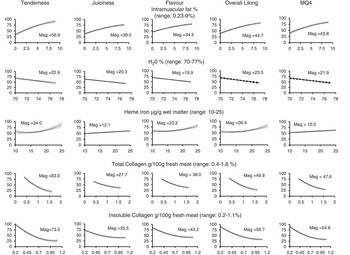
There were significant relationships between all the biochemical parameters and sensory scores except for soluble collagen (Table 5; Figure 1). Of the biochemical parameters tested, total and insoluble collagen contents demonstrated the strongest association with consumer eating quality with more than 30% of the variance in sensory scores explained by these two factors (Table 1) and with all sensory scores reduced across the increasing total and insoluble collagen range (Figure 1). The magnitude of these associations varied for the different sensory scores, being strongest for tenderness, which reduced by 35.5 units across the insoluble collagen range, and weakest for juiciness, which reduced by only 33.0 units across the same range (Figure 1). For each of the different sensory scores, the majority of this response occurred between insoluble collagen of 0.2–0.7 g/100 g fresh meat. Total collagen had a similar relationship with the sensory scores as insoluble collagen although the magnitude was greater for insoluble collagen. Hence, the greatest relationship for total collagen was with tenderness, reducing the scores by 63 units, and the lowest was with juiciness, reducing the scores by 27.7 units across the range of total collagen, which varied between 0.4 and 1.6 g/100 g fresh meat.
The effect of biochemical parameters on untrained French consumer perceptions of tenderness, juiciness, flavour liking and overall liking, and on the combined consumer MQ4 score of six muscles taken from 18 cattle from France and 18 steers from Australia prepared at medium or rare cooking doneness and aged for 5, 10 or 21 days without muscle included in the model. Mag=magnitude of effect. All measurements are on a fresh meat basis; MQ4=a weighted combination (0.3, 0.1, 0.3, 0.3) of the other four sensory scores, tenderness, juiciness, flavour liking and overall liking.

For IMF%, the strongest association was with tenderness which increased by 57.0 units across an IMF% range of almost 9 units. The lowest association was with flavour liking, which only increased by 34.5 units across the IMF% range. Of all the biochemical parameters measured, juiciness was most strongly associated with IMF%, increasing by 39.0 units across the IMF% range (Figure 1). In all cases, the impact of IMF% on sensory scores was curvilinear, but no plateau was reached within the range of IMF%, 0.2% to 9%, in this study.
Haem iron had a positive relationship with all sensory traits. The impact was greatest on tenderness, which increased by 34 eating quality points across the haem iron range, respectively, with less impact on flavour liking, MQ4 and juiciness, which increased by only 23.2, 10 and 12 units across the range. This effect of haem iron was reduced in the French 10-day-aged samples, with tenderness, flavour liking and overall liking scores increasing by 14.5, 3.6 and 13.9 eating quality points across the haem iron range.
H2O% had a negative relationship with all the sensory scores. The magnitude of change in the different sensory scores was quite consistent, ranging from −19.9 for flavour liking to −23.5 for overall liking.
Analysis with ‘muscle’ as a fixed effect
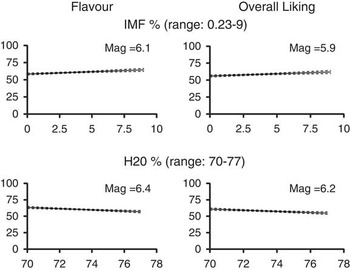
The percentage of variation in sensory scores explained by the core model increased markedly when muscle was included, increasing to 79.5% for MQ4, 77.8% for overall liking, 82.0% for tenderness, 70.1% for flavour liking and 66.0% for juiciness (data not shown). Of the biochemical parameters tested as covariates, the only ones retaining significance in the model corrected for muscle were IMF% and H2O% (Table 6, Figure 2). When IMF% was added to the model, it explained an additional 0.06% of the variance in overall liking scores and an additional 6.3% of the variance in flavour liking scores over the variance explained by the core model. This is much reduced from the 35.8% and 29.4% variation explained by IMF% in overall liking and flavour liking when muscle was not included in the model (Table 4). Across the IMF% range, flavour liking and overall liking increased by 6.1 and 5.9 units. When moisture content was added to the model, it explained an additional 0.08% of the variance in overall liking scores and an additional 6.3% of the variance in flavour liking scores over the variance explained by the core model. This is reduced from the 8.3% and 6.9% variation explained by moisture content in overall liking and flavour liking, respectively, when muscle was not included in the model (Table 4). Across the H2O% range, the flavour liking and overall liking scores decreased by 6.4 and 6.2 units.
The effect of IMF% and H2O% on untrained French consumer perceptions of tenderness, juiciness, flavour liking and overall liking, and on the combined consumer MQ4 score of six muscles taken from 18 cattle from France and 18 steers from Australia prepared at medium or rare cooking doneness and aged for 5, 10 or 21 days with muscle included in the model. Mag=magnitude of effect. All measurements are on a fresh meat basis; MQ4=a weighted combination (0.3, 0.1, 0.3, 0.3) of the other four sensory scores, tenderness, juiciness, flavour liking and overall liking. The graphed range of intramuscular fat has been truncated at 9%, excluding three samples with higher levels.

F-values for the core model including cut and the impact of IMF% and H2O% on untrained French consumer perceptions of tenderness, juiciness, flavour liking and overall liking, and on the combined consumer MQ4 score of six muscles taken from 18 cattle from France and 18 steers from Australia prepared at medium or rare cooking doneness and aged for 5, 10 or 21 days

NDF=numerator degrees of freedom; DDF=denominator degrees of freedom; IMF%=intramuscular fat; all measurements are on a fresh meat basis; *P<0.1; **P<0.05; ***P<0.01; MQ4=a weighted combination (0.3, 0.1, 0.3, 0.3) of the other four sensory scores, tenderness, juiciness, flavour liking and overall liking.
The core model comprised the fixed effects of cut and source country/ageing time (Australian samples aged 5 days, Australian samples aged 21 days and French samples aged 10 days) and cooking ‘doneness’ (rare, medium). Cooking ‘doneness’ was fitted within source country/ageing time as only the French 10-day-aged samples were cooked rare. Animal ID was included as a random term. The biochemical measurements were then introduced to the core model individually, and the model was regressed in a step-wise fashion until only significant terms remained.
Discussion
Relationship between the different sensory scores
The high correlations between all the four sensory scores and MQ4 reflect the fact that the MQ4 value has been derived from these scores and demonstrates the ability of MQ4 to reflect the whole of the consumer eating experience. The development of the MQ4 value from untrained consumer scores was first described in detail by Watson et al. (Reference Watson, Gee, Polkinghorne and Porter2008). High correlations (range 0.5 to 0.6) between the sensory scores were reported using Australian consumers tasting grilled steaks to a medium doneness, with the only exception being flavour liking (range 0.1 to 0.3). The comparative accuracy of the MQ4 value for both French and Australian consumers was investigated by Legrand et al. (Reference Legrand, Hocquette, Polkinghorne and Pethick2013) with the conclusion that it is at least as accurate at describing the consumer eating experience for French consumers as it is for Australian consumers. The correlations for French consumers between the four sensory scores and with MQ4 in this study are similar or stronger on average than those reported by Watson et al. (Reference Watson, Gee, Polkinghorne and Porter2008) with Australian consumers.
Relationship between collagen measurements and untrained consumer scores
Across muscles
The hypothesis that increasing total and insoluble collagen or decreasing soluble collagen would reduce consumer sensory scores across muscles was partially supported by our results, with both total and insoluble collagen having negative relationships with eating quality. Yet contrary to this hypothesis, soluble collagen showed no relationship with eating quality. Total collagen comprised both soluble and insoluble collagen and therefore reflects the impact of insoluble collagen on untrained consumer scores, with the magnitude diminished by incorporating the soluble collagen component. This aligns well with the findings of Chriki et al. (Reference Chriki, Gardner, Jurie, Picard, Micol, Brun, Journaux and Hocquette2012) who showed a relationship between both total and insoluble collagen and eating quality (r=−0.15, r=−0.20).
This result is further supported by the work of Schonfeldt and Strydom (Reference Schonfeldt and Strydom2011) who found that collagen content was the main driver of the differences in tenderness between different muscles (r=0.986) and by Light et al. (Reference Light, Champion, Voyle and Bailey1985) who reported that increasing total collagen and collagen cross-linking (insoluble collagen) was associated with increasing toughness across six different muscles. Large variations in collagen content exist across different muscles due to their different roles in the live animal. The negative relationship and relatively high magnitude of effect between insoluble collagen and eating quality demonstrates that a large proportion of the well-known differences in eating quality between different muscles is due to differences in insoluble collagen.
The lack of association between soluble collagen and eating quality conflicts with the results of Purslow (Reference Purslow2005) and Renand et al. (Reference Renand, Picard, Touraille, Berge and Lepetit2001) who both demonstrated that increasing collagen solubility had a positive relationship with trained taste panel scores both across muscles and within muscle. However, in contrast to our study where soluble collagen was expressed as a percentage of total muscle mass, Purslow (Reference Purslow2005) and Renand et al. (Reference Renand, Picard, Touraille, Berge and Lepetit2001) espressed soluble collagen as a proportion of total collagen. When soluble collagen is expressed as a proportion of total collagen, it incorporates the influence of insoluble collagen through the denominator of this ratio, limiting the capacity to understand soluble collagen independently. Consequently, the lack of any relationship between soluble collagen and untrained consumer eating quality in this study implies that previously published relationships between collagen solubility and tenderness may be driven by the insoluble collagen component of the proportion. This is supported by Chriki et al. (Reference Chriki, Gardner, Jurie, Picard, Micol, Brun, Journaux and Hocquette2012) who failed to find a relationship between soluble collagen and eating quality. Knowledge of soluble collagen levels would therefore fail to add any further information in the prediction of eating quality.
Within muscle
Contrary to our hypothesis, total collagen content, insoluble collagen content and soluble collagen content did not demonstrate any relationship with untrained consumer scores within any one muscle. This expectation was based on evidence that as the amount of insoluble collagen increases, more collagen remains in the final cooked product, increasing the resistance to mastication and therefore toughness (Purslow, Reference Purslow2005). Although both Chriki et al. (Reference Chriki, Gardner, Jurie, Picard, Micol, Brun, Journaux and Hocquette2012) and Schonfeldt and Strydom (Reference Schonfeldt and Strydom2011) were able to demonstrate small effects of collagen solubility on sensory tenderness, this was done using trained consumer scores, contrasting with the present study where untrained consumer scores were used. Hence, the greater variability inherent within untrained consumer data (Watson et al., Reference Watson, Gee, Polkinghorne and Porter2008) was likely the reason that we were not able to detect these small differences. Furthermore, the relatively small data set and experimental factors such as the different animal breeds, different abattoirs and different production methods would also preclude the detection of subtle relationships.
Alternatively, these results align with the work of Jeremiah and Martin (Reference Jeremiah and Martin1981) who found no relationships between total collagen content, insoluble collagen content and soluble collagen content and tenderness within muscle. However, unlike in our study, the carcasses were slaughtered at a similar chronological age, which would reduce the within-muscle variation in collagen solubility resulting from age-related collagen cross-linking. The effect of animal age on collagen cross-linking and subsequent increases in insoluble collagen content is well documented in the literature (Bailey et al., Reference Bailey, Paul and Knott1998). However, the expected positive relationship between animal age and insoluble collagen was not observed in this particular data set. Given the large range in animal ages in our study, this was expected to deliver a large range in insoluble collagen content improving the possibility of identifying an association between collagen and tenderness. We hypothesise that the lack of the expected positive relationship between animal age and insoluble collagen may be a result of the multiple different animal production methods, confounded with animal age, gender and breed, for example, older French dairy cows, older French beef cows, young Australian steers and young French bulls, combined with low animal numbers, inherent biological variability and a relatively high technical error of the biochemical test itself. The lack of this expected positive relationship may possibly explain the absence of any relationship between collagen measurements and eating quality within muscles.
Relationship between IMF% and consumer scores
Aligning with our hypothesis, IMF% had a positive relationship with eating quality both across muscles and within muscle. Lipids carry the majority of the species-specific flavour profiles of meat, which has a large, positive impact on eating quality (Hornstein and Crowe, Reference Hornstein and Crowe1960). IMF% also improves juiciness scores by the stimulation of salivation in the consumer and prohibits the absorption of moisture by meat due to its hydrophobic nature (Thompson, Reference Thompson2004). IMF% also affects tenderness, as shown in sheep meat by Pannier et al. (Reference Pannier, Gardner, Pearce, McDonagh, Ball, Jacob and Pethick2014) where a 1-unit increase in IMF% increased tenderness scores by 2.2 eating quality points. This may be due to the weaker structural properties of fat than other muscle tissue components (Thompson, Reference Thompson2004). These relationships are supported by O’Quinn et al. (Reference O’Quinn, Brooks, Polkinghorne, Garmyn, Johnson, Starkey, Rathmann and Miller2012) who found that as the IMF% in the m. longissimus thoracis increased American untrained consumer scores for tenderness, flavour liking, juiciness and overall liking increased, though this effect was not consistent between the samples of beef derived from Australian and American cattle. This mirrors the findings of Thompson (Reference Thompson2004), who also utilised untrained consumer panels and the m. longissimus thoracis. The results of our study show that French untrained consumer scores have a similar positive response to increasing IMF% compared with Australian and American consumers both across muscles and within muscle. This demonstrates that IMF% or a proxy measurement will add value to a predictive grading system based on meat quality irrespective of whether muscle is in the prediction model. This is consistent with its use within numerous quality grading systems around the world including the Australian MSA system (for a review, see Polkinghorne and Thompson, Reference Polkinghorne and Thompson2010).
The ability of moisture content to act as a proxy for IMF%
Our hypothesis that H2O% would act as a proxy for IMF% and have similar eating quality predictive capacities as IMF% was partially supported. As expected, while exhibiting effects of similar magnitude, IMF% and H2O% had contrasting relationships with eating quality because of the inverse relationship between moisture content and IMF% (Barlocco et al., Reference Barlocco, Vadell, Ballesteros, Galietta and Cozzolino2006; Pflanzer and de Felício, Reference Pflanzer and de Felício2011). However, when the two covariates were run in the model simultaneously, their F-values reduced, though they both retained significance. This demonstrates that the correlation between IMF% and H2O% does not completely account for the relationship between H2O% and eating quality. H2O% is not simply acting as a proxy for IMF% and also explains some of the variation in eating quality completely independent of its relationship with IMF%. This is reinforced by Renand et al. (Reference Renand, Picard, Touraille, Berge and Lepetit2001) who found that within the m. longissimus thoracis of Charolais young bulls the dry matter, the inverse of moisture content, was the principle muscle component related to flavour liking (r=0.40) when compared with other biochemical measures including IMF%. This may be due to the flavour contribution of the water-soluble components of meat and smaller errors in the measurements of H2O% when compared with IMF% (Renand et al., Reference Renand, Picard, Touraille, Berge and Lepetit2001). These results indicate that H2O% or its inverse, dry matter, may have a similar value in an eating quality prediction system in addition to IMF%.
The ability of haem iron to act as a proxy for IMF%
Our results only partially supported our hypothesis that haem iron would function as a proxy for IMF% when predicting eating quality. When muscle was excluded from the model and the IMF% and haem iron were both describing variation across and within muscle, both covariates had a positive relationship with eating quality. In addition, when the two biochemical measurements were included in the prediction model concurrently, only IMF% retained significance. This indicates that the correlation between the two biochemical measurements is the sole basis for the relationship that exists between haem iron and eating quality and haem iron is therefore functioning as a proxy and not describing any additional variation in eating quality. However, IMF% had an average magnitude of effect 21.3 points higher than haem iron across all the sensory scores. This is almost double the magnitude of effect of haem iron and highlights the reduced ability for haem iron to predict eating quality when compared with IMF%. This contradicts our hypothesis that haem iron had no relationship with eating quality scores within individual muscles. This result contrasts with the work of Renand et al. (Reference Renand, Picard, Touraille, Berge and Lepetit2001) who found that, within the m. longissimus thoracis, haem iron content had a positive correlation with trained taste panel scores for flavour and juiciness (r=0.21, r=0.19, respectively). This may be explained by the different animal types used in the two studies. As with insoluble collagen, the greater variability inherent within untrained consumer data (Watson et al., Reference Watson, Gee, Polkinghorne and Porter2008) used in this study was likely one major reason among others that we were not able to detect these small differences. Haem iron does function as a proxy for IMF% when predicting eating quality across muscles, however, the magnitude of the effect is heavily reduced and this relationship is not present within muscle. This shows that haem iron, despite being correlated with IMF% (Turkki and Campbell, Reference Turkki and Campbell1967) is not suitable as a proxy when predicting eating quality.
Conclusion
Biochemical measurements, particularly IMF% and insoluble collagen have the capacity to explain a large amount of the variation in the eating quality of beef. However, this capacity of insoluble collagen is eliminated when muscle type is known. Muscle type is enough to explain the effect of connective tissue on the eating quality of beef. Our results show that a combination of muscle type and IMF% allows for a very good prediction of the eating quality of beef and that an industrial model would not be greatly improved by the estimation of collagen content. This is reflected in the Australian MSA model where muscle type has the strongest influence on the final quality grade of a piece of beef (Polkinghorne et al., Reference Polkinghorne, Thompson, Watson, Gee and Porter2008). If a model like MSA was to be implemented in the European market other factors such as animal age, cooking method and the effects of the country of origin for the beef and the consumer would have to be investigated.
Acknowledgements
This research was funded by Meat and Livestock Australia and Murdoch University. The authors would also like to acknowledge the financial contributions of the European research project ProSafeBeef (Contract No. FOOD-CT-2006-36241), the French ‘Direction Générale de l’Alimentation’ and FranceAgriMer. Furthermore, this project would not have been possible without the practical support of the Association Institut du Charolais, the Syndicat de Défense et du promotion de la Viande de Boeuf de Charolles and the gourmet restaurants ‘Jean Denaud’. The authors are also very grateful to the staff of the Meat Laboratory from the French Livestock Institute in Villers Bocage, which provided all muscle biochemical data. The international travel required for this project has been funded by ‘Egide/Fast’ funds from the French and Australian governments, respectively. The assistance and participation of the Beef CRC, Janine Lau, Alex Ball (MLA, Australia), Alan Gee (Cosign, Australia), Ray Watson (Melbourne University, Australia), Paul Allen (Teagasc, Irish Republic) and John Thompson (UNE) are also gratefully acknowledged.