Introduction
Allanite, ideally A 1(Ca)A 2(LREE 3+)M 1,M2(Al)2M 3(Fe2+,Fe3+)(SiO4)(Si2O7)O(OH), is a sorosilicate belonging to the epidote-group minerals, with monoclinic symmetry and structure topology consistent with the space group P21/m (Dollase, Reference Dollase1971; Catlos et al., Reference Catlos, Sorensen and Harrison2000; Franz and Liebscher, Reference Franz and Liebscher2004; Armbruster et al., Reference Armbruster, Bonazzi, Akasaka, Bermanec, Chopin, Gieré, Heuss-assbichler, Liebscher and Menchetti2006). With respect to the other epidotes, allanite preferentially incorporates a significant fraction of light rare earth elements (LREE), and minor Th, U, Sr, Zr and Cr into its structure (Deer et al., Reference Deer, Howie and Zussman1992; Catlos et al., Reference Catlos, Sorensen and Harrison2000). The crystal structure is characterised by single silicate tetrahedra (SiO4), double silicate tetrahedra (Si2O7) and continuous chains of MO6 and MO4(OH)2 octahedra parallel to the crystallographic b axis (Dollase, Reference Dollase1971; Gieré and Sorensen, Reference Gieré and Sorensen2004; Armbruster et al., Reference Armbruster, Bonazzi, Akasaka, Bermanec, Chopin, Gieré, Heuss-assbichler, Liebscher and Menchetti2006).
The crucial role of allanite for metamorphic petrology is due to its wide compositional range and P-T stability field. Allanite shows variable phase relations depending on P-T conditions and on the reacting chemical system (e.g. Finger et al., Reference Finger, Broska, Roberts and Schermaier1998; Cox et al., Reference Cox, Wilton and Kosler2003; Gregory et al., Reference Gregory, Rubatto, Allen, Williams, Hermann and Ireland2007): it occurs in igneous and metamorphic rocks (Franz et al., Reference Franz, Thomas and Smith1986; Moore and McStay, Reference Moore and McStay1990; Sorensen, Reference Sorensen1991; Schmidt and Thompson, Reference Schmidt and Thompson1996; Tribuzio et al., Reference Tribuzio, Messiga, Vannucci and Bottazzi1996; Liu et al., Reference Liu, Dong, Xue and Zhou1999; Carswell et al., Reference Carswell, Wilson and Zhai2000; Cenki-Tok et al., Reference Cenki-Tok, Oliot, Rubatto, Berger, Engi, Janots, Thomsen, Manzotti, Regis and Spandler2011, Reference Cenki-Tok, Darling, Rolland, Dhuime and Storey2014; Cliff et al., Reference Cliff, Oberli, Meier, Droop and Kelly2015; Manzotti et al., Reference Manzotti, Bosse, Pitra, Robyr, Schiavi and Ballèvre2018) and it can incorporate up to ~60 wt.% of the bulk rock LREE (especially Ce, La and Nd) as well as Th (Exley, Reference Exley1980; Brooks et al., Reference Brooks, Henderson and Rønsbo1981; Gromet and Silver, Reference Gromet and Silver1983; Tribuzio et al., Reference Tribuzio, Messiga, Vannucci and Bottazzi1996). Allanite competes with monazite, (LREE)PO4, one of the major carriers of LREE that can incorporate from 40 to 80 wt.% of the LREE of the host rock (e.g. Bea, Reference Bea1996; Finger et al., Reference Finger, Broska, Roberts and Schermaier1998). For this reason, the two minerals are considered the main potential carriers of LREE in the Earth's mantle through subduction (e.g. Hermann, Reference Hermann2002; Gieré and Sorensen, Reference Gieré and Sorensen2004; Hermann and Rubatto, Reference Hermann and Rubatto2009).
The P-T stability fields of these LREE-bearing minerals are mostly controlled by temperature and Ca activity (e.g. Rasmussen et al., Reference Rasmussen, Muhling, Fletcher and Wingate2006; Boston et al., Reference Boston, Rubatto, Hermann, Engi and Amelin2017; Engi, Reference Engi2017). Allanite stability at high-temperature and high-pressure conditions increases in Ca-rich rocks (e.g. Janots et al., Reference Janots, Engi, Berger, Allaz, Schwarz and Spandler2008; Kim et al., Reference Kim, Cheong, Lee and Williams2009; Radulescu et al., Reference Radulescu, Rubatto, Gregory and Compagnoni2009). In metapelitic systems, a monazite-to-allanite reaction develops between low-grade and amphibolite-facies conditions (e.g. Smith and Barreiro, Reference Smith and Barreiro1990; Wing et al., Reference Wing, Ferry and Harrison2003; Tomkins and Pattison, Reference Tomkins and Pattison2007; Janots et al., Reference Janots, Brunet, Goffé, Poinssot, Burchard and Cemič2007, Reference Janots, Engi, Berger, Allaz, Schwarz and Spandler2008; Spear, Reference Spear2010). In magmatic environments, the crystallisation temperature of these LREE-rich phases is similar (e.g. Lee and Silver, Reference Lee and Silver1964; Casillas et al., Reference Casillas, Nagy, Pantó, Brandle and Fórizs1995) and Ca content and H2O activity, during magma crystallisation, are the major parameters controlling allanite and monazite P-T stability (e.g. Broska et al., Reference Broska, Petrík and Williams2000; Wing et al., Reference Wing, Ferry and Harrison2003; Dini et al., Reference Dini, Rocchi and Westerman2004; Janots et al., Reference Janots, Engi, Berger, Allaz, Schwarz and Spandler2008; Berger et al., Reference Berger, Rosenberg and Schaltegger2009; Engi, Reference Engi2017). In addition, allanite is characteristic of Ca-rich metaluminous granitoid rocks, whereas monazite is widespread in Ca-poor peraluminous granitoid rocks (e.g. Broska and Siman, Reference Broska and Siman1998; Catlos et al., Reference Catlos, Sorensen and Harrison2000).
Although the crystal chemistry and P-T stability of allanite in natural systems have been thoroughly studied in the last decade (e.g. Wing et al., Reference Wing, Ferry and Harrison2003; Janots et al., Reference Janots, Brunet, Goffé, Poinssot, Burchard and Cemič2007, Reference Janots, Engi, Berger, Allaz, Schwarz and Spandler2008; Gregory et al., Reference Gregory, Rubatto, Hermann, Berger and Engi2012), little is known about the behaviour of its structural parameters during deformation and diffusion processes. Very recently, Gatta et al. (Reference Gatta, Milani, Corti, Comboni, Lotti, Merlini and Liermann2019) described the compressional behaviour of allanite by in situ single-crystal synchrotron X-ray diffraction with a diamond anvil cell. The experiments, conducted under hydrostatic conditions on natural allanite crystals, demonstrated that allanite preserves its crystallinity, along with an elastic compressional behaviour, at least up to 16 GPa (at room temperature), without any P-induced phase transition within the P-range investigated. The thermodynamic elastic parameters have been obtained by an isothermal Birch-Murnaghan Equation of State fit to the P-V data, and the evolution of the lattice parameters with P showed a slight anisotropic compressional pattern (governed by the monoclinic symmetry of the structure). The main deformation mechanisms at the atomic scale were described on the basis of a series of structure refinements at different pressures. Comparing the (isothermal) compressional patterns with those obtained in previous studies, the effect of LREE on the elastic behaviour of epidote-group minerals was inferred (Gatta et al., Reference Gatta, Milani, Corti, Comboni, Lotti, Merlini and Liermann2019).
Recent works reported contrasting chemical and physical behaviours for allanite, preserving its primary chemical and isotopic fingerprint in crystals hosted in shear zones within eclogitised metagranitoid (e.g. Monte Mucrone, Western Austroalpine domain), suggesting a high shielding property due to high Young's modulus and low diffusion rates (Cenki-Tok et al., Reference Cenki-Tok, Oliot, Rubatto, Berger, Engi, Janots, Thomsen, Manzotti, Regis and Spandler2011). However, in this last work, LREE were not considered as the focus was on chemical elements used for geochronology. Conversely, allanite grown during shearing and metamorphism appears to have a higher diffusion rate and lower Young's modulus (e.g. Dabie Shan, Liu et al., Reference Liu, Dong, Xue and Zhou1999; Monte Bianco, External Crystalline Massifs domain, Cenki-Tok et al., Reference Cenki-Tok, Darling, Rolland, Dhuime and Storey2014; Sesia-Lanzo Zone, Regis et al., Reference Regis, Rubatto, Darling, Cenki-Tok, Zucali and Engi2014).
Given these contradictory results, our aim in the present study is to investigate structural parameters, chemical compositions and texture patterns of natural allanite-(Ce) crystals from the Lago della Vecchia metagranitoids in the Sesia-Lanzo Zone, Western Alps, in order to: (1) describe any potential crystal structure and mineral chemistry variation in response to the different conditions of the surrounding plastically deformed matrix during strain partitioning; and (2) estimate the LREE fraction released from allanite-(Ce) as a function of the accumulated strain in the host rocks. Allanite-(Ce) crystals were sampled in rock volumes that recorded different degrees of fabric evolution and metamorphic reaction progress (Corti et al., Reference Corti, Alberelli, Zanoni and Zucali2017) during the development of the blueschist-facies dominant fabric (Corti et al., Reference Corti, Alberelli, Zanoni and Zucali2018). Hereafter, mineral abbreviations are used according to Whitney and Evans (Reference Whitney and Evans2010), except for Wm (“white mica”).
Materials and methods
Geological outline
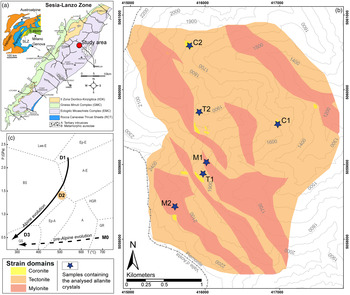
The allanite-(Ce) crystals analysed in this study were sampled from the Lago della Vecchia metagranitoids, which are part of the Eclogitic Micaschists Complex of the Sesia-Lanzo Zone, in the Austroalpine domain of the Western Alps (Fig. 1a). The Sesia-Lanzo Zone is a slice of continental crust that experienced HP–LT conditions during the Alpine subduction (e.g. Compagnoni et al., Reference Compagnoni, Dal Piaz, Hunziker, Gosso, Lombardo and Williams1977; Spalla et al., Reference Spalla, Lardeaux, Dal Piaz and Gosso1991; Zucali et al., Reference Zucali, Spalla and Gosso2002; Gosso et al., Reference Gosso, Messiga, Rebay and Spalla2010; Roda et al., Reference Roda, Spalla and Marotta2012; Giuntoli et al., Reference Giuntoli and Engi2016; Roda et al., Reference Roda, De Salvo, Zucali and Spalla2018, Reference Roda, Zucali, Regorda and Spalla2019). Metagranitoids occur as metre- to kilometre-sized bodies in tectonic contact with micaschists and gneisses (Corti et al., Reference Corti, Alberelli, Zanoni and Zucali2017). They have spectacularly preserved magmatic textures and igneous minerals, within metre to decametre domains. These domains are only weakly affected by superposed Alpine tectonometamorphic imprints developed under eclogite- and blueschist-facies conditions (Zucali, Reference Zucali2011; Corti et al., Reference Corti, Alberelli, Zanoni and Zucali2018). The multiscale structural analysis and geothermobarometric estimates allow inference of the tectono-metamorphic evolution of the Lago della Vecchia metagranitoids (Corti et al., Reference Corti, Alberelli, Zanoni and Zucali2017; Reference Corti, Alberelli, Zanoni and Zucali2018). The Pre-Alpine M0 magmatic stage consists of magmatic textures and igneous relicts in coronitic domains and allanite-(Ce) crystals in all-strain domains (P = 0.46 ± 0.15 GPa; T = 710 ± 19°C). The first Alpine stage is D1 that developed the S1 foliation at P = 2.23 ± 0.18 GPa and T = 537 ± 43°C, under eclogitic-facies conditions. S1 is only preserved locally, in metabasite boudins within metagranitoids. D1 structures were transposed and obliterated by the D2 stage that developed the pervasive S2 foliation at P = 1.12 ± 0.11 GPa and T = 477 ± 39°C, under retrograde blueschist-facies conditions that suggest a thermal state compatible with oceanic subduction (Corti et al., Reference Corti, Alberelli, Zanoni and Zucali2018; Fig. 1c). S2 foliation wraps metabasite boudins and intersects meta-aplitic dykes in metagranitoids. D3 and D4 stages (P = 0.6 ± 0.10 GPa; T = 302 ± 24°C) consist of localised S3 foliation, shear zones, and open folds marked by greenschist-facies assemblages, D5 developed km-long brittle-to-ductile mylonitic shear zones at a shallow crustal level (Corti et al., Reference Corti, Alberelli, Zanoni and Zucali2017, Reference Corti, Alberelli, Zanoni and Zucali2018). In contrast with most of the Eclogitic Micaschists Complex, where the dominant fabric developed under eclogitic-facies conditions (Zucali and Spalla, Reference Zucali and Spalla2011; Corti et al., Reference Corti, Zucali, Visalli, Mancini and Sayab2019; Zucali et al., Reference Zucali, Corti, Delleani, Zanoni and Spalla2020), the dominant fabric of the Lago della Vecchia metagranitoids developed under the D2 blueschist-facies conditions. In response to deformation partitioning, D2 produced low-strain domains (i.e. coronitic domain) that are wrapped by intermediate (i.e. tectonitic domain) and high (i.e. mylonitic domain) finite strain domains (Fig. 1b; e.g. Gosso et al., Reference Gosso, Rebay, Roda, Spalla, Tarallo, Zanoni and Zucali2015; Corti et al., Reference Corti, Alberelli, Zanoni and Zucali2017).
(a) Location of the study area in the Sesia-Lanzo Zone, Western Alps. (b) D2 fabric domains and location of analysed allanite-(Ce) crystals (UTM 32N-WGS84; modified after Corti et al., Reference Corti, Alberelli, Zanoni and Zucali2017). (c) P-T-d-t path and D2 dominant fabric conditions as inferred by Corti et al. (Reference Corti, Alberelli, Zanoni and Zucali2018).

Allanite sampling
Six metagranitoid samples with allanite-(Ce) crystals were selected, taking into account the D2 domains of the ‘degree of fabric evolution’ (DFE) (Fig. 1b), as defined by Corti et al. (Reference Corti, Alberelli, Zanoni and Zucali2017) and Zucali et al. (Reference Zucali, Corti, Delleani, Zanoni and Spalla2020). While in mylonitic domains the rock fabric is related entirely to the new metamorphic conditions, in tectonitic to coronitic domains relic fabrics and mineral associations are preserved. The contouring of such domains with a homogeneous DFE is facilitated by integrating meso- and micro-scale structural analysis (i.e. Gosso et al., Reference Gosso, Rebay, Roda, Spalla, Tarallo, Zanoni and Zucali2015). Estimation of the DFE is based on the volumes occupied by different degrees of grain-scale reorganisation during D2, which span from coronitic to mylonitic domains (Lardeaux and Spalla, Reference Lardeaux and Spalla1990; Gosso et al., Reference Gosso, Rebay, Roda, Spalla, Tarallo, Zanoni and Zucali2015) (planar fabric: coronitic: 0–20%; tectonitic: 21–60%; mylonitic: 61–100%). Thus, two samples were chosen from coronitic (C1 and C2 samples), tectonic (T1 and T2 samples) and mylonitic (M1 and M2 samples) metagranitoids, respectively (Fig. 1b). The sampling locations are shown in Fig. 1b and indicated in the following analytical tables and figures.
Methods
The rock microstructures and the crystallochemical features of the allanite-(Ce) crystals in different D2 fabric domains have been investigated by (transmitted) polarised light microscopy, scanning electron microscopy using energy-dispersive spectroscopy (EDS) and electron microprobe analyses (EPMA) in wavelength-dispersive spectroscopy (WDS) mode and single-crystal X-ray diffraction (SCXRD).
Quantitative WDS chemical micro-analyses were obtained with a JEOL 8200 Super Probe system at the Earth Sciences Department, University of Milan, with operating conditions of 15 kV and 5nA, 5 μm beam diameter, and counting times of 30 s on the peaks and 10 s on the background. Natural and synthetic crystals were used as standards and the results were corrected for matrix effects using a ZAF routine (Armstrong and Buseck, Reference Armstrong and Buseck1975), set in the JEOL suite of programs. The standards used are synthetic phosphate (LREE; Jarosewich and Boatner, Reference Jarosewich and Boatner1991), forsterite-154 (Mg), ilmenite-149 (Ti), thorium oxide (Th), grossular (Al–Si–Ca) and fayalite-143 (Fe). Selected mineral chemical data for each strain domain are reported in Table 1. The chemical formula of allanite-(Ce) was calculated following the IMA procedure, based on Σ(A + M + T) = 8 cations per formula unit (Armbruster et al., Reference Armbruster, Bonazzi, Akasaka, Bermanec, Chopin, Gieré, Heuss-assbichler, Liebscher and Menchetti2006). X-ray elemental maps (i.e. WDS system: Al, Si, Ce, Nd and Th; EDS system: Mg, La, Pr, Fe and Ca) of one Aln crystal within each strain domain were acquired under 60 ms dwell time, 15 kV accelerating voltage and a probe current of 100 nA. A step size of 0.40 μm on both the orthogonal reference directions (x and y) was used for acquiring an image with a resolution of 625 × 625 pixels.
WDS-EPMA data of 18 selected allanite-(Ce) from the three strain domains (i.e. C: coronite, T: tectonite and M: mylonite).

Note: *total iron content given as FeO; **H2O is calculated assuming 1 OH per 8 cations; †Czo – borderline Aln (BSE image in Fig. 4). The missing elements at the A site consist of HREE and Y, as they were sought by EDS analyses and found to be not significant. The crystals used for the SCXRD experiments are from the domains C1 (i.e. crystals #3.10, #3.11 and #1.10), T1 (#5.3, #5.5) and M2 (#8.1) (see the supplementary CIF and Table S1).
The Quantitative X-Ray Map Analyser (QXRMA; Ortolano et al., Reference Ortolano, Visalli, Godard and Cirrincione2018) was used to classify rock-forming minerals starting from an array of X-ray elemental maps and to quantify the chemical zoning of Aln crystals and their chemical and textural relationships with the surrounding rock-matrix (e.g. Ortolano et al., Reference Ortolano, Visalli, Cirrincione and Rebay2014b). The QXRMA first cycle is useful to distinguish mineral phases as well as to extrapolate their modal fractions by a multivariate statistical analysis that allowed the handling of the X-ray maps through the ‘Principal Components Analysis’ and the supervised ‘Maximum Likelihood Classification’ (Ortolano et al., Reference Ortolano, Zappalà and Mazzoleni2014a). The second cycle performs a deeper analysis of Aln crystals, identified during the first cycle, for detecting mineral zonation.
A series of sub-millimetric crystals of Aln from all strain domains were chosen for the SCXRD investigation. In particular, three crystals from a coronitic allanite-(Ce), two from a tectonitic, and one from a mylonitic domain were used. Intensity data were collected with an Xcalibur-Oxford Diffraction diffractometer, equipped with CCD, using graphite-monochromatised MoKα radiation, and operated at 50 kV and 40 mA. A combination of omega and phi scans was used to maximise the reciprocal space coverage and redundancy, fixing a scan width of 0.5°, an exposure time of 30 s/frame and a crystal-to-detector distance of 80 mm. The unit-cell was found to be monoclinic for all the crystals, and absence conditions all were compatible with the P21/m space group. Intensities from all the datasets were integrated and corrected for Lorentz-polarisation effects using the CrysAlis TM software (Rigaku, 2018). Correction for absorption was applied by the semi-empirical ABSPACK routine implemented in CrysAlis TM. The anisotropic structure refinements were conducted using the software SHELXL97 (Sheldrick, Reference Sheldrick1997), starting from the structure model of Dollase (Reference Dollase1971) and Bonazzi et al. (Reference Bonazzi, Holtstam, Bindi, Nysten and Capitani2009) in the space group P21/m. The atomic sites were modelled as follows: the A1 and A2 sites were modelled with a mixed (Ca + Ce) X-ray scattering curve; the M1 and M2 octahedral sites as populated by Al only and the M3 site as populated by (Fe + Al); the three independent tetrahedral sites (i.e. Si1, Si2 and Si3) were modelled as fully occupied by Si. The proton site was located in all the refinements. Convergence was achieved rapidly for all the refinements and no significant correlation was observed in the variance–covariance matrix of the refined parameters. Further details pertaining to the data collection strategy and structure refinements are reported in Table S1 and in crystallographic information files which have been deposited with the Principal Editor of Mineralogical Magazine and are available as Supplementary material (see below).
Results
Microstructures
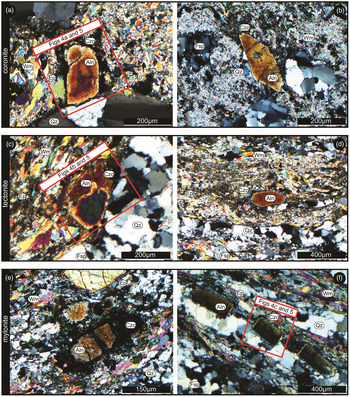
The microstructural analysis (in optical microscopy) reveals that, in all strain domains, Aln occurs as mm-sized single crystals characterised by high birefringence and dark-brown (cores) to light-brown (rims) pleochroism. The Aln crystals are surrounded by blueschist-facies metamorphic assemblages consisting of Czo rims, fine-grained aggregates of Wm + Pl + Ep and large crystals or aggregates of Qz. The photolith of the analysed metagranitoids consists of a granodiorite (Fig. 2a,b), according to the bulk-rock chemistry estimated on modal mineral content and mineral chemistry (data in Corti et al., Reference Corti, Alberelli, Zanoni and Zucali2018).
Estimated bulk-rock composition based on the integration of modal mineral content, mineral chemistry and CIPW normative analysis. Allanite-(Ce) crystals (Corti et al., Reference Corti, Alberelli, Zanoni and Zucali2018) from coronitic (yellow), tectonitic (orange) and mylonitic samples (red). Analysed samples are represented by filled circles. (a) QAP diagram used to classify granitoid rocks - Q: quartz; A: alkali feldspar; P: plagioclase (normalised to 100%). (b) Metagranitoid samples plotted on TAS diagram (modified after Middlemost, Reference Middlemost1985).

Coronitic domains are medium- to coarse-grained rocks showing a well-preserved magmatic texture with igneous mineral relics only partially replaced by Alpine metamorphic assemblages (Table 2). These domains are (volumetrically) constituted by Qz (20–25%), Pl (15–20%), Kfs (10–15%), Wm (10%), Grt (10%), Ep (7–10%), Aln (5%), ±Amp (<5%) and ±Opq (<5%). The igneous minerals such as Bt, Kfs and Aln constitute ≈ 20–30% of the rock volume. Tectonitic domains consist of fine- to medium-grained rocks that contain Qz (30–40%), Wm (15–20%), Ep (15–20%), Grt (5%), Amp (5%), Kfs (5%) and Aln (3%). These domains mostly show a well-developed foliation marked by shape-preferred orientation of Qz and aggregates of Wm and Ep (Table 2). Mylonitic domains consist of fine-grained rocks showing a millimetre-spaced foliation defined by the shape-preferred orientation of Wm, Ep and Amp that wraps porphyroblasts of Grt and porphyroclasts of Kfs (Table 2). These rocks are constituted by Qz (40–50%), Wm (15–20%), Ep (12–15%), Grt (5–7%), Amp (5–10%) and Aln (<5%). In tectonitic and mylonitic domains, igneous Kfs (<5%) and Aln (<5%) constitute less than 10% of the rock volume and the new planar fabrics largely overprint igneous textures.
Summary of the modal mineral fraction, the mineral growth-deformation relationships, and the features of allanite-(Ce) crystals vs. host rock matrix microstructures for the six analysed samples. Long side of the crossed polars microphotographs is 14 mm. SPO – shape preferred orientation.

In coronitic domains, Aln occurs in well-formed 50–200 μm-sized crystals (Fig. 3a), surrounded by Czo, Wm and Ep (Fig. 3b). In tectonitic domains, the Aln crystal size is similar but the corona of Czo is more developed (Fig. 3c) and is wrapped by the dominant foliation (Fig. 3d). The microstructural analysis of evolution of superposed fabrics and related mineral assemblages suggests that Aln pre-dates the Alpine metamorphism and it is interpreted as a magmatic relict (Table 2). In mylonitic domains, the dominant S2 is a spaced and discontinuous foliation marked by microlithons of Qz and Fsp, and films of Wm, Ep and Czo, which wrap millimetre-sized Aln porphyroclasts. The Aln crystals are aligned and commonly boudinaged along S2 (Fig. 3e), without evidence of plastic deformation (Table 2). In contrast, the matrix minerals, such as Qz, Wm, Fsp, Czo and Ep show evidence of plastic deformation and grain-size reduction (Fig. 3f). Crystal plasticity and grain reduction increase with the DFE (e.g. Punturo et al., Reference Punturo, Cirrincione, Fazio, Fiannacca, Kern, Mengel, Ortolano and Pezzino2014), making the solid-state flow itself more efficient in further decreasing the matrix grain size; these processes all contribute to increase the rheology contrast of matrix minerals against stiffer phase-forming porphyroclasts. The lack of plastic deformation suggests that Aln porphyroclasts experienced passive rotation during the development of S2 that results in shape-preferred orientation, which is more evident the higher the total strain accumulated by the host rock. Details on petrography and microstructures of metagranitoids are in Corti et al. (Reference Corti, Alberelli, Zanoni and Zucali2017, Reference Corti, Alberelli, Zanoni and Zucali2018).
Microstructural features of the analysed Aln crystals (crossed polars). In coronitic domains (a: sample C1, UTM: 417087–5059526; b: sample C2, UTM: 415879–5060637), Aln occurs in well-preserved single crystals rimmed by Czo and surrounded by fine-grained rock-matrix constituted by Wm + Ep + Qz. In tectonitic domains (c: sample T1, UTM: 415994–5058867; d: sample T2, UTM: 4159071–5059737), the Aln porphyroclast is partially replaced by Czo and wrapped by a Wm + Ep + Qz + Fsp assemblage marking the S2 foliation. In mylonitic domains (e: sample M1, UTM: 416137–5059099; f: sample M2, UTM: 415699–5058603), Aln crystals are aligned and boudinaged along S2 that is constituted by a Qz + Wm + Fsp + Czo + Ep assemblage. The location of the X-ray maps is shown (red rectangle).

Chemical imaging
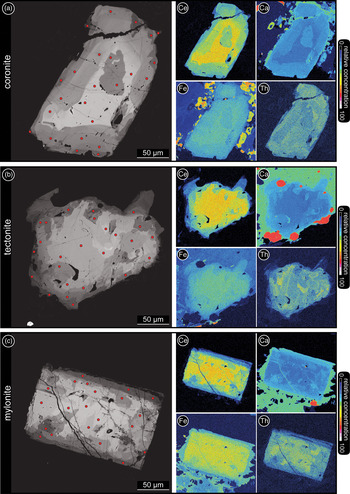
X-ray elemental mapping of the selected Aln crystals from the different strain domains reveals evident mineral zonation, especially related to the relative concentration of Ca, Ce, Fe and Th (Fig. 4). An increase in the proportion of Ca and decrease in the proportions of Fe, Ce and Th towards the Aln rim (Fig. 4 and Table 1) are consistent with the substitution mechanisms relating Aln and Czo: REE 3+ + M 2+ → Ca2+ + M 3+ (Armbruster et al., Reference Armbruster, Bonazzi, Akasaka, Bermanec, Chopin, Gieré, Heuss-assbichler, Liebscher and Menchetti2006).
Back-scattered electron images and X-ray elemental maps (WDS: Ce and Th; EDS: Ca and Fe) of an Aln crystal in a: (a) coronitic domain; (b) tectonitic domain and (c) mylonitic domain. Red circles indicate the position of the mineral chemical analyses in Aln. The chemical pattern shows as the concentric zonation in coronitic domain is mostly given by the decrease of Ce content and the increase of Ca and Fe contents towards the crystal rim. The element partitioning generates patchwork and en-echelon-like chemical zonation in tectonite and mylonite domains, respectively.

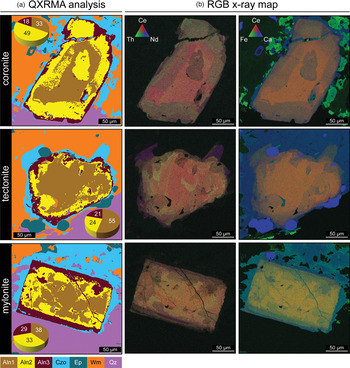
The QXRMA procedure is a powerful tool for quantitatively defining the spatial distribution of Aln chemical zoning and to discuss this chemical variation in relation with the strain domains. The first cycle of QXRMA analysis allows the mineral classification within the three microdomains. The classified pixels are 99.98%, 99.87% and 99.93% for the images related to coronitic, tectonitic and mylonitic domains, respectively. The identified mineral phases are Aln, Czo, Ep, Wm and Qz (Fig. 5), which correspond to the pre-Alpine Aln porphyroclasts, and Alpine Czo, Ep, Wm and Qz blueschist-facies mineral associations.
(a) QXRMA results, with type and spatial distribution of the mineral species, along with the modal fraction of Aln chemical zoning in relation with the domains of progressive strain. (b) RGB X-ray maps that show Ce–Th–Nd and Ce–Fe–Ca patterns within Aln crystals in relation with the domains of progressive strain. A clear decrease of Ce content in all strain domains, concentric zonation in the coronitic domains, patchwork zonation in the tectonitic domains, and en-échelon-like zonation in the mylonitic domains, oblique with respect to S2, are evident in Aln porphyroclasts.

The second cycle of QXRMA analysis reveals three major chemical zones in Aln: Aln1, Aln2 and Aln3 as shown in Fig. 5a. In general, Aln1 constitutes the core and Aln3 the rim in the crystals from all strain domains, though the relative proportion of Aln1, Aln2 and Aln3 may change (Fig. 5a). These three zonations are defined by the relative variation of LREE–Fe2+vs. Al–Fe3+–Ca concentrations, which is characterised by LREE–Fe2+ depletion and Al–Ca enrichment from Aln1 to Aln3 (Fig. 5b; Table 1). The LREE partitioning shows as the concentric zonation in coronitic domain is given by the Ce-rich core and Th/Nd-rich rim, whereas the chemical zoning in tectonitic and mylonitic domains is elongated according to the S2 foliation. The RGB X-ray map analysis reveals differences in the chemical pattern of LREE elements, such as Ce, Nd and Th, in relation to the strain domains (Fig. 5b). These elements generate patchwork and en-échelon-like chemical zonation in tectonite and mylonite domains, respectively (Fig. 5b). En-échelon-like chemical zonation forms an angle of ~30° with respect to S2 in rock matrix.
Mineral chemistry
Allanite crystals show homogeneous chemical variation from core to rim (LREE depletion and Al enrichment from Aln1 to Aln3; Fig. 6). Regardless of the strain domain, allanite-(Ce) crystals show Ce depletion and Nd enrichment from Aln1 to Aln3 (Fig. 7). The chemical zoning is highlighted by the Ce/LREE and Ca/LREE ratios vs. Al partitioning, and follow a linear trend of LREE depletion and Al enrichment from Aln1 to Aln3 (Figs 8a,b).
Total LREE vs. Al content diagram shows the chemical variation in allanite-(Ce) crystals from core (Aln1) to rim (Aln3) in the different strain domains (circle: coronite, diamond: tectonite, triangle: mylonite).

Ce–Th–Nd triangular plot showing the chemical variation in allanite-(Ce) crystals from core (Aln1) to rim (Aln3) in the different strain domains (circle: coronite, diamond: tectonite, triangle: mylonite).

Chemical variation in allanite-(Ce) crystals from core (Aln1) to rim (Aln3) in the different strain domains (circle: coronite, diamond: tectonite, triangle: mylonite). (a) Ca/LREE ratio vs. Al content. (b) Ce/LREE ratio vs. Al content.

Allanite-(Ce) in coronitic and tectonitic domains displays a similar chemical pattern: Ce/LREE-richer core (Fig. 8b) and a generally higher Al content than Aln in mylonitic domains. The lowest Ce/LREE values in all Aln zonations represent a common feature in mylonitic domains (Fig. 8b). In Aln3 from mylonitic domains, the Ca/LREE ratio shows the highest values, and this ratio in Aln3 progressively decreases in tectonitic and coronitic domains (Fig. 8a).
Single crystal X-ray diffraction
As shown in Fig. 9, the XRD patterns of the crystals of allanite-(Ce) investigated, from three different domains (i.e. C1 – coronitic, T1 – tectonitic and M2 – mylonitic), show diffraction spots with approximately circular sections (maximum ellipticity ratio: 1.2:1) and a similar full-width-at-half-maximum (FWHM), in turn similar (within 3σ) to those of unstrained gem-quality epidote crystals (previous studies by Gatta et al. Reference Gatta, Meven and Bromiley2010, Reference Gatta, Alvaro and Bromiley2011a, using the same experimental set-up as this present study). In other words, there is no evidence of potential textured patterns (on some specific crystallographic planes) and this is irrespective of the different strain domains of the sample (i.e. coronite, tectonite or mylonite).
Unwarped single-crystal X-ray diffraction patterns (based on raw data) of the allanite-(Ce) crystals from the different strain domains (C = coronitic, #1.10; T = tectonitic, #5.5; M = mylonitic, #8.1, see also the Supplementary material).

The structure refinements based on the six data sets (i.e. #3.10, #3.11 and #1.10 from the coronitic C1, #5.3 and #5.5 from the tectonitic T1 and #8.1 from mylonitic M2 domains; see the Supplementary material) are of similar quality, as shown by the values of the statistical parameters: R int ≈ 0.03–0.04, R(F)obs ≈ 0.03–0.04, wR(F 2)obs ≈ 0.05–0.06 (see the Supplementary material). All the least-squares refinements produce similar atomic coordinates (and therefore similar bond distances and angles of the coordination polyhedra) along with their anisotropic displacement parameters (excluding the proton site, which was modelled isotropically). In the structure refinements of this study, the anisotropic displacement factor exponent of each atomic site is modelled on the Gaussian approximation, with the form: –2π2[(ha*)2U 11 +(kb*)2U 22…+ 2hka*b*U 12], according to Fischer and Tillmanns (Reference Fischer and Tillmanns1988). The individual atomic anisotropic displacement parameters may represent atomic motion or possible static displacive disorder. When a given crystallographic site is populated by a multi-elemental population, its anisotropic displacement parameter can be virtually pronounced in response to the different displacement of the elements from the centre of gravity. This could be the case for allanite-(Ce), in which (at least) A1, A2 and M3 sites are affected by multi-elements site population. Despite that, the refined atomic displacement ellipsoids, pertaining to all the six structure refinements of this study, are all in line with those usually found in gem-quality unstrained crystals (i.e. with a modest ratio of the longest and shortest root-mean-square components of the ellipsoids, <1.7–2.0) and, in turn, very similar (per each relative crystallographic site) among the six refinements. For example, Fig. 10 shows the refined structure model based on the X-ray intensity data generated by the crystal #8.1, belonging to the mylonitic domain M2 (i.e. the most strained one), with the atomic displacement probability factor at 99%.
The anisotropic structure refinement of the Aln crystal (#8.1) from a mylonitic domain (atomic displacement probability factor: 99%). The modest anisotropy of the atomic displacement ellipsoids is evident, in line with the previous findings for gem-quality epidote crystals (see text for further details).

Discussions
Crystallography constrains
As observed by Gatta et al. (Reference Gatta, Rotiroti and Zucali2009) for strained kyanite crystals from the Eclogitic Micaschists Complex of the Sesia Lanzo Zone, the SCXRD experiments can provide evidence of plastic deformation at two different levels, which are mutually related: (1) the first reflects the 3-dimensional periodic arrangement of the atomic sites, and it is represented by shape and size of the Bragg diffraction spots; (2) the second reflects the displacement from the centre of gravity of any given atomic site, and it is represented by magnitude and orientation of the displacement ellipsoid produced by the structure refinement. On the whole, Gatta et al. (Reference Gatta, Rotiroti and Zucali2009) ascribed the anomalous magnitude (and orientation) of the displacement parameters (i.e. with an extremely high ratio of the longest and shortest root-mean-square components of the ellipsoids, up to 4.0) and the features of the diffraction pattern (elliptical shape of the Bragg spots on the (h0l)*-plane with significantly relevant ellipticity ratio, up to 3:1, and a severe bending) of Ky to two potentially combined effects: (1) crystals were actually composed by several blocks; (2) crystals were affected by pervasive residual strain, as a result of plastic deformations and re-crystallisation (with at least two stages of growth) during the long-lived tectono-metamorphic evolution.
Allanite crystals in this study show no evidence of pervasive residual strain ascribable to a plastic deformation: (1) the SCXRD patterns are those of clearly unstrained crystals, with Bragg spots of almost circular section (ellipticity ratio up to 1.2:1) and FWHM comparable (within 3σ) to that of gem-quality unstrained epidote crystals; (2) the structure refinements provide structural models virtually identical to those of other (unstrained) allanites reported in the literature, in particular with atomic displacement parameters which are, in shape and magnitude, comparable to those reported previously.
The different behaviour of Aln and Ky cannot be ascribed simplistically to the different general symmetry of the structures (as symmetry governs the deformation mechanisms): Aln and Ky are both low-symmetry minerals (Aln is monoclinic, Ky is triclinic), with high-degrees of freedom of deformation, though the lower symmetry of kyanite permits more degrees of deformation. However, kyanite and allanite show a remarkable contrasting physical behaviour in relation with the incremental deformation, even under similar P/T ratios (e.g. Delleani et al., Reference Delleani, Spalla, Castelli and Gosso2012; Corti et al., Reference Corti, Alberelli, Zanoni and Zucali2018) and hosting rock-matrix (in both cases Qz rich). The response to the tectono-metamorphic conditions appears not to be simply related to the bulk compressibility: the isothermal bulk modulus (valid at room conditions, K P0,T0) of kyanite is K P0,T0 = 190–200 GPa (Liu et al., Reference Liu, Shieh, Fleet and Zhang2009), that of allanite is K P0,T0 = 131(4) GPa (Gatta et al., Reference Gatta, Milani, Corti, Comboni, Lotti, Merlini and Liermann2019); therefore, kyanite is drastically stiffer than allanite. In addition, the combined effect of P and T could play an important role: in situ experiments at high T (and room P) proved that Ky experiences a remarkable T-induced expansion [α0(V) ≈ 7.4 · 10–3 K–1, Gatta et al., Reference Gatta, Nestola and Walter2006] if compared to epidote-group minerals [α0(V) ≈ 5.1 · 10–5 K–1, Gatta et al., Reference Gatta, Merlini, Lee and Poli2011b]. In other words, Ky is stiffer than allanite (or epidotes, in general) at room T, but it is pronouncedly more expandable in response to the applied high T. The competing effects generating by P and T would explain the different behaviour of the two minerals.
As the plastic behaviour is expected to be governed by the crystal structure, the further question is: how does isomorphic substitution influence plastic response among the (isostructural) epidote-group minerals? The answer to this question is not trivial. The recent study of Gatta et al. (Reference Gatta, Milani, Corti, Comboni, Lotti, Merlini and Liermann2019) on the elastic behaviour of allanite under a compressional regime, which also provided a comparative analysis among the epidote-group minerals (based on previous data by Gatta et al., Reference Gatta, Merlini, Lee and Poli2011b and Qin et al., Reference Qin, Wang, Fan, Qin, Yang, Townsend and Jacobsen2016), reported that the compressional patterns among this group of minerals are different at a significant level, in terms of bulk compression and elastic anisotropy, though not drastically. The following isothermal bulk moduli were obtained: K P0,T0=131(4) GPa for allanite, K P0,T0=111(3) GPa for epidote with 0.74 Fe atoms per formula unit (apfu) and K P0,T0=115(2) GPa for epidote with 0.79 Fe3+ apfu, and K P0,T0=142(3) GPa for clinozoisite with 0.40 Fe3+ apfu. Epidote is the least stiff, clinozoisite the stiffest, and allanite is intermediate in stiffness between the two. Among the aforementioned epidote-group minerals, there are at least three variables that can generate the different compressional behaviour: the Fe3+vs. Al substitution at the M3 site (epidote, clinozoisite and allanite); the occurrence of Fe2+ at M3 in allanite; and the Ca2+vs. LREE substitution at the A1 and A2 sites in allanite.
On the basis of the structural homology among the aforementioned minerals, which governs their ‘similar’ compressional behaviour, we cannot exclude that even the other epidote-group species would experience a similar plastic behaviour as that of allanite under the same tectono-metamorphic conditions of the samples investigated here.
LREE released vs. host rock matrix total strain
The multidisciplinary approach of this study reveals that Aln can be remarkably resistant to deformation and metamorphism under a cold subduction thermal state (see Corti et al., Reference Corti, Alberelli, Zanoni and Zucali2018). Under these conditions, Aln crystals show no evidence of intra-crystalline plastic deformation from the micro- to atomic-scale along strain gradients. Aln behaves as a ‘rigid’ object, at a first approximation, in a weak rock matrix (metagranitoids with a modal amount of Qz + Wm > 60%; Table 2) and it is characterised by high mechanical strength and it is reluctant to recrystallise during polyphasic tectono-metamorphic history. Even in mylonitic domains, Aln is rigid because deformation is accommodated by the recrystallisation of Qz and Pl grains and crystal folding (e.g. Wm). In addition, it should be considered that the positive correlation of the DFE and the DRP (degree of the metamorphic reaction progress, Corti et al., Reference Corti, Alberelli, Zanoni and Zucali2017, Zucali et al., Reference Zucali, Corti, Delleani, Zanoni and Spalla2020) implies that mylonitic rocks are enriched in weak mineral phases, such as Wm and Qz. In this context, the solid-state flow becomes easier as the deformation progresses. Deformation is thus responsible for a progressive interconnection of weak mineral phases (e.g. Goncalves et al., Reference Goncalves, Oliot, Marquer and Connolly2012) that eventually defines a new foliation, which makes the solid-flow easier for itself. Thus, under blueschist-facies conditions, Aln porphyroclasts can behave more rigidly, with respect to rock matrix, in mylonite than in tectonitic and coronitic domains. Therefore, the joint effect of deformation and metamorphism is responsible for an increase of competence contrast (i.e. viscosity) between stiff and weak materials (Ramberg, Reference Ramberg1955), that is between Aln porphyroclasts and host rock matrix. Indeed, we found boudinaged Aln porphyroclasts only in mylonitic rocks.
Quantitative mineral chemical analyses and chemical imaging procedures were performed to decipher the chemical features of the Aln zoning in relation to the rock-matrix strain accumulation. The Aln chemical zoning is mostly defined by the Ca/ and Ce/LREE ratio. The high Ca fraction in the Aln3 sample may be due to a more progressed metamorphic transformation, especially in mylonitic domains. Despite a general Al depletion in the mylonitic domains, the analysed Aln crystals show a similar LREE content within the inner zoning (i.e. Aln1, Aln2). The chemical variation became appreciable in the outermost zoning (i.e. Aln3) and in mylonitic domains, the Aln3 shows even lower LREE contents than Aln3 in coronitic and tectonitic domains (Fig. 8a,b).
The QXRMA procedure reveals that elements such as Ce, Nd and Th build up patchwork and en-échelon-like re-arrangement of Aln zoning in tectonitic and mylonitic domains, respectively (Fig. 5). These chemical features might, therefore, be the effect of the strong strain partitioning between Aln and the matrix minerals at HP–LT conditions during subsequent tectono-metamorphic stages and the interplay of strain, temperature, pressure and fluids in promoting ion intracrystalline mobility.
Allanite is known as one of the main potential carriers of LREE in the mantle wedge (e.g. Hermann, Reference Hermann2002; Gieré and Sorensen, Reference Gieré and Sorensen2004; Hermann and Rubatto, Reference Hermann and Rubatto2009), because of high shielding property during subduction processes (Cenki-Tok et al., Reference Cenki-Tok, Oliot, Rubatto, Berger, Engi, Janots, Thomsen, Manzotti, Regis and Spandler2011). Combining the Ca/LREE ratio of the Aln crystals with the DFE rock-matrix estimation of each analysed sample (Table 2; Corti et al., Reference Corti, Alberelli, Zanoni and Zucali2017), it is possible to estimate the LREE release in relation with the strain accumulated by the rock-matrix during D2 (responsible for the S2 dominant foliation) tectono-metamorphic stage (Fig. 11). The LREE released during the exhumation in the subduction mantle wedge for the six analysed Aln crystals was estimated through two parameters in relationship with the DFE (Fig. 11). The first is the difference between Ca/LREE ratio in Aln1 and Aln3, normalised to the sum of Ca/LREE ratio in the three zones of a single grain. Figure 11a shows a well-defined linear regression (y = 0.2x + 20, with R2 = 0.97) between the normalised Ca/LREE ratio and the strain accumulation in the rock matrix. The second parameter is the difference between the LREE contents in Aln1 and Aln3, normalised to the sum of LREE in the three zones of a single grain (Fig. 11b), and it reflects a LREE loss parameter. The relation between LREE variations and the DFE is characterised by an exponential regression (y = 0.96e 0.06x, with R 2 = 0.96). These two correlations allow the quantification of the amount of LREE released from Aln grains in the three strain domains. In tectonite and mylonite, the amount of LREE remaining in Aln3 is insufficient for it to be allanite; instead Aln 3 is Czo, according to the IMA classification (Armbuster et al., Reference Armbruster, Bonazzi, Akasaka, Bermanec, Chopin, Gieré, Heuss-assbichler, Liebscher and Menchetti2006). We consider this composition type as a transition between Aln and Czo due to the loss of LREE resulting from deformation accumulated by rock matrix.
LREE release. (a) Normalised Ca/LREE ratio vs. D2-stage ‘degree of fabric evolution’ (DFE) estimated for each sample. The label of each sample is reported. The linear regression and the related coefficient of determination between Ca/LREE ratio during the D2 strain accumulation is reported. (b) LREE loss vs. D2-stage DFE estimated for each sample. The exponential regression and the related coefficient of determination between LREE released during the D2 strain accumulation is reported.

Our results show that Aln appears to be able to carry and release LREE under HP-LT conditions if the surrounding rock matrix accumulates high total strain and metamorphic transformation. Indeed, Aln in mylonitic rocks shows higher Ca/LREE and LREE loss parameters than Aln in tectonitic and coronitic domains (Figs 8a and 11). The diagrams in Fig. 11 show that from coronite to mylonite the increase of the two parameters is continuous, and by comparing Fig. 11 with Table 2 a positive correlation of these two parameters with the quantitative estimates of the DFE is evident. Therefore, a LREE loss of 1–2%, 15–38% and 72–88% (Fig. 11b) and increase of Ca/LREE parameter of 20–21%, 28–30% and 34–38% (Fig. 11a) are estimated for coronitic, tectonitic and mylonitic domains, respectively. The two parameters increase from coronite to mylonite but with a linear and exponential trend for Ca/LREE and LREE loss, respectively. The high Ca/LREE value and LREE loss parameters may be due to a more progressed metamorphic transformation facilitated by high strain accumulation in mylonitic domains. During mylonitic deformation, fluid may be driven more effectively into local low stress domains than during development of tectonitic and coronitic textures. For instance, these low stress domains are strain shadows around allanite prophyroclasts, and fluids coming in may leach away incompatible elements (i.e. LREE) from allanite.
Conclusion
This work shows that allanite-(Ce) enclosed in metagranitoids under a subduction thermal state and blueschist-facies conditions do not record any plastic deformation regardless of the total strain accumulated by the host rock. The plastic deformation is accommodated by the rock matrix minerals, such as quartz, feldspar and white mica. The only evidence of deformation in allanite-(Ce) is represented by brittle boudinage in mylonitic rocks. The deformation in the rock matrix appears to be responsible for the linear chemical zoning patterns in tectonite and mylonite crystals. The total strain accumulated by hosting rocks under HP–LT has also a strong control on LREE in allanite-(Ce). The release of LREE from allanite-(Ce) is indeed facilitated if high strain and metamorphic transformation is accumulated in the surrounding rock matrix (i.e. mylonitic shear zones). Therefore, strain is a fundamental parameter to provide subduction wedges with LREE.
Acknowledgments
Peter Leverett, Geoff Bromiley, Gaetano Ortolano and the Associate Editor Edward Grew are acknowledged for their suggestions that improved the quality of the manuscript. We thank Davide Comboni for his help with the single-crystal X-ray data collections, Andrea Risplendente for his assistance during the X-ray maps and WDS-EMPA analysis, and Manuel Roda for reading the first draft of the text. Funding by PSR2018_DZANONI and FFABR2018DZANONI, Univeristy of Milano. The authors acknowledge the support of the Italian Ministry of Education (MIUR) through the project “Dipartimenti di Eccellenza 2018–2022, Le Geoscienze per la Società: Risorse e loro evoluzione”.
Supplementary material
To view supplementary material for this article, please visit https://doi.org/10.1180/mgm.2020.4.