Thermoelectric (TE) materials, which directly convert thermal energy into electricity through the Seebeck effect, have potential application in waste heat recovery and power generation. The overall performance of a TE material is determined by the dimensionless figure of merit:
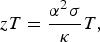 $$zT = \displaystyle{\alpha^2 \sigma \over \kappa}T\comma \;$$
where α is the Seebeck coefficient, σ the electrical conductivity, T the absolute temperature, and κ the thermal conductivity. Conventional established TE materials, such as Si-Ge alloys, Bi2Te3, and PbTe, have zT values of less than unity.[Reference Snyder and Toberer1] Recent progress in our understanding of the physics of thermoelectrics combined with advanced synthesis techniques have helped push zT values close to or even higher than two at high temperature. For example, one efficient way to increase zT is to control the structure of a material from the mesoscale to the nanoscale in order to scatter phonons with a wide range of wavelengths, resulting in low thermal conductivity without affecting the electronic transport properties.[Reference Biswas, He, Blum, Wu, Hogan, Seidman, Dravid and Kanatzidis2] Other approaches have sought to enhance the power factor (α 2σ), for instance by implementing band structure engineering,[Reference Pei, Shi, LaLonde, Wang, Chen and Snyder3] introducing resonant states,[Reference Bilc, Mahanti, Quarez, Hsu, Pcionek and Kanatzidis4] or taking advantage of energy barrier filtering.[Reference Heremans, Thrush and Morelli5] All of these methods typically require careful doping or nanostructuring, necessarily employing complex synthesis processes that involve significant energy, time, and human effort. This, together with the fact that many of the most high-performing TE materials are comprised of expensive, toxic or rare elements, presents serious impediments to the large-scale application of TE materials.
Another direct approach to increase zT is to design and synthesize TE materials with intrinsically low lattice thermal conductivity caused by large lattice anharmonicity.[Reference Morelli, Jovovic and Heremans6] One example is the newly reported copper-antimony/arsenic-sulfur ternary family of compounds known as tetrahedrite/tennantite, which occurs also as a natural mineral and is in fact the most widespread sulfosalt on Earth.[Reference Pfitzner, Evain and Petricek7, Reference Johnson and Jeanloz8] This class of compounds, of general composition Cu12−x(Zn,Fe)x(Sb,As)4S13 with 0 ≤ x ≤ 2, has a strongly anharmonic phonon spectrum, which is thought to arise from the existence of a lone pair of electrons surrounding the Sb/As atoms.[Reference Skoug and Morelli9, Reference Nielson, Ozolins and Heremans10] Compounds with Sb on the pnictide site are geologically referred to as tetrahedrite, while those with As on this site are known as tennantite, and a complete solid solution exists between these two members. Synthetic specimens exhibit a maximum zT near unity at 723 K for x = 0.5 for Zn and x = 1.0 for Fe,[Reference Lu, Morelli, Xia, Zhou, Ozolins, Chi, Zhou and Uher11] but maintain zT > 0.8 over a wider range of x. The natural mineral, on the other hand, typically has x ~ 2, corresponding to a copper composition near 10.0, and is almost insulating.[Reference Johnson and Jeanloz8] We have suggested earlier[Reference Lu, Morelli, Xia, Zhou, Ozolins, Chi, Zhou and Uher11] that the natural minerals themselves may serve directly as source TE materials if their compositions can be adjusted to fall into the optimum range for thermoelectricity, namely a Zn (Fe) concentration of 1.0–1.5, corresponding to a Cu concentration of 10.5–11.0. In this spirit, a method of mixing natural mineral tetrahedrites with synthetic Cu12Sb4S13 was developed by our group, in order to “dilute” the Zn concentration of the natural mineral; this process successfully produces material containing up to 50% natural mineral with zT once again near unity.[Reference Lu and Morelli12] This result is very exciting because it can make use of large amounts of natural mineral tetrahedrite directly to produce high-performing thermoelectrics. However, the processing of synthetic Cu12Sb4S13, used to optimize the composition of the natural mineral, employs a traditional solid state reaction followed by at least a one week anneal, which still requires significant energy and time.
High-energy ball milling has been used as an efficient method to synthesize TE materials at fully scalable quantities from a few grams to kilograms in a few hours, especially for simple binary compounds such as Si1−xGex alloy[Reference Joshi, Lee, Lan, Wang, Zhu, Wang, Gould, Cuff, Tang, Dresselhaus, Chen and Ren13] and Bi2Te3.[Reference Poudel, Hao, Ma, Lan, Minnich, Yu, Yan, Wang, Muto, Vashaee, Chen, Liu, Dresselhaus, Chen and Ren14] However, for more complex systems, high-energy ball milling synthesis often requires additional heat treatments[Reference Li, Sui, Pei, Barretean, Berardan, Dragoe, Cai, He and Zhao15] or gives rise to noticeable second phase.[Reference Zevalkink, Toberer, Zeier, Flage-Larsen and Snyder16] In this article, we present a rapid method of synthesizing tetrahedrite TE material by high-energy ball milling of natural mineral powder mixed with small amounts of elemental Cu, Sb, and S powder, followed by consolidation using hot pressing. The details of this procedure are provided in the Supplementary online materials. A key feature of this process is that it requires no additional heat treatment. We show that the presence of the natural mineral tetrahedrite acts as a “seed matrix” that accepts the additional elements into its structure, thus modifying the composition to yield high zT of approximately 0.9 at 723 K. This value compares very favorably with other p-type TE materials in this temperature region. To the best of our knowledge, this might be the most efficient and economical method for processing TE materials with high performance in the intermediate high-temperature range (600–700 K), thus offering a promising route to cost-effective, large-scale application in harvesting of waste heat.
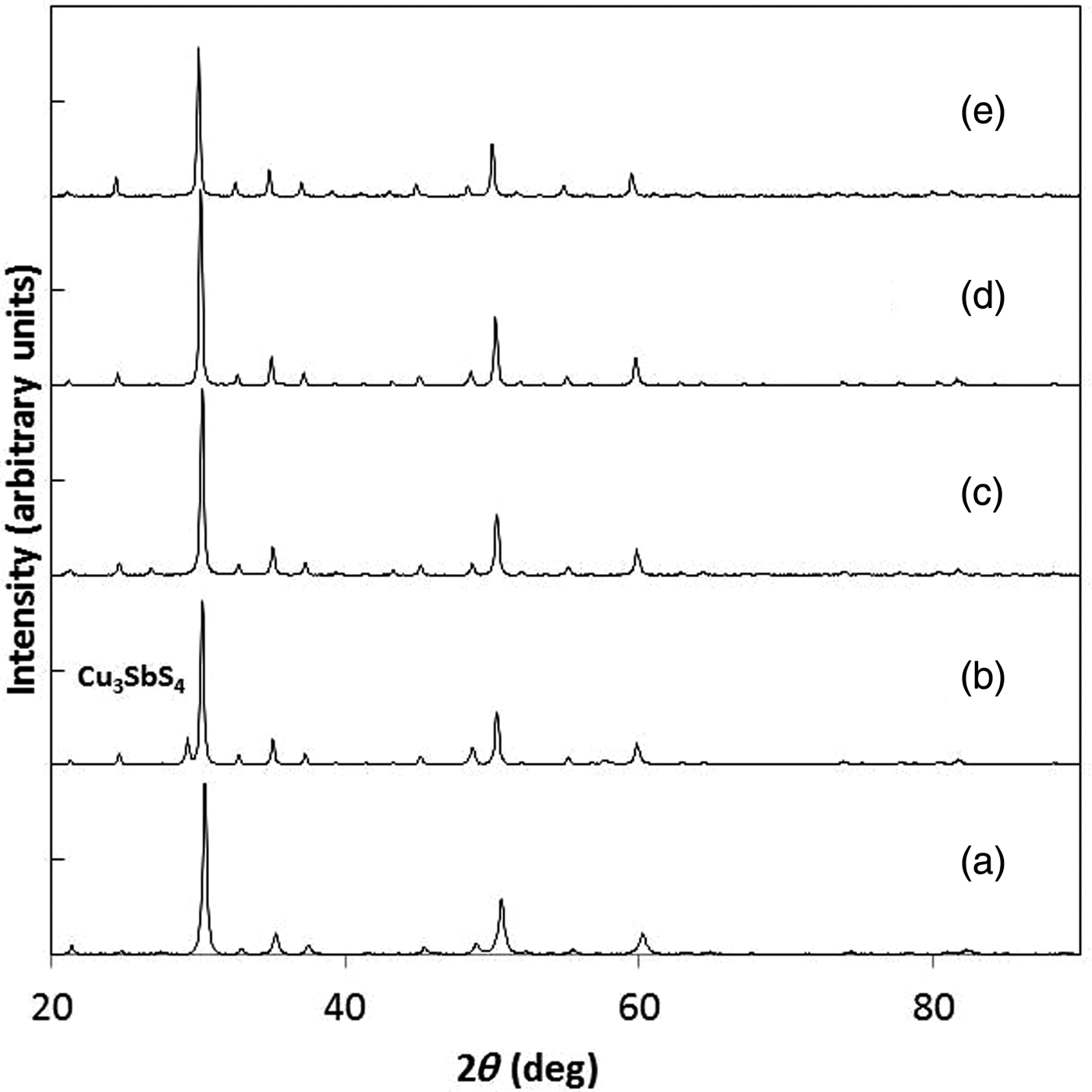
X-ray diffraction (XRD) patterns of samples made by mixing 50% by weight natural mineral (nominal composition Cu9.7Zn1.9Fe0.4As4S13) with Cu, Sb, and S powders (the latter in a molar ratio of 12:4:13), as a function of ball milling time, are displayed in Fig. 1. Also shown in this figure, for comparison, are the patterns for pure synthetic Cu12Sb4S13 and the pure natural mineral. The latter two samples exhibit a single-phase pattern corresponding to the tetrahedrite (or tennantite) crystal structure; the peaks are shifted in these two samples primarily due to different atoms on the pnictide site. Peaks corresponding to the tetrahedrite structure for the ball-milled samples lie between the patterns of pure synthetic Cu12Sb4S13 and pure natural mineral, indicating good mechanical alloying effect. For the sample milled for 1 h, a noticeable pattern of Cu3SbS4 (famantite) phase was observed. As we describe below, this phase forms readily when Cu, Sb, and S are ball milled together alone without the natural mineral present. When the ball milling time is increased to 3 h, this impurity phase of Cu3SbS4 becomes minute; after 6 h of milling, the sample is almost exclusively tetrahedrite structure with only a trace amount of Cu, which we observe in all of the ball-milled samples. These XRD thus show that milling the elemental powders for 3–6 h is sufficient to form single-phase tetrahedrite solid solution in the presence of the natural mineral. To verify the role of the natural mineral as a “seed matrix” for formation of a single-phase tetrahedrite structure, we ball milled the pure elements in the ratio of 12:4:13 without the presence of the natural mineral. After 6 h of ball milling, the final product has at least 50% Cu3SbS4. Therefore, we reach the conclusion that natural mineral serves as a parent matrix, efficiently absorbing Cu, Sb, and S elements into the crystal structure, altering its composition but maintaining its single-phase tetrahedrite character.
XRD spectra for tetrahedrite samples with 50 wt% pure element addition: (a) pure mineral of nominal composition Cu9.7Zn1.9Fe0.4As4S13; (b) the specimen with 1 h ball milling; (c) the specimen with 3 h ball milling; (d) the specimen with 6 h ball milling; (e) synthetic Cu12Sb4S13. After only 1 h of milling there is evidence of impurity phase Cu3SbS4. After 3 and 6 h of milling this phase is absent. The x-ray peaks for the sample made from a mixture of elements and natural mineral lie between those of the natural mineral and synthetic tetrahedrite, indicating that a solid solution is formed with composition shifted in the direction of larger copper concentration.

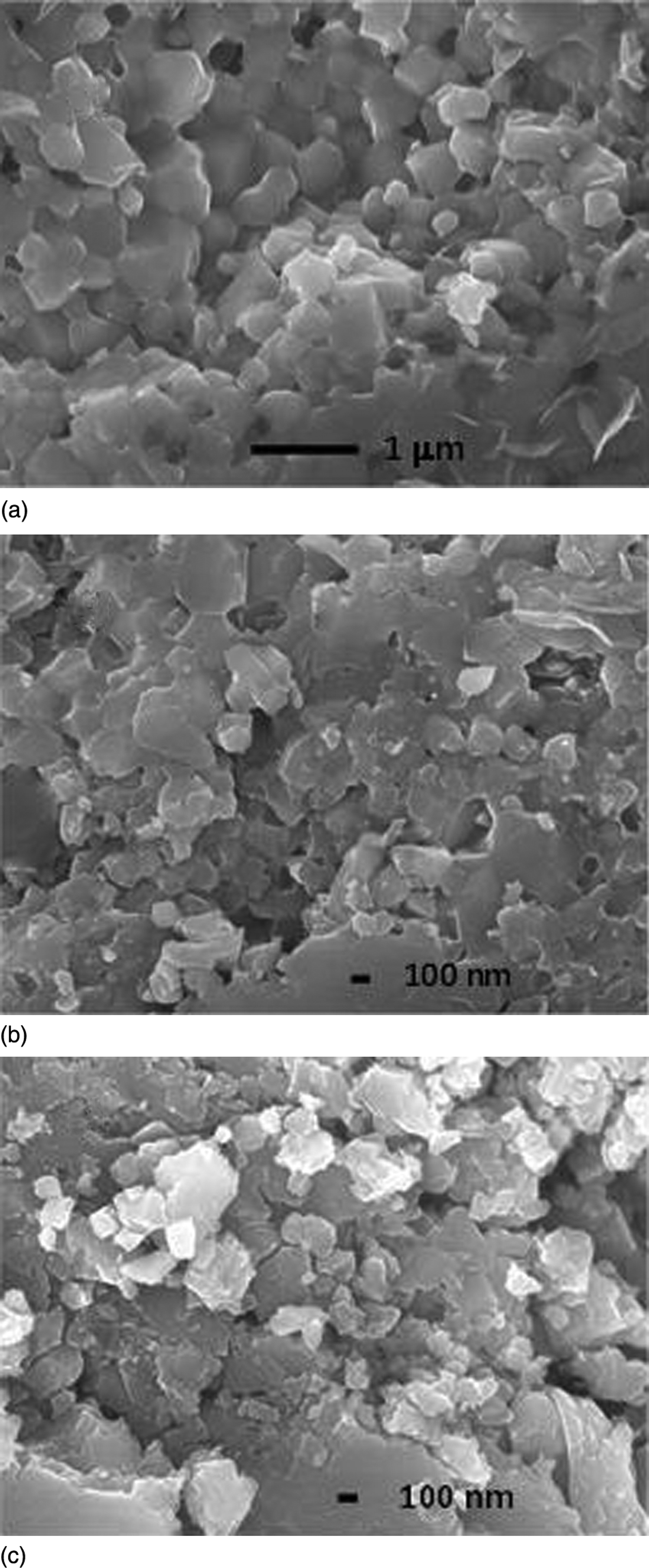
Scanning electron microscope images of fracture surfaces of a disk hot pressed using powder consisting of 50% elements and 50% natural mineral as a function of ball milling time are shown in Fig. 2. As the ball milling time is increased from 1 to 3 h, the average grain size is reduced from 330 to 180 nm; milling for 6 h, however, reduces the grain size to only 150 nm. Detailed energy-dispersive X-ray spectroscopy mapping results (see Supplementary online material) show that all of the major elements are homogeneously distributed in the sample without any sign of segregation. It is quite remarkable that, while forming the tetrahedrite phase by synthesis directly from the elements requires a very extended anneal (one week or longer), the elements can be incorporated readily into the natural mineral tetrahedrite matrix simply by mechanical alloying.
Scanning electron microscope images for a sample with 50%wt pure element addition: (a) the specimen with 1 h ball milling; (b) the specimen with 3 h ball milling; (c) the specimen with 6 h ball milling. The average grain size for the three cases is 330, 180, and 150 nm, respectively.
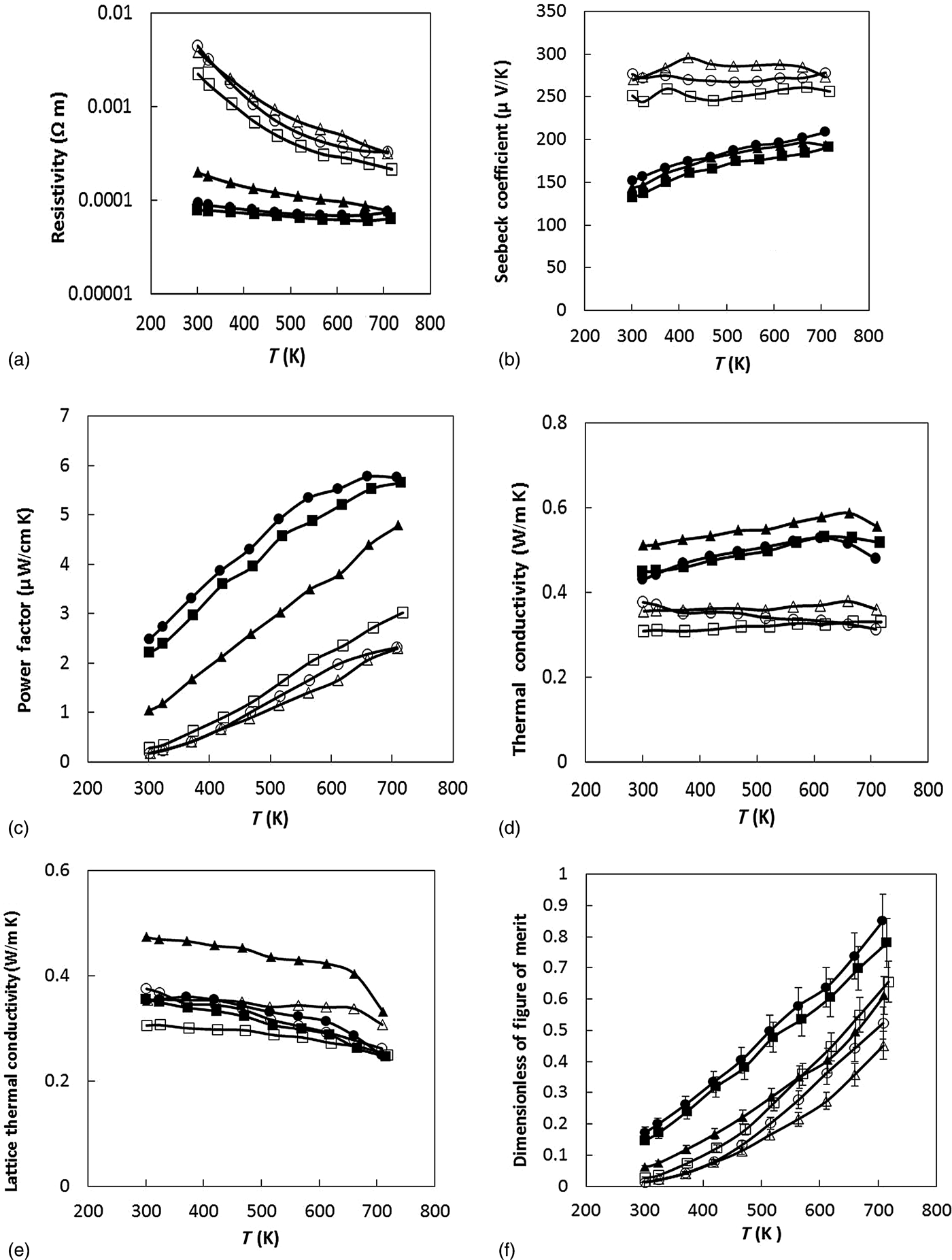
Figure 3 shows the temperature dependence of the TE properties of the mixture of natural mineral and pure elements after ball milling and consolidation. Samples with 25 and 50 wt% pure elements added to the natural mineral for different ball milling time were investigated. We use a simplified notation to describe different samples. For example, 50%–3 h means the sample has 50 wt% pure elements addition and a 3 h ball milling time. In our previous study, we showed that the pure synthetic Cu12Sb4S13 is a semimetal with the Fermi level located in the valence band, and therefore this compound has a low resistivity of ~10−5 Ω m. When Zn or Fe replace Cu, forming Cu10−x(Zn,Fe)xSb4S13, the Fermi level gradually moves up close to the top of the valence band. For x = 2, the Fermi level lies in the gap, the magnitude of which is 1.2–1.7 eV,[Reference Lu, Morelli, Xia, Zhou, Ozolins, Chi, Zhou and Uher11, Reference Jeanloz and Johnson17] and the compound becomes insulating at room temperature. As mentioned above, the Zn(Fe) substitution value of the natural mineral we used in this study is close to 2. Notably, by adding Cu into the natural mineral (along with stoichiometric amounts of Sb and S), we are able to move the Fermi level back down close to the top of the valence band in order to optimize the transport properties. As can be seen from Fig. 3(a), the resistivity of samples with 50 wt% pure element addition is 5–6 times smaller than that of 25 wt% element addition samples. Increasing the ball milling time from 1 to 3 h reduces the resistivity for a given composition since the additional milling suppresses the amount of the impurity Cu3SbS4 phase. When the ball milling time was extended to 6 h, the resistivities increase for both 25 and 50 wt% additions, which is typical for ball milling synthesis with extended ball milling time. The contamination from the milling media and wear on the jar, an increased density of nanosized defects on the surface of grains[Reference Bux, Blair, Gogna, Lee, Chen, Dresselhaus, Kaner and Fleurial18] and strain in the crystal lattice induced by ball milling[Reference Heremans, Thrush and Morelli5] may all contribute to the degradation of electrical properties.
Electrical and thermal transport properties of all samples in this study. The sample designations are as follows (the first number indicates the weight percent of pure elements added to the natural mineral specimen, and the second number indicates the hours of ball milling): open triangles: 25%–1 h; open squares: 25%–3 h; open circles: 25%–6 h; (a) electrical resistivity as a function of temperature. Compared with the natural mineral, which is insulating, samples containing 25 and 50% added elements are good electrical conductors, indicating that the hole concentration has been increased. The Seebeck coefficient, (b), decreases as the pure element content is increased but still remains large in all samples, leading to modestly large power factor (c). The total thermal conductivity (d) is well below 1 W/m/K, and the lattice thermal conductivity (e) is close to the theoretically minimum thermal conductivity for a solid. As a result, the dimensionless figure of merit (f) rises close to unity at 723 K for samples containing 50% natural mineral, rivaling values for state-of-the-art p-type thermoelectrics in this temperature range.
The amount of pure element addition also has significant effect on the Seebeck coefficient, which is shown in Fig. 3(b). For the 25 wt% element addition samples, the Seebeck coefficients are all between 250 and 300 µV/K while for 50 wt% element addition samples, the Seebeck coefficients are reduced to 150–200 µV/K due to an increase in the carrier concentration. The power factor results shown in Fig. 3(c) indicate that the 25% pure element addition samples have a maximum value of power factor of 3 µW/cm/K2 with 3 h ball milling. For the 50% pure element addition samples with 6 h of ball milling, the degradation of electrical conductivity is offset by enhancement of the Seebeck coefficient, and the power factor remains at a high value of 5.8 µW/cm/K2. Therefore, the ball milling time can be extended without degrading power factor if more pure elements are added for ball milling.
Figure 3(d) shows the temperature dependence of total thermal conductivity of all samples. The 25 wt% element addition samples have a weakly temperature-dependent thermal conductivity with values in the range of 0.3–0.4 W/m/K, indicating the intrinsic low lattice thermal conductivity from the tetrahedrite structure dominates. In contrast, the total thermal conductivity of the 50 wt% addition samples increases significantly with increasing temperature since these samples have much lower resistivity and thus a larger electronic thermal conductivity contribution that increases quickly with increasing temperature. At the highest test temperature of 723 K, the total thermal conductivity begins to decline. This same phenomenon was also found in our synthetic tetrahedrites study, and is consistent with the increase in resistivity in this temperature range. Interestingly, although sample 50%–1 h has higher resistivity than that of 50%–3 h and 50%–6 h, it still has higher total thermal conductivity over the entire temperature range. This can be explained by its larger grain size and presence of small amounts of Cu3SbS4, which has much higher thermal conductivity than tetrahedrites. The 50%–6 h sample has lower total thermal conductivity than that of 50%–3 h, resulting from both the reduced electronic part and smaller grain size. We can extract an estimate of the lattice thermal conductivity by subtracting the electronic portion as determined from the Wiedemann–Franz law. Here we choose a value of the Lorenz number equal to 2.0 × 10⁻⁸ V2/K2, appropriate for the disordered type of material studied here. The results are shown in Fig. 3(e); we see that the lattice thermal conductivity of all of the samples (except for that of 50%–1 h, which may have some second phase material) are in the range of 0.3 W/m/K, consistent with minimal thermal conductivity behavior. Combining the results for the power factor and total thermal conductivity yields the figure of merit zT, shown in Fig. 3(f). The zT value of sample 50%–6 h reaches 0.9 at 723 K, which is comparable to other p-type TE materials at this temperature. For the 25 wt% element addition samples, zT reaches 0.7 after 3 h of ball milling. These results indicate that the optimal ball milling time is variable with different amounts of pure element addition.
In conclusion, high-performance TE materials with zT of 0.9 were synthesized by using natural mineral tetrahedrite and a high-energy ball milling method. Nearly single-phase tetrahedrites with compositions optimized for TE performance were obtained after ball milling the natural mineral tetrahedrite and pure elements without additional heat treatment. The high zT value results from the intrinsic low thermal conductivity of the tetrahedrite crystal structure and the small grain size of the pressed pellets. It is believed that the process described here represents the simplest and most economical method for synthesizing high-performance TE materials, requiring neither expensive starting materials nor complex synthesis procedures, and thus has great potential for implementation in a wide range of power generation and heat recovery scale applications.
Supplementary materials
For supplementary material for this article, please visit http://dx.doi.org/10.1557/mrc.2013.26
Acknowledgments
This work was supported as part of the “Revolutionary Materials for Solid State Energy Conversion,” an Energy Frontier Research Center funded by the U.S. Department of Energy, Office of Science, Basic Energy Sciences under Award #DE-SC0001054. The authors also would like to thank Professor Eldon Case and Xiaofeng Fan for the grain size analysis.