Ventricular arrhythmias are a late complication in patients with repaired tetralogy of Fallot with sudden death being the most common cause of mortality in this population.Reference Gatzoulis, Balaji and Webber1, Reference Nollert, Fischlein and Bouterwek2 Elevated left ventricular end diastolic pressure >12 mmHg is an important risk factor for ventricular arrhythmias in tetralogy of Fallot patients.Reference Khairy, Harris and Landzberg3 Often, adolescent and adult patients with repaired tetralogy of Fallot are well compensated and highly functional, and therefore, may not have recent catheter-defined hemodynamic data.Reference Ternestedt, Wall, Oddsson, Riesenfeld, Groth and Schollin4–Reference Lu, Cotts, Agarwal, Attili and Dorfman6 Nonetheless, these patients may still be at increased risk of ventricular arrhythmias and sudden death. Therefore, reliable non-invasive assessment of diastolic function is vital for this population. Some echocardiographic measures of diastolic dysfunction have been shown to be associated with ventricular arrhythmias in tetralogy of Fallot patients.Reference Khairy, Aboulhosn and Gurvitz7 However, it is unknown how frequently repaired tetralogy of Fallot patients have normal diastolic function by echocardiogram yet have elevated left ventricular end diastolic pressure by heart catheterisation. To our knowledge, no studies evaluate the correlation of echocardiographic assessment of diastolic dysfunction with catheterisation measurement of left ventricular end diastolic pressure in this population. This study aimed to determine which echocardiographic measures were most predictive of a left ventricular end diastolic pressure >12 mmHg in patients with repaired tetralogy of Fallot.
Materials and methods
We performed a retrospective study of all patients age ≥13 years with repaired tetralogy of Fallot or pulmonary atresia with ventricular septal defect who underwent a left heart catheterisation in our Congenital Cardiac Catheterization Laboratory at Mott Children’s Hospital between 2001 and 2017. Patients who had both cardiac catheterisation with measured left ventricular end diastolic pressure and an echocardiogram performed within 7 days prior to the catheterisation were included. Any patient who had changes in cardiac medications or diuresis between the echocardiogram and heart catheterisation were excluded. This study was approved by our Institutional Review Board.
Demographic, clinical, and surgical data were obtained via chart review which included the number and type of prior cardiac surgeries and age at the time of definitive surgical repair. Any history of sustained atrial or ventricular tachyarrhythmias or placement of a pacemaker or implantable cardioverter-defibrillator was noted. Additionally, other possible causes of ventricular systolic and diastolic dysfunction were collected including known coronary artery disease, systemic hypertension, diabetes, hyperlipidaemia, and tobacco exposure.
Echocardiographic data were assessed and measured independently by the authors (AML and MDN) who were blinded to catheterisation data at the time of echocardiogram analysis. Echocardiographic assessments included left ventricular dimensions (parasternal long axis view), left atrial anterior–posterior diameter (parasternal long axis view), visual estimate of the left ventricular ejection fraction, left and right atrial enlargement (present or absent), left atrial area (apical four-chamber view), mitral valve closure time, mitral peak E and A wave velocity, mitral valve deceleration time, peak tricuspid regurgitation velocity, and the degree of mitral and tricuspid regurgitation. Septal and lateral mitral valve annular tissue Doppler velocities were also recorded. The degree of pulmonary valve insufficiency was documented with severe insufficiency defined as colour Doppler flow reversal in the branch pulmonary arteries. Right ventricular dilation and function were estimated by visual inspection. Lastly, mean mitral inflow velocity and presence or absence of pulmonary vein stenosis was documented to ensure there is no left heart inflow obstruction.
Catheterisation data were obtained from the detailed catheterisation report in the medical record. Only hemodynamic data obtained prior to any catheter-based intervention were recorded. These data included right and left ventricular systolic pressure, right and left ventricular end diastolic pressure, pulmonary artery pressure (systolic, diastolic, and mean), mean pulmonary capillary wedge pressure, and cardiac index by Fick calculation.
Data are reported as frequency and percentage for categorical variables and mean ± standard deviation or median (interquartile range) for continuous variables, as appropriate. Univariate comparisons between patients with left ventricular end diastolic pressure >12 mmHg versus those with left ventricular end diastolic pressure ≤12 mmHg were made in demographic and clinical characteristics and echocardiographic data using chi-square test or Fisher’s exact test for categorical variables and two-sample t-test or Wilcoxon rank sum test for continuous variables. For the echocardiographic variables significantly associated with left ventricular end diastolic pressure >12 mmHg (p<0.05) in univariate analysis, a receiver operating characteristic curve was used to determine an optimal cut point for each echocardiographic variable based on the best combination of sensitivity and specificity from each curve. The area under the curve determined which echocardiographic measures were most predictive of a left ventricular end diastolic pressure >12 mmHg. Diagnostic characteristics, such as sensitivity, specificity, positive predictive value, and negative predictive value, as well as odds ratio with 95% confidence interval for each optimal value were also reported. All analyses were performed using SAS version 9.4. (SAS Institute Inc., Cary, NC, USA). P-value <0.05 was considered statistically significant.
Results
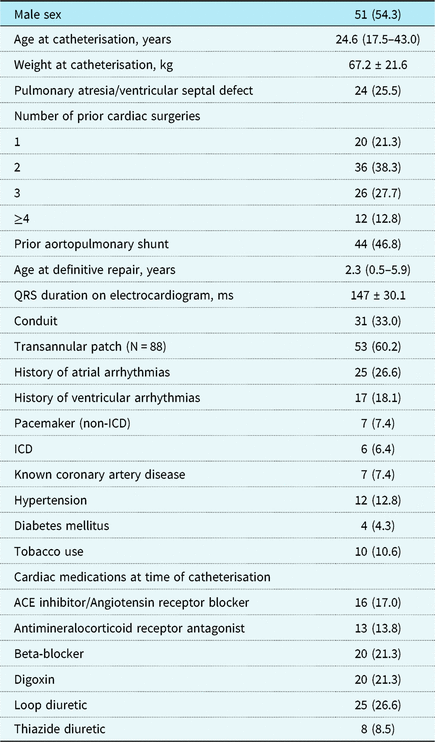
A total of 94 patients were included in the analysis. The baseline characteristics of those included in the study are shown in Table 1. The echocardiographic characteristics of all patients in the cohort are shown in the online supplementary Table S1.
Patient characteristics (N = 94).

*Data are presented as N (%) for categorical variables and median (interquartile range) or mean ± standard deviation for continuous variables.
ACE = angiotensin-converting enzyme; ICD = implantable cardioverter-defibrillator; ms = milliseconds.
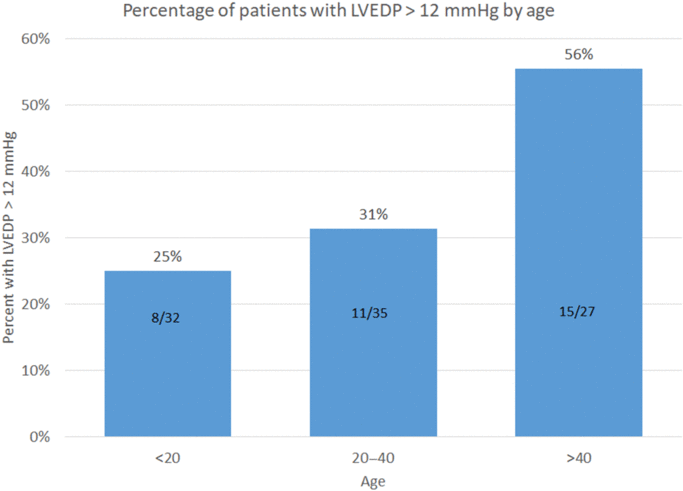
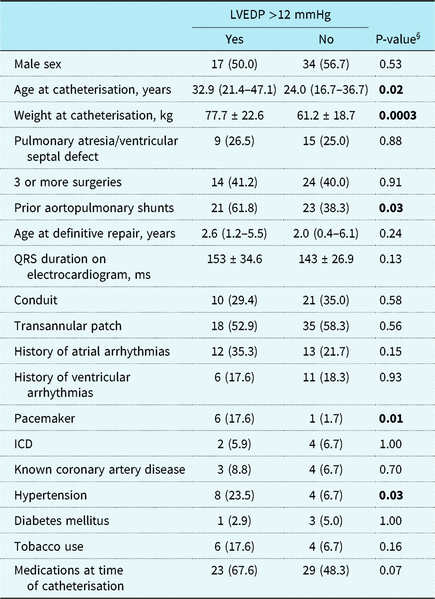
There were 34 (36%) patients who had a left ventricular end diastolic pressure >12 mmHg. The age distribution of patients with a left ventricular end diastolic pressure >12 mmHg is shown in Figure 1. Patients with left ventricular end diastolic pressure >12mmHg were older, had a higher weight at catheterisation, were more likely to have a history of an aortopulmonary shunt, more likely to have a pacemaker, and have a diagnosis of hypertension compared to those with left ventricular end diastolic pressure ≤12 mmHg (Table 2). There was no association of age at complete repair, QRS duration, or history of arrhythmia with left ventricular end diastolic pressure >12 mmHg.
Percentage of patients with left ventricular end diastolic pressure >12 mmHg broken down by age.

Association of patient/clinical data with LVEDP >2 mmHg.

*Data are presented as N (%) for categorical variables and median (interquartile range) or mean ± standard deviation for continuous variables.
§ P-value from chi-square test or Fisher’s exact test for categorical variables and two-sample t-test or Wilcoxon rank sum test for continuous variables.
ICD = implantable cardioverter-defibrillator; LVEDP = left ventricular end diastolic pressure; ms = milliseconds.
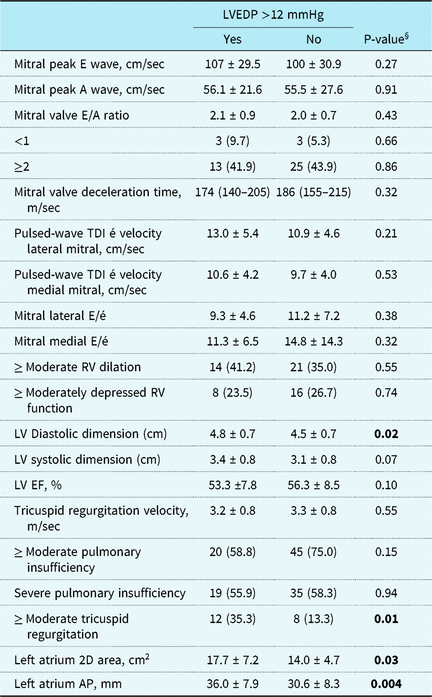
Patients with left ventricular end diastolic pressure >12mmHg had a larger left ventricular internal diameter at end diastole (mean 4.8 versus 4.5 cm, p = 0.02), larger left atrial area (mean 17.7 versus 14.0 cm2, p = 0.03), and a larger left atrium anterior–posterior diameter (mean 36.0 versus 30.6 mm, p = 0.004) (Table 3). There were no significant differences in mitral valve E/A ratio, septal or lateral e’ velocity, or E/e’ ratio between patients with left ventricular end diastolic pressure >12 versus ≤12 mmHg.
Association of echocardiogram data with LVEDP >12 mmHg.

*Data are presented as N (%) for categorical variables and median (interquartile range) or mean ± standard deviation for continuous variables.
§ P-value from chi-square test or Fisher’s exact test for categorical variables and two-sample t-test or Wilcoxon rank sum test for continuous variables.
2D = two-dimensional; A = late mitral filling velocity; AP = anterior posterior diameter; E = mitral early filling velocity; EF = ejection fraction; LV = left ventricular; RV = right ventricular; TDI = tissue Doppler imaging.
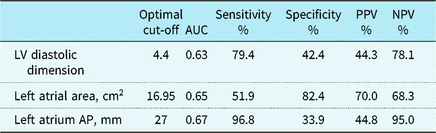
Receiver operating characteristic curves for the echocardiographic data associated with left ventricular end diastolic pressure >12 mmHg determined the optimal cut-off values (Table 4); Optimal cut-offs associated with left ventricular end diastolic pressure >12 mmHg were left ventricular internal diameter at end diastole ≥4.4 cm (area under the curve 0.63; odds ratio 2.84, 95% confidence interval 1.11–8.01), left atrial area ≥17 cm2 (area under the curve 0.65; odds ratio 5.03, 95% confidence interval 1.64–17.1) and left atrium anterior–posterior diameter ≥27 mm (area under the curve 0.67; odds ratio 15.4, 95% confidence interval 2.93–285).
Performance characteristics of (selected) echocardiogram data for predicting LVEDP >12 mmHg.

AP = anterior posterior diameter; AUC = area under the receiver operating characteristic curve; LV = left ventricle; LVEDP = left ventricular end diastolic pressure; PPV = positive predictive value; NPV = negative predictive value.
Discussion
This study found that the most reliable predictors of a tetralogy of Fallot patient having a left ventricular end diastolic pressure >12 mmHg were measures of left atrial size. Interestingly, tissue Doppler measurements including septal and lateral E/e’ ratio were not associated with left ventricular end diastolic pressure. Current echocardiography guidelines for evaluation of left ventricular diastolic dysfunction in the general population recommend assessment of annular e’ velocity, average E/e’ ratio, LA volume index, and peak tricuspid regurgitation velocity.Reference Nagueh, Smiseth and Appleton8 The guidelines mention that each signal is affected by several hemodynamic factors and that some measures may be in the normal range even in the presence of diastolic dysfunction.Reference Nagueh, Smiseth and Appleton9 Our study suggests that these typical measures may not be reliable in tetralogy of Fallot patients. For example, the presence of a ventricular septal defect patch likely makes assessment of the septal e’ velocity inaccurate. Additionally, tricuspid regurgitation velocity is unreliable as an estimate of distal pulmonary artery pressure due to the frequent occurrence of right ventricular outflow or branch pulmonary artery obstruction in this population. Our study found that echocardiographic assessment of left ventricle diastolic dysfunction in tetralogy of Fallot patients should include measurements of left atrial size and that clinicians should not conclude that there is no diastolic dysfunction if tissue Doppler measurements are normal.
Overall, there is little additional medical literature on echocardiographic assessment of left ventricular diastolic dysfunction in tetralogy of Fallot patients. One multi-centre study evaluating diastolic dysfunction by echocardiogram in adults with tetralogy of Fallot found 13.8% had left ventricular diastolic dysfunction as defined by a lateral mitral annulus e’ velocity <10 and E/e’ ratio > or = 9.Reference Aboulhosn, Lluri and Gurvitz10 This is a lower percentage of patients than would be expected in the general population of around 30%.Reference Vasan, Benjamin and Levy11 This lower percentage may be secondary to unreliable tissue Doppler in these patients. Our study found that 36% of patients had a left ventricular end diastolic pressure >12 mmHg (56% in patients over 40 years old) suggesting that the use of tissue Doppler alone is not sufficient for the diagnosis of left ventricular diastolic dysfunction in this population, albeit our cohort all underwent a heart catheterisation and may not represent the tetralogy of Fallot population as a whole.
Another study by Khairy et al. demonstrated that echocardiographic assessment of left ventricular diastolic dysfunction was associated with ventricular arrhythmias.Reference Khairy, Aboulhosn and Gurvitz7 This study suggested an E/e’ ratio of 10 as a cut-off for risk stratification. It is possible that tissue Doppler E/e’ in this study was not sensitive to pick up patients with only mildly elevated left ventricular end diastolic pressure. Therefore, patients with E/e’ ≥10 may actually have markedly elevated left ventricular filling pressure. Additionally, the majority of the patients in this study had right ventricular dilation and severe pulmonary insufficiency. The ventricular-ventricular interactions in the setting of a dilated, volume loaded right ventricle could make tissue Doppler imaging less reliable.
The present study found that measures of left atrial size were strongly correlated to left ventricular end diastolic pressure >12 mmHg. Routine congenital echocardiographic assessment of patients with repaired tetralogy of Fallot often focuses primarily on the right heart and ventricular function with little attention paid to the left atrium.Reference Carminati, Pluchinotta and Piazza12, Reference Swamy, Bharadwaj, Varadarajan and Pai13 Qualitative assessment of left atrial enlargement may be flawed in this population as these estimates are often influenced by relative size to other heart structures. Patients with repaired tetralogy of Fallot frequently have a dilated right atrium as well as a dilated aortic root. Comparisons between the left atrium and these structures could lead one to conclude that the left atrium is normal size despite actually being enlarged if measurements are made. Additionally, Baggen et al. in their study of tetralogy of Fallot left atrial dilatation suggested that the dilation may be predominantly in the craniocaudal direction possibly secondary to the dilated right ventricle, sternum, and spine preventing dilation in the anterior posterior direction.Reference Baggen, Schut and Cuypers14 This and the current study argue for the need for routine measurement of left atrial volume in tetralogy of Fallot patients.
Further study is needed with the use of both typical and novel echocardiographic measures of diastolic function in tetralogy of Fallot patients. Prospective studies should use bi-plane imaging to measure left atrial volume. Additionally, with improving technology, tissue tracking measurements are becoming more reliable and reproducible. Measures of left ventricular global longitudinal diastolic strain rate and left atrial systolic strain may have clinical utility in tetralogy of Fallot patients. Friedberg and colleagues have studied diastolic strain rate in children with tetralogy of Fallot and demonstrated that this may be useful measurement for assessment of left ventricular diastolic function.Reference Friedberg, Fernandes and Roche15 This same group has also suggested that restrictive right ventricular physiology may be associated with elevated left ventricular end diastolic pressure.Reference Ahmad, Kantor and Grosse-Wortmann16 The association of left ventricular end diastolic pressure and echocardiographic findings of restrictive right ventricular physiology could be assessed on future studies. It seems feasible that prospective studies could yield echocardiographic assessments with high specificity for left ventricular end diastolic pressure >12 mmHg. This would help risk stratify patients for ventricular arrhythmias and aid in determining who to send for an electrophysiology study or directly to primary prevention implantable cardioverter-defibrillator.
This study had several limitations including the retrospective methodology and limited sample size. Additionally, there were several echocardiographic measurements that were not available including left atrial volume due to the frequent absence of an apical two-chamber view, pulmonary vein Doppler, and many patients had absent or poor-quality tissue Doppler imaging. Over half of the patients included in this study had severe pulmonary insufficiency; therefore, the findings may not be generalisable to tetralogy of Fallot patients who have already undergone a pulmonary valve replacement.
In conclusion, typical echocardiographic measures of left ventricular diastolic dysfunction including mitral valve E/A, tissue Doppler e’, and E/e’ ratio were not associated with left ventricular end diastolic pressure >12 mmHg in tetralogy of Fallot patients. The strongest predictors of left ventricular end diastolic pressure >12 mmHg were measurements of left atrial size. Therefore, assessing risk for ventricular arrhythmias related to elevated left ventricular end diastolic pressure may not be reliable using traditional echocardiographic measures of diastolic function. Prospective studies with the use of both typical and novel echocardiographic measures are needed.
Author ORCIDs
Adam Lubert, 0000-0001-6401-9980
Acknowledgements
None.
Financial support
This research received no specific grant from any funding agency, commercial or not-for-profit sectors.
Conflict of interest
None.
Ethical standards
The authors assert that all procedures contributing to this work comply with the ethical standards of the United States national guidelines on human experimentation and with the Helsinki Declaration of 1975, as revised in 2008, and has been approved by the University of Michigan Institutional Review Board.
Supplementary material
To view supplementary material for this article, please visit https://doi.org/10.1017/S1047951119001331.