I. Introduction: The Argument
Concerns are frequently expressed about the problems of American education and how it could be improved. One important and influential strand of thinking focuses on school choice initiatives such as vouchers and associated reforms as a route to educational improvement.
One approach sees a system of vouchers and associated reforms as an end in itself — the introduction of vouchers will spur competition and innovation in education, leading to required improvements. Footnote 1 Another school of thought, however, sees vouchers as a means to a more radical option: a purely private education system. An important topical commentator in this vein is President of the Cato Institute, John A. Allison. He writes of a public school system that “has failed” Footnote 2 ; in particular, it has failed low-income and minority families. The solution is “a private educational system driven by competition and innovation.” In order to get there, we need “to privatize education initially by subsidizing the students (through tax credits or vouchers), not the schools.” These reforms “would lead to intense competition in existing education,” eventually bringing about the “ultimate goal” of “truly private schools with no subsidies.” Footnote 3
Whichever approach is taken, whether vouchers are ends or means, trivially, voucher reforms first have to be implemented. Here we run into difficulties. There are theoretical reasons why there might be implementation difficulties. Public choice theory, for instance, suggests that as government gets increasingly involved in education, vested interests within the state and its supporters are likely to thwart any action that attempts to undermine these interests, as vouchers (ceding power to parents and children) inevitably must do. Footnote 4
This essay will not pursue this strand of theoretical debate further. If the voucher movement had been successful, then few would mind that the reforms only work in practice, not in theory. However, one substantial argument against vouchers in this essay is the practical objection that reformers have been singularly unsuccessful in getting meaningfully large voucher programs adopted anywhere.
My argument does not eschew theory altogether, of course: it is based around the theory and practice emanating from the works of Milton Friedman. The paper sections are structured therefore as follows: Section I addresses the justifications for vouchers, and outlines the argument of Milton Friedman’s seminal 1955 article, “The Role of Government in Education.” Section II explores the question of how successful the voucher movement has been in getting programs adopted. Friedman set up a foundation in order to conduct high-level, research-based advocacy for vouchers and associated reforms. While the Foundation’s own assessment of the success of this effort appears upbeat, the opposite conclusion is drawn when the evidence is probed. This pessimistic conclusion, curiously, appears to be shared by Friedman himself, at least in part.
In Section III, I consider second thoughts about justifications for vouchers. It also turns out that Friedman changed his mind about justifications for vouchers. While that might be interesting on its own account, the reasons why he did so appear compelling to this author. Reading the works of E. G. West about the practice of education in nineteenth-century England and Wales, and American states led Friedman to realize that his theoretical justifications were no longer valid. Now he was ambivalent about what form reforms should take. Going for what in theory he now believed was desirable — a fully private system — was out of the question. In any case, one could achieve desirable results through vouchers, so this could be the way forward. The practical discussion of Section III, however, suggests that his approach is over-optimistic.
Section IV explores grassroots privatization. The Friedman Foundation itself points to a movement that appears more successful, at least in terms of the percentage of America’s children using it, than the voucher movement: the purely private sector. However, this is not held up as a way forward by social reformers; for any self-respecting social reform project must tackle social inequality, or show concern for the poorest or most disadvantaged. The purely private sector does not seem able to do that. Or does it? In fact, around the world, in the poorest countries and emerging economies, the purely private solution appears to be working to serve the poorest. Evidence from this movement — of low-cost private schools — shows its potential to extend access to the poor and improve educational quality.
Finally, in Section V, I pursue a thought experiment. Could something similar happen in America? The potential of creating low-cost private schools in America, that extend access to high quality education for the poor, is outlined based on market research, exploration of regulatory environments, and theoretical considerations.
The conclusion of my argument is that focusing on vouchers and associated reforms (as influential people like Allison today appear to be doing, and of course Friedman did throughout his lifetime) is likely to waste energy without tangible payoffs. But there is an alternative that could satisfy the theoretical arguments of the later Friedman and the desired goal of people like Allison, which is at least worthy of attention: The private school option is one where people can move ahead right now in the practical arena and actually make a difference, without waiting for the political climate to change, which it may never do.
Two caveats should be made at the outset: First, I have sympathy for the goal of a purely private education system and have written at length in its defense. Footnote 5 As the paper moves toward the exploration of “grassroots” privatization for America, it will assume that this defense has been made elsewhere and will not rehearse the arguments (although the discussion of Section V provides some pointers).
Second, the main focus is on vouchers and associated reforms such as tax credits/deductions, tax credit scholarships, and education savings accounts. These are “demand-side” reforms, mobilizing demand from parents in order to effect educational improvements. There are also “supply-side” reforms, notably charter schools, which focus on changing the nature of the supply of schools to improve education. These will only be briefly mentioned. However, I believe a parallel argument can be made about charter school reforms too. Footnote 6
II. Theory: The Justifications for Vouchers
In 1962, Milton Friedman published Capitalism and Freedom, his classic defense of capitalism and the economic liberal order. One chapter reprinted is his earlier 1955 article, “The Role of Government in Education,” which is the seminal statement in favor of vouchers, is a key inspiration for the current school choice movement in America. Footnote 7
The key argument built on Friedman’s economic treatment of cases where government intervention is required; the two relevant ones for education include cases in which there are externalities, or neighborhood effects, and cases in which the protection of minors principle was invoked. In the cases of neighborhood effects, “strictly voluntary exchange is impossible” as “actions of individuals have effects on other individuals for which it is not feasible to charge or recompense them.” Footnote 8
A major externality of education concerns democracy: “A stable and democratic society is impossible without a minimum degree of literacy and knowledge on the part of most citizens and without widespread acceptance of some common set of values.” Footnote 9 Education contributes to both, and “the gain from the education of a child accrues not only to the child or to his parents but to other members of the society,” that is, “the education of my child contributes to other people’s welfare by promoting a stable and democratic society.” Footnote 10 Hence, for Friedman, this is a genuine “externality.” That is, “the action of one individual imposes significant costs on other individuals for which it is not feasible to make him compensate them or yields significant gains to them for which it is not feasible to make them compensate him.” Footnote 11
This leads to justified state intervention for “the imposition of a minimum required level of schooling and the financing of this schooling by the state.” Footnote 12 The neighborhood effects argument led Friedman to propose giving vouchers to parents as a means of enhancing the educational market within the constraints of public compulsion and funding: “Governments could require a minimum level of schooling financed by giving parents vouchers redeemable for a specified maximum sum per child per year if spent on ‘approved’ educational services.” Footnote 13 Importantly, parents could supplement the sum available, and the educational services “could be rendered by private enterprises operated for profit, or by non-profit institutions.” Footnote 14 For all educational institutions, government’s role “would be limited to ensuring that the schools met certain minimum standards, such as the inclusion of a minimum common content in their programs, much as it now inspects restaurants to ensure that they maintain minimum sanitary standards.” Footnote 15
Friedman believes that compulsory schooling is required in order to bring about the desired externality of education for democracy. Compulsion implies the need for universal government funding (rather than specifically targeted only at the poor and indigent). Further reasons why it must be a universal voucher program are later outlined by Friedman: everyone, particularly the rich and middle classes, needs to be involved in a voucher system, to stimulate the kind of innovation in education that is required: “One function of the rich is to finance innovation. They bought the initial cars and TVs at high prices and thereby supported production while the cost was being brought down, until what started out as a luxury good for the rich became a necessity for the poor.” Footnote 16 With all people involved, he spells out what is required to transform education:
Change the organization of elementary schooling and secondary schooling from top-down to bottom-up. Convert to a system in which parents choose the schools their children attend — or, more broadly, the educational services their children receive, whether in a brick-and-mortar school or on DVDs or over the Internet or whatever alternative the ingenuity of man can conceive. Parents would pay for educational services with whatever subsidy they received from the government plus whatever sum they want to add out of their own resources. Producers would be free to enter or leave the industry and would compete to attract students. As in other industries, such a competitive free market would lead to improvements in quality and reductions in cost. Footnote 17
Friedman’s writings are one of the major inspirations for the School Choice movement in America. How has it fared?
III. Practice: How Successful Has the Voucher Movement Been in Getting Programs Adopted?
As part of their advocacy work, Friedman and his wife created a foundation in 1996 focused on promoting school choice in America. Usefully, the Foundation publishes a comprehensive annual survey of school choice programs in America. This publication, The ABCs of School Choice, is a comprehensive source specifically answering our question concerning the take-up of voucher and related programs. Given that it would not be in the Foundation’s interests to under-report the number and extent of such programs, this survey is used as a guide throughout this section.
A quick perusal of this document gives the sense that the school choice movement in America is successful and extensive: its summary shows “18 voucher programs in 12 states and Washington DC,” “14 tax-credit scholarship programs in 11 states,” “6 individual tax credit/deduction programs in 6 states” and “1 education savings accounts program in 1 state.” Footnote 18 There are boxes highlighting some impressive numbers — a figure of 530,000 with respect to Indiana for instance, (as discussed below). Footnote 19
A deeper look at the evidence however brings a less sanguine perspective. We’ll go through each of the types of reforms listed by the Friedman Foundation.
A. Vouchers
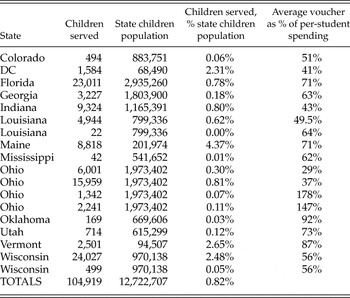
Collating the Friedman Foundation’s data into Table 1 below shows that, far from being anywhere near universal, a third (6) of these programs is risibly small: Louisiana’s voucher program has 22 students; Mississippi’s has 42 students, while Oklahoma’s has 169 children. Indeed, if we took 10,000 students as a cut off for a minimally-sized program — still very far from universal, with typical states having one million or more children — then only three programs would remain: Florida, Ohio, and Wisconsin. For 20,000 students, there are only two programs. For 25,000 students or more? There are none.
School choice in America — Voucher programs Footnote 20

Even the larger programs are tiny with respect to the proportion of the child population served. Florida (23,011 students) serves just 0.78% of the state child population. Ohio (15,959) serves 0.81%, while Wisconsin (24,027) serves 2.48%. We can leave aside the slightly unusual Maine and Vermont programs, which, while having slightly higher percentage populations served (still only 4% and 3% respectively), have no pretense at being universal, applying only to those students whose home districts do not have public schools. Apart from that, Wisconsin’s aforementioned 2.48% is the largest by percentage of state child population as well as by size. The vast majority (12 out of 18) of the programs serve less than one percent of the state child populations.
This is nothing like a universal voucher system that Friedman proposed, not even within states, let alone across the country. But what of the headline figure noted earlier, of 530,000 students from Indiana, which would seem to convey more optimism about the extent of voucher programs? This is not the actual number in the current voucher program, but the “Largest Eligible Voucher Population,” that is, the number of students across the state who are eligible to use the voucher. The headline figure of 530,000 eligible is impressive; currently, however, only 9,324 students are participating, or 0.80% of the child population of the state. True, this is just two years after approval and the figure will surely increase. And it is certainly possible, as was conveyed at a recent conference organized by the Friedman Foundation in Indianapolis, that this program will turn the tide and be the first genuinely universal voucher system in America. If this happened, the case in this paper would collapse, and its pessimism would be unwarranted.
But I am skeptical. When I was writing an earlier book, Footnote 21 I made my editor suffer last-minute changes because, as the book was going to press, my attention had been drawn to a new voucher program in Utah, which was finally going to break the mold. Revising the book I announced “Finally, the state of Utah, in February 2007, passed a bill to sign into law the first universal voucher scheme in the United States . . . by 2020 every child in the state will be able to participate in the program.” Footnote 22 I looked with keen anticipation for the Utah voucher program in the Friedman Foundation report of 2013. It is nowhere to be found. Indeed, in Utah there is only one tiny voucher program, for special needs students. It currently has 714 students enrolled in 40 schools, that’s 0.12% of the population of children in Utah. What went wrong?
Perhaps to keep myself covered, in my book revisions I had continued, “As this book is being finalized, a group called the Utahns for Public Schools, formed by, among others, the Utah Education Association, the state teachers’ union, is trying to stop” the program. Footnote 23 This was so even though “To soften the blow to government schools, if a student uses his or her voucher to transfer from a public to private school, the school district will continue to fund the school for a period of five years as if the student had not transferred.” Footnote 24 That surely would placate even the most ardent teacher unionist? I even reported the additional complexity that, procedurally, the Utahns for Public Schools had only apparently challenged half of the required bills: “Short of a court-ordered injunction,” I reported the Senate majority leader as saying, “vouchers are going forward.” Footnote 25
Yet they didn’t. The problem is that high-profile and potentially transformative voucher programs are very susceptible to political blockage, as public choice theory would predict. Footnote 26 That was the fate of the Utah program, and may well be of any others that threaten to rock the boat, such as the Indiana program.
What of other school choice reforms? Do they fare any better?
B. Education savings accounts
These “allow parents to withdraw their children from public district or charter schools and receive a deposit of public funds into government-authorized savings accounts with restricted, but multiple, uses. Those funds can cover private school tuition and fees, online learning programs, private tutoring, community college costs, and other higher education expenses.” Footnote 27 This sounds promising; however, there turn out to be only 362 children using these, in one state (Arizona). It is envisaged — providing that the political wind continues to blow in the right direction — that the program will expand from its current restrictions only to those with special needs, to include “students from the foster care system, children of active military members, and students in public schools or districts graded D or F.” Footnote 28 After expansion, however, still less than 25% of Arizona’s children will be eligible. Again, this does not seem an important program that fits with Friedman’s aspirations for universal vouchers.
C. Tax credit scholarships
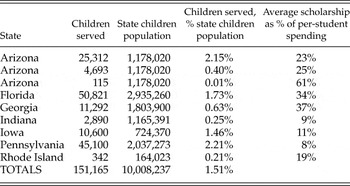
Tax credit scholarships “allow taxpayers to receive full or partial tax credits when they donate to nonprofits that provide private school scholarships.” Footnote 29 The numbers again are not large (Table 2). Data are available for nine of the 14 programs in 11 states. In total, the estimated number of recipients is 151,165, which is just 1.5% of the children in the states that have these programs. Some of these programs are again very small — with just three (Arizona, Florida, and Pennsylvania) making up 80% of all children in the programs. None of the programs is particularly generous in terms of its scholarships. Only one, for special needs and foster-care children, has an average scholarship over 50% of the total per-student spend in public schools, while the second largest program (Pennsylvania) leads to only 8% of the total per-student spend in public schools as scholarships. Other programs are tiny — the Rhode Island Tax Credits to Scholarship Organizations funds 342 students, and then only at 19% of the Rhode Island total per student amount in public schools.
School choice in America — Tax credit scholarship programs Footnote 30

One of these Tax Credit Scholarship programs is highlighted in the Foundation’s two-page summary as having the “Highest enrollment” of all school choice programs: this is the Florida Tax Credit Scholarship Program, with 50,821 students. Again putting this into context, the proportion served is very small, only 1.73% of the total children in the state. In addition, the program is very restrictive — only those “who qualify for free and reduced-price lunch or who are in foster care” are eligible — so it is very far from the desired goal of Friedman of a universal voucher (or credit) system. The fact that the average scholarship is only 34% of the total state per student funding reinforces this conclusion.
D. Individual tax credits and tax deductions
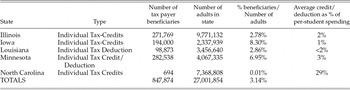
Individual tax credits and tax deductions allow parents to “receive state income tax relief for approved educational expenses,” including “private school tuition, books, supplies, computers, tutors, and transportation.” Footnote 31 Of the five programs for which data are available (Table 3), while the number of taxpayer beneficiaries at least is now beginning to look more impressive (847,874), this is still only 3% of the adult population of the states served, and only 0.36% of the total adult population of the United States. However, the average credit/deduction amount allowed, as a percentage of the total per-student spending in public schools, is derisory — only one runs into double figures. The highest is in Minnesota, where the average tax credit value is only $269 and is 3% of the total per-student funding in the state ($10,665). In Illinois, the average tax credit value is $278, only 2% of what the state spends per student on schooling ($11,739). Iowa’s program is praised by the Friedman Foundation as being “strong on student eligibility, as it is available to all students statewide.” Footnote 32 The downside is that the average amount of tax credit is $78, or less than 1% of what the state spends per student on schooling ($9,748).
The only program where the average amount of tax credit is in double figures as a percentage of the total per-student state spending is in North Carolina, where the average tax-credit value is $2,400 (29% of the $8,225 total per-student spending). The Friedman Foundation notes: “Encouragingly . . . the program has the largest individual tax credit allowance nationwide.” Footnote 33 Unfortunately, there are only 694 taxpayers participating. I suggest that we discount these programs from our overview of School Choice programs in America as being too small to be of any significance.
School choice in America — Individual tax credit/deduction programs Footnote 34

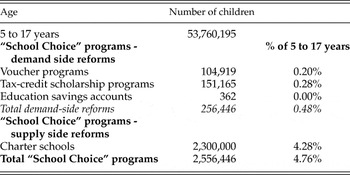
In summary, as the Friedman Foundation points out, there have been 145 years of voucher systems (the earliest began in Vermont in 1869), nearly 60 years of high-level advocacy (since Friedman’s paper in 1955), and nearly 25 years since the introduction of vouchers in America’s ‘modern’ era (in 1990). What is there to show for it? I’ve collated the data discussed above into Table 4.
School choice in America: Summary Footnote 35

America has only 0.20% of school-aged children using vouchers. A further 0.28% are on tax-credit scholarship programs, making a maximum of 0.48% of school-aged children on any kind of demand-side school choice reform. That is, only one in 500 children in America uses an educational voucher, and only one in 200 children in America has experience of any kind of voucher-like reform.
Although the focus of this essay is on demand-side reforms, for the sake of completeness, we can also add children in charter schools. More children are using these: 2.3 million students attend, adding a further 4.28% of children in America using some kind of government school choice program. Elsewhere I’ve catalogued the political “roller-coaster” of charter school reform, showing how politically fraught the whole process is. Charter schools bring in even more political instability than the voucher and tax credit schemes outlined above. There are significant caps on the number of charter schools that can be created (even though there are an estimated 600,000 children on waiting lists for charter schools), so the percentage of children in America having access to them is not likely to increase much. Footnote 36
Including all these figures, we arrive at a total of 4.76% of American children in any kind of school choice program. Or to put it another way, less than one in twenty children is touched by school choice programs in America. I’m all for looking at a glass and seeing it half-full, rather than half-empty. But this glass is most definitely 1/20 empty.
Fifty years after his seminal 1955 essay, the Cato Institute published a volume celebrating Friedman’s influence, entitled Liberty and Learning: Milton Friedman’s Voucher Idea at Fifty. Footnote 37 Friedman wrote both the prologue and the epilogue.
In the prologue, he is circumspect. Taking all of the school choice reform programs in America together, he noted, “they cover only a small fraction of all children in the country.” Footnote 38 It must have been even smaller than the 1/20 today in all school choice programs; in terms of vouchers alone, it must have been smaller than the 1/500 noted above.
Friedman also expresses how he has been “repeatedly frustrated” over the last fifty years of advocating vouchers, by the “adamant and effective opposition of trade union leaders and educational administrators to any change that would in any way reduce their control of the educational system.” Footnote 39 For instance, he gives the example of his (and Rose’s) involvement in trying to bring about in California, not a small-scale experiment, but a “statewide,” that is, within the state universal, voucher system, twice, in 1993 and 2000. In both cases, he writes, “the initiatives were carefully drawn up and the voucher sums moderate.” The costings had been carefully worked out to show the advantages. Public opinion polls only nine months or so before the elections showed “a sizeable majority in favor of the initiative”; “a sizable group of fervent supporters” were active in promotion. But then, on each occasion about six months before the election, “opponents of vouchers launched a well-financed and thoroughly unscrupulous campaign against the initiative. Television ads blared that vouchers would break the budget,” even though the carefully worked out sums clearly showed a reduction in government spending, given that the vouchers for private schools were “only a fraction of what government was spending per student.” Most sinisterly, “Teachers were induced to send home with their students misleading propaganda against the initiative. Dirty tricks of every variety were financed from a very deep purse.” In each case, these tactics won the day. “The result was to convert the initial majority into a landslide defeat.” Footnote 40 The same thing occurred, Friedman says, in Washington State, Colorado, and Michigan. “Opposition like this explains why progress has been so slow in such a good cause.” Footnote 41
In his Epilogue too, Friedman appears at best ambivalent. Certainly, in places he is optimistic, as when he outlines the desirability of universal vouchers and how this can bring competition, innovation, and experimentation into the education system (already quoted above). But he is also pessimistic: the problem is “how to get from here to there.” Footnote 42 For the kind of vouchers that have been tried in America are not the solution at all, “limited, directly or indirectly, to low-income families” (or special needs children), and not allowing parental add-ons. Progress toward Friedman’s desired kind of educational voucher has been almost nonexistent, he writes. And the reason is that
. . . centralization, bureaucratization, and unionization have enabled teachers’ union leaders and educational administrators to gain effective control of government elementary and secondary schools. The union leaders and educational administrators rightly regard extended parental choice through vouchers and tax-funded scholarships as the major threat to their monopolistic control. So far, they have been extremely successful in blocking any significant change. Footnote 43
In other words, the kinds of factors that public choice theory would point to are acknowledged by Friedman to have blocked his desired reforms.
IV. Theory: Second Thoughts about Justifications for Vouchers
Friedman’s practical frustration with voucher reforms is one thing. If one is convinced by the ideal and its theoretical justification, then one can throw off practical doubts and keep on with the struggle.
But it turns out, not only did he have practical doubts, but Friedman also had intellectual doubts: in fact, he changed his mind about his defense of vouchers. Of course, him changing his mind is itself is not significant. What is significant is why he did so: Twenty years after writing his 1955 seminal essay, Milton Friedman took part in a symposium organized around an essay by Professor E. G. West at the University of Chicago, funded by Liberty Fund. Footnote 44 Friedman’s piece is very brief — a page and a half — but of huge significance, challenging the case that he had previously put forward in defense of vouchers. Friedman wrote as follows:
Over the years, I have become increasingly persuaded that the case for (1) compulsory schooling and (2) government financing of schooling based on supposed externalities is seriously flawed. The flaw is present in my own treatment of these issues in Capitalism and Freedom . . . . Footnote 45
The problem, says Friedman, is “the failure to distinguish between marginal and average externalities.” Footnote 46 Suppose, he says — and we’ll come in a moment to the source for his hypothesis — if “private self-interest alone” would lead to the vast majority of parents providing schooling for their children: “Let me grant that I, as a representative citizen, would be better off if the fraction schooled at each level were markedly smaller.” Footnote 47 Thinking along these lines, “there is an average externality; I have benefited from other people’s behavior though, by assumption, I have paid none of these costs.” Footnote 48 But if one more child was schooled, “is it obvious that my benefit would be increased . . . ? Is it obvious that this would [say] reduce crime further?” In other words, “does not the net (positive or negative) externality from extra schooling depend on the amount to which that schooling is added?” Footnote 49
He continues,
I have never found any plausible argument for net positive externalities from schooling that would not be satisfied if 90 percent, to take an arbitrary figure, received elementary schooling — the three R’s. I have yet to see a plausible argument for any net positive marginal externality from additional schooling. But if this be so, and if private interest alone could lead to at least this much schooling — as I believe it is overwhelmingly plausible that it would — then there is no case from externalities for either compulsory schooling or the governmental financing of schooling. There may, of course, still be a case, on paternalistic or redistributive grounds, for government assistance to pay for schooling children of indigent parents, but not for increased government financing of schooling. Footnote 50
A similar, even stronger, restatement is made in 1980, when Milton Friedman, writing with his wife, Rose, observe that they are no longer convinced about the “justification for . . . compulsory attendance.” Footnote 51 Since compulsory attendance provided the justification for public finance through vouchers, the intellectual edifice for vouchers crumbled.
It is fitting that this admission is first made in a publication edited by West. For it is West’s writing that led to the Friedmans changing their minds; as I’ve made clear elsewhere, Footnote 52 I also find West’s reasoning compelling. The Friedmans write that they have become aware of research on “the history of schooling in the United States, the United Kingdom, and other countries” that “has persuaded us that compulsory attendance at schools is not necessary to achieve that minimum standard of literacy and knowledge.” The research has shown that schooling was “well-nigh universal in the United States before attendance was required,” while in the United Kingdom, it was “well-nigh universal before either compulsory attendance or government financing of schooling existed.” Footnote 53
The historical work they refer to was that of West on the history of public education in New York state, Footnote 54 and in England and Wales, and Scotland: Footnote 55 “In Britain, as in the United States, schooling was almost universal before the government took it over. Professor West has maintained persuasively that the government takeover in Britain, as in the United States, resulted from pressure by teachers, administrators, and well-meaning intellectuals, rather than parents. He concludes that the government takeover reduced the quality and diversity of schooling.” Footnote 56
This evidence is of great importance. I’ve written about it at length elsewhere. Footnote 57 For instance, considering England and Wales, before the state got involved there was almost universal schooling provision, with schools provided by church, philanthropy, and a burgeoning for-profit private sector, including for the poor. West marshals considerable evidence in this regard, including the (government) report of the Newcastle Commission of 1861, which found only 4.5% of the school-aged population not in school, and an average length of schooling for the vast majority of 5.7 years. Moreover, when finally the state did intervene, Forster’s Education Act of 1870 explicitly set out only to “fill in the gaps” left by private provision, not to provide universal state education, for such was clearly not needed. And all this was achieved with only very small state subsidies in some schools from 1833.
It was this kind of evidence that led to the Friedmans changing their minds. Although still viewing the education voucher as a useful stepping stone, by 1980 the Friedmans were in favor of something more radical: “We regard the voucher plan as a partial solution because it affects neither the financing of schooling nor the compulsory attendance laws. We favor going much farther.” Footnote 58 Where they favored going might now be characterized as a move away from the desirability of universal vouchers to an emphasis on, at most, targeted assistance: “Public financing of hardship cases might remain, but that is a far different matter than having the government finance a school system for 90 percent of the children going to school because 5 or 10 percent of them might be hardship cases.” Footnote 59
That is, by 1980, they were actually in favor of a more complete privatization of education, with government withdrawing from funding of education and compulsory schooling laws, except for, at most, a small minority of parents who are “hardship cases” (a justification based not on externalities, but on the protection of minors principle). However, rather disappointingly, in Free to Choose, the Friedmans wrote that they would not elaborate on the more radical implications of their position, recognizing that their new views “on financing and attendance laws will appear to most readers to be extreme;” Footnote 60 hence they “return to the voucher plan — a much more moderate departure from present practice.” Footnote 61 But implicit here is that vouchers are now seen as a means, not an end, to the same position that we’ve noted Allison desired, a fully privatized education system. Similarly, in a letter dated October 22, 1975, based on reviewing the material that was to be published as Nonpublic School Aid, Footnote 62 Friedman wrote; “ . . . I would be much more favorable to abolishing both compulsion and governmental financing than I would have been at the time I wrote Capitalism and Freedom. . . . [However, t]he case for vouchers remains as a superior alternative to a system of governmentally run as well as financed schools.” Footnote 63
We have seen that Friedman’s justification for a system of universal vouchers in education lost (for Friedman) its power under the historical evidence of West. We have also seen that, despite many decades of input and advocacy, very little progress has been made in terms of the take-up of voucher programs — with only one in 500 children in America benefitting from them. Even including all kinds of school choice reforms, including charter schools, we still only get to less than one in 20 children.
In practical terms, the voucher reform movement appears to have been markedly unsuccessful. Fortunately, that isn’t the end of the story.
V. Practice: Grassroots Privatization
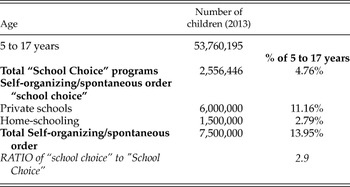
The Friedman Foundation report includes two other statistics that can give pause for thought (Table 5). The Friedman Foundation notes that there are six million students attending 34,000 private schools in the United States, and that there are over 1.5 million children being home-schooled.
School choice in America — spontaneous order Footnote 64

Sixty years of School Choice (with capital letters, referring to that brought about through government reform) has delivered fewer than 5% of American children. However, school choice (in lower case, denoting the free acts of individual parents and children, outside of government reform) has delivered three times more, 14%. Indeed, the number of children in the school choice movement is 70 times more than the number of children in School Choice voucher programs.
Children are going to private schools, paid for by parents who are not waiting for any government permission to do so. Likewise, children are being home-schooled, again without parents having to go through all the rigmaroles we’ve witnessed in terms of School Choice reform. (Of course it is true that governments can get in the way and stop these kinds of freedoms — in Germany, home-schooling is illegal, for instance, and in many countries there are restrictions on private schools. In America, there are not these same problems.) We could call this kind of school choice, the “self-organized” or “spontaneous order” kind, in contrast to School Choice which has to be sponsored by governments.
If you’re looking for a vehicle to bring about educational privatization, as a contemporary visionary like Allison is, or the Friedman Foundation, committed to following Friedman’s beliefs, might be expected to be, should you focus on reform that at most, and with considerable blood, sweat, and tears, has delivered x (School Choice), or instead focus on the spontaneous order that, with minimal fuss or bother, has delivered 3x?
I agree, 3x is still small. Fourteen percent is not a large percentage — only one in seven children. However, the self-organized, spontaneous order in education has considerably more potential than that, as we shall see in a moment.
Before doing so, of course, there is a reason why social reformers might not have considered this purely private route toward educational reform to be an option. The image of private education is primarily that it is used by the elites, or at least the middle-classes and above. Home-schooling is similar. Any proposed reform that posits a vehicle primarily used by the advantaged, rather than being accessible to the disadvantaged, would not gain ground. Implicit here, and explicit in many of the justifications for government intervention in education, is that one of the major reasons why governments should intervene in education is because it needs to do so in order to ensure universal access to quality educational opportunities, or alternatively to ensure access to quality educational opportunities for the most disadvantaged in society.
I am sympathetic to the sentiments behind these justifications, as I have written elsewhere. Footnote 65 However, I have also argued that I do not believe these values lead to any justification for wholesale government intervention in education. Indeed, the opposite is true: the values of equality or social justice can lead to a defense of educational freedom, of privatized education, rather than government control. At most, these arguments lead to welfare funding for the small percentage of very poor and/or indigent whose children would not be able to access private education (and leaves open whether this must be state funding or philanthropic).
I have argued for this using two sets of evidence. First, evidence stems from history, which I have touched on above (and which, as I suggested, shows that, apart from a very small minority, most parents were able and willing to access schooling for their children before the state got involved; this evidence was of course instrumental in Friedman changing his mind about the justification for vouchers). Second, there is important evidence from developing countries or emerging economies today, which I will outline now. In neither case were or are states required to ensure near-universal access to educational opportunities, and the educational opportunities provided outside of the state, where evidence is available, are of higher quality than those provided by the state.
The revolution of low-cost private education is taking place across much of the world. I first discovered the phenomenon for myself in 2000, and since then I have been privileged to research and continue to uncover this remarkable phenomenon more or less everywhere that I have looked for it. Far from being a phenomenon that only serves the middle classes and above, my research has shown private schools burgeoning in poor communities across sub-Saharan Africa, Asia, and Latin America. The main initial body of the research, funded by the John Templeton Foundation, explored slums, shanty towns, and poor peri-urban communities in India, Kenya, Ghana, and Nigeria, as well as rural communities in India and China. We typically found that the vast majority of school children in urban and peri-urban communities were attending low-cost private schools, while a significant minority of children in rural communities were similarly attending the schools. On quality, we tested a total of 24,000 children in mathematics, English, and one other subject and found that children in the low-cost private schools significantly outperformed those in government schools, even after controlling for family background variables and possible selectivity biases. The private schools appeared to be doing this for a lower per pupil cost, at least as far as teacher salaries were concerned. The Beautiful Tree Footnote 66 summarizes this research and suggests that these schools have a valuable contribution to make to the campaign of moving toward education for all.
More recently, I have extended this research, again funded by the John Templeton Foundation, to some of the most disadvantaged communities on earth — in conflict-affected states in Africa, Sierra Leone, Liberia, and South Sudan. In the slums of Monrovia (Liberia) for instance, fully 71% of children are in private schools, while only 8% use government schools (the remaining 21% are out of school). Importantly, although government schools are typically assumed to be “free” to parents, my research shows that the total cost to parents of sending a child to a (supposedly “free”) government school, once “extra costs” of schooling are taken into account, is actually 75% or more of the cost to parents of sending a child to a private school. This alone may begin to explain some of the attraction for parents.
But to be clear: it’s not just “fragile” or “failed” states where this phenomenon is happening. India has an estimated 400,000 low-cost private schools; a representative survey of Lagos State, Nigeria, shows that fully 70% of children are in private schools, and 71% of the poorest families below the poverty line use private schools for all or some of their children.
Privatization means the assigning of businesses or services to private rather than government control or ownership. The way Allison used the term — the way it is most commonly used — is to suggest a “top-down” approach; that is, governments are required to bring about reforms, like vouchers and tax credits, which will have the effect of “denationalizing” education. However, what we see happening across developing countries and emerging economies is a “bottom-up” or “grassroots” privatization, where the people themselves, not the state — perhaps even against the wishes of the state — are engaged in reassigning education to private rather than state control and ownership. It is privatization de facto, rather than de jure.
There is no low-cost private school revolution in America. But could there be?
VI. Theory: A Thought Experiment
In the convivial atmosphere of dinner at the Mont Pelerin Society 2012 meeting in Prague, I sat with an educational philanthropist. He enthused about Education Savings Accounts, just announced in Arizona. Although not knowing a year into the program that it would be serving only 342 students, I was rather dubious about its potential to transform education in Arizona, let alone America. Perhaps he too concurred. But, he said, we’ve got to start somewhere to change public education in America.
The philanthropist knew about my work on low-cost private schools. It had always been disappointing to us that no such grassroots revolution was taking place in America. Perhaps it was because of welfare and entitlement that private schools were not emerging at the same rate as elsewhere? Or was it because regulations were so heavy that it would be impossible to make the cost low enough to parents? We decided to conduct a thought experiment, and enlisted some MBA students from Wharton School of the University of Pennsylvania to help. Could we devise a business plan for a chain of low-cost private schools in America? We were looking for school fees of around $2,500 per pupil per annum.
In Ghana and Sierra Leone, I have cofounded a chain of low-cost private schools, which, reflecting the daily cash flow of the poor, charged an all-inclusive daily fee to include lunch, uniform, books, and tuition. For America, I thought a weekly fee might be appropriate: Aiming for $2,500 would require $50 per week. I even had in mind a marketing slogan: work for seven or eight hours a week at minimum wage, flipping burgers at McDonald’s, and you can afford to send your child to private school. Would it be possible to bring the price so low? And would there be any market for it if we could?
The spreadsheets have been prepared. It turns out that, while some states in America do have onerous regulations that would push the cost of private education out of reach of the poor, many do not. We looked at cities like Jacksonville, Florida, St Louis, Missouri, and Atlanta, Georgia, which had the right combination for our model of a failing public education system, amenable regulatory regime, low enough property prices and/or rentals, and public school reform which had either not been able to satisfy demand (with huge waiting lists for charter schools, for instance, reflecting this) or was largely nonexistent. We developed a financial model for those places that did bring the student fees down to around the projected figure of $2,500 per annum.
The idea of the chain of schools is important: A stand-alone school could not afford to fund the necessary research and development, or support the people required for teacher training and mentoring, or curriculum development. Moreover, a chain could realize economies of scale, buying technology hardware and software, and books and materials at a much lower cost than would be imaginable for a stand-alone school.
We conducted some limited market research among prospective communities. Over 80% of the parents approached on the streets in poor communities said they would want their children to attend private school. We followed this with an open question — how much would they be able to spend on private education? The interviewees generally demurred and refused to answer. A typical response was: “I can’t afford private education, period.” So we modified the question and asked instead: if the school fees were paid weekly, what is the maximum amount you could afford to pay for your children? We allowed them to tick from $10 per week, as high as they could go. Many felt that $50 per week was affordable, certainly $30 or $40.
So the model for a low-cost private school chain for America began to take shape. The epithet “low-cost” must not mislead: the financial model allowed for several million dollars to be spent on the building, while around $250,000 per school would be spent on technology requirements for a blended learning model.
Of course, there would be many obstacles to making this vision a reality. Finding the right kind of entrepreneur might not be too hard; finding investors who believe in the model and would provide patient capital might be more difficult. Regulatory obstacles could be overcome, if one chose the right states; but the greatest obstacle might be finding enough parents willing to pay. Poor parents might be too aware of the welfare entitlements to free public education, and would resist paying for what should be theirs by right for free. But there are over 600,000 students on waiting lists for charter schools. Footnote 67 Perhaps enough of these kinds of aspirational parents would see that there is an alternative to the public schools they are so desperate that their children exit? Perhaps enough parents could be found to make the first one or two schools sustainable, to enable investors to risk investing in the chain?
Just as there must have been a first entrepreneur who tried this model out (or more likely a series of entrepreneurs, simultaneously trying it out in different places) in Africa or India — which has led to the current system of grassroots privatization, where to repeat, the vast majority of (urban) students are not in public schools — so there must be a first entrepreneur to get this process going in America.
But it is clear that, if the entrepreneur should start, and be successful, overcoming the welfare and entitlement sense that might thwart it, and create a chain of low-cost private schools in America, and this is successful, then others will replicate it; and soon that figure of 14% of America’s children being educated outside of government will grow, until it begins to resemble the figures for Africa and Asia. Philanthropists — or reformers who wish to use government for this end — could step in to provide scholarships/vouchers for the poorest of the poor to attend these low-cost private schools, to ensure that every child, no matter how poor or indigent his or her parents, can access high-quality private education.
If this should happen, then the educational revolution that Allison envisioned, and which Friedman was eventually persuaded should be the way forward, would have become reality. But it would not be through government reform that a privatized education system was achieved. It would be by people “Just Doing it.”
VII. Conclusions: Practical Routes to Improving American Education
Many believe that America’s education system needs improving. One approach is to suggest School Choice reforms like vouchers and tax credits. Some suggest these as ends in themselves, to improve education, while others see them as means to an end of a fully privatized education system.
The argument for vouchers goes back to Friedman’s 1955 paper, “On the Role of Government in Education.” This outlined a justification — primarily on the grounds of the externality of “education for democracy” — for governments to legislate for compulsory schooling, and to provide universal vouchers to use in private schools that satisfied government regulatory requirements. For sixty years or so, in particular inspired by Friedman’s paper and subsequent advocacy with his wife, Rose, a School Choice movement in America has endeavored to bring this vision into reality.
It has not fared particularly well; and this is surprising to an outsider, given the amount of attention voucher and similar reforms seem to get in America. Taking all the voucher programs across America into account, only 0.20% of American children are served by them. Adding in tax credit scholarships only doubles the figure, while adding in children going to charter schools increases the proportion to less than 5%. This does not seem to be a glowing endorsement of sixty years of this route to educational improvement.
Friedman in places seemed to agree — he was at times somewhat pessimistic, tired of continually striving to bring about universal vouchers (even in one state) and falling at the last hurdle. Practical disillusion aside, it also transpired that he had intellectual doubts about the justification for universal vouchers, once he had found the research of E. G. West which showed near universal schooling in several countries without compulsion or state funding. In fact, this research led him to consider that a purely private system was in fact economically and philosophically justified, with at most some welfare provision for the poorest (justified by the protection of minors principle). Now Friedman appeared to see a universal voucher program as a way of bringing about this more desirable solution, rather than an end in itself.
But still this appears unduly optimistic, given the failure to get even close to any realization of universal vouchers anywhere in the United States. Indeed, it leads to the conundrum of educational reform — that in order to bring about market solutions in education, you have to go through the public education system, which appears resistant to such change. (What of the so-called universal voucher programs in Sweden and Chile? These were brought about in conditions far too idiosyncratic to believe that they could be replicable anywhere else — even in the same countries at different times. They also impose severe regulations on private providers, which makes them unlikely vehicles to push forward Friedman’s vision. Footnote 68 )
Friedman’s reasoning, I have argued elsewhere, Footnote 69 appears compelling; his pointers to what was happening without state intervention in England and Wales, New South Wales, and American states suggests there could be an alternative way of bringing about the desired privatized education system — not through government reform, but through the initiative of private entrepreneurs creating an alternative system entirely outside of government. Most powerfully, across the developing world, in Africa, Asia, and also Latin America, entrepreneurs are creating low-cost private schools, serving poor families, which outperform government schools at a fraction of the cost, accessible to those on poverty-line incomes. This is not just one family or two — the vast majority of urban poor families and a significant minority of rural poor families are using these schools. Education has been privatized in these countries — but not through any government reforms. Instead it has been privatized through the accumulation of numerous individual actions of entrepreneurs, parents, and children.
Could the same thing happen in America? Could this be an alternative route to bringing about an improved education system? In theory, the paper suggests it could. In many U.S. states, the regulatory regimes are not so onerous as to push the cost of private education too high. In many states, there is clearly unmet demand for higher-quality education than is found in the public schools (as indicated for instance by waiting lists for charter schools). And many poor parents, when asked, considered they might be able to afford the sums required to send their children to a chain of high-quality, low-cost private schools, if, for instance, they were able to pay in weekly installments.
This is all conjecture at this stage. Given what has happened in developing countries, however, if someone wanted to try this approach, there is not going to be a long gestation period before we could ascertain whether it is a solution or not. To gauge the kind of time frame that might be required, it might be worth outlining how long it took similar chains to emerge in Africa. One of my early publications outlining the idea of chains of low-cost private schools was the 2006 IFC/Financial Times prize-winning essay “Educating Amaretch.” Footnote 70 Within a few weeks, an American entrepreneur, Jay Kimmelman, had come to visit me in Newcastle, eager to learn more about the idea; he went on to co-found Bridge International Academies in Kenya in 2008, which opened its first schools in 2009 and by now is probably the largest chain of schools in the world, with (at the time of writing), 150 schools and 80,000 students, and still growing. Another entrepreneur, the Ghanaian Ken Donkoh, was also inspired by the idea in the essay; we co-founded Omega Schools in Ghana, also in 2008, and opened our first schools also in 2009; currently Omega has 40 schools and 25,000 students, and will also continue to grow.
Both chains have commissioned research that shows their educational standards are higher than government schools and existing stand-alone private schools. Both together prove the for-profit model as a way of bringing higher standards to the poor at an affordable price (both have monthly fees of around $6 per student). Now many entrepreneurs are getting in on the act — seldom a week goes by without someone writing to me seeking advice on setting up a similar program somewhere in Africa, Asia, or Latin America.
So within seven years of my first publication outlining the issue, it has gone from being an idea to a proven concept. Within ten years, it is likely to be at scale. To repeat, this did not depend on getting government reforms through: governments of course need to be persuaded not to make it all impossible, but that’s far easier than getting School Choice reforms past the gate-keepers and vested interest groups that have resisted attempts so far in America.
If the time scale was the same in America, then by 2022 we could expect the American equivalents of Bridge and Omega to be serving 105,000 students — coincidentally, precisely the current enrollment in School Choice voucher programs in America, which have had at least sixty years to prove themselves. Growth could drastically accelerate thereafter.
I began the essay with concerns about education in America, and the suggestion that reforming the public education system through voucher or voucher-like programs could be a way to effect improvements, especially for the poor. I have suggested that the alternative of grassroots privatization is likely to be a quicker, more painless way of achieving the same goal. A straightforward experiment would prove the case either way.