I. INTRODUCTION
Thin film transistor (TFT) devices have been widely applied in flat-panel displays, optical sensors, and solar cells. Reference Street1,Reference Nomura, Ohta, Takagi, Kamiya, Hirano and Hosono2 In general, the properties of TFTs closely depend on the nature of the insulating layer. Reference Choi, Park and Jung3 Silicon dioxide (SiO2) and silicon nitride (SiN x ) have been commonly used as gate dielectric materials because of their excellent physical and electrical properties. Reference Shimizu, Sato, Konagai, Ikeda, Takahashi and Nishide4 However, SiO2 and SiNx gate dielectrics usually have a high operation voltage which could results in high power consumption. To meet low-power application requirements, the thickness of SiO2 and SiNx will be downscaled to its ultimate theoretical direct tunneling limit in future. Reference Wilk, Wallace and Anthony5,Reference Wong and Gritsenko6 The ultrathin dielectric layer required by high resolution displays will inevitably lead to the increase of gate leakage currents that result from direct tunneling, furthermore, increasing the off-state power of the devices. Alternative dielectrics with substantially higher dielectric constant should be considered to replace SiO2 and SiN x . High-k dielectrics can increase the physical thickness of gate insulators to prevent electron tunneling while simultaneously maintaining the same high specific capacitance. Reference Tsay, Cheng and Wang7,Reference Li, Xin and Zhang8
There are already numerous high-k dielectric metal oxides that could be used as the gate dielectrics in TFTs, such as Y2O3, Reference Song, Yang, Jung, Jeong and Moon9 ZrO2, Reference Soo, Prastomo, Matsud, Kawamur, Mutob, Noor, Lockman and Cheong10 HfO2, Reference Wang, Kumagai, Kokawa, Tsuaur, Ichiki and Maeda11 Al2O3, Reference Peng, Sun, Wang, Wang and Ma12 Ta2O5, Reference Zhang, Li, Zhang, Jiang and Zhang13 CeO2, Reference Kim, Jo, Lee, Kim, Baik, Lee, Hwang and Im14 ZrTiO4, Reference Hsua, Tseng, Lai, Tung and Lin15 etc. Among the various high-k materials, HfO2 has high dielectric constant (20–25), high band gap (∼5.68 eV), good thermal stability with silicon, low density of interface states, good electrical reliability, but high leakage current and low breakdown voltage. Reference Gong, Li, Qian, Zhao and Wu16,Reference Khairnar and Mahajan17 Aluminum oxide (Al2O3) is another well-known high-k material for the high breakdown electrical field, large band gap, and low leakage current. Nevertheless, the permittivity of 9 for Al2O3 is relatively low compared with other high-k metal oxides. Considering the possibility to achieve high dielectric oxide with low leakage current and high breakdown electrical field characteristics as well as high dielectric constant using a composite of the HfO2 and Al2O3 films, Cho et al. Reference Cho, Roh, Whang, Jeong, Choi, Nam, Ko, Lee, Lee and Fujihara18 and Park et al. Reference Park, Ryu, Jeong and Ahn19 used stack structure, that is alternating HfO2 and Al2O3, to form dielectric films by atomic layer deposition (ALD) technique. Meanwhile, Son et al. Reference Son, Kim, Yang, Cho and Yi20 and Pei et al. Reference Pei, Pereira, Gonçalves, Barquinha, Franco, Alves, Rego, Martins and Fortunato21 reported the composite of HfO2 and Al2O3 (HAO) dielectric films fabricated by co-sputtering, respectively. Although the vacuum-based deposition method has advantages, the high fabrication cost restricts its areas of application. Reference Hwang, Seo, Yun, Park, Yang, Park and Bae22
The sol–gel method offers the advantages of low cost and component controllability. However, up to date, few studies had reported HAO films coating using the sol–gel method. Reference Phani, Passacantando and Santucci23 In particular, investigation had rarely been carried out on the properties of HAO with various ratios of Hf and Al by sol–gel technique. Therefore, to explore the practical application of HAO films further, it will be very interesting to investigate the properties of HAO films coating by low cost and component-controlling sol–gel methods. In this work, HAO films with the different ratios of Hf and Al were fabricated on glass and ITO substrates by the sol–gel process. The structural, optical, and electrical properties of HAO films had been investigated thoroughly.
II. EXPERIMENT
0.3 mol/L HAO precursor solution was synthesized with hafnium (Ⅳ) dichloride oxide octahydrate [HfCl2O·8H2O] and aluminum-tri-sec-butoxide [Al(OC4H9)3] dissolved in 2-methoxyethanol which is used as a solvent. The mole ratio of Hf/Al was varied as follows: 1:0 (pure HfO2), 9:1, 2:1, 1:1, 1:2, 1:9, and 0:1 (pure Al2O3). The solutions were stirred vigorously in a water bath at 70 °C for 3 h. After being aged for 48 h to yield homogeneous sols, the solutions were filtered through a 0.2 μm polytetrafluoroethylene (PTFE) syringe filter. The HAO solution with the Hf/Al mole ratio of 1:2 was turbid. We also synthesized HAO solutions with the mole ratio of Hf and Al = 1:3, 1:4, 1:5, and 1:6. However, all of them were turbid. The phenomenon appeared again while we repeated the experiments.
The HAO films were deposited by spin-coating at 3000 rpm for 30 s on Corning EXG glass (and ITO) substrates with the thickness of 0.7 mm at first. Then the as-deposited films were preheated at 300 °C in air for 30 min. After the spin-coating and preheating procedures had been repeated five times to obtain a desired thickness, the HAO films were annealed at 500 °C for 2 h under air ambiance in a furnace.
The thermal behavior of the precursor solution was analyzed by a thermogravimetry–differential thermal analysis (TG-DTA Q600 analyzer, TA incorporation, New Castle, DE) at a heating rate of 4 °C/min. The optical transmission of HAO films on the glass substrate was measured with the wave length ranging from 300 to 800 nm by H-3900 spectrophotometer (Hitachi, Tokyo, Japan). The HAO film thicknesses and refractive index were confirmed by a spectroscopic ellipsometer. The HAO film was also characterized by using a scanning electron microscopy (SEM; Hitachi S-4800, Hitachi, Japan). Surface analyses of the HAO films were performed using atomic force microscopy (AFM; Nanonavi SPA-400 SPM, Seiko, Shinagawa, Tokyo, Japan). The crystallization and structure information were obtained using grazing incidence x-ray diffraction (GIXRD, D/MAX-2550, Rigaku, Akishima, Tokyo, Japan) with the glancing incident angle of 1°. ITO/HAO/Al metal–insulator–metal (MIM) capacitor structures were fabricated to characterize the electrical properties of HAO films. The capacitance–voltage (C–V) and current–voltage (I–V) curves of the ITO/HAO/Al capacitors were measured using Agilent E4980A (Agilent, Santa Clara, CA) precision LCR meter and Agilent 4155C semiconductor parameter analyzer, respectively.
III. RESULTS AND DISCUSSION
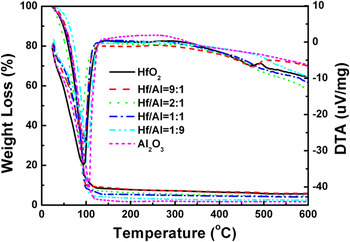
Figure 1 shows TG-DTA analysis of HAO precursor solutions with various mole ratios of Hf/Al. The significant weight loss of all the HAO solutions happened in the range of 25–130 °C, which was accompanied by an endothermic reaction peaked at ∼100 °C in all HAO precursor solutions. The phenomenon represented drying solvent and hydrolysis of the HAO precursors. When the ratio of Hf and Al was less than 2:1, no exothermic peak related to crystallization was obtained even if the temperature reached 600 °C. When the ratio of Hf and Al exceeds 2:1, DTA curves exhibited large exothermic peak in the range of 470–530 °C, owing to the transformation of HAO structure from amorphous to crystallization, which was further confirmed by the GIXRD results. Furthermore, the exothermic peak shifts to high temperature with the increasing Al content from 0 to 100 at.%, which revealed a higher crystallization temperature of HAO film with more Al incorporation. The fact showed also that Al incorporation can effectively suppress the crystallization of HfO2 film and improve the dielectric property of HfO2.
Thermal behavior of the HAO precursor solutions with various mole ratios of Hf and Al.

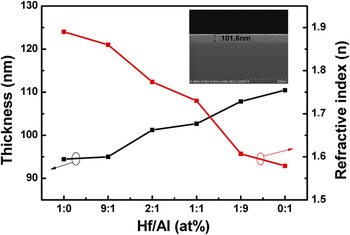
Figure 2 shows the thickness and refractive index of HAO films obtained by the spectroscopic ellipsometry at a wave length of 633 nm. The thickness of HAO films increased with the increase of Al content. Generally, the thickness of HAO films has the relation of the spinning speed and viscosity of precursor solutions. It indicated that the viscosity of HAO precursor solution maybe increase with the increase of Al content, which resulted in the increase of the thickness of HAO films. The inset is the SEM image of HAO with the ratio of Hf/Al = 2:1. And the result of SEM was in consistent with that of spectroscopic ellipsometry. The refractive index of HAO films monotonically decreased from 1.89 to 1.58 as the ratio of Hf and Al decreased from 1:0 to 0:1, indicating the refractive index of HAO films determined by the content of Hf and Al. The result suggested that the refractive index of HAO can be controlled and modulated by the mole ratio of Hf and Al.
Thickness and refractive index of the HAO films with various mole ratios of Hf and Al. Inset is the SEM image of HAO with the ratio of Hf/Al = 2:1.

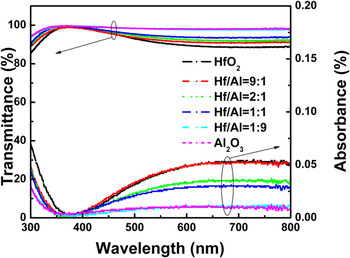
To investigate the optical properties of the HAO films, transmittance and absorbance of the HAO films were measured. Figure 3 shows the optical transmittance and absorbance spectra of HAO films as a function of the mole ratio of Hf and Al. The absorption edge of HAO films generated blue shifts in the near UV region with the increase of Al incorporation in HfO2, indicating that Al incorporation in HfO2 can enlarge the band gap of HAO films. High average optical transmittance values (>88%) and low average optical absorbance values (<0.06%) can be obtained in the visible range for all the HAO films. Due to their high transparency in the visible region, HAO films can be considered as candidate dielectric materials for transparent devices.
Transmittance and absorbance spectra of the HAO films with various ratios of Hf and Al.

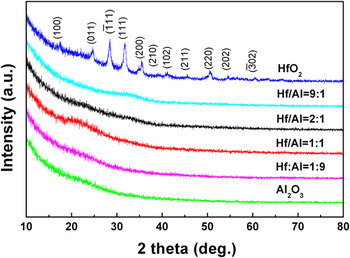
Figure 4 shows the GIXRD patterns of the HAO films with various ratios of Hf and Al annealed at 500 °C for 2 h. No apparent diffraction peaks of crystalline phase in GIXRD patterns were observed in the films with Al addition, indicating that the HAO films existed in amorphous phase. The diffraction peaks were found in HfO2 films without Al incorporation, indexing with the HfO2 powder diffraction peaks, which indicated that the HfO2 films remain in the polycrystalline phase due to lower crystallization temperature of HfO2. Reference Wang, Kumagai, Kokawa, Tsuaur, Ichiki and Maeda11 The result was corresponded to that of TG-DTA analysis. It is confirmed further that introducing appropriate amount of Al2O3 in HfO2 would remarkably block the crystallization of the HfO2 films. The HAO film in amorphous phase would be advantageous over a crystalline phase when used as a gate dielectric for TFTs, which has lower leakage current and higher breakdown voltage than that in crystalline phase. Reference Chiou, Chang, Wang, Lee, Wu, Kwo and Hong24
GIXRD patterns of the HAO films with various mole ratios of Hf and Al.

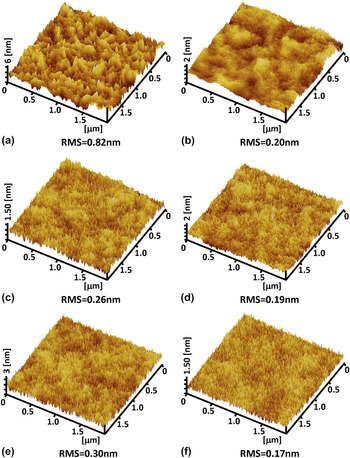
The surface morphology of HAO films was evaluated by AFM and the surface roughness of HAO films was calculated by AFM in a scan size of 2.0 × 2.0 μm. AFM images of HAO film with mole ratios of Hf and Al varied from 1:0 to 0:1 are shown in Fig. 5. HfO2, as shown in Fig. 5(a), had apparent crystalline grains and the RMS roughness was 0.82 nm. The surface of the HAO films with Al addition is very smooth, no apparent grains were observed, and the RMS roughness was <0.3 nm. The RMS roughness of pure Al2O3 films reached the lowest value of 0.17 nm. It showed that the roughness of HAO film decreased by Al2O3 incorporation. Meanwhile, the surface of all HAO films was very smooth.
AFM images of HAO films with the different Hf/Al mole ratios: 1:0 (pure HfO2) (a), 9:1 (b), 2:1 (c), 1:1 (d), 1:9 (e), and 0:1 (pure Al2O3) (f).

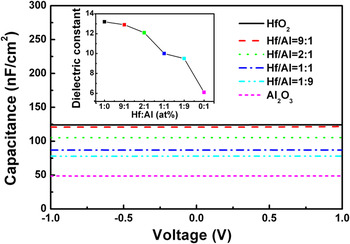
To investigate the dielectric properties of HAO films, parallel-plate capacitors with MIM glass/ITO/HAO/Al configuration were manufactured. Figure 6 shows high frequency (1 MHz) capacitance–voltage (C–V) curves of the ITO/HAO/Al capacitance. The inset shows the dielectric constant of the HAO films as a function of the ratio of Hf/Al. Both of the capacitance and dielectric constant monotonically decreased as the ratio of Hf and Al decreased from 1:0 to 0:1. The Al2O3 thin film and the HfO2 thin film had capacitances of 48.5 nF/cm2 and 124.0 nF/cm2, respectively. The corresponding permittivity values were 6.1 and 13.2, which were comparable to the previously reported thin films deposited by sol–gel method. Reference Yoo, Park, Lee, Lee, Song, Lee and Baik25,Reference Yang, Song, Jung, Jeong and Moon26 Both HfO2 and Al2O3 film exhibited relatively low dielectric constant k values less than that of their stoichiometric crystalline counterparts (e.g., k (Al2O3) ∼ 9 and k (HfO2) ∼ 25). It could be attributed to the fact that the chemical-solution synthesized thin film commonly exhibited incomplete oxide lattice formation, and partial densification, leading to a relatively low k value. Reference Yang, Song, Jung, Jeong and Moon26 The permittivity values for Hf/Al = 9:1, 2:1, 1:1, and 1:9 were 12.9, 12.1, 10.0, and 9.5, respectively. This demonstrated that the relative dielectric constant of HAO films could be modulated and controlled by varying the ratio of Hf and Al, and the HAO films had compensative characteristics to the HfO2 or Al2O3 films, which means that it was possible to achieve high dielectric oxide with high thermal stability as well as high band gap characteristics using a composite of the two oxides.
Capacitance of the HAO films with various ratios of Hf/Al versus voltage plots measured at 1 MHz. Inset is the ratio of Hf/Al versus the dielectric constant of HAO films.

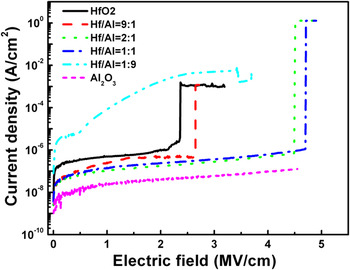
Electrical field measurements were performed to evaluate the leakage current behavior of HAO films. Figure 7 shows the leakage current density and breakdown voltage as a function of electric field applied on the HAO films. The magnitude of the leakage current density which suggested the dielectric properties of HAO films was obviously affected by the Al content in the films. As the ratio of Hf and Al in the films increased, the leakage current density of HAO films basically increased and the breakdown voltage of HAO films evidently decreased. The leakage current density of HfO2 and Al2O3 was better than previously reported studies. Reference Wang and Cheong27,Reference Kim, Fuentes-Hernandez, Potscavage, Zhang and Kippelen28 As shown in Fig. 4, HAO films in amorphous phase with less grain boundary current compared with HfO2 films in crystalline phase effectively suppressed the tunneling electrons from the active layer, which may be helpful to decrease the gate leakage current of TFT. However, the leakage current density of HAO films was abnormally high and degenerates to 1.75 × 10⁻³ A/cm2 at 2 MV/cm when the ratio of Hf and Al of HAO films was 1:9, which was due to the loose films as confirmed in the wet etching treatments. One of the reasons of loose films may be that the solution does not completely form a homogeneous sol, considering the turbid solution with the mole ratio of Hf/Al varied as follows: 1:3, 1:4, 1:5, and 1:6. It is known that in TFT devices, the leakage current density of gate dielectrics should be <10−6 A cm−2 at 2 MV/cm. The HAO films with the reasonable Al concentration could be used as gate dielectrics.
Electric field versus leakage current density of the HAO films with various mole ratios of Hf and Al.

Wet etching treatments of HAO films with the 2 cm × 2 cm surface area were performed in a 1% HF solution at room temperature. Table I shows the variation in etching rate of HAO films as a function of the ratio of Hf and Al. Wet etching rate was closely related to the compactness of material and material properties. HfO2 etches relatively slower than Al2O3 in diluted HF solutions. Reference Vos, Arnauts, Bovie, Onsia, Garaud, Xu, HongYu, Kubicek, Rohr, Schram, Veloso, Conard, Leunissen and Mertens29 In general, the etching rate of HAO films increases with the increase of Al content in the HAO films, as listed in Table I. The etch rates of HAO films except of Hf/Al = 1:9 were slow enough and <1 nm/s, which confirmed that the films had relatively high density and well I–V performance. On the contrary, the abrupt increase in etching rate of HAO film with Hf/Al = 1:9 can be attributed to the poor density of the film. One reason of the degeneration may be that the precursor solution does not completely form a homogeneous sol, considering the turbid solution with the mole ratio of Hf/Al varied as follows: 1:3, 1:4, 1:5, and 1:6. The fact can be further confirmed by the high leakage current density as shown in Fig. 7.
Etching rate of the HAO films with various mole ratios of Hf and Al, using 1% of hydrofluoric acid.

IV. CONCLUSION
In summary, the HAO dielectric films had been prepared by spin coating process. After annealed at 500 °C, the HAO films had good transparency and average optical transmittance was above 88% within the visible light range. The HAO films with the mole ratio of Hf/Al < 9:1 were amorphous in structure. The refractive index of HAO films increased with the decrease in mole ratio of Hf and Al. The leakage current density and permittivity value of HAO films with the ratio of Hf and Al = 2:1 were 1.69 × 10⁻⁷ A/cm2 at 2 MV/cm and 12.1, respectively. The results showed that the HAO films prepared by solution technique can meet the requirement of high-k dielectric material in TFTs and may be promising high-k dielectric materials in TFTs.
ACKNOWLEDGMENTS
This work is supported by the National Natural Science Foundation of China under Grant 61006005, the Shanghai Science and Technology Commission under Grant 13520500200 and 14XD1401800, and the Shanghai Visiting Oriental Scholar Program.