Implications
Bacillus subtilis natto is a potential probiotic bacteria isolated from natto, an Asian fermented soybean food. The effects of B. subtilis natto on milk yield and composition, ruminal fermentation and ruminal microbial population were assessed in dairy cattle. Results showed that B. subtilis natto increased milk yield, reduced milk somatic cell counts, optimized ruminal fermentation and promoted growth of some desirable ruminal microorganisms, such as proteolytic and amylolytic bacteria in dairy cows. Therefore, B. subtilis natto has potential to be used as a probiotic for dairy cows and expected to create benefits for improving milk production and quality.
Introduction
Probiotics are live microbial supplements that are capable of positively altering the microbiota of the digestive tract (Rook and Brunet, Reference Rook and Brunet2005; Fujiwara et al., Reference Fujiwara, Yamazaki, Abe, Nakashima, Yakabe, Otsuka, Ohbayashi, Kato, Namai, Toyoda, Miyaguchi and Nakamura2009). Some of the positive effects include improved establishment of beneficial gut microflora and competitive exclusion of pathogenic microorganisms (Fujiwara et al., Reference Fujiwara, Yamazaki, Abe, Nakashima, Yakabe, Otsuka, Ohbayashi, Kato, Namai, Toyoda, Miyaguchi and Nakamura2009). Recently, several Bacillus sp. bacteria, such as Bacillus licheniformis and Bacillus subtilis have gained attention for their role in controlling infectious diseases, thereby improving productive performance in animals (Alexopoulos et al., Reference Alexopoulos, Georgoulakis, Tzivara, Kyriakis, Govaris and Kyriakis2004; Chen et al., Reference Chen, Kho, You, Yeh, Tang and Hsieh2009). Furthermore, the spore forms of these bacteria have the ability to survive in the digestive tract (Casula and Cutting, Reference Casula and Cutting2002).
B. subtilis natto is a gram-positive spore-forming bacterium. The existence of spores is one of the survival modes of the bacterium and B. subtilis spores can survive in harsh environment. Although Bacillus species are not normally found in the gastrointestinal tract, the spores that can resist the digestion of digestive enzymes can reach the intestinal tract and grow in the intestine. Therefore, to some extent, spores have the better, at least the same effects as the growing bacteria. B. subtilis natto is the bacterial strain cultured from natto (Samanya and Yamauchi, Reference Samanya and Yamauchi2002), a fermented soybean food that has exhibited several beneficial effects for human health (Fujita et al., Reference Fujita, Hong, Ito, Fujii, Kariya and Nishimuro1995; Tanimoto et al., Reference Tanimoto, Mori, Motoki, Torii, Kadowaki and Noguchi2001). B. subtilis has also demonstrated probiotic characteristics because it has been shown to inhibit pathogens, such as Clostridium species (Teo and Tan, Reference Teo and Tan2005), Campylobacter species (Fritts et al., Reference Fritts, Kersey, Motl, Kroger, Yan, Si, Jiang, Campos, Waldroup and Waldroup2000; Teo and Tan, Reference Teo and Tan2005), Streptococcus species (Teo and Tan, Reference Teo and Tan2005) and Escherichia coli (Fritts et al., Reference Fritts, Kersey, Motl, Kroger, Yan, Si, Jiang, Campos, Waldroup and Waldroup2000; Guo et al., Reference Guo, Li, Lu, Piao and Chen2006; Teo and Tan, Reference Teo and Tan2006).
To date, only limited research relating to the dietary utilization of B. subtilis in ruminants has been completed (Jenny et al., Reference Jenny, Vandijk and Collins1991; Kritas et al., Reference Kritas, Govaris, Christodoulopoulos and Burriel2006), and studies have seldom evaluated the effect of feeding B. subtilis natto on ruminal microbial fermentation in dairy cows. Available results from in vitro studies have shown that B. subtilis natto has beneficial effects on the growth of some anaerobic microorganisms, such as Lactobacillus sp. and Bifidobacterium sp. (Hosoi et al., Reference Hosoi, Ametani, Kiuchi and Kaminogawa2000). Our previous studies have also demonstrated that B. subtilis natto increased the growth performance and promoted rumen development both in calves (Sun et al., Reference Sun, Wang and Zhang2010 and Reference Sun, Wang and Zhang2011) and early lactation dairy cows without any adverse effects (Peng et al., Reference Dong, Wang, Peng, Sun, Bu, Zhou and Kang2011), which suggests that B. subtilis natto might be used as a probiotic for dairy cattle. The objective of this study was to assess the effects of dietary B. subtilis natto on milk yield and composition, rumen fermentation and ruminal microbial populations.
Material and methods
Culture of solid-state fermentation products of
B. subtilis natto
The live B. subtilis natto cells used in the present study were isolated from fermented soybeans and identified by observation of colony morphology, determination of physiological and biochemical indices and analysis of 16SrDNA gene sequences in State Key Laboratory of Animal Nutrition, Institute of Animal Science, Chinese Academy of Agricultural Sciences. Briefly, the bacteria were prepared in sterile fermentation medium, which contained 1% sucrose, 1% glucose, 2% soya peptone, 0.4% K2HPO4, 0.2% KH2PO4, 0.05% MgSO4 and 0.02% CaCl2 at 37°C for 24 h. B. subtilis natto is gram-positive rod-shaped bacteria, in the middle of which is the spore. Compared with the reported gene sequence of B. subtilis natto strain in Genbank, the similarity rate between our cultured strain and the known bacteria is 100%, suggesting the identification of B. subtilis natto. The solid-state fermentation products were obtained by inoculating B. subtilis natto in soybean meal medium and the number of viable B. subtilis natto spores in the products were measured by plate count on Luria-Bertani medium (5% agar, 0.5% NaCl, 1% soya peptone, 0.3% beef extract, pH = 7.0) and after heat treatment (80°C for 10 min), respectively. Approximately 5.2 × 10⁹ spores existed in each gram of solid-state fermentation products.
Experiment 1
Cows, design and treatments
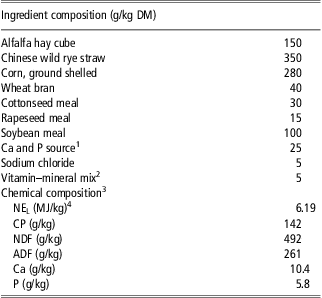
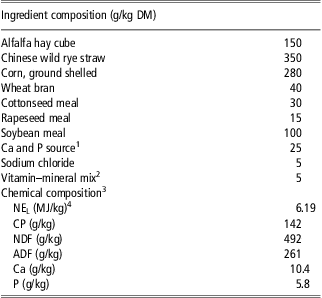
Animal care and management were carried out as a regulated procedure with established standards of the Institute of Animal Science, Chinese Academy of Agricultural Sciences, Beijing, China. Thirty-six multiparous early lactating Chinese Holstein cows (days in milk (DIM) = 56 ± 23 days, milk yield = 24.7 ± 3.3 kg) were housed together in a free-stall barn and had ad libitum access to water. All cows were fed the same basal diet as a total mixed ration (TMR), which was formulated to satisfy the nutrient recommendations for 25 kg/day of milk production according to the Feeding Standards of Dairy Cattle, China NongYe HangYe Biaozhun/Tuijian-34 (China NY/t34, 2004). The ingredient and chemical composition of the diet is presented in Table 1. Seven days later, all the animals (56 ± 23 DIM, 24.7 ± 3.3 kg of milk/day) were randomly assigned to 1 of 3 dietary treatments: (1) Control: cows were fed with TMR; (2) BSNLOW: cows were fed with TMR and 10 g/day solid-state fermentation products containing 0.5 × 10¹¹ cfu (colony-forming units) of B. subtilis natto; and (3) BSNHIGH: cows were fed with TMR and 20 g/day solid-state fermentation products containing 1 × 10¹¹ cfu of B. subtilis natto. The TMR was fed twice daily at 0700 and 1900 h in amounts to ensure ∼5% refusals. The B. subtilis natto supplements were individually hand-mixed with 50 g of TMR to ensure that all the supplements had been consumed by the cows, and then more TMR were fed to individual cows subsequently. Feed offerings and orts were recorded daily for individual cows for determination of dry matter intake (DMI).
Ingredient and chemical composition (mean) of the diet
DM = dry matter.
1Contained limestone (500 g/kg) and calcium phosphate monobasic (500 g/kg).
2Contained (per kg of DM) a minimum 250 000 IU of vitamin A; 65 000 IU of vitamin D; 2100 IU of vitamin E; Fe 400 mg; Cu 540 mg; Zn 2100 mg; Mn 560 mg; Se 15 mg; I 35 mg; and Co 68 mg.
3Analyzed value.
4Calculated value (the sum of the percentage of the feed ingredients times the NEL values of different feed ingredients presented in the Feeding Standards of Dairy Cattle, China NongYeHangYe Biaozhun/Tuijian-34, 2004).
Sample collection and analysis
TMR samples were collected weekly and composited monthly to measure the CP (Association of Official Analytical Chemists (AOAC), 2000; method 976.05), NDF, ADF (Van Soest et al., Reference Van Soest, Robertson and Lewis1991), Ca and P (AOAC, 2000; method 935.13).
Cows were milked twice daily at 0900 and 2100 h. Individual cow milk weights were recorded by an electronic monitoring system daily throughout the experiment. A 24-h composite sample (∼50 ml) was daily collected from two milkings of each cow and mixed at a 1 : 1 ratio by volume that reflected the milk yield of day and night and stored at 4°C until analysis. Fat, protein and lactose were determined by mid-infrared spectrophotometry using a Milko™Scan (MilkoScan Type FT120, Foss Electric, Hillerød, Denmark); somatic cell counts (SCC) were determined using a Fossomatics 5000 (Foss Analytical A/S; Foss Electric, Hillerød, Denmark).
Experiment 2
Cows, design and treatments
Four mid-lactating, ruminally cannulated Chinese Holstein cows (BW 540 ± 25 kg) were used in this study. Cows were individually housed in tie-stalls fitted with rubber mats to avoid cross-contamination. Water was available ad libitum throughout the trial. The whole trial lasted for 28 days and the experiment was divided into three periods: (1) pre-trial from days 1 to 7: cows were fed with TMR (Table 1); (2) trial from days 8 to 21: cows were fed with TMR and 20 g/day solid-state fermentation products containing 1 × 10¹¹ cfu of B. subtilis natto; and (3) post-trial from days 22 to 28: cows were fed with TMR. The diet was offered twice daily at 0700 and 1900 h in amounts to ensure ∼5% refusals. The bacterial supplements were also hand-mixed with TMR diet and ensure the entire consumption by dairy cows as described in Experiment 1. Feed offerings and orts were recorded daily for determination of DMI.
Sample collection and analysis
Feed samples were collected and analyzed as described in Experiment 1. To evaluate the potential effects of B. subtilis natto on ruminal digestion, samples of feed including concentrates, alfalfa hay and Chinese wild rye straw were incubated in sacco for 24 h on the last day of each period. The concentrates, hay and straw were dried at 55°C for 48 h and ground in a Wiley mill equipped with a 4.5-mm screen. Following grinding, feeds were sieved to remove particles more than 1 cm in length, then 2.5 g of each of the feedstuffs was placed into nylon bags (11.0 cm × 6.0 cm; mean pore size 50 μm) and closed with nylon string. Four replicate samples of each feedstuff were attached to a nylon pipe (70 cm length and 0.5 cm inner diameter), which was placed in the rumen for incubation. Before incubation, all bags were soaked in 39°C water for 10 min. At the end of the incubation period, all bags were removed and rinsed with cold water until the effluent was clear. The bags were then dried at 60°C for 48 h and weighed to determine the dry matter disappearance. Residues from the nylon bags were analyzed with amylase for NDF as described by Van Soest et al. (Reference Van Soest, Robertson and Lewis1991).
Rumen contents were sampled at 0, 6 and 12 h after the morning feeding on days 6, 7, 20, 21, 27 and 28, that is, the last 2 consecutive days of each period. Samples were obtained from four sites within the rumen (Tafaj et al., Reference Tafaj, Maulbetsch, Junck, Steingass and Drochner2001 and Reference Tafaj, Junck, Maulbetsch, Steingass, Piepho and Drochner2004), composited, and strained through four layers of cheesecloth. The pH of the strained ruminal fluid was measured using a portable pH meter (370 model pH meter, Jenway, London, UK). A 5-ml aliquot of rumen filtrate was collected for volatile fatty acids (VFA) analysis and was preserved by adding 1 ml of 25% (wt/vol) metaphosphoric acid. A 6-ml portion of rumen filtrate was collected for NH3 analysis and was preserved by adding 2 ml of 25% (wt/vol) metaphosphoric acid. An additional 5 ml of rumen filtrate was preserved by adding 10 ml of methyl green–formalin–saline solution (35% formalin 100 ml, 8.0 g NaCl and 0.6 g methyl green dissolved in 900 ml distilled water) for protozoa enumeration. The protozoa samples were stored at room temperature in a brown bottle to protect them from light until counted. The VFA contents of rumen filtrate were determined by gas chromatography as described previously (Stewart and Duncan, Reference Stewart and Duncan1985). Ammonia was determined by using an adaptation of the phenol/hypochlorite method (Broderick and Kang, Reference Broderick and Kang1980). Protozoa were counted in duplicate samples in a hemocytometer chamber and if values differed by more than 10%, the counts were repeated.
Samples for ruminal bacterial enumeration by culture method were taken 6 h after the morning feeding on days 6, 7, 20, 21, 27 and 28. Within 10 min of collection, a quantity of the rumen contents was tightly squeezed through four layers of cheesecloth into a vessel. For each sample, 10 ml of liquid was serially diluted in cold anaerobic diluent. Five replicate tubes were inoculated (0.2 ml/tube) from each serial dilution into specific broths by the most-probable-number procedures for enumeration of amylolytic, proteolytic and cellulolytic bacteria, as well as total bacteria (Dehority et al., Reference Dehority, Tirabasso and Grifo1989). The amylolytic bacteria medium contained (per 100 ml) 15 ml of mineral solution A (3 g of K2HPO4 per liter), 15 ml of mineral solution B (3 g of KH2PO4 per liter, 6 g of (NH4)2SO4 per liter, 6 g of NaCl per liter, 0.6 g of MgSO4 7H2O per liter, 0.2 g of CaCl2 2H2O per liter), 30 ml of depleted clarified rumen fluid, 0.0001 g of resazurin, 0.5 g of soluble starch, 0.05 g of cysteine hydrochloride, 0.6 g of NaHCO3 and 0.1 ml of pfenning trace elements. The proteolytic bacteria medium contained (per 100 ml) 15 ml of mineral solution A, 15 ml of mineral solution B, 30 ml of depleted clarified rumen fluid, 0.0001 g of resazurin, 1 g of soluble casein, 0.05 g of cysteine hydrochloride, 0.6 g of NaHCO3, 0.1 ml of pfenning trace elements, 0.05 g of yeast extract, 0.05 g of soluble starch, 0.05 g of glucose, 0.05 g of maltose and 0.05 g of xylose. The cellulolytic bacteria medium contained (per 100 ml) 15 ml of mineral solution A, 15 ml of mineral solution B, 0.05 g of trypticase, 30 ml of depleted clarified rumen fluid, 0.0001 g of resazurin, 0.2 g of cellulose (ball-milled), 0.8 g of NaHCO3, 0.05 g of cysteine hydrochloride, 0.05 g of yeast extract, 0.1 ml of pfenning trace elements, 0.31 ml VFA mix and 1 mg of hemin. Total ruminal bacteria medium contained (per 100 ml) 15 ml of mineral solution A, 15 ml of mineral solution B, 0.05 g of trypticase, 30 ml of centrifuged (clarified) rumen fluid, 0.8 g of NaHCO3, 0.05 g of cysteine hydrochloride, 0.1 ml of pfenning trace elements, 0.31 ml VFA mix, 1 g of soluble casein, 0.05 g of cellobiose, 0.05 g of soluble starch, 0.05 g of glucose, 0.05 g of maltose, 0.2 ml of sodium lactate (70%, wt/vol), 0.05 g of xylan and 0.05 g of pectin. The selective medium for determination of amylolytic, proteolytic and cellulolytic bacteria and total ruminal bacteria medium for total ruminal bacteria were incubated at 39°C for 5 days before enumeration.
Statistical analysis
All data in Experiment 1 were analyzed using the GLM procedure of SAS (version 9.1; SAS Institute Inc., Cary, NC, USA). Linear and quadratic polynomial contrasts were used to determine the dose-dependent effect of supplementation of B. subtilis natto. Results from Experiment 2 were tested using ANOVA procedure of SAS system. Significance was declared at P < 0.05 and trends at P < 0.1.
Results
DMI, milk production, components and SCC
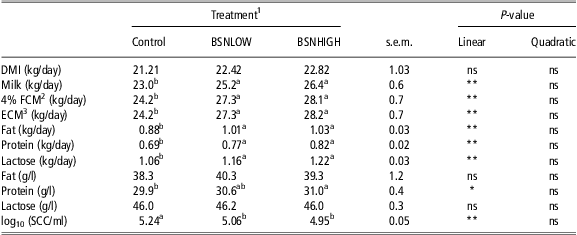
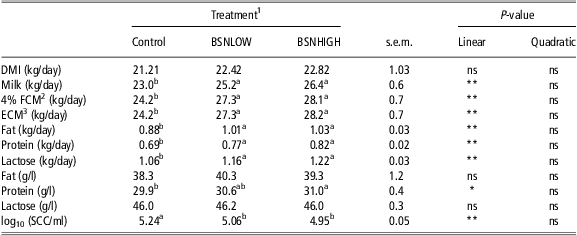
No difference was observed in DMI with the supplementation of B. subtilis natto in Experiments 1 and 2. Supplementing dairy cows with B. subtilis natto linearly increased milk yield, 4% fat-corrected milk (FCM), energy-corrected milk (ECM), as well as milk fat, protein and lactose yield (P < 0.01) but decreased milk SCC (P < 0.01) in Experiment 1 (Table 2).
Effect of dietary supplementation of Bacillus subtilis natto on DMI, milk yield and composition during 10-week study (Experiment 1)
BSNLOW = Bacillus subtilis natto low; BSNHIGH = Bacillus subtilis natto high; s.e.m. = standard error of the mean; DMI = dry matter intake; FCM = fat-corrected milk; ECM = energy-corrected milk; SCC = somatic cell counts; TMR = total mixed ration.
1Each value is the mean of data from 12 calves per group. Control: cows were fed with TMR; BSNLOW: cows were fed with TMR and 10 g/day solid-state fermentation products containing 0.5 × 10¹¹ cfu of B. subtilis natto; BSNHIGH: cows were fed with TMR and 20 g/day solid-state fermentation products containing 1 × 10¹¹ cfu of B. subtilis natto.
24% FCM = 0.4 × actual milk yield (kg/day) +15 × actual milk fat yield (kg/day).
3ECM = 0.327 × milk (kg) +12.95 × fat (kg) +7.65 × protein (kg; Dairy Records Management Systems, 2011).
*P < 0.05, **P < 0.01.
Ruminal fermentation and microbial profile
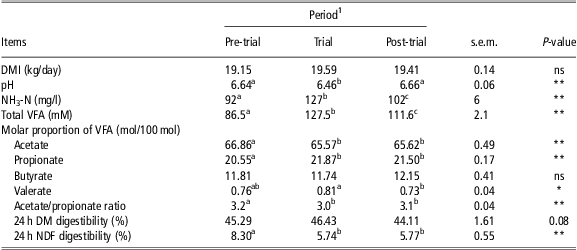
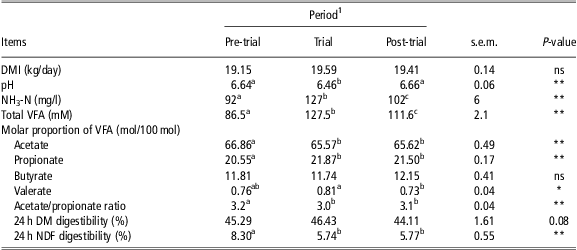
The results of rumen pH, ammonia concentration, VFA and in sacco digestibility are presented in Table 3. Mean rumen pH decreased with the consumption of B. subtilis natto during the B. subtilis natto feeding period compared with the pre- and post-trial periods (P < 0.01). However, rumen ammonia nitrogen (NH3-N) and total VFA concentrations were significantly elevated during the ingestion of B. subtilis natto. Furthermore, the effects of B. subtilis natto on NH3-N and total VFA concentrations still existed when ingestion of B. subtilis natto terminated because the rumen NH3-N and total VFA concentrations were still higher in the post-trial period than in pre-trial period although no B. subtilis natto was consumed by the dairy cows (P < 0.01).
Effects of Bacillus subtilis natto supplementation on DMI and ruminal fermentation in Chinese Holstein cows (Experiment 2)
DMI = dry matter intake; s.e.m. = standard error of the mean; VFA = volatile fatty acids; DM = dry matter.
1Period: pre-trial = no B. subtilis natto (7 days), trial = 1.0 × 10¹¹ cfu/day of live B. subtilis natto (14 days), post-trial = no B. subtilis natto (7 days).
*P < 0.05, **P < 0.01.
Compared with the pre-trial period, the molar proportion of acetic acid decreased (P < 0.01) but that of propionate increased (P < 0.01), so the acetate to propionate ratio was lower during the trial and post-trial periods (P < 0.01). The results showed that B. subtilis natto supplementation not only directly influenced ruminal bacterial fermentation, but had potential effects for at least 7 days after B. subtilis natto supplementation was terminated.
As shown in Table 3, there was no difference among different trial periods in 24-h in sacco DM digestibility. However, NDF digestibility was dramatically decreased after ingestion of B. subtilis natto during the trial and post-trial periods compared with the pre-trial period (P < 0.01).
Microbial profile
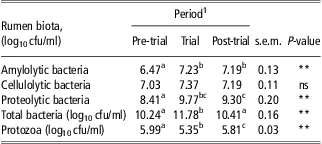
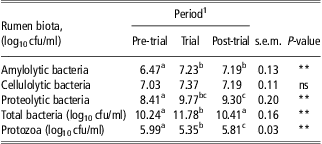
A significant finding from Experiment 2 was the effects of B. subtilis natto on ruminal microbial populations (Table 4). When quantified by the culture method, the numbers (log10 value) of amylolytic, proteolytic and total bacteria in the rumen were increased (P < 0.01) but total protozoa was decreased (P < 0.01) during the trial period compared with the pre-trial period (Table 4). However, the populations of protozoa increased during the post-trial period when compared with trial period (P < 0.01). In addition, no difference was observed in the numbers of cellulolytic bacteria throughout the whole experiment.
Effect of Bacillus subtilis natto on bacterial and protozoal numbers in the rumen of Chinese Holstein cows (Experiment 2)
s.e.m. = standard error of the mean.
1Period: pre-trial = no B. subtilis natto (7 days), trial = 1.0 × 10¹¹ cfu/day of live B. subtilis natto (14 days), post-trial = no B. subtilis natto (7 days).
*P < 0.05, **P < 0.01.
Discussion
This study investigated the effects of oral supplementation of B. subtilis natto on milk production, rumen fermentation and ruminal microbiome of dairy cows. Many studies have demonstrated that B. subtilis has the potential to increase growth performance of pigs (Alexopoulos et al., Reference Alexopoulos, Georgoulakis, Tzivara, Kyriakis, Govaris and Kyriakis2004; Kritas and Morrison, Reference Kritas and Morrison2005), chickens (Fritts et al., Reference Fritts, Kersey, Motl, Kroger, Yan, Si, Jiang, Campos, Waldroup and Waldroup2000) and calves (Jenny et al., Reference Jenny, Vandijk and Collins1991; Sun et al., Reference Sun, Wang and Zhang2010). Kritas et al. (Reference Kritas, Govaris, Christodoulopoulos and Burriel2006) reported that B. subtilis supplementation in ewe's feed increased average daily milk yield and milk fat and protein contents (Kritas et al., Reference Kritas, Govaris, Christodoulopoulos and Burriel2006). Peng et al. (Reference Dong, Wang, Peng, Sun, Bu, Zhou and Kang2011) showed that B. subtilis natto fermentation product effectively increased lactation performance of early lactation dairy cows. Consistent with those publications, our results indicated that milk production was increased and the milk components were improved by elevating milk fat, protein and lactose yield as a result of the improved rumen fermentation when cows were fed with B. subtilis natto. However, SCC were decreased in the milk from B. subtilis natto treated cows compared with the control. Our previous study has shown that B. subtilis natto can survive for at least 24 h in the rumen fluid in vitro (Dong et al., Reference Dong, Wang, Peng, Sun, Bu, Zhou and Kang2011). Furthermore, the survival B. subtilis natto might enter intestinal tract and reduce coliform bacteria excreted in the feces, which has also been verified in our previous study (Kang et al., Reference Kang, Wang, Bu, Zhou, Sun, Peng, Wang and Dong2011).
Rumen pH, NH3-N and VFA concentrations are the important indicators that reflect rumen function and stability of the intraruminal milieu. In the present study, oral administration of B. subtilis natto lowered the rumen pH, but increased concentration of NH3-N and total VFA in the ruminal fluid of dairy cows. Ingestion of B. subtilis natto reduced acetate concentration, but increased propionate and valerate concentrations thus decreased the ratio of acetate to propionate. Similar results were also observed in calves in our previous study (Sun et al., Reference Sun, Wang and Zhang2011). It has been postulated that propionate is the major glucogenic precursor, which may increase blood glucose availability via gluconeogenesis and subsequently increase milk lactose production (Sauer et al., Reference Sauer, Kramer and Cantwell1989). Available evidence has also demonstrated that higher levels of ruminal propionate increase milk yield (Oba and Allen, Reference Oba and Allen2003), as well as lactose and protein contents in milk (Rigout et al., Reference Rigout, Hurtaud, Lemosquet, Bach and Rulquin2003; Stein et al., Reference Stein, Allen, Perry, Bruner, Gates, Rehberger, Mertz, Jones and Spicer2006). Therefore, the alteration of VFA in the present study may indirectly explain the increased milk yield, as well as the milk fat, protein and lactose contents.
An interesting finding of our study is that supplementation of B. subtilis natto significantly decreased the NDF digestibility, whereas DM digestibility was not influenced, which might be associated with the ruminal microbial population. To our knowledge, NDF digestion relates to the fibrolytic bacteria count and, even more important, fibrolytic bacteria activity. Although no difference was observed in the cellulolytic bacteria numbers among different periods (treatments) in Experiment 2, the activity of cellulolytic bacteria might be decreased when B. subtilis natto was administered. Further study is still needed to investigate the mechanism of dietary supplementation of B. subtilis natto on the activity of amylolytic, proteolytic and cellulolytic bacteria in the rumen.
It is known that ruminal microbial population is of great importance for rumen fermentation and milk production. Increased numbers of certain groups of bacteria, such as amylolytic and proteolytic bacteria number, and reduced protozoal number in B. subtilis natto treated period might accelerate ruminal recycling of bacterial N (Ghorbani et al., Reference Ghorbani, Morgavi, Beauchemin and Leedle2002) and thus resulting in higher ruminal NH3 concentrations. It is known that protease and amylase are the metabolites of the B. subtilis natto. Early in 1987, Reference Sumi, Hamada, Tsushima, Mihara and MurakiSumi et al. extracted a novel fibrinolytic enzyme named nattokinase from the vegetable cheese natto. Hosoi et al. (Reference Hosoi, Ametani, Kiuchi and Kaminogawa2000) demonstrated that B. subtilis natto produced subtilisin, which enhanced the growth and viability of lactobacilli. In the present study, B. subtilis natto including the spores, bacteria together with the culture medium was orally administered to the cows, which increased the concentrations of protease and amylase in the rumen. Therefore, the degradation of dietary protein and carbohydrates was promoted, resulting in higher concentrations of ammonia and carbon chain and accelerating the synthesis of microbial protein, which is responsible for the increase of amylolytic, proteolytic and total bacteria in the rumen. Although B. subtilis natto used in this study is not ubiquitous in the rumen environment, it is metabolically active and beneficial to dairy cows when supplemented daily. Our data show that milk production, ruminal fermentation and ruminal microbiome were modified when cows received B. subtilis natto.
Conclusions
Supplementation of B. subtilis natto improved milk production and milk fat, protein and lactose yields, increased populations of certain kinds of ruminal bacteria including amylolytic, proteolytic and total bacteria, decreased that of protozoa and modified rumen fermentation, particularly enhanced total VFA concentration and elevated molar proportion of propionic acid. Our results have demonstrated that B. subtilis natto may be a potentially useful probiotic in dairy cows and that a recommended effective daily dose is 1.0 × 10¹¹ cfu/cow per day.
Acknowledgments
This research is supported by China Agriculture Research System (CARS-37). The authors thank the staff of the ruminant nutrition laboratory at the Institute of Animal Science, Chinese Academy of Agricultural Science, for their assistance. They also acknowledge the kind contribution of Richard O. Kellems and Wendy Kellems from Brigham Young University to this work.