In general, we will find that consonant cluster simplification is a phonological process which intersects with grammatical processes, operating on a number of surface formatives to produce highly reduced surface forms, and the general rule which governs simplification can only be written when these grammatical forms are accurately known.
—Labov, Cohen, Robins, & Lewis (Reference Labov, Cohen, Robins and Lewis1968:124)What was once seen as a vernacular feature of African American Vernacular English (AAVE) has now been investigated as a common feature in varieties of English around the world. As Schneider (Reference Schneider, Schneider, Burridge, Kortmann, Mesthrie and Upton2004:1126) summarized, deleting the final consonant of a consonant cluster “is the norm in the Caribbean, in ethnic dialects and contact forms in Am[erican] E[nglish], in L[iberean] S[ettler] E[nglish] and Cameroon, and in South-East Asia, and it also occurs variably in all dialects of Am[erican] E[nglish], all non-white dialects of S[outh] A[frican] E[nglish], and also in northern England.”
This paper focuses on how coronal stop deletion (CSD) (e.g., best → bes') has developed in the variety of English found in the West Virginia region of Appalachia at the end of the twentieth century, exploring primarily its linguistic patterns through quantitative variationist analysis. As an often-studied variable, CSD, in its many guises, provides an excellent opportunity to make comparisons across the linguistic and social factor groups of vernacular communities. Taking up traditional methodological assumptions as a point of study, this paper fully examines the language variation patterns for the speakers, including lexical rates, morphological subdivisions, and phonological hierarchies.
A survey of coronal stop deletion
Some sociolinguistic variables have several decades of research on their inner workings, and CSD is a variable with such a rich literature of study. Given this lineage, it is important to review what methodological issues have arisen in the study of CSD. One of the first order concerns is about what constitutes the variable itself. Three names are generally used. The name t/d deletion appears in most of the literature of the 1970s and 1980s, and CSD is a rebranding of that variable. Consonant cluster reduction (CCR) is a slightly different variable. Rather than standardizing the names from the different sources, I have kept the names used originally. From these early days of cluster analysis, it should be noted that three different sets of possible tokens were being analyzed by various researchers: final, single consonant deletion (e.g., bad → ba'); CCR with final /t,d,p,k/; and CSD (a.k.a. /t,d/ deletion). Note that CSD and CCR are not the same variable, and their names are not interchangeable.
Romaine (Reference Romaine1984:221) argued that consonant cluster deletion has been operating in its modern form since at least the beginning of the Middle English period, citing examples in The Peterborough Chronicle, but that “the rule of t/d deletion was ‘open-ended’; and that it reaches back to Proto-Germanic … ” (Romaine, Reference Romaine1984:243). She identified the morphological constraint as most historically influential, because morphemic boundaries tend to inhibit reduction of consonant clusters. This finding is of interest because, regularly, the following phonological environment most greatly affects the rate of CSD. Romaine also argued that the t/d deletion rule was “spread fairly widely through the social continuum” (Reference Romaine1984:244), and that even in the highest classes, the prohibitions against t/d deletion went unheeded.
Labov, Cohen, and Robins (Reference Labov, Cohen and Robins1965) and Labov and Cohen (Reference Labov and Cohen1967) were the first in the variationist era of linguistics to systematically examine CSD. Labov and Cohen's focus was the effects of CSD for literacy, a theme to which Labov (Reference Labov and Lanehart2001) returned. Wolfram (Reference Wolfram1969:50) also took up consonant clusters but added /sp/ and /sk/ clusters to the /t, d/ clusters. This choice remains the standard for Wolfram's work (e.g., Mallinson & Wolfram, Reference Mallinson and Wolfram2002; Wolfram, Childs, & Torbert, Reference Wolfram, Childs and Torbert2000).Footnote 1 Labov et al. (Reference Labov, Cohen, Robins and Lewis1968) considered postvocalic /t,d/ deletion to be part of the same variable rule that produced /t,d/ cluster deletion, however Wolfram (Reference Wolfram1969:57, 95) defined CCR and postvocalic /d/ deletion as separate rules. In another study, Wolfram (Reference Wolfram and Fasold1973b:83) argued for keeping the rules separate because they have different ordering of influential constraints. For a comparison of these approaches, see the elucidating discussion of Fasold (Reference Fasold1972:58–60).
In those previous works, the voicing of the cluster became a point of methodological concern. Wolfram (Reference Wolfram1969:51) wrote, “Clusters in which voicing or voicelessness is not a defining characteristic of the entire cluster such as [mp] (e.g., jump), [nt] (e.g., count), [lt] (e.g., colt), [ŋk] (e.g., crank), and [lp] (e.g., gulp) are not included in this analysis since they do not function in the same way… .” Subsequently, several early studies discussed the nature of voicing with final clusters. Wolfram and Fasold (Reference Wolfram and Fasold1974:130) argued for a voicing constraint where the consonant clusters would be either both voiced or both voiceless: “the reduction rule only operates … when both members of the cluster are either voiced or voiceless.” Accordingly, several studies excluded clusters such as lt and nt from their potential tokens. In the current corpus, it was considered worthwhile to assess patterns of variation of heterovoiced clusters.
Several general findings emerged from these early studies. First, consonant clusters were reduced more often before other consonants. For example, preconsonantal clusters showed deletion between 79% and 97% of the time for African Americans in Detroit (Wolfram, Reference Wolfram1969:62); for the same speakers, the rates fell between 23% and 72% for following nonconsonants. In New York, Labov et al. (Reference Labov, Cohen, Robins and Lewis1968:128) found that working-class adults had rates that ranged between 47% and 86% for preconsonantal clusters. Second, clusters in monomorphemic forms had higher rates of deletion than did clusters in bimorphemic forms. For prevocalic consonant clusters, Labov et al. (Reference Labov, Cohen, Robins and Lewis1968:128) found that working-class adults had rates of 49% for monomorphemic forms but rates of only 18% for bimorphemic forms. Third, the preceding phonological environment influences deletion, but it is seen as tertiary in comparison to the other two constraints.Footnote 2
Guy (Reference Guy and Labov1980) enhanced the concept of the variable rule and ushered in the modern era of CSD study with an examination of individuals and groups in Philadelphia. He found that the linguistic constraints apply not only to the groups as conglomerates but also to individuals. Guy (Reference Guy1991) examined monomorphemic words, semiweak verbs, and regular past tense verbs to test a model of lexical phonology. Part of Guy's (Reference Guy1991) analysis hinged on the idea that the final /t/ or /d/ is cut free from the coda cluster and is therefore available for resyllabification with the following word. At face value, this deduction aligns well with the general finding that following consonants favor deletion and following vowels inhibit it.
However, Labov (Reference Labov, Hinskens, van Hout and Wetzels1997) argued against resyllabification of the final consonant as the explanation for the following phonological environment effect. He noted that earlier studies (Fasold, Reference Fasold1972; Labov et al., Reference Labov, Cohen, Robins and Lewis1968; Wolfram, Reference Wolfram1969) found that “in all English dialects, (t,d) deletion was favored by the sonority of the following environment, by the presence of two preceding consonants, by absence of stress, by homogeneity of voicing in the cluster, and by the absence of any grammatical function of the deleted segment.” Here the ordering falls from least sonorant—with the highest rates of CSD—to most sonorant—with the lowest rates of CSD. The categorization is, however, made by manner of articulation (stops, fricatives, liquids, glides, vowels), and differentiation within categories is rarely made. After recognizing the broad application for CSD research, Labov (Reference Labov, Hinskens, van Hout and Wetzels1997) argued that resyllabification does not account for CSD because in order for the desyllabified final consonant to be considered part of the next syllable, it would be realized phonetically as an onset (e.g., /t/ would be aspirated word initially). Labov (Reference Labov, Hinskens, van Hout and Wetzels1997) argued that this is not the case, and he also cast doubt on the usefulness of sonority as an explanation. Guy and Boberg (Reference Guy and Boberg1997) revamped the argument over phonological structure when they evaluated CSD in terms of the obligatory contour principle, which has the general effect of differentially disallowing adjacent segments with similarities: the more different, the better.
Tagliamonte and Temple (Reference Tagliamonte and Temple2005) examined CSD in York English to provide a British perspective. Their study provides the most recent methodological basis for the remainder of the current paper. Their important and surprising finding is that the morphological constraint does not operate for York English speakers. For their speakers, CSD is strictly a phonological process. Tagliamonte and Temple (Reference Tagliamonte and Temple2005:283) reiterated the importance of the sonority of the preceding phonological environment but acknowledged that there are exceptions. They worked from Labov's (Reference Labov1989) hierarchy: /s/ > stops > nasals > other fricatives > liquids. Their results showed that preceding phonological segments strongly affect CSD, considerably more so than morphological constraints. Following phonological environment is still the strongest constraint and patterns similarly to other varieties.
Raymond, Dautricourt, and Hume (Reference Raymond, Dautricourt and Hume2006) took a new track in the linguistic analysis of /t,d/ deletion with a thorough analysis of deletion word-internally, where clusters could be either onsets (e.g., still) or codas (e.g., holds). Clusters in the two different positions were found to undergo different deletion processes. For the internal codas, which parallel the context of the current study, Raymond et al. (Reference Raymond, Dautricourt and Hume2006) noted two influential linguistic factors: following phonological environment and preceding phonological environment. Nevertheless, they wrote (2006:89), “No features defining natural classes of consonants that followed word-internal alveolar stops predicted deletion of the preceding stop, although different consonants were associated with different rates of /t,d/ deletion.” They did not (2006:75) find an effect of word frequency. For their model of speech production, they argued, “deletion results from cluster simplification to achieve gestural economy and is introduced during segment planning” (Raymond et al., Reference Raymond, Dautricourt and Hume2006:55).
Related to the acquisition of variable patterns is the storage of CSD constraints in the mental grammar. From a different linguistic methodological perspective, Gahl and Garnsey (Reference Gahl and Garnsey2004) used /t,d/-deletion to argue for the inclusion of probabilities in the syntactic knowledge of the mental grammar. This argument is based on the observation that “Frequent words tend to shorten (see, e.g., Schuchardt Reference Schuchardt1885, Hooper Reference Hooper and Christie1976), as do words that have a high probability of occurrence given a neighboring word (Jurafsky et al. Reference Jurafsky, Bell, Gregory, Raymond, Bybee and Hopper2001).” Gahl and Garnsey (Reference Gahl and Garnsey2004) reported that a word's frequency and its likelihood of having a reduced CC are proportional to each other. According to Gahl and Garnsey (Reference Gahl and Garnsey2004), this situation is especially true for word pairs such as supreme court. Like Jurafsky, Bell, Gregory, and Raymond (Reference Jurafsky, Bell, Gregory, Raymond, Bybee and Hopper2001), Gahl and Garnsey (Reference Gahl and Garnsey2006) suggested that word frequency be considered as an independent variable in /t,d/-deletion, because high frequency content words yield higher rates of word final /t,d/-deletion. For the current paper, corpus-internal probabilities of highly frequent words are considered.
Following from Schreier (Reference Schreier2003), Schreier (Reference Schreier2005) is a thorough book-length study of consonant changes in English, within which final cluster reduction, especially CCR, plays a large role. After reviewing the methodological choices made in many studies—whether to include tokens with more than two consonants, whether to include heterovoiced clusters, whether to include clusters ending in a nonalveolar—Schreier compares constraints on CCR in New Zealand and the Englishes of the South Atlantic. He finds that for preceding environments, Pakeha New Zealand English adheres to the patterns familiar in U.S. varieties, in that laterals and nasals favor deletion more than most fricatives and plosives (2005:150). For Maori New Zealand English, preceding fricatives favor deletion more than other factors. St. Helenian English and Tristan da Cunha English invert the pattern of Pakeha speakers with plosives as the most favoring environment and laterals as the least favoring environment for CCR. For following phonological environment and morphological context, the New Zealand Englishes pattern as expected with consonants favoring reduction over pauses and vowels, whereas bimorphemic forms disfavor reduction of the final consonant (2005:151). Maori English is differentiated from Pakeha English by its notably higher rates (higher by 30 to 40 percentage points depending on the environment). For the South Atlantic Englishes, the following environments are not ordered in familiar patterns. The average rates of 86.5% for St. Helenian English and 87.8% for Tristan da Cunha English are distributed so that the bimorphemic tokens have higher rates than those for monomorphemic words, although the following phonological constraint appears to be the same as other varieties. In the prevocalic environment, the bimorphemic tokens have rates of 89.7% for St. Helenian English, whereas the monomorphemic forms have rates of 72.5%. In the same phonological environment, Tristan da Cunha English speakers have a rate of deletion of 93.8% for bimorphemic words but 81.4% for monomorphemic environments. Clearly, the South Atlantic English speakers have different constraint hierarchies for CCR. Schreier (Reference Schreier, Flippula, Klemola and Paulasto2009) took those observations further when he investigated CCR worldwide to assess the claim of vernacular universals. He concluded that “there exist individual and dialect-specific differences as to the frequency and conditioning of CCR in English varieties around the world” (2009:67). From the many studies he surveyed, he found that in the United States, CCR is quantitatively significant for differentiating language variation patterns of English.
The literature on consonant reduction is vast and can be found in linguistic studies and strictly social studies of ethnicity, language contact, and many other social examinations. Researchers have disagreed about how to delimit the envelope of variation in which they were most interested, with various researchers defining the variable as all word-final consonant clusters and others narrowing the scope of consonant deletion. Some have restricted the variable to clusters with word-final coronal stops, and others have opted to restrict the consonant-cluster pair to the same voicing (e.g., [sp] and [nd] but not [nt]). From the studies reviewed here and many more, researchers have found the variable processes of deletion to be socially diagnostic and an efficient means of assessing the mental grammar.
Previous research on Consonant Cluster Reduction in Appalachia
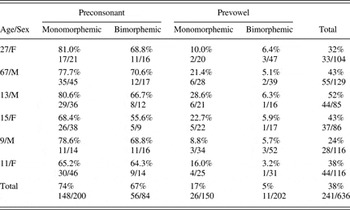
Wolfram and Christian (Reference Wolfram and Christian1976:33), in their summary of phonological aspects of Appalachian English, examined CCR and found that Appalachians follow the normal phonological constraint of higher rates of deletion before a consonant than a vowel and lower rates in the bimorphemic context. As with other Wolfram studies, only heterovoiced clusters were examined. Table 1 is a replication of their findings (1976:36, Tables 10 and 11).
CCR findings for six speakers from Wolfram and Christian (Reference Wolfram and Christian1976)

Wolfram and Christian (Reference Wolfram and Christian1976:35) also found that the rate of deletion before pauses for the six speakers was 24.5%, which aligns pauses more closely with, yet still above, vowels, which averaged a rate of 11% (37 of 352). In terms of what the deletion of consonant clusters can reveal about Appalachian society, Wolfram and Christian (Reference Wolfram and Christian1976:37) wrote, “On the whole, consonant cluster reduction in A[ppalachian] E[nglish] does not appear to be particularly socially diagnostic and speakers from different age and social group levels do not differ significantly from each other in terms of the extent of simplification.”
Luhman (Reference Luhman1990) used CCR in a matched guise study of attitudes about English in Appalachia, based on the identification of CCR by outsiders as an Appalachian feature. He (1990:334) noted that consonant cluster simplification was one of the least predictable of the sociolinguistic variables analyzed in the speech samples of the four speakers used to construct the matched guise samples.
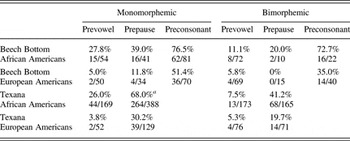
Mallinson and Wolfram (Reference Mallinson and Wolfram2002) studied a small Appalachian, African American community in Beech Bottom, North Carolina, as part of the quest to understand the origins of AAVE. In most U.S. Southern communities during the last third of the 20th century, African American youth were moving away from local norms and toward an external norm for AAVE. Within their rural community, however, Mallinson and Wolfram (Reference Mallinson and Wolfram2002) found accommodation to the local non–African American norms with several variables. Age was not included as a factor group in their multivariate analysis, but in contrast to other AAVE features that were receding, CCR did not show reduced rates through the generations. As with other studies, AAVE has been found to have considerably elevated rates of CCR. Mallinson and Wolfram (Reference Mallinson and Wolfram2002:757) argued that for African Americans in Beech Bottom, CCR is a highly diagnostic variable, especially in comparison with other varieties of European-American Appalachian English. Their CCR results are displayed in Table 2, along with those from Childs and Mallinson (Reference Childs and Mallinson2004). Mallinson and Wolfram (Reference Mallinson and Wolfram2002:759) found that African Americans had a rate of 28% for prevocalic monomorphemic forms, in comparison with 5% for European Americans.
CCR rates from Mallinson and Wolfram (Reference Mallinson and Wolfram2002:759) and Childs and Mallinson (Reference Childs and Mallinson2004:39)

aThese combined columns are reconstructed from Childs and Mallinson (Reference Childs and Mallinson2004:39, Table 6).
Childs and Mallinson (Reference Childs and Mallinson2004) examined the biethnic community of Texana, North Carolina, another small community in the Smoky Mountain region of Appalachia. They took the same analytical strategy and contrasted the prevocalic environment for CCR in the two ethnic groups. Their data shows that their speakers have significantly lower rates of CCR in bimorphemic tokens (2004:39), thereby demonstrating that ethnic groups do not diverge in terms of the variable's morphological constraints. For prevocalic, monomorphemic forms, African Americans have rates of 26% versus 4% for European Americans, as shown in Table 2.
The data from Appalachia indicate that the patterns found elsewhere in the United States also operate in this vernacular dialect region. Phonological constraints, at least between consonants and vowels, affect rates of consonant deletion, and morphological constraints also have an effect, albeit they are less influential than the phonological factors. Socially, consonant deletion operates across Appalachian communities in all ethnic groups and generations. From these previous investigations into CCR, the most straightforward hypothesis for the current examination of CSD is that its vernacular status will be reduced and that both phonological and morphological factors will influence the frequency of deletion.
Methods
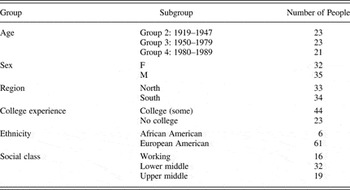
For the investigation of sociolinguistic variation in Appalachia, the West Virginia Dialect Project (WVDP) has conducted sociolinguistic interviews with 151 native Appalachians. From these interviews, 67 speakers,Footnote 3 born between 1919 and 1989, form the basis for the West Virginia Corpus of English in Appalachia (WVCEA), as shown in Table 3. Most of these interviews include word lists and reading passages besides casual conversation. These speakers were chosen because of the quality of their interviews,Footnote 4 their social distribution in terms of geography, age, and sex, and, lastly, the status of their parents as natives of Appalachia.Footnote 5
Social divisions for the West Virginia Corpus of English in Appalachia (WVCEA)

These speakers are divided into three age groups, each of which is fairly evenly divided by region and sex.Footnote 6 Those three social categories were the major design goal of the corpus. Of the 67 speakers, 6 are African American. Most speakers were born and raised in West Virginia (64), although a few were born near the West Virginia border in Ohio (2) and Pennsylvania (1).
Two social factors require explicit definition: regional division and educational level. The regional division between North and South was designated with a latitudinal line running through the middle of West Virginia from east to west, following Kurath's (Reference Kurath1949:27) division between northern and southern West Virginia. It also echoes the divisions made by Carver (Reference Carver1987) and Labov, Ash, and Boberg (Reference Labov, Ash and Boberg2006). The regional decision was also supported by speakers' own observations. Most people assured us that Braxton County, WV, is where the Southern–Northern division is found in the state. The second social factor is the category of college/no college. The differentiation rests between those speakers with no college experience versus those with some, which could be as slight as a single community-college class. A wide range exists in the corpus. Some speakers do not have a high school degree and others have only a high school degree; some of the college speakers started postsecondary education but never finished; some finished with a bachelor's degree, and one finished with a master's degree. The “college” speakers, defined as those who have oriented themselves with postsecondary education in some fashion, could be any of the three social classes in the corpus. The corpus contains working-class speakers who have taken college classes and upper-middle-class speakers who are in the “no-college” category. In this way, the social factor group of college/no college is not a level of educational attainment but a category of identity and orientation to social institutions (Hazen, Reference Hazen2002). It is also a category of social orientation, which provides a check on our designations of social class and has shown strong correlations with language variation patterns in previous studies of this corpus (Hazen, Reference Hazen2008; Hazen, Hamilton, & Vacovsky, Reference Hazen, Hamilton and Vacovsky2011).
For social class itself, the categories presented here are designed with traditional indicators such as occupation and social-class environment in which the speaker was raised (Labov, Reference Labov and Lanehart2001). For this study, the WVDP designated social class based on occupation (or occupation of the parents if the subject was a minor), housing conditions (as known), self-discussion of high-school cliques, and living conditions (whether they had to work in high school; their hobbies). These categories were used in addition to other factors, including the speakers' perceptions of their social class standings, their extracurricular activity choices, and their explanations of their belongings. The previous results from this corpus (Hazen, Reference Hazen2008:128) strongly support the legitimacy of these social class divisions.
The interviews were transcribed orthographically, and the WVDP researchers used those transcripts as maps to help guide them through the audio interviews. Each token was coded with the linguistic and social categories. All coders were trained and their success rate was evaluated before starting on CSD coding. Difficult cases were evaluated using spectrograms to gather different clues for making a judgment. Unclear instances were not kept as part of the data set, and overall, the coding was a group effort, with several coders checking the more difficult tokens.
The data were analyzed using Goldvarb X (Sankoff, Tagliamonte, & Smith, Reference Sankoff, Tagliamonte and Smith2005). Tables 10 and 13 are arranged to emphasize the constraint ranking within each factor group and the relative strength of each factor group. Tagliamonte (Reference Tagliamonte2006:237) wrote, “Constraint ranking … provides a detailed model of the structure of the relationship between variant and linguistic context, or the ‘grammar’ underlying the variable surface manifestations.” The relative strength of each factor group indicates which factor groups are most influential for that dependent variable (Tagliamonte, Reference Tagliamonte2006:242).
As noted previously, a distinction should be made between what numerous researchers refer to as consonant cluster reduction (CCR) and coronal stop deletion (CSD). For researchers such as Wolfram, Childs, and Torbert (Reference Wolfram, Childs and Torbert2000) and Torbert (Reference Torbert2001), the possible set of clusters to be examined includes instances of /sk/ and /sp/. Obviously, those are not available to the same morphological constraints as the other clusters, because /sk/ and /sp/ will only have monomorphemic tokens. That distribution creates two concerns for the statistical analysis. First, the potential for skewing the morphological hierarchy will arise, because the monomorphemic forms will have phonological conditioning that the bimorphemic tokens will not have. Second, the potential forms have /s/ as a preceding sound, which has been found to be the preceding environment that most favors deletion. Conversely, when CCR studies report on the preceding /s/ environment, it will have a higher proportion of monomorphemic forms, which will also skew the results. Accordingly, to avoid an imbalance and possible interactions of the linguistic constraint categories, this study examines only coda clusters with coronal stops (i.e., CSD).
The dependent variable was coded for six variants, although [ʔ], [p], and [k] were rare. The variants were thus reduced to [t], [d], and zero for the analysis. The tokens were coded for factor groups of underlying representation (/t/ or /d/), morphological context, and preceding and following phonological environment. For following phonological environments, vowels were coded as a single factor, and for both phonological environments, consonants were coded individually to allow for subsequent grouping as needed. Morphemic status was coded for eight divisions: monomorphemic nonverb (e.g., the past), monomorphemic verb (e.g., bust), bimorphemic preterit (e.g., I passed), semiweak verb (e.g., swept), regular past participle (e.g., I have walked), semiweak past participle (e.g., I have swept), bimorphemic adjective (e.g., the burnt porch), and semiweak adjective (e.g., the swept porch). These morphemic categories were condensed throughout the analysis.
Numerous combinations of factor groups and factors within each group were explored as part of coding the 17,694 tokens. Both phonological and phonetic environments were assessed, although the differences between them were negligible in the end. Other methodological choices are revealed in the results section, where subsets of tokens are peeled away one by one to reveal certain language variation patterns. This paring down of the token set allows the main results to be comparable with the largest swath of studies.
Results
This section provides results within two areas. First, the analysis of CSD is discussed in light of several linguistic constraints. Second, the corresponding analysis of social constraints is presented, following the approach of Tagliamonte and Temple (Reference Tagliamonte and Temple2005). All percentages are the rates of zero forms divided by the total number of tokens for that category.
Linguistic results
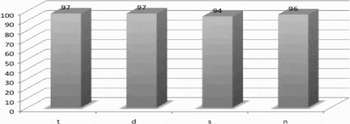
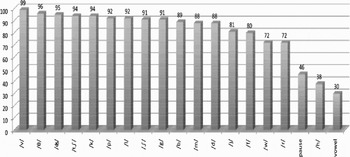
In analyzing many sociolinguistic variables, a wide variety of contexts arise that might influence the assessment of the linguistic processes. With this variable, the most abetting context to be considered is before alveolar consonants. For both homovoiced and heterovoiced clusters, prealveolar positions foster CSD rates above 93%, as seen in Figure 1 (/t/ [1416 of 1473]; /d/ [473 of 490]; /s/ [727 of 788]; /n/ [238 of 246]). Clearly, following phonological environment heavily influences CSD for these Appalachian speakers, and the lynchpin element is the place of articulation because the wide range of sonorancy, manner, or voicing does not affect the rates. With this phonological influence in mind, these environments are removed for the remainder of the analysis.
Rates of CSD with following alveolar phonological environments.

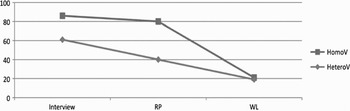
Rates of CSD within interviews, reading passages, and word lists.

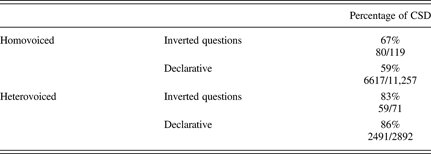
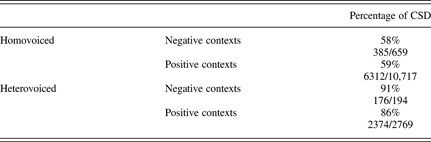
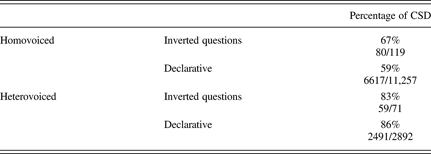
Additionally, Tagliamonte and Temple (Reference Tagliamonte and Temple2005) developed a comprehensive set of contexts in which not to code CSD. For example, they exclude tokens in interrogative and negated contexts. It is not exactly clear from that article why those contexts would be excluded, although potential phonological stress patterns might be altered within interrogative contexts. For this study, the tokens were collected and the following results were found, as shown in Tables 4 and 5. At this point in the analysis, both homovoiced (e.g., /nd/, /st/) and heterovoiced (i.e., /rt/, /lt/, /nt/) tokens are included.
Rates of CSD in inverted question contexts
Rates of CSD in negative polarity contexts
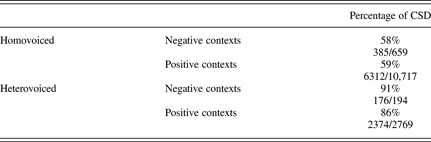
Neither negative contexts nor inverted question contexts were found to have significant effects on the rate of CSD in preliminary Goldvarb analysis. Inverted questions in either homovoiced or heterovoiced contexts did not have a dramatic effect, and inverted questions were a small fraction of the overall token count. For negative constructions, the rates were even more comparable with their positive counterparts. Future studies, in the search for sufficient tokens, should be able to take these contexts as viable options. However, from this point forward in this paper, these tokens will be excluded for the sake of comparability.
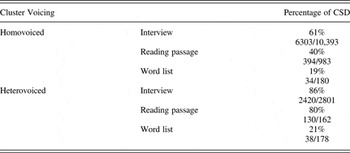
Another possible constraint for the consideration of CSD is that of stylistic context. In Table 6, within both homovoiced and heterovoiced clusters, the rates of CSD drop dramatically from the interview to the word list to the reading passage. For the heterovoiced, however, the decline between the interview and the reading passage is not nearly as sharp, only a 6-percentage point drop. The overall impact of the stylistic contexts may be a result of social stigma about CSD, but it may also be attention to speech or the articulatory effects of the speech rate. Labov (Reference Labov and Lanehart2001:196) argued that -t,d deletion involves minimal style shifting and social awareness. The word list and reading passage are frequently produced more slowly, or carefully, than the interviews. If it is not a social influence from stigmatization, then we can conclude that articulatory effects contribute to these rates. This conclusion would lend credibility to the interpretation of this variable being predominantly phonological in nature. After the analysis of social factor groups, the potential influence from stylistic context will be reconsidered. From this point forward in this analysis, given the wide discrepancy between the three stylistic contexts, the interview tokens are the only ones examined.
The effect of different stylistic contexts on rates of CSD

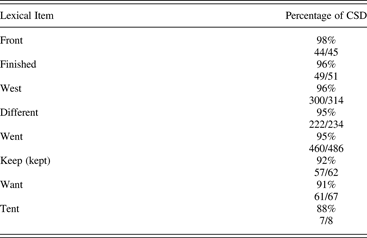
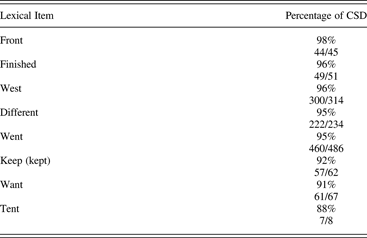
As noted by Tagliamonte and Temple (Reference Tagliamonte and Temple2005), among others, one of the basic exclusions in the study of CSD is the word and, because its rate of deletion is often nearly categorical. It is not included in this study. Guy (Reference Guy2009) argued that its reduced form has been lexicalized, as in the phrase rock 'n' roll. Following this line of thought, three decisions were made regarding lexical items. First, a lexical factor group would track frequently used lexical items, with 67 lexical items under observation. This tracking of individual lexical items allowed for analysis of which lexical items might yield high rates of CSD, indicating possible lexical conditioning. Second, it was decided not to adopt the five-token-per-type sampling method established by Wolfram (Reference Wolfram1969:58, Reference Wolfram and Preston1993:214). The primary rationale for establishing that sampling procedure was to limit the potential effect of any one lexical item; for CSD specifically, the concern was that some words might be stored in the lexicon as a reduced form, and hence CSD could not apply as a variable rule. In the present study, by tracking lexical effects, the research team could guard against undue lexical influence without restricting the number of tokens overall. Third, during analysis, it was decided to exclude the lexical items with deletion rates around or above 90%. That set of lexical items is displayed in Table 7. These high frequency lexical items with rates above 87% are excluded from the analysis for the remainder of this paper. Phonologically, five of these lexical items are [nt] combinations and two contain voiceless fricatives and one a voiceless stop. Although these phonological contexts are not determinative in producing the associated high rates of deletion, they do lend themselves to higher rates in many studies.
Lexical items removed from further analysis
One lexical item that is occasionally excluded before coding potential tokens of cluster simplification is just. This one word had an overall rate of deletion of 82% (1455 of 1783). Although this rate is high, it was not excluded because it was still variably produced. Additionally, other words with preceding alveolars had a rate of 77%, in line with that of the alveolar /s/ of just.
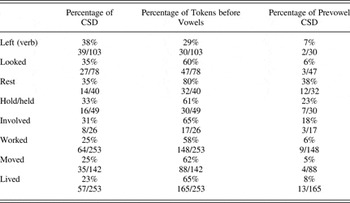
In reviewing the individual lexical items, an unexpected result appeared. Some lexical items had a noticeably lower rate of reduction than expected. In Table 8, the lexical items with the lowest rates of CSD are listed. The first column is the lexical item itself. The second column is the rate of CSD for that lexical item. The third column is the percentage of tokens of that lexical item that fall before vowels, and the fourth column is the rate of reduction for that prevowel subset. Vowels in almost all studies of CSD strongly disfavor deletion. Table 8 displays an unusually large percentage of these lexical items that come before vowels and do, indeed, have considerably lower rates of deletion (cf. Bybee, Reference Bybee2002).
Lexical items with low rates of reduction

In this corpus, the 3830 tokens in the prevowel environment constitute 34% of all the tokens. Given that these lexical items show up before vowels more often than that average, their lower rates of CSD would be best seen not as a lexical exception but as a phonological effect. That these lexical items do show up before vowels more often is a matter of historical happenstance (e.g., many of these vowels are following prepositions). The one exception in Table 8 is the verb left. For this lexical item, the percentage of tokens before vowels is lower than the others; in this case, however, pauses might be significant, as there are 27 instances in which left is followed by a pause, and the deletion rate is 15% (4 of 27). For left overall, the percentage of tokens before vowels and pauses would be 44% (57 of 130), with a rate of 11% (6 of 57).
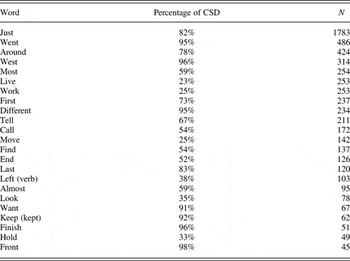
As previous studies of consonant deletion have examined frequency, some assessment of word frequency is in order here. As the current methods assessed both extremely high and extremely low rates for frequent words, a comparison of frequent words and their rates of deletion became available, based on the corpus internal frequency of each word. Raymond et al. (Reference Raymond, Dautricourt and Hume2006) found no effect of word frequency on deletion for word-internal clusters, but Gahl and Garnsey (Reference Gahl and Garnsey2004) and Jurafsky et al. (Reference Jurafsky, Bell, Gregory, Raymond, Bybee and Hopper2001), among others, found highly frequent words to delete final consonants more often. Table 9 provides the most frequent candidates for CSD, ordered top to bottom from most to least frequent. In looking at the corresponding rates of deletion in the middle column of Table 9, it is clear that the percentage of CSD does not correlate with how frequent the word was in the corpus. For example, front has a 98% rate of CSD with only 45 appearances in the corpus but lived has a rate of 23% CSD with 253 tokens. Frequency within the WVCEA does not appear to be an influential factor.
Most frequent words, ordered by N

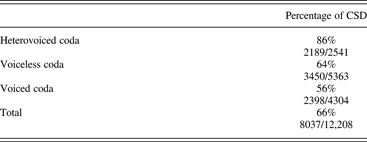
The final task in grooming the data to match many previous studies remains in the voicing of the consonant cluster coda. Many studies have selected only coda clusters with the same voicing, for example best (–voice) and wind (+voice). Other studies, such as Khan (Reference Khan and Cheshire1991), have taken both those kinds of codas and codas with heterovoicing, for example cart, went, and bilk. Given this methodological discrepancy in the CSD literature, a question begs to be answered. Does the voicing harmony of the coda make a difference in the rate of CSD? To answer this question, a factor group was established to mark voiceless codas, voiced codas, and heterovoiced codas. As a factor group, the voicing of the coda was found to be significant in all subsequent Goldvarb analyses. Importantly, even between the homovoiced codas, a difference in the rate of deletion was found (see Table 10). The heterovoiced clusters (a voiced + voiceless consonant) were the most strongly correlated with deletion, with a rate of 86%. This higher rate primarily is a result of the preceding consonants of the clusters being /n/, /s/, and /l/, all of which favor deletion in any coda cluster.Footnote 7 For the voiceless clusters, the rate falls to 64%. The rate for the voiced clusters drops again to 56%. This factor group was originally part of the Goldvarb analysis. In that examination, the factor group for the voice of the consonant cluster was second most influential with a range between the lowest and highest factor of 38. Considering that most studies do not consider this factor group, it was a surprise that its effect was so strong. With this finding, future researchers should investigate how the voicing of the coda affects CSD in different communities.
Rates of CSD in three different types of consonant clusters
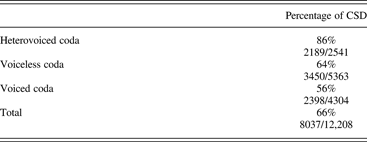
However, as a regular factor group in the following analysis, statistical anomalies arose. With the preceding phonological environment also a factor group, not all heterovoiced tokens could fully participate in the variation of the preceding phonological environment. For the sake of comparability with previous studies, and to avoid interactions in the following tables, the tokens will be restricted to homovoiced codas. For all of the following findings, it is safe to assume that heterovoiced codas would yield higher rates for any category examined.
To summarize the analysis up until this point, tokens from the following contexts and categories have been removed from the subsequent analysis: following alveolars, inverted questions, negative constructions, reading passages, word lists, lexical items with unusually high rates of CSD, and heterovoiced codas. The analysis now turns to consideration of the remaining significant linguistic influences on CSD.
In Table 11, three potential linguistic factor groups were investigated, and all three were found to significantly affect its rate. As expected from previous studies, the most influential factor group is that of the following phonological segment. The factor groups themselves are ordered from most influential to least influential, and internal to each factor group, the factors are ordered again from most to least favorable (Tagliamonte, Reference Tagliamonte2006). The range between the highest and lowest factor in each group indicates the relative strength of influence from that group.
Linguistic factors influencing CSD (Goldvarb analysis)

Note: Other factor groups included in analysis: ethnicity, age, social class, sex, region, college experience (see Table 14).
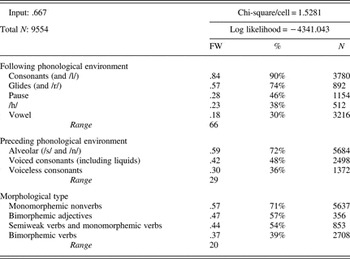
The factor group for the following phonological environment was most significant with a range of 66. The difference between this range and the ranges of the other two factor groups should be kept in mind. It is evident that CSD for these speakers is mainly a phonological process controlled by the following phonological environment. In this environment, the CSD rate for consonants was 90%, and the percentage for vowels was 30%. Those two factors, themselves collections of various sounds, constituted the majority (73%) of the tokens. The full range of sounds is given in Figure 3.
The rates of CSD for following phonological environment.

The following environment of /l/ was found to have rates equal to other consonants, but following /r/ behaved differently. Following /l/ had a rate of 92% (416 of 453), and following /r/ had a rate of 72% (105 of 145). As with preceding environments, the status of /l/ as a lateral liquid with alveolar tongue contact appears to be the deciding factor; for many West Virginians, /r/ is produced as a bunched velar liquid. Following glides correlated with the next highest rate of CSD at 74%. The glides /j/ (81%, 174 of 216) and /w/ (72%, 384 of 531) are grouped with the following environment of /r/, all of which had comparable rates. The rates of glides and other consonants were distinct enough that when combined, the larger grouping did not improve the model within Goldvarb, and these categories were kept as separate factors. Following pauses demonstrated a differential influence on CSD, with a rate of 46%. The following environment of /h/ was a separate conundrum. One would expect that word-initially and as an onset, /h/ would maintain its consonantal qualities and match the rates of deletion found with the other fricatives in the consonant group. It clearly does not, correlating with deletion 38% of the time. Even though there are only 512 tokens, the addition of these /h/ tokens to the consonant category did not improve the model. For the factor group as a whole, exactly what linguistic quality is the triggering influence is unclear: The following phonological environment provides hints of the effect of sonorancy, but it is not a foregone conclusion that sonorancy is the actual triggering mechanism. The possible phonological workings will be explored further in the discussion section.
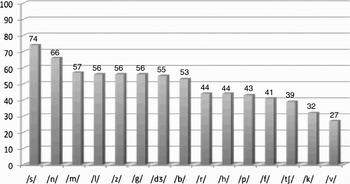
The factor group for preceding phonological environment was next most influential, with a range of 29 between the highest and the lowest ranked factors, as shown in Table 11. Contrary to many studies, this factor group outranked the morphological context in terms of its strength of influence. Although this factor group was originally coded as individual sounds, different natural classes were subsequently tested with Goldvarb to assess which classification had the most striking influence and provided the best model. The individual factors were tested in groups by sonorancy, by manner, by voice, and by place. Of those combinations, the place of articulation and voicing provided the best fit. As noted for other studies, preceding alveolars strongly correlate with CSD, with a rate of 72%. Of the permutations of the other sounds, place of articulation was not clearly relatable to the rate of CSD. For example with velars, /g/ had a rate of 56% but /k/ only had a rate of 32%. The most applicable natural class for the remainder of the factor group appears to be voicing. The sounds /r/ and /l/ had comparable rates, 44% (206 of 474) and 56% (634 of 1131), respectively. Given their multiple places of articulation and other phonological similarities, they were grouped together in this factor group with the voiced consonants. A graph of the individual factors is given in Figure 4. As Tagliamonte and Temple (Reference Tagliamonte and Temple2005:283) noted of Labov (Reference Labov1989), the hierarchy /s/ > stops > nasals > other fricatives > liquids has been viewed as the normal ordering of influence from preceding phonological contexts. According to Figure 4, that hierarchy does not fully match these data.
The rates of CSD for preceding phonological environment.

After the alveolars, the preceding environment demonstrates a gradual decline across voiced consonants to voiceless consonants. The one anomaly is /v/, a voiced consonant with the lowest corresponding rate of CSD. This case is a good example of a factor reflecting a separate linguistic influence. Through historical happenstance, 518 of the 532 /v/ tokens are bimorphemic preterits, which have a lower rate of CSD: 138 of those 518 tokens (27%) had CSD. The other 14 tokens of /v/ correlate with a 50% rate of CSD, which would put it firmly in the voiced consonant range of rates. With that anomaly accounted for, the nonalveolar factors were grouped into voiced and voiceless categories. The resulting Goldvarb analysis aligned well with the percentage distribution.
The least influential, yet significant, linguistic factor group was the morphological context, with a range of only 20, less than one-third of the following phonological environment (and a smaller range than ethnicity in Table 14). This factor group began with more finely grained distinctions between actively conjugated past tense forms and past participles and between adjectives and verbs. After winnowing these down, they were grouped together into the categories in Table 11. The end points on this range of factors are the expected candidates. The vast majority of the monomorphemic forms have the highest rate at 71%. There is a subset of monomorphemic forms, the monomorphemic verbs such as rest (verb), which fit neither the pattern of the monomorphemic nonverbs nor the bimorphemic verbs. Semiweak verbs, be they adjectives or participles or actively conjugated, all patterned similarly, with a total rate of 55% (204 of 368). Monomorphemic verbs fell in line with the semiweak verbs with a rate of 53% (257 of 485). Bimorphemic forms had differing rates within their subset. The bimorphemic verbs had the lowest rate at 39% deletion (either as participles or not). The bimorphemic forms used as adjectives (e.g., the trapped miners) were found to have higher rates of reduction, 57%, than bimorphemic verbs. Unlike Tagliamonte and Temple's (2005) York corpus, the WVCEA demonstrates a morphological influence, although its internal categories are not as tidy as that found in other studies.
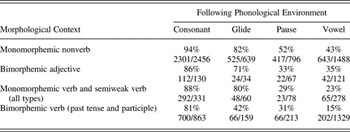
The cross tabulation between the following phonological environment and the morphological context reveals a fairly regular set of implicational tendencies in Table 12. Clearly, in looking across Table 12, the phonological environment has the strongest influence. Even the morphological category with the most dampening effect, bimorphemic verbs, had a rate of deletion at 81% before a following consonant, although only a 15% rate before following vowels. It should be noted that for bimorphemic verbs, following vowels constitute 52% (1329 of 2564) of the instances, which is more than any other morphological category. Monomorphemic nonverbs had following vowels 28% of the time (1488 of 5379); bimorphemic adjectives had following vowels 34% of the time (121 of 352); and the combined monomorphemic and semiweak verb category had following vowels 37% of the time (278 of 747). The rates do vary according to morphological category, as can be seen even in the vowel column in Table 12, but having one-half of the bimorphemic verbs come before vowels yields lower CSD rates for that category. The morphological context with the highest rates of deletion, monomorphemic nonverbs, drops from 94% before consonants to 43% before vowels. This phonological influence is strongest with following consonants, which clearly override other constraints and maintain rates above 80% for all the morphological categories. The monomorphemic nonverbs have the highest percentage of tokens that come before consonants with 46% (2456 of 5379). Bimorphemic verbs on the other hand have only 34% (863 of 2564) of their tokens before consonants. The phonological influence from both ends of the spectrum reaches into the full range of morphological categories.
Cross tabulation between morphology and phonology

With the cross tabulation of the morphological and following phonological categories, some cells are somewhat out of alignment. The preglides and prepauses contain most of the discrepancies. Semiweak verbs and bimorphemic adjectives overall have lower numbers of tokens than the other morphological categories, and these lower numbers may have affected the order of rates.
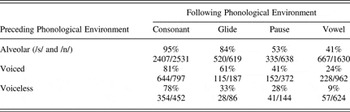
For the cross tabulation of the following and preceding phonological environment, no cells are out of alignment. As these two are the most influential linguistic categories, their importance can be seen in the strict ordering of Table 13. The range in this table is extremely wide, with rates as high as 95% for CSD after an alveolar and before a consonant and as low as 9% for CSD after a voiceless consonant and before a vowel. Both the wider range of rates and the stricter ordering provides more evidence for CSD's nature as a phonological process for these Appalachian speakers.
Cross tabulation between preceding and following phonological environments

Social results
This section provides the results for possible social constraints on CSD as they potentially affect language variation patterns. These social results include divisions in age, sex, educational orientation, social class, region, and ethnicity.
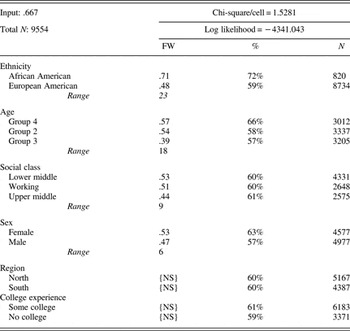
As shown in Table 14, the differences between the social groups are slight, and two social categories—region and college experience—were not found to be significant at all in the step-up/step-down procedure in Goldvarb. They were removed from the final Goldvarb analysis. Given these small differences, it would be difficult to argue that the large differences (Table 6) found between the stylistic contexts of interview, reading passage, and word list are a result of social stigma. Only ethnicity illustrates a sizable difference in rates of CSD, with African Americans holding a 13-percentage point higher rate than European Americans.
Social factors influencing CSD (Goldvarb analysis)

Note: Other factor groups included in analysis: following phonological environment, preceding phonological environment, and morphological type (see Table 11).
The range between the factor weights is wider for ethnicity than for morphological context, one of the linguistic factors, but no social factor is more influential than the phonological constraints. The African American population of Appalachia is small (3.6% for West Virginia), and it is unclear how strongly associated CSD is with African Americans in the West Virginia region.
The social class results do not mirror those found for other variables in this corpus. For (ING) (Hazen, Reference Hazen2008), the rate of alveolar –in was found to be strongly correlated with social class, with a decline from 73% for the working class to 50% for the lower-middle class to 38% for the upper-middle class. In Table 14, the rates for the three social classes are nearly identical. The college experience category is also an indication of this lack of social stigma, because it often times strongly correlates with social class differences. In these results, there is little difference between those with some college experience and those with none. If CSD were heavily stigmatized for these speakers, social differences matching the wide range of stylistic context differences would arise (Preston, Reference Preston1991). None do. Therefore, it would be best to conclude that the stylistic differences are the result of articulatory effects of speed or attention paid to speech. This finding confirms Labov's (2001) assertion that CSD offers only moderate style shifting opportunities for communities.
Coronal stop deletion does not appear to be undergoing a change in progress in Appalachia, as would be expected given what we know from previous studies. The rates for the three age groups are similar, and it is the youngest age group that has the highest rates. Unlike sociolinguistic variables such as a-prefixing (Hazen, Butcher, & King, Reference Hazen, Butcher and King2010; Wolfram & Christian, Reference Wolfram and Christian1976), CSD is maintaining its linguistic and social patterns.
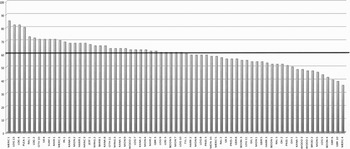
Lastly, for this small social examination, a look at individual variation is in order. The rates for each individual are displayed in Figure 5, with the mean average line displayed. These rates are ordered from highest to lowest to allow a perspective of whether there are important breaks between speakers. Given the smooth cline from the top speaker (85%) to the bottom speaker (36%), it is apparent that this sociolinguistic variable follows a pattern of gradient stratification, a typical scenario for a phonological variable. Given Romaine's (Reference Romaine1984) assumption that this linguistic process is quite old, it should be no surprise that large gaps do not appear across the speech community despite the wide range of interspeaker variation. Unlike the distributions for individuals found for (ING) by Trudgill (Reference Trudgill1974) and Hazen (Reference Hazen2008), the upper and lower limits are not as distinct. That lack of distinction again reflects the low degree of social marking this variable provides.
Rates of CSD for individuals.

A comparison of Appalachian rates of CCR and CSD.

Discussion
The linguistic constraints on CSD fall into two basic categories—phonological constraints and morphological constraints—as analyzed in this paper. The phonological constraints themselves are divided into preceding and following environments and are considered as segmental influences. As a general assessment for this set of speakers, analysis has revealed that CSD is primarily a phonological process.
From the first CSD study to the present, the following phonological environment has been the most significant factor group for English. For these Appalachian speakers, the effect of the following phonological environment is vastly stronger than that of other constraints. The ordering of influence within that factor group has been open to debate for some time, although clearly some trends hold between communities. Following alveolars contribute the most to higher rates of deletion. Following vowels do not favor deletion relative to following consonants. This relative ordering is to be expected given previous results. The full hierarchy for this study is: consonants > glides > pause > /h/ > vowel. Schreier (Reference Schreier2005:169) presented this following hierarchy as fitting the findings of Tagliamonte and Temple (Reference Tagliamonte and Temple2005), Fasold (Reference Fasold1972), Guy (Reference Guy1991), and Labov (Reference Labov, Hinskens, van Hout and Wetzels1997) for the effect of the following segment: “plosive > glide > liquids > vowel > pause.” This study's hierarchy is not disharmonious with Schreier's hierarchy, in that plosives fall in with all consonants, liquids divide between consonants (/l/) and glides (/r/) for this study, and pauses vary between communities. Like Philadelphia and the Southern United States, these Appalachian speakers' CSD rates before a pause more closely align with vowels than they do with following consonants. Relatedly, Schreier (Reference Schreier2005:169) noted that some varieties, such as English in Philadelphia (Guy, Reference Guy1991) showed more deletion with following /l/. For most speakers in this region of Appalachia, the American /r/ is produced as bunched, with most of the body of the tongue grouped toward the velar region. In contrast, light /l/ in onset position will have an alveolar tongue tip placement. This contrast explains the difference between /l/ with 92% deletion and /r/ with 72% deletion.
Sonorancy has been an open question as a factor for following segments. Vowels, being the most sonorant elements, have always disfavored deletion. However, within the consonants, the following environments do not align with the most sonorant elements favoring deletion more than the less sonorant elements. For example, in Figure 3, the rates for interdental fricatives and bilabial stops are inverted from what their voicing would predict were the sonority hierarchy strictly enforced. Labov (Reference Labov, Hinskens, van Hout and Wetzels1997) noted, “The auxiliary notion of the sonority hierarchy has no more likely chance of success, since as we have seen, the behavior of /w/ is not predicted by this principle any more than by resyllabification.”
One anomaly in the current results is the behavior of /h/ as a following segment. It should pattern like other voiceless fricatives and have rates somewhere between 80% (/f/) and 96% (/θ/). Instead, CSD before /h/ had a rate of 38%, second only to vowels (30%) for its inhibiting effect on CSD. In other words, neither following vowels nor following /h/ encroached upon the preceding consonant clusters enough to cause higher rates of deletion. The possible reason for this /h/-scenario is that its qualities as a voiceless fricative may be waning in areas of Appalachia. It is not uncommon for native West Virginians to say 'uge for huge or 'umid for humid. At this point, the process seems to be lexically constrained. This /h/ dropping is not a feature remarked on by outsiders and has not become part of common stereotypes of Appalachian speech. It does appear for natives in our study, however, and it certainly provides an explanation for the exceptionally low rate of CSD before /h/.
Given the changing nature of initial /h/ and the strong effects from consonants, we are able to reassess resyllabification. Labov (Reference Labov, Hinskens, van Hout and Wetzels1997) provided a convincing argument against resyllabification as the motivation for the low rate of CSD before vowels. The idea of resyllabification follows from word final (t,d) being reconfigured as the onset of the following word. As the onset, the (t,d) escapes the deletion rule, which can no longer operate on that form. For resyllabification to be a factor, it assumes that CSD occurs because a rule operates proactively. The data from this analysis present a different picture. The word-final (t,d) appears to be deleted most prominently when the following consonant encroaches upon it. When articulation for the following consonant is being processed psycholinguistically, the final consonant of the preceding word has a dramatically lower chance of being articulated. Two different constraints or rules may be operating here: (1) a (phonological) rule or constraint operating on all word-final CC clusters to reduce them to C codas approximately 50% of the time, and (2) then an additional (articulatory) rule or constraint operating on all codas followed by an encroaching consonant.
For CSD, following pause has varied from dialect to dialect, sometimes inhibiting deletion, sometimes correlating strongly with deletion. Schreier (Reference Schreier2005:206) developed an analysis across many varieties to assess how they group according to rates before pauses. The varieties where following pauses inhibit deletion are those that have been long established and have been without contact with substrate languages using only simple codas (CVC) (e.g., York English, England; Pakeha English, New Zealand; European American English, North Carolina). The varieties where following pauses correlate with higher rates of CSD have histories of language contact (Hyde County AAVE; Black Bahamian English). Schreier wrote (2005:207), “One could make a case in point that this is phonotactically motivated, namely that contact-derived varieties have a strong tendency to reduce complex final clusters with the aim of modifying the syllable structure to CVC in saliently pre-P{ause} environments.” Within the WVCEA data, the ethnic divide does reveal a divide in the prepausal environment. In Table 15, the monomorphemic forms before pauses have a considerably higher rate for African Americans than do those for European Americans. This finding aligns these Appalachian African Americans with those from Hyde County, North Carolina, and supports Schreier's claim about diachronic effects on syllable structure from contact varieties.
The ethnic division for following phonological environment and morphemic status

Note: Semiweak tokens are excluded from this table.
Moving away from the following environment, the preceding phonological environment was second most influential on the rates of CSD, a surprising finding. As Tagliamonte and Temple (Reference Tagliamonte and Temple2005:283) noted, Labov's (Reference Labov1989:90) constraint of /s/ > stops > nasals > other fricatives > liquids is a “relatively weak constraint.” For these data, the overall process of CSD appears to be more thoroughly a phonological process than a morphophonological process. Guy and Boberg (Reference Guy and Boberg1997) argued within the autosegmental framework that the obligatory contour principle constrains the final consonant in the CC coda, disfavoring similar adjacent forms. The data for these Appalachian speakers indicates that preceding phonological environment has this hierarchy: s > voiced consonants > voiceless consonants. Because the alveolar place of articulation contributes greatly to deletion, Guy and Boberg's hypothesis is substantiated to some degree. Yet no one quality appears to rule the preceding phonological environment's effect on CSD, because a voiced segment favors deletion, regardless of the place of articulation. No clear alignment appears for manner of articulation either. Many studies have appealed to sonority for an explanation for the preceding phonological environment effect. Tagliamonte (Reference Tagliamonte2006:115) summarized, “For preceding phonological context, variable (t,d) varies roughly in proportion to the sonority of the preceding segment: less sonorous segments (stops and fricatives) tend to favour deletion, while more sonorous segments disfavour deletion.” Raymond et al. (Reference Raymond, Dautricourt and Hume2006:84) found that for coda /t,d/ deletion, the preceding consonant class worked in the following way: nonhomorganic nonapproximant > homorganic nonapproximant > approximant. The results in this analysis for word-final CSD do not match either of these findings, indicating a different set of constraints.
With the morphological analysis of these data, a few avenues of linguistic enquiry are revealed. The ordering of morphological context, from those that correlate with higher rates to those that correlate with lower rates, is the following: monomorphemic nonverbs > bimorphemic adjectives > semiweak verbs and monomorphemic verbs > bimorphemic verbs. The normal ordering, as noted by Tagliamonte and Temple (Reference Tagliamonte and Temple2005:285), is monomorphemes > past tense semiweak verbs > past tense regular verbs. Two anomalies appear in the current data, namely that neither monomorphemic nor bimorphemic forms behave as a single group. It would be accurate to describe these category results for CSD as nonverbs versus verbs, regardless of whether they are monomorphemic or bimorphemic. Future studies could assess whether syntax could play a role, but it seems more likely that the phonological prominence within certain phrases is influential. Within the verb phrase, it appears that the verb would receive more phrasal stress than a predicate adjective or an adjective embedded in a noun phrase. This alone would explain the differences between the monomorphemic nonverbs and the monomorphemic verbs. Alternatively, if one were to adopt the lexical phonology path of Guy (Reference Guy1991), the bimorphemic adjectives might be stored as complete adjective forms, but the verbs might be actively constructed (and thereby be subjected to fewer opportunities for deletion). However, the lexical phonology approach does not have much to say about the difference between the monomorphemic forms.
Furthermore, this study demonstrates that the voicing of the cluster—voiceless, voiced, or heterovoiced—can be a significant factor influencing the language variation pattern of CSD. Labov (Reference Labov1989:90) posited a hierarchy of homovoiced > heterovoiced, as drawn from (t,d) deletion studies of the 1960s and 1970s, and others have claimed that heterovoiced consonant clusters rarely undergo deletion. In contrast to previous scholars' claims, the heterovoiced context not only demonstrates CSD but also had the highest rate of deletion. Because this factor has been shown to be significant for other English varieties around the world (e.g., Khan, Reference Khan and Cheshire1991), it should become a regular part of the CSD investigation.
For the field of language variation analysis, one of the advantages in having multiple CSD studies is the opportunity for comparing language variation patterns for many communities. The caveat about comparing the overall rate remains. Tagliamonte and Temple (Reference Tagliamonte and Temple2005:288) wrote, “As is well known, the input rate to the rule varies across dialects and even across individuals (e.g., Guy, Reference Guy and Labov1980).” The rate for the speakers in this study is higher than what has been found for other studies of Appalachia. This finding is probably related to the decision to not limit the tokens to a small set per speaker or to limit the tokens-per-type ratio. Monitoring the rates of frequent lexical items was a crucial part of that choice, as certain lexical items could have skewed the variable results otherwise. This methodological change also yielded a more robust set of data and allowed for a fuller statistical analysis.
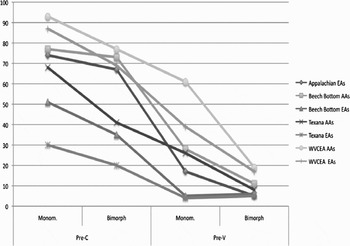
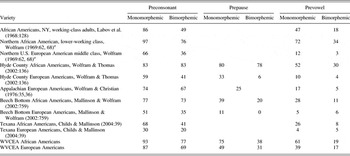
Table 16 and Figure 6 compare rates from several U.S. varieties. Only Appalachian studies are included in Figure 6, whereas Table 16 also contains studies of different ethnic varieties in the North and the South (United States). As a collection, a solid assertion can be made that these varieties operate with the same language variation patterns for CSD and CCR.
A cross-lectal comparison of rates of CSD and CCR in U.S. varieties

aIn this study, the division was between consonants and nonconsonants.
The phonological constraint is evident across all varieties, and the morphological constraint shows effects for at least some cells. For the Appalachian varieties, they are most similar in that they have their lowest rates with bimorphemic prevowel environments, between 5% and 19% deletion. This comparability is remarkable because their rates diverge widely for monomorphemic prevowel environments, between 4% and 61%. The input rate for these Appalachian speakers is not the same for each of the studies, but the internal linguistic constraints are exceedingly similar.
Conclusions
This paper examines CSD at the end of the 20th century in the English of Appalachia, exploring both its linguistic and social patterns through quantitative variationist analysis. From sociolinguistic interviews with 67 Appalachian speakers and 17,694 of their coded tokens, the variationist analysis worked through different subsets of data to reach a data set comparable with other studies. From this investigation, it is clear that CSD plays a role in the language variation patterns of Appalachia. Yet even though it has been a regular part of English in Appalachia throughout the 20th century, internal to Appalachian communities, CSD has not been developed as a social marker. The lack of social differentiation may well result from the high rates throughout the corpus. Some social factors, ethnicity and sex, for example, do significantly affect CSD rates, but the difference between ethnic groups and social classes does not parallel those gaps found in other communities. For CSD to be used as a social marker inside Appalachia, the high rates of these Appalachians would most likely need to drop down into lower frequencies.
This study of CSD for English in Appalachia reveals that the majority of linguistic constraints are similar to other U.S. varieties. The following and preceding phonological segmental environments affect variation as well as the morphological category of the word containing the consonant cluster. Differences, or at least phenomena that are newly accounted for, do arise in the language variation patterns of this corpus. A major distinction for this group of Appalachian speakers is that the preceding phonological environment more significantly affects rates of CSD than do morphological categories. Another distinction is that within the morphology factor group significant differences were found between different types of monomorphemic and bimorphemic forms: monomorphemic verbs had lower rates than monomorphemic nonverbs; bimorphemic verbs had lower rates than bimorphemic adjectives. Lexical influences were also discovered, with some lexical items having extremely high rates of deletion and some lexical items having extremely low rates of deletion. To probe the lexical patterns, the methodological choice was made to avoid the five tokens-per-type collection technique, and consequently more tokens became available to analyze. On another methodological front, neither inverted question contexts nor negative contexts influenced rates of CSD, opening up other language corners where researchers can find tokens of CSD. The last methodological corner illuminated in this CSD study was that of the variable voicing of the coda consonant cluster. This factor group included three factors—heterovoiced, voiced, and voiceless—and it was found to be strongly significant.
In the end, this investigation has revealed that even in the most inhibiting environments, the CSD rates are relatively high, marking these speakers as vernacular in the ears of listeners from other parts of the country. However, it is questionable how vernacular CSD seems for Appalachians themselves. Despite its high rates, the scant social divisions reveal that for the West Virginia area of Appalachia, CSD is not a socially defining feature. The variable patterns of CSD do not appear to be changing over time, and accordingly, it seems that it will be a stable feature for West Virginia in the 21st century.
With its relatively high rates for so many speakers, the social factors associated with CSD in other regions do not strongly correlate with it in this corpus. Some social factors, such as ethnicity, are found to be statistically significant influences on the rates of CSD, but the results clearly indicate that its powers of social differentiation are underwhelming. From these findings, it can be said that for Appalachians at the turn of the century, their rates of CSD are flying high above the social radar.