

1. Introduction.
Dutch, English, and German, all three well-known languages of the West Germanic branch, share many linguistic properties. On the level of vocabulary, they share many cognates, that is, words with a common etymological origin that are spelled and/or pronounced similarly, for example huis, house, and Haus, or boek, book, and Buch. Furthermore, some words are spelled identically (except for the upper versus lower case distinction) across the three languages, such as land, wind, or wolf. On other linguistic levels (for example, phonology, morphology, syntax), the three languages also display rather similar structures.
In comparisons of the three languages, Dutch is often positioned between English and German (see, among others, van Haeringen 1956). Dutch and English both have relatively simple morphological systems, while German morphology is more complex, featuring a case system. As neither Dutch nor English have undergone the High German Consonant Shift, their respective phonological and orthographic word patterns are more similar to one another's than to those of Standard German. Dutch and German share more vocabulary, however, as the lexicons of both languages are predominantly Germanic in origin. In contrast, a significant proportion of the English lexicon is of Romance origin due to the Norman invasion.
More importantly for the purposes of this paper, however, Dutch and English contrast in a way that Dutch and German do not. Dutch (as well as German) orthography is very different from that of English with regards to ORTHOGRAPHIC TRANSPARENCY/DEPTH, that is, the extent to which the relations between written and spoken language are predictable. Comparative analyses of alphabetic orthographies (see, among others, Van den Bosch et al. 1995; Borgwaldt et al. 2004, 2005) have shown that English has a relatively irregular orthography, falling on the deep end of the orthographic-depth continuum (Katz & Frost 1992). Dutch, on the other hand, has a relatively regular or shallow orthography, displaying, at least for native monomorphemic monosyllabic words (for example, Nunn 1998), very predictable relations between spelling and pronunciation. German, like Dutch, is relatively shallow, so although we do not address German directly in this study, a reader interested in how Dutch is “sandwiched” between English and German might reasonably speculate that reading German should resemble reading Dutch more than reading English.
Orthographic depth is somewhat difficult to characterize. It can manifest itself on several linguistic levels both within and across languages. One level is where LETTER-PHONEME CORRESPONDENCES are the focus. An absolutely transparent orthography on this level (a hypothetical case) would be one, in which every phoneme corresponds to only one letter, and every letter to only one phoneme. This is the smallest GRAIN SIZE feasible in an alphabet, where grain size refers to the linguistic level (for instance, letters, letter clusters, syllables, morphemes) which readers convert into phonology.Footnote 1 However, this letter-to-phoneme equivalency is never quite realized, especially for vowels, as the number of vowel phonemes often exceeds the number of vowel letters in the Roman alphabet.Footnote 2 Instead, other strategies, such as super-imposing diacritics or combining letters into multi-letter units that represent a single phoneme (as in the <sh> in ship), were devised to accommodate the changing phonemic inventories (Rogers 2005). The latter strategy results in the notion of GRAPHEMES, a term used generally by psycholinguists to describe any letter or letter combination that represents a phoneme.Footnote 3 The word sheep, for example, consists of five letters, but only three graphemes: <sh>, <ee>, and <p>.
Another measure of orthographic depth is the POLYVALENCE of grapheme-phoneme correspondences. Some orthographies, such as Finnish or Hungarian, are nearly 100% consistent at the grapheme-phoneme level. This makes them relatively monovalent. However, most orthographies show considerable polyvalence (Coulmas 2003). Not only can a single grapheme represent different phonemes in different words (for instance, English <ea> representing /ɛ/ in bread but /i/ in bead), but also a single phoneme can be represented by different graphemes in different words (for instance, /aj/ being represented by <ie> in lie but by <uy> in buy). Compared to most alphabetic orthographies, English displays a relatively strong case of polyvalence in both directions. Indeed, polyvalence is very common in English, but minimal in Dutch, where at least in monomorphemic words of native origin, graphemes are pronounced fairly consistently (Nunn 1998, Martensen et al. 2000).Footnote 4 The current paper focuses on how these differences in polyvalence between English and Dutch may lead to processing differences.
It is already fairly well established that orthographic depth affects the timeline in the acquisition of literacy. A number of studies (see, among others, Wimmer & Goswami 1994, Aro & Wimmer 2003, and Seymour et al. 2003) have compared the reading performance of age-matched groups of children who learn to read in either a deep orthography (prototypically English or French) or in a shallow orthography (such as German, Dutch, or Finnish). They have concluded that literacy development in general seems to follow different time courses across orthographies, depending, to a large extent, on the orthographic transparency of the language in question. Learners of deep orthographies generally need more time to be able to spell and read, and make more mistakes along the way than learners of transparent orthographies. However, since there seem to be few differences in the level of literacy ultimately attained by proficient readers of different orthographies (that is, proficient readers of English and Finnish are considered equally literate), it is worth asking whether there is any detectable psychological trace left at all from the literacy-development process that would specifically reflect the orthographic depth of the writing system. Here, the prediction could be made, that learning to read in a shallow orthography encourages learners to rely on smaller units, or grain sizes, such as graphemes, whereas learning to read in a deep orthography (particularly English) compels readers to process higher-order grain sizes, such as rimes, syllables, morphemes, or even words.
This is the assumption of the PSYCHOLINGUISTIC GRAIN SIZE THEORY (hereafter PGST)—Ziegler & Goswami's (2005) theory of reading development that predicts (among many things) that the literacy-development process across alphabetic orthographies of different depths leaves FOOTPRINTS still present when a learner becomes a skilled adult reader. Footprints are essentially the traces of psychological processes that took place while someone was learning to decode the writing system in the literacy-development process. Proficient readers exhibit such traces during normal reading. These footprints might manifest them-selves in the units that readers employ to convert orthography to phonology—a process that proceeds in that order in some fashion in all scientific models of word recognition in normal, proficient readers of alphabetic writing systems.Footnote 5 For example, it is fairly well established that English readers seem to treat the orthographic rime of monosyllabic words as the unit, where orthography-phonology relations become rather regular, and hence useful (Treiman et al. 1995). Dutch readers, apparently, do not, nor would they have any reason to do so. Instead, since Dutch grapheme-phoneme relations are regular, Dutch readers seem to choose these lower-level units to convert orthography to phonology (Martensen et al. 2000).
The priming paradigm has offered certain insights that can be incorporated into this debate. This paradigm involves presenting participants with two consecutive stimuli: a prime, then a target. The participant is usually told to ignore the prime and respond only to the target. The insight provided by this paradigm is that one can test how processing the prime (usually a word) affects the processing of the target. Masked priming uses the same sequence of stimuli, but the prime is presented in such a way that it either goes unnoticed consciously or is difficult to discern. The advantage of this paradigm is that one can test how early subconscious perception of the prime affects processing of the target.
Using the masked-priming paradigm in French with various prime durations (namely, 17, 33, 50, 67, 83, and 100 ms), Ferrand & Grainger (1993) found that orthographic effects preceded phonological effects. They calculated net orthographic priming by subtracting, for each prime duration, the response times to targets with unrelated control primes (as in jink > CLAN) from response times to targets with orthographically related primes (as in slan > CLAN). They also calculated net phono-logical priming by subtracting the response times to targets with the same orthographically related primes from those to targets with primes that were both orthographically and phonologically related (as in klan > CLAN). They found that net orthographic priming emerged at 17 ms, peaked between 33—50 ms, and began to decline at 67 ms. Net phonological priming took the same course, but at longer prime durations. That is, it emerged at 50 ms, peaked at 67 ms, and began to decline at 83 ms. Again, the authors concluded that generally, the orthographic code is activated earlier than the phonological code (but see, for example, Lukatela & Turvey 1994, who claim that phonological effects emerge much earlier).
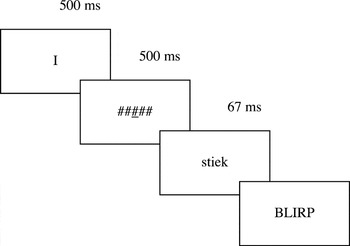
Capitalizing on this difference between orthographic and phonological processing in masked priming, Bolger et al. (2009) used the paradigm for letter detection (see section 2.1, and figure 1, for an illustration). They found a footprint that the PGST would predict. Namely, they showed that Dutch readers exhibit multi-letter vowel grapheme activation at a prime duration of 50 ms, while English readers do not.Footnote 6 The authors concluded that their failure to find the effect in English could be attributed to one of two reasons: either the prime durations used (17, 33, and 50 ms) were too short to allow English readers to activate multi-letter graphemes, or the grapheme might not be the optimal grain size to allow for such orthographic effects in English. The latter conclusion is possible since English readers might rely more heavily on letter combinations that reflect higher-order linguistic units, such as the rime.
The current study expands the study by Bolger et al. (2009) to longer prime durations, namely, 67 ms in Dutch, and both 67 and 81 ms in English. Whereas the 50-ms prime duration may reflect either orthographic or phonological processing (or both), the 67- and 81-ms durations are widely believed to maximize phonological effects, which is the goal of the current study. Specifically, we use the stimuli from Bolger et al. 2009 (that is, identical pseudo-word stimuli that are orthographically and phonotactically legal in both languages), and compare the response patterns of English and Dutch participants in the same letter-detection task at relatively long masked-prime durations. Combined with the results of Bolger et al. 2009, this design allows us to gain insight into the time-course of grapheme-phoneme activation in the two languages. We restrict our experiment to the processing of vowel graphemes, as vowels are often considered to be processed more slowly than consonants (see, among others, Berent & Perfetti 1995). Therefore, the time course of vowel grapheme processing is easier to observe than the time course of consonant grapheme processing (such as th, ph, or sh). The PGST might predict that grapheme-to-phoneme processing proceeds faster overall in languages with shallow grapheme-phoneme relations, such as Dutch, compared to languages with deep grapheme-phoneme relations, such as English.
2. Experiment 1: Dutch at 67 ms.
2.1. Method, Participants, Materials, and Design.
The participants in this experiment were 30 students at the University of Amsterdam, all native speakers of Dutch, who participated for course credit. We used the same stimuli as Bolger et al. (2009), namely, 186 four- and five-letter monosyllabic pseudo-word targets that were legal in both English and Dutch. The syllabic nuclei in all target words were represented by single written vowels with consonants on both sides (for example, hurf, nirk, or blelk). A depiction of the sequence of screens in the experiment can be seen in figure 1 below.
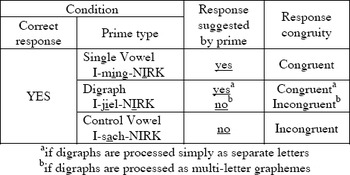
The primes were designed to impose response-congruity effects on the targets. That is, assuming the participant initiates a correct response to the pseudo-word prime, if the correct response to the target is the same, it is response CONGRUENT (that is, yes-yes/no-no). If the correct response to the target is different, it is response INCONGRUENT (that is, no-yes/yes-no). Response congruity should facilitate response times relative to response incongruity, and vice-versa, that is, result in FACILITATIVE and INHIBITORY congruity effects, respectively. The response-congruity relations for the YES responses are displayed summarily in table 1. We do not include the NO responses in the table because they were included in the experiment only for task purposes. However, we explain below how these stimuli were configured in the experiment.
Design of the letter-detection experiment.

Response congruity relations by prime type.

Targets were preceded by three kinds of pseudo-word primes: SINGLE VOWEL, (vowel) DIGRAPH, and CONTROL VOWEL. These primes appeared for only 67 ms, a time period too short to allow conscious processing; that is, often participants would not be aware of the prime. For single-vowel primes, the search letter and the relevant letter in the prime were identical (as in i-ming). For the YES responses, the respective vowels in the prime and target were response congruent (for example, I-ming-NIRK). For the NO responses (not represented in table 1), the prime and target were response incongruent (for example, I-ming-HURF).
For digraph primes, the search letter was identical to one of the vowel-digraph letters in the prime (as in I-jiel). Sometimes it was identical to both (as in E-dweem). The same congruity relations hold between the primes and targets in this case, being response congruent in YES responses (for example, I-jiel-NIRK), and response incongruent in NO responses (for example, I-jiel-HURF). Note that our explanation of this condition as congruent for YES responses rests on the assumption that letters are the mental unit of analysis. However, if the digraph is processed as a single unit at this point (that is, two letters functioning mentally as a unitized whole), then the relation here is more incongruent. For control-vowel primes, the search letter and the relevant letter in the prime were different (as in I-sach). In the YES responses, the control-vowel prime and the target were response incongruent (as in I-sach-NIRK).Footnote 7
The participants performed the experiment on a PC desktop computer with Windows XP, connected to a CRT monitor (1024x768 screen resolution, 60Hz refresh rate). The stimulus delivery software was DMDX (Forster & Forster 2003). Participants were randomly assigned to one of three counterbalanced files, each of which contained all conditions, and which collectively primed each target with all three prime types. Participants pressed the right shift key to indicate that the letter was present in the word and the left shift key to indicate that it was not. All stimuli in the experiment were in the non-proportional, fixed-pitch font COURIER NEW, 12 point, with white letters on a black background. The only exception to this was the yellow hash mark symbol (see below).
As depicted in figure 1, the first stimulus was the search letter presented for 500 ms. Next, a forward mask consisting of either four or five hash marks (#####) replaced the letter, and remained on the screen for another 500 ms. One of the hash marks was colored yellow and underlined (for example, #####), which appeared in the same position as the search letter, and the relevant letter in both the prime and the target. The next item to appear on the screen was the prime in lowercase letters. It remained on the screen for 67 ms. Directly after the prime, the target appeared in uppercase (for instance, drent—BLELK) and remained on the screen for 2,000 ms or until a response was made, whichever happened earlier.
As in Bolger et al. 2009, the experimental items were blocked by search letter. The experiment began with trials of the search letter E, proceeded through blocks consisting of the search letters I and O, respectively, and ended with the block consisting of the search letter U.
2.2. Results.
Errors were few and far between in this experiment, with the vast majority of participants committing between 0 and 3 errors apiece. We did not feel that this was enough to consider for analysis. Therefore, we concentrate on the response times.
Naturally, response times below 200 ms can only be false starts, so these were not considered in the analysis. Also, the task demands in this experiment were unusually simple, so we felt that response times over 1,000 ms were unusually long. Our reasoning seems to be correct—response times above 1,000 ms accounted for just under 4% of the observations. We treated these as outliers and deleted them from the analysis.
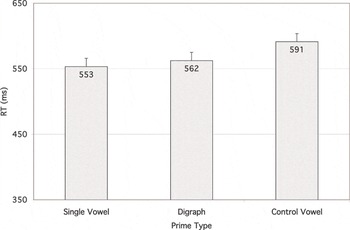
Response times to letter-detection experiment with 67-ms primes by Dutch participants (N=30).

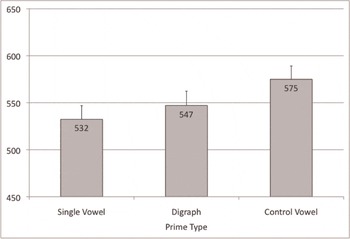
We performed a factorial repeated-measures ANOVA with Prime Type as a 3-level factor. We analyzed each result in two ways: one with participants as a random factor (F1), and one with items as a random factor (F2). Mean reaction times appear in figure 2. There was a main effect for Prime Type in both analyses, F1(2,54)=44.51, p<.001, F2(2,184)=28.83, p<.001.
In the planned comparisons, it became clear that digraph effects were significant at the 67-ms prime duration (as they were at 50 ms in Bolger et al. 2009). The control-vowel primes were significantly inhibitory relative to both single-vowel and digraph primes. These differences were 43 ms in the case of single-vowel primes, F1(1,27)=73.95, p<.001, F2(1,92)=48.65, p<.001, and 28 ms in the case of digraph primes, F1(1,27)=40.90, p<.001, F2(1,92)=27.47, p<.001. Crucially, there was a significant 15-ms difference between the single-vowel and digraph primes, with digraph primes being significantly more inhibitory than single-vowel primes, F1(1,27)=11.17, p<.003, F2(1,92)=4.98, p<.03.
2.3. Discussion.
With Dutch participants at a prime duration of 67 ms, we see significant differences between single-vowel and digraph primes, with the digraph primes being more inhibitory. This is nearly identical to the digraph effect that Bolger et al. 2009 obtained with 50-ms primes in Dutch participants. Thus, the findings of the current experiment confirm the conclusions of that study, namely, that the digraph effect manifests itself in Dutch on a phonological level.
It remains to be seen, however, whether English readers show the same effect. They did not show the digraph effect in Bolger et al. 2009 in contrast to the Dutch. However, it is possible, because of the enormous complexity of the English orthography, that the prime durations were not long enough for English participants to show the effect. Perhaps English readers need more time for digraph effects to occur. This is the focus of the next section.
3. Experiment 2: English at 67 ms.
In Experiment 1 we were trying to confirm the digraph effect for Dutch that had shown up at a shorter prime duration in Bolger et al. 2009. In Experiment 2, a replication of the Dutch experiment with English participants, we are merely trying to find the effect in English. In Bolger et al. 2009 there was no digraph effect at either 17, 33, or 50 ms. For the English participants, if we found the effect at this point, i.e. at 67 ms, it would be clearly associated with phonological processing, not orthographic processing. It is entirely possible that English readers would need more time to activate vowel digraphs than Dutch readers, since there is so much inconsistency in English orthography with respect to vowels.
3.1. Method, Participants, Materials, and Design.
The participants in this experiment were 30 students at the University of Alberta, all native speakers of English. The materials and design of this experiment were identical to those of experiment 1. The procedure for this experiment was exactly the same as for experiment 1, except that both the oral and written instructions were in English.
3.2. Results.
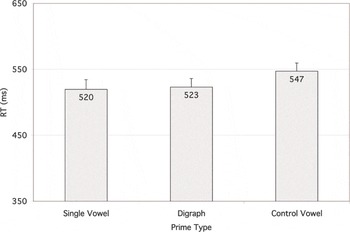
One hundred and sixty-one data points with reaction times below 200 ms or above 1,000 ms were treated as outliers and deleted from the analysis. To analyze the data, we performed the same factorial repeated-measures ANOVA, with Prime Type as the 3-level repeated factor. Mean reaction times are displayed in figure 3. There was a main effect for Prime Type in both analyses, F1(2,54)=18.17, p<.001, F2(2,184)=10.84, p<.001.
Response times to letter-detection experiment with 67-ms primes by English participants (N=30).

Planned comparisons revealed a 27-ms difference for the single-vowel primes, F1(1,27)=36.31, p<.001, F2(1,92)=15.98, p<.001, and a 24-ms difference for the digraph primes, F1(1,27)=29.82, p<.001, F2(1,92)=15.68, p<.001. The 3-ms difference between single-vowel and digraph primes was not significant, both Fs<1, both ps>.56.
3.3. Discussion.
In the current experiment with 67-ms primes, we see the same effect as at the shorter prime durations of 17, 33, and 50 ms (Bolger et al. 2009). In short, single-vowel and digraph primes were equally inhibitory relative to control primes. The English participants are still not showing a digraph effect; they only show a letter effect. This is a bit puzzling since English participants have shown other effects related to phonology in other studies at prime durations longer than 60 ms, with some researchers claiming such effects at even earlier prime durations (see Rastle & Brysbaert 2006 for a review). However, most of these studies rely on pseudo-homophones and not on digraphs. It is possible that our English readers “bypass” the grapheme-processing level in order to proceed more directly to higher-order units like orthographic rimes.
To test further whether English digraph effects are simply elusive due to being strongly delayed relative to Dutch, we presented this experiment to English participants at one more prime duration: 83 ms. Beyond this prime duration, the prime begins to become quite visible to participants, thereby changing the interpretation of results since masked priming and traditional (non-masked) priming can produce very different effects (Forster 1999). Accordingly, failure to find an effect at such a prime duration could suggest that the digraph effects cannot be obtained in English pseudo-words, and that English readers appeal to some mechanism of orthography-to-phonology conversion other than grapheme-phoneme conversion.
4. Experiment 3: English at 83 ms.
4.1. Method, Participants, Materials, and Design.
The participants in this experiment were 30 students at the University of Alberta, all native speakers of English. None of them had participated in the previous experiment. The materials, design, and the procedure of this experiment were identical to those of experiment 2, except that the prime duration was extended to 83 ms.
4.2. Results.
Two hundred and fifty data points with reaction times below 200 ms or above 1,000 ms were treated as outliers and deleted from the analysis. The omnibus analysis with repeated measures showed a significant main effect for Prime Type, F1(2,54)=25.28, p<.001, F2(2,184)=24.65, p<.001. Again, errors were rare in this experiment, accounting for only 2.3% of the total. Mean reaction times are displayed in figure 4.
Response times to letter-detection experiment with 83-ms primes by English participants (N=30).

The results of the planned comparisons were similar to those of experiment 2 with 67-ms primes. There were significant inhibitory differences between the control-vowel primes on the one hand, and both the single-vowel and digraph primes on the other. This was a 38-ms difference for the single-vowel primes, F1(1,27)=57.92, p<.001, F2(1,92)=50.35, p<.001, and a 29-ms difference for the digraph primes, F1(1,27)=21.49, p<.001, F2(1,92)=23.65, p<.001. Finally, there was no significant difference between the single-vowel and digraph primes, though the latter was 9 ms more inhibitory than the former, F1(1,27)= 2.83, p>.10, F2(1,92)=2.54, p>.11. On a liberal interpretation, one could consider these effects marginal. However, they are quite weak, and if real, show up much later than the obtained effects for the Dutch readers.
4.3. Discussion.
The data in this experiment begin to show a weak digraph trend, suggesting that grapheme-phoneme conversion could be taking place, though the effect is still non-significant. Specifically, the 9-ms difference between the single-vowel and digraph primes is in the right direction to suggest that digraphs are becoming more inhibitory than single-vowel primes. This is what one would expect if phonology were becoming more active as time passes. However, the lack of significance prevents us from making a strong claim here.
Unfortunately, we have run out of testing space to generate this effect in English. Letter detection with masked-priming may never be able to detect a digraph effect in English. The effect may only appear when the digraphs are in non-masked targets (as in Rey et al. 2000). English orthography might be too poor for us to find such effects in measures of early processing (such as masked priming), as readers might rely more on sublexical units larger than graphemes, such as ortho-graphic rimes. Again, this is what the PGST would predict, and what Martensen et al. (2000) found investigating the grain size at which phonological information is extracted during reading, concluding that Dutch readers use smaller grain sizes than English readers.
5. General Discussion and Conclusion.
To review the findings briefly, digraph primes were inhibitory relative to single-vowel primes in Dutch at 67-ms prime durations by 15 ms. However, with the English participants, we did not find such differences at 67 ms (only 3 ms), and only a weak 9-ms trend at 83 ms. Thus, the Dutch participants showed the digraph effect, whereas the English participants did not, or if they did, they did so only weakly, and much later.
With respect to the possible PGST footprint outlined in the introduction, the findings are clearly confirmatory, extending the results of Bolger et al. 2009. According to the PGST, a possible developmental footprint left by the literacy-development process would be stronger grapheme effects in shallow orthographies, such as Dutch, versus weaker ones in deep orthographies, such as English. We believe we found such a cross-linguistic difference here. Presumably, effects similar to those found in Dutch would be found in German. Indeed, Ziegler et al. (2001) found such evidence in a comparison of German and English word naming.
The difference we found was more extreme than we had predicted at the start of this project. We had predicted merely a difference in the timing of multi-letter grapheme activation in English, with the (expected) effects appearing at longer prime durations. However, what we found instead was that multi-letter graphemes are either not activated at all during early processing in English, or activated weakly and quite late. This could have been due to methodological constraints, namely, the window of masked priming durations was too small to find the effect. For now, we will side with this interpretation.
There is sufficient evidence for phonological effects in English, at least in studies that use pseudo-homophones (see, among others, Perfetti & Bell 1991, Braun et al. 2009) and non-masked letter detection (Rey et al. 2000). This means that at this point we are able to conclude only that Dutch readers are faster than English readers at grapheme-to-phoneme conversion in the early stages of reading. English readers, assuming they process multi-letter graphemes at all, do it later. Importantly, the PGST would predict that a “footprint” would manifest itself just as such difference among adult readers of the two languages. We believe that our current study is evidence for such a footprint.
Presumably, the effects that we found (or did not find) for vowel digraphs would also generalize to consonant digraphs, although we did not test them because they are more difficult to match across English and Dutch. There is some reason to believe that consonants and vowels are treated differently in reading, however. For instance, Berent & Perfetti (1995) claimed that consonants and vowels are processed on different tiers. Only future research will provide the answers to this question.
Although we employed stimuli that were orthographically identical in both English and Dutch, within-language characteristics of the stimuli (for instance, frequency values of the letter combinations, neighborhood size, pronunciation) could help account for the differences we found between the groups. Bolger et al. (2009) also noted this challenge in using identical stimuli across languages. Nonetheless, our interpretation of our results is consistent not only with findings of previous studies that compared Dutch and English (such as Martensen et al. 2000), but also with the findings of Ziegler et al. (2001), who compared English and German using identical stimuli in the two languages, and came to virtually the same conclusion as we did. Therefore, it is perfectly reasonable to adopt this interpretation for now. We leave it to future research to determine how the within-language differences of identical stimuli might play a role in the outcomes of such studies. This will not be easy, but will be worth it in the long run.
To sum up, in the study described above we show that Dutch and English participants processed the pseudo-words according to the reading strategies they developed in the course of the acquisition of literacy in their specific orthographies. That is, the components of one and the same pseudo-word (for example, dweem, which could potentially be either a Dutch or English word) were processed differently in Dutch and in English. Despite strong similarities between English and Dutch in terms of language structure, the actual language processing in the two languages, at least via their respective orthographies, differs strongly. We would also expect similar experiments comparing German and English to show similar results. However, this is only a reasonable speculation that requires further testing.