INTRODUCTION
Behavioural disturbance amongst people with a psychotic illness is an issue of great importance to patients, carers and staff, in terms of safety as well as reduction in the distress associated with acute psychosis (Allen et al. Reference Allen, Currier, Hughes, Docherty, Carpenter and Ross2003; Castle et al. Reference Castle, Daniel, Knott, Fielding, Goh and Singh2005; Castle et al. Reference Castle, Tran, Alderton, Castle, Copolov, Wykes and Mueser2008). The problem is particularly pertinent as pressure on psychiatric inpatient facilities rises, with increased acuity, shorter lengths of stay and often a highly charged clinical environment. There is a major methodological problem, however, in the assessment of efficacy of different interventions, largely because of patient selection issues. Thus, randomised controlled clinical trials rely on patients being sufficiently ‘well’ to provide valid informed consent for participation, yet ‘unwell’ enough to warrant an ‘emergency’ intervention. The field has been further complicated by concerns regarding the use of certain well-established therapies (e.g. thioridazine, droperidol; McAllister-Williams & Ferrier, Reference McAllister-Williams and Ferrier2002) as well as the advent of liquid, dispensable and injectable forms of some of the atypical anti-psychotics (Currier & Simpson, Reference Currier and Simpson2000; Wright et al. Reference Wright, Birkett, David, Meehan, Ferchland, Alaka, Saunders, Krueger, Bradley, San, Bernardo, Reinstein and Breier2001). There remains a lack of ‘real life’ data regarding the use of these newer agents and formulations in day-to-day practice in inpatient psychiatric settings.
This study used a naturalistic prospective design to address these deficits in the literature. A particular focus was a comparison of the efficacy of typical and atypical antipsychotic agents in this clinical setting. It should be stated that non-pharmacological interventions are a key part of the management of behavioural disturbance. We have adopted a standardised approach to the non-pharmacological component of the management of these clinical scenarios (detailed in Castle et al. Reference Castle, Daniel, Knott, Fielding, Goh and Singh2005). This current study does not address anything other than the pharmacological aspect of the intervention.
METHODS
The study was based on the acute psychiatry wards at The Alma Street Centre (W Block) in Fremantle, Western Australia. It is a purpose-built acute psychiatric unit offering a full range of services to a catchment population of some 500,000. The centre provides 50 acute adult admission beds for people between ages 18 to 64 years. The inpatient accommodation is almost exclusively single rooms either with en-suite or shared ablutions, with some provision for shared accommodation on all wards, except the intensive care ward (a discrete 10 bed unit).
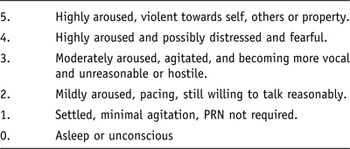
The methodology of the study was based on that employed in a previous study in Melbourne, Australia (Daniel et al. Reference Daniel, Chamberlain and Castle2007). In brief, we developed operationalized interventions, ‘staged’ according to the level of arousal of the patient, ascertained by the Fremantle Acute Arousal Scale (FAAS; Castle et al. Reference Castle, Tran, Alderton, Castle, Copolov, Wykes and Mueser2008). This scale is a simple six-point scale (see Table 1) which is clinically relevant and easy to administer and which has a high level of agreement (kappa 0.83) with the Excited Component (PEC) of the Positive and Negative Symptom Scale (PANSS), the ‘gold standard’ measure of level of behavioural disturbance in this context (Daniel et al. Reference McAllister-Williams and Ferrier2007; Kay et al. Reference Kay, Fiszbein and Opler1987).
The Fremantle Agitation and Arousal Rating Scale

We included any patient requiring an acute ‘as required’ (prn) intervention for behavioural disturbance in the period 2007–2008. All data were recorded on a single flow sheet, the Agitation and Arousal Medication chart, which documented baseline and follow-up arousal using the FAAS as well as indicating the interventions used, and medications given. Patients were re-rated 30–60 minutes after the initial intervention to assess efficacy and at this point, a decision was made as to whether a further intervention was required, or not. The process could be repeated as necessary until the patient was clinically settled.
At an interval of some 24–48 hours post-episode, patients were offered debriefing by an experienced psychiatric nurse who was not involved in the episode of management of behavioural disturbance. Since the medication mapping and debrief were part of the normal clinical practice, the local Human Research Ethics Committee advised that it was not necessary to obtain consent to audit the data and present the aggregated results.
Statistical analysis
Stata 10 was used to analyse the data. Initial analyses were descriptive, detailing what medications were used, what doses, and what the initial outcomes were. We then tested the specific hypothesis that typical and atypical antipsychotics were equally efficacious in the treatment of behavioural disturbance. To this end, we employed three measures: (a) whether a second intervention was required after the first intervention (i.e. the patient was not clinically settled 30–60 minutes post first intervention); (b) worse/same/better (comparing baseline to post first intervention rating on the FAAS); and (c) post first intervention FAAS rating. Finally, we compared the different specific antipsychotic agents in terms of their efficacy. Logistic regression was employed in the case where a second intervention was needed and generalised ordinal logistic regression for the other two efficacy measures. A ‘cluster’ option was used in the logistic regression and generalised ordinal logistic regression procedures to model the effect of multiple incidents for some patients. Baseline FAAS rating was used as a covariate to take into account the differences in baseline levels of behavioural disturbance. No other covariates were included in the logistic regressions analyses.
RESULTS
The sample comprised 506 males (53.2%) and 445 (46.8%) females. Patients aged in range from 18 to 65 (mean = 36.62, SD = 11.88) years. The most common ICD-10 diagnoses were paranoid schizophrenia (32.0%), borderline personality disorder (10.8%), schizoaffective disorder, unspecified (7.0%), unspecified nonorganic psychosis (4.7%), and bipolar affective disorder, current episode manic with psychotic symptoms (4.3%).
In 2007, 7006 incidents were perpetuated by 436 patients (mean 16.03 incidents per patient), while 8272 incidents were perpetuated by 623 patients (mean 13.28 incidents per patient) in 2008. Considering the first intervention only (N = 951), medication was used in 816 (85.8%) incidents. Of these 816 incidents, atypical antipsychotics were used in 402 (49.2%) incidents, typical antipsychotics were used in 280 (34.3%) incidents, and benzodiazepines were used in 312 (38.2%) incidents. The predominant atypical antipsychotic used was quetiapine (46.2% of all medications given in the first intervention), the predominant typical antipsychotic was haloperidol (8.0%), and the predominant benzodiazepine was lorazepam (31.2%).
Efficacy of typical vs. atypical antipsychotics
The first set of analyses was a comparison of all typical agents combined versus atypical agents combined. For all efficacy measures, an odds ratio greater than one indicates that the atypical antipsychotics are more effective than typical antipsychotics, while an odds ratio less than one indicates that the typical antipsychotics are more effective.
The first efficacy measure is a simple measure according to the probability of requiring another intervention should the first intervention have been ineffective in reducing behavioural disturbance. This measure (no = 0, yes = 1) is measured in the negative direction with higher scores indicating worse outcomes. For those patients administered a typical agent as the first intervention, only 7.7% required a further intervention, compared to 16.2% of those initially receiving an atypical agent (OR = 0.98, 95% CI = 0.88 – 1.10, p = 0.78).
The second efficacy measure, better/same/worse, reflects whether the patient improved, stayed the same, or got worse after the intervention. This measure (better = 1, same = 0, worse = -1) is rated with higher scores indicating better outcomes. Typical and atypical agents performed much the same in this regard, with 84.4% of patients receiving typical agents considered ‘improved’, and 1.6% ‘worse’, whilst for atypical the respective proportions were 83.5% and 1.7% (OR = 0.93, 95% CI = .84 – 1.05, p = 0.27).
For the post first intervention FAAS rating, the odds ratio is the odds of being in a higher category (rather than a lower category) for a typical divided by the odds of being in a higher category (rather than a lower category) for an atypical. The confidence interval and associated p-value (OR = .99, 95% CI = .87 – 1.13, p = 0.49) shows that this odds ratio was not statistically significant. Taken together, the results show no statistically differences in efficacy between typical and atypical antipsychotics.
Comparison of specific agents
The second set of analyses compared olanzapine and quetiapine (the most extensively used atypical agents in this study) with haloperidol. Analyses were performed on all cases, whether or not a benzodiazepine was also administered, and also when the antipsychotic was used alone.
Second intervention required
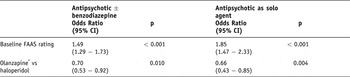
Table 2 presents the results of the logistic regression examining whether a second intervention was required post first intervention (i.e. the patient was not clinically settled 30–60 minutes after the first intervention) for olanzapine versus haloperidol. In particular, the efficacy of olanzapine versus haloperidol was examined (a) whether or not a benzodiazepine was also administered and (b) when used as a solo agent. Haloperidol was more efficacious than olanzapine.
Odds ratios (and 95% confidence intervals) from logistic regression analyses predicting whether a second intervention was required post first intervention for olanzapine versus haloperidol

a reference category
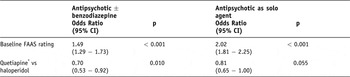
The results of the logistic regression examining whether a second intervention was required post first intervention for quetiapine versus haloperidol are shown in Table 3. When all cases were considered, haloperidol was more efficacious than quetiapine. However, when administered as solo agents, quetiapine and haloperidol did not differ significantly with regards to increasing the odds of getting worse or of getting better.
Odds ratios (and 95% confidence intervals) from logistic regression analyses predicting whether a second intervention was required post first intervention for quetiapine versus haloperidol

a reference category
Change in symptoms
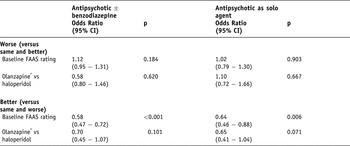
Generalised ordinal logistic regression was used to assess whether the patient improved, stayed the same, or got worse after the first intervention. Table 4 shows that there were no significant differences in the odds of getting worse or of getting better when olanzapine was compared with haloperidol (a) in all cases whether or not a benzodiazepine was also administered or (b) when the antipsychotic was used alone.
Odds ratios (and 95% confidence intervals) from generalised ordinal logistic regression analyses predicting whether patients improved, stayed the same, or got worse post first intervention for olanzapine versus haloperidol

a reference category
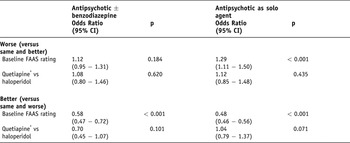
Similarly, Table 5 shows that there were no significant differences in the odds of getting worse or of getting better when quetiapine was compared with haloperidol (a) in all cases whether or not a benzodiazepine was also administered or (b) when the antipsychotic was used alone.
Odds ratios (and 95% confidence intervals) from generalised ordinal logistic regression analyses predicting whether patients improved, stayed the same, or got worse post first intervention for quetiapine versus haloperidol

a reference category
Generalised ordinal logistic regression was used to assess whether there were differences in first post intervention FAAS ratings. Haloperidol was more efficacious than olanzapine, that is, haloperidol had greater odds of having a lower first post intervention rating, but there were no significant differences in efficacy between quetiapine and haloperidol (data available from the authors upon request).
DISCUSSION
This naturalistic study investigated the efficacy of typical and atypical antipsychotics in the management of behavioural disturbance in people with psychiatric disorders. No significant difference was found between typical and atypical antipsychotics. However, in terms of specific agents, olanzapine was found to be inferior to other agents. Haloperidol and quetiapine tended to show equal efficacy. These findings are at odds with some of the published literature, but previous studies have been mostly of highly selected samples in the setting of randomised controlled trials. Further naturalistic studies are required to confirm or refute our findings.
The findings of the present study must be interpreted within the context of several limitations. Medication choice and dosing was entirely at the discretion of the individual treating psychiatrist, though guidelines had been provided in this regard, following the stepped approach outlined in Castle et al. (Reference Castle, Tran, Alderton, Castle, Copolov, Wykes and Mueser2008). Another limitation is the omission of a uniform measure of side effects of medication or of the use of side-effect medication such as anticholinergics.
The major strength of our study is the large sample size. Moreover, it is a naturalistic and prospective study performed in a ‘real life’ setting rather than in a selected patient sample. This enables clinicians from a practical point of view to apply the results to their practice. The drawback is that it addresses only the pharmacological interventions albeit that non-pharmacological aspects of care are standardized in the clinical setting in which the study was conducted.
CONCLUSION
Atypical antipsychotics were as effective as typical agents in the management of acute behavioural disturbance in a mental health setting. Further work is required to determine the relative side effect burden of those agents.