Introduction
Welfare-to-work policy in the UK increasingly frames ‘choice’ in relation to employment decisions in terms of consumer-type powers of selection between options within active labour market programmes. Any increase in choice within employment services, however, has sat alongside heightened constraints on the option of choosing non-market activity if you are a recipient of out-of-work benefits. In the past, lone parents with children below 16 years of age maintained the right to decide whether to seek paid work without risk of sanction. Drawing on the recommendations of the Freud Review of welfare-to-work provision (Freud, Reference Freud2007), the 2007 Green Paper on Welfare Reform, In Work Better Off, marked a critical juncture in policy, proposing a new social contract that strengthens lone parents’ obligations to seek paid work (DWP, 2007). Since October 2008, lone parents whose youngest dependent child is above twelve years of age lose eligibility to Income Support (IS) on the grounds of being a lone parent if they are assessed as able to work and it can be demonstrated that they will be ‘better off’ in paid work. From 2010, this is extended to lone parents whose youngest dependent child is above seven years old and from 2011 it will be extended to lone parents whose youngest dependent child is five and above (HM Treasury, Reference Treasury2010: 49).
These reforms involve a shift of the lone-parent IS caseload onto Jobseeker's Allowance (JSA), a benefit with greater conditionality, mandated job search and powers of sanction. Such developments align with proposals that aim to simplify and reform out-of-work benefits (Gregg, Reference Gregg2008). Claimants are to be more directly addressed in terms of their existing readiness to enter paid work rather than categorised according to benefit recipient category (DWP, 2008b; Convery, Reference Convery2009: 10).
In this paper, we examine the choice agenda in relation to welfare reform and lone-parent employment in the period following the Freud Review (Freud, Reference Freud2007). Large-scale survey data are used to estimate the extent to which economically inactive lone parents state they would presently like paid work and, if not, their main reported reasons. This is undertaken to provide an overview of the extent to which policies that promote compulsory job search by dependent child age map onto lone parents' own stated decision making regarding if and when to enter the labour market.
Plans to heighten conditionality in light of the substantial proportion of lone parents we identify whose stated position is that they presently do not want to seek paid work reinforces how the notion of choice is limited to a particular form of acceptable behaviour, grounded in the prioritisation of the formal economy. Although economic activity is related to dependent child age, the findings demonstrate that employment barriers, such as poor health, sickness or disability, are particularly pronounced among those with older children. The potential side effect of increased compulsory activation is that, without satisfactory support, an increase in the number of lone parents entering the labour market who face greater employment barriers, or who ‘choose’ currently not to seek paid work, will negatively impact on job retention rates and the economic stability of lone-parent families.
The choice agenda and welfare reform
Largely eschewed during New Labour's first term in office, an emphasis on choice and marketisation subsequently featured strongly in public service reform in regard to how to encourage a more diverse range of providers and ‘empower’ service users in various policy sectors, such as health, social care and education (Greener, Reference Greener and Powell2008: 222; Needham, Reference Needham and Powell2008: 182). Choice has been presented as the means to drive efficiency and effectiveness and build support for public provision of welfare services (Brown, Reference Brown2007; Needham, Reference Needham and Powell2008: 181). As a policy mechanism, choice also holds out the promise to free politicians and the public from past frustrations and failures in public service delivery (Clarke et al., Reference Clarke, Newman and Westmarland2007: 246).
Implementing the choice agenda with respect to employment and social security, however, is somewhat problematic. It contains within it a message that is subversive of the prevailing welfare reform agenda. After all, if choice is central to empowering users and they are best placed to choose how to benefit from public services, should some claimants have the option to choose, in their self-defined interests, to not participate in the labour market or activation programmes, while maintaining their welfare entitlements?
Lone parenthood presents an interesting case for the evolving choice agenda, as does non-market care activity more generally. Benefit entitlements in the absence of job search conditionality for the ‘economically inactive’ have largely been confined to people who are assessed as presently unable to take up paid work. The right to social security support has, nonetheless, increasingly been hedged around with conditions that stipulate individual ‘acceptable’ responsibilities linked to paid work activity. Previous exemptions from the need to be actively seeking work, such as lone parents’ participation in caring activity or, in the general population, for reasons of personal sickness or disability, are thus subject to ongoing challenge and have been weakened as benefit eligibility criteria are tightened (Dwyer, Reference Dwyer2004: 268, Reference Dwyer and Powell2008).
Greener (Reference Greener2007: 259) argues that the version of choice New Labour promoted is grounded in the extension of consumer rights, standards and expectations to the delivery of public services. This is combined with the notion of individualised responsibilities, with claimants required to accept their responsibility to be independent productive members of the labour market. New Labour's approach to ‘citizenship’ concerned itself with the exercise of welfare rights and provision of state support in relation to an individual's obligations (Giddens, Reference Giddens2002: 16; Clarke, Reference Clarke2005: 451), an approach that continues to inform welfare policy under the Coalition Government (Duncan-Smith, Reference Duncan-Smith2010). Such an approach offers little space for people to define for themselves how these obligations might or should be enacted. Instead, the active responsible citizen is one chiefly defined in terms of their contribution to the labour market. Individual decisions regarding paid work are subjugated to macro-economic policy objectives concerning labour market flexibility, wage inflation and welfare expenditure containment. New Labour's employment and social security measures to bolster labour market entry by the non-employed were primarily concerned to reduce long-term labour market detachment. Detachment from the labour market risks the erosion of skill levels and employers’ willingness to hire the long-term non-employed. As a consequence, the ability of the non-employed to compete effectively for jobs and bear down on wage costs, thought necessary to promote higher levels of employment, is compromised (Grover and Stewart, Reference Grover and Stewart2002: 62). Welfare reform seeks to improve the effective supply of labour and its flexibility through reducing financial barriers to employment and tightening benefit conditionality (Grover, Reference Grover2005: 76; Grover and Piggott, Reference Grover and Piggott2007: 738).
It is from within these contexts that constraints operating on the expansion of choice in the field of welfare-to-work become visible. Yet fuller recognition of the value of non-market forms of work and the validity of choosing care could permit policy to better address the reality of life for many outside of, and marginal to, the labour market. It could also enhance the capacity people have for self-determination in the balance between paid work and family life, which low-paid individuals may experience as unpredictable and unsatisfactory (Dean, Reference Dean2007: 526; Williams, Reference Williams2001).
For lone parents, as for the primary carers of children (the vast majority of whom are women) more generally, decisions about whether and when to enter paid work are multi-faceted. These may reflect the deliberation of opportunities, but also structural barriers or constraints, such as childcare availability, a lack of potential labour market opportunities, issues around access to paid work and transportation or the marginal financial value of employment (for example, see Bell et al., Reference Bell, Finch, La Velle, Sainsbury and Skinner2005; Lewis, Reference Lewis2003; Hoxhallari et al., Reference Hoxhallari, Connolly and Lyon2007; Millar and Ridge, Reference Millar and Ridge2008).
Socially situated but personal notions of what constitutes responsible parenting also affect the choices people make (Duncan and Irwin, Reference Duncan and Irwin2004; Edwards et al., Reference Edwards, Duncan, Reynolds and Alldred2002). Considerable variation exists between parents in what is understood to constitute ‘good parenting’ in relation to decisions regarding the balancing of paid work and family life (for example, Duncan and Edwards, Reference Duncan and Edwards1999). Current welfare-to-work policy, in demanding lone-parent labour market activation by dependent child age, thus effectively constrains an aspect of self-determination regarding what good parenting is enacted to entail.
We do not seek to disparage ‘choice’ as an objective, but to recognise its limitations and draw a contrast between the promotion of market-orientated choice by governments and their resistance to choices around non-market-based activities. The former Secretary for State for Work and Pensions, James Purnell, was quite clear that there could be no choice not to work:
We will provide better support, and expect more responsibility in return. Claimants should have the choice over how to get back to work, not whether they should go back to work. We want a work culture not a welfare culture. (Purnell, Reference Purnell2008)
Lone parents and welfare-to-work reform post-Freud
Although policy reform following the Freud Review (Freud, Reference Freud2007) has sought to increasingly constrain the option of remaining outside of the labour market for lone parents deemed able to work, it would be unfair to suggest the New Labour Government did little other than tighten benefit eligibility conditions in order to encourage the take up of employment. A sizeable component of welfare reform, while not exclusively focused on lone parents, facilitated greater choice by making paid work, an option previously less plausible for many lone parents, more feasible (Lewis, Reference Lewis2003; Bell et al., Reference Bell, Finch, La Velle, Sainsbury and Skinner2005). Policy measures to make paid work more financially attractive have included: the National Minimum Wage, Working Tax Credit/Child Tax Credit, the National Childcare Strategy, Work Focused Interviews with Personal Advisers and active labour market programmes, such as the New Deal for Lone Parents. Where available, lone parents were able to participate voluntarily in the Employment Zones (EZs) programme (see Knijn et al., Reference Knijn, Martin and Millar2007: 645). The EZs contained the seeds of future reforms developed by New Labour's Flexible New Deal and the Coalition Government's Work Programme. Rolled out as pilots in 13 areas of the country in 2000, and largely delivered by private sector organisations, EZs enjoyed considerable flexibility over how to move clients into paid work in comparison to New Deal providers. The EZs were initially targeted at the long-term unemployed who were mandated to participate, although from 2003 the opportunity to participate was extended to lone-parent volunteers. In 2004, the EZs underwent further reform, with the introduction of Multiple Provider Employment Zones (MPEZ) in six areas. The aim here was to create greater competition between providers. The clients of the MPEZ were, initially, randomly allocated to a provider by a Jobcentre Plus adviser, but in 2007 clients were permitted to select their provider (Rafferty and Wiggan, Reference Rafferty and Wiggan2008: 31).
In the EZ programme, we see experimentation with a more expansive role for contracted return-to-work providers, together with the operation of consumerist rights and the enforcement of individual responsibilities. Many of the users were not there through choice for example. The long-term unemployed and New Deal for Young People returnees participated through direction and under the threat of sanction. As in other policy fields, the notion of choice has been collapsed into a market model of exchange, so that choice is principally concerned with operationalising (acceptable) options in response to signals concerning efficiency and effectiveness (Clarke et al., Reference Clarke, Newman and Westmarland2007: 248).
The recommendations made by the Freud Review (Freud, Reference Freud2007) show a debt to the approach taken in the EZs, as well as to the growing international emphasis on personalisation and contracting out (Finn, Reference Finn2009). The Freud Review proposed merging all New Deal schemes into a ‘Flexible New Deal’. The Review argued that, while claimants do have particular needs, they also face common obstacles to employment, irrespective of their age, disability, gender or parenthood status, and a common platform would help spread best practice. Flexible New Deal, it was proposed, would also build on previous experience of contestability to expand the use of the private and voluntary sector in the provision of welfare-to-work services, particularly for those most likely to face greater obstacles to participation in the labour market (DWP, 2007: 58; DWP, 2008a; DWP, 2008b).
The Flexible New Deal also incorporated greater freedom for providers to shape the services offered to clients through a ‘black box’ approach. In this model, Jobcentre Plus sets the desired outcomes, but does not prescribe the methods providers may use in order to achieve them (DWP, 2008a: 119). The Coalition's active labour market scheme, the Work Programme, to be introduced in Great Britain in 2011, replaces the Flexible New Deal, but shares many of the features of Flexible New Deal. This is not surprising given that David Freud helped inform development of the Work Programme as Shadow Minister for Welfare Reform for the Conservative Party and continues to assist its development as Minister for Welfare Reform in the Coalition Government. The Work Programme expands the market in welfare-to-work services and develops the ‘black box’ payment-by-results performance model. Contracted providers from the not-for-profit and for-profit sectors will continue to be rewarded primarily according to client job outcomes, but enjoy the freedom to tailor services to clients' perceived needs (Grayling, Reference Grayling2010).
As reforms to active labour market programmes have intended to foster the notion of the responsible citizen, independent and within the labour market, changes to the benefit system to tighten eligibility conditions have sought to buttress this. New Labour's 2006 Green Paper, A New Deal for Welfare: Empowering People to Work (DWP, 2006), proposed replacing Incapacity Benefit and IS paid on the grounds of incapacity with a new benefit: Employment and Support Allowance (ESA). Following the Welfare Reform Act (2007), the ESA was introduced in October 2008. ESA tightens eligibility for out-of-work benefits on grounds of disability or sickness. Recipients are subject to a Work Capability Assessment that examines what paid work participants may be capable of, rather than what paid work they cannot do (DWP, 2008a). Those judged to be able to move into the labour market in the medium or short term are placed in the ‘Work Related Activity Group’ (WRAG) of ESA and required to participate in employment-related activities as part of establishing a route back into the labour market. Alternatively, they are moved to Jobseekers’ Allowance to begin job-search activity immediately. Claimants deemed unable to move into employment even in the long term are placed in the ‘Support Group’ with no requirement to engage in work-related activity (DWP, 2008b: 69).
The tailoring of conditionality to employment readiness, needs and/or responsibilities and not to specific benefit category echoed the recommendations of the Gregg report, which reviewed conditonality in the benefit system for the Department of Work and Pensions (Gregg, Reference Gregg2008). Gregg also proposed that requirements for participation in work-related activity be extended to lone parents with children below three years of age (Gregg, Reference Gregg2008: 57). New Labour's agreement with the broad thrust of Gregg's (Reference Gregg2008) proposals was outlined in the White Paper, Raising Expectations and Increasing Support: Reforming Welfare for the Future (DWP, 2008b: 76). The prioritisation of labour market participation was affirmed by the Welfare Reform Act (2009), which includes the power necessary for the Secretary of State to abolish IS in the future, and move claimants to Jobseekers' Allowance or ESA. Under New Labour, the requirement to engage in work-related activity would be focused (at least initially) on lone parents with children aged between three and seven. The door was left open to the extension at a later date of a requirement to participate in work-related activity to lone parents with children aged between one and three (DWP, 2008b: 123). As noted earlier, the Coalition has already announced that from October 2011 lone parents with a youngest dependent child aged five or over are to be moved to the more ‘active’ Jobseekers’ Allowance (HM Treasury, Reference Treasury2010).
Such developments are not surprising, given what appears a cross-party consensus on welfare rights as conditional entitlements dependent on duties met and values adhered to (Dwyer, Reference Dwyer2004: 277), rather than as social rights that are ‘inalienable’. Welfare reform is permeated by the notion that paid employment will secure the independence of the individual and their family, and that encouraging participation in paid work is, and should be, the main priority for policy (Blair, Reference Blair2002; Brown, Reference Brown2007). Yet, as Grover and Stewart (Reference Grover and Stewart2002: 7) among others have pointed out, for those moving into low-paid work, the reality is often exchanging dependence on out-of-work benefits for dependence on in-work benefits in the form of the Working Tax Credit and state financial support for childcare (HM Treasury, Reference Treasury2008). Given government effectively exercises control over the minimum income of low-wage families, it is difficult to conclude that lone parents in low-paid employment achieve independence from the state.
Method
Data
In the remainder of the paper, we consider whether activation policies, tapered by age of youngest dependent child, fit with what lone parents actually say regarding whether or not they currently wish to seek paid work. Lone parents’ experiences have been explored through qualitative research, examining their reasons for not seeking paid work and barriers faced towards employment (for example, Ford, Reference Ford1996; Duncan and Edwards, Reference Duncan and Edwards1999; Rowlingson and McKay, Reference Rowlingson and McKay2005; Millar, Reference Millar, Glendinning and Kemp2006; Millar and Ridge, Reference Millar and Ridge2008). Information on the reasons people give for not seeking paid work is also collected across a number of government surveys, giving a broad but nationally representative overview. To provide a sample of lone parents of suitable magnitude, we use two quarters of the UK Quarterly Labour Force Survey (QLFS), pooling together independent samples from the Winter 2006 and Winter 2007 quarters. These years were selected as they sit before recent reforms to compulsory activation. The small sample size of lone fathers means our analysis is chiefly restricted to lone mothers.
Outcome measures
The first outcome measure we consider is the extent to which people claiming IS on grounds of lone parenthood state they are looking for paid work and, if not, whether or not they would currently like a job. The QLFS collects detailed information on the self-reported reasons people give for not undertaking paid work, used to construct international definitions of employment, unemployment and ‘economic inactivity’.Footnote 1 The questionnaire routing for respondents who state they are not currently in paid work takes them through a series of questions regarding whether they were looking for work in the last four weeks. If they were not looking for work, respondents are asked whether ‘they would like to have a regular job at the moment, either a full- or part-time job’. This question routing is used to define our first measure.
Despite people claiming IS on grounds of lone-parent status being a key target group for changes to activation policy, it is likely that some lone parents will not be required to seek paid work in the short term for other reasons, such as poor health or disability, provided they are eligible for claiming ESA. Although it is difficult based on the current data to estimate the incidence of this group, it remains instructive to examine the extent to which poor health or disability are reported by lone parents as their main reason for not seeking paid work. In the QLFS, respondents who have not sought paid work during the four-week reference period are questioned regarding why this is the case, with up to eight reasons recorded. If more than one reason is given, they are asked to state their main reason. Based on these questionnaire items, we have grouped reported main reasons into four categories:
• people who state they are not looking for paid work, currently they would not like a job, and the (main) reason for not looking for work is that they are looking after their child(ren);
• people who state they are not looking for paid work, but currently they would like a job, but the (main) reason they are not seeking paid work is because they are looking after their family. Due to small sample sizes, this category includes both those looking after dependent children, and other family/household care reasons, such as caring for another adult;
• people who state their main reason for not looking for work is their sickness, illness or disability;
• other categories of International Labour Organisation (ILO) economic inactivity.Footnote 2
The first three categories represented the most common reported reasons. Although the questionnaire items we use provide a broad overview of the reasons economically inactive lone parents state why they would presently not like a job, they do not provide any detailed insight into the underlying causal factors determining such responses. A person stating that the main reason they would presently not like a job is that they are looking after their family might reflect the (past or present) deliberation of constraints or personal difficulties faced on attempting to combine paid work and parenthood, as opposed to a ‘free’ or unconstrained choice to give preference to domestic activities. Alternatively, as Burchardt and Le Grand (Reference Burchardt and Grand2002) note, although some people may have the ‘capability’ or opportunity to enter paid work, they may actively choose not to do so at a given time and to allocate greater time resources to childrearing or other personally valued non-market activities. We therefore do not draw conclusions on the extent to which our outcome measures reflect ‘preferences’ (Hakim, Reference Hakim2000, Reference Hakim2004), ‘constraints’ (for example, see; Crompton, Reference Crompton1998; Fagan, Reference Fagan2001; McCrae, Reference McCrae2003a, Reference McCrae2003b) or the extent to which people have the capabilityFootnote 3 (see Sen, Reference Sen1997) to enter paid work. For present purposes, we treat such factors as not directly observed. Nonetheless, as we discuss, it is conceivable that the increased mandated activation of lone parents who presently state they would not like a job is likely to raise job retention issues, albeit in different manners, regardless of whether a person has the capacity to take up paid work, or whether labour market barriers or constraints presently make entering paid work an unviable or excessively difficult option.
Characteristics
Our principal concern is to explore the above outcome measures in relation to age of youngest dependent child, grouped to reflect current and proposed policies on compulsory job search activity. In our multivariate analysis, using logistic regression, we examine whether differences by youngest dependent child age in our outcome measures persist after controlling for other characteristics. The factors considered are levels of educational attainment, respondent's age, ‘category’ of lone parenthood (that is, single/never married, divorced/separated or widowed), whether respondents have ever had a job in the past and self-reported incapacity. Government Office Region and ethnicityFootnote 4 are also included in the models, although not reported here.
Findings
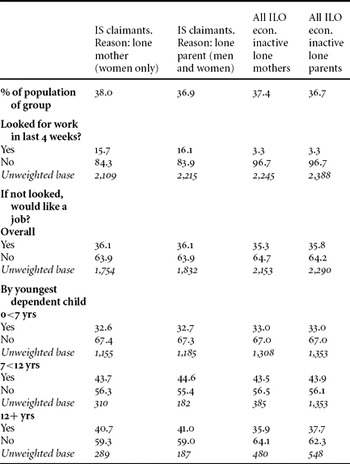
Overall, around eight out of ten lone parents (women and men grouped together) claiming IS for reasons of lone parenthood had not looked for work in the last four weeks (83.9 per cent) (Table 1). Of these, nearly two-thirds (63.9 per cent) stated that they would currently not like either a part-time or full-time job. Notable differences were apparent by age of youngest dependent child, with this number being highest for those with younger children: at around two-thirds (67.3 per cent) for lone parents whose youngest dependent child was aged between zero and seven years. This fell to around a half (55.4 per cent) for those whose youngest dependent child was between seven and 12 years of age, and to slightly more (59 per cent) for lone parents whose youngest dependent child was older (12+ years). Given that the majority of lone parents are women, the equivalent figures for lone mothers were similar to those for all lone parents. These findings suggest that the vast majority of people claiming IS on grounds of their lone-parent status were currently not looking for paid work, and that around half to two-thirds of this group, depending on age of youngest dependent child, stated that they presently would not like a job.
Self-reported job search activity: ILO economically inactive lone parents

Note: Column percentages, aged 18–60 yrs, excluding students (QLFS October–December, 2006 and 2007, weighted).
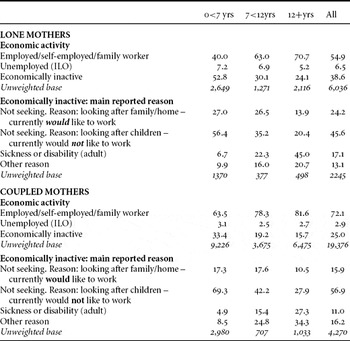
Table 2 goes on to break down the main reported reasons lone parents give for not seeking employment, presented for all economically inactive lone parents.Footnote 5 Differences in levels of economic inactivity and the main reasons reported for not looking for paid work were again notable by age of youngest dependent child. Over half (56.4 per cent) of economically inactive lone mothers, whose youngest dependent child was below seven years of age, stated that they were not seeking paid work, they would not like paid work and the (main) reason for not seeking employment was that they were looking after their children. The equivalent figure for those whose youngest dependent child was between seven and 12 years of age was lower, at around one-third (35.2 per cent). This compared to around 69.3 per cent and 42.2 per cent of coupled mothers respectively. There is thus nothing particularly unique about our findings for lone mothers. Economically inactive coupled mothers with younger children were more likely than lone parents to state that they currently would not like a job and their main reason for not seeking paid work was that they were looking after their children.
Economic activity and main reasons for not seeking paid work by youngest dependent child

Note: Column percentages, aged 18–60 yrs, excluding students (QLFS October–December, 2006 and 2007, weighted).
Although, compared to those with younger dependent children, lone mothers outside the labour market with older children were less likely to report looking after their children as the main reason for not seeking paid work, a greater number reported personal sickness or disability as their main reason. This was the case for 45 per cent of economically inactive lone mothers whose youngest dependent child was 12 years old or above. At the same time, the employment rates for those with older dependent children were higher than for those with younger dependent children (Table 1). As barriers relating to childrearing reduce with child age, more lone parents move into the labour market, although for those who remain outside of paid work, other forms of labour market barriers appear to come to the fore or concentrate. Notably, coupled mothers with similar aged children were less likely to report sickness, illness or disability as their main reason for not looking for work (Table 2). The comparatively poorer health of lone parents is evidenced in other research (for example, Benzeval, Reference Benzeval1998).
Not all lone mothers who stated they were not looking for work, because they were looking after their family or home, did not currently want a job. Around a quarter of economically inactive lone parents whose youngest dependent child was below seven years old, and an equivalent figure for those whose youngest dependent was between seven and 12 years of age, stated that although they were not seeking paid work, and the main reason was because they were looking after the family/home, they would currently like a job (27 per cent and 26.5 per cent respectively) (Table 2). Closer inspection, however, indicated that these people were more likely to be those with children towards the top end of each of dependent child age categories.
Other surveys include similar question items to those used in the current study, but with different response categories. The Families and Children Study (FACS), for example, offers the response ‘do not want to spend more time apart from my children’ as a reason for not looking for paid work, alongside other reasons, such as the availability or affordability of childcare. Using the 2005 FACS, Hoxhallari et al. (Reference Hoxhallari, Connolly and Lyon2007) found that 44 per cent of lone parents who were not in paid work stated not wanting to spend more time apart from their children as a reason for not undertaking paid work of 16 or more hours per week. The corresponding percentages for people who reported childcare availability (15 per cent) or affordability (7 per cent) were considerably lower. These figures, however, were not broken down by dependent child age.
Multivariate analysis
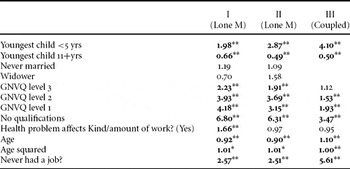
The multivariate analysis considers whether differences by dependent child age persist after controlling for other factors. Comparisons again are drawn to economically inactive coupled mothers. For this task, three separate logistic regression models were estimated (Table 3). The outcome variable for the first model (Model I) predicts members of the working-age lone-mother population who are claiming IS on grounds of lone parenthood, have not looked for work in the last four weeks and state they presently would not like a job (1 = yes). The second model estimated (Model II) predicts members of the working-age lone-mother population who are economically inactive (including IS claimants), not looking for paid work, who say they presently would not like a job and who state the main reason they are not looking for work is they are looking after their children. In the third model (Model III), an equivalent model to model II is estimated for coupled mothers.
Logistic regression: reasons for ILO economic inactivity, lone and coupled mothers

Notes: ** p <0.01, * p <0.05. Odds ratios. Aged 18–60 yrs, excluding students (QLFS October–December 2006 and 2007, not weighted). Outcome variables: Model I: 1 = IS claimant on grounds of lone parenthood, not looking for work, who presently would not like a job; Model II: 1 = ‘ILO economically inactive lone mother, not looking for work, presently would not like a job, (main) stated reason: looking after the family; Model III: 1 = ‘ILO economically inactive coupled mother, not looking for work, presently would not like a job, (main) stated reason: looking after the family. Base category: Youngest child 5–11 yrs; divorced lone parent (variable excluded from coupled mother model); NVQ Level 4/5; No reported health problem that affects kind/amount of work; North East; ‘White’ (2001 Census ethnic group definition). Ethnic Group and Government Office Region control variables are not reported.
All three models indicate that age of youngest dependent child remains a significant predictor of both outcome measures after controlling for other considered factors. At the same time, the findings demonstrate how low qualification levels are particularly important predictors of these forms of economic inactivity, especially for lone mothers. Compared to those with a degree level or above certificate (NVQ Key Skills Level 4/5), lone mothers with no qualifications were over six times more likely to be claiming IS, and state that they were not looking for a job and would currently not like a job (Model I, Odds ratio (OR) = 6.80, p< 0.01). Having no formal qualifications similarly predicted economically inactive lone mothers who were not looking for a job, currently not wanting paid work and who stated looking after their children as their main reason (Model II, OR = 6.31, p<0.01). Although having no formal qualifications similarly predicted economically inactive coupled mothers who reported they did not want a job and the main reason for this was looking after their children, the difference between those with no qualifications and those with NVQ level 4/5 certificates was not as large (Model III, OR = 3.47, p< 0.01). Levels of educational attainment therefore appear to be a bigger predictor of such forms of economic inactivity for lone mothers than for coupled mothers.
Other findings indicated that lone mothers who had never had a job in the past were around two and a half times more likely to be found in our two considered economic inactivity categories. Those with ill-health that restricted the amount or type of work they could undertake were also more likely to claim IS on grounds of lone parenthood, and say they currently would not like a job. After controlling for other factors, no significant differences were found, however, between the different categories of lone motherhood (never married, divorced/separated and widowed).
Discussion and conclusions
The choice agenda in welfare reform is primarily based around ‘opening up’ choice by removing obstacles to paid work and encouraging a plurality of welfare-to-work providers and consumerist notions about empowering benefit claimants by giving them greater influence within active labour market programmes. These may be useful developments that open up opportunities for claimants. They offer, however, a narrower conception of choice around labour market activity than may be construed by many who are the primary carers of dependent children generally. Lone parents’ freedom to choose whether and when participation in paid work is appropriate is increasingly circumscribed as choice largely serves to support government's particular notion of what appropriate parenting and citizen behaviour entails.
New Labour and now the Coalition Government, in placing anti-poverty and economic wellbeing as overriding moral justifications for intervention to promote work-related activity, have arguably overlooked an aspect of the mass view of lone parents available in its own survey data. Despite prior interventions and improved opportunity – whether through constraint or choice – many of those targeted for mandatory activation policies state that they do not currently want a job. Consequently, they appear, despite welfare reform, to still not view paid work as an attractive enough proposition to enter the labour market in their current circumstances, perceived opportunity sets or at their present life points.
A substantial proportion of lone parents whose youngest dependent children were in the age categories forming the basis of policy targeting stated that they currently did not want a job and that the main reason they were not looking for paid work was they were looking after their children. Our findings however do not say anything on the extent to which lone parents with younger children may be receptive to measures as proposed for the work-related activity group in relation to the Gregg Review proposals.
The current findings also do not mean that lone parents who state they currently do not want a paid job in the future will not be seeking or wanting employment, or will be unreceptive to further policy measures. The extent to which lone mothers state they would presently like a job is related to the age of their youngest dependent child. In this sense, tapering obligations to seek paid work by youngest dependent child age is to an extent consistent with the manner in which childrearing influences decision-making for many lone mothers, as well as with the barriers to employment faced in relation to child-caring responsibilities. Nonetheless, although dependent child age is an important consideration, economically inactive lone mothers remain more likely to be those with other chronic problems, such as low educational attainment, poor health or no prior employment history, and these employment barriers cut across dependent child age categories (for example, see Hoxhallari et al., Reference Hoxhallari, Connolly and Lyon2007). Although childcare responsibilities appear less of a barrier to employment, lone parents with older children, who are a target group for recent reforms, were more likely to report sickness, illness or disability as a reason for not seeking paid work.
Life events associated with entry into lone parenthood, such as the experience of domestic violence, divorce or separation, may also occur at any time point in relation to dependent child age, disrupting employment (see Wilcox, Reference Wilcox2000). Other research indicates that children are more likely to be reported as disabled in lone-parent households than married-couple households (over 40 per cent of lone-parent households) and mothers who report their children are disabled are less likely to be in full-time employment (McKay and Atkinson, Reference McKay and Atkinson2007). For those with children with additional care needs, care requirements may continue to affect employment, even when children grow older. Discretion made in mandatory activation policy for these sets of considerations is consequently warranted.
We make no attempt to identify the extent to which respondents’ statements regarding currently not wanting paid work reflect unconstrained choices made by people who have the opportunity and capacity to take up paid work but presently decide not to, or constraints or labour market barriers that make entering paid work currently infeasible, nor do we provide direct evidence on the job retention effects of policy. However, based on other research on the barriers to work and the employment stability of lone parents (for example, see Johnson, Reference Johnson2002; Bell et al., Reference Bell, Finch, La Velle, Sainsbury and Skinner2005) some tentative inferences can be drawn on these issues. Where lone parents’ reasons for currently not wanting a paid job mainly reflect significant barriers faced towards entering and sustaining employment, increasing levels of mandated activation are likely to bring a greater number of lone parents into the labour market who are less ‘work ready’ than those who, in the past, entered the New Deal gateway voluntarily. This may raise job retention issues. Once in employment, factors that act as barriers to labour market entry, such as inadequate childcare arrangements or poor child health, may act as ‘stressors’ on employment retention, triggering labour market exits (Johnson, Reference Johnson2002; McKay and Atkinson, Reference McKay and Atkinson2007). Where this occurs, it is difficult to see how such outcomes necessarily improve the lives of lone-parent families.
For lone parents, such as those who choose at a given time to remain outside the labour market for childrearing but who have the capacity to enter paid work, policy may present a double bind between duties as responsible parents, as promoted by government, but interpreted and enacted individually, and state-defined objectives of being a responsible ‘active’ citizen in the labour market. Resistance to government-defined norms regarding when it is appropriate to enter the labour market could lead to increased levels of employment instability or cycling between paid work and out-of-work status if, having been pushed into work, upon deciding to quit a job, lone parents are repeatedly mandated to search for employment. It is also conceivable that lone-parent benefit recipients may find themselves at greater risk of sanction as they move onto Jobseekers’ Allowance or ESA due to the more stringent job-search and work-related activity requirements of these benefits in comparison to IS.
The public service reform rhetoric of increasing ‘choice’ or ‘empowering service users’ sits uncomfortably with our findings and the context of welfare services which in their very nature are often about enforcing certain behaviours viewed as desirable by government. A genuine discussion of the nature of choice and empowerment in welfare-to-work rests beyond the prescription of what is assumed best for people and what it is assumed people want. Government social security reforms and approaches to choice thus often appear more concerned with addressing what is perceived as individual failure to find employment (Grover, Reference Grover2007: 543), and developing a ‘sovereign consumer’ who acts in accordance with market norms rather than enhancing the autonomy of social security recipients.
Acknowledgements
We are grateful to the Office for National Statistics and the Economic and Social Data Service for making available the data from the Quarterly Labour Force Survey.