Introduction
Head and neck squamous cell carcinoma (SCC) is the sixth most common human cancer in all parts of the world.Reference Parkin, Pisani and Ferlay1 It has been estimated that there are approximately 400 000 new cases each year worldwide. Early detection can improve patient survival and diminish the morbidity of treatment, compared with that of advanced disease.
Recent investigation of the molecular biology of laryngeal SCC has revealed a multistep progression model of genetic alterations which participate in the initiation and progression of carcinogenesis. Laryngeal SCC is thought to progress through a series of well defined clinical and histopathological stages.Reference Ah-See, Cooke, Pickford, Soutar and Balmain2 Califano et al. demonstrated that these progressive clinical and histological stages run more or less parallel with an increase in the number of genetic alterations.Reference Califano, van der Riet, Westra, Nawroz, Clayman and Piantadosi3 Within this progression model, allelic imbalances of chromosomes 3p, 9p, and 17p could be defined as early alterations.Reference Tabor, Brakenhoff, van Houten, Kummer, Snel and Snijders4, Reference Yoo, Cho, Lee, Park, Kim and Kim5 However, it is not yet clear which genes participate in the histopathological stages of laryngeal SCC.
Deoxyribonucleic acid (DNA) microsatellites are highly polymorphic markers used to map specific areas of chromosomes. Certain genetic alterate in microsatellite markers, including microsatellite loss of heterozygosity and microsatellite instability.
In the current study, we examined allelic imbalance in laryngeal premalignant lesions and SCC at highly polymorphic microsatellite markers located on chromosomes 3p, 9p and 17p. Allelic imbalance was evaluated using polymerase chain reaction – single sequence length polymorphism – silver staining. The aim of the study was to elucidate the temporal order of genetic events in laryngeal SCC progression and to provide insight into the underlying genetic changes and biological behaviour which accompany clinical phenotypic progression. We present evidence that these genetic alterations are detectable phenomena in the above regions of the genome. Those loci with high mutation rates deserve further investigation.
Materials and methods
Patients and specimens
We collected 34 laryngeal premalignant lesions and 15 laryngeal squamous cell carcinogenesis lesions, as fresh tissue samples, along with their corresponding normal tissues or peripheral blood leucocytes as sources of control DNA, from previously untreated patients between November 2004 and December 2005. Tissue was obtained, with consent, from An Hui Province Hospital patients. Each sample was not only formalin-fixed, paraffin-embedded and stained with haematoxylin and eosin (H&E) for routine histopathology, but also immediately snap-frozen in liquid nitrogen and stored at −80°C for further processing. All H&E-stained slides were examined by two experienced pathologists and scored according to the standard criteria of the World Health Organization international histological classification of tumours. Lesions were classified as: (1) hyperplasia (n = 9); (2) mild dysplasia (n = 10); (3) moderate to severe dysplasia or carcinoma in situ (n = 10); and (4) SCC (n = 15).
Tissue and DNA extraction
Freshly frozen tissue from a biopsy or operation specimen was meticulously dissected on a cryostat to ensure that the specimen contained at least 75 per cent epithelial cells from the mucosal lesion. Genomic DNA was extracted from freshly frozen tissue by standard proteinase K digestion, followed by phenol/chloroform extraction precipitation. Peripheral blood cell DNA was extracted using the Nucleon Kit (Amersham Biosciences, Piscataway, New Jersey, USA), following the manufacturer's instructions. Samples of DNA were stored at 4ºC.
Microsatellite markers and polymerase chain reaction analysis
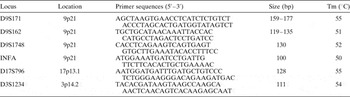
Six polymorphic microsatellite markers located on chromosomes 3p, 9p and 17p were used to investigate microsatellite instability or loss of heterozygosity. The specific markers used in this study were selected because they identify a minimal area of loss at putative tumour suppressor gene loci and because they are lost frequently and early during head and neck SCC tumourigenesis. The microsatellite markers used for analysis were supplied by Invitrogen (Burlington, Ontario, Canada) and mapped to the following regions: 3p14.2 (D3S1234), 9p21 (D9S171, D9S162, D9SINFA and D9S1748) and 17p13.1 (TP53). Primer sequences were obtained from the Genome Database for all of these markers (Table I).
Polymorphic loci and primer sequences

Tm = melting temperature; A = Adenine; G = Guanine; C = Cytosine; T = Thymine; INFA = D9SINFA
These microsatellite loci were amplified by polymerase chain reaction in a 12.5-μl reaction volume containing 50–100 ng template genomic DNA and 2 pmol of each primer (determined separately for each primer pair). The polymerase chain reaction buffer included 16.6 mM ammonium sulphate, 67 mM Tris (pH 8.8), 6.7 mM magnesium chloride, 10 mM β-mercaptoethanol, and 1 per cent dimethyl sulfoxide, to which were added 1.5 mM deoxynucleotide triphosphate and 1.0 units of Taq DNA polymerase (Boehringer-Mannheim Biochemicals, Indianapolis, Indiana, USA). Polymerase chain reaction amplifications of each primer set were performed for 30–35 cycles, each cycle consisting of predenaturation at 95°C for 40 s, denaturation at 95°C for 30 s, annnealing at 50–60°C for 60 s, and extension at 70°C for 60 s. One-third of the polymerase chain reaction product was analysed by electrophoresis on 8 per cent urea-formamide-polyacrylamide gels, followed by silver staining. Gels were dried and exposed to film. Two scientists who were unaware of the clinical characteristics of the subjects performed independent readings. Samples were coded, so that the observers were blinded to the individual subject.
Definition of loss of heterozygosity and microsatellite instability
Determination of allelic imbalance by the informative microsatellite marker was made by visual evaluation. For informative cases, allelic loss was inferred by two independent observers when the signal intensity of one allele was decreased by at least 50 per cent in the DNA sample from a lesion, as compared with the corresponding allele in the matching normal tissue DNA. Microsatellite instability was inferred if one or both alleles at a given locus showed size variation – either expansion or contraction – in comparison with the same alleles in the normal control DNA. When calculating the frequency of loss of heterozygosity, samples showing homozygosity and microsatellite instability only were not considered. When calculating the frequency of microsatellite instability, samples showing loss of heterozygosity only were not considered. All samples showing loss of heterozygosity and/or microsatellite instability were subjected to repeat analysis after a second, independent amplification, whenever the quantity of DNA was sufficient.
Statistical analysis
Statistical analysis was performed using Statistical Package for the Social Sciences software version 10.0 (SPSS, Chicago, Illinois, USA). Data were analysed using Fisher's exact test; the chi-square test was used to investigate differences in progression to invasive cancer in the different histological subgroups. The chi-square test was also used for comparison of percentages. A p value of less than 0.05 was considered statistically significant.
Results
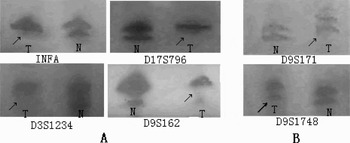
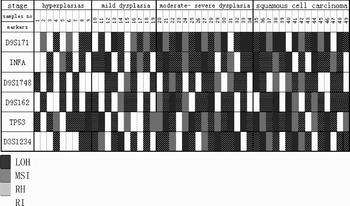
None of the healthy control subjects exhibited any genetic alteration of the six markers tested. Figure 1 shows typical examples of microsatellite instability and loss of heterozygosity of the various markers. The results of microsatellite analysis, by marker and patient, are shown in Figure 2.
Representative illustrations of LOH and MSI at six different microsatellite markers on the chromosome 3p, 9p and 17p. The markers were amplified from paired tumor (T) and normal (N) tissue. (A) The samples show LOH; (B) The samples show MSI. The arrows indicate the loss of an allele or a shift of the allele. LOH = loss of heterozygosity; MSI = microstatellite imbalance

Allelic imbalance data for chromosomes 3p, 9p and 17p markers in laryngeal premalignant lesions and laryngeal squamous cell carcinoma (LSCC) samples. Patients are arranged according to stage of the tumor. INFA = D9SINFA; LOH = loss of heterozygosity; MSI = microsatellite imbalance; RH = retention of heterozygosity; NI = non-informatine or homozygotic

Analysis of loss of heterozygosity and microsatellite instability in SCC samples at different stages
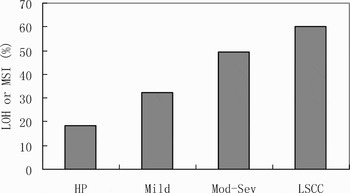
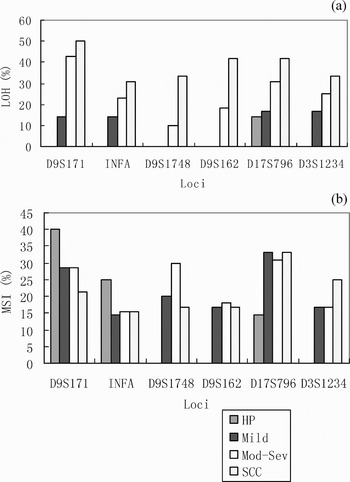
We genotyped 49 laryngeal SCC tumours, at different stages of development, for loss of heterozygosity and microsatellite instability, at six different loci on chromosomes 3p, 9p and 17p, using highly polymorphic microsatellite markers (Figure 3). Loss of heterozygosity was found in 3.7 per cent (1/27) of cases of hyperplasia, 10.81 per cent (4/37) of mild dysplasia, 26.03 per cent (19/73) of moderate to severe dysplasia, and 38.67 per cent (29/75) of laryngeal SCC (Figure 4). There was a strong correlation among groups (χ2 = 17.686, p = 0.000). The frequency of loss of heterozygosity on D9S171 and D9S162 at different histopathology stages was statistically significant (p = 0.022, p = 0.025). At the laryngeal SCC stage, loss of heterozygosity was observed in more than 40 per cent of multiple microsatellite loci (D9S171, TP53 and D9S162).
Allelic imbalance data of the chromosome 3p,9p and 17p markers in laryngeal premalignant lesions and laryngeal squamous cell carcinoma (LCSS) samples. LOH = loss of heterozygosity; MSI = microsatellite imbalance; HP = hyperplasia; Mild = mildly dysplastic; Mod-Sev = moderately to severely dysplastic

Frequency of (a) loss of heterozygosity (LOH) and (b) microsatellite instability (MSI), for six different markers on chromosomes 3p, 9p and 17p in laryngeal carcinogenesis. INFA = D9SINFA; HP = hyperplasia; mild = mildly dysplastic; mod–sev = moderately to severely dysplastic; SCC = squamous cell carcinoma

Microsatellite instability was found in 14.81 per cent (4/27) of cases of hyperplasia, 21.62 per cent (8/37) of mild dysplasia, 23.29 per cent (17/73) of moderate to severe dysplasia and 21.33 per cent (16/75) of laryngeal SCC (Figure 4). These differences in detection rates were not statistically significant (χ2 = 0.314, p > 0.05). Analysis of the allelic imbalance in laryngeal premalignant and malignant lesions revealed that hyperplastic and mildly dysplastic tissues exhibited more microsatellite instability than loss of heterozygosity, whereas moderate to severely dysplastic and laryngeal SCC tissues exhibited significantly more loss of heterozygosity than microsatellite instability.
Analysis of loss of heterozygosity and microsatellite instability at different microsatellite loci
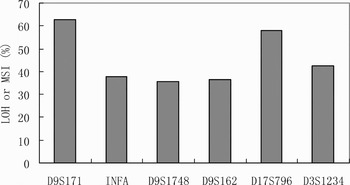
Genotyping of the 49 tissue specimens, using D9S171, D9S1748, D9S162, D9SINFA, D17S796 and D3S1234 microsatellite markers, revealed several intriguing features (Figure 5). It was found that, of the informative samples, loss of heterozygosity and microsatellite instability were exhibited in 14 and 11 cases on D9S171. Similarly, the incidence of loss of heterozygosity and microsatellite instability was respectively 8/37 and 6/37 on 5/31 and 6/31 on D9S1748, 7/33 and 5/33 on D9S162, 11/38 and 11/38 on D17S796, and 8/33 and 6/33 on D3S1234. The marker most frequently affected by either loss of heterozygosity or microsatellite instability was D9S171 (62.5 per cent) on chromosome 9p21, followed by D17S796 (57.89 per cent) on 17p13.1. The marker on D17S796 displayed both microsatellite instability and loss of heterozygosity in hyperplastic lesions. Allelic imbalance at the D17S796 marker was seen in all stages of laryngeal SCC progression. Three patients' specimens (30 per cent) within the mildly dysplastic group showed loss of heterozygosity or microsatellite instability on more than one marker (Figure 2). Similarly, eight patients' specimens (53 per cent) in the moderately to severely dysplastic group exhibited microsatellite alterations at more than one locus, and nine specimens (60 per cent) in the laryngeal SCC group displayed changes at more than one marker. No statistically significant difference was found in these three groups.
Frequency of loss of heterozygosity (LOH) or microsatellite instability (MSI) for six different markers, in laryngeal premalignant lesions and squamous cell carcinoma samples

Discussion
Laryngeal carcinogenesis proceeds in a multistep fashion and requires the accumulation of multiple genetic alterations within laryngeal epithelial cells. However, the pathologist, while recognising most of these precursor lesions as hyperplasia or mild, moderate or severe dysplasia, may not be able to indicate accurately the risk of progression to frank malignancy. In recent years, extensive genetic analysis of head and neck SCC and premalignant lesions has resulted in the identification of many common genetic abnormalities in these lesions. Such lesions can exhibit a variety of histological features, from hyperkeratosis, hyperplasia and mild dysplasia to severe dysplasia. It has been shown that a specific pattern of allelic imbalance is an important marker which predicts progression.Reference Sudbo, Kildal, Risberg, Koppang, Danielsen and Reith6 Therefore, the presently used microsatellite analysis technique may be sensitive enough to provide strong evidence supporting the role of genetic testing to augment histopathological evaluation of laryngeal premalignancies.
Study of head and neck cancers has revealed different incidences of loss of heterozygosity and microsatellite instability on the following chromosomes: 2q, 3p, 5q, 8p, 9p, 11q, 13q, 17p and 19p.Reference Zhou, Jordan, Li, Huang and Wong7–Reference Rogowski, Walenczak, Pepinski, Skawronska, Sieskiewicz and Klatka9 Certain genetic events (9p21 loss of heterozygosity, 3p loss of heterozygosity and 17p13 loss of heterozygosity) tend to occur earlier on the progression pathway.Reference Joseph, William, Glenn, Russel, Wayne and David10 We chose six microsatellite markers for our analysis, based on the following criteria: (1) they identify a minimal area of loss at a putative tumour suppressor gene locus; and (2) they have shown a substantial degree of loss of heterozygosity in invasive lesions, by allelotype analysis. Chromosome 9p21 includes the MTS1 gene (D9S1748), the CDKN2A gene (D9S162), the INK4A gene (D9SINFA) and the INK4B gene (D9S171) which encodes the p16. The chromosome band 17p13.1 is known as the location of the p53 gene. Chromosome 3p is the presumed location of the fragile histidine triad tumour suppressor gene, on 3p14.2 in cases of head and neck SCC. The present study detected a loss of heterozygosity and microsatellite instability in 38.69 per cent (53 of 137) of laryngeal premalignant lesions and in 60 per cent (45 of 75) of laryngeal SCC specimens, suggesting that allelic loss increases as laryngeal carcinogenesis progresses.
The results of this study show that, following microsatellite assessment of laryngeal premalignant lesions and laryngeal SCC, the incidence of loss of heterozygosity was significantly different (p = 0.000) at different histopathological stages. A similar finding has been reported for other solid tumours.Reference Kakinuma, Kohu, Sato, Yamada, Nakajima and Akiyama11 Loss of heterozygosity differed significantly at different histopathological stages for only a single microsatellite marker, detecting loss of heterozygosity on D9S171 and D9S162. However, no statistically significant difference was found in the frequency of microsatellite instability. These observations indicate that an accumulation of genetic events is associated with histopathological progression. This in turn implies that the temporal sequence of genetic alteration is not the same for each individual tumour, but that an accumulation of genetic events is critical for determining tumour progression. In this study, we observed that loss of heterozygosity and chromosomal instability phenotypes can coexist. It has been suggested that the frequency of loss of heterozygosity increases as laryngeal carcinogenesis progresses. We found that hyperplastic and mildly dysplastic lesions exhibited more microsatellite instability than loss of heterozygosity (14.81 and 21.62 per cent, respectively). This is consistent with other reports,Reference Ha, Pilkington, Westra, Sciubba, Sidransky and Califano12 indicating that microsatellite instability becomes increasingly more common as early dysplastic lesions progress to fully malignant head and neck SCC. This finding also confirms the detection of microsatellite instability as an important aspect of microsatellite analysis. Patients with microsatellite alteration of two or more microsatellite markers have subsequently been found to have recurrences or progression of laryngeal premalignant lesions.
• Early detection of laryngeal squamous cell carcinoma (SCC) can improve patient survival and diminish the morbidity of treatment required for advanced disease
• The aim of this study was to reveal the temporal order of genetic events in laryngeal SCC progression and to provide insight into the underlying genetic changes and biological behaviour that accompany clinical phenotypic progression
• Allelic imbalance was associated with carcinogenesis and development of laryngeal SCC. Microsatellite analysis may provide new approaches to early genetic detection of laryngeal premalignant lesions
Allelic loss is the most common phenomenon in the inactivation of the putative tumour suppressor gene. Analysis of allelic imbalance has provided important clues to the position of known and putative tumour suppressor genes and has assisted cloning research. Some tumour suppressor genes have been identified,Reference Simoneau and Jones13 such as the TP53 gene on chromosome 17p and the CDKN2A locus on 9p21. Evidence exists that TP53 mutations represent early genetic alterations in the development of head and neck SCC. In our study, loss of heterozygosity and microsatellite instability were most frequent at D9S171,Reference Braakhuis, Tabor, Kummer, Leemans and Brakenhoff14 followed by TP53, which is consistent with reports from other populations.Reference Joseph, William, Glenn, Russel, Wayne and David10, Reference Rizos, Sourvinos and Spandidos15 Our study found that the incidence of loss of heterozygosity at D9S1748, which is closely linked to the p16 tumour suppressor gene, is significantly less than that at D9S171, D9S162 and D9SINFA centromeric to p16. We therefore believe that, in addition to the p16 tumour suppressor gene on 9p21, two or more additional putative tumour suppressor genes may reside on chromosome 9p21 and play a role in laryngeal carcinogenesis.
Conclusion
The results of this study show that loss of heterozygosity and microsatellite instability are detectable phenomena within the process of laryngeal carcinogenesis, and that these alterations may play a role in the pathogenesis of the disease. Identification of these chromosomal patterns could easily be applied as an additional tool in the diagnosis of preinvasive lesions. However, microsatellite analysis may not be suitable to evaluate lesions in which carcinogenesis involves mechanisms other than loss of heterozygosity or microsatellite instability at the chromosome regions examined. Tests for other molecular alterations (such as DNA hypermethylation in the promoter regions of certain tumour suppressor genes, and abnormal protein expression) may be integrated with microsatellite analysis and histopathology to form a comprehensive but still practical panel of assays, allowing classification of laryngeal premalignant lesions.
This study may have been limited by the small number of patients involved; further studies are thus needed to clarify our findings.
Acknowledgements
The authors would like to thank ShenQuan Zhang, Xing Luo and GuangLun Wan for technical assistance. The financial support of the Educational Natural Science Foundation of An Hui Province is gratefully acknowledged.