The Portable Antiquities Scheme (PAS) was established in 1997 as an initiative to record archaeological objects found by members of the general public. Initially set up in pilot form, in 2003 it was extended to the whole of England and Wales.Footnote 1 Surveys of Roman period finds recorded by the PAS have been published in Britannia since 2004. This sixteenth annual report summarises the general character and distribution of Roman finds reported in 2018 and publishes significant individual artefacts recorded by Finds Liaison Officers.
OVERVIEW
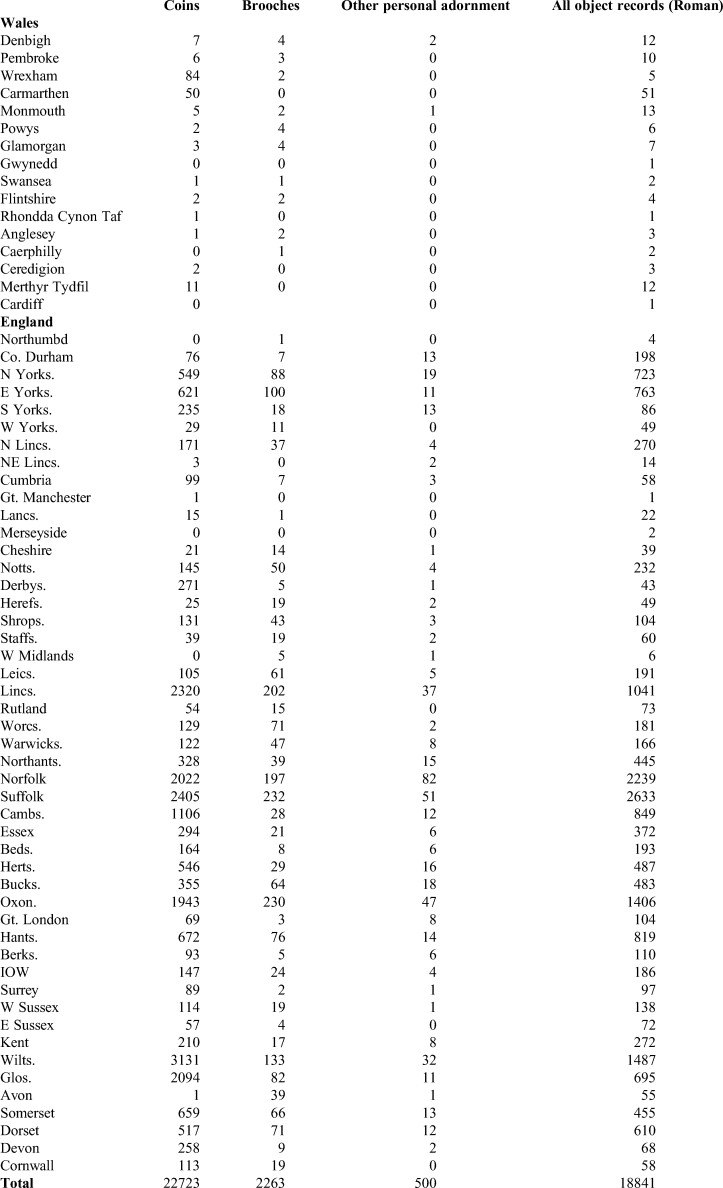
As in previous reports the summary of Roman period finds reported to the PAS in 2018 begins with a discussion of their distribution. Table 1 documents the numbers of object types recorded on the online-accessible database by county, as before using older administrative boundaries from England and Wales for consistency with previous reports and grouping counties by PAS region. The first three categories comprise coins, brooches and other personal ornaments made of metal, these being the numerically most important categories of Roman period finds. The fourth column reports the number of records of Roman objects in all materials, including metallic and non-metallic objects (i.e. ceramic, glass and stone objects and building materials). This follows the same format used for presenting finds from 2016 onwards.Footnote 2 As a single record may sometimes document more than one item, for example describing an assemblage of building materials or ceramics or a coin hoard, the total number of Roman objects documented in the year exceeds the total number of records for the year. The number of Roman coins documented in 2018 is therefore considerably greater than the number of Roman period records. Nonetheless the distribution of records serves as a reliable proxy indicator for the distribution of findspots of objects reported to the PAS. 2018 saw many records made for Roman objects found in eastern England, especially in coastal counties from North Yorkshire to Suffolk, in some counties of the south-east Midlands and in central southern and south-western England. In western England and Wales the number of records is much smaller. The documenting of a small number of large hoards partly explains the very many coins documented in Gloucestershire, Wiltshire and Lincolnshire during 2018. Significant examples include a Severan denarius hoard from Norton, Doncaster (SWYOR-4B2BFF), and large third-century hoards from Riby, Lincs. (LIN-E5A12D) and English Bicknell, Glos. (GLO-756722).Footnote 3 In general the regional variability in the distribution of PAS records closely follows the pattern established over the last fifteen years. Multiple factors determine this distribution pattern, including variations in the availability of metal objects as well as their use and deposition in antiquity, diverse historic and contemporary farming practice and the uneven intensity of metal-detector use.Footnote 4
NUMBERS OF NON-CERAMIC ARTEFACTS RECORDED BY THE PAS IN 2018 BY COUNTY AND TYPE

With the addition of the coins recorded in 2018 (22,723) more than 279,000 Roman coins have now been recorded by the PAS, as calculated from these annual totals, the result of the continuing emphasis on recording large assemblages of Roman coins in toto.Footnote 5 The tabulation format this year means that the frequency of coins documented relative to all other metallic objects in 2018 can only be compared directly to the 2016 and 2017 data. Nonetheless the outnumbering of brooches by coins at a ratio of more than 10 to 1 continues to indicate that patterns of discovery and documentation approximate to those established from 2003 onwards.Footnote 6
30,425 brooches have been documented by the Scheme since 2003 in these annual reports, including the 2,263 examples recorded in 2018.Footnote 7 As before this total includes brooches with date-spans across the late Iron Age–Roman transition as well as those dated to the Roman period proper. The distribution of 2018 brooch finds is very similar to previous years in two principal respects. First, the highest numbers are again documented from North Yorkshire to Suffolk and in some southern English counties. Second, in several counties in a wide zone across northern England, the Midlands and western England the ratio of brooches to coins is much higher than average, from 1:3 (for example West Yorkshire, Cumbria) to 1:2 or greater (for example Herefordshire, Shropshire, Staffordshire, Leicestershire).Footnote 8 The same is true of several Welsh counties, though the numbers of finds are much smaller. Among the other personal ornaments finger-rings and bracelets remain the most frequently documented artefacts after brooches, but their numbers are much smaller. The most significant single assemblage of (non-coin) objects found in 2018 is the Wilcot (Wilts.) vessel hoard (WILT-047110), the second late Roman deposit of copper-alloy vessels from the Pewsey area to be documented by the PAS, the first having been discovered in 2014 (WILT-0F898C). Both hoards are published in this volume.Footnote 9
ARTEFACT DESCRIPTIONS
The following 24 entries publish highlights among the past year's finds recorded by members of the PAS and Treasure Department at the British Museum.Footnote 10 They are chosen for their contribution to the study of the visual and material culture of Roman Britain. The reference number associated with each record is the unique identifier which can be used to consult individual object records on the PAS website: www.finds.org.uk. Two objects were also treated as Treasure cases and are therefore also designated with their Treasure number in the format of year (20XX) and reference number (TXX).Footnote 11
The metal, bone and ceramic artefacts included in this report were made between the late Iron Age and the fifth century a.d. and belong to various functional categories and artistic traditions. The four figurines include more commonly documented deities and their attributes (Minerva, Fortuna, a cockerel) as well as a fragment from a large statuette of unidentified form; an amulet is recorded this year of unparalleled form combining a phallus and a pecking bird. Objects related to personal ornament and care of the body include a gold ring, an enamelled disc brooch, a late antique lead mirror frame and a cosmetic set. Vessel elements comprise two handles and three mounts with figural elements as well as a zoomorphic spout from a strainer. A sphinx-shaped mount and a bust of the goddess Diana are likely furniture fittings. Other household objects include a figural bone knife-handle, possibly of a gladiator, and a small handle in leopard form, perhaps from a knife or key, as well as a late antique lamp. Amongst objects with a potential connection to the Roman army are a shield boss, two enamelled mounts from harness or baldrics, and a belt-fitting decorated in Quoit Brooch style.
CO. DURHAM
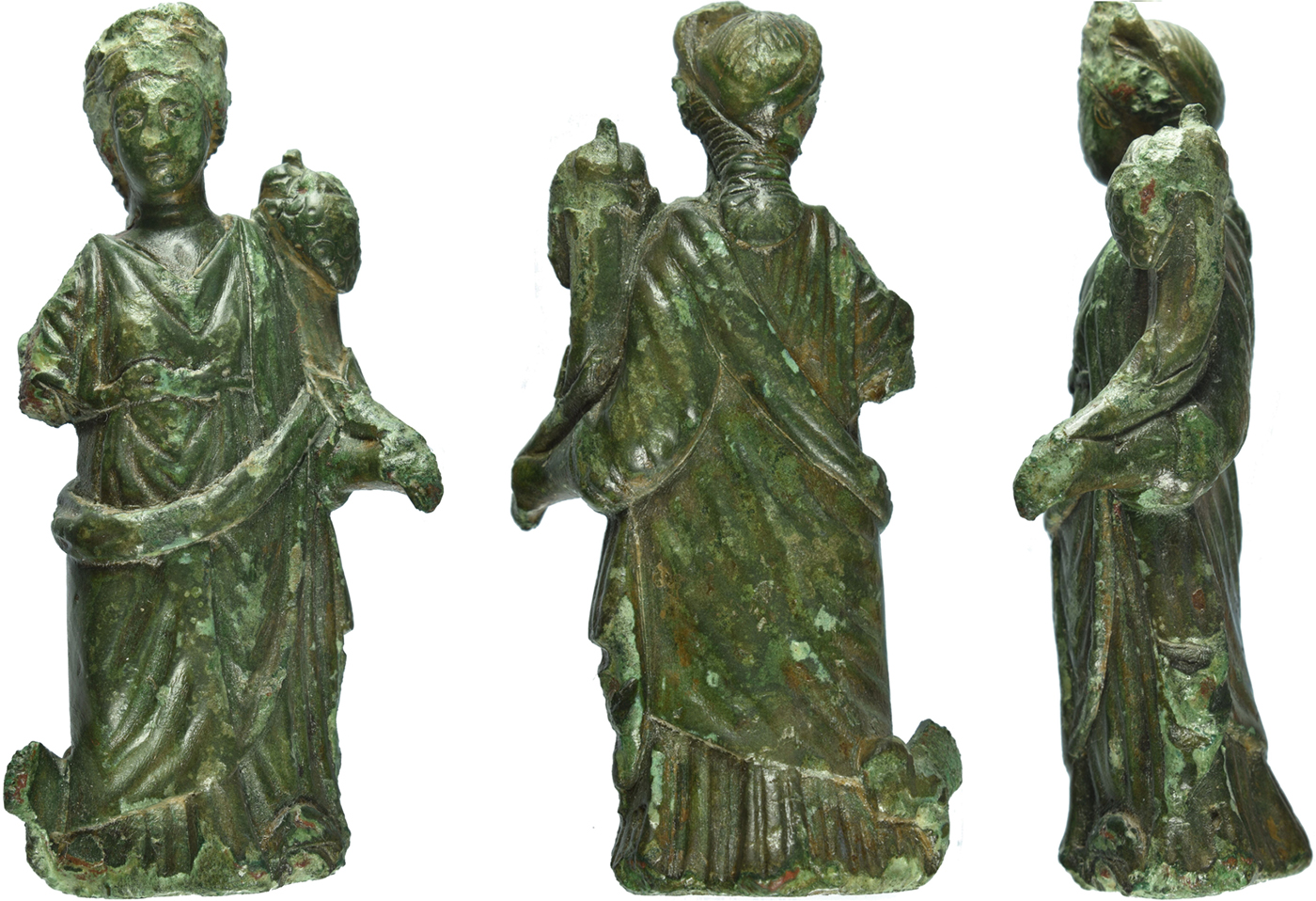
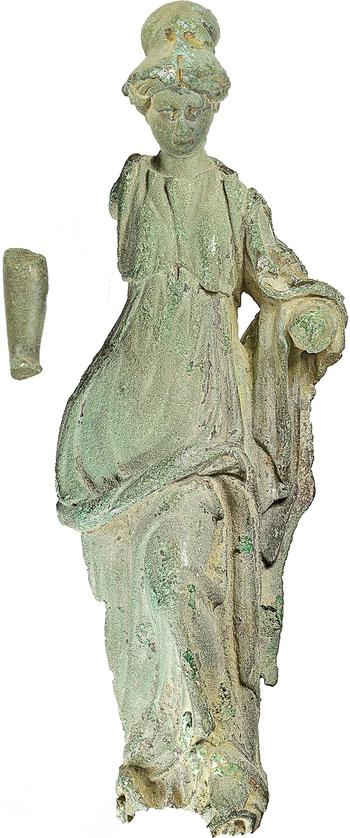
(1) Gainford area (DUR-08B7FB) (fig. 1).Footnote 12 A small figurine of a standing Fortuna, largely complete, except for the missing right arm, carefully modelled and well preserved with a patina in which the fine detail remains clear. The statuette is 60 mm high and weighs 72.9 g. Fortuna wears a diadem, of which the upper part is lost to damage. Beneath this the hair is centrally parted and swept back on either side of the head. At the back of her head the hair is plaited and bound in a clubbed braid which extends onto her shoulders. On her face the eyeball and pupils and a short straight mouth are clearly rendered, though much of the nose is lost to damage. She wears a long, pleated tunic, falling in V-shaped folds to her waist, with a belt beneath her breasts. A cloak is draped over the left shoulder, descends diagonally across her back and is gathered across her waist to rest over her left forearm. Beneath the cloak the tunic reaches to her feet, where the figurine has suffered some slight damage. The folds of tunic and cloak are rendered with some sophistication, revealing the contrapposto stance of the body beneath. The right arm is missing from below the elbow, it points down towards her right foot where there are traces of the steering oar or rudder she can be assumed to have held. In the crook of her left arm is a cornucopia, its tip resting in her hand, the fruits in its overflowing mouth represented in stylised form by dots within circles.
Gainford area, Fortuna figurine (No. 1). Scale 1:1. (Photo: B. Westwood; © Durham County Council)

The rudder and cornucopia allow the goddess to be identified confidently as Fortuna, documented in several examples from Britain which reproduce the widely employed iconography for the goddess.Footnote 13 At least three have now been documented by the PAS, from Urchfont, Wilts. (WILT-0774B1), Kettlebaston, Suffolk (SF-302EF1), and a composite figure of Minerva-Fortuna, from Hinxworth, Herts. (BH-ED9F44).Footnote 14 Although several figurines have been documented at nearby Piercebridge (c. 3 km to the east), especially from the bed of the Tees, this is the first attestation of Fortuna in the vicinity of the fort.Footnote 15
NORTH YORKSHIRE
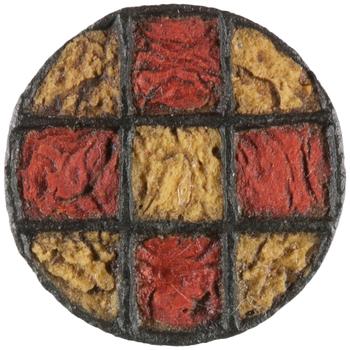
(2) Hunmanby (YORYM-8597F3) (fig. 2).Footnote 16 A complete copper-alloy enamelled stud of late Iron Age to early Roman date, well-preserved with a dark brown patina. The object is 13.7 mm in diameter, 2.5 mm thick and weighs 1.6 g. Circular in form, it carries a chequerboard design of nine alternating red and yellow enamel cells within a grid of reserved metal on its upper surface; there is no evidence of attachment on the smooth lower surface. The stud can be closely paralleled in finds from East Yorkshire. A very similar stud was inlaid centrally in the hilt end of an Iron Age sword from Thorpe Hall, Rudston, a likely burial find dated between the second century b.c. and first century a.d. and unusual for a sword fitting in including yellow enamel along with the violence-evoking red.Footnote 17 A similar example was documented by the PAS from the Dalton area (DUR-4E3C45). Comparable chequerboard red and yellow enamelling can also be seen on other late Iron Age or early Roman objects, for instance two linchpins recorded by the PAS, one from Hatherton, Staffs. (WMID-947693), and the other from near Market Weighton (YORYM-B3FDA2), another East Yorkshire find. The same enamelling is documented on an unusual button-and-loop fastener, dated a little later (a.d. 50–200), from nearby Holme-on-Spalding Moor (YORYM-83B977).
Hunmanby, mount (No. 2). Scale 3:1. (Photo: R. Griffiths; © R. Griffiths and York Museums Trust)

EAST YORKSHIRE
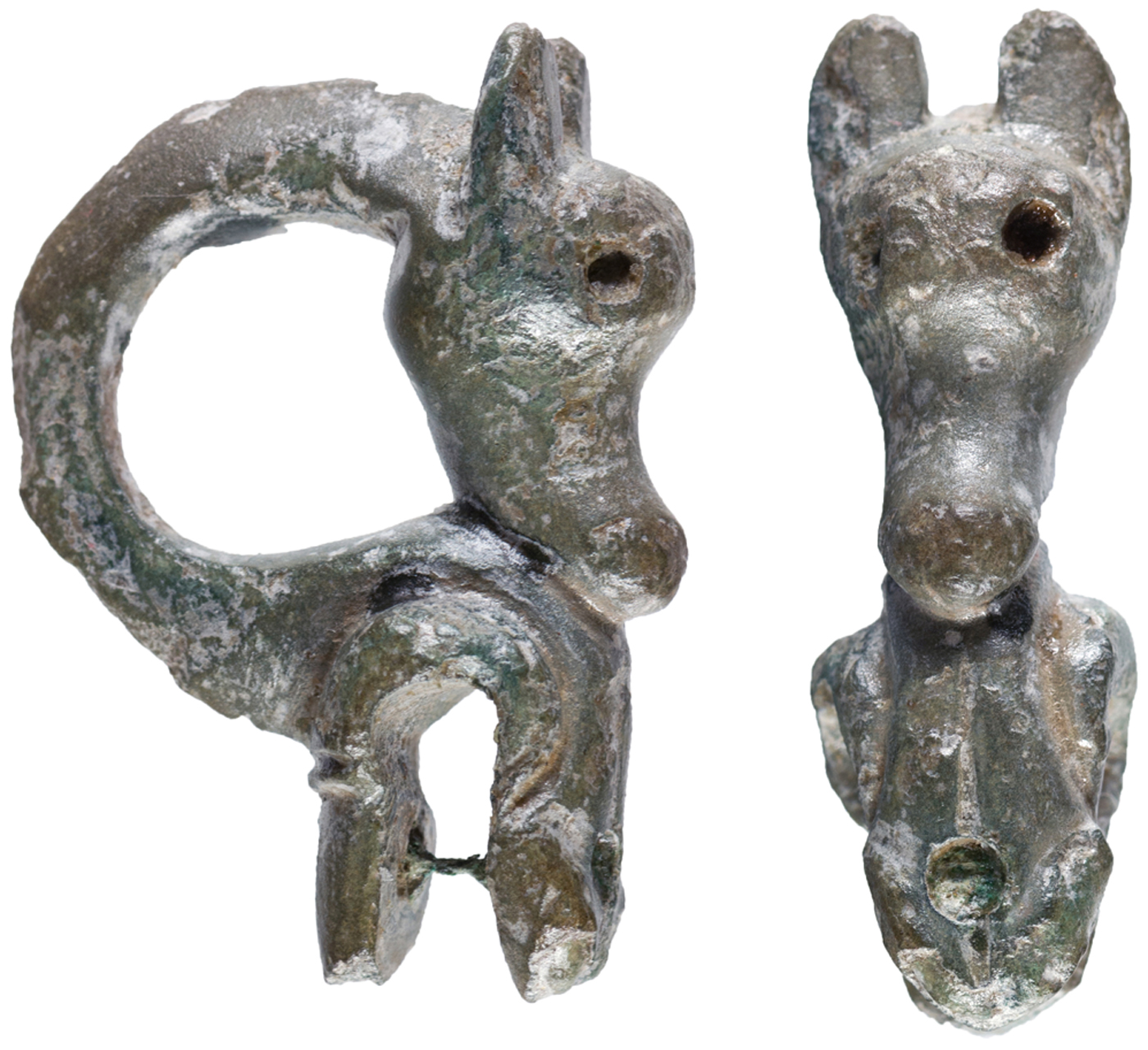
(3) Bestwick (YORYM-700D19) (fig. 3).Footnote 18 A complete copper-alloy zoomorphic vessel mount dated between c. 100 b.c. and a.d. 100. It is 35 mm long, 11 mm wide, 25 mm thick and weighs 14 g. The mount comprises a loop with an animal head at one end and a divided attachment terminal at the other. The bovine(?) head is quite fully modelled, with raised ears, deep recesses for eyes, though the setting is lost, a prominent brow and outward-curving muzzle which rests against the junction between its elongated neck, curled in a circle, and the split terminal. Chevrons are incised into the top of the neck, perhaps to indicate hair. On both sides the terminal plates taper slightly and the front plate carries vertical grooves. A worn rivet remains within the holes through which it was driven to attach the terminal to the vessel. Ox head mounts are widely documented as decorative elements on Iron Age and Roman metal vessels.Footnote 19 Mounts from Norfolk at Quidenham (NMS-1E6986) and (in a hoard) from Shipdham (NMS-E51D37) also have bovine heads on elongated curving necks but differ in their means of attachment to the vessel.
Bestwick, vessel mount (No. 3). Scale 1:1. (Photo: R. Griffiths; © R. Griffiths and York Museums Trust)

NORTH LINCOLNSHIRE
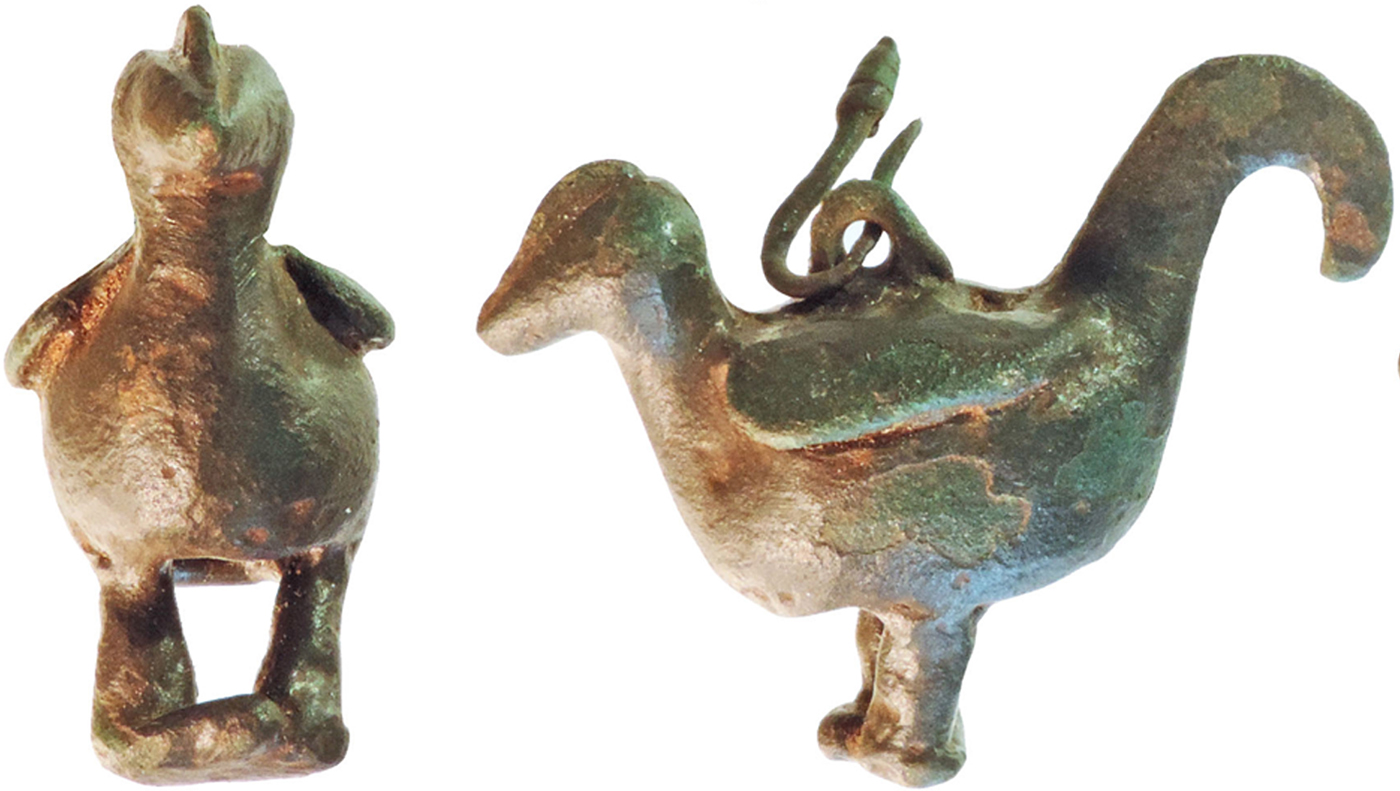
(4) Roxby cum Risby (NLM-6B99F4) (fig. 4).Footnote 20 A copper-alloy cockerel figurine with a suspension loop. It is 31.2 mm high, 40 mm long and 15.8 mm wide; the object weighs 22.9 g. The bird, rendered schematically, has a broad bowl-shaped body, high arched tail and short wings slightly separated from the body at their edges, as well as a head tapering to the beak and carrying a short crest or comb. The short legs end in a flat joined terminal, on which the bird balances, though an integrally cast loop rising from the bird's back retains a hook for suspending the figure.
Roxby cum Risby, cockerel figurine (No. 4). Scale 1:1. (Photo: M. Foreman; © North Lincolnshire Museum)

The suspension loop suggests a possible purpose for this figure as a steelyard weight. However, it lacks a lead-alloy core, its weight does not correspond to any common fraction of the Roman pound and steelyard weights in figural form are mainly anthropomorphic. The figure may be better identified as a votive object, perhaps part of a group associated with an image of the god Mercury. Among the many small copper-alloy cockerels documented from Britain, a handful have a suspension loop.Footnote 21 Found across eastern England, these are of a similar size to the Roxby cum Risby figure, albeit none of them resembles it closely (although three examples from East Yorkshire, Lincolnshire and Cambridgeshire closely resemble one another).Footnote 22
CUMBRIA
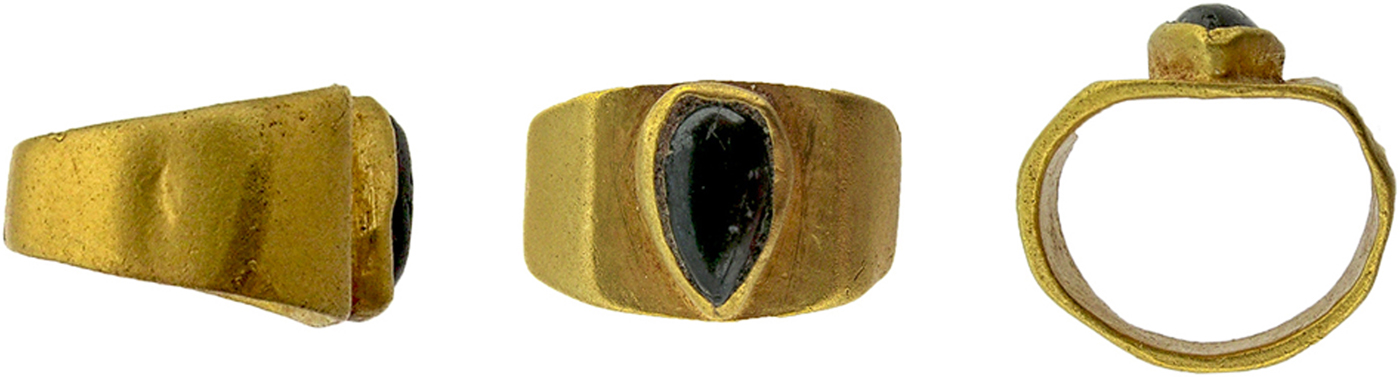
(5) Maryport area (LANCUM-313319 / 2017T112) (fig. 5).Footnote 23 A complete gold and garnet finger-ring, of likely third-century a.d. date. The hoop measures 17.5 m by 10.6 mm; it is 17 mm deep and 1 mm thick; the ring weighs 6.24 g. The thin octagonal hoop widens at the shoulders to meet the flat, sub-rectangular bezel. In the centre of the latter a raised cell is set with a tear-shaped garnet. This is a ring of a well-known Roman type, i.e. octagonal with raised bezel. Similar rings are documented at Piercebridge (NCL-914391), albeit with applied globules of gold modelled as grape clusters, and at Ropley, Hants. (KENT-5BEBAB/ 2016T929). At Vindolanda a gold ring of Henig Type IX with an inscribed cornelian gem (anima mea) in a hexagonal setting was excavated from a deposit dated to the early third century a.d.Footnote 24 A garnet of the same shape but in a gold ring of different form dated to the second or third century comes from a cremation burial at Cologne.Footnote 25
Maryport area, gold ring (No. 5). Scale 2:1. (Photo: D. Boughton; © D. Boughton)

LANCASHIRE
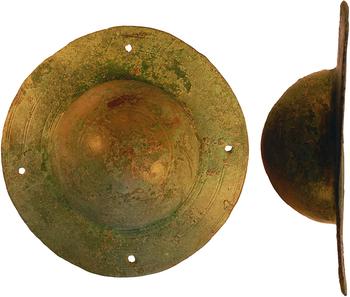
(6) Over Kellet (LANCUM-D876DE) (fig. 6).Footnote 26 A copper-alloy hemispherical shield boss, well-preserved with a light green patina, formed from a bowl with a thin flat flange. The boss is 186 mm in diameter, the bowl is 52 mm high (with a diameter of 98 mm) and the flange is 1 mm thick. It weighs 383 g. The flange is perforated with four equally spaced, lozenge-shaped rivet-holes; their flaring edges on the underside suggest that the rivets were driven through from above. Groups of shallow grooves run in parallel around the flange (upper surface) and a further pair is visible near the top of the bowl, decoration likely cut while the boss was spun on a lathe. A small circular indentation at the apex of the bowl might also result from contact with the lathe.Footnote 27 Bosses of this form in iron and copper alloy are widely attested throughout the Roman period.Footnote 28 A similar example in iron was found at Doncaster in association with the remains of a burnt first-century a.d. rectangular shield with rounded ends.Footnote 29
Over Kellet, shield boss (No. 6). Scale 1:2. (Photo: L. Prosser; © L. Prosser and Lancashire County Council)

In many instances hemispherical bosses are associated with Roman military sites, in intra- and extramural contexts, but there is no immediate military association in the case of this discovery.Footnote 30 The findspot, just west of Carnforth on the likely route of the Roman road proposed between Lancaster and Watercrook (Margary 70e), is c. 11 km from the auxiliary fort at Lancaster to the south, occupied from the early a.d. 70s, and further from those at Watercrook to the north and Burrow to the east. At face value therefore this is a further occurrence of Roman military equipment without an immediate association to a military site, a widely documented phenomenon of which the Crosby Garrett helmet provides a well-known further example in this region.Footnote 31 Even amongst this material, however, the discovery of a shield boss is a rare occurrence.Footnote 32
WEST CHESHIRE
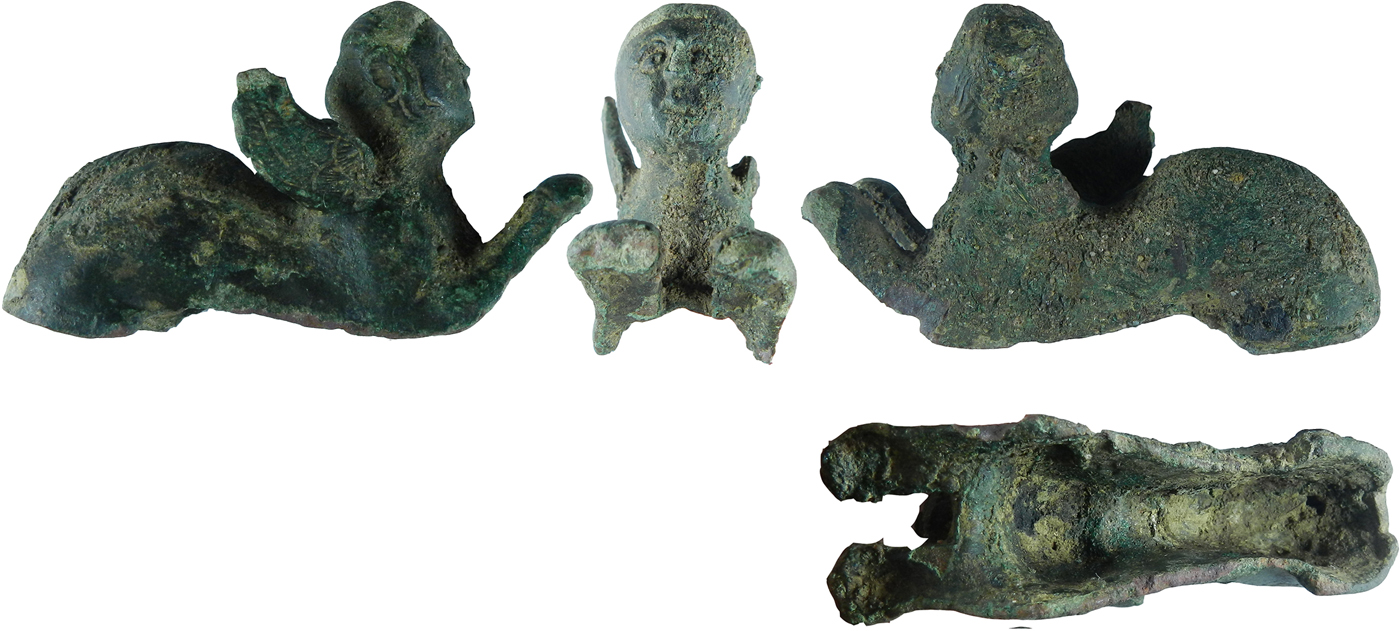
(7) Shrewsbury area (LVPL-C7CFC9) (fig. 7).Footnote 33 A worn copper-alloy figurine of a sphinx, with winged leonine body and female human head, actively corroding but with some surface detail visible. The object is 77 mm long, 43 mm tall, 22 mm wide and weighs 103 g. The face is schematically rendered with incisions – a triangular nose, lentoid eyes with eyebrows and a short slit for a mouth. Locks of hair fall past the ears while the rest is drawn to the back of the head, the strands being more visible on the right side. The short forelimbs are extended, representing the creature at rest; on the right leg better preservation of the surface shows the delineation of individual claws. Most of the short right wing is preserved, with some schematic detail of feathering visible, especially in fan-like arrangements at the shoulder; only a broken stump remains of the left wing. On the curving body raised haunches are modelled, hatched to indicate where the tail lies on top of them. The object is hollow beneath. A very similar sphinx, slightly smaller, documented at the villa at Couthuin (Braives, Belgium), has been interpreted as a possible ‘attache de coffre’, an explanation also likely to apply to this piece.Footnote 34
Shrewsbury area, sphinx furniture fitting (No. 7). Scale 3:4. (Photo: B. Jones; © B. Jones and National Museums Liverpool)

STAFFORDSHIRE
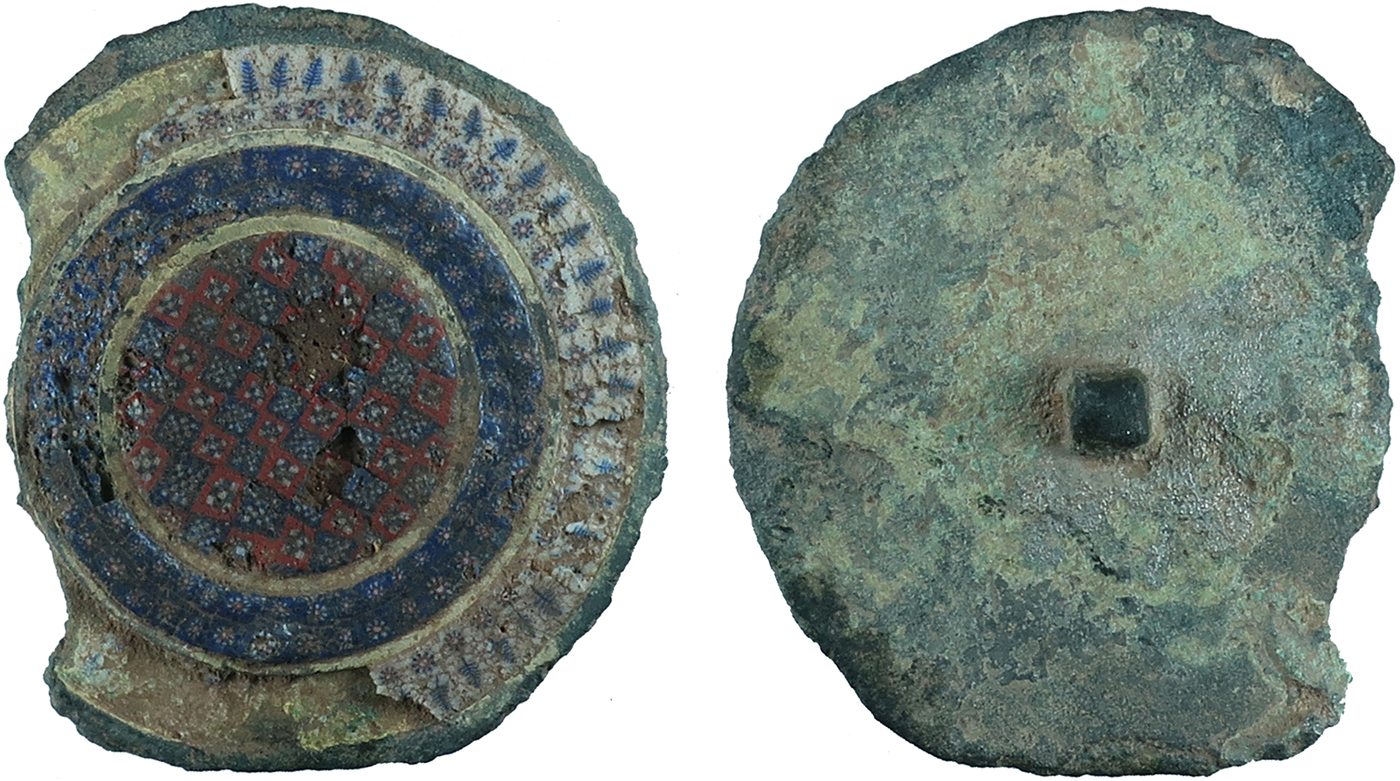
(8) Eccleshall (HESH-AA37E9) (fig. 8).Footnote 35 An incomplete cast copper-alloy circular mount inlaid with enamel and complex millefiori decoration, with much of its edge and some of its enamelled surface lost to damage; where better preserved the mid-grey-green metal has a well-formed patina. The diameter is 51.8 mm, the mount is 3.6 mm thick and weighs 27.4 g. The front face comprises a central circular panel enclosed by two concentric bands, all millefiori inlaid, separated by reserved metal borders. The central circle is decorated with enamelled squares of varying size arranged in a chequerboard pattern (up to nine by nine squares). The alternating squares occur in two different types, both inlaid with miniature millefiori chequerboards, a red surround containing larger blue and white squares (three by three), and a blue surround containing smaller squares of the same colours, varying considerably in form and size (six by six). The middle band is inlaid with blue enamel and contains a double ring of rosettes, formed by a white centre within a red circle and white petals. The outer band, partly lost to damage, is inlaid with white enamel and contains an inner ring of the same rosettes, but with blue petals, and an outer ring of foliate motifs in blue enamel. The specific source of the foliate motif is not easily identified; on palm branch motifs or stylised votive feathers/leaves the fronds or veins are set at a tighter angle.Footnote 36 From the centre of the reverse extends a short square-sectioned shank, what survives of the stud for fixing this object. A light grey patch around the shank may be traces of a metal solder, but this would not be the normal method for fixing the mount (see below).
Eccleshall, enamelled mount (No. 8). Scale 1:1. (Photo: P. Reavill; © P. Reavill and Birmingham City Council)

This mount is a decorated harness or belt fitting. An almost identical example (49 mm diameter) with an Oxfordshire provenance was acquired by Oxfordshire Museum Service in 2006.Footnote 37 Three very similar mounts (also 49 mm diameter) of unknown provenance were also sold in 2008 from a collection formed in the 1950s to early 1970s.Footnote 38 In these latter cases the central chequerboard comprises squares of a single design of alternating blue and white squares within a red surround, within a middle band of blue enamel, inlaid with a single ring of millefiori rosettes (white centre within a red circle and white petals) and an outer band inlaid with white enamel, containing an inner ring of the same rosettes, and an outer ring of the foliate motifs (in one case the outer band repeats the rosettes). Additional mounts very closely resembling these three are documented as a grave find from Tjaereborg, near Esbjerg, Denmark, and in the V & A Collection.Footnote 39
Similar mounts with varying forms of millefiori decoration in chequerboard and rosette motifs have been documented by the PAS across Britain, mainly in the same range of colours. They can be grouped approximately in two size categories, larger examples (c. 2.5–6 cm in diameter) and smaller (c. 1.5–2.5 cm in diameter). The former include mounts from North Oxfordshire (BERK-555701, 61 mm), Chilton, Oxon. (BERK-D929C2, 35 mm), and Hibaldstow, N Lincs. (NLM-3F9905), all of which also use this foliate motif (much decayed but just about visible in the latter case). Two further large mounts, which closely resemble one another, are from Penrith (LANCUM-5ED187, 50 mm, incomplete) and the Market Rasen area (LIN-225302, 41 mm), while further examples carry varying arrangements of motifs, from West Ilsley, Berks. (BERK-D66574, 46 mm), Thornham, Norfolk (NMS-40A082, 53 mm), Ludford, Lincs. (DENO-FE87A5, 49.6 mm), Anston, E Yorks. (DENO-C6BD17, 28.6 mm), Bolam, Durham (DUR-C60B52, 41.5 mm) and Glanton, Northumbria (NCL-A38DF3, 40.9 mm), the latter representing the best preserved example.Footnote 40 Other well-preserved mounts in this size range are documented from a villa at Gestingthorpe, Essex, and two very similar mounts from Chepstow and Usk are respectively in the collections of the British Museum and National Museum of Wales.Footnote 41 Smaller mounts or studs with millefiori inlay in a wider variety of pattern and colour include examples from Hutton Buscel, N Yorks. (YORYM-889AFE, 20.2 mm), Boyton, Wilts. (BUC-373A71, 23.6 mm), Nailsea, Somerset (GLO-549164, 20 mm), Wath, S Yorks. (SWYOR-CAE5A5, 17.4 mm), Yapham, E Yorks. (YORYM-ACF902, 18.8 mm), Freckenham, Suffolk (SF-D17023, 23.5 mm) and south Cambridgeshire (LEIC-15DA68, 16 mm).
The precise purpose of these mounts and of other enamel-decorated mounts of the same form is not yet clear.Footnote 42 The projecting rivet or prong which would have enabled their fixing to a backing is best preserved in the mounts from Anston and the Victoria and Albert Museum; in other examples it usually survives only as a worn and broken stub. These rivets suggest that the mounts were fitted to leather strapping, perhaps horse harness, supported by the discovery of the example from Gestingthorpe in close association with the bones of a horse's skull,Footnote 43 but also potentially to sword belts, as proposed for Tjaereborg where the mount is associated with scabbard fittings in a third- to fourth-century grave, one of several funerary finds from the Baltic of millefiori-decorated mounts.Footnote 44 The set of mounts discussed above of circular and quasi-rectangular form and of unknown provenance, as well as similar rectangular mounts, may also be belt plates rather than harness fittings.Footnote 45 There is no reason why mounts of this type could not be used to embellish both belt and harness, though the size of the larger circular mounts may make them better suited to the latter use. These and related belt plates are usually dated to the second and third centuries a.d., though few have been found in closely-dated stratified contexts.Footnote 46 As the above discussion shows, there are many examples from Britain but the Baltic finds indicate the wide distribution of these mounts across northern Europe, yet to be synthesised.Footnote 47 The making of these mounts is likely to be related to that of other objects carrying similar millefiori motifs, such as the disc brooches which carry similar chequerboard designs, for example at Horton cum Peel, Cheshire (LVPL-F1F6CC), Standlake, Oxon. (BERK-9EC5C6), and Longparish, Hants. (SUR-8CEC4C).Footnote 48
WARWICKSHIRE
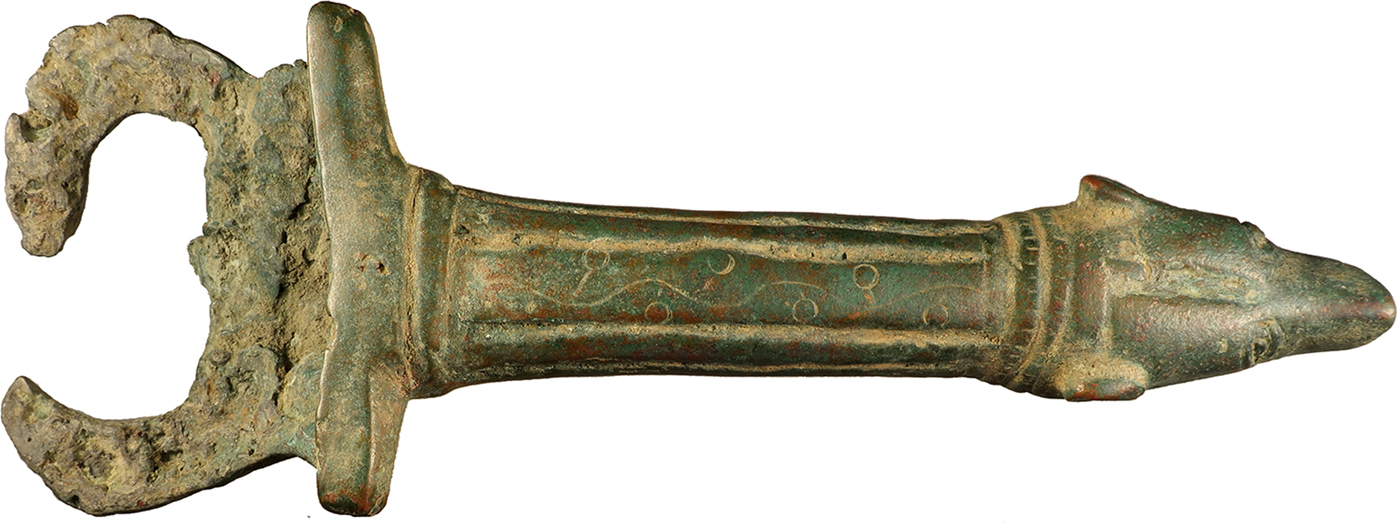
(9) Grendon (WMID-08375F) (fig. 9).Footnote 49 An incomplete decorated copper-alloy vessel handle with a mid- to dark green patina. It is 190 mm long and weighs 360 g. The handle ends in a canine (or lupine) head terminal. Its eyes are set at the junction between the broad grooved cranium and the tapering snout while the ears are flattened. Behind the head are two collars with incised line decoration. The shaft of the handle is fluted on its sides, with wider panels above and below incised with a very stylised plant scroll, more clearly visible above; the handle ends in a collar and a plate which attaches it to the shallow bowl of the vessel. The plate curves with two extensions beneath the base of the bowl.
Grendon, vessel handle (No. 9). Scale 2:3. (Photo: S. Burford; © S. Burford and Birmingham City Council)

Handles of this type with fluted or facetted shafts more commonly terminate in ram's heads, especially among examples documented by the PAS.Footnote 50 A very similar canine terminal was discovered at Santon Downham (Suffolk).Footnote 51 Other examples of canine heads include PAS finds from Newstead, Notts. (LVPL-F535A7), and Middlewich, Cheshire (LVPL1952), as well as vessels from burials in neighbouring provinces, for example at Sint Huibrechts-Hern (Limburg) and Cortil-Noirmont, as well as beyond the Rhine frontier.Footnote 52 This handled pan type is widely documented within grave deposits, especially in combination with jugs in the largest burial assemblages of south-east England, northern Gaul and beyond in the first and second centuries a.d.Footnote 53 Well-preserved examples, albeit with ram's heads, were documented among the grave goods from richly furnished cremation burials of Claudio-Neronian date from Site D on the A2 road scheme, Kent, and of later second-century date from Turnershall Farm, Wheathampstead (Herts.).Footnote 54
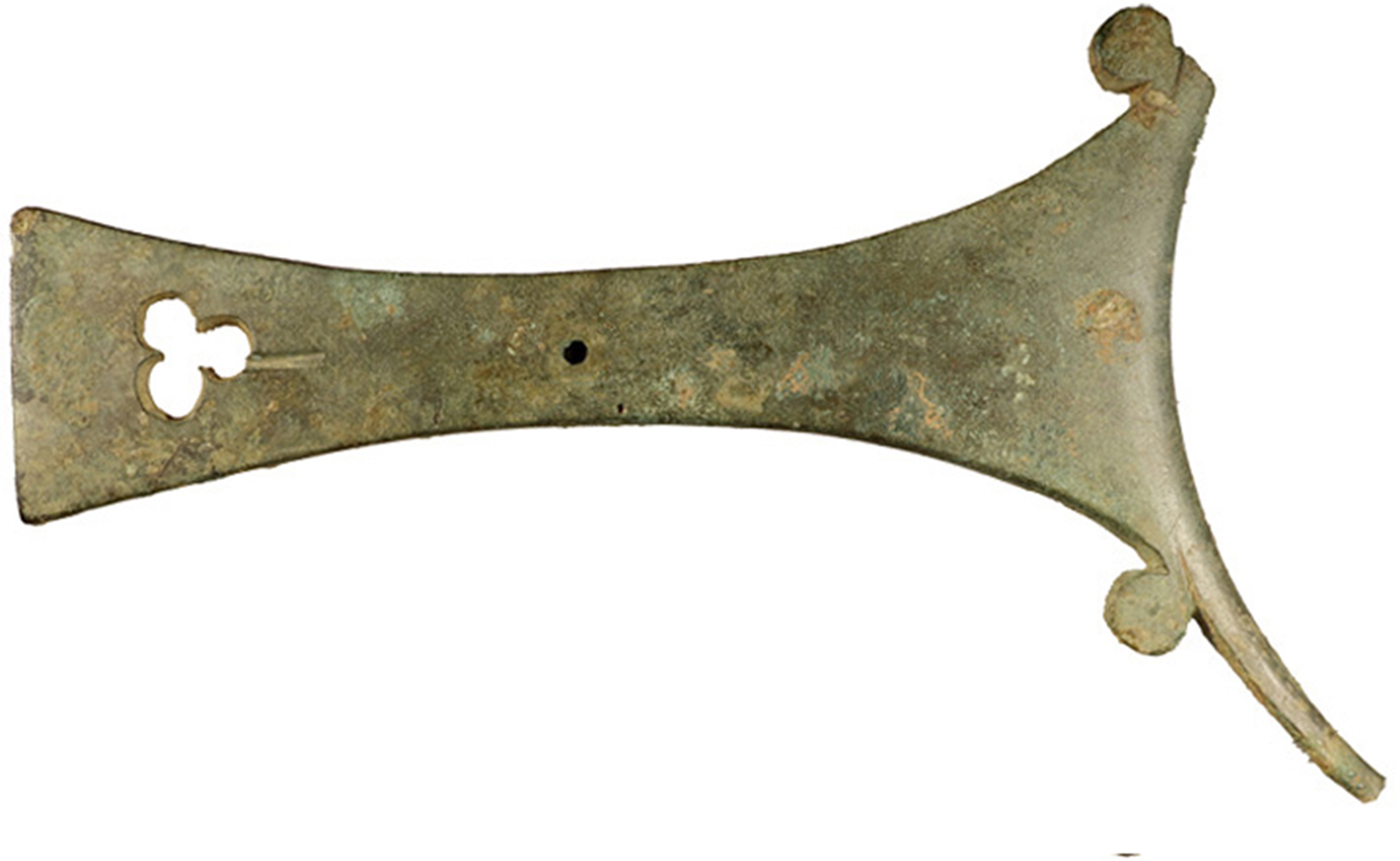
(10) Grendon (WMID-09C0C1) (fig. 10).Footnote 55 A copper-alloy pan handle with a mid-green patina. The flat handle is 127 mm long and weighs 99 g. The handle is of waisted form, narrow in the middle and broadening at both ends. It has a straight terminal perforated with a trefoil-shaped suspension hole and has two circular knops where it widens to join the rim of the vessel.
Grendon, vessel handle (No. 10). Scale 3:4. (Photo: S. Burford; © S. Burford and Birmingham City Council)

Flat-handled pans are widely documented in Britain in structured deposits and as single finds.Footnote 56 Among these, handles which terminate with a rounded end and with a circular suspension hole are much more common than those like the Grendon handle with its trefoil perforation; rounded end handles include examples from Shiptonthorpe, E Yorks. (SWYOR-8F20A5), and the Kingston Deverill hoard, Wilts. (WILT-92B052).Footnote 57 A complete example of a pan with a similar handle was found in the legionary fortress at Usk in a pre-Flavian latrine pit.Footnote 58 The handle fits Feugère's type PAT-4014 dated to the first century a.d., with several examples being documented from Gaul and from beyond the Rhine frontier, including a complete pan from a hoard at Izernore, Ain, now in the collection of the British Museum.Footnote 59 An example from the Jura region, now in the collection of the Musée des Antiquités Nationales, reveals the origin of the ‘knops’ on these vessels where the handle meets the bowl as stylised bird's heads, their beaks stretching along the vessel rim.Footnote 60
NORTHAMPTONSHIRE
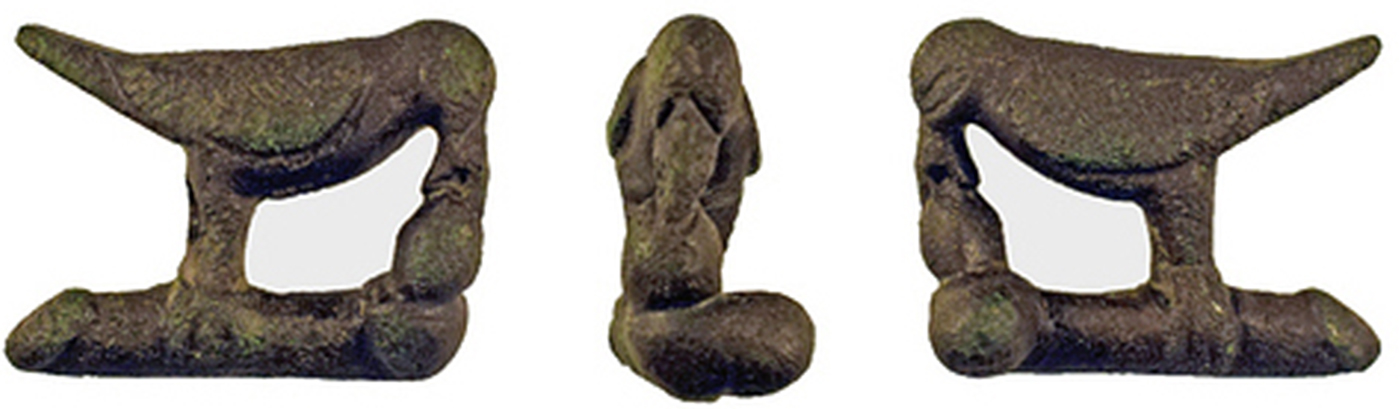
(11) Rushden (NARC-5C0816) (fig. 11).Footnote 61 A complete copper-alloy amulet, in the form of a bird pecking at male genitals, its surface rather corroded but sufficiently well preserved still to show key detail. It is 29.7 mm long, 11.1 mm wide, 22.5 mm high and weighs 16.2 g. The bird is modelled in stylised and rather schematic form. From a rounded head and broadening and deepening body it tapers to a pointed tail. One eye, a narrow oval, is visible, the other barely if at all. The repeated chevrons on both folded wings mark its plumage. The bird is too stylised to attribute to a species — a corvid (crow, raven etc.) or a bird of prey are possible subjects. The bird's feet grip the centre of the phallus while its tapering beak (opened wide in profile view) tugs at one of the testes which is pulled sharply upwards from the shaft. The glans of the phallus, distinctly modelled, is beneath the bird's tail. On its underside the phallus appears to be partly hollowed-out.
Rushden, phallic amulet (No. 11). Scale 1:1. (Photo: E. Cox; © E. Cox)

The Rushden object is a phallic amulet of so far unparalleled form, though it is not clear how it was intended to be suspended (as a pendant, perhaps, using the loop made where the claws meet the phallus) or attached to the body or object to which it offered protection.Footnote 62 As an apotropaic symbol for averting the evil eye the phallus is widely figured on objects from Britain and beyond.Footnote 63 Pendants to be worn by humans or animals are both documented and numerous examples have been recorded by the PAS, illustrating the widespread use of this symbol in a rural setting, well beyond the Roman army with which it was previously thought to be associated in the province.Footnote 64 As in this case, some other phallic amulets play with incongruous elements to help deflect the malign effects of Invidia. As well as the famous tintinnabulum from Herculaneum where the phallus, morphing into a dog, turns back to fight the gladiator to whom it ‘belongs’, the combined phallus and quadruped from Longford, Derbys. (DENO-82D537), the bovine mount which doubles as a horned phallus from Pitton and Farley, Wilts. (HAMP-A02C9E), or several winged phalluses provide further examples documented by the PAS.Footnote 65 At first sight the Rushden object might be taken for a genre nature scene, for example like the intaglio from the Bloomberg site in London on which an eagle pecks at a hare's splayed carcass, or one from Kirk Deighton, E Yorks. (SWYOR-D1BF15), where a bird holds a pair of cherries in its beak.Footnote 66 In the absence of features identifying it to species, it is difficult to know what symbolism the bird itself may carry.Footnote 67 However, the double-take prompted by the pairing of bird and phallus has the potential to mislead the ill-intentioned viewer, reinforcing the power of the charm to avert bad fortune.
NORFOLK
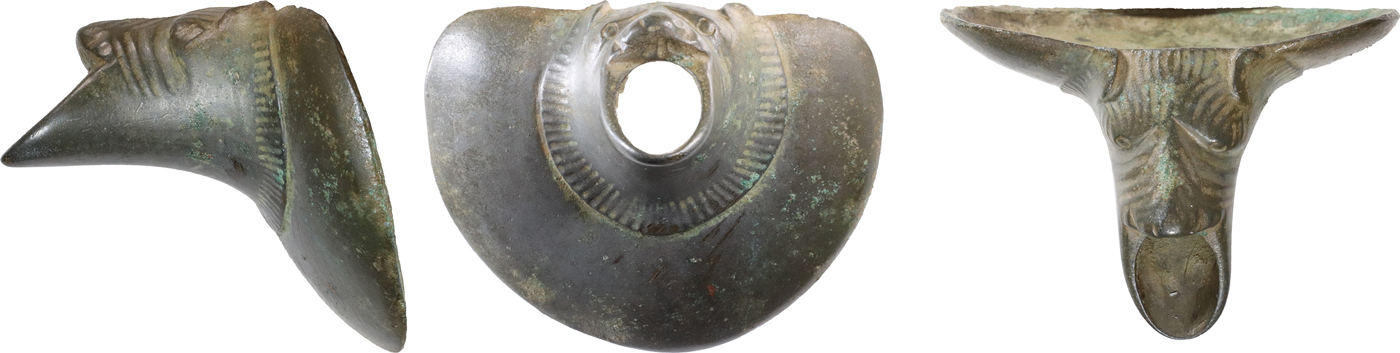
(12) Northrepps (NMS-C27736) (fig. 12).Footnote 68 A late Iron Age to early Roman copper-alloy zoomorphic spout from a bicarinated strainer bowl. The spout is 42.3 mm long, 65.5 mm at its widest and 20.7 mm wide at the mouth; it weighs 77.4 g. The curving D-shaped plate behind the spout would have attached it to the vessel just below the rim. Its reverse has a slightly raised edge and is described as having traces of the solder which attached it to the vessel. The spout itself projects as a highly stylised animal head. The upper part of the head is modelled in detail, with short pointed and slightly upturned ears, close to the junction with the base plate, between which the hair runs in parallel strands. Small circular eyes stare forward beneath prominently moulded brows, while a broadening muzzle has flaring nostrils with parallel ‘wrinkling’ on either side. The lower jaw extends beyond the upper to form an oval end to the spout. Where spout and base plate meet, short hatched parallel lines indicate a ruff of fur around the animal's neck.
Northrepps, vessel spout (No. 12). Scale 2:3. (Photo: J. Shoemark; © Norfolk County Council)

The Northrepps spout is paralleled by those from bicarinated strainer bowls documented by the PAS in the Kingston Deverill hoard (WILT-92B052)Footnote 69 and at Cranfield, Bucks. (BUC-FBC5A5), as well as in the spout from the bowl excavated from the ‘Doctor's burial’ at Stanway.Footnote 70 The detail of the Northrepps head is less stylised than these and is clearly different from the fish-head spout from Felmersham, Beds.Footnote 71 Metal (and ceramic) strainer bowls of the type represented by this spout are documented from the later first century b.c. to the mid-first century a.d. The findspot of this example places it a little further than other instances from the core of the distribution of strainer vessels in south-east Britain north of the Thames. Their function is likely to be related to infusing or straining alcoholic or medicinal beverages.Footnote 72
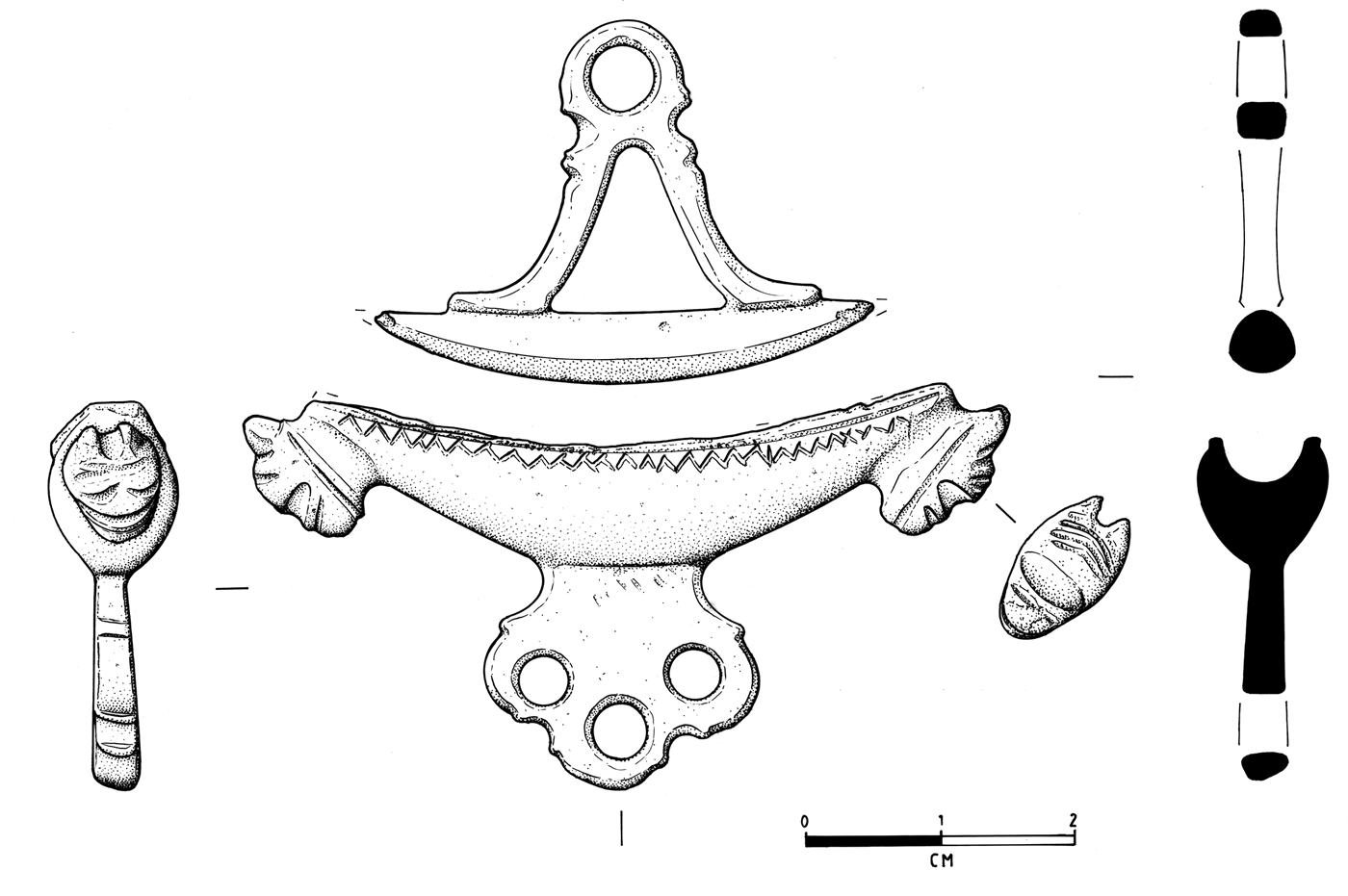
(13) Shotesham (NMS-34C43D) (fig. 13).Footnote 73 A finely cast and engraved copper-alloy centre-looped cosmetic set, comprising mortar and pestle probably for grinding powders for cosmetics, dated to the first to third centuries a.d. The mortar is 57 mm long, 26 mm high and 9 mm thick, weighing 20.4 g; the pestle is 37 mm long, 27 mm high and 5.5 mm thick, weighing 6.8 g. The mortar has schematised zoomorphic terminals in the form of bovid heads, and the bow with a U-sectioned groove carries an incised line and continuous hatching with alternating diagonals at the top of both walls. The unusual loop plate takes the form of a perforated trefoil, each of the holes being approximately equal in size. The pestle has a rounded (or D-shaped) keel and is of ‘rocking-horse’ type, with a high centre-loop for suspension supported by struts. In this characteristic it shares the propensity identified by Jackson of the pestle to resemble the mortar when they are made as a set.Footnote 74
Shotesham, cosmetic set (No. 13). Scale 1:1. (Photo: J. Shoemark; © Norfolk County Council)

At least two other complete cosmetic sets have been documented by the PAS, from Battisford, Suffolk (SF-0DD8B6/SF-0E0233), and Micklefield, W Yorks. (SWYOR-172272/SWYOR-170A20). Individual mortars have been documented much more frequently.Footnote 75 The Shotesham pestle is similar to some others of ‘rocking-horse’ type.Footnote 76 The form of the mortar identifies it as an example of Jackson's type E, with a large centre-loop and bovid terminals, though it lacks the ‘sinuous struts’ identified as an attribute of this type. The findspot is very close to those of other examples of type E in northern East Anglia.Footnote 77
OXFORDSHIRE
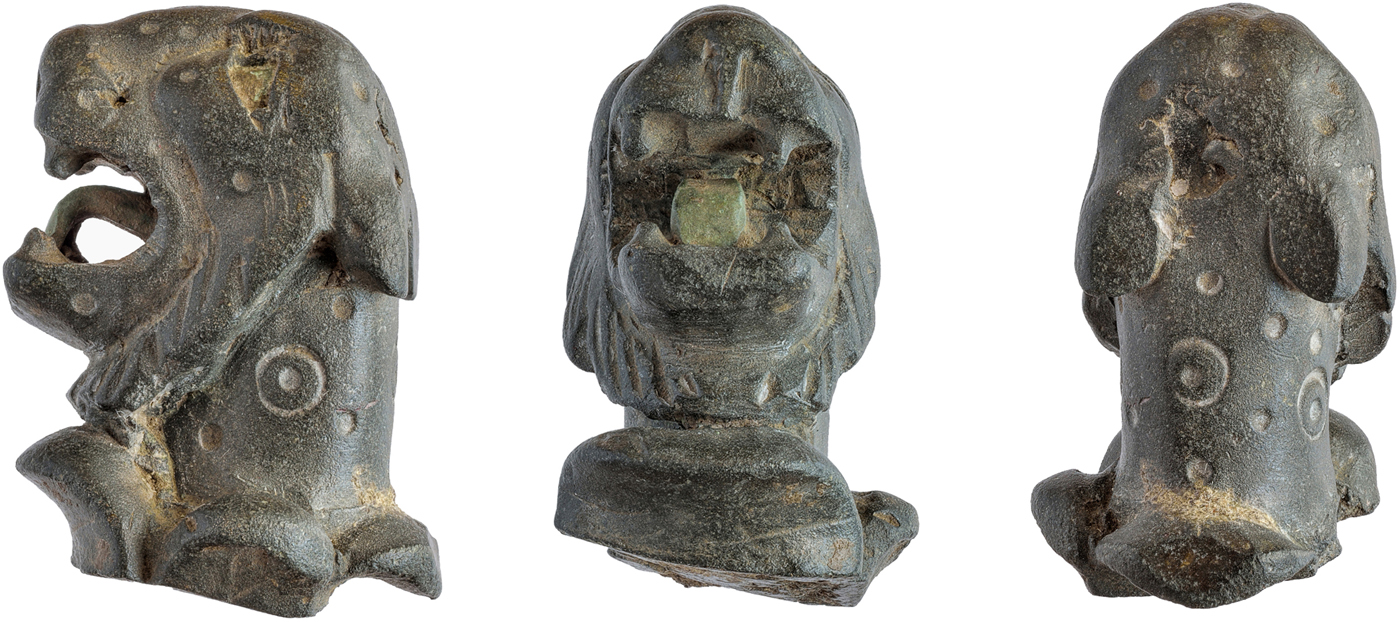
(14) Aston, Cote, Shifford and Chimney (BERK-3243DB) (fig. 14).Footnote 78 A small copper-alloy terminal in the form of a leopard head, with an even grey-brown patina. The surviving terminal is 33.5 mm long, 18.4 mm wide and 23.2 mm thick. The feline head emerges from a petalled calyx, below which the object is broken off. It is worn but sufficiently preserved to show the careful modelling of its features. The mouth gapes open, with a lolling tongue, curving downwards between pronounced upper and lower canines. The prominent muzzle widens to flaring nostrils, while the wide-open eyes are deep-set between the gentle curve of the cheeks and temples. The eyes may have been inlaid. The head is flat, with a shallow groove between the supra-orbital ridges, while the ears are flattened against the head. A tufted mane is rendered on either side of the head and beneath the chin. The spotting of the animal's fur is rendered by unevenly distributed recessed dots and dot-and-ring motifs which may contain traces of metal inlay.
Aston, Cote, Shifford and Chimney, handle(?) terminal (No. 14). Scale 1:1. (Photo: R. Trevaskus; © A. Byard and R. Trevaskus)

The function of the object is uncertain. Its small size suggests that it might have been part of a knife or key handle, but the breakage means that both the nature of the object and the method of attachment to any blade or shank remain unclear. It joins the extensive repertoire of feline heads used as handles, mounts and fittings, but is unusual in its careful and detailed modelling of an alert animal.Footnote 79
(15) Hailey (OXON-7B00CD / 2018 T449) (fig. 15).Footnote 80 An incomplete copper-alloy figurine of Minerva, surviving in three pieces, the head and lower right arm being detached from the body. The lower left arm and possibly a small section of the base are also missing, but otherwise the figurine is well preserved. As it survives the figurine is 170 mm high and weighs 791.5 g. The goddess, with elongated body, stands in a slightly sinuous contrapposto pose, her left leg bent and right leg straight. On the head, a little small in relation to the body, can be seen the bowl of Minerva's helmet, pushed up from the face, its crest missing from an old break, with some modelling of the facial features on the helmet mask. On either side towards the back are two silver rivets. The hair is parted in waves over the temple. The facial features are heavily worn, the eyes and mouth containing traces of silver inlay. The clothing of the goddess is rendered in unusual detail. She wears a long sleeveless chiton descending to her feet, gathered below the breast, with the aegis bearing the head of Medusa supported on her upper left arm, its curling edges and the spiralling snakes of Medusa's hair carefully modelled. The tunic is fastened at the shoulders by two silver rivets, imitating brooches. A long cloak is (implausibly) suspended from her left arm, some folds falling at the front down her left side, the greater part crossing her back diagonally and rising across her wide hips at the front. The upper part of the cloak is modelled as a thick roll, clearly differentiated from the tunic beneath. At the left arm the folds of the cloak which are drawn across the waist of the goddess join those folds which fall directly from the left hand. At the base the finer folds of the tunic and sandaled toes re-emerge. The missing left hand may have held a shield, while the raised right arm probably held a spear or sceptre. Indentations beneath the figure may indicate points of attachment.
Hailey, figurine (No. 15). Scale 1:2. (Photo: A. Byard; © A. Byard)

Although Minerva is the most frequently represented of female deities among surviving figurines from Roman Britain, this predominance is not so clear among figurines documented by the PAS.Footnote 81 The Hailey statuette is a significant addition to the corpus from the province and differs from most examples in its embellishment with silver, the sophisticated rendering of anatomy and carefully modelled clothing and the placing of the aegis with prominent gorgoneion down the left arm. The configuration of the clothing is somewhat unusual. Few representations of the goddess from Britain wear a cloak; on figurines from other provinces where the cloak is more common, it hangs behind from both shoulders (for example at Enns and Carnuntum)Footnote 82 or falls diagonally across the back from the shoulder and across the hips in a thick fold (for example Liberchies, Avenches, Wels and Augst).Footnote 83 Occasionally the aegis lies ‘chlamys-like’ on the left arm but in these cases it is usually tied at the right shoulder and lacks the prominent gorgoneion seen in this example.Footnote 84
GREATER LONDON
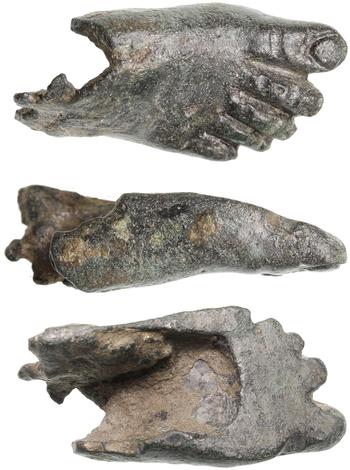
(16) Bishopsgate (PUBLIC-599AF8) (fig. 16).Footnote 85 A cast copper-alloy statuette fragment, comprising the greater part of a right foot, namely the toes and middle part of the foot. The fragment is 42.4 mm long, 20.7 mm wide and 13.1 mm thick, and weighs 28.2 g. The musculature is quite carefully modelled, and considerable detail is devoted to the toes, partially separated. Their surface wrinkles at the joints and the nails are clearly delineated. The toes are solid but the foot is hollow from the ball towards the ankle. At the ankle is a jagged old break, with much of the heel missing. The size of the foot suggests that it derived from a statue approximately one fifth or one sixth life-size. This fragment joins a growing corpus of elements of larger statuettes and statues of Roman date documented by the PAS. Among these new discoveries, extremities including fingers, toes and fragments of the head predominate, a consequence both of their likely recognisability and (perhaps) of their curation after the fragmentation of statues.Footnote 86
Bishopsgate, statuette fragment (No. 16). Scale 1:1. (Photo: W. Thompson; © W. Thompson and Kent County Council)

(17) Billingsgate, Thames foreshore (LON-071016) (fig. 17).Footnote 87 This lead-alloy mirror of late antique date, near complete, is 92.7 mm long. The disc containing the glass is 57.5 mm in diameter and the handle is 34.5 mm long. The object weighs 35.3 g. Around the small central recess which once held the glass are concentric zones of decoration, comprising (from the centre outwards): a band with radial divisions; a stylised vine scroll; repeated peltiform shapes of alternating orientation; a beaded band; a mainly plain outer border. There may be traces of a suspension loop on the disc rim opposite the handle. On the back of the mirror the recess for the glass is decorated with a rosette and two concentric rings follow the edge of the disc. On the flat handle three longitudinal ridges run along the front and one on the reverse. At the junction of handle and disc there are openwork scrolls on either side, better preserved on the right. Where the disc joins the handle a mass of pellets renders a stylised bunch of grapes.
Billingsgate, mirror (No. 17). Scale 1:1. (Photo: E. Wood; © E. Wood and Museum of London)

Lead-alloy mirror frames are hitherto rare finds in Britain and mirrors of the type to which the Thames find belongs have not, to our knowledge, been previously documented from the province.Footnote 88 It fits within Lloyd-Morgan's Group Y mirrors (glass mirrors with lead frames), in particular those with circular frames for small pieces of glass (between 1.5 and 3 cm in diameter), flat handles and sometimes a suspension ring.Footnote 89 In particular the Billingsgate mirror shares close affinities in size, form and decorative detail with some Type Y4b mirrors, as grouped by Feugère.Footnote 90 Of the five other examples known, three are documented from sixth-century a.d. levels at Sucidava-Celei/Corabia (Romania).Footnote 91 If this date applies to these mirrors in general, then this is a rare indicator of post-Roman activity in London, where there is little evidence for intramural occupation after a.d. 450.Footnote 92 Baratta has argued for a votive purpose for small lead-framed mirrors of this and other types.Footnote 93 The findspot on the Thames foreshore, 50 m out from the Roman quay at Custom House, may indicate votive deposition, as has been argued for other complete or near-complete objects from the Thames.Footnote 94 However, other explanations for the mirror's presence here, including disturbance of Roman occupation deposits by the river or by later construction, cannot be precluded.
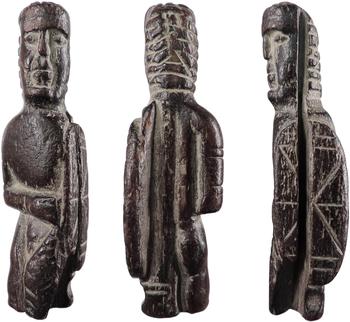
(18) Billingsgate, Thames foreshore (LON-88EF5E) (fig. 18).Footnote 95 An incomplete bone folding-knife handle, 59 mm long, in the form of a stylised male figure, perhaps a gladiator, missing the lower legs and iron blade. The groove for accommodating the blade is cut through the side of the head and front of the shield. A shallow longitudinal groove which runs down the figure's back may be an abandoned attempt to house the blade in a more conventional position or may simply indicate the figure's physique.Footnote 96 The head, turned left, is disproportionately large and modelled in detail. Beneath the flat and furrowed(?) temple the eye sockets are large, the nose narrow and short, with philtrum, narrow closed mouth and jutting chin clearly rendered. The hair is drawn back on either side in rectangular strips which turn upwards at the back of the head towards the crown. Incisions on the latter suggest some braided arrangement, but they do not resolve into a coherent pattern. The figure is largely naked. On its upper right arm, held by the side, are two armlets, while the right forearm extends across to the oval shield held in the left hand. This shield has transverse bands incised at top and bottom and transverse and diagonal lines cut across the centre. The buttocks and right leg appear to be naked. At the groin a blank triangular zone may indicate a loin cloth, though there is no trace of this at the back. The upper left leg appears bulkier and the diagonal hatching as well as what appears to be a strap beneath the shield may indicate limb padding. The lower legs and feet, where the handle would have pivoted with the blade, are broken away.
Billingsgate, knife handle (No. 18). Scale 1:1. (Photo: S. Wyatt; © S. Wyatt and Museum of London)

This is one of many folding-knife handles documented by the PAS, but unusual in being made of bone rather than copper alloy.Footnote 97 The figure calls to mind some of the folding-knife handles in gladiator form of the second and third century a.d. but it is not easily classifiable as such since it lacks key attributes (a weapon or helmet) and does not fit the gladiatorial types into which most knife handles fall.Footnote 98 As Marshall suggests, the object may represent a misunderstanding or adaptation of these conventions. The hairstyle is also more reminiscent of a female coiffure than of male figures. The object's findspot south of the Roman waterfront, close to that of the mirror documented above (No. 17), may again indicate votive deposition, as is occasionally the case for knife handles.Footnote 99 Again, however, accidental disturbance to its original context of deposition cannot be ruled out.
(19) Billingsgate, Thames foreshore (LON-94C8E4) (fig. 19).Footnote 100 A complete North African red slip mould-made oil lamp of Hayes Type IIA, dating to the very late fourth or first decades of the fifth century a.d.Footnote 101 Although cracked, the lamp survives complete, with white concretions (‘Thames race’) adhering to its surface and within the cracks. The lamp is 143 mm long, with a body diameter of 87.1 mm; it weighs 184.3 g. It has a wide-open nozzle channel, rounded nozzle and integral wedge-shaped handle. The discus has two holes, one an oil pour-hole, the other an air vent. On the base it has a near-circular foot-ring, within which are two engraved circles. The lamp carries a relief motif, crisply rendered, of a running lion, its hind legs and tail stretching along the channel to the wick, its body, forelimbs and head in profile and facing right on the discus. The lion is exuberantly modelled, with considerable detailing of mane and face and fringes of fur on its fore and hind limbs and belly, as well as a band of circlets around its middle. Around the discus on the shoulder frame are two bands carrying the same sequence of moulded motifs, a spiral within a circle (nearest the wick) followed by alternating leaves and squares.
Billingsgate, lamp (No. 19). Scale 3:4. (Photo: S. Wyatt; © S. Wyatt and Museum of London)

Running lions are recurring motifs on North African oil lamps: a very similar example from Salona is documented by Bubić in the collection from Split, who argues for a Christian significance for the motif.Footnote 102 Lamps of Hayes Type II are extremely rare in Roman Britain, only one example of those in British collections being documented from a stratified archaeological context. As a highly collectable item, whether or not this lamp arrived in Britain in antiquity cannot be confirmed.Footnote 103 However, its foreshore findspot, very close to the London finds discussed in the previous two entries (the mirror and the handle, Nos 17 and 18), and the concretion offer some support to its having been eroded from stratified deposits or deposited in the river in the Roman period. It may thus be another potential indicator of late Roman activity in the city.Footnote 104
KENT
(20) Mersham (KENT-04964F) (fig. 20).Footnote 105 A complete copper-alloy vessel mount with a mid-green patina probably dating to the first century a.d. The mount is 44.4 mm high, 32.6 mm wide, 15.2 mm thick and weighs 37.4 g. It takes the form of a female face modelled in some detail, though worn. The eyes are executed in considerable detail, the brows, eyelids and pupils being individually rendered. Although worn almost flat, enough survives to show the differentiated nostrils and the narrow mouth. On the top of the head incisions indicate hair parted in waves from the centre, ending in exuberant bunches by the ears. A fillet or band runs across the forehead and re-emerges beneath these bunches to fall to the shoulders, framing a thick neck. The reverse is hollow.
Mersham, vessel mount (No. 20). Scale 1:1. (Photo: J. Ahmet; © J. Ahmet and Kent County Council)

Similar mounts are documented on other copper-alloy vessels. This example is paralleled to some extent in the female faces on the escutcheons joining handles to jugs on vessels dated to the period between the late first century b.c. and the reign of Claudius. Two examples were recently documented in Claudio-Neronian graves excavated during the widening of the A2 between Pepperhill and Cobham (Kent), though neither is as well modelled, with hair being more difficult to differentiate from cloth, diadem or other moulding.Footnote 106 Tassinari identifies such masks, widely distributed on copper-alloy jugs, as those of Maenads.Footnote 107
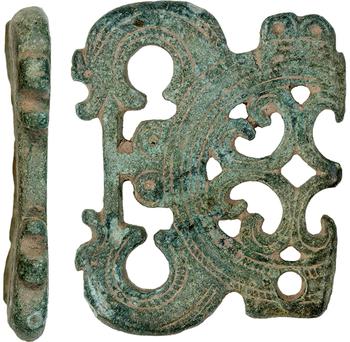
(21) Lyminge (KENT-198D8D) (fig. 21).Footnote 108 An incomplete and worn copper-alloy openwork buckle-plate, with a bright green patina. The buckle is 31.2 mm long, 25.6 mm wide, 2.9 mm thick and weighs 10 g. The plate, plain on the back, carries two opposed animal heads (with small eyes and swept-back ears clearly rendered) on long necks which abut a possible strap bar, holding it in their flaring jaws. The necks curl outwards from the central circular openwork element of the frame, one side of which is missing, broken off in antiquity. This central element is formed from four peltiform scrolls (or ‘palmettes’)Footnote 109 set back to back within a circular band edged on inside and outside with a beaded border (comprising short, transverse or diagonal grooves between grooved lines). This border is perforated with a hole drilled on one side where the buckle-plate has been adapted for re-use. On the surviving sides of this band are small paired rectangular mask-like lugs, one of which abuts the strap bar. The same beaded borders follow both sides of the curving beasts’ necks.
Lyminge, buckle-plate (No. 21). Scale 2:1. (Photo: J. Ahmet; © J. Ahmet and Kent County Council)

The Lyminge buckle-plate has similarities to those late Roman buckles usually associated with the Roman army, though no direct parallel to its central circular openwork element has been found.Footnote 110 Its combination of outer zoomorphic and inner geometric motifs parallels the decoration of belt fittings and brooches in the Quoit Brooch style of the middle decades of the fifth century a.d. and this find too can be classed among these objects and assigned a post-Roman date. Individual motifs can also be paralleled on objects in this style. For example, the cross-like configuration of the ‘palmettes’ resembles those on a buckle-plate from Mitcham, Greater London, and the similar design on a strap-junction from Shouldham, Norfolk, and a possible pendant from Watchfield, Oxon.Footnote 111 The beading is similar to that on the buckles from Bifrons and Highdown, again on the necks of the biting animals, and noted also on the hooked plaques carrying Quoit Brooch style decoration from Graves 145 and 67 at Saint-Marcel ‘le Bourg’ (Morbihan).Footnote 112 This is the fifth object recorded by the PAS in the Quoit Brooch style.Footnote 113 Its findspot and those of other objects from Hampshire and the Isle of Wight east to Kent put them at the centre of the distribution of objects decorated in this style, as now documented on both sides of the English Channel.Footnote 114
DORSET
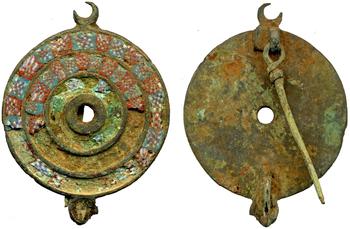
(22) Puddletown (DOR-8A9B68) (fig. 22).Footnote 115 An incomplete cast copper-alloy millefiori enamelled disc brooch, dated to the second to third centuries a.d. The brooch is 44.7 mm at its longest, 8.3 mm deep and weighs 9.9 g. The face of the brooch is decorated with millefiori enamelling in three concentric zones, separated by reserved metal. The enamelling is of chequerboard motifs comprising blue and white squares set on alternating red and turquoise backgrounds. The circular hole at the centre may have accommodated some additional decorative element. Two elements extend from the outer edges opposite one other, a crescent and a recessed projection retaining traces of an enamel or glass inset. Beneath the crescent is a single lug, attached to the brooch perhaps as a repair, and perforated to accommodate the loop of the pin with its short end coiled around to secure it; at the other end beneath the knop is a short catchplate.
Puddletown, enamelled brooch (No. 22). Scale 1:1. (Photo: C. Hayward-Trevarthern; © South West Heritage Trust)

Disc brooches carrying similar concentric zones of millefiori enamelling are widely documented, mainly in continental Europe and dated to the decades around a.d. 200.Footnote 116 No specific close parallel to this brooch has been identified, but disc brooches with concentric zones of decoration include an example from Teston, Kent (KENT 0542E1), documented by the PAS.Footnote 117
SOMERSET
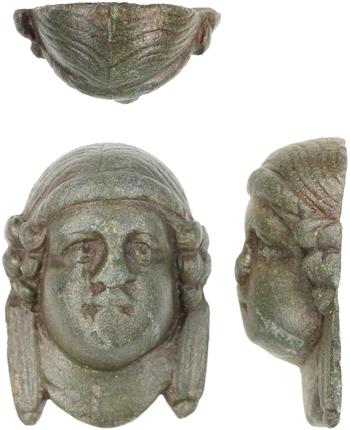
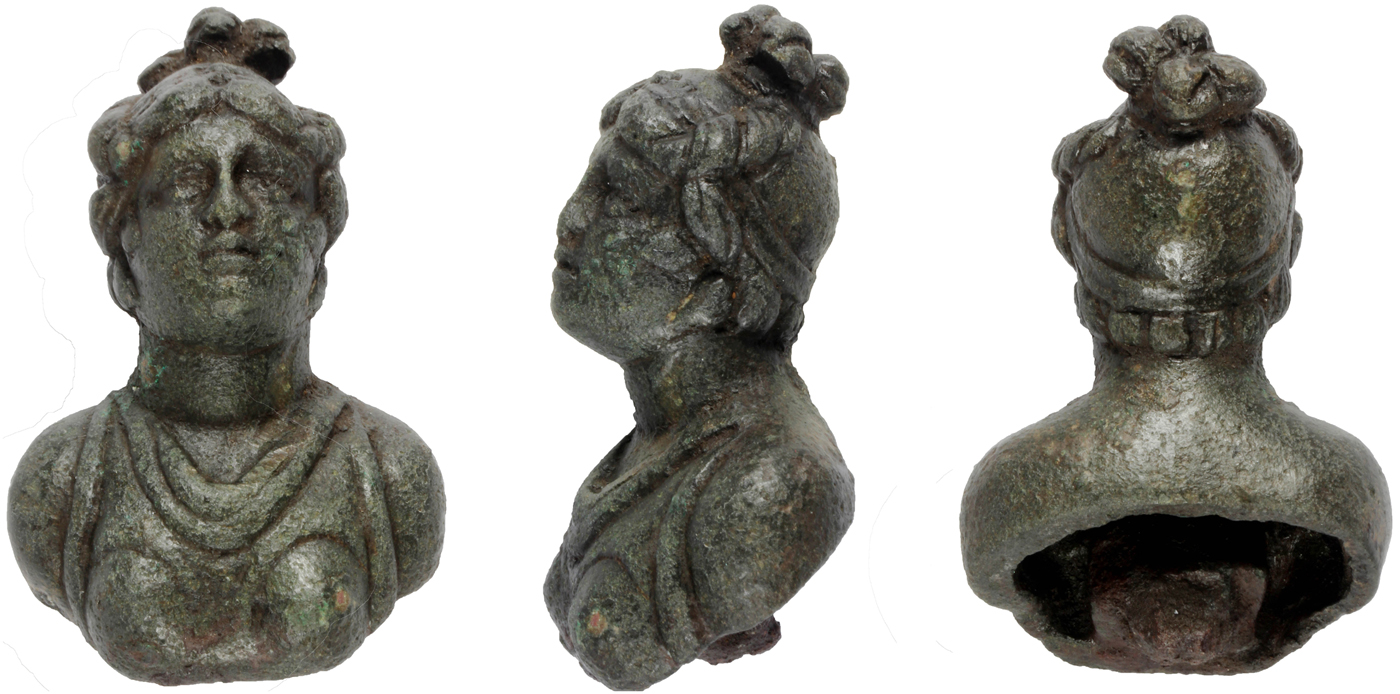
(23) Trudoxhill (SOM-762B9F) (fig. 23).Footnote 118 A copper-alloy anthropomorphic terminal, perhaps representing the goddess Diana, well-preserved with a brown-green patina. The bust is 68.5 mm tall, 43.7 mm wide (at the shoulders), 26.0 mm thick and weighs 157.1 g. The well-modelled figure faces forwards and upwards. Her hair is centrally parted on the forehead, and on either side spiral locks are drawn up into a topknot. The topknot secures in position a cap, beneath which emerge several curls at the nape. The smooth youthful face has a heavy jaw and thick neck beneath. The eyes, nose and full lips are carefully detailed (the pupils and nostrils are visible for example), if worn. The figure wears a short-sleeved tunic, also rendered in detail, with two broad V-shape folds at the neck and rising over the breasts. At the back it is open, showing it to be hollow with a worn copper-alloy stud and perhaps traces of a corroded iron rivet, by which the mount was attached.
Trudoxhill, furniture fitting (No. 23). Scale 3:4. (Photo: L. Burnett; © South West Heritage Trust)

This object is closely paralleled by a terminal from Adderbury, Oxon., and a little less closely by terminals from Cockfield, Suffolk, and North Tarrant Hinton Down, Dorset, the latter dated to the second century a.d. by Toynbee on grounds of style.Footnote 119 A rectangular socket extends from the back of the latter, with holes to indicate where it would have been riveted to the wooden piece of furniture which it may have decorated. On a couch fitting of unknown provenance in the British Museum (1905,1103.1) the same coiffure is much more finely rendered. A possible identification with Diana may be suggested by the hairstyle and short tunic, Diana's hair being typically drawn up into topknots formed by spiral strands of hair.Footnote 120 In the absence of other attributes, for example the bow or quiver, the identification is uncertain, as it is also for other somewhat similar terminals, for example the near identical pair found very close together at Much Hadham, Herts. (ESS-D51C31 and ESS-C55282), or at Haversham-cum-Little Linford, Bucks. (NARC-062D54). The presence of a quiver disambiguates the finely rendered mount from Lancaster (LANCUM-7780D3).Footnote 121
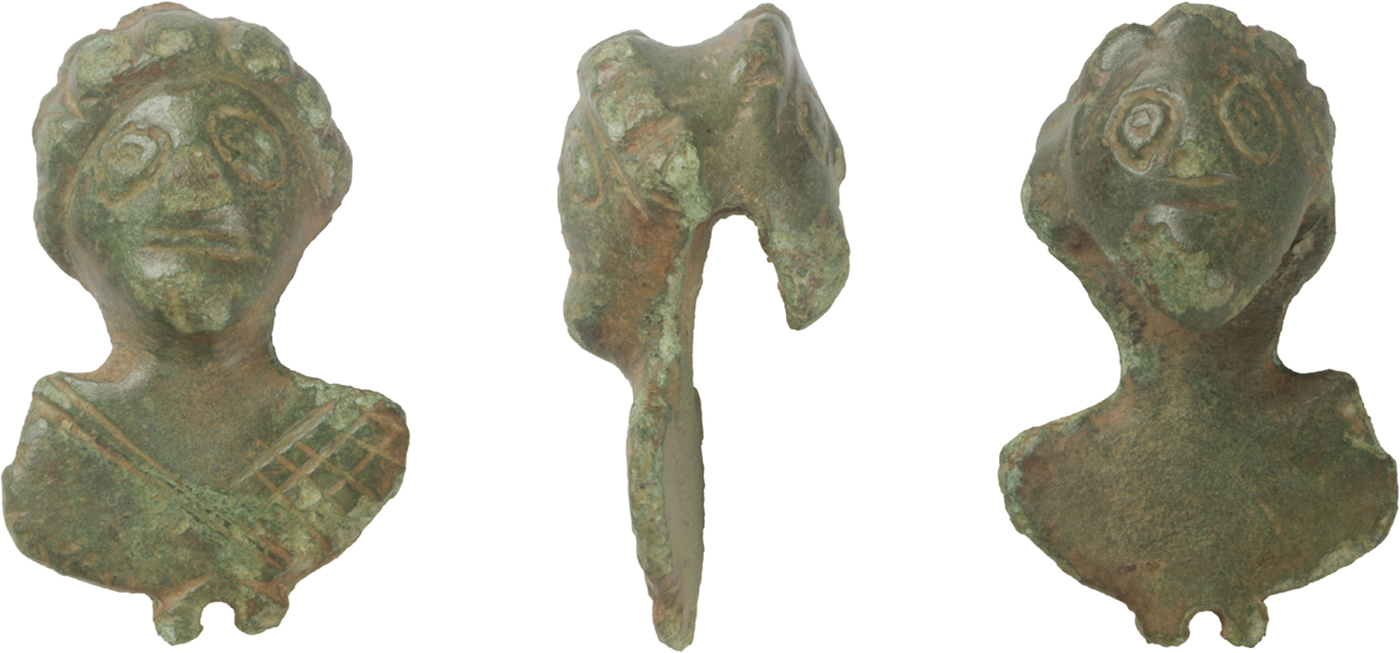
(24) Lydeard St Lawrence (SOM-B6E28A) (fig. 24).Footnote 122 A near-complete though worn copper-alloy vessel mount in the form of a janiform bust, broken across the attachment loop at the base. The mount is 48.3 mm from top to base, 23 mm from front to back between the chins and 32.1 mm wide (bust); it weighs 64.4 g. On the front the head and shoulders survive, while at the back the face ends at the chin. At the top a broad groove separates the two faces both with clumps of hair running in a curve above the temple and both triangular with projecting chins. Facial features are crudely rendered, with large eyes of varied size, slit mouths and broad noses. On the bust a V-neckline is formed by what appear to be two layers of cloth, the hemmed plain fabric on the right shoulder overlapping the patterned fabric on the left shoulder which is decorated with a grid of engraved lines. Beneath the bust is a loop, now broken with a patinated break.
Lydeard St Lawrence, vessel mount (No. 24). Scale 1:1. (Photo: L. Burnett; © South West Heritage Trust)

The slot form of the mount and loop indicate that this was attached to the rim of a vessel and riveted to hold it in place. The Lydeard St Lawrence object fits within a tradition of mask-like mounts on vessels, attested for example on late Iron Age buckets.Footnote 123 Partial parallels to this slotted form sitting over the rim are documented elsewhere in south-west England, with examples from Fivehead, Somerset (a female mask; BUC-DFB19A), South Petherton, Somerset (GLO-460D3B),Footnote 124 and Kings Langley, Wilts. (NMGW-097C90). In this case it is impossible to identify the gender of the figure. The grid patterning on the fabric on the left shoulder may be one of a handful of representations of a tartan-like patterned textile, the most famous being on the cloak of the standing figure from the equestrian group on the Arch of Caracalla at Volubilis, on which a barbarian seated beneath a trophy has a chequerboard design rendered in different metals on his trousers.Footnote 125