Health institutions, which are established on a very complex and dynamic structure, are in a constant state of development and transformation. They have also undertaken very important missions such as protecting and improving the health of the society.Reference Toni, Mattia and Pratesi 1 Health institutions need to be prepared for crises that may occur periodically due to both their structure and the tasks they undertake. Crises such as natural disasters, large-scale institutional problems, and epidemics can manifest themselves in different ways.Reference Maskrey, Jain and Lavell 2 In the event of these crises, health institutions should be able to manage crises, continue to provide health services, and fulfill other roles expected of them. Crises can affect the entire system.Reference Vega, Arvidsson and Saiah 3 Therefore, the institution should be fully prepared for crises and perform crisis management in the best possible way. Otherwise, the weak points of the management will emerge, control will be lost, and the institution will become dysfunctional.
Although crisis processes have negative consequences for the organization and its employees, changes made for the continuity of the organization can contribute to the renewal of the organization. Therefore, crisis management is very important.Reference Emami, Lorenzoni and Turchetti 4 –Reference Alkhazali, Al Aqrabawi and Alshamayleh 6 In addition to comprehensive services, nurses are the most important health professionals in health institutions that have multidisciplinary teams. The largest organization in health institutions is hospitals. In this context, nurses who are mostly face to face with patients in a hospital during a crisis are expected to be very good at crisis management skills. Manager nurses have a lot of responsibility in providing this skill.Reference Aydogdu 7 –Reference Shamshiri, Ajri-Khameslou and Dashti-Kalantar 9
In a study, it was reported that emergency nurses who first encountered disasters, one of the crises, had moderate resilience, good coping styles, and high anxiety and depression levels. Again, in the same study, suggestions were made for nurses to provide effective intervention plans for crisis management, reduce psychological pressure, and improve their capacity to cope with disasters.Reference Huang, Li and Zhuo 10 The necessity of providing crisis management skills not only for working nurses but also for students receiving nursing education has been reported in a different study.Reference Roihana, Emaliyawati and Pebrianti 11
Today’s digital age offers many different learning techniques in the field of health.Reference Florencio, Rivera and Prado-Inzerillo 12 These techniques include educational suggestions for crisis management in nursing.Reference Andrews, Niederhauser and Sanford 13 In this study, it was aimed to provide an innovative approach to crisis management training given with the pecha kucha technique.Reference White and Louis 14 In order to increase crisis management skills especially for manager nurses involved in the organization of nursing services, a training content prepared with the pecha kucha technique was created using a mobile phone.
Pecha kucha is a new approach that provides self-management, collaboration learning, creativity, innovation, skill acquisition, and motivation to trainees.Reference Solusia, Kher and Rani 15 –Reference Laieb and Cherbal 18 The training given with Pecha Kucha encourages participants to read more materials online, research, and collaborate with other participants.Reference Mabuan 19 The pecha kucha technique is derived from the Japanese word “chit chat,” which represents a fast-paced presentation used in different fields including education-training, marketing, advertising, and design.Reference Angelina 20 –Reference Yerkoy and Okur 22 For effective learning through a Pecha Kucha presentation, the design and format of the presentation should be limited to 20 slides and 20 seconds should be targeted, and the duration for the entire presentation should be 6 minutes and 40 seconds. 17
During the pandemic process, manager nurses faced uncertainties regarding the process, long working hours, constantly changing decisions and implementation of new decisions, some physical deficiencies in hospitals at the beginning of the process (such as a lack of monitors), and, in addition to checking material and equipment stocks, they also performed nursing duties in clinics. This tempo wore out manager nurses both physically and mentally.Reference Yerkoy and Okur 22 In the earthquakes that occurred in Turkey on February 6, nurses were trying to help the earthquake victims who died, lost relatives, and lost limbs under the influence of many emotions such as stress, anxiety, sadness, loss, and hope, while also thinking about their own loved ones and relatives. It has been emphasized that the working conditions of nurses should be improved in such a disaster and that managerial studies should be carried out in this regard.Reference Sancar, Cüceler and Özcanarslan 23
In addition to classical educational approaches, it is thought that crisis management training prepared with the innovative approach technique of pecha kucha will contribute to the rapid, effective, and safe crisis management skills of manager nurses in times of crisis.
Objective
The objective of the research is to examine the effect of crisis management training given by the pecha kucha method on the crisis management skills of nurse managers. In this context, the hypotheses of the study are:
H1: There is no significant difference between the standard training and the pecha kucha technique in the crisis management training given to manager nurses.
H2: There is a significant difference between the standard training and the pecha kucha technique in the crisis management training given to manager nurses.
Methods
Research Design
The research was conducted as a randomized controlled quasi-experimental study.
Sample size and randomization
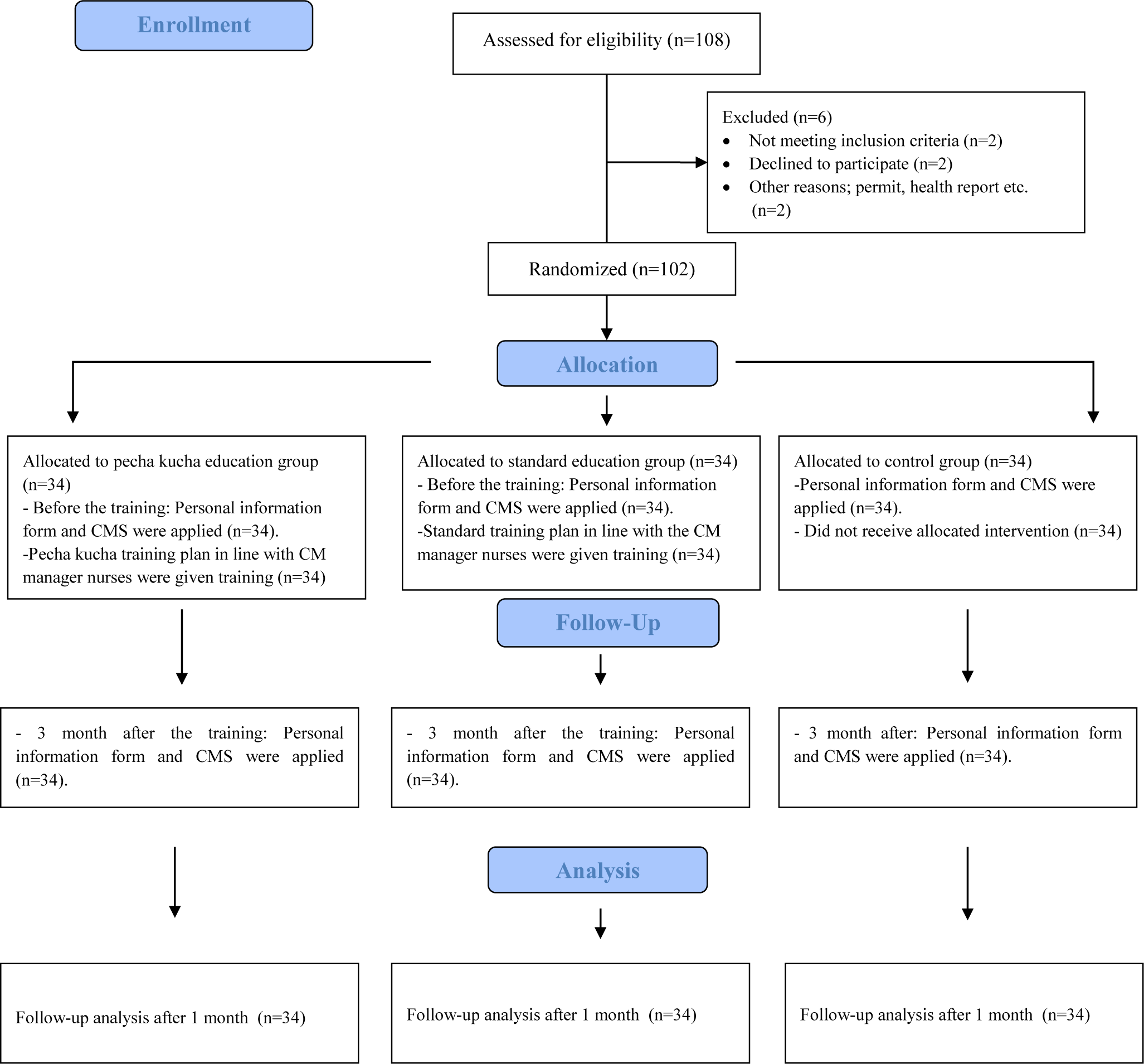
The population of the research consisted of nurse managers working in a public hospital serving in a province located in the southeastern region of Turkey. The sample size was calculated using the G*Power V.3.1.9 program. Inspired by a similar study using the pecha kucha method used in our study,Reference Joseph and Natarajan 24 the sample size was determined as at least 28 for each group with Cohen d = 0.5. α = 0.05 and a power (1-β) of 0.8 representative power of the universe.Reference Cohen 25 Due to the risk of data loss, 108 nurse managers who met the inclusion criteria were assigned to the experimental (36), standard (36), and control (36) groups. Two people from each group were excluded from the study due to reasons such as not complying with the research plan or wanting to leave the study. The groups were created using the simple randomization method. The nurse managers who would participate in the study were asked to draw a paper from a bag with even and odd numbers written on it using simple randomization. The first 34 people who drew the paper with even numbers were assigned to the experimental group, the first 34 people who drew the paper with odd numbers were assigned to the standard group, and the remaining 34 people were assigned to the control group. The consort flow diagram of the research is also shown (Figure 1).
CONSORT flow diagram of the participants.

Inclusion criteria for the study
Inclusion criteria were not having received similar training on crisis management before, being a volunteer to participate in the study, and complying with the training plan provided within the scope of the study.
Exclusion criteria from the study
Exclusion criteria were having received similar training on crisis management before and not complying with the research plan.
Ethical considerations
Ethics committee approval (Date:01.02.2023-No:394) was obtained from the Adıyaman University Social and Human Sciences Ethics Committee to conduct the study. The study was conducted in accordance with the Helsinki Declaration with the written consent of the participants.
Data-gathering tools
“Crisis Management Scale” and “Introductory Information Form” were used to collect research data.
Introductory information form
Includes questions such as participants’ age, gender, education level, years of professional work, years of work as a manager, whether they encountered major crises during their managerial career, and whether they overcame crises.
Crisis Management Scale
The scale was developed by Calışkan (2020). It consists of 23 items and 3 sub-dimensions. The sub-dimensions are pre-crisis (9 items), during-crisis (10 items), and post-crisis (4 items) activities. The scale has a 5-point Likert rating system (1: Strongly disagree….5: Strongly agree). Cronbach’s alpha was calculated as 0.89 for the scale.Reference Calıskan 26 In our research, Cronbach’s alpha was calculated as 0.81.
Interventions
The training content was created by using the resources available in the Turkish Disaster and Emergency Management Presidency (AFAD) online library. What is a crisis? What could be the causes of a crisis? What is crisis management? Who should make up the crisis management team? How should a nursing services crisis management plan be prepared? How should precautions be taken in nursing services crisis management? How should communication be in nursing services crisis management? How should nursing services crisis management evaluation be done? The training content was prepared for the questions. 27
Control Group
After the necessary information about the research was given, the introductory information form and crisis management scale were applied to the manager nurses in the control group without any intervention.
Standard Group
A research survey was applied to the participants before the training. The training content was the same as the experimental group and the training was given with the classical oral presentation technique and an average of 15-20 minutes of narration. After the training, the participants’ questions were answered and the session was concluded.
Experimental Group
A research survey was applied to the participants before the training. The training content was the same as the standard group, and the training content was prepared with intensive visuals and minimal text in accordance with the pecha kucha technique, and was created with 20 slides. The presentation times were adjusted to 6 minutes and 40 seconds in accordance with the technique. Then, the trainings prepared for the smart phones of the nurse managers were directed to and training was provided with the pecha kucha technique. After the training, the session was concluded by answering the participants’ questions.
The data collection process ended with the evaluation of the training 3 months after the training in the experimental and standard groups; and with the collection of the data again 3 months after the collection of the first data from the control group without any intervention.
Evaluation of the Data
IBM SPSS (IBM SPSS Statistics for Windows, Version 23.0 IBM Corp.) was used to evaluate the data obtained as a result of the research. Descriptive statistics and normality tests were used to determine the method to be used in the analysis phase. Then, the chi-square test and variance analysis (ANOVA) were used. As a result of the analyses, P < 0.05 was considered significant.
Results
The sociodemographic characteristics of the manager nurses in the experimental and control groups participating in the study are given in Table 1. When the data were examined, it was determined that there was no statistically significant difference between the groups in terms of socio-demographic characteristics (P > 0.05).
Comparison of socio-demographic characteristics of nurse managers in the experimental and control groups

X2 = Chi-square test. P<0.05.
Crisis management scale pre-test scores of manager nurses in the experimental and control groups participating in the study are given in Table 2. When the data were examined, it was determined that there was no statistically significant difference between the groups in terms of the total and sub-dimensions of the crisis management scale (P > 0.05).
Comparison of crisis management scale pre-test scores of manager nurses in the experimental and control groups

* ANOVA test, P<0.05.
Table 3 shows the post-test scores of the crisis management scale for the nurse managers in the experimental and control groups. When the data were examined, it was determined that there was a statistically significant difference between the groups in terms of the total and sub-dimensions of the crisis management scale (P < 0.05). In addition, the effect size is expressed with eta squared in the Anova test. The effect size degree is accepted as “low” if it is between 0.01 ≤ η2 < 0.06, “medium” if it is between 0.06 ≤ η2 < 0.14, and “high” if it is η2 ≥ 0.14.Reference Cohen 25 Accordingly, when the effect sizes of the crisis management total and sub-dimensions were examined, it was determined that the total score was η2 = 0.39 (high effect level), the pre-crisis activities sub-dimension was η2 = 0.19 (high effect level), the crisis activities sub-dimension was η2 = 0.13 (medium effect level), and the post-crisis activities sub-dimension was η2 = 0.42 (high effect level) (Table 3).
Comparison of crisis management scale post-test scores of manager nurses in the experimental and control groups

* ANOVA test, P<0.05.
Discussion
Crisis management processes are very important in health care facilities. Strategic planning is necessary, especially in hospitals, as crises can create multifaceted effects. These plans should be shared not only with hospital managers but also with other employees.Reference Dalain 28 It is important to provide crisis management skills to nurses who are both the numerical majority and the primary responsibility in health care services compared to other health care professionals in hospitals. In this context, the leading nurse group that will provide coordination and organization in times of crisis is the manager nurses.
In our study, where the effect of the pecha kucha technique was examined in providing crisis management skills to manager nurses, the pre-test crisis management scale total score and sub-dimension score averages of manager nurses were similar to the literature, and pre-crisis activities received the lowest and post-crisis activities received the highest score averages from the sub-dimensions.Reference Gurler, Cavusoglu and Ozdamli 29 , Reference Yagmur and Myrvang 30 It has been reported that nurses working in busy and stressful units have higher crisis management skills.Reference Todaro-Franceschi 31 In our study, when manager nurses were asked about their crisis encounters and management skills, the majority of them answered yes. This is thought to be due to the fact that they mostly work in busy and stressful clinics such as intensive care and emergency services. In addition to busy and stressful working conditions, nurses also spend most of their lives at their workplaces. For this reason, nurses encounter a crisis at least once during their work processes.Reference van Wijngaarden, de Mul and Ahaus 32
The majority of the nurse managers who participated in this study also stated that they encountered a major crisis in their working lives, a finding similar to the literature. It was reported that nurses were stressed during a crisis and had difficulty managing the process.Reference Firouzkouhi, Kako and Abdollahimohammad 33 Similar to the nurses who participated in the study, they were asked about their ability to manage the process when faced with a crisis, and it was seen that the majority of them answered sometimes. However, when the nurse managers who participated in the study were asked whether they had received crisis management training, the majority stated that they had received training. In this context, it was observed that although the nurse managers who participated in the study had previously received crisis management training, they had difficulty managing the process during a crisis, they experienced stress, and their crisis management skills and crisis management training were inadequate. Therefore, crisis management training supported by pecha kucha technique,Reference Solusia, Kher and Rani 15 , Reference Haramba, Millanzi and Seif 34 , Reference Saracoglu, Yilmaz and Turan 35 which is used in many fields, from language education to marketing and from undergraduate education to vocational education, was applied to manager nurses. In addition, a standard crisis management presentation training was given to manager nurses in a different group, independent of the innovative pecha kucha training. The aim here was to examine the level of difference between pecha kucha training and the control group, instead of just showing the difference between pecha kucha training and the training given with a classical presentation technique. After the training, it was determined that the total and sub-dimension means of crisis management given to manager nurses with pecha kucha technique were significantly different from the control and standard training groups and received the highest mean scores (Table 3) (P < 0.05).
This study shows that the crisis management training given with pecha kucha technique positively affects the crisis management skills of manager nurses, in other words, the crisis management training given with this technique can fulfill the actions that manager nurses should take before, during, and after a crisis.
Conclusion and Recommendations
As a result of the research, it was determined that the training programs conducted with the pecha kucha technique made significant positive contributions to the crisis management processes of manager nurses. In line with this finding, the H2 hypothesis of the research was accepted; namely, the pecha kucha method is an effective tool in developing the crisis management skills of manager nurses. Because the pecha kucha training method is carried out in the form of visually focused and time-limited presentations that encourage short and concise information transfer, it prevents the distraction of the participants and ensures that learning is more effective. In addition, this training technique, which can be applied in various fields, is also considered as a suitable training method for manager nurses who need to develop their management skills, especially those who carry out organization and coordination duties in the field of nursing. In this context, it is thought that pecha kucha training can be a new and effective tool for increasing the managerial competencies of nurses, together with its use as an alternative to traditional training methods. In addition, the applicability and effectiveness of this method provides advantages in terms of time and cost, and can make professional learning processes more enjoyable and motivating. In conclusion, the pecha kucha training method is an innovative and practical training method that will contribute to the development of leadership and management skills in the field of nursing education and practice and is considered a very good alternative to other training methods. It can also be used in different studies in the field of nursing management in the future.
Acknowledgements
The authors want to thank all our participants.
Author contribution
YC: conceptualized and designed the study and conducted the intervention, analyzed the data, and wrote the first draft of the article. Author revised the manuscript for important intellectual content and approved the final submitted version to be published.
Funding statement
No financial support was received from any institution for this study.
Competing interests
The authors declare none.
Ethical standard
Ethics committee approval was obtained from Adıyaman University Social and Human Sciences Ethics Committee (No: 01.02.2023-394) and written permission was obtained from the hospital where the study was conducted.