


1. Introduction
Nearly all eukaryotes alternate haploid and diploid generations. In many cases one or the other generation is reduced to one or a few cells; in animals, for example, the haploid phase is a single cell with limited or no expression of the genes it carries (the gametes). In land plants, either the haploid phase (ferns, seed plants) or the diploid phase (mosses, liverworts, hornworts) is reduced to varying degrees. At the opposite extreme, some taxa have haploid and diploid phases that are virtually indistinguishable (e.g., the ulvophyte green algae Ulva and Cladophora). Animals and Ulva represent the ends of a continuum between isomorphic (phases indistinguishable) and heteromorphic (phases morphologically distinct) alternation of generations. Intermediate examples exist with varying degrees of heteromorphy, ranging from near isomorphy (e.g., the brown alga Ectocarpus) to so different that the two phases were originally described as different genera (e.g., the red alga Porphyra).
At its most basic, alternation of diploid and haploid generations involves fusion of haploid gametes to form a diploid zygote and meiosis of diploid cells to produce haploid propagules or gametes. In plants and multicellular algae, the haploid phase is generally called a gametophyte, and the diploid phase the sporophyte. Many variations on this theme exist with and without the growth of multicellular structures in one or both phases. The life cycles of various species include phases that range from complete isomorphism (i.e., haploid and diploid phases morphologically indistinguishable) through various degrees of heteromorphism to the extreme of one phase or the other being reduced to (or remaining) a single cell. Even within a ploidy level, distinct types may co-occur that differ in morphology and in their mode of reproduction. Heteromorphic life history stages may also be ecologically differentiated, occupying different niches and having little or no effect on each other’s viability and reproduction. An additional complication is that the haploid and diploid phases do not always strictly alternate. Many life cycles include clonal reproduction of one or both phases (reviewed in Herron et al. Reference Herron, Rashidi, Shelton and Driscoll2013).
Alternation of generations and more complex life cycles complicate the question of which biological units should be considered individuals. The concept of biological individuality is intertwined with that of its close conceptual cousin, fitness; in fact, for some authors, defining individuality and defining fitness are the same problem. For example, fitness plays central roles in the individuality concepts of Godfrey-Smith (Reference Godfrey-Smith2009), Clarke (Reference Clarke2010), Folse and Roughgarden (Reference Folse and Roughgarden2010), Strassmann and Queller (Reference Strassmann and Queller2010), and Metz (Reference Metz2013).
Yet in most eukaryotic life cycles, it is not possible to predict evolutionary outcomes by considering fitness differences in just one phase. Even in so-called ‘paradigm’ individuals (Wilson Reference Wilson1999), doing so is only an approximation, as selection can take place among gametes. The view that effective selection among gametes does not occur is no longer tenable, as an increasing body of evidence shows that at least some genes are expressed by gametes (Erickson Reference Erickson1990; Hendriksen et al. Reference Hendriksen, Hoogerbrugge, Themmen, Koken, Hoeijmakers, Oostra, van der Lende and Grootegoed1995; Engel, Holmes-Davis, and McCormick Reference Engel, Holmes-Davis and McCormick2005; Torgerson and Singh Reference Torgerson and Singh2006; Borges et al. Reference Borges, Gomes, Gardner, Moreno, McCormick, Feijó and Becker2008; Gou et al. Reference Gou, Yuan, Wei and Russell2009). As we move away from the extremely reduced end of the heteromorphy spectrum, this approximation gets worse and worse, until not even the sign of evolutionary change can be reliably predicted by considering only one phase of the life cycle (as I will show).
2. The Model
I start by developing a single-locus model of a simple haploid-diploid life cycle. Diploid sporophytes produce haploid spores by meiosis, which develop into haploid gametophytes. Gametophytes produce gametes by mitosis, which fuse to produce diploid zygotes. Assuming Lotka–Volterra-like dynamics, we can calculate the dynamics of such a population as follows:

where dH/dt and dD/dt describe the dynamics of haploid gametophytes and diploid sporophytes, respectively. Haploids produce diploids at an intrinsic per-capita rate rH, diploids produce haploids at rD, and the carrying capacities of haploids and diploids are KH and KD, respectively. The relative strength of competitive effects is represented by a matrix of competition coefficients, where αx,y represents the competitive effect (reduction of growth rate) of type y on type x. The terms ∅H and ∅D represent constant per-capita death rates for haploids and diploids.
I introduce evolutionary dynamics by modeling two alleles at a single locus. I assume that genotype does not affect competitive ability or death rate. Gametes combine randomly, so diploids are produced in Hardy–Weinberg frequencies (A 2, 2Aa, and a 2):
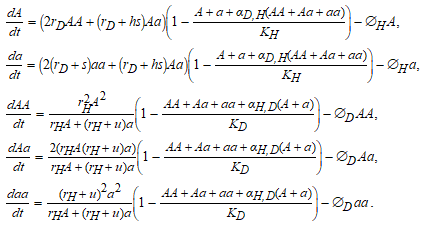
In this version, dA/dt and da/dt represent the dynamics of the wild-type and mutant haploids, while dAA/dt, dAa/dt, and daa/dt represent the dynamics of wild-type homozygotes, heterozygotes, and mutant homozygotes, respectively. The terms s and u represent the selective effects of the mutation, in terms of production of propagules, on the haploid and diploid phases, respectively. If u = s, the mutant has the same selective effect on the haploid (a) and homozygous diploid (aa). If u and s differ, the effect of the mutation differs between ploidy levels. The relationship between u and s reflects the type of pleiotropy: when u and s are both positive (or both negative), the mutation is beneficial (or harmful) regardless of ploidy level (positive pleiotropy); when the signs differ, pleiotropy is negative. The degree of dominance (h) determines the strength of selection on the heterozygote (Aa) relative to the homozygous mutant (aa).
The competitive coefficients across ploidy levels (αH,AA, etc.) roughly reflect the degree of isomorphy: when haploids and diploids are isomorphic and consuming the same resources, these terms will be near unity; for extremely heteromorphic species in which haploids don’t compete with diploids, they will be near zero.
In this form, the system of equations approximates the dynamics of a new mutation in a haploid-diploid population and allows us to calculate the invasion fitness of such a mutation. The frequency of the mutant allele in such a population is

where the total number of alleles in the population is N = A + a + 2(AA + Aa + aa), and the change in frequency of the mutant allele is represented by

which will be positive whenever  .
3. Discussion
Among eukaryotic lineages, complex life cycles are the rule rather than an exception. Understanding how such lineages respond to selection is thus crucial for understanding adaptive evolution in eukaryotes. Models that consider selection in only one phase of the life cycle at best only approximate this process, and except when the dominance of one phase is extreme, predictions from models that consider only one phase are likely to be substantially wrong.
This model shows that the fitness effect of an allele cannot be accurately calculated without taking its influence on all life cycle phases into account. Furthermore, fitness is a function not only of allele frequency but also of the proportion of alleles represented in each phase of the life cycle. In cases in which the sign of selection differs between haploid and diploid phases, not only the magnitude of selection but also the direction depends on the composition of the population, both allele frequency and the proportion of those alleles in haploid versus diploid phases.
For concepts of individuality that include fitness or adaptation as an important component, the realization that calculating fitness requires considering the entire life cycle presents a challenging complication. The concept of fitness is useful to the extent that it predicts, at least probabilistically, the direction and magnitude of short-term evolutionary change. However, I have shown that such predictions will often be in error when only one phase of the life cycle is considered. Privileging one or the other phase as ‘the’ individual therefore neglects potentially important selective effects.
Previous authors have recognized that alternation of generations and more complex life cycles present problems for concepts of biological individuality, sometimes arriving at very different solutions. Godfrey-Smith (Reference Godfrey-Smith2009, Reference Godfrey-Smith, Bouchard and Huneman2012, Reference Huneman, Pradeu and Guay2014) considers individuals to be members of ‘Darwinian populations’, those groups that have the necessary ingredients for adaptive evolutionary change. One factor in the cohesiveness of such populations is the strength of intraspecific ecological interactions, which plays a role nearly identical to the α parameter in my model (and in Lotka–Volterra models of interspecific competition). At the extreme of heteromorphy, α = 0, the haploid and diploid phases are ecologically distinct, such that the density of one life history phase has no competitive impact on the growth of the other. Nevertheless, a shared gene pool dictates that they do affect each other’s evolution, as selection in one phase will inevitably affect allele frequencies in the other.
In the view of Griffiths and Gray (Reference Griffiths and Gray1994), the life cycle itself is the individual. While I agree that the entire life cycle needs to be taken into account, it is not clear how to square this developmental view with the evolutionary view of individuals as subjects of selection. How, for example, does selection operate among life cycles, and do life cycles have the requisite conditions of heritable variation in fitness?
Much of the literature on biological individuality has focused on the question of which level (or levels) in the hierarchy of life comprises individuals, for example, cells versus multicellular organisms, ramets versus genets, multicellular organisms versus eusocial ‘superorganisms’. This remains an important question, but my focus here has been quite different, looking instead at a single hierarchical level, that of the multicellular organism (though most of the conclusions would be identical for facultatively sexual unicells).
If we can draw any conclusion from this, it is probably that approaches to biological individuality that privilege one life history stage at the expense of the other(s) are not viable unless we are willing to give up the idea that individuals are the bearers of fitness. First, such an approach may work acceptably for a particular case, but even then it is an approximation; accurately predicting the outcomes of selective processes will require considering fitness differences in both (or all) phases of the life cycle. Second, the choice of which phase to privilege is at least somewhat arbitrary, and the dominant phase will change depending on what taxon we are looking at: in animals and land plants, the diploid; in Porphyra and Volvox, the haploid. Finally, in cases of isomorphic alternation of generations (such as Ulva), haploid and diploid phases are on equal footing, and there is no basis on which to choose which phase to privilege.
I have taken a gene-centric and adaptationist approach, neglecting the possible effects of stochastic processes such as genetic drift. It seems unlikely, however, that including such effects would change the qualitative outcomes. The model could be extended to capture stochastic effects as well as to consider quantitative traits, pleiotropic effects within a phase, and development. In addition, the model could be extended from the simple alternation of generations I have considered to include complications such as clonal propagation of one or both phases, reproduction of unicellular phases (as in the red alga Porphyra; Polne-Fuller and Gibor Reference Polne-Fuller and Gibor1984), additional multicellular phases (such as parthenosporophytes in the green alga Ulva; Hoxmark and Nordby Reference Hoxmark and Nordby1974; and the brown alga Ectocarpus; Charrier et al. Reference Charrier, Coelho, Bail, Tonon, Michel, Potin, Kloareg, Boyen, Peters and Cock2008), and chromosome doubling during development (as in Ulva; Föyn Reference Föyn1958; Fjeld Reference Fjeld1972).


