While numerous studies have been carried out in recent years on abandoned children and children in care in Southern Europe,Footnote 1 in the British IslesFootnote 2 and in North America,Footnote 3 studies on unwed mothers remain scarce. Only two studies on unwed mothers have been completed for France, both concerning Paris,Footnote 4 and there is one on various Italian cities by David Kertzer.Footnote 5 All these studies primarily involve analyses of the records of organizations set up to help and control those young women.Footnote 6 When unwed mothers are studied, there is usually no longitudinal perspective. Instead, the focus is on the birth of the child, as if the former life of these women, their life courses leading them to give birth to a bastard and their later lives, should remain unknown.Footnote 7 Hence Steven King's reconstitution of Charlotte Eastwood's reproductive history, as a mother of six illegitimate children born between 1821 and 1836, is an original and welcome study.Footnote 8 Mothers of children born out of wedlock in Paris also appear in Ivan Jablonka's recent study, but only through the relationships they were able to maintain with children assisted by the Assistance Publique and not much is revealed about the women themselves.Footnote 9 The following up of such women over several years and the recording of their of residential and migratory moves have been accorded scant consideration, especially in recent studies.Footnote 10
In this article, we are able to examine the life courses of the young women who delivered at the Charité de Lyon maternity hospital, larely thanks to the richness of the documents held by the Hospices Civils of Lyon. This powerful institution exercised tight control over unwed mothers and abandoned children in Lyon, organizing the accommodation and delivery of the former and then the guardianship of the latter. The abandoned infants were quickly sent to wet-nurses, members of poor rural families in the region.Footnote 11 The records of admittance and delivery of pregnant young women who came to the Charité were used as the basis of this study.Footnote 12 Nuns and staff accommodating these young women were supposed to ask a battery of questions, with the aim of ascertaining whether a young woman was fully entitled to give birth in that maternity hospital and, afterwards, to be provided with material assistance. Those records were very well kept and the information was collected and written down in a systematic manner; we took the decision to select a 10 per cent sample of the records from the period 1871–1881.Footnote 13 The data were analysed from both a quantitative and a qualitative perspective: the former to reveal the characteristics of the selected population and the latter to provide fascinating insights into the migration patterns and changes of residence of particular women. The recording of these changes of residence on maps of Lyon has clarified the nature of their mobility within the city.
I. UNWED MOTHERS: NEWCOMERS IN TOWN AND UNSKILLED WORKERS
The proportion of illegitimate births was very high in Lyon, as it was in other major French cities during the second half of the nineteenth century.Footnote 14 In the 1870s, every year hundreds of young women came to give birth at the Charité de Lyon maternity hospital in the centre of the city, which was only open to unmarried women. Married women used another maternity hospital, that of the Hôtel-Dieu, which was located in the immediate vicinity. Births out of wedlock represented around a fifth of all recorded births in the city, and the great majority of them took place at the Charité. For instance, 8,975 births were registered in Lyon in 1882 and of these 1,785 were to unmarried mothers (19.9 per cent). Of the 1,430 births that were out of wedlock, (80.1 per cent) took place in the Charité. There was no charge for the delivery and food was abundant, but the women were subjected to very strict discipline.Footnote 15 On the other hand, delivering a child in the city, in the home of the mother or that of a midwife, was expensive and was beyond what most unwed mothers could afford. Women who gave birth at the Charité de Lyon were probably less well off but they were far more numerous.
Throughout the nineteenth century, the Charité de Lyon maternity hospital had been extended several times to meet an ever higher influx of unwed mothers. Moreover, important investigations were launched to try and avoid periodical outbreaks of puerperal fever. For instance, ventilation was improved and the cleanliness of the wards was assessed in the 1860s, but without great result. It was only with the initiation of policies ordering the isolation of women with infections and better hygiene at the end of the 1870s that major improvements were realized.Footnote 16
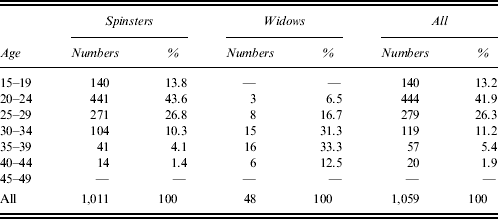
The maternity hospital, which had accommodated around 800 young women in the 1840s, received more than 1,000 annually from the 1850s to the end of the 1870s. Then a quick rise occurred: 1,267 young women were received in 1881, 1,430 in 1882, 1,694 in 1883. The peak of 2,000 yearly admissions, that is to say more than five every day, was reached in 1890 (see Table 1).
Distribution of women admitted to the Charité maternity hospital in Lyon, 1871–1881, according to their age at delivery and their marital status

Sources: One-in-ten sample of records from the period 1871–1881, City Archives of Lyon, bundle 5Q32–5Q124, and ‘Registres de renseignements recueillis à l'admission des femmes enceintes’, 1857–1892, bundle 5Q128–5Q156l.
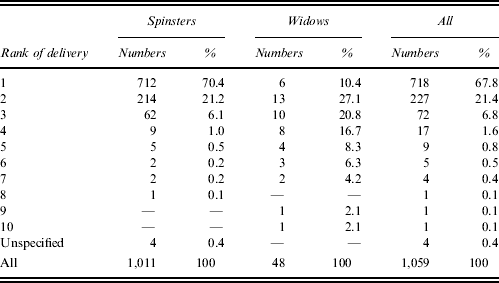
Widows represented only a small minority (4.5 per cent) of the women whose babies were delivered in the Charité and most were in their thirties. Unmarried women were generally younger. Although few of them were under 20 (13.8 per cent), most of them were between the ages of 20 and 24 (43.9 per cent) and 25 and 29 (26.8 per cent). There was a broad spectrum of ages, with the oldest being 43 years old. This age distribution of the unmarried women reflected to some extent the fact that not of all these women were experiencing their first delivery (see Table 2).
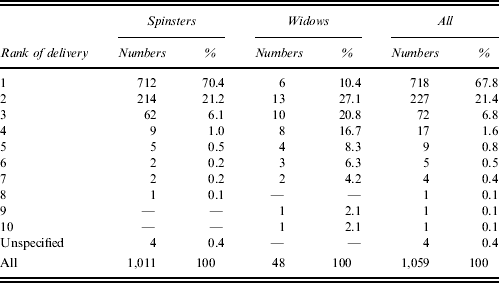
Distribution of women admitted to the Charité maternity hospital in Lyon, 1871–1881, according to the numbers of deliveries and the marital status of the women
Sources: As in Table 1.
For the great majority of the single mothers (70.4 per cent), their first birth out of wedlock often remained the only one. But others were already multiparous. Among the latter, most came for a second delivery. Yet there was a small minority (8 per cent) who gave birth to at least a third illegitimate child. A handful of women even had five or more illegitimate children delivered at the Charité. Widows were more often multiparous, but for most this was their first illegitimate birth, the earlier ones having occurred while they were married (see Table 3).
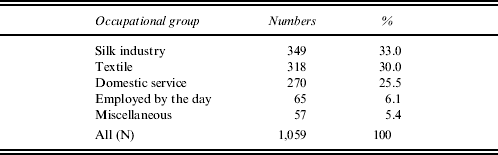
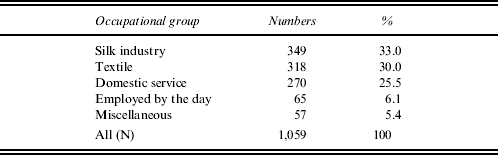
Distribution of women admitted to the Charité maternity hospital in Lyon, 1871–1881, according to occupational group
Sources: As in Table 1.
The occupations of unwed mothers in Lyon were similar to those of unwed mothers in ParisFootnote 17 and Geneva.Footnote 18 Most were unskilled or held specific jobs in Lyon's textile and silk industries. Nearly two-thirds were employed in textiles or silk manufacturing, performing a wide variety of skilled jobs such as seamstresses, linen-maids or laundresses in the textile industry, or as spinners, weavers or ovalistes (throwers) in the silk industry.
An important second group, a quarter of the delivered women, were servants. Women employed by the day and those in a variety of miscellaneous employments are much less frequently found. With the exception of a handful of women in better positions (2 schoolteachers, 2 shop assistants, around 20 shopkeepers), all the women were members of the working-class population of the city, and some of them lived in extreme poverty (see Table 4).
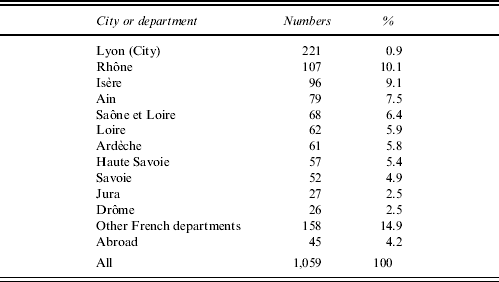
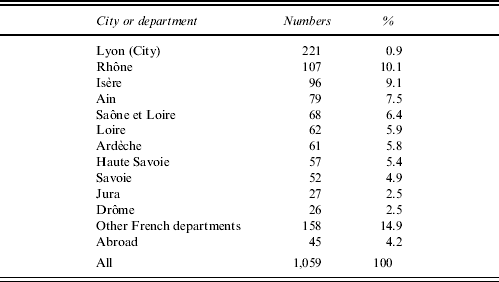
Distribution of women who delivered children at the Charité maternity hospital in Lyon, 1871–1881, according to their department of birth
Sources: As in Table 1.
Of the women who gave birth at the Charité, only a fifth (20.9 per cent) had themselves been born in Lyon.Footnote 19 The vast majority of the young women had migrated to the city. Unsurprisingly, most of them came from departments that were situated closest to Lyon and which had largely contributed to the population growth of the city. The Isère, Ain and Loire departments shared borders with the department of the Rhône, of which Lyon is the prefecture. Providing somewhat fewer migrants were more distant departments, yet still in the vicinity of the Lyon area, such as those of Saône-et-Loire, Ardèche, Haute Savoie and Savoie. Beyond these, the numbers are lower: only around 20 young women were born in the departments of Jura and Drôme, slightly more in those of Puy de Dôme (16) or Bas-Rhin (14). Women who had been born abroad only represent only 4.2 per cent of those who delivered at the Charité, and of these most came from Italy (25) and Switzerland (15).
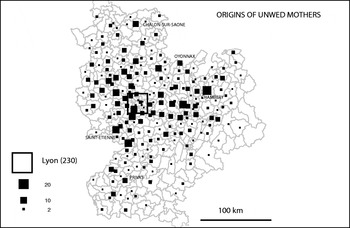
Figure 1, showing the origins of the women according to their birth canton (subdivision of a department) confirms the importance of proximity to Lyon as a determinant of the extent of migration into Lyon. Even within specific departments, those cantons nearest to the city supplied the largest numbers of migrant women.
Places of birth (French cantons) of unwed mothers who delivered at the Charité maternity hospital of Lyon, 1871–1881. (Sources: As in Table 1.)

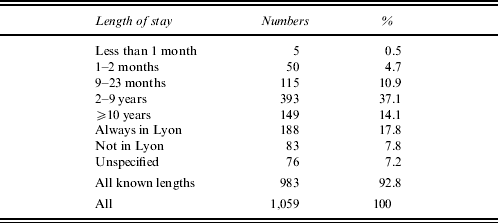
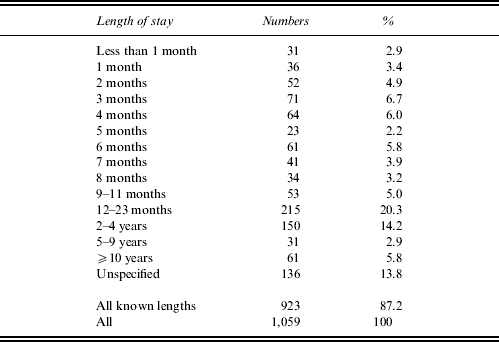
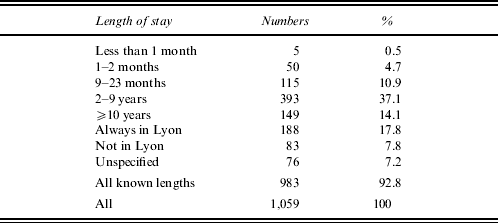
When women were admitted to the maternity hospital, they were asked how long they had been residing in Lyon (see Table 5). Their answers, in most cases, were precise, yet for 7.2 per cent of these women the length was not specified. A small minority of women (7.8 per cent) declared they did not live in Lyon, which was contrary to the policy of the Charité, which was to admit only women living in the city.Footnote 20 This policy was subverted when a woman arrived just as she was about to deliver. In these cases, the interrogation of the woman took place only after the child was born and a place of residence outside Lyon could be declared without any risk that the woman would not be admitted. It seems plausible that some women, aware that they should not be admitted to this maternity hospital, knowingly circumvented the policy by showing up as an emergency.
Distribution of women admitted to the Charité maternity hospital in Lyon, 1871–1881, according to their length of stay in the city
Sources: As in Table 1.
Women who declared that they had always dwelt in Lyon represented only 188 (17.8 per cent of those who delivered children at the Charité). The others were therefore migrants, most of them coming from other departments. For around 50 women, who stated they had been in the city for less than eight months, their pregnancy probably began before they came to Lyon. On the other hand, very few of them stated that they had been in Lyon only for a couple of days, which suggests that only a small minority of the women arrived in the city specifically to deliver their child. As for other women, their arrival at Lyon had occurred much earlier, ranging between ten months and 33 years before they entered the Charité. That is to say that for most of these women there was no chronological link between their coming to Lyon and their observed pregnancy.
II. UNWED MOTHERS IN THE CITY: SPECIFIC PLACES OF RESIDENCE
Most of these young women probably lived alone. When they were admitted to the maternity hospital, the nuns would routinely ask about the identity of their child's father and if the latter would be contributing to the child's education. Their answers to these questions need careful evaluation. The presence of a father who could help the mother meet the cost of rearing the child prevented her from getting material assistance from the institution.Footnote 21 Moreover, the staff of the Hospices Civils of Lyon could check the truthfulness of their declarations.Footnote 22 In fact 94 per cent of women who delivered vowed that their child's father was ‘gone’ and 3.3 per cent said that he was dead. Very few of them expressed any hope that their child's father would contribute to the child's education, and only three mentioned that a wedding had been planned.
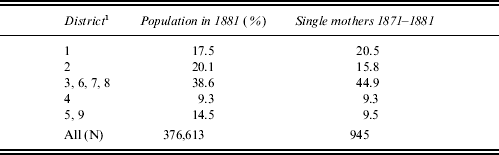
The distribution of the districts of residence of the women indicates that they could be living in many different areas of the city (see Table 6). Yet most of them lived on the left bank of the river Rhône, where the construction of numerous new districts was underway at the beginning of the Third Republic, in the last decades of the nineteenth century. They congregated in particular in these new, predominantly working-class, districts, since nearly 45 per cent lived there even though those suburbs housed only 38.6 per cent of Lyon's population. Above-average numbers of these young women also came from the First district,Footnote 23 which was predominantly working-class, whereas a contrario few of them lived in the historic areas of the right bank of the Saône (only 9.5 per cent of the women who delivered in the Charité lived in the Fifth and Ninth districts, although these contained 14.5 per cent of the population of Lyon).
Distribution of the population of Lyon in 1881 and distribution of the single mothers who delivered at the Charité maternity hospital there, 1871–1881, according to their district of residence
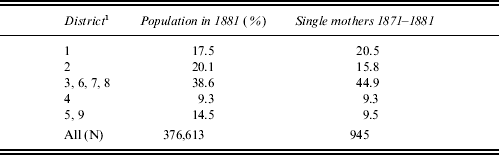
1 Lyon was divided at the time into six districts, termed ‘First’, ‘Second’, ‘Third’ and so on. Three others were created in the first part of the twentieth century, with district 3 divided into new districts 7 and 8 and district 9 created out of district 5. Where appropriate, we have reassigned some of the addresses to these new districts in this table.
Sources: As in Table 1.
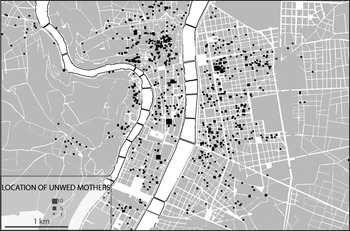
Tracing the district of residence, however, is but a first step: it is the identification of the specific address that is essential and very informative (see Figure 2). For example, location of the actual addresses reveals that unwed mothers were present in some numbers in certain restricted areas whereas they were absent from other sectors.Footnote 24 Specifically, there was a concentration in the central part of the Pentes de la Croix-Rousse hills. This was a working-class district mainly inhabited by a large number of textile and silk workers, an economic sector in which the female workforce was abundant. Another pole of concentration was located on the other side of the Rhône, in the Sixth district. The population of this district was more mixed, with mainly middle-class housing near the river Rhône and the Tête d'Or park. There is some initial surprise, therefore, that many unwed mothers were resident in that sector, yet they actually lived in a restricted area, some streets back from the Rhône, in some blocks of flats of lesser quality. Finally a third sector of particular concern for the presence of unwed mothers was the suburb of La Guillotière, on the left bank of the Rhône, at the end of the bridge leading to the city centre and the Charité hospital. As in the case of the Pentes de la Croix-Rousse, this was a working-class district, typical of the blue-collar areas of Lyon. However, the distribution of unwed mothers was more diffuse than on the slopes of the Croix-Rousse. This can be explained partly by the nature of the blocks of flats in the district, which contained fewer storeys and apartments than those on the Pentes.
Precise location of residences of unwed mothers who delivered at the Charité maternity hospital of Lyon, 1871–1881, and who declared an address in the city. (Sources: As in Table 1.)

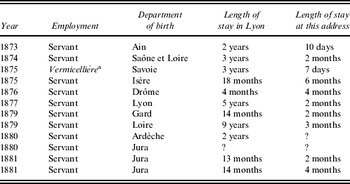
The identification of specific addresses reveals, for instance, the existence of some blocks of flats that seemed to provide shelter for pregnant young women who later gave birth in the Charité de Lyon maternity hospital. Thus twelve women reported that they lived at 20 rue Confort, eight at 8 rue Bossuet, seven at 10 rue de la Charité and also seven at 12 rue Imbert-Colomès. The second address is located in the noted concentration in the Sixth district and the third in an area on the Pentes de la Croix-Rousse. The first and third addresses were nearest to the maternity hospital. The accommodation was in the form of furnished rooms and most of the women reported that they had a landlady. We can, for instance, study the situation of the twelve women who were living at 20 rue Confort (see Table 7).
Migratory history of the twelve women who delivered at the Charité maternity hospital in Lyon between 1871 and 1881 and who were reported to be living at 20, rue Confort

a A specific task undertaken by women in the textile factory. The nature of the work is not dissimilar from that of a lacemaker (in French, dentellière) or an embroiderer (in French, brodeuse).
Sources: As in Table 1.
The twelve women who lived at this address all reported that they lived in furnished rooms or ‘at their landlady's. The geographical origins of these women were very diverse, but it is surprising that eleven of them claimed to be servants. The length of their presence in Lyon shows that most of them had apparently only recently arrived in the city, even though for ten of the twelve their arrival predated the beginning of their pregnancy. Some of these pregnancies began a short time after their arriving in Lyon, since three women reported having been in the city for more than 8 months but less than 15 months. However, it is significant that what all these women had in common was that none had dwelt at this address for more than 6 months, and most had lived there for a much shorter period, that is to say that their pregnancies were already largely advanced and, for some of them, easily visible. They may indeed have lost their position as a servant due to their pregnancy and have been forced to find shelter in furnished rooms.Footnote 25 Two of these women had lived at this address for a couple of days only. It seems likely that these furnished rooms would be known only to provide shelter to pregnant young women, since the house was located just a couple of minutes’ walk from the Charité maternity hospital. Given that we took a one-in-ten sample of all the women who delivered a child at the Charité yet still found two women who claimed this as their address in the same year (as was the case in 1875, 1879, 1880 and 1881), it may be inferred that maybe around 20 women, all pregnant, were living in that building at the same time. Their presence in that building can hardly have been coincidental. One avenue of research for us was to try and identify the ‘landlady’ who had been accommodating so many pregnant single young women for several months. According to the city directory of 1879, the premises were rented to a Mlle Gontard, who was listed simply as a lodger.Footnote 26 Unfortunately the sources reveal nothing further about this woman.
Another line of enquiry was to determine the proximity of the addresses of the women and those of the midwives living and working in the city of Lyon. The 1879 city directory indicates that there were 95 of the latter. They were present in most districts of the city, several of them living very close to the Charité maternity hospital, used by unmarried women, and that of the Hôtel-Dieu, which was available to married women. Midwives seem to have been more numerous in the areas where a concentration of unwed mothers is noticed, essentially on the Pentes de la Croix-Rousse and in the Sixth district. Nonetheless, reliance on these midwives would have been far too costly for many unwed mothers, and it was usually the wealthiest ones, who did not deliver at the Charité, who requested their services. The 1879 city directory includes some advertising by midwives. One entry for Mmme Berdot can be considered typical and reads as follows: ‘Midwife's home – Mme Berdot. First class midwife. Cours Morand 49, basement. Can accommodate residents. Consultation hours from noon to 4 P.M. Care, Discretion. Moderate price.’ In spite of these ‘moderate prices’, it is possible that most unwed mothers could not afford such care and discretion.Footnote 27
III. A VERY UNSTEADY POPULATION
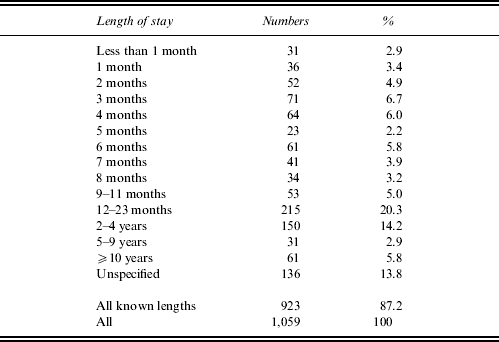
The length of their presence at their last address is available for 87.2 per cent of the women (see Table 8). It is unfortunate that there is no way of discovering how many places of residence each woman had occupied since her arrival in Lyon, especially since the beginning of her pregnancy, but the available information is still of sufficient interest. The residential instability of a significant proportion of unwed mothers is readily apparent. For instance, at least 431, that is to say 44.7 per cent, of those whose babies were delivered at the Charité had changed their place of residence during their pregnancy. For some of them, the last move coincided with the beginning of the pregnancy, yet the others were well into their pregnancy when they changed their residence. About 30 of the women had lived in their new address for a couple of days only, while for around 200 their move had occurred as much as four months before they delivered. On the other hand, 242 women (26.2 per cent) had lived at the same address for two years at least.
Distribution of women who delivered children at the Charité maternity hospital in Lyon, 1871–1881, according to how long they had stayed at their declared address
Sources: As in Table 1.
As we can see from Table 2, a minority of the women had already delivered several children. Yet the distinction between single mothers and widows should be underlined. Most widows had already given birth to a child while legally married and their recorded child deliveries at the Charité de Lyon maternity hospital were their first after the death of their husbands. One such widow was Marie Mery, a 42-year-old laundress who delivered for the tenth time. She had been a widow for three years and all her previous children were born within her marriage. The same was true of Marie Bourges, a 36-year-old presser who delivered for the ninth time in 1879.
There were, however, a number of unmarried women who gave birth to several children out of wedlock. If, for most of them, it was just a second child delivery, for others, their reproductive history was longer. Such was the case of Marie Jeanne Vitteau, a 37-year-old laundress when she gave birth to her eighth illegitimate child. Coming from Saône et Loire, she had lived in Lyon for fourteen years and had been accommodated for four months in a furnished room on rue de la Pyramide prior to the last birth. As for Laurence Baron, who gave birth in 1871 for the seventh time, she had been born in Lyon and worked as a weaver at la Croix-Rousse.
The changes of address of these multiparous women could be traced through their successive deliveries and yielded further insights into their social and familial situations. Eleven unwed mothers appear twice in the sample. Of these, 8 declared different addresses at successive deliveries, with the birth intervals ranging from one to four years. These changes of residence inside the city do not seem to have any obvious logic. They often involved just a short-distance move within the same district but, in some cases, the distances were more important and the woman moved to a different district.
These repeated observations enable us to draw a more accurate profile of some of these women and to assess the significance of changes in their situation. For instance, only fourteen months had elapsed between Pauline Paraud's first delivery of a child, in September 1875, and her second in 1876. In 1875, this 25-year-old spinner was living in a district on the Pentes de la Croix-Rousse whereas in 1876, still a spinner, she had resided for five months at a different address on the other side of Lyon. Claudine Grégoire's history as an unwed mother is particularly striking. When she delivered her first child, in September 1871, she was 17 years old and was living at her father's home on rue Crillon. She again gave birth to a child in May of 1873 and had then been lodging in the home of a passementier (braider) for three months on rue Garibaldi, having left her family's home. She declared that her future child's father had been employed by the braider but had left. On the other hand, Marie Louise Fessy emerges as geographically stable. On giving birth to her first child in July 1872, at the age of 27, as well as to her second one in October 1876 at the age of 32, she gave the same address in rue Cuvier. Moreover, she declared this to be her own home, which means that she was not subletting a room from someone else. On each occasion she declared that the fathers of her children had gone, though adding that the second father was a house-painter.
For a better perception of the unwed mothers' life histories and their changes of residence, we attempted to trace all the successive deliveries of the unmarried women who gave birth to at least five children between 1861 and 1881. Probably because of the frequency of these deliveries, these women were atypical in a number of ways, including their frequency of changing address. There were just around 100 identified, which may underestimate the number somewhat because some life stories had been truncated (omitting deliveries before 1861 or after the 1881) and there may have been other, undeclared, children delivered elsewhere than at the Charité.
In our study of the changes of residence of these women, two main characteristics stand out: first their great instability and secondly the short distances that most of them covered throughout their reproductive histories. With some rare exceptions, all of these women were living, over a long period of time, in the two poles of concentration in Lyon that have already been identified: the working-class suburbs on the left bank of the Rhône river (Third and Sixth districts) and the Presqu'île peninsula (sector of the Pentes and Plateau de la Croix-Rousse).
Few reported the same address at different deliveries. Among these exceptions was Jeanne Faudin, weaver, who gave birth to six children, from 1864 to 1874, and who consistently gave the same address at 31 place Saint Louis in the La Guillotière district. There was also Rose Augustine Colson, seamstress then laundress, who specified the same address, 26 rue Vauban in the Sixth district, where she successively gave birth to four children between 1862 and 1868. This stability can be explained by the fact she was living, in 1866 at least, with a man, a silk-painter, who was declared to be the father of her child. These two women appear to have been in long-term cohabiting relationships, with some of the security that was provided by marriage. But by 1871, when she delivered her tenth child, Rose Augustine had moved out and lived at 159 rue Duguesclin, just a few hundred metres away from her previous residence.
Most of these women were therefore mobile within the city, but often only over short distances. Thus Marie Delpèche, spinner, declared four different addresses through her successive four deliveries, always on the same street: in 1864 she lived at 18 rue Madame, in 1865 at 107, in 1866 at 101 and in 1870 at 62.
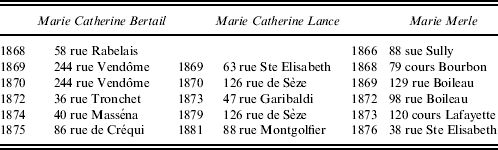
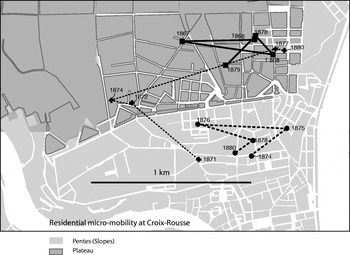
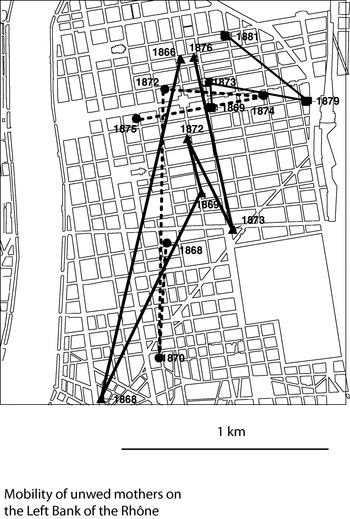
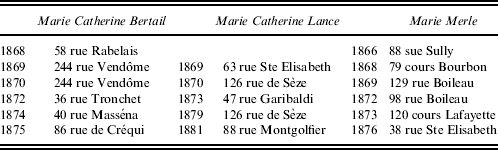
These instances of frequent changes of residence over short distances can be illustrated by the moves made within the Third and Sixth districts by Catherine Bertail, ovaliste (thrower); Marie-Catherine Lance, weaver; and Marie Merle, servant, day worker and cartonnière (box-maker) (see Table 9 and Figure 4).
Declared addresses of three multiparous mothers in districts on the left bank of the river Rhône, Lyon, 1868–1875
Sources: As in Table 1.
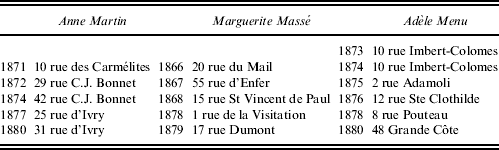
The same phenomenon of residential micro-mobility can be found in the sector of La Croix-Rousse with, for instance, the trajectories of Anne Martin, Marguerite Massé and Adèle Menu (see Table 10 and Figure 3). Once more, displacements were frequent but over very short distances, each of them having its own characteristics when we study their addresses in detail. While Adèle Menu, presser, stayed in the Pentes de la Croix-Rousse through her six child deliveries, Marguerite Massé, spinner, remained on the Plateau de la Coix-Rousse. Anne Martin, tailoress, first dwelt on the Pentes de la Croix-Rousse in 1871 then settled on the Plateau from 1872.


Declared addresses of three multiparous mothers in the district of Croix-Rousse, Lyon, 1871–1880

Sources: As in Table 1.
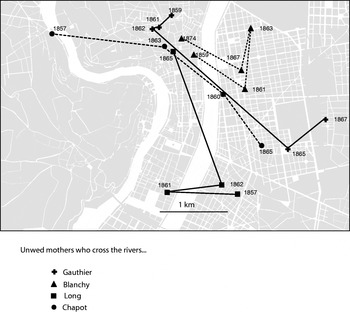
We can even find some cases of multiparous unwed mothers who changed districts during the course of their reproductive history. Some examples are displayed in Table 11 and Figure 5. These changes of residence have no particular logic. Thus Jeanne Blanchy, silk-worker, left the north-western part of the city (the Vaise district on the right bank of the river Saône) for the left bank of the Rhône, before settling in the north of Presqu'île. Catherine Long, linen maid, left the left bank for the south part of Presqu'île before returning to the left bank of the Rhône and moving on to the north part of Presqu'île. The only common feature to these itineraries seems to be that the women never moved out of the working-class districts. These moves might in some cases have occurred as a woman changed her employer.


For some women, monitoring these changes of residence uncovered a more important geographical mobility. This is the case for seven women who gave birth to one or more children out of wedlock in other towns before coming and delivering at the Charité de Lyon. For instance Marie-Sophie Grenier delivered in her first illegitimate child in the town of Vanosc in the Ardèche department, before giving birth four times in Lyon; Benoîte Morand gave birth to three children in the small village of Druillat (in the Ain department) before delivering twice more in Lyon. A few women had come a long way, having been born variously in Saint-Etienne, Paris, Valenciennes and so on. For only one woman can a migratory itinerary, involving several stages over long distances, be identified. Pauline Wolf, a hawker born in Phalsbourg in Moselle (north-eastern France) gave birth to four children in the Charité de Lyon between 1854 and 1859 before delivering in Marseille in 1860 and once again in the Charité in 1865. She declared one address in Lyon, an address which was discovered to be false.Footnote 28 The Hospices Civils of Lyon found out, after an investigation, that she was living with a man, a fact that this woman wanted to keep hidden.
IV. CONCLUSION
Residential instability was a common feature of the lives of the nineteenth-century urban working class, whether in Russia, England or France.Footnote 29 In the case of France, this has been established for LyonFootnote 30 and for Strasbourg, where some women from working-class backgrounds were real ‘whirligigs’, even though they covered only short distances.Footnote 31 The unwed mothers who delivered their babies at the Charité maternity hospital in Lyon clearly belonged to this working class, with its high residential mobility. These young women, at least the least wealthy ones who delivered at the Charité, constituted an extremely vulnerable section of society which encountered many difficulties when seeking appropriate accommodation, and had to accept woefully furnished rooms whose sole recommendation was the low rent. It is possible that the residentially more stable unwed mothers were particularly indebted to their partners, but this point cannot be verified in a systematic way.
At the time, the cityscape of Lyon was undergoing important transformations. The creation of large streets near the city centre, following the Haussmannian model, resulted in the destruction of unhealthy dwellings and the expulsion of a great number of textile and day-labourers. In addition, new districts, with greater working-class populations, were being developed on the left bank of the Rhône, encouraging further mobility. At the beginning of the Third Republic, unwed mothers were present and stayed, deliberately or not, in the working-class districts that were often located on the most disadvantaged ‘islets’ of the city's demography. Their great residential instability rarely took them out of these districts which were inside the city but were socially and spatially segregated from the rest of it.Footnote 32 What cannot yet be determined is whether this residential behaviour of the unwed mothers is particular to Lyon. It seems likely that a similar situation occurred in other large cities in the nineteenth century. Yet these comparisons have still to be undertaken.