Introduction
If a stranger had arrived in Letchworth early in the afternoon of last Saturday he would have been very much mystified. From all points of the compass came men and women and boys and girls with spades and forks upon their shoulders, but the explanation was simply that Arbor Day had come around again.Footnote 2
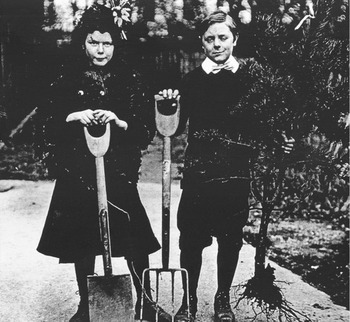
At 2.45 pm on a brisk March afternoon in 1910 a crowd of school children, many resplendent in chaplets and wreaths of evergreen fir-cones, chestnuts and acorns, began to assemble at the Skittles Inn, the famous ‘pub without beer’ near the centre of Letchworth. Joined by an army of adult citizens bearing spades and trowels, they formed a snaking procession headed by the Town Board and the school banner, and began their rather ill-disciplined progress to the site of the planting. As they marched, they raised their voices in The Planting Song:
The trees and their holes, ready dug, were awaiting the group, and on arrival the guest planter, Mr. Hooper Pearson, stepped forward to perform the honour of planting the first tree, to the accompaniment of the children singing ‘The Brave Old Oak’. In the course of a short address he wished both the trees and the city health and good growth, and invited the children to take up the planting. By the end of the afternoon a further three hundred trees were planted, an achievement acknowledged by Ebenezer Howard who, as father of the garden city movement, brought proceedings to a close.Footnote 3
Arbor Day in Letchworth, 1913. Reproduced courtesy of the First Garden City Heritage Museum.

How are we to understand the purpose and meaning of this tree-planting ceremony? Far from being the whimsical local custom it first appears, Arbor Day, both in Letchworth and elsewhere as the movement flourished, became a vehicle through which to address the pressing economic, social and ideological concerns of the day. It dovetailed with contemporary debates on protectionism, the ‘back to the land’ movement, and discussions over the best educational experience for children. Furthermore, by addressing the question of who ought to control woodland in England, it entered into patriotic discourses particularly pertinent during the Boer War. To address these interwoven narratives, this article is divided into three sections. The first looks at why England was receptive to the reports of Arbor Day as celebrated overseas which had been circulating since the early 1870s, and how a distinctly English Arbor Day was influenced by particularly English concerns over woodland. The article then focuses on the appeal of the event to the Society for the Protection of Birds and how, through Bird and Tree Day, it not only reached a wider audience but sought to influence the educational curriculum by promoting a more affective engagement with nature at a time when nature study was increasingly rationalised along scientific lines. Finally, it examines the importance of trees in the first garden city of Letchworth, and how the Arbor Day ceremony became a focal point for individuals trying to forge a sense of community through the organisation of their environment.
I. An Arbor Day for England
The first reports of Arbor Day appeared in the British press in the 1870s, celebrating the ‘special work of the tree-planting movement’ in Nebraska, and putting the number of trees planted anywhere between one million and an ‘incredible’ ten million.Footnote 4 Though inconsistent, all reports emphasised the two aspects of the movement that were to become key to the attempt to establish an Arbor Day in England: it was planting on a large scale, and it was actively promoted by the state. There was some indication that the individuals and the state in England were taking a similar interest in their woodland. The English Arboricultural Society was established in 1881 and an International Forestry Exhibition was held in 1884. The scientific and professional forestry techniques practised on the continent started to gain serious attention and began to challenge the authority of John Evelyn's seventeenth-century treatise Sylva as sources of information on the best means of forest management. In 1885 a Parliamentary Select Committee was set up to consider whether British woodland could be rendered more remunerative by the establishment of a forestry school. It is here we can see the first official reference to Arbor Day overseas.Footnote 5
There was no absolute necessity to replant or preserve woodlands, all sectors being largely untroubled by the country's near total dependence on overseas imports, while the advent of iron-clad warships had steadily eroded the traditional elision of woodland and maritime strength.Footnote 6 As such, patriotic discourse became less focused on the protection of England's ‘wooden walls’, and more on a general unease that allowing English woodland to be drawn into a spiral of over-exploitation and neglect would affect its appearance and character. The result would mean a changed land, with greedy individuals supplanting England's traditional oaks with profitable fast growing soft woods, and a link to her prehistoric past severed by the plugging of gaps in the ancient woodland of the New Forest with the ‘suburban shrubbery’ of Aucubas and laurels.Footnote 7 What Arbor Day in America and the colonies represented, therefore, was not only an active state involvement in the maintenance of the nation's woodland, but also an example of how private individuals could be persuaded to view tree planting as a civic duty as well as a commercial enterprise. Without taking similar measures in England the woodland heritage of the country would be lost forever.Footnote 8
At first glance, the plantings which took place during England's first Arbor Days could not seem further removed from such grandiose ambitions. In November 1888, under the auspices of the Newcastle Tree Culture and Protection Society, Princess Louise inaugurated ‘Arbor Day’ in Newcastle-upon-Tyne by planting a sycamore at the opening of the Durham College of Science.Footnote 9 In February 1897, during the Queen's diamond jubilee, villagers of the small Kentish town of Eynsford planted a row of trees across the school bank in acrostic form to spell out the proverb MY SON, BE WISE! (Maple, Yew, Sycamore, Oak, Negundo, Birch, Elm, Weigela, Ivy, Sumach, Elder).Footnote 10 In 1900, this time along the village street, they planted a Weeping Lime, a Plane, and a Sycamore, commemorating the relief of Mafeking, Ladysmith and Kimberley respectively, as a memorial to the bravery of British troops fighting in the Boer War. Such performances would fit with the process identified by Douglas Davies whereby symbols become a physical manifestation of ideas, that they aid the process of gaining access to and of manipulating otherwise abstract concepts, such as kinship, and self-sacrifice, and are an accessible means of sharing these concepts. The ‘practical symbolism’ of trees in particular is that they stand, both literally and metaphorically, as living entities spanning many generations.Footnote 11 Cecil Rhodes had written to Elliot Downs Till, the founder of the day in Eynsford, expressing such a sentiment: ‘Trees,’ he wrote, ‘are more durable than even a monument. I suppose you planted oaks. What is their life? Curious the desire of human beings that records should last.’Footnote 12 So these ceremonies played upon widely held associations of tree planting with aspirations for the future, as well as with the marking of a notable event.
What lifts the tale of the English Arbor Day from charming parochialism and the purely symbolic, is the way in which it became caught in the tailwind of the debates surrounding forestry in England. The interest and the involvement of Sir George Birdwood, a supporter of the cider industry, and Member of Parliament Radcliffe Cooke, dubbed the ‘member for cider’, in the work of Eynsford sent out an unequivocal message that this supposed revival of the tree planting ‘custom’ was directly related to promoting the economic health of the nation as a whole.Footnote 13 The hope had been, as Cooke made clear in the House of Commons in May 1897, that initiatives such as Arbor Day would be successful through state endorsement, and that the newly formed Board of Agriculture would take its lead from America and Canada and establish experimental farms to help growers to identify the best variety of apple for their climate.Footnote 14 It was becoming increasingly evident, however, that the state was not interested in such interventionist measures. In 1899 they had made a recommendation that the New Forest should no longer be devoted to timber production, and in 1903 a Departmental Committee on Forestry became the latest to make it clear that while the state's interest in woodland management had been piqued, support for large-scale planting emanating from the state would not be forthcoming.Footnote 15 With this, the dream of aping the ‘tree-planters state of Nebraska’ faded.
The message to be promoted through Arbor Day was, however, adaptable. Whilst the grand plans for large scale planting had been curtailed by government indifference, Cooke and Till began to promote the day less as a remedy for deforestation and more as the first step in the education of the planters of the future. In a letter to The Times they made it clear that, as protectionism for farmers was now unlikely, with thousands of acres of uncultivated land failing to be rendered profitable by the systematic planting of trees, the duty of safeguarding Britain's resources lay with ‘average Britishers’ who ‘would scoff at the idea that his country stood in want of trees’.Footnote 16 It was up to producers to ensure the high quality of their goods and to create demand for them, for only then would they be able to compete on the world market.Footnote 17 Tree planting, in Cooke's analysis, was therefore nothing short of being ‘in the nature of a patriotic act’.Footnote 18 Enlivened by processions, bands of music and patriotic songs, Arbor Day would be the perfect vehicle through which to instil a keen interest not only in the planting, but also in the preservation and welfare, of trees. The Arbor Day custom could never take the place of forestry, Till recognised, but it was ‘nevertheless its handmaiden’.Footnote 19
II. The Society for the Protection of Birds and Bird and Tree Day
Whilst this may appear a retreat into the atavistic practice of symbolic tree-planting, it was this refocusing which allowed Arbor Day to gain greater prominence under the auspices of the Society for the Protection of Birds, a crusading organisation with a systematic focus on the education of children.Footnote 20 The Society had heard of the tree planting traditions that were by then developing in America, Canada, Australia, New Zealand and the Cape. In 1901 its Chairman, Mr. Montagu Sharp, arrived at the annual meeting with tales of his recent travels to the wilder parts of America, where he had been struck by the ‘want of bird song and twitter’ and the most oppressive silence. This lack of bird life was, he admitted, in part due to the untrammelled shooting of birds, but it was also a result of the migration of birds ‘consequent on the woods having been cut down’. The solution, he felt, would be to follow the American tradition and institute in England an ‘Arbour [sic] and Bird day’.Footnote 21 The Society launched an essay competition on how best to achieve this. The winner, announced by the Secretary to the Board of Education, Sir George Kekewich was Elliot Downs Till of Eynsford, ‘a gentleman who was almost foremost in doing good to the schools of the people.’Footnote 22
Till was clear that success of the scheme would come only by inducing children to take an active interest in the observance of the day, for ‘the plastic mind of the rising generation forms excellent material for moulding into the desired form; the habits of children become natural to the man’. Most children, he felt, were born naturalists, but their tastes were usually stunted or checked by want of encouragement.Footnote 23 Sir John Cockburn, the Minister of Education who had introduced Arbor Day to South Australia in 1886, was also at the meeting, and agreed unreservedly, for in Australia the idea had taken such ‘deep root’ that ‘he did not think that any school festival was more popular’.Footnote 24 He was certain that no more valuable education could be given to children, whether moral, physical or intellectual, than teaching them to become friends of flowers, birds and trees, which were ‘the choirs in which the winged messengers from heaven chanted the matins and the vespers of their service of song’.Footnote 25 As a result of such support an annual ‘Challenge Shield’ was established and a circular was sent to schools in the counties selected for the competition, inviting children to study birds and trees during the summer months and to write essays upon them under the superintendence of a school committee. The six best papers were then to be sent to the committee of the Society, who would make the final awards.Footnote 26
Bird and Tree Day, by encouraging the observation, care and love of nature as an educational device, intersected with the Board of Education's own particular focus on observation and nature study as part of the curriculum. In July and August 1902, the year the Society for the Protection of Birds inaugurated its competition, the Royal Botanic Society held the first exhibition devoted to the aim and scope of nature study in Regent's Park, displaying work including tree and floral calendars kept by children throughout the year, and their observations on specific types of animals or plants.Footnote 27 In his report following the exhibition, Kekewich expressed the sentiments that he had previously articulated at the meeting of the Society, that no kind of teaching conferred on children ‘so many and such varied advantages’ as nature study.Footnote 28 It is no surprise, therefore, that he so wholeheartedly approved of the Society's project as an activity that would shore up the contemporary philosophy of the Board of Education.
Yet, in some ways the Royal Society for the Protection of Birds diverged from the Board of Education and the concept of nature study as it was understood in 1905. What the Society was proposing through Bird and Tree Day was more akin to an earlier form of nature study, or what were known as ‘object lessons’. These had been made compulsory in the first three standards in 1895 and differed from nature study because while they encouraged children, normally under the age of ten, to acquire ‘the power of exact observation’, they did not ‘exercise the scholars in reflecting and reasoning upon the results of their own direct observation’.Footnote 29 Effete though they may have been in educational terms, compared to the emergent practice of nature study, object lessons served the Society's purposes. They fostered a sentimental love of nature in children which the Society believed to be as powerful, if not more so, than the more rigorous requirements of nature study.
E. W. Jenkins has shown that a persuasive strand of thinking at this time concluded that the natural world could be studied either to discover new truths for the purpose of increasing the sum of knowledge or to develop a sympathetic attitude towards nature, ‘for the purpose of increasing the joy of living’. Object lessons were concerned with the latter. They were not to be equated with elementary, or even popular, science, and their virtues were more affective than cognitive, appealing to the emotional as opposed to the intellectual side of the character. They had at their heart a message that was pedagogical and moral, rather than one which was more narrowly scientific and rational.Footnote 30 This is clearly reflected in the Society's vision for the competition. Often treated as a ‘mere prancing hobby-horse for educational faddists to ride’, nature study, they concluded, was too often equated with simply the ‘dragging of natural (or unnatural) objects into the schoolhouse’. Instead, the Society believed that a more frank and simple understanding of nature would be developed by the national adoption of Bird and Tree Day as an opportunity ‘to send the young student as much as possible out into Nature's larger room, and to create delight and interest in all that lives’.Footnote 31 Increased curiosity about the beauty and utility of nature was, of course, welcomed by the Society, but it also caused them ‘a hesitation and fear lest “natural history” may prove only a synonym for destruction of wild life, and an excuse for the cage, the net, and the “specimen”’.Footnote 32
The Society's notion of nature study was, therefore, rooted in a consciously anti-intellectual position. Groups such as the Royal Society for the Protection of Animals’ Bands of Mercy were already fostering the care and nurture of wildlife, but the Society feared that learning confined to the classroom was not enough, for the ‘sentiment of humanity alone will probably not survive the hard knocks of prejudice and ridicule’. It was better that children should learn about nature at first hand. This would instil a true intelligence about the utility and habits of birds and trees which would stay with them into adulthood. At the same time, making children mere scientific or theoretic apologists would be worse ‘than to leave the unsophisticated bird-nester alone’. The only true appeal should be to a dynamic sentimentalism, grounded in real experience of the natural world.Footnote 33
Through Arbor Day, therefore, the Society carved out a particular definition of ‘naturalist’, with several members of the Committee and Trustees going on to be leading proponents of this particular philosophy of life. Edward Grey, one of the Vice Presidents of the Society in 1902, Member of Parliament for Berwick-upon-Tweed and later First Viscount Grey of Fallodon, was to write as his opening line to The Charm of Birds, published in 1927, that his work ‘had no scientific value’. He did not claim that his personal observations would add anything new to those naturalists who threw ‘new light on territory, courtship, mating, and the intimate life of birds’, but that his observations ‘made for recreation; in search of pleasure, not for knowledge’ and pursued only so they would minister to the pleasure of holidays or home life. This however was a virtue and not a hindrance: as it was not simply the exchange of information which bought bird lovers together, ‘even those of us who have nothing new to tell, may have something that is fresh to say’.Footnote 34 Similarly, William Henry Hudson, who had been a founding member of the Society and sat on the committee during discussions of Bird and Tree Day, had already published Nature in Downland in 1900 and would go on to write Hampshire Days, both volumes documenting his tramps and rambles through the countryside of southern England, observing forms of plant and animal life, and describing the country folk he met.
Although an author of fiction, Hudson had made a significant contribution to the two volume study, Argentine Ornithology, which was published in 1888. The impressionistic and literary observations of nature which were to characterise his later work, and which dwelt on the joy of personal observation as opposed to the purposeful scientific reasoning to be obtained from those observations, were therefore less a product of his inability to be a scientifically minded naturalist than of a conscious decision not to be.Footnote 35 It has been said that Hudson took a great interest in Bird and Tree Day from its inception for this very reason.Footnote 36 The poet Edward Thomas, in his introduction to a 1909 edition of Richard Jeffries’ The Hill and the Vale, was also keen to emphasise that despite Jeffries’ former life as an agricultural journalist his approach was of ‘informal chitchat, addressed chiefly to the amateur naturalists’ and that ‘the full English hedges, which he condemns as an agriculturalist, he would now save from the modern Goths; he can even be sorry for the death of beautiful jays’.Footnote 37
So this conscious choice of the affective and sentimental, over the purely scientific and rationalist approach to observing nature was arguably a distinct definition of the meaning of ‘naturalist’ at this time. It was not the only approach represented at the Society, its membership including the self-confessed ‘scientific MP’ Lord Avebury, who held a famously anti-sentimental approach to nature, but it was the one which appears to have been most influential in relation to Bird and Tree Day.Footnote 38 The Society credited this sentimental but genuine and vital engagement with the natural world with the ability to make a real contribution to ameliorating the perceived problems of the early twentieth century. The ideas surrounding nature study had emerged at a time when, in the Society's own words, ‘tales of mean streets, of sordid poverty, and of declining physique, with an answering cry from the country of “no labour”, brought up theories of “back to the land”’.Footnote 39 When the fog of two decades of agricultural depression lifted in the late 1890s, it revealed an empty countryside. The workers had been driven to the cities by hunger, poverty and desperation, only to find those cities to be polluted and unsanitary places, full of unsavoury characters and practices, and with high levels of unemployment and destitution. The result was a voluble concern from the philanthropic classes that the urban industrial system, once vaunted as being the touchstone for Britain's economic prowess, had become tarnished and ought to be dismantled, with calls for people to resettle back in the country and for the economy to return to craft workshops and guilds.Footnote 40
The Society fully subscribed to the restorative benefits of a return to the land, for nature study would undoubtedly stimulate observation and cultivate the intelligence of the child. Country life would ensure that children realised that there was ‘more to education than algebra and pittman's shorthand’.Footnote 41 Moreover, life in the country might be rendered more attractive to the rural population.Footnote 42 H. D. Rawnsley, co-founder of the National Trust and a prominent member of the Society, felt that those who lived in the country knew that unless country life could be made full of interest, it was quite impossible to ‘induce the farm lads and lassies’ to stay there, so that everything they could do to make the ordinary life of the toiler in the fields more attractive, ‘was a distinct gain to the nation's being’.Footnote 43 The Society's agenda was based on a genuine belief that not only the encouragement of the observation of nature in general, but also a very specific festival associated with Bird and Tree Day, would substantially improve the quality of rural life. It envisaged these festivities as forming an essential part of the community life and there was a genuine desire for the day to become a community event, supported by local residents.
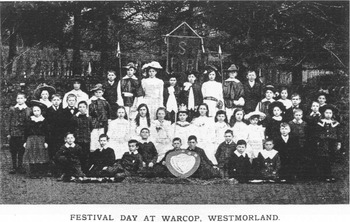
Festival day at Warcop, 1916, by permission of the Royal Society for the Protection of Birds archive.

In some places this vision was realised. In 1906, in Warcop, Westmoreland, where, it was noted, they also celebrated the ‘ancient custom of rushbearing’, the event was attended by members of the community and the children created a perfect Arbor Day tableau at the presentation of the Challenge Shield at the Temperance Hall. On the platform, decorated with ‘plants and fairy lamps, was some thirty of the head scholars – the girls in white, the boys in foresters’ dress – grouped round the crowned “queen” of the festival, who bore her wand of office.’Footnote 44 Reports from other days describe senior girls ‘dressed in white with trails of ivy and holly’ and at one Somersetshire school the day included songs, dialogues and a Maypole dance.Footnote 45 In most instances in addition to the tree planting, which constituted the focal event of the day, there was also some sort of school concert, entertainment, lecture, band parade, procession, tea-party or the acting of children's plays. Mrs. Suckling, a vice-president of the Society and organiser of the festival in Awbridge, even produced a musical play “Bird and Tree Day” to be performed at the fete.Footnote 46
Reduced to these terms, it is easy to agree with Martin Wiener's assertion that the key note of English culture during this period was a retreat from the modernity characterised by urban industrialisation into a mythologised rural past of a green and pleasant land, complete with a contented rural population and the return of the squire and the stately home as touchstones of country and national life.Footnote 47 Without doubt the Society had a very specific ideal which they hoped to promote through the competition, and it was almost exclusively rural. They felt that the enthusiasm for observing nature fostered by the competition ‘would help Englishmen to understand what England was in the old days when birds sang in every field and on every tree, and when men listened to them and their hearts were glad’.Footnote 48 In some ways the Society was also cultivating a distinctly rural vision fashioned on a nostalgic version of ‘the south’. Alun Howkins has described this ‘south country’ as characterised by rolling hills, thatched cottages, village greens and hedgerows and therefore conceptually encompassing Shropshire but excluding Cornwall, by virtue of being too rocky and craggy.Footnote 49 Similarly Denis Cosgrove has demonstrated how this ordered and domestic scene of ‘country house, cosy cottage and herbaceous border’ has come to characterise an English landscape, and in particular the ‘Constable Country’ of the south.Footnote 50 One speaker mused during early discussions of the competition ‘how delightful England might be if every cottage was surrounded with flowers and trees, including the walnut, which was a great feature of Sussex’.Footnote 51 By 1907, Bird Notes and News was bewailing not only the ‘defection’ of Westmoreland from the competition but also the disappointing standard of the competition in Cumberland. The traditions of the Lake District really ought, in their opinion, to have stimulated such work, there being plenty to inspire young naturalists. The conclusion of the Society was that this indicated ‘that the north of England is not so keen on nature study as the South’, and that this was to be lamented.Footnote 52
Yet, it does not seem useful to read too much into this division in the performance of schools in the north and south. A more significant division seems to have been between the rural and the urban, particularly given the type of naturalistic observation that was promoted in the competition. Although notionally open to all schools within the chosen counties, it was clear that those schools in urban areas competing in the Challenge Shield were at a distinct disadvantage. Bird Notes and News reported in 1912 that Dosthill School in Warwickshire had furnished teams ‘both of which must have worked zealously to achieve so great a measure of success, especially when it is remembered that this is a colliery district, where, as one of the essayists writes, Trees are poisoned by smoke’.Footnote 53 This would suggest that the Society was not just promoting observation of nature as it presented itself, but rather the observation of an idealised form of nature. This poisoning of the trees by smoke was not of itself interesting, and there was no attempt to extrapolate from this observation the adverse effect on the tree or the surrounding wildlife as we might expect had a scientific approach been encouraged. Instead, it was commented upon only because it was seen as a barrier to the achievement, and therefore observation, of ‘proper’ nature. This did not exclude children in towns from winning the prize, and indeed some of the principal winners in 1911 were from urban schools, but a pastoral environment was seen as something of a benefit in the competition.Footnote 54
In addition, the Society did not appear to be interested in promoting a particular type of tree for observation. There are some traces of the contemporary debate over the ‘native’ versus the ‘alien’ species of trees. There is, for example, the comment about how a description of the ‘exotic’ Rhododendron, ‘with others of its kind, would be better replaced on the lists by British hedgerow shrubs’, but for every remark of this kind there is another such as that which observes, without any trace of judgement, that the children were looking forward to the old elms in the church avenue being ‘replaced by evergreens’.Footnote 55 Instead, the emphasis was laid, as it was beginning to be at national level with the appointment of E. H. Howard (later Sir Stafford Howard) as Commissioner of Woods in 1893, not so much on the provenance of a tree but rather its suitability. The point here was not necessarily that the tree should be ‘native’, but rather that it should grow well in the available soil and conditions. Emphasis was put on the importance of proper care and recognition of the individual value of the trees. Bird and Tree Day was therefore concerned not so much with the promotion of a certain type of landscape as with abstract notions of nurture and posterity through a generalised rural vision.
This raises the question of whether the Society succeeded in propagating this ruralist vision. In dissenting from Wiener's thesis, Peter Mandler's principal objection is not that this vision of a nostalgic, deferential and rural ‘Englishness’ did not exist, but rather that it was culturally marginal and confined to a small, albeit articulate, elite.Footnote 56 The two positions are not exclusive, as Paul Readman has demonstrated by looking at the numerous preservationist societies which emerged in the late nineteenth century. It was possible for an organisation to have an intentionally small and unrepresentative membership, whilst still reflecting ideals held in wider society, and seeking to bring their influence to bear in ways which benefited people beyond than their immediate circle, and even, in the case of an organisation like the National Trust, the nation as a whole.Footnote 57 It is at this interstice that the Society for the Protection of Birds positioned itself. It is undeniable that the Society had a narrow and elite membership. Supporters of Bird and Tree Day included, in addition to Rawnsley, the Duchess of Portland, who was President of the Society; the Marquess of Granby, who felt that the Day would ‘be found practicable to effect such an institution in these prosaic times in matter-of-fact England’; the Duchess of Somerset; the Earl of Stamford; Lords Avebury, Reay, Overtoun and Wolseley, and the Earl of Jersey.Footnote 58 In Eynsford, Till fancied himself a benevolent Lord of the Manor, and as a member of Society for Checking the Abuses of Public Advertising, was part of an organisation with a small membership but lofty aims. His friend in parliament, Radcliffe Cooke, was a substantial Hereford landowner.
Yet it would be unfair to characterise either the Society's efforts, or those in Eynsford, as simply the manifestations of a narrowly based agenda to recreate a type of anachronistic idyll. The vision was undoubtedly rural, and to a degree nostalgic, but it was anything but a retreat from modernity. It may have posited an arguably conservative solution to the social problems of the day, but it always did so with an eye to the future. The Society's vision for Bird and Tree Day, beyond that of simply fostering a love of nature and a renewed interest in the countryside, was that it should contribute to the improvement of an entire generation. The first purpose was to teach children to care for plant and animal life, but it also offered ‘indirect training in quick and safe and sure observation’. This was a skill of utmost value, the need for trained eyes and swift observation on the part of soldiers having been clearly demonstrated during the Boer war of 1899–1902.Footnote 59 In 1910 Henry Rider Haggard, the well-known novelist and writer on rural affairs, spoke at the prize-giving ceremony in Norfolk, concluding that many serious accidents had befallen British troops during the war because men were town-bred and could not match the Boer on his veldt: ‘If we are to continue to build up our nation,’ he concluded:
We must teach townspeople something of the charm of Nature. . . Such schemes as the Bird and Tree Competition gave to children the uncommon gift of observation, and taught them to admire, to wonder at, and to love that beautiful creation which was at once the handiwork and the visible garment of God.Footnote 60
This was not just lip service. The genuine observation of nature was a strict criterion for judging the essays, and there are numerous references to the unacceptability of reliance on books as opposed to the first-hand observation. Those who did this invariably did not win the prize.Footnote 61
It is clear from the tone adopted during such discussions that the aim was to halt not just the physical but the moral degeneration of a generation. Training individuals to utilise their God given faculties would undoubtedly bring tangible benefits to the nation but only if developed in concert with moral rectitude and self control. Focusing the development of such sensibilities through the natural world was nothing new: by the late eighteenth century both juvenile natural history and moral fiction were packed with uplifting messages about how it was virtuous to treat animals kindly, and these messages were reinforced by the founding of the Royal Society for the Prevention of Cruelty to Animals in 1824. This kindness to animals, particularly admirable in boys to whom it did not seem to come naturally, demonstrated a child's exercise of self-control over their baser instincts and their understanding that to contravene this moral code would be to alienate themselves from a community based on the English virtue of ‘humanity’.Footnote 62 It is a narrative taken up by the Boy Scouts in the twentieth century with Scouting for Boys, published in 1908, enjoining Scouts to be kind to animals as well as honourable, loyal, useful, friendly, courteous, and financially thrifty.Footnote 63
In explicitly aligning itself with the Scouts by 1910, the Royal Society for the Protection of Birds was, by implication, adopting a similar moral exemplar, albeit focused less on the ideal masculine character, and more on a wider conception of citizenship earned through a specific type of conduct, which rewarded a non-invasive love of nature, and discouraged destructive behaviour.Footnote 64 In this it was clearly aligned to the wider outdoor movement gaining momentum at this time. This centred on leisure based escape to the country, which borrowed from the idea of ‘muscular Christianity’, but also rejected the inherent athleticism and obsession with physical prowess that this implied.Footnote 65 The Society was therefore part of the movement which sought to temper this ‘masculine’ athleticism with an appeal to a quieter, more emotional and contemplative appreciation of nature, uncomplicated by scientific reflections, and which fostered a genuine love of nature. This type of ‘naturalist’ would, by extension, become part of a happier, fitter, more productive generation, to the benefit of humankind as a whole. It was the ability to translate these abstract concepts and ideals into physical form which signalled the true importance of trees within Bird and Tree Day. The competition was arguably better suited to the observation of birds, with their animated habits and the visible playing out of the milestones of their lives, but the attendant fetes held by successful schools focused almost exclusively on the tree planting ceremony. This was in part because, as with Princess Louise and the sycamore at the Durham College of Science, the planting of a tree was comparable to the planting of an ideal. If firmly rooted and nurtured, it would grow steadily and healthily and oversee many generations to come.
The Society, however, was also quick to exploit the contemporary resonance of tree-planting. It would be incorrect to posit that Bird and Tree Day was initially about afforestation, since it is clear from early discussions that the protection of trees was seen as a necessary factor in the protection in birds but not necessarily important in itself, but references to afforestation gradually increased in the literature surrounding the Challenge Shield. The Annual Report for 1904 trumpeted that Arbor Day, a term that was increasingly interchangeable with ‘Bird and Tree Day’, was ‘without doubt a national festival for the future’. Following the introduction of Bird and Tree Day by the Society, the question of afforestation was rapidly becoming of national importance as a result of the 1903 Select Committee, and the Society felt that Arbor Day was now recognised as ‘not merely an ornamental appendage but of practical value to the movement’.Footnote 66 In December 1907, a year after a Royal Commission on Coastal Erosion and Afforestation had been appointed, the Society was quick to defend the commercial as well as educational value of Arbor Day: ‘when Arbor Day was first suggested’, it reported, ‘a common objection was “We have too many trees in England as it is”, or “If we want trees, what is the good of one or two planted by school children?”‘. Yet now it was clear that the value in Arbor Day lay in its ability to train children in some understanding of the uses and properties of trees, and of instilling by object lesson the necessity of tree planting for the benefit of forestry and the industries which depended upon it.Footnote 67
Therefore Arbor Day, as promoted by the Society, clearly tracked the arc of national interest in forestry. By making a link between their own concerns and the wider national project, it was part of a strategy to establish a Bird and Tree Day, recognised by the National Education Department. Back in 1902 Kekewich had been careful to manage expectations. Whilst he heartily approved of the initiative, he felt that the celebration ought to fall on a Saturday, since ‘he always hesitated as a humble servant of the Board of Education to give his approval to anything which involved the change of an existing law’.Footnote 68 In practice, the competition and the accompanying festival were often given visible support by the local education authorities, with the Chairman of the local Education Committee making an appearance as a key speaker on the day, and in many counties the competition was organised by the County Education Authority.Footnote 69 The Society's wider aim to have Bird and Tree Day recognised as a public holiday was even further from their grasp, but being able to demonstrate the contemporary relevance of their agenda would have done this objective no harm.Footnote 70
It was on Festival day that this cross-narrative of the educational, sentimental and commercial value of trees really came to the fore. The competition itself, by encouraging close observation of a particular tree, actually fostered an atavistic regard for the care of individual trees rather than a mass production outlook, which could be equated with the particular kindness to animals that was also encouraged at this time.Footnote 71 The tree that was planted at the Festival was, however, imbued with a far wider meaning. The rationale for the competition was not only that it might impart a happy interest in, and love of, birds, but also that it would lead to a knowledge of the aesthetic value of trees: ‘thus the humble saplings planted in school grounds or village green points to the garden-cities which are to come, and to the re-afforestation of England, urgently recommended as a commercial asset of the future’.Footnote 72 It was clear to the Society that the trees planted during the festivals ought to stand as an exemplar. In their promotional material for the competition, the Society informed Educational Authorities and schools that ‘with regard to the planting of trees, it is desirable that care should be taken that only those kinds which are suitable to the soil and are likely to become of real utility should be selected’.Footnote 73 Indeed, in 1909 Close Hill School in Cumberland looked forward to the tree planting when twelve apple stocks would be planted in the school garden so that the boys could learn to graft.Footnote 74 Again, the symbolic power of trees was used as a ‘physical manifestation’ of an idea, of hopes for the future, of the lessons learned by a new generation about the appreciation and care for nature and how this would work for the betterment of society as a whole.
III. The moral custodianship of trees in the first Garden City
The use of the health of trees as a marker of success or failure became particularly pertinent in the case of the Arbor Day in the first Garden City of Letchworth. The Royal Society for the Protection of Birds, as has been noted, alluded to the competition as part of the larger ‘back to the land’ project and to the garden-cities that were to come. In 1906 the Daily Mirror reported that the celebration of Arbor Day in ‘the artistic village of Eynsford’ allowed the place to be able to lay claim to being ‘a miniature “garden city”’.Footnote 75 A connection had clearly been made between Arbor Day and the main aims and aspirations of the Garden City project. Arbor Day was predicated upon, and sustained by, notions of the careful and appropriate care for trees, not only as a demonstration of an ideal, but as a symbol of the commercial regeneration of woodland. In Letchworth, these concerns were heightened by the realisation that in order to produce the type of environment desired, effort was required to exploit and in some cases tame those resources and to address the integral question of fertility. For the fertility of the Garden City was not always assured. The First Garden City Company had to make great efforts to overcome natural impediments, not least the nutritionally poor soil.Footnote 76 Trees, therefore, played an important role in the production of a fertile, welcoming and green environment for the inhabitants of the new city.
In Garden Cities of Tomorrow, Ebenezer Howard set out his vision for a town with a ‘semi-rural appearance’, and commented on the vital role to be played by trees, shrubs and grasses. Whilst he envisaged that much of the planned forty acres of park space could be left in a ‘state of nature’, he noted that the planting of trees and shrubs on this land ‘would not entail great expense’.Footnote 77 Writing in The City, the monthly magazine for Letchworth, six years after its founding in 1903, the company forester, F. J. Cole, was proud of what the company had achieved and wrote of it in terms of taming a frontier. When the Garden City Estate had purchased the land, much of it was ‘unprotected by trees – conditions very similar to those which obtain in some of Colonial towns’. They were confronted with impoverished soil, timber felled but not replaced, healthy trees robbed and diseased trees left. The city was saddled with exhausted veterans and without young, healthy specimens. The company had worked hard to ‘remedy this evil’, its staff having planted 100,000 young trees, many purchased and grown on nursery beds until they had attained ‘sufficient vigour to fight for themselves in the hedgerows’.Footnote 78 It has been suggested that whilst care for the natural world is an emotional commitment to be encouraged, especially in children, it is apt to slip into a sense of custodianship, then of possessiveness, and then into a habit of seeing the natural world as not just in need of protection, but unable to thrive without that help.Footnote 79 This is something we can see in the Royal Society for the Protection of Birds competition, but which became particularly relevant in Letchworth.
This careful nurturing and protection of trees in Letchworth could be regarded as intuitive to the founders of a city which was a wholly artificial construct, but carefully planned to give the impression of being of natural, organic but ordered growth, as opposed to the chaos of the urban city. The purity of the environment and the fertility of soil, once it had been brought into the proper condition, could be demonstrated by the liberal planting of trees. Each avenue had its own distinct variety, to produce the shady avenues of the future. In smoky towns the planting was confined to a few smoke resistant trees, ‘but in the pure air of the country there is no reason why there should not be great variety’. Cole, for one, believed they could produce a ‘model arboretum’ at Letchworth.Footnote 80 To achieve this there would be no place for sentimentality for old trees, no fixity of variety, and, most importantly, strong encouragement for respect for the trees already planted. By 1909, Cole was already concerned that new trees and shrubs had been thoughtlessly damaged by people treading them down ‘for the sake of “short cuts”’. Whilst he realised that it might appear prescriptive to interfere with the movements of ordinary people, it was important that ‘more public spirit should be shown in protecting what are really in the interests of the residents in general’.Footnote 81 The company was already setting itself up as the moral custodian of the trees of Letchworth and to be one of the ‘few careless or malicious people’ damaging the plant life would be to risk community marginalisation in a city which was built on civic responsibilities.
This raises the question of why ceremonial tree planting such as that carried out on Arbor Day should be so important in a city where the very practical planting of trees, and on a large scale, was already practised, and why it should be taken up with such enthusiasm. The Citizen, with tongue gently in cheek, describes the first Arbor Day in 1908 as a perfect scene from Merrie England. The youngsters set out:
Festooned and gay with greenery, with a brave dash of red worn by the Noel Home girls, and followed by eke many a gallant knight and courtly maiden, determined to ignore the snow and cold, and shouldering spades (yea, even the said fair females).Footnote 82
It would be easy to read from this that the ‘tradition’ had been manufactured by the inhabitants of the city as a vision of an idyllic rural life. Standish Meacham has suggested that the men and women who founded Letchworth did so by constructing a myth of a green and pleasant heaven to replace an ugly and unhealthy urban hell. In this they turned away from Howard's own forward thinking, and conjured an alternative ideal predicated on a type of Englishness that saw resolution to present difficulties and uncertainties in a mythic imagining of a pre-industrial, rural and hierarchical society.Footnote 83 There are problems with this analysis, and I have already noted that expressions of apparently anti-modern, anti-urban sentiments were not clear cut. Before addressing this characterisation of the founders as reactionary, it is worth exploring how this sense of a unified vision of the community was instrumental in establishing Arbor Day in Letchworth.
The identification of the form of the Letchworth Arbor Day with a strong sense of civic ideals is borne out by the fact that far from springing from an elite vision, the impetus and planning of the event originated with the residents themselves. As early as November 1906 the idea of Arbor Day had been discussed by the Letchworth Branch of the Garden Cities’ Association, later to become the Residents’ Association, as a celebration for the whole community. Cole had attended the meeting to provide information about the trees to be planted by the company near the station in the hope of improving its aspect, and at this meeting a discussion about Arbor Day was introduced, although not concluded.Footnote 84 In March 1907 The Citizen credited a couple of lines in the Manchester Guardian for refreshing their memory as to Arbor Day, which had not been forgotten by citizens of Letchworth, but had been subsumed by elections and other important functions which had been given greater, ‘and perhaps less worthy’, prominence.’Footnote 85 The paper praised the company and its forester for being particularly active in the ‘good and abiding work’ of tree planting, and felt it was natural that the company should support the idea of a local celebration of Arbor Day, as it was, after all, ‘very closely allied . . . to the aim of the Garden City Association and the Company’. It should indeed have been ‘a foremost item in Garden City propaganda work!’Footnote 86 Yet it was also quick to pose the rhetorical question of whether, whilst the company notionally supported the project, the citizens of Letchworth could join in with it ‘in making a big, public celebration, the first of many Annual ones?’ The city, after all, was ‘a commune’, and the citizens should be delighted to share in this tree-planting ‘as an opportunity for the exhibition of a communal delight in a beauty that is art, and art that is always beautiful’.Footnote 87
This suggestion was something which appealed to the Residents’ Association. Shortly after the piece in The Citizen, they invited Miss L. Gardinier, Secretary to the Royal Society for the Protection of Birds, to attend their meeting and speak on the protection of birds. During the course of her talk she hoped that Letchworth would see its way to instituting Bird and Tree Day, and the Association minuted a resolution to look into what could be done among the children to that end.Footnote 88 Yet, the form the ceremony eventually took in Letchworth did not follow the Society's example, and there is no indication that they became involved in the Challenge Shield. Instead, an Arbor Day Committee was formed in 1907 and that the resulting celebration should be an evocation of an Arthurian legend fits easily with other citizen-led projects. The city's Folk-Drama, for example, was described:
As a ray from the heart of the sun, a spirit of pageantry, fellowship and joy has touched our old strongholds, and the slumbering life within has burst forth in the drama of pageantry, in whose scene the people live again the life that built their city's triumph.
Such events were a manifestation of the socialist dream to do away with the individualism which had been fostered by capitalism at the expense of community, and Folk-Drama should encourage them to:
Join hands with those who, like Ruskin, like William Morris and his brotherhood, see in the spell thus laid upon the world the curse of separateness: - the things of life, the powers of life, set apart, divided and subdivided until unity has fled and vision is dimmed.
The Pageant would unite ‘the man at the plough, the wagoner with his team, the potter at his wheel’ with others and in that they would have representations of the main activities and interests that made civic life.Footnote 89
It is easy to see a correlation between these ideals and those invested in Arbor Day: the celebration of a community coming together to create a new beginning and say something about its future. Despite this, and the presence of Sir John Cockburn who was an important figure in the movement, the first Arbor Day in 1908 was a muted affair. The Citizen reported that the effort had not been ‘too ambitious and was characterized by the heartiness with which the children entered into the spirit of the occasion’. Although underwhelmed by the occasion, the reporter did look in anticipation towards ‘what this latest child of our Garden City movement’ might grow into.Footnote 90 The following year, the aspiration that the event would grow in importance came to fruition with the presence of Rider Haggard as chief planter. Haggard was at this time sitting on the Royal Commission on Coast Erosion and Afforestation, which had just published its second report.Footnote 91 As a tree planting ceremony, therefore, Arbor Day had a contemporary political resonance which Haggard, like the Royal Society for the Protection of Birds, was quick to exploit. The state, he commented, was not going into afforestation as an interesting speculation, or because it desired that the children and grandchildren of the future would have timber and shade. In this time of depression, the only reason that would induce the state to go into it at all was that it would help in the matter of unemployment, and the Commission could only advise them to undertake such large scale work on a commercial basis. As such, afforestation was peculiarly a task which should be ‘undertaken by the nation for the benefit of the nation’.Footnote 92
In this way, Haggard alluded to a problem which had characterised the movement since its earliest days, and had been such a source of frustration to Till and Cooke: namely, the reluctance of the state to become involved in large scale tree planting. Haggard understood that an objection to afforestation was that it was ‘“naked Socialism” of the worst order’, because it proposed that the state should take up land and carry out the business of rearing trees, which should be left to the private individual. This, he suggested, was nonsense: ‘Men unfortunately died, but the state did not. . ..A tree took some eighty years to grow to perfection. What chance would the individual have of seeing his work accomplished?’Footnote 93 Haggard's speech beautifully encapsulates the tensions which existed between the commercial and affective aspects of tree planting, which had been adumbrated in Eynsford but were given further definition and force when the question of afforestation was played out on the national stage. His speech could not have failed to appeal to the inhabitants of a city which was clearly not part of the state, but had been founded on private enterprise and had the ability to act collectively and to determine its own future. The Citizen for one agreed with his sentiment that the youngsters of Letchworth were ‘planting for posterity’, the paper concluding it had been a ‘second right good Arbor Day planting for futurity and the good of the City that is to be.’Footnote 94
It could be suggested that for such a new society, which prided itself on being artificially constituted, to be enacting a ceremony as a form of ‘custom’ had a particular appeal. A society without tradition was attempting to create one of its own. This seems to be overstating the case for Letchworth. There is, however, something in the notion that the symbolic nature of tree planting, as an act of community engagement, and of futurity and longevity, was nowhere more important than in a city which was, essentially, attempting to establish itself from scratch. There was certainly a sense of ownership of Arbor Day by the residents of Letchworth. When the event was postponed in 1911 ARBOR VITAE wrote to the paper expressing not only disappointment, both for himself and for the children who had so been looking forward to the event, but also disquiet about the motivations of the Arbor Day committee.Footnote 95 In strongly protesting against the postponement of the ‘splendid institution’, he concluded that ‘there is something behind this matter which the general public are not cognizant, and we citizens have a right to know what it is!’Footnote 96 The Ceremony resumed in 1912, the chief planter being Walter Crane, a socialist prominent in the Arts and Crafts movement, and the artist behind the rustic iconography of the frontispiece for Garden Cities of Tomorrow. In 1913 there was a procession down the main thoroughfare of Leys Avenue, ‘bearing aloft the firs, so that it seemed as though a scene in “Macbeth” were being repeated with the wood of Birnam removing to Dunsinane’.Footnote 97
Yet, although the ceremony continued to provide a focus for the community, there was a degree of disquiet about the larger environmental project at Letchworth. Entreating, in the words of a famous song, ‘Woodman, spare that Tree!’, FAIR PLAY wrote to The Citizen in January 1913 arguing that the wholesale destruction of ‘one of the prettiest hedgerows in Letchworth’ was ‘the latest act of vandalism on the part of the Company whose “ideals” have now fallen upon evil days’.Footnote 98 So there was clearly an emotional investment in silvaculture as a visual manifestation of the ideals on which the Garden City had been founded, and a defence of the ‘custom’ of Arbor Day, which had become something of a civic duty. This, therefore, is the irony in seeing Arbor Day as an expression of anti-modern sentiments. The city had been brought into being by Howard's ‘grand principle’ that everyone was equally entitled to the use of the earth, and therefore all land ought to be held in common. Meacham's analysis of the project is that the residents of the City, as conservatives, betrayed Howard's vision for the city which had been grounded in his radical, avant-garde approach. Yet this ceremony was not the work of Mandler's reactionary derriere-garde. The citizens saw themselves as the ultimate custodians of the physical environment, and through Arbor Day they had decided on a solution to the environmental problem through essentially democratic means, grounded in a utopian vision and carried out as an act of community.
Conclusion
If someone had taken a snapshot of the Arbor Day movement in 1910, it would have captured the festival being celebrated across the country. In counties from Cumberland to Somersetshire children were receiving their Challenge Shield and commemorative book on bird life, and no doubt looking forward to the festivities to follow. In Letchworth, Mr. Hopper Pearson, the editor of Gardener's Chronicle, was expressing the hope that the spirit of the day, that of ‘tree-love’, would make children realise there are ‘many better reasons for trees than tree climbing’.Footnote 99 In Eynsford, Sir John Cockburn and the Member of Parliament, Mr. Henniker Heaton, who had been depicted as cherubs on the invitation, were heeling in the first saplings of the day watched by a crowd of villagers, wrapped up against the cold. These performances seem to be the culmination of that optimistic talk of the ceremony becoming a tradition in England. Radcliffe Cooke had written to The Times to express his view that to plant trees in commemoration of public events, distinguished men, or the visit of crowned heads was a custom that went back to the earliest times in the recorded history of man, ‘and Arbor Day is but an extension of this custom’.Footnote 100 The Literary Review, in crediting the celebration at Eynsford as the first of its kind, also felt that ‘it is to become a custom, and is at present only an experiment; but that was once true of every custom in the world. It was a good experiment and will become a good custom.’ Indeed, the article went so far as to suggest that the occasion was ‘just suited to one branch of the great work’ carried on by Benjamin Stone and his photographic survey, ‘that of making an illustrated record of local customs’.Footnote 101 Yet this year marked the zenith in the observance of Arbor Day. Celebrations in Eynsford, held only sporadically after 1912, ceased after Till's death in 1917. In Letchworth, the First World War marked the end of the festival. The Royal Society for the Protection of Birds’ Bird and Tree Day had always battled with wider indifference, noting that residents ‘in some certain districts refrain, to a disappointing extent, from the helping the nature studies and the Bird and Tree fetes of their young neighbours’. By 1964 the essay writing element was finally deemed outdated, since the quality of the entries and enthusiasm for the competition had been diminishing for some time.Footnote 102
What appears to have sounded the death knell for Arbor Day was the state appropriation of timber production, expedited by the First World War. As an increasing level of tonnage crossing from the Baltic and Canada was being lost to German torpedo strikes during the middle years of the war, the Forestry Sub-Committee of the Reconstruction Committee, with F. D. Acland as its Chairman, recommended that the country should seek to break the traditional reliance on imported timber, and grow more timber within the British Isles. This process was initially overseen by an Interim Forestry Authority, with the Forestry Commission being established as the permanent body in August 1919 by the Forestry Act. This legislation both signalled and reinforced the increasingly inflexible belief that the management of the nation's timber resources ought to be entrusted to the state as opposed to individuals, as it alone had the sufficient technical and scientific reach required for such a large scale and long term endeavour. It was in this political climate that The Times pinpointed the ‘problem’ with Arbor Day: whilst of course all such efforts should be encouraged, it was ‘not enough to push an acorn or a sapling into the earth and to leave its growth to chance’.Footnote 103
Yet, the curtailed lifespan of the ceremony does not diminish its relevance. Arbor Day was referenced in Parliamentary Select Committees, mentioned in the House of Commons and picked up by the national press and this suggests that there was an awareness of the performance and meaning of the ceremony which belies its local and seemingly quaint origins. This article has demonstrated how responsive Arbor Day was to the changing currents of thought not only over the question of woodland management, but also in relation to the larger social and economic concerns of the day. The narrative coming from Eynsford may have had much in common with the old tradition of tree planting as an act of memorial, but woven into these already well established associations with longevity, posterity and futurity were well defined and pertinent economic messages about how the state ought to support the producer in a free trade world. It was only when this call went unheeded by the government that focus shifted from commercial planters to the education of children in the purposes, beauty and utility of nature. Here the Royal Society for the Protection of Birds, through the promotion of Bird and Tree Day, was able to refine and promote its vision of the naturalists of the future. They believed that a child, reared on due respect and love of nature and who chose a sentimentalist response to nature which at its heart was purposeful and vital, would become part of a fitter, healthier and more morally upstanding generation. In Letchworth, Arbor Day became a focal point in the battle for the moral custodianship of trees, which in turn became part of a wider discussion about the behaviour expected of a citizen. The presence of figures such as Rider Haggard also ensured that the ceremony became a platform through which to address the pressing national issues of unemployment and the health of the nation, and clearly demonstrates how Arbor Day played a role in helping a generation to understand and order the rapidly changing world in which they lived.
Acknowledgements
My gratitude goes to Dr Paul Readman of King's College London for his consistently careful readings and encouragement of my work, and to Dr Dan Browne of University College London for his invaluable comments on an earlier draft of this article. I would also like to thank the anonymous reviewer for his/her thoughtful and encouraging comments.