1. Introduction
With the changes of service objects and developments of task demands, the applications for the advanced control algorithm and driving technologies of robotic arms are also increasing. However, the high sensitivity and maneuverability of the typical robotic arm is limited by an inherent characteristic that the joint actuators are mounted onto the arms themselves [Reference Costa, Wullt, Norrlof and Gunnarsson1, Reference Chen and Guo2]. Hence, in order to avoid this problem, scholars have conducted extensive research on the applications of parallel mechanisms and hybrid mechanisms in the field of robotic arms. Among them, the configuration synthesis [Reference Ye and Li3, Reference Wei and Dai4] and performance optimization [Reference Meng, Xie, Liu and Takeda5, Reference Li, Xu, Wen, Qin and Huang6] of the mechanisms are one of the most important research contents.
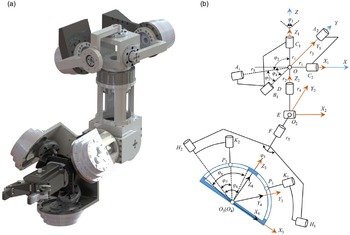
Generally speaking, there are three types of mechanisms: serial mechanisms, parallel mechanisms, and hybrid mechanisms. The serial mechanism is the typical configuration of robotic arms with a large workspace and flexible movement [Reference Datouo, Ahanda, Melingui, Biya-Motto and Zobo7]. However, the joint actuators are mounted onto the bottom of the link will cause a bulky mechanical structure, large moment of inertia, and low payload to weight ratio [Reference Sun, Lian, Song and Feng8]. Compared with the serial mechanism, the parallel mechanism has a compact structure, and its multiple closed kinematic chains can provide greater stiffness, higher payload to weight ratio, reduced inertia, and higher precision [Reference Baron, Philippides and Rojas9, Reference Sun and Yang10]. Although the parallel mechanism effectively compensates for the shortcomings of the serial mechanism, it also has the disadvantage of small workspace and large lateral size. The hybrid mechanism, which combines series mechanisms and parallel mechanisms through different structural configurations, exhibits broad application prospects. As such, the serial mechanism can provide a larger position space for the end manipulator, and the parallel mechanism can guarantee the stronger stiffness and greater load capacity of the entire mechanism as well as the higher positioning precision. In our previous work [Reference Sun, Li, Wang, Chen, Chen, Zeng, Zhao and Yue11, Reference Sun, Li, Chen, Zhu, Zhong and Chen12], a novel eight-degree-of-freedom hybrid humanoid robotic arm (HRA) is proposed to realize the kinematics characteristic of the human arm that is to cooperate with the hand to perform partial fine operations, as shown in Fig. 1(a).
Structural configuration of HRA (left arm): (a) Three-dimensional model; (b) mechanism diagram. The revolute pairs H 3 and K 3 and the prismatic pair P 3 are abnegated.

After determining the configuration synthesis [Reference Ye and Li3, Reference Wei and Dai4] of mechanisms, the workspace analysis can be regarded as the first crucial step in the procedure of dimension synthesis [Reference Ding, Cai, Chen, Ke and Mao13, Reference Garcia-Marina, de Bustos, Urkullu and Ansola14]. However, because the workspace is embedded in a six-dimensional space which cannot be represented graphically in a readable way, its rendering and evaluation are especially challenging. So far, there is no universal method to analyze and determine the boundary of the six-dimensional workspace, so dividing it into position space and orientation space is a feasible and recognized method. The position space refers to a space that the end-moving platform can reach with a certain or uncertain orientation, which can be depicted easily and directly. But the study of orientation space is very complicated, and its boundary is related to the position of the end-moving platform. Due to the coupling effect of position and orientation, how to express the execution ability of the workspace of the end-platform is a very meaningful matter. Guo et al. [Reference Zhao, Guo, Liu, Deng, Li and Tian15] used a transformation method to analyze a novel n (3RRlS) metamorphic serial-parallel manipulator with multiple working conditions. Vieira et al. [Reference Vieira, Fontes, Beck and da Silva16] employed Monte Carlo algorithm to compute failure probabilities for a dense grid of manipulator workspace configurations of parallel manipulators under geometrical uncertainties. Masouleh et al. [Reference Novin, Masouleh and Yazdani17] proposed a new extension of growing neural gas network for obtaining the singularity-free workspace of planar parallel mechanisms. This subject has been extensively explored, and it is still under investigation in concrete applications.
On the other hand, in order to select a set of structural parameters for the ideal workspace and perfect performance, a multitude of effort has been made in the design optimization. The method of design optimization is roughly divided into two categories: one is to construct the dimension space [Reference Li, Angeles and Gao18, Reference Meng, Xie, Liu and Takeda19] of structural parameters and the other is to apply intelligent algorithms. The dimension space is a simple and direct design method that considers all indicators and can ensure the independence of each indicator, but it is not suitable for handling the multi-parameter design. At present, many research studies have been carried out on this topic, and the commonly used optimal intelligent algorithms mainly include genetic algorithms [Reference Yasojima, de Oliveira, Teixeira and Pereira20, Reference Shen, Chablat, Zeng, Li, Wu and Yang21], differential evolution algorithms [22, Reference Lou, Zhang, Huang, Chen and Li23], particle swarm algorithms [Reference Lee, Eoh and Lee24, Reference Khemili, Ben Abdallah and Aifaoui25], ant colony algorithms [Reference Yang, Li and Chen26]. The optimization complexity is increased due to the high nonlinearity of the optimization objective functions and structural parameters as well as the non-identity between the objective functions. The initial value selection of the intelligent algorithms has a great influence on the optimization result, and it cannot directly show the mapping relationship between performance indicators and structural parameters. Hence, designing a three-dimensional visualized dimension space and combining it with intelligent algorithms is a meaningful research.
In this work, we focus on the workspace-based optimization of the HRA. In Section 2, the structural parameters of each joint are defined, and the conclusions of the inverse displacement analysis are briefly listed. The humanoid shoulder joint (HSJ) and humanoid elbow joint (HEJ) determine the position space of the end-reference point and also provide a parasitic orientation for the end-moving platform. The revolute joint F of the HEJ and humanoid wrist joint (HWJ) determine the active orientation space of the end-moving platform. In Section 3, according to the structural characteristics of each joint, the constraint conditions of the workspace are set, and the workspace of each joint based on the initial structural parameters are illustrated. The HSJ allows the amplitude mobilization of the large arm, and the HEJ allows the upper limb to bend or stretch backward and the forearm to rotate along its longitudinal axis, and the HWJ and the end revolute joint of the HEJ realize flexible rotation of the hand in partial operations. In Section 4, a multi-parameter planar model is proposed for the optimization problem with multidimensional parameters and highly nonlinear constraints. Based on this visualization optimization method, a set of structural parameters is obtained, and the corresponding optimized workspace is illustrated too. Finally, the directions for future work are discussed in Section 5.
2. Structure of Humanoid Robotic Arm
2.1 Structural configuration of HRA
The mechanism diagram of the HRA is shown in Fig. 1(b), and the definition of structural parameters of the HRA is presented in Table I.
Structural parameters of HRA.

According to the spherical 5R parallel mechanism, the HSJ is composed of a fixed platform, an active platform, and two asymmetric kinematic chains (RRR and RR). The base reference frame O-XYZ and moving reference frame of the HSJ O-X 1 Y 1 Z 1 are both attached at the center O, which is the common intersection of the rotation axes. In the initial pose, the X, X 1, and OC 2 axes, the Y, Y 1, and OA 2 axes, and the Z, Z 1, and OC 1 axes are coincident, respectively.
The HEJ is a series 3-DOF kinematic chain RRR. The moving reference frame O 2-X 2 Y 2 Z 2 is attached at the center O 2, which is the common intersection of the rotation axes. In the initial pose, the X 1 and X 2 axes, the Y 1 and Y 2 axes, and the Z 1, Z 2, and OO 2 axes are coincident, respectively.
Based on the spherical 3-RRP parallel mechanism, the fixed and active platforms of the HWJ are restrained by three symmetrical kinematic chains RRP. The base reference frame of the HWJ O 3-X 3 Y 3 Z 3 and moving reference frame O 4-X 4 Y 4 Z 4 are both attached at the common center O 3 (O 4), which are the common intersection of the rotation axes and the normals of the prismatic pairs. In the initial pose, all the moving pair axes of each kinematic chain are in the same plane, respectively. The X 3 and X 4 axes are coincident and perpendicular to the plane H 3 O 3 K 3; the Y 3 and Y 4 axes are coincident in the plane H 3 O 3 K 3; the Z 3, Z 4, and O 2 F axes are coincident.
2.2 Mobility analysis
As such, in the base coordinate system, the initial unit axis vectors of all the motion pairs of each humanoid joint can be obtained as
 \begin{align}&\begin{cases}{\boldsymbol{{S}}_{{A_1}}} = {\left( {{ { - \sin {\varphi _2}} \quad 0 \quad {\ \cos {\varphi _2}} } } \right)}^{\textrm{T}}\\ \\[-7pt] {\boldsymbol{{S}}_{{B_1}}} = {\left( { - \cos {\varphi _4}} \quad { - \sin {\varphi _4}} \quad 0 \right)}^{\textrm{T}} \\ \\[-7pt] {\boldsymbol{{S}}_{{C_1}}} = {{\left( {{ 0 \quad 0 \quad 1 } } \right)}^{\textrm{T}}} \end{cases} \quad \begin{cases} {\boldsymbol{{S}}_{{A_2}}} = {{\left( {{ 0 \quad 1 \quad 0 } } \right)}^{\rm{T}}} \\ \\[-7pt] {\boldsymbol{{S}}_{{C_2}}} = {\left( {{ 1 \quad 0 \quad 0 } } \right)}^{\textrm{T}} \end{cases} \nonumber \\[3pt]&\begin{cases} {{\boldsymbol{{S}}_D} = {{\left( {{ 0 \quad 0\quad 1 } } \right)}^{\rm{T}}}} \\ \\[-7pt] {{\boldsymbol{{S}}_E} = {{\left( {{ 1\quad 0 \quad 0 } } \right)}^{\rm{T}}}} \\ \\[-7pt] {{\boldsymbol{{S}}_F} = {{\left( {{ 0 \quad 0 \quad 1 } } \right)}^{\rm{T}}}} \end{cases} \quad \begin{cases} {{\boldsymbol{{S}}_{{H_1}}} = {{\left( {{ {\sin {\varphi _5}\sin {\varphi _6}} {\ \cos {\varphi _5}\sin {\varphi _6}} {\ \cos {\varphi _6}} } } \right)}^{\rm{T}}}} \\ \\[-7pt] {{\boldsymbol{{S}}_{{K_1}}} = {{\left( {{ {\sin {\varphi _5}\sin \left( {{\varphi _6} - {\varphi _7}} \right)} {\ \cos {\varphi _5}\sin \left( {{\varphi _6} - {\varphi _7}} \right)} {\ \cos \left( {{\varphi _6} - {\varphi _7}} \right)} } } \right)}^{\rm{T}}}} \\ \\[-7pt] {{\boldsymbol{{S}}_{{P_1}}} = {{\left( {{ { - \sin \left( {{\pi \mathord{\left/ {\vphantom {\pi 6}} \right. } 6}} \right)} { - \cos \left( {{\pi \mathord{\left/ {\vphantom {\pi 6}} \right. } 6}} \right)} 0 } } \right)}^{\rm{T}}}} \end{cases}\nonumber\\[3pt]&\!\!\begin{cases} {{\boldsymbol{{S}}_{{H_2}}} {=} {{\left( {{ {\! - \sin {\varphi _5}\sin {\varphi _6}} {\ \cos {\varphi _5}\sin {\varphi _6}} {\ \cos {\varphi _6}} } } \right)}^{\rm{T}}}} \\ \\[-7pt] {{\boldsymbol{{S}}_{{K_2}}} {=} {{\left( {{ { \!- \sin {\varphi _5}\sin \left( {{\varphi _6} - {\varphi _7}} \right)} {\ \cos {\varphi _5}\sin \left( {{\varphi _6} - {\varphi _7}} \right)} {\ \cos \left( {{\varphi _6} - {\varphi _7}} \right)} } } \right)}^{\rm{T}}}} \\ \\[-7pt] {{\boldsymbol{{S}}_{{P_2}}} {=} {{\left( {{ {\sin \left( {{\pi \mathord{\left/ {\vphantom {\pi 6}} \right. } 6}} \right)} { - \cos \left( {{\pi \mathord{\left/ {\vphantom {\pi 6}} \right. } 6}} \right)} 0 } } \right)}^{\rm{T}}}} \end{cases}\!\!\!\!\!\! \begin{cases} {{\boldsymbol{{S}}_{{H_3}}} {=} {{\left( {{ 0\ {\sin {\varphi _6}} {\ \cos {\varphi _6}} } } \right)}^{\rm{T}}}} \\ \\[-7pt] {{\boldsymbol{{S}}_{{K_3}}} {=} {{\left( {{ 1\ {\sin \left( {{\varphi _6} - {\varphi _7}} \right)} {\ \cos \left( {{\varphi _6} - {\varphi _7}} \right)} } } \right)}^{\rm{T}}}} \\ \\[-7pt] {{\boldsymbol{{S}}_{{P_3}}} = {{\left( {{ 1 \quad 0 \quad 0 } } \right)}^{\rm{T}}}} \end{cases}\end{align}
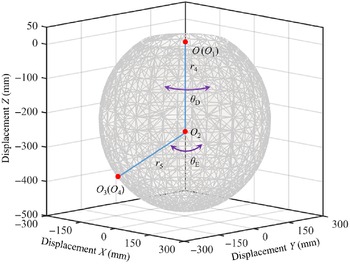
According to the number and nature of DOF of each parallel mechanism, which was already analyzed in our previous work [Reference Sun, Li, Wang, Chen, Chen, Zeng, Zhao and Yue11, Reference Sun, Li, Chen, Zhu, Zhong and Chen12], the HRA can be equivalent to a serial robotic arm, and its mechanism diagram is shown in Fig. 2.
 $\beta$
1 and
 $\gamma$
1 denote the rotation input of the equivalent series shoulder joint around the Y
1 and X
1 axes, respectively.
 $\alpha$
4,
 $\beta$
4, and
 $\gamma$
4 denote the rotation input of the equivalent series wrist joint around the Z
4, Y
4, and X
4 axes, respectively.
Mechanism diagram of equivalent series robotic arm.

In addition, based on screw theory and exponential product formula, the homogeneous transformation matrix g 04 for the forward displacement of the equivalent series robotic arm could be established as
 \begin{align}{\boldsymbol{g}_{{\rm{04}}}}&=\exp \left( {{{{\hat{\boldsymbol\xi}}}_{{Y_1}}},{\beta _1}} \right) \cdot \exp \left( {{{{\hat{\boldsymbol\xi}}}_{{X_1}}},{\gamma _1}} \right) \cdot \exp \left( {{{{\hat{\boldsymbol\xi}}}_{{Z_2}}},{\theta _D}} \right) \cdot \nonumber\\[3pt] &\exp \left( {{{{\hat{\boldsymbol\xi}}}_{{X_2}}},{\theta _E}} \right) \cdot \exp \left( {{{{\hat{\boldsymbol\xi}}}_{{Z_3}}},{\theta _F}} \right) \cdot \exp \left( {{{{\hat{\boldsymbol\xi}}}_{{Z_4}}},{\alpha _4}} \right) \cdot \nonumber\\[3pt] &\exp \left( {{{{\hat{\boldsymbol\xi}}}_{{Y_4}}},{\beta _4}} \right) \cdot \exp \left( {{{{\hat{\boldsymbol\xi}}}_{{X_4}}},{\gamma _4}} \right) \cdot {\boldsymbol{g}_{{\rm{04}}}}\left( {\rm{0}} \right)\end{align}
where g 04(0) denotes the initial position orientation of the end platform in the base reference frame O-XYZ.
Furthermore, taken into account the inverse displacement analysis, Eq. (2) could be derived as
 \begin{align}\exp \left( {{{{\hat{\boldsymbol\xi}}}_{{Y_1}}},{\beta _1}} \right) \cdot \exp \left( {{{{\hat{\boldsymbol\xi}}}_{{X_1}}},{\gamma _1}} \right) \cdot \exp \left( {{{{\hat{\boldsymbol\xi}}}_{{Z_2}}},{\theta _D}} \right) \cdot \exp \left( {{{{\hat{\boldsymbol\xi}}}_{{X_2}}},{\theta _E}} \right) \cdot {\boldsymbol{p}_{{O_{\rm{4}}}}}{\rm{ = }}{\boldsymbol{p}_{{\rm{st}}}}\end{align}
where
 ${\boldsymbol{p}_{{O_{\rm{4}}}}}$
denotes the initial homogeneous position vector of point O
4,
p
st denotes the homogeneous position vector of the space target point, and
 ${\boldsymbol{p}_{{\rm{st}}}} = {\boldsymbol{g}_{{\rm{04}}}} \cdot \boldsymbol{g}_{04}^{ - 1}{\rm{(0)}} \cdot {\boldsymbol{p}_{{O_{\rm{4}}}}}$
.
According to Eqs. (2) and (3), the HSJ and HEJ (except for the revolute pair F) determine the position space of the end reference point O 4 and also provide a parasitic orientation for the end-moving platform. The revolute joint F of the HEJ and the HWJ determine the active orientation space of the end-moving platform.
3. Workspace Analysis
In this study, the position space of the end-reference point is decided by the orientation space of the HSJ and the position space of the HEJ, and the two parts do not affect each other without considering the external interference. Therefore, in order to make the workspace analysis specific and simple, the orientation space of the HSJ, the position space of the HEJ, and the active posture space of the end-moving platform are analyzed based on the coordinate search method to realize the workspace analysis of the proposed HRA.
3.1 Orientation space of HSJ
The displacement analysis of the HSJ and the position vectors of all the motion pairs are obtained as
 \begin{align} \begin{cases} {\beta _1} = {\theta _{{A_2}}} \\ \\[-7pt] {{\gamma _1} = \textrm{arctan} (A/B)} \end{cases}\end{align}
 \begin{align} \begin{cases}{{{\boldsymbol{{A}}}_1} = {r_3}{{{\boldsymbol{S}}}_{{A_1}}}}\\ {{{\boldsymbol{{S}}}_1} = {r_2}\exp \left( {{{{{\hat{\boldsymbol{{S}}}}}}_{{A_1}}},{\theta _{{A_1}}}} \right){{\boldsymbol{{S}}}_{{B_1}}}}\\ {{{\boldsymbol{{C}}}_1} = {r_1}{{\boldsymbol{{S}}}_{{C_1}}}}\\ {{{\boldsymbol{{A}}}_2} = {r_3}{{\boldsymbol{{S}}}_{{A_2}}}}\\ {{{\boldsymbol{{C}}}_2} = {r_1}\exp \left( {{{{{\hat{\boldsymbol{{S}}}}}}_{{Y_1}}},{\beta _1}} \right)\exp \left( {{{{{\hat{\boldsymbol{{S}}}}}}_{{X_1}}},{\beta _1}} \right){{\boldsymbol{{S}}}_{{C_2}}}}\end{cases} \end{align}
where
 $A = {\rm{c}}{\theta _{{A_1}}}{\rm{s}}{\theta _{{A_2}}}{\rm{s}}{\varphi _2}{\rm{s}}{\varphi _3} - {\rm{s}}{\theta _{{A_2}}}{\rm{s}}{\varphi _2}{\rm{c}}{\varphi _3} + {\rm{c}}{\theta _{{A_2}}}{\rm{c}}{\varphi _2}{\rm{c}}{\varphi _3} + {\rm{c}}{\theta _{{A_1}}}{\rm{s}}{\theta _{{A_2}}}{\rm{c}}{\varphi _2}{\rm{s}}{\varphi _3}$
,
 $B = {\rm{s}}{\theta _{{A_1}}}{\rm{s}}{\varphi _3}$
, s, and c are the abbreviation of trigonometric function sin and cos, respectively.
Interference of rotation pairs B 1 and A 2: (a) Three-dimensional model; (b) interference principle.

There exist three main sets of basic mechanical constraints that limit the orientation space of the HSJ, viz.: (1) the interference of rotation pairs B 1 and A 2; (2) the link interference of B 1 C 1 and A 2 C 2; and (3) additional constraints related to the trunk movement characteristics. Let us make the assumption that the elements of the links and rotation pairs can be approximated by cylinders of radius d.
-
(1) The interference of rotation pairs B 1 and A 2: As shown in Fig. 3, the structure imposes a constraint, whose classification conditions as
(6)where \begin{align}{f_1}({\varphi _2},{\varphi _3},{r_2},{r_3},{\beta _1},{\gamma _1}) = \left\{ {\begin{array}{*{20}{c}}{{\boldsymbol{{S}}_{{B_1}}} \cdot {\boldsymbol{{S}}_{{A_2}}} \lt \cos ({\theta _1} + {\theta _2})}\\ \\[-7pt] {{\boldsymbol{{S}}_{{B_1}}} \cdot {\boldsymbol{{S}}_{{A_2}}} \gt \cos ({\theta _1} + {\theta _2})\begin{array}{*{20}{c}}{}\end{array}\ {} \begin{array}{*{20}{c}}{}\end{array}(r_2^2 + d_{{B_1}}^2) \le (r_3^2 + d_{{A_2}}^2)}\end{array}} \right.\end{align}
${\theta _1} = \arccos ({r_2}/\sqrt {r_2^2 + d_{{B_1}}^2} )$
,
${\theta _2} = \arccos ({r_3}/\sqrt {r_3^2 + d_{{A_2}}^2} )$
.
-
(2) The link interference of B 1 C 1 and A 2 C 2: According to the structural characteristics of the HSJ, the constraint condition is established based on the complicated interference constraint of the moving link which detailed discussed by scholars [Reference Monsarrat and Gosselin27]. As shown in Fig. 4, if the links B 1 C 1 and A 2 C 2 interfere, the intersection of the common perpendicular and the links must be on themselves, not on the extension line. Such that the critical conditions as
(7)
\begin{align}{f_2}({\varphi _2},{\varphi _3},{r_1},{r_2},{r_3},{\beta _1},{\gamma _1}) = \left\{ {distance({B_1}{C_1},{A_2}{C_2}) \ge } \right.\left. {2{d_{{\rm{link}}}}} \right\}\\[-25pt] \nonumber\end{align}
-
(3) Additional constraints related to the trunk movement characteristics: The robotic arm cannot collide with the torso during its movement, which is mainly determined by the posture space of the HSJ. The specific design imposes to consider the following constraint
(8)
\begin{align}{f_3}({\varphi _2},{\varphi _3},{\beta _1},{\gamma _1}) = \left\{ {distance(\begin{array}{*{20}{c}}{{\rm{upper}}}\ {}{{\rm{arm}}}\end{array},{\rm{torso}}) \ge } \right.\left. {{d_{{\rm{arm}}}}} \right\}\\[-20pt] \nonumber\end{align}


In addition, the search space is
 $\beta$
1
 $\in$
[
 $-\pi$
,
 $\pi$
],
 $\gamma$
1
 $\in$
[
 $-\pi$
,
 $\pi$
]. The number of the point-group that contents the constraint conditions is taken as the workspace value (WSV) [Reference Monsarrat and Gosselin27]. The simulation results developed in MATLAB code for the orientation space of the HSJ based on the initial structural parameters (as shown in Table I) are shown in Fig. 5. The forward flexion of the HSJ reaches 100° and the rear extension of the HSJ reaches 30° with the shoulder joint abduction. The adduction of the HSJ occurs simultaneously with the forward flexion of the HSJ. The coupling movements of the HSJ are in accordance with the kinematic characteristics of the human shoulder joint.
Link interference of B 1 C 1 and A 2 C 2.

Initial orientation space of HSJ.

3.2 Position space of HEJ
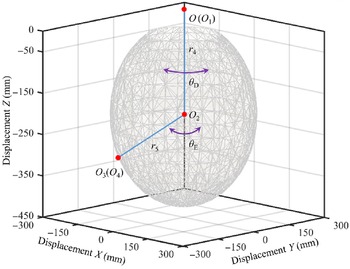
The constraint condition is the rotation range of the revolute pair E, such that
 \begin{align}{f_4}({\theta _E}) = \left\{ {\left\| {{\theta _E}} \right\| \le } \right.3{\rm{\pi }}/4\end{align}
Thus, the search space is θ
D
 $\in$
[
 $-\pi$
,
 $\pi$
], θ
E
 $\in$
[−3/4
 $\pi$
, 3/4
 $\pi$
], and the volume of the point-group that satisfies the constraint conditions is taken as the WSV. The initial position space developed in MATLAB code is shown in Fig. 6. When a certain posture of the HSJ is given (as shown in Fig. 5, the HSJ located in the initial orientation), the volume of the position space is directly determined by r
5. Furthermore, the proportional relationship between r
4 and r
5 determines the extreme position of the end-reference point. Therefore, the appropriate ratio of r
4 and r
5 can be considered as one of the main factors affecting the volume of workspace.
Initial position space of HEJ.

3.3 Active orientation space
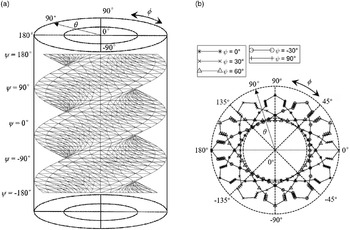
In order to describe the active orientation space more visually, the tilt-and-torsion angles proposed by Gosselin et al. [Reference Monsarrat and Gosselin27] are adopted in this study. In this orientation representation, the moving platform is first rotated about the Z axis by an angle
 $\phi$
, then about the new Y axis by an angle θ, and finally about the new Z axis by an angle
 $\psi-\phi$
. The search space is
 $\phi$
 $\in$
[
 $-\pi$
,
 $\pi$
], θ
 $\in$
[0,
 $\pi$
/2], ψ
 $\in$
[
 $-\pi$
,
 $\pi$
]. The displacement analysis of the active orientation space is obtained as
 \begin{align}\exp \left( {{{{\hat{\boldsymbol\xi}}}_F},{\theta _F}} \right)\exp \left( {{{{\hat{\boldsymbol\xi}}}_{{H_j}}},{\theta _{{H_j}}}} \right) \cdot \exp \left( {{{{\hat{\boldsymbol\xi}}}_{{K_j}}},{\theta _{{K_j}}}} \right) \cdot \exp \left( {{{{\hat{\boldsymbol\xi}}}_{{P_j}}},{\theta _{{P_j}}}} \right) = \exp \left( {{{{\hat{\boldsymbol\xi}}}_{{Z_4}}},\phi } \right) \cdot \exp \left( {{{{\hat{\boldsymbol\xi}}}_{{Y_4}}},\theta } \right) \cdot \exp \left( {{{{\hat{\boldsymbol\xi}}}_{{{Z\prime}_4}}},\psi } \right)\end{align}
where j = 1, 2, 3.
The constraint condition is the moving range of the prismatic pairs, such that
 \begin{align}{f_4}({\varphi _6},{\varphi _7},{\varphi _8},\phi ,\theta ,\psi ) = \left\{ {\begin{array}{l}{({\varphi _6} - {\varphi _7} - {\varphi _8} - 5^\circ ) \le {\theta _{{P_1}}} \le ({\varphi _6} - {\varphi _7} - 5^\circ )}\\ \\[-7pt] { - ({\varphi _6} - {\varphi _7} - 5^\circ ) \le {\theta _{{P_2}}} \le {\varphi _8} - ({\varphi _6} - {\varphi _7} - 5^\circ )}\\ \\[-7pt] {({\varphi _6} - {\varphi _7} - {\varphi _8} - 5^\circ ) \le {\theta _{{P_3}}} \le ({\varphi _6} - {\varphi _7} - 5^\circ )}\end{array}} \right.\end{align}
The volume of the point-group that fulfills the constraint conditions is taken as the WSV. The initial active orientation space developed in MATLAB code is shown in Fig. 7. As shown in Fig. 7 (a), the orientation space has a spiraling trend and changes periodically with ψ, with a period of 120°. According to Fig. 7 (b), [0,
 $\pi$
/4] is the dexterous range of θ. In addition,
 $\phi$
 $\in$
[
 $\pi$
/4,
 $\pi$
] and [−3
 $\pi$
/4,
 $-\pi$
/4], the limit angle of θ is slightly reduced. As a whole, based on the initial structural parameters of the HWJ, the dexterous range of the active orientation space is
 $\phi$
 $\in$
[
 $-\pi$
,
 $\pi$
], θ
 $\in$
[0,
 $\pi$
/4], ψ
 $\in$
[
 $-\pi$
,
 $\pi$
].
Initial active orientation space of end-moving platform: (a) Perspective view; (b) top view with ψ = −30°, 0°, 30°, 60°, and 90°.

4. Workspace-Based Optimization
In order to realize the visualization design optimization of multiple parameters, a multi-parameter planar model is proposed, which could obtain all the parameter combinations. For a current set of structural parameters, the associated workspace and WSV are analyzed based on the aforementioned numerical method. Afterward, the evaluation index (EI) based on each group of structural parameters is calculated by computing the ratio of the corresponding WSV and RV, which represents the initial WSV also obtained in the previous section. Furthermore, based on the multi-parameter planar model, a set of structural parameters are obtained to realize the goal of increasing workspace, and its associated workspace is illustrated. This procedure is described schematically in Fig. 8, and the calculated formula about EI is
 \begin{align}{\rm{EI = }}\frac{{{\rm{WSV}}}}{{{\rm{RV}}}}\end{align}
Flowchart describing optimization procedure.

4.1 Multi-parameter planar mode
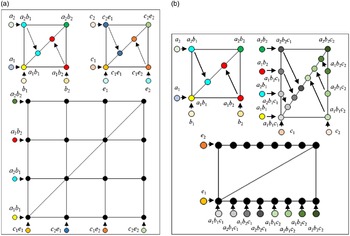
To further demonstrate the multi-parameter planar model, additional specifications are performed. It is assumed that there are L parameters, K sample points are taken for each parameter, and any two parameters are taken to form a square scatter diagram. Each intersection point of the square represents a combination, and these intersection points are mapped to a diagonal line. Any two diagonal lines are also formed into a new square (or rectangle) scatter diagram in accordance with the aforementioned method to obtain a new diagonal. This step is repeated until the last square (or rectangle) scatter diagram is obtained, whose intersection points contain the combination of all parameters. Note that the rectangular scatter diagram is caused by the fact that L is odd. Here, four parameters, a, b, c, and e, each of which takes the same number of sample points a l , b l , c l , and e l (l = 1, 2), are illustrated as an example, as shown in Fig. 9(a). It is worth noting that there is a similar method here. The main difference lies in a diagonal line and a new parameter to form a new rectangular scatter diagram, whose process is shown in Fig. 9(b).
Multi-parameter plane model: (a) model 1; (b) model 2.

4.2 Design optimization of HSJ
In the simulation analysis of this study, the value range for the structural parameters of the HSJ is presented in Table I, and parameters
 $\varphi$
2,
 $\varphi$
3, r
1, r
2, and r
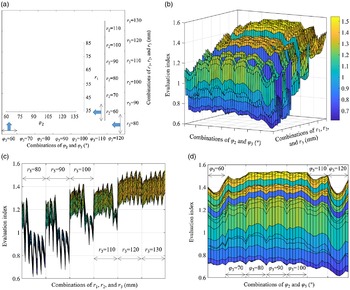
3 are taken 7, 5, 6, 6, and 6 sample points, respectively, producing 7560 combinations as shown in Fig. 10(a). According to the visualization optimization algorithm developed in MATLAB code, the EIs based on each group of structural parameters are obtained, as shown in Fig. 10.
Visualization design optimization of HSJ: (a) Parameter combinations; (b) perspective view; (c) left view; (d) front view.

As shown in Fig. 10(b) and (c), the EI increases with the increases of r
3. The influence of r
2 on the EI is related to r
3, and the greater the difference between r
3 and r
2 is, the greater the EI is. As shown in Fig. 10(b) and (d), when
 $\varphi$
3
 $\in$
[80°, 100°],
 $\varphi$
2 represents a negligible influence on the EI. When
 $\varphi$
3
 $\in$
[60°, 80°] and [100°, 120°], the EI decreases first and then increases as
 $\varphi$
2 increases. On the other hand, it is neither necessary nor possible to select the combination of parameters that maximizes EI. If the EI is greater than 1.45 (the maximum is 1.53), it is considered to achieve the goal of workspace-based optimization. Thus, considering the processing and assembling technology of the HSJ, a set of structural parameters is selected as
 $\varphi$
2 = 110°,
 $\varphi$
3 = 90°, r
1 = 55 mm, r
2 = 80 mm, and r
3 = 100 mm. The corresponding workspace is graphically represented in Fig. 11, which has significantly increased by a factor of 1.4. Compared with the initial posture space of the HSJ, the rear extension of the HSJ reaches 40° with the shoulder joint abduction. The adduction of HSJ occurs simultaneously with not only the forward flexion but also the rear extension of the HSJ.
Optimized orientation space of HSJ.

4.3 Design optimization of HEJ
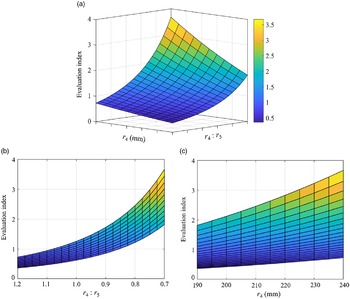
In the simulation analysis of this study, the value range for the structural parameters of the HWJ is presented in Table I, and parameters r 4 and r 4 : r 5 are taken 11 and 21 sample points, respectively, producing 231 combinations. According to the visualization optimization algorithm developed in MATLAB code, the EIs based on each group of structural parameters are obtained, as shown in Fig. 12.
Visualization design optimization of HWJ: (a) Perspective view; (b) left view; (c) front view.

As shown in Fig. 12(a) and (b), the EI increases rapidly as the ratio of r 4 and r 5 decreases. Especially when the ratio is less than 1, the growth rate increases swiftly. As shown in Fig. 12(a) and (c), when the ratio is greater than 0.9, the EI increases steadily with the increases of r 4. When the ratio is less than 0.9, the EI increases rapidly with the increases of r 4. As a whole, the smaller the ratio and the larger r 4, the larger the EI. If the EI is greater than 1.2, it is considered to achieve the goal of workspace-based optimization.
On the other hand, in his work named Vitruvian Man, Leonardo da Vinci [Reference Oranges, Largo and Schaefer28] developed 15 rules of proportion, which were used to model a human. Among these rules, the forearm, upper arm, and hand are 1/4, 1/8, and 1/10 of the height of a man, respectively. According to the aforementioned three rules, r 4 : r 5 = 5 : 6.
Therefore, the structural parameters of the HWJ must not only achieve the goal of workspace-based optimization but also conform to the structural characteristics of the human arm. Thus, based on a man with height of 1760 mm, r 4 = 220 mm and r 5 = 264 mm are obtained. The corresponding workspace is graphically represented in Fig. 13, which has significantly increased by the factor of 1.68.
Optimized position space of the HEJ.

4.4 Design optimization of HWJ
In the simulation analysis of this study, the value range for the structural parameters of HWJ is presented in Table I, and parameters
 $\varphi$
6,
 $\varphi$
7, and
 $\varphi$
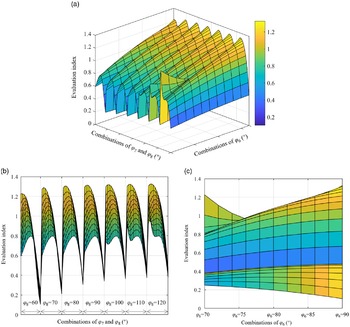
8 are taken 11, 13, and 7 sample points, respectively, producing 1001 combinations. According to the visualization optimization algorithm developed in MATLAB code, the EIs based on each group of structural parameters are obtained, as shown in Fig. 14.
Visualization design optimization of HWJ: (a) Perspective; (b) left view; (c) front view.

As shown in Fig. 14(a) and (b), the EI increases slightly with the increases in
 $\varphi$
8, and the effect of
 $\varphi$
7 on the EI is mainly related to
 $\varphi$
8. As shown in Fig. 14 (a) and (c), the EI increases with the increases in
 $\varphi$
6. When
 $\varphi$
6
 $\in$
[70°, 75°],
 $\varphi$
7
 $\in$
[30°, 40°], and
 $\varphi$
8
 $\in$
[110°, 120°], the greater the difference between
 $\varphi$
6 and
 $\varphi$
7 is, the greater the EI is. If the EI is greater than 1.2(the maximum is 1.32), it is considered to achieve the goal of workspace-based optimization. Considering the compactness of the HWJ, a set of structural parameters is selected:
 $\varphi$
6 = 90°,
 $\varphi$
7 = 35°, and
 $\varphi$
8 = 120°. The corresponding workspace is graphically represented in Fig. 15, which has significantly increased by the factor of 1.3. The orientation space also has a spiraling trend and changes periodically with ψ, with a period of 120°. The limit angle of θ is slightly reduced to 80°. The dexterous range of the active orientation space is
 $\varphi$
 $\in$
[
 $-\pi$
,
 $\pi$
], θ
 $\in$
[0,
 $\pi$
/3], ψ
 $\in$
[
 $-\pi$
,
 $\pi$
].
Optimized active orientation space of end-moving platform: (a) Perspective view; (b) top view with ψ = −30°, 0°, 30°, 60°, and 90°.

Thus, all the structural parameters are obtained as follows:
 $\varphi$
1 = 90°,
 $\varphi$
2 = 110°,
 $\varphi$
3 = 90°,
 $\varphi$
4 = 90°,
 $\varphi$
5 = 120°,
 $\varphi$
6 = 90°,
 $\varphi$
7 = 35°,
 $\varphi$
8 = 120°, r
1 = 55 mm, r
2 = 80 mm, r
3 = 100 mm, r
4 = 220 mm, and r
5 = 264 mm, as listed in Table I.
5. Conclusion
This study shows the workspace of each human joint of the hybrid robotic arm and studies the workspace-based parameter optimization based on the multi-parameter plane model. Considering the compactness and the processing and assembling technology of the mechanism, a set of structural parameters satisfying the workspace-based optimization objective is obtained.
The structural configuration of the hybrid robotic arm, which realizes the distribution of joints similar to that of a human arm, has the structural feature of workspace separation, providing researchers with more specific and clear information than the entire workspace analysis. In addition, the much larger active orientation space ensures the refined operation of the end manipulator. Furthermore, compared to other algorithms applied to parameter optimization, the multi-parameter planar model is proposed to the visualization design optimization of multiple parameters, which could demonstrate the coupling effect of parameters on the optimization target, instead of just getting a few numerical values of parameter combinations. Moreover, the obtained parameter domain can provide researchers with more combinations that meet other influencing factors.
It is worth noting that the structural parameters selected based on the workspace optimization in this study do not necessarily lead to the optimal kinematic performance of the HRA. Therefore, the kinematics and dynamics of the hybrid mechanism and the corresponding performance index will be studied by the authors in the future. In addition, multi-objective optimization based on the multi-parameter planar model remains an open issue also worth further study.
Acknowledgements
This work was supported by the Zhejiang Province Foundation for Distinguished Young Scholars of China [grant number LR18E050003], the National Natural Science Foundation of China [grant number 51975523, 51475424].
Conflict of Interest
The authors declare none.
Ethical Considerations
The authors declare none.
Authors’ Contributions
YL supervised the entire trial; PS wrote the manuscript; KS, YY, and BW assisted in sampling and laboratory analyses. All authors read and approved the final manuscript.